Monthly Archives: November 2025

Rich folks aren’t taxed because they have no income; you can do some of this too.

Two tax questions: (1) How do the top rich people manage to pay such low taxes, e.g. Warren Buffett paying at 0.1%. and (2) why do these rich folks campaign for higher taxes. Warren Buffett has campaigned for higher taxes for 50 years. These questions seem perhaps related.

I got my tax data from a public tax advocacy group, ProPublica. In 2021 they received the tax filings for many important people including the 25 US richest from the years 2014 to 2018. They find that these individuals paid a total of $13.6 billion in federal income tax while their wealth rose a collective $401 billion, go here for more. Dividing the numbers, we see an average income tax rate of only 3.4%, with Warren Buffett paying the least, 0.1%. This is far less than the “half of the rate that my secretary pays,” that Buffett likes to claim.
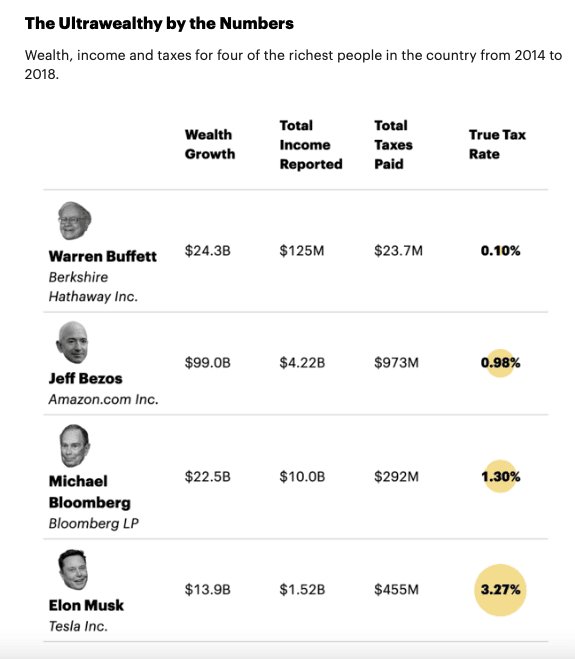
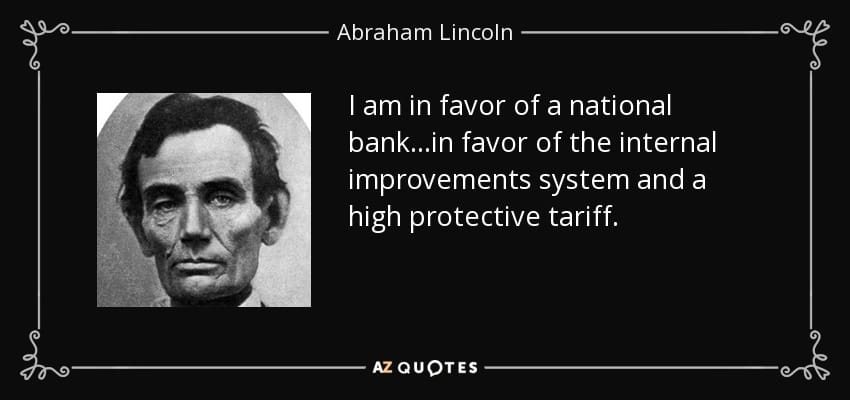
The reason these people pay so little tax is that their taxable income is zero. They use a very wide variety techniques to do this. Among these are charitable foundations, including those that lobby for higher taxes and against climate change. The foundations buy private planes and send the founders (and their families) to climate change events in the South of France or Davos, Switzerland. “Pro-tax” foundations hire tax accountants to research ways that the rich avoid taxes, often the founders then use these methods while speaking out against others who do the same. Bezos was so successful at avoiding income that he got welfare payments in two of the five years, ProPublica found. Soros and his son got $2,400 in COVID payments. They had almost no income. The one tax all these folks hate is tariffs because it is almost impossible to buy new, expensive things from abroad while avoiding them. See my essay, “Tariffs are inflationary, but not on you.”

Another advantage of a charitable foundation is that 74% of your donation can offset capital gains. You have to itemize your donations, but If you give $1 million to your foundation, you can use it to offset $740,000 of stock appreciation earnings. Not a bad deal. You can also use any stock losses against gains. Thus, it’s a good idea, if you itemize, to sell some losing stocks when you sell gainers (while holding on to other gainers, of course.) All of this is only available to those who itemize, and it’s only the rich who benefit by itemizing.

Borrowing money against your assets is another popular tax avoidance scheme, one that ordinary folks could use (but don’t over-do it*). The scheme is often called “Borrow, Buy, Die.” You borrow a large sum against your assets (your home, your stocks, or options –Musk has lots of Tesla options, etc). You then use the borrowed money to purchase property, typically: a vacation home, rental properties, a hotel, or a car. If you structure the purchase right, the interest can be deducted from any other earnings you have including rents. You then have no taxable income, or a lower income while the property appreciates. You can often structure the purchase so that depreciation can be deducted against income as well. Meanwhile, you get to drive the car, live at the vacation home, or rent it as an Air B&B, or stay at the hotel for free.

You live this way until you die. When you die, your heirs get the asset, but they are not taxed on the appreciation. The asset is transferred at its value at the time of death. You’ve avoided paying all the income tax you’d have to pay if you were to sell before death. Most home-owners do this on a small scale: They borrow to buy their home or the building where their business is. Or borrow to buy a vacation home or income property. They use through their life-time, deducting the interest, then leave it to their kids. There is no inheritance tax on most homes or small businesses, and the asset appreciates year to year. Both Nixon and Obama proposed eliminating this loophole by taxing appreciation at death. This would be a lot fairer than the current inheritance tax that is full of loopholes, and unfair when it works. If your parent bought a $10,000,000 item with taxable income, and it remains at that value, why should it be taxed a second time at death?

For a small businessman like me, it made sense to borrow to buy the building that my business operates out of and pay myself a normal rent. It’s income, as real as salary, but taxed at a lower rate, Besides there is no payroll tax on rental income. Another advantage of renting to myself is I can be trusted to fix the building and pay the rent, and I will not throw myself out if there is a downturn, nor will I raise the rents exorbitantly. My car is owned by my business, another plus. I pay a fee for personal use, but this is cheaper than using my own taxed income. When I die, the building (and car) will go to my heirs, tax free.

One last change I’d like to see is in the payroll tax. I’d like to see it tax the entire taxable income, but at a lower percent than the current 15.2 or 7.6. Currently the first $150,000 of income is payroll taxed at 15.2% for a self-employed individual, a plumber or office cleane, even before he/she pays income tax. An office worker is taxes at half this rate, 7.6% before income tax, with the company making up the other 7.6%. A CEO making $10 million pays this rate too, but only on the first $150,000. This amounts to $11,400 in payroll tax, or less than 0.11% of salary. I consider this disparity a bigger scandal than the fact that the richest 25 Americans paid only 3.4% in income tax.

Robert Buxbaum, November 25, 2025. *Trump presents a cautionary tale about property investing; if you invest at the wrong time, you can lose your shirt. In the late 80s, the property market in NY collapsed briefly, and he really was less than penniless. Don’t over-extend. The property market doesn’t collapse often, but you don’t want to be wiped out if it does.
What causes innovation? is it worth it?

Innovation is the special sauce that propels growth and allows a country to lead and prosper. The current Nobel prize believe that innovation powered the Industrial Revolution, causing England to become rich and powerful, while other nations remained poor, weak, and stagnant. Similarly, Innovation, they believe is why 19th century Japan rose to defeat China, and propelled China’s 21st century rise. But why did they succeed when others did not. What could the leader of a country do to bring power and wealth through innovation. Improved education seems to help; all of the innovation countries have it, but it is not the whole. Some educated countries (Germany, Russia) stagnate. An open economy is nice, but it isn’t sufficient or that necessary: (look at China). That was the topic of this year’s, 2025 Nobel prize in economics to Mokyr, Howitt, and Aghion, with half going to Joel Mokyr for his insights, historical and forward looking, the other half going for economic modeling. I give below my understanding of their insights, more technical than most, but not so mathematical as to be obtuse the normal reader..

The winners hold that innovation, as during the industrial revolution, is a non-continuous contribultion caused by a particular combination of education and market opportunity, of theoretical knowledge, and practical, and that a key aspect is depreciation (destruction) of other suppliers. Let’s start by creating a simple, continuous function model for economic growth where growth = capital growth, that is dK/dt. K, Capital, is understood to be the sum of money, equipment, and labor knowledge, and t is time with dK/dt, the change in K with time modeled as equal to the savings rate, s, times economic activity, Y minus a depreciation factor, δ, times capital, K.

growth = dK/dt = sY − δ K.

Innovation, in the Howett model, is discontinuous and accumulative. It builds on itself.

For the authors, Y = GDP + x, where x is the cost of outside goods used. They then claim that Y is a non-linear function of K, where K is now considered a product of capital goods and labor K = xL and,

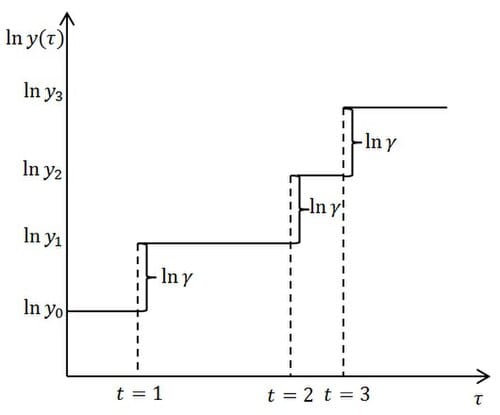
dY/dK = AKα + γ where 0< α <1, and where γ is the contribution of innovation and/or depreciation. The power function, as I understand it, is a mathematical way of saying there are economies of scale. The authors assume a set of interacting enterprises (countries0 so that the innovation factor, γ for one country is the depreciation factor for the other. That is, growth and destruction are connected, with growth being a function of monopoly power — control of your innovation.

According to the Nobel winners, γ is built n previous γ as shown in the digram at right. It can not be predicted as such, but requires education and monopolistic power. The inventor-manufacturer of the typewriter has a monopolistic advantage over the makers of fountain pens. Innovation thus causes depreciation, δ K as one new innovation depreciates many old processes and products. If you add enough math, you can derive formulas for GDP and GDP growth, all based on factors like A and α, that are hard to measure.

GDP = α(2α/1−α) (1-α2)A L,

Thus, GDP is proportional to Labor, L and per-capita GDP is mostly an independent function related to economies of scale and the ability to use capital and labor which is related to general country-wide culture.

The above analysis, as I understand it, is in contrast to Kensyan models, where growth is unrelated to innovation, and where destruction is bad. In these Kenysean models, growth can be created by government spending, especial spending to maintain large industries with economies of scale and by spending to promote higher education. The culture preferred here, as I understand is one that rewards risk-taking, monopoly economics, and creative destruction. Howitt, and Aghion, importantly codify all this with formulas, as presented above that (to me) provide little specific. No great guidance to the head of a country. Nor does the math make the models more true, but it makes the statements somewhat clearer. Or perhaps the only real value of the math is to make things sound more scientific see the Tom Lehrer song, Sociology.

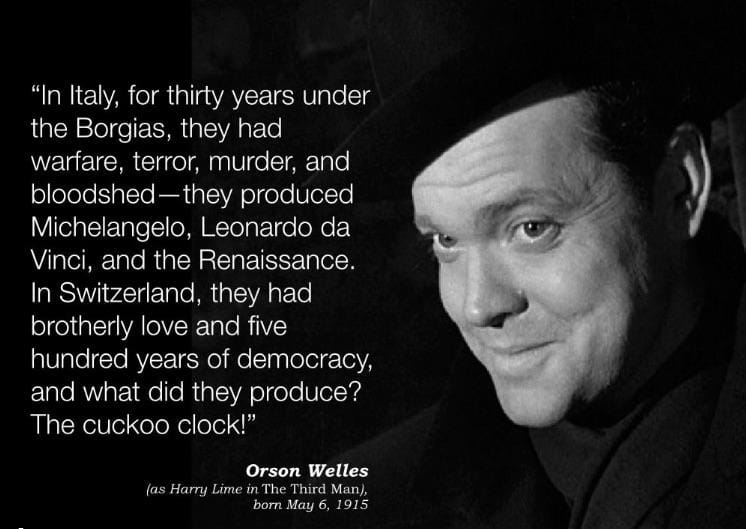
This insight from movie script by Grham Green suggests to me that progress may not be the greatest of advantages, perhaps not even worth it.

This work seems more realistic, to me, than the Keynesian models Both models are mathematically consistent, but if Keynes’s were true, Britain might still be on top, and Zambia would be a close competitor among the richest countries on earth. Besides these new fellows seem to agree with the views of Peter Cooper, my hero. See more here.

Writing all this reminds me that the fundamental assumption that progress is good, in not necessarily true. I quote above a line that Orson Wells, as Harry Lime, ad-libbed for the movie, “The Third Man.” Lime points out that innovation goes with suffering, and claims that Switzerland had little innovation because of its stability. Perhaps then, what you really want is the stability and peace of Switzerland, along with the lack of domination and innovation. On the same note, I’ve noticed that engineering innovators often ruin themselves dining in ruin, while the peaceable, stable civil engineers live long pleasant lives of honor.

Robert Buxbaum, November 16, 2025. A note about Switzerland is that was peaceful and stable because of a strong military. As Publius Vegetius wrote, Si vis pachim para bellum (if you wish of peace, prepare for war).

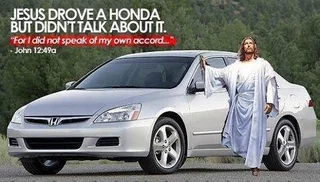
What car did Jesus drive, or God, or Moses..

So, as is little known, Jesus drove a car, a large Honda, but didn’t publicize the fact: “I did not speak of my own accord.” (John 12:49) You can tell it was a large Honda, likely a wagon, as it says “the apostles were in one accord” (Acts 1:14). It is appropriate that He drive a modest car. I would have expected him to drive an F150, as he was a carpenter, single, 30 years old. That’s the perfect demographic for an F150.

David also drove a small vehicle, “In a Triumph, I will divide Shechem, and measure out the valley of Succoth.” Similarly, Isiah, (13:3), but he was proud of it:  “I have called my warriors who exult in my Triumph.”

As for God, it’s clear he drove muscle cars, “He terrifies them in his Fury. (Ps. 2:5) “Behold, I will gather them out of all countries where I have driven them .. in My fury… ” (Jeremiah 32:37). He also had a Tempest: “You snatch me up and make me ride in the Tempest.” (Job 20:32), “Pursue your enemies with your Tempest.” (Ps. 83:15).

Moses, like God drove a large vehicle, a Ram with a loud horn, “… when the Ram’s horn sounds a long blast, they can approach the mountain. (Ex 19:13). Even so, he gave a Mazda to Eliezer, “Moses gave the Tribute to Eleazar the Priest. (Numbers 31:41).

My claim is that the people of the Bible had good senses of humor, even if those today seem rather glum.

Robert Buxbaum, November 5, 2025.