Tag Archives: soccer

Qatar, unbalanced but stable

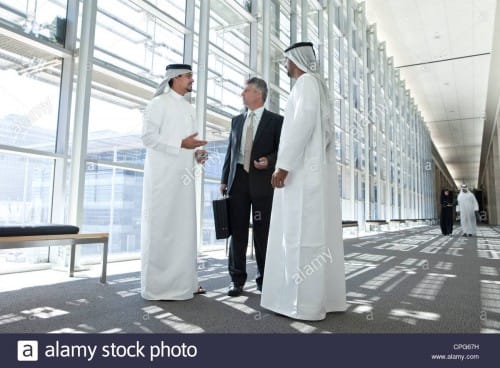
Doha Airport, Qatar.

Doha Airport, Qatar.

I visited Qatar airport twice this month, just passing through, but there were several things that so impressed me that I had to write. What impressed me most was not so much the size and richness of the airport, but the clothes of the locals. All of the local men wore the same, very sharp robes: blindingly white, long sleeved, and floor-length. They’re called Thobes. While other nations wear something similar. Here, every one was unwrinkled, and unstained. They all looked new, with no signs they’d ever been washed. Some were worn with cuff-links (gold), and most had a pen sticking out of the breast pocket (gold). White pants peak from underneath and a headress usually sits on the head. It’s a really dramatic look, like seeing dozens of Ricardo Montaubans of Fantasy Island in one place. Local women and children were there too, but the thobes were so dramatic that the women and children disappeared from my mind-space almost immediately. There is a local woman in the picture above, but you hardly notice.

Not everyone wears the thobes. There are lots of stores filled with gold and technology, beer and coffee, and these are maned by non-locals, Moslems mostly, almost all men. The non-locals wear western garb, not particularly sharp; none wear thobes of any sort. Some months ago, I wrote that China had severe imbalance and speculated that it was ripe for revolution. As it happens the large number of foreign worker means that Qatar is far more unbalanced. To some extent this is shown by the male-female population pyramid below.
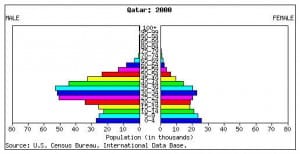
Qatar demographic pyramid. Vastly more males than females, mostly foreign workers.

Qatar demographic pyramid. The imbalance is caused by the presence of vastly more male than female foreign workers.

Qatar is a country of 2,500,000 residents, of whom 310,000 are locals — citizens and permanent residents. The rest are foreign workers; long term inhabitants without permanent residency or citizenship. They make up 85% of the population, recruited from poor, English-speaking Muslim countries mostly: Egypt, Malaysia, Tunisia. They do all the work, as best I could tell. I saw no one who looked like a local working, male or female.

Foreign workers have very few rights, but don’t seem unhappy. There is no right to unionize, and not even the right to roam around the country. For the most part, they live in employer-owned housing, and are transported back and forth to work in employer vans. They sign up for year-long contracts, and at the end of the year, they have the choice to re-up or leave. Up a year ago, foreign workers could not become permanent residents. Then, last year, the Emir’s order 10 authorized permanent residency status for as many as 100 foreign workers who had sufficient means, had been in Qatar for 10 to 20 years (depending on whether they were born there), had stayed out of trouble, and who otherwise were considered desirable. It’s a step.

I suspect that the foreign workers feel lucky to have good pay, decent hours, and a clean bed. Then again, the workers are recruited for positive outlook. And the ones I saw might have had more rights than most. The airport is part of the Umm Al Houl, free enterprise zone. These are areas of Qatar where westerners and their vices like alcohol are tolerated and welcome.
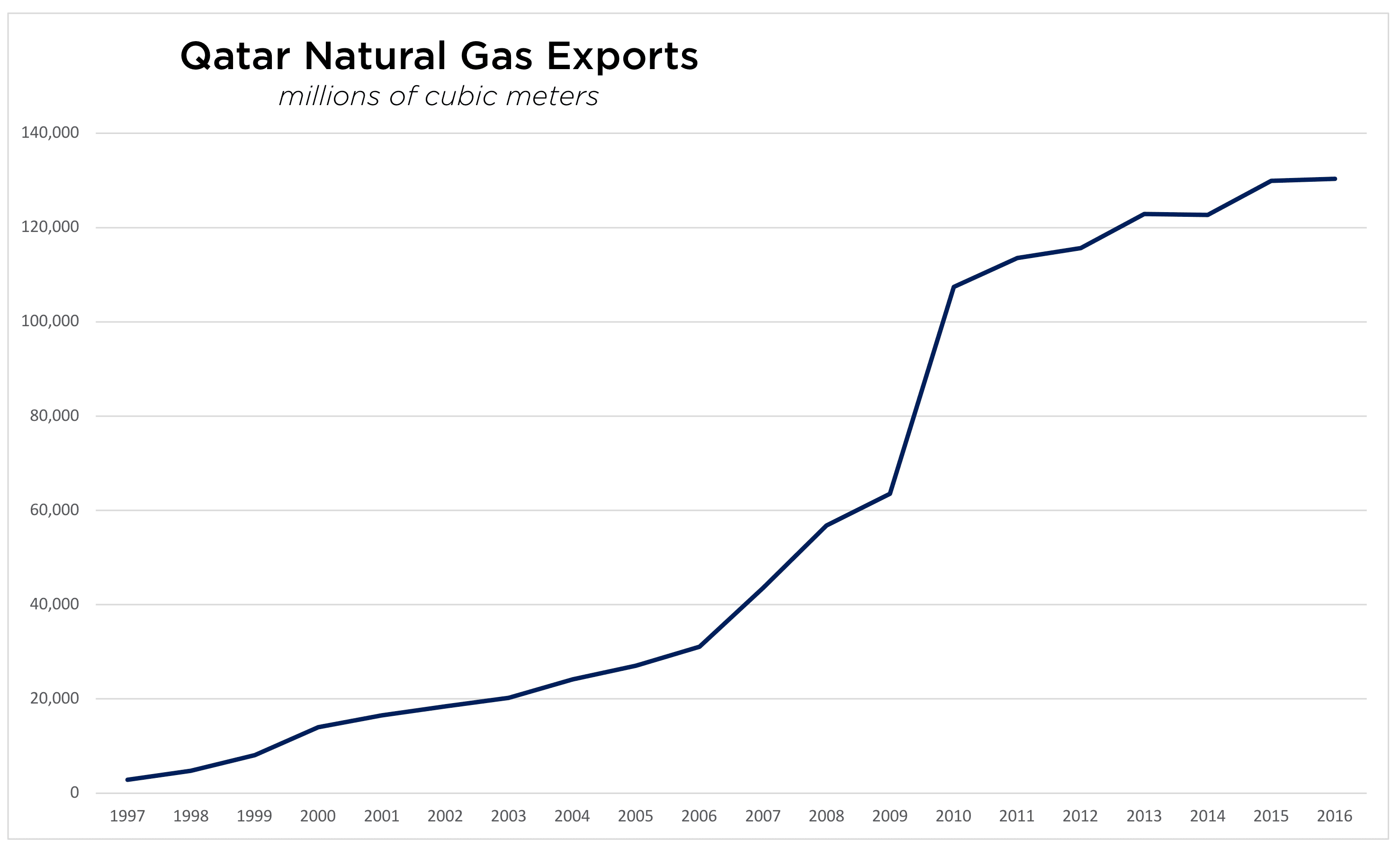
Qatar natural gas production. Natural gas provides 90% of the country's income as best I can tell.

Qatar natural gas production. Natural gas provides 90% of the country’s income as best I can tell. That’s half the GDP almost, the rest of the GDP is Qataris spending the money

There are three “free enterprise zones” in Qatar; the name for the one near the airport, “Al Houl” interestingly enough means “bird trap”. What’s going on with them, as best I can tell, is diversification. Qatar is the worlds second largest exporter of natural gas, with most going to Europe, and a significant portion to India and China. But the gas will run out eventually. They are trying to supplant this income with tourism, industry and transport: running a major airline, a bustling, air hub, and tourist hotels. The airline is only marginally profitable, and though I didn’t see the hotels, I imagine they are luxurious and marginally profitable too. Saudi Arabia, next door, is trying to diversify the same ways, aiming to control west-east, air-traffic via Emirates air.

The GDP of Qatar is $191 B as of last year at the going exchange, and over $450 B at price parity. That suggests a few things. For one, that the Qatari currency is undervalued. It also suggests a per-capita GDP of at least $76,400, but more likely $616,000 or higher depending on how you count buying power and foreign workers. This buys a nice lifestyle, if not republican freedoms.  In terms of government, Qatar is a real monarchy, Emir Hamad bin Khalifa al-Thani’s is an absolute ruler who came to power the traditional way: he overthrew his father. Then again his father, Khalifa al-Thani, came to power by overthrowing his cousin. Supporting the Emir’s rule, there is an Advisory Council. The 35 ministers are mostly relatives, and as in North Korea, and they have only advisory power. The Prime Minister and Minister of Foreign Affairs is Sheikh Hamad bin Jasim bin Jabir al-Thani; the Deputy Prime Minister is Abdallah Al-Thani. The Economy and Commerce minister is Fahd Al-Thani, and the Communications and Transport minister is Ahmad Al-Thani. Nasir al-Thani heads Cabinet Affairs; Hamad al-Thani is the Secretary of State, and the Governor of the Central Bank is Abdallah bin Saud al-Thani. All close relatives.
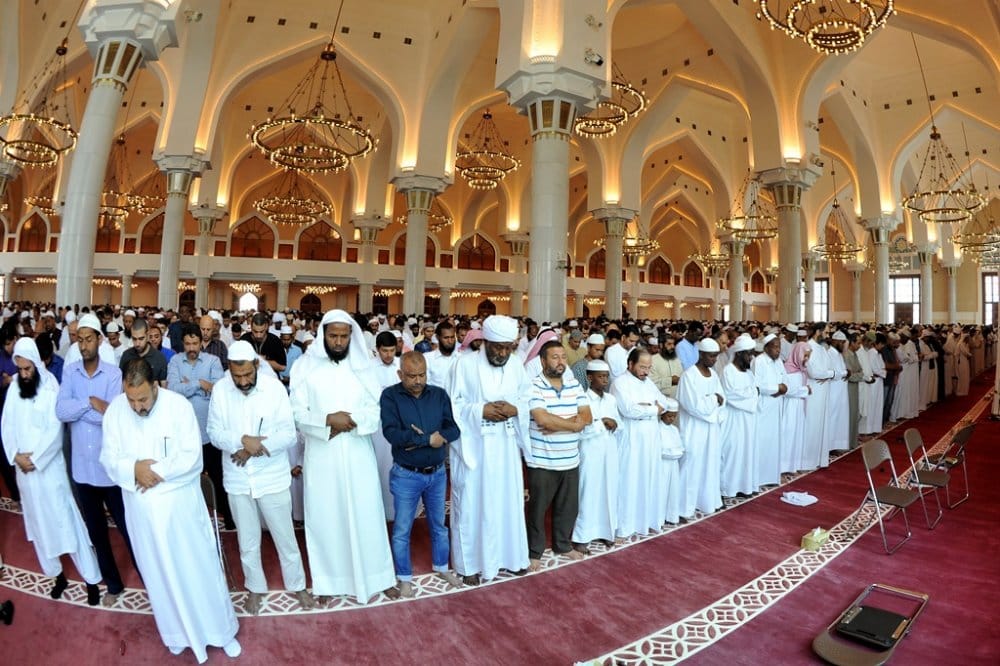
Qatar main mosque. Residents stand out from the foreign workers.

Qatar main mosque. Residents stand out from the foreign worker, though they pray together.

My sense was that Qatar was the Disneyland version of Islam. Life in the Qatari free zones resembled normal Islamic life the way that Main Street of Disneyland resembles an actual main street in the US. Every citizen is well dressed and rich without having to work. Western visitors are welcome, and not forced to follow the local customs; we’re allowed our vices, alcohol etc. in our own zones.

The state supports all ecological and left-wing causes except unionization. . Al Jazeera, the Emir’s left-leaning news agency, spreads money and influence world-wide. Left-flavored news is presented with high-quality graphics, and different versions of the news story published in different languages. The Emir acknowledges that Al Jazeera is a money-losing propaganda agency. It’s anti Israel, pro revolution (elsewhere of course) and virulently against petroleum production for all counties outside of Qatar. Professors and “independent” journalists world-wide are funded to promote these views. As with Disneyland, most people seem happy to live the fiction, as best I can tell.
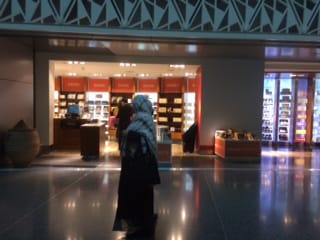
Qatari woman and shop. They blend into the scenery compared to the resplendent men

Qatari woman and shop. They blend into the scenery compared to the resplendent men

One bonus of living in Qatar is that the world comes to you. The next world soccer tournament will be held in Qatar, 2022, and Qatari’s are excited, and pleased. There is a lot of building going on, some for the world cup, the rest for general tourism. The free enterprise zones are growing.

There is a cold war going on with Saudi Arabia, and the Saudis are doing what they can to pour cold water on the Qatari PR, but so far, Qatar seems to be winning the war at home and abroad. It shows a beautiful, progressive face to the west, and it seems to have brought in the majority of the middle east travel. More to come. It’s stable but for how long?

Robert Buxbaum April 15, 2019. As I side note, I just bought a Qatari Thobe.
American education sucks, how do we succeed?

Despite my PhD from a top American college, Princeton University, I find I lag ordinary Europeans in languages and history. I can claim to know some math, and a little Latin and a little Greek, but in my case it’s two short friends, Manuel Ramos and Stanos Platsis. It was recently reported that one fourth of college-educated Americans did not know that the earth spun on an axis. With an education system of this sort, how is it that the US has the largest GDP, and nearly the largest per-capita GDP. We have a grosser national product than any European country despite a degree of science ignorance that would be inconceivable there.

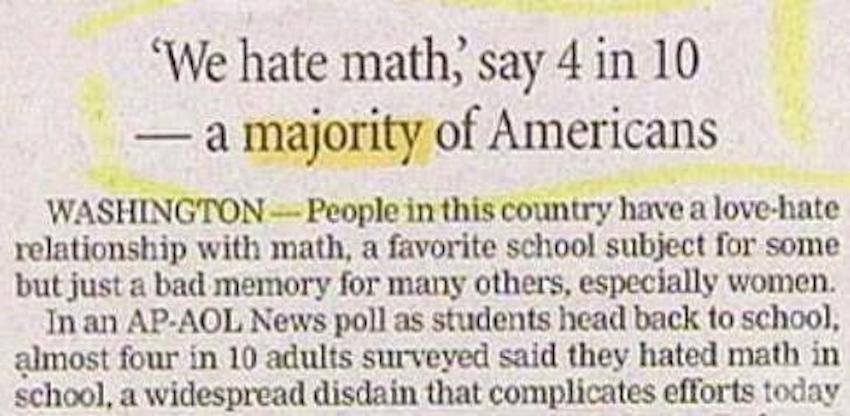
Americans hate math.

Americans hate math.

One part of US success is imported talent, of course. We import Nobel lauriate chemists, Russian dancers, German rocket scientists…, but we don’t import that many. The majority of our immigrants are more in the wretched refuse category, and even these appear to do better here in the US than their colleagues that they left behind. Otto von Bismark once joked that, “God protects children, drunks, and the United States of America.” But I’d like to suggest that our success is based on optimism, pronia: a can-do belief in ourselves that our education provides, at least to our more creative citizens.

Most of the great successful businesses of the USA are not started by the A students, it is clear, but by the C students who develop the greatness of the little they know. Consider Colonel Harlen Sanders, founder of Kentucky Fried Chicken. He believed in the greatness of his chicken recipe, and developed to skills to sell it fast. He did not have to know astronomy, whether the earth goes round the sun. It’s an important fact, but only relevant if you can use it, as Sherlock Holmes points out. I suspect that few Europeans could use the knowledge that the earth spins productively, and suspect that the majority of those that might, lack the confidence to do so (I provide some at the end of this essay).

Benjamin Jowett. His students included the heads of 6 colleges and the head of Eaton

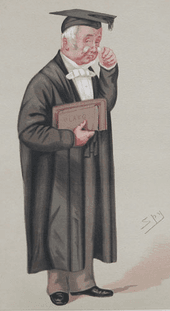
Benjamin Jowett, Master of Balliol College, Oxford.

A classic poem about European education describes Benjamin Jowett, shown at right. It goes: “The first come I, my name is Jowett. There is no knowledge, but that I know it. I am master of this college. What I don’t know isn’t knowledge.” Benjamin Jowett was Master of Balliol College, Oxford. By the time he died in 1893, his ex-student pallbearers included the heads of 6 colleges, and the head of Eaton. Most English heads of state and industry were his students directly or second-hand. All left university with a passing knowledge of Greek, Latin, Plato, law, science, theology, classics, math, rhetoric, logic, and grammar. Only people so educated were deemed suited to run banks or manage backward nations like India or Rhodesia. It worked for a while but showed its limitations, e.g. in the Boer Wars.

In France and continental Europe, the education system is similar, to this day ,to England’s under Jowett. There is a fixed set of knowledge and a fixed rate to learn it. Government and industry jobs go largely to those who’ve demonstrated their ability to give the fixed, correct answers to tests on this knowledge. In schools across France, the same page is turned virtually simultaneously in the every school– no student is left behind, but none jump ahead either or deviate. As new knowledge is integrated, the approved text books are updated and the correct answers are adjusted. Until then, the answers in the book are God’s truth, and those who master it can comfort themselves to have mastered the truth. The European system appears to benefit the many, providing useful skills (and useless tidbits) but it is oppressive to others with forward-thinking, imaginative minds, or who see a new truth a year before the test acknowledges it. College, it is said, “..is a place where pebbles are polished but diamonds are dimmed.” The system work well in areas that barely change like French grammar, geometry, law, and the map of Europe. It does not work so well in music, computers, or the art of war. For creative students, bright or otherwise, schooling is “another brick in the wall.” These students need learning in ‘how to get along without a teacher.’

The American approach leans, or perhaps leaned, towards independence of thought, for good or bad. American graduates can live without the teacher, but leave school knowing no language but English, knowing hardly and maths or science, and hardly any grammar. We can hardly find another country on a map, and often can’t find our own. Teachers will take incorrect answers as correct as a way to build self-esteem, so students leave with the view that there is no such thing as truth. Strangely, this model works, at least in music, engineering, and science where change is fast, creativity is king, and nature itself is a teacher. American graduate-schools are preeminent in these areas. In reading, history and math our graduates might well be described as galumphing ignorants.

Every now and again the US tries to Europeanize education. The “no child left behind” movement was a Republican-led effort to teach on the French model, at least in reading and math. It never caught on. Drugs are a popular approach to making American students less obstreperous, but they work only temporarily. Americans leave school ignorant, but not stupid; respectful of those who can do things, and suspicious of those with lengthy degrees. Without Latin, we do OK as managers of the most complex operations, relying on bumptious optimism and distain for hierarchy.

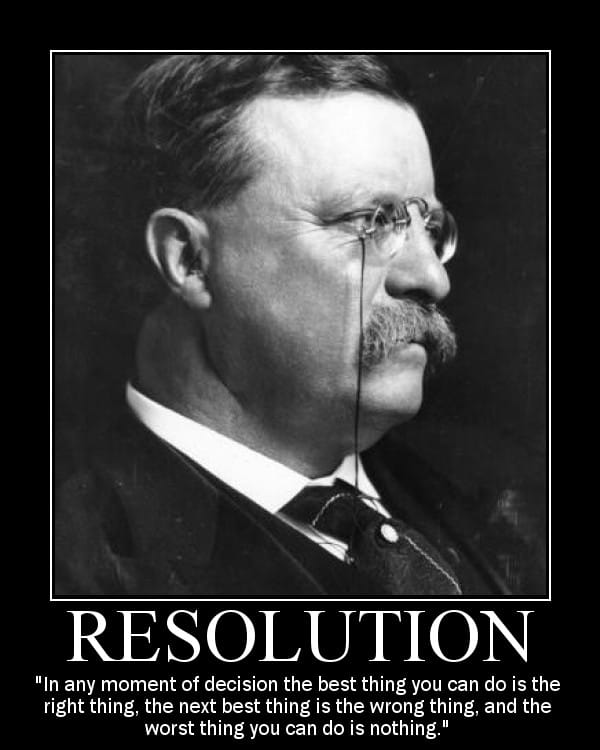
In any moment of decision, the best thing you can do is the right thing, the next bet thing is the wrong thing, and the worst thing you can do is nothing. An American attitude that sometimes blows up, but works surprisingly well at times.

Often the inability to act is worse than acting wrong.

The American-educated boss will do some damage by his ignorance but it is no more than  comes from group-think: non-truths passed as truths. America stopped burning witches far sooner than Europe, and never burned Jews. America dropped nobles quicker, and transitioned to electric lights and motor cars quicker, perhaps because we put less weight on what nobles and universities did. When dealing Europeans, we greet them in a loud, cheerful voice, appoint a subordinate to “get things done,” and get in the way until lunchtime. The Europeans are suitably appalled, both by the crassness and by the random energy.

European scholars accepted that nobility gives one a handle on leadership. This belief held back the talented, non-noble. Since religion was part of education, they accepted that state should have an established religion, Anglican, in England, Catholicism in France; scientific atheism now. They learned from the state, and accepted, that divorce was unnecessary, that homosexuality should be punished by prison or worse, In the early 60s, Turing, a brilliant mathematician and computer scientist, was chemically castrated as a way to cure his homosexuality. In America our “Yankee ingenuity,” as we call it, screwed up too, but in ways like prohibition, McCarthyism, and disco. Such screwups resolved themselves relatively fast. “Ready, fire, aim” is a European description of the American method to any problem. It’s not great, but works better than “steady as she goes.”

The best option, it seems, is when we work together with those “across the pond.” It worked well for us in WWI, WWII, and the American Revolution, benefitting from Lafayette, Baron Von Steuben, Kosciusko, etc. Heading into the world cup of football (fifa soccer) this week, we’re expected to lose badly due to our lack of talent and our general inability to pass, dribble, or strategize. Still, we’ve got enthusiasm, and we’ve got a German coach. The world’s bookies give us 0.05% odds, but our chances are 10 times that, I’d say: 5%. God protects our galumphing corn-fed ignorants when, as in the Revolution, it’s attached to European coaching.

Some businesses where it helps to know the earth spins: rocketry (military and exploratory), communication via geosynchronous satellites (they only work because the earth spins), weather prediction (the spin of hurricanes is because the earth spins), cyclone lifting. It amazes me that people ever thought everything went around the earth, by the way; Mercury and Venus never appear overhead. If authorities could have been so wrong about this for so long, what might they be wrong about today?

Dr. Robert Buxbaum, June 10, 2014 I’ve also written about ADHD on Lincoln’s Gettysburg Address, on Theodore Roosevelt, and how he survived a gun shot.