Tag Archives: sewage engineering

Sewage: rain to the river, poop to the fields, nothing to your basement

I’ve written a fair amount about sewage over the years, including the benefits of small dams, and problems of combined sewers, but I thought I’d write here about something really fundamental: sewage has two components, poop and rain, and they should be kept separate. The poop and related liquids are known as sanitary sewage. Ideally it is the treated, saved and used as fertilizer. Rain, known as storm sewage, needs to go to the rivers at a controlled speed, unmixed with sanitary sewage. Sorry to say, in many counties, mine included, the two are mixed following every rain, costing us unnecessary money, and making swimming unsafe, and boating (sometimes) unpleasant.

Our system is not quite mixed, but is semi-separate. It only mixes in a “big” rain, more than 1/2″, something that happens once per month, on average. The Pipes are semi-connected as shown below.

Combined sewer system, like in our county, Oakland MI. We use little dams in the pipe system to semi-separate the flows. Here, showing a rain-induced overflow of combined sewage, a CSO.

The pipes of a sanitary sewage system can be relatively small in diameter as this flow is continuous, but never that large. The cost of treatment is high, per gallon though. Some of this cost can be recovered in fertilizer value.

Stormwater flow, by contrast, requires big pipes because the flow, while episodic and be 10,000 more than the sanitary flow. A city can go for weeks without storm flow as there’re is no rain. A storm will then drop more water in an hour than all the sanitary sewage of the last few weeks. You need large diameter stormwater pipes, and you typically want retention basins so that even these pipes are not overwhelmed, and to provide a little settling. The pipes should direct storm water to the nearest river. In our county we mixed the two for historical reasons. This adds tremendously to the cost of sewage treatment, and we find we regularly overwhelm the treatment facility. When this happens, as shown above, sanitary sewage is flushed into the riveras I described ten years ago in a post focussed on pollution from combined sewers. If the rains are really heavy, they back up “sanitary” sewage into basements as well. More commonly, once or twice a month where I live, we just pollute the river. Several cities with combined sewers have separated them recently. Paris, for example, ahead of the 2024 Summer Olympics.

To get an idea of the relative size of the flows in our county, note that Oakland county is a square 30 miles by 30 miles. That’s 900 square miles, or 25.1 billion square feet. In th4e event of a, not uncommon, 2″ rain on this area, we must deal with 4.2 billion cubic feet of water or 33 billion gallons. Some of this absorbs into the ground, but much of it runs goes to pipes heading to the rivers. Ideally we retain some of it above ground for an hour or more because the pipes can’t handle this flow. Even with retention, our rivers rise some 10 feet typically and begin to flow at many miles per hour after a storm. They can be seen carrying trees along, and massively eroding the soil, even in areas that were prepared appropriately.
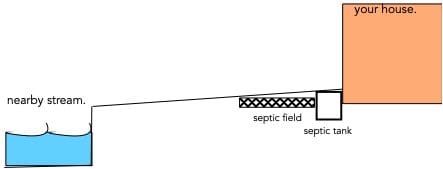
A home based approach to sewage. Many homes near me have this setup — with internal plumbing and a septic field for sewage treatment. Often, these homes are near a stream that flows at least temporarily.

Sanitary sewage flows are far less voluminous. Our county has roughly 1 million people who flush about 100 million gallons per day, generally sending this to our sanitary sewage treatment plants. That averages a mere 4 million gallons per hour, or 500,000 cubic feet. That’s roughly 8000 times less flow than the storm flow. If any significant fraction of the rainwater goes into our sanitary system, it will quickly overwhelm it and back up into our basements.

Many people try to get out of paying the high price for municipal sewage treatment by making their own small system with a septic tank an a septic field. I think this is a great idea, a benefit for them and the county. I will be happy to direct them to appropriate educational materials so that home waste flows to the septic tank where anaerobic bacteria break things down, it should then flow to a septic field that filters the nutrients and allows aerobic bacteria to break things down further. Nutrients in the sewage helps whatever you plant and, as we say, “the grass is always greenest over the septic tank.” As for the county on the whole, I wish we got real value from the fertilizer, as Milwaukee does, and wish we’d separate the sewers.

Robert Buxbaum, February 23, 2025
Upgrading landfill and digester gas for sale, methanol

We live in a throw-away society, and the majority of it, eventually makes its way to a landfill. Books, food, grass clippings, tree-products, consumer electronics; unless it gets burnt or buried at sea, it goes to a landfill and is left to rot underground. The product of this rot is a gas, landfill gas, and it has a fairly high energy content if it could be tapped. The composition of landfill gas changes, but after the first year or so, the composition settles down to a nearly 50-50 mix of CO2 and methane. There is a fair amount of water vapor too, plus some nitrogen and hydrogen, but the basic process is shown below for wood decomposition, and the products are CO2  and methane.

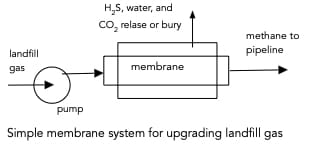
System for sewage gas upgrading, uses REB membranes.

C6 H12 O6  –> 3 CO2  + 3 CH4 

This mix can not be put in the normal pipeline: there is too much CO2  and there are too many other smelly or condensible compounds (water, methanol, H2S…). This gas is sometimes used for heat on site, but there is a limited need for heat near a landfill. For the most part it is just vented or flared off. The waste of a potential energy source is an embarrassment. Besides, we are beginning to notice that methane causes global-warming with about 50 times the effect of CO2, so there is a strong incentive to capture and burn this gas, even if you have no use for the heat. I’d like to suggest a way to use the gas.

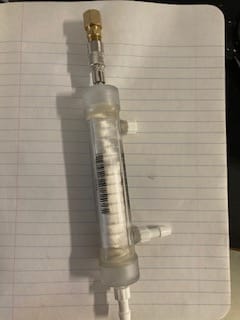
We sell small membrane modules too.

The landfill gas can be upgraded by removing the CO2. This can be done via a membrane, and REB Research sells a membranes that can do this. Other companies have other membranes that can do this too, but ours are smaller, and more suitable to small operations in my opinion. Our membrane are silicone-based. They retain CH4 and CO and hydrogen, while extracting water, CO2 and H2S, see schematic. The remainder is suited for local use in power generation, or in methanol production. It can also be used to run trucks. Also the gas can be upgraded further and added to a pipeline for shipping elsewhere. The useless parts can be separated for burial. Find these membranes on the REB web-site under silicone membranes.

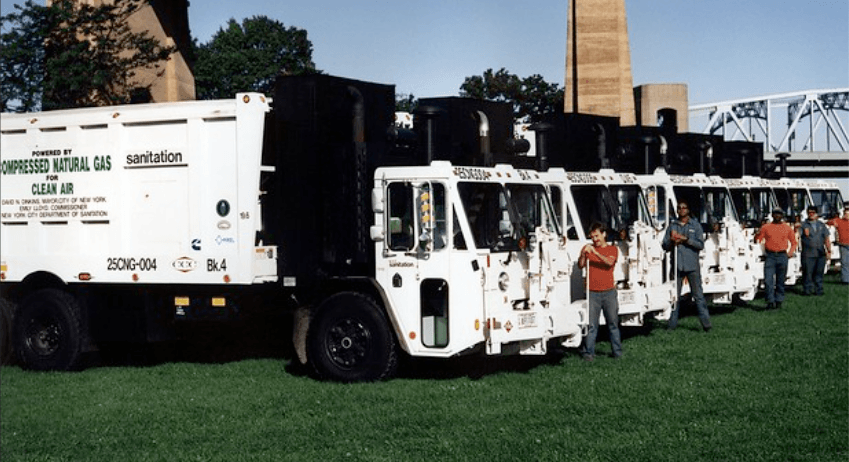
Garbage trucks in New York powered by natural gas. They could use landfill gas.

There is another gas source whose composition is nearly identical to that of landfill gas; it’s digester gas, the output of sewage digesters. I’ve written about sewage treatment mostly in terms of aerobic bio treatment, for example here, but sewage can be treated anaerobically too, and the product is virtually identical to landfill gas. I think it would be great to power garbage trucks and buses with this. Gas. In New York, currently, some garbage trucks are powered by natural gas.

As a bonus, here’s how to make methanol from partially upgraded landfill or digester gas. As a first step 2/3 of the the CO2 removed. The remained will convert to methanol. by the following overall chemistry:

3 CH4 + CO2 + 2 H2O –> 4 CH3OH. 

When you removed the CO2., likely most of the water will leave with it. You add back the water as steam and heat to 800°C over Ni catalyst to make CO and H2. That’s done at about 800°C and 200 psi. Next, at lower temperature, with an appropriate catalyst you recombine the CO and H2 into methanol; with other catalysts you can make gasoline. These are not trivial processes, but they are doable on a smallish scale, and make economic sense where the methane is essentially free and there is no CNG customer. Methanol sells for $1.65/gal when sold by the tanker full, but $5 to $10/gal at the hardware store. That’s far higher than the price of methane, and methanol is far easier to ship and sell in truckload quantities.

Robert Buxbaum, June 8, 2021

We don’t need no stinking primary clarifier

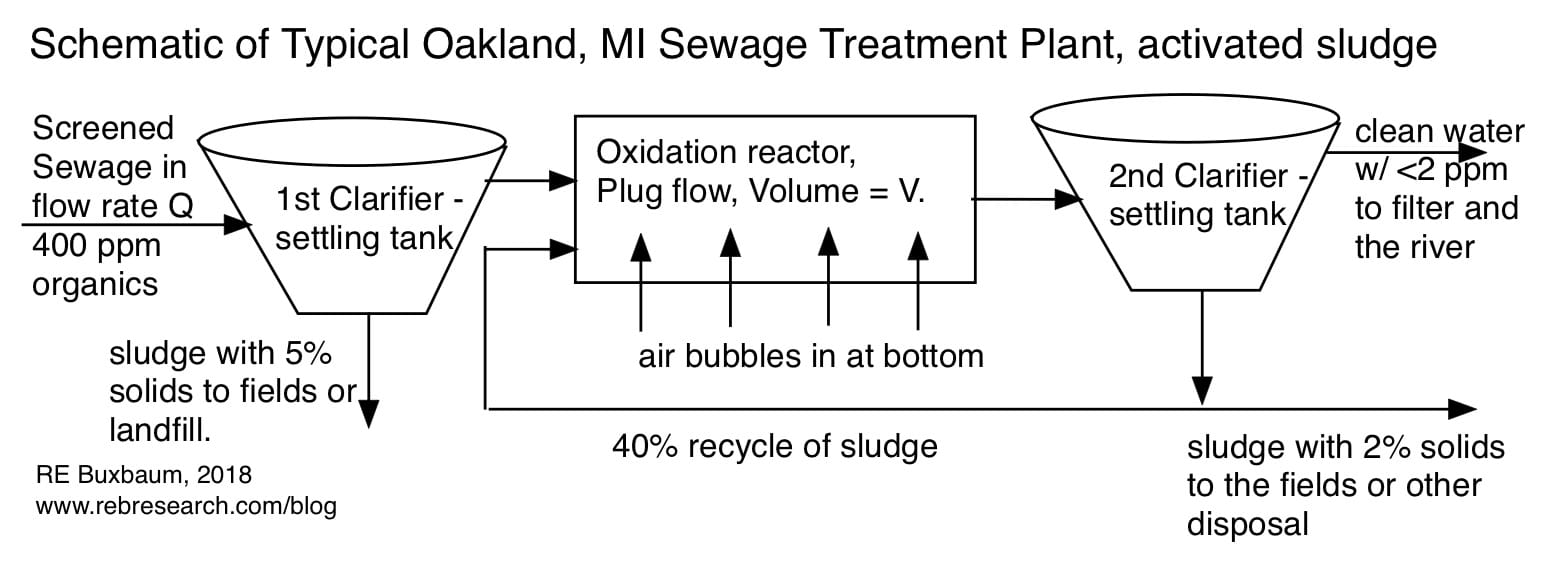
Virtually every sewage plant of Oakland County uses the activated sludge process, shown in the layout below. Raw sewage comes in, and goes through physical separation — screening, grit removal, and a first clarifier – settling tank before moving to the activated sludge oxidation reactor. The 1st clarifier, shown at left below, removes about half of the incoming organics, but it often stinks and sometimes it “pops” bubbles of fart. This is usually during periods of low flow, like at night. When the flow is slow, it arrives at the plant as a rotting smelly mess; it’s often hard to keep the bubbles of smell down.

Typical Oakland Sewage plant, activated sludge process with a primary clarifier.

Typical Oakland County Sewage treatment plant, activated sludge process with a primary clarifier.

The smell is much improved in the oxidation reactor, analyzed here, and in the 2nd clarifier, shown above at right. Following that is a filter, an ultraviolet cleanup stage, and the liquids are discharged to a local river. In Oakland county, the solids from the two clarifiers are hauled off to a farm, or buried in a landfill. Burial in a landfill is a costly waste, as I discuss here. The throughputs for most of these treatment plants is only about 2-3 million gallons of sewage per day. But Oakland county can produce 500 million gallons of sewage per day. The majority of this goes to Detroit for treatment, and sometimes the overflow is dumped rotting and smelly, in the rivers.

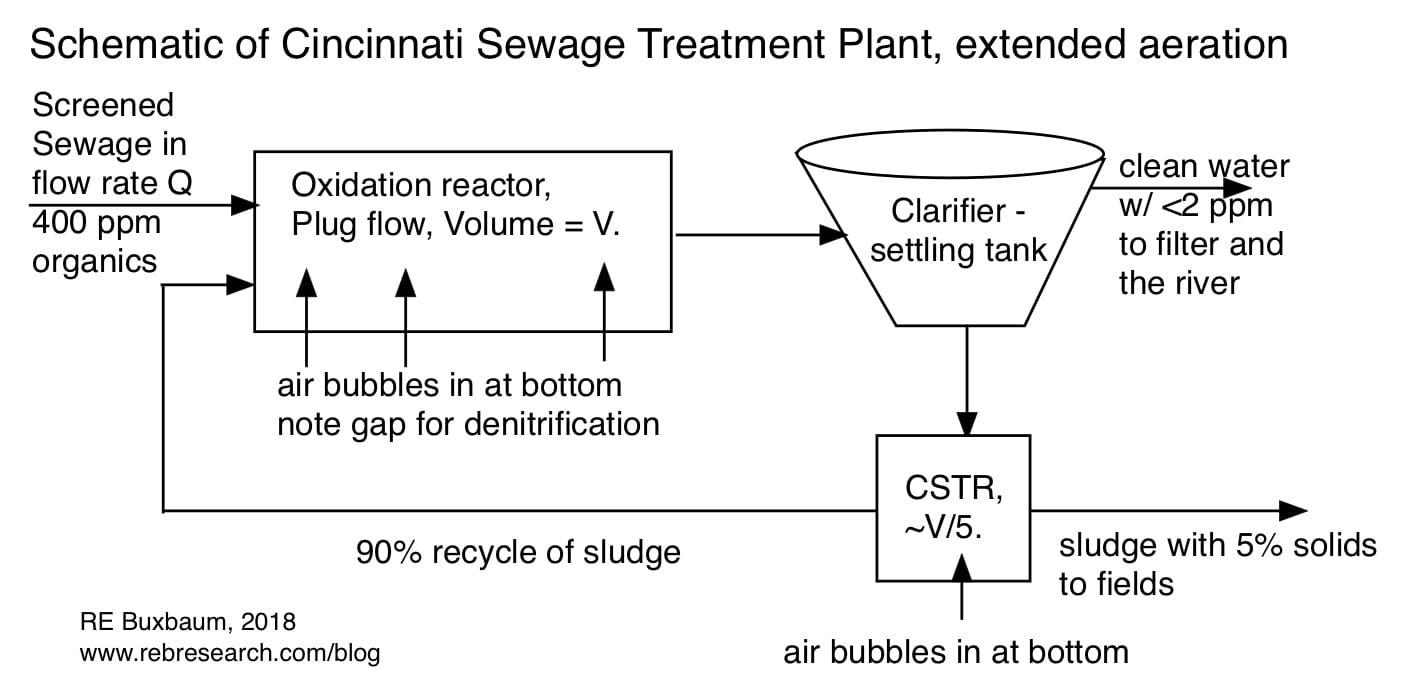
A few months ago, I visited the Sycamore Creek Wastewater facility outside of Cincinnati. This is an 8 million gallon per day plant that uses the “extended aeration process”, shown in the sketch below. I noticed several things I liked: the high throughput (the plant looks no bigger than our 2-3 million gallon plants) and the lack of a bad smell, primarily. The Sycamore Creek plant had an empty hole where the primary clarifier had once been. Lacking this clarifier, the screened sewage could not sit and pop. Instead it goes directly from grit removal to the oxidation reactor, a reactor that looks no bigger than in our plants. This reactor manages a four times higher throughput, I think, because of a higher concentration of cellular catalyst. Consider the following equation derived in a previous post:

ln C°/C = kV/Q.

Here, C° and C are the incoming and exit concentrations of soluble organic; k is the reaction rate, proportional to cellular concentration, V is the volume of the reactor, Q is the flow, and ln is natural log. The higher cellular concentration in the extended aeration plant results in an increased reaction rate, k. The higher the value of k, the higher the allowed flow, Q, per reactor volume, V.

The single clarifier at the end of the Sycamore Creek plant does not look particularly big. My sense is that it deals with a lot more sludge and flow than is seen in our 2nd clarifiers because (I imaging) the sludge is higher density, thus faster settling. I expect that, without the 1 clarifier, there is extra iron and sulfate in the sludge, and more large particles too. In our plants, a lot of these things are removed in the primary clarifier. Sludge density is also increased, I think, because the Cincinnati plant recycle a greater percentage of the sludge (I list it as 90% in the diagram). Extra iron in the reactor also helps to remove phosphates from the water effluent that flows back to the river, an important pollution concern. Iron phosphates are insoluble, and thus leave with the sludge. In Oakland county’s activated sludge plants, it is typical to add iron to the reactor or clarifier. In Cincinnati’s extended aeration plant, I’m told, iron addition is generally not needed.

Typical Oakland Sewage plant, activated sludge process with a primary clarifier.

Cincinnati sewage treatment plant, extended aeration process with no primary clarifier.

The extended aeration part of the above process refers to the secondary sludge oxidizer, the continuously stirred tank reactor, or CSTR shown at lower right above. The “CSTR” is about 1/5 the volume of the main oxidation reactor and about the size of a clarifier. Oxidation in the CSTR compliments that in the main oxidizer removing organics, making bio-polymer, and improving (I think) the quality of the sludge that goes to the farms. Oxidation in the CSTR reduces the amount of sludge that goes to the farms. The sludge that does go, is  less-toxic and more concentrated in organics and minerals. I’m not sure if the CSTR product is as good as the product from an anaerobic digester, or if the CSTR is cheaper to operate, but it looks cheaper since there is no roof, and no (or minimal) heating. This secondary oxidizer is very efficient at removing organics because the cellular catalyst concentration is very high – much higher than in the main oxidizer.

During periods of high load, early morning, the CSTR seems to serve as a holding tank so that sludge does not build up in the clarifier. Too much sludge in the clarifier can start to rot, and ruin the effluent quality. The way you tell if there is too much sludge, by the way, is through a device called the “sludge judge.” I love that name. The Cincinnati plant used a centrifugal drier; none of our plants do. The Cincinnati plant had gap the bubble spots of the main oxidizer. This is good for denitrification, I’m told, an important process that I discuss elsewhere.

The liquid output of their clarifier (or ours) is not pure enough to be sent directly to the river. In this plant, the near-pure water from the clarifier is sent to a trickling filter, a bed of sand and anthracite that removes colloidal remnants. Some of our plants do the same. I suspect that the large surface area in this filter is also home to some catalysis: last stage oxidation of remaining bio-organics. On a regular basis, the filter bed is reverse-flushed to remove cellular buildup, slime, and send it to the beginning of the process. The trickling filter output is then sent to an ultraviolet, bacteria-killing step before being released to the rivers. All in all, I suspect that an extended aeration process like this is worth looking into for Oakland County, especially for our North Pontiac sewage treatment facility. That plant is particularly bad smelling, and clearly too small to treat all its sewage. Perhaps we can increase the throughput and decrease the smell at a minimal cost.

Dr. Robert E. Buxbaum, December 18, 2018. I’m running for water commissioner of Oakland county, MI. If you like, visit my campaign site. Here are some sludge jokes and my campaign song.

Activated sludge sewage treatment bioreactors

I ran for water commissioner of Oakland county in 2016, a county with 1.3 million people and eight sewage treatment plants. One of these plants uses the rotating disk contractor, described previously, but the others process sewage by bubbling air through it in a large tank — the so-called, activated sludge process. A description is found here in Wikipedia, but with no math, and thus, far less satisfying than it could be. I thought I might describe this process relevant mathematics, for my understanding and those interested: what happens to your stuff after you flush the toilet or turn on the garbage disposal.

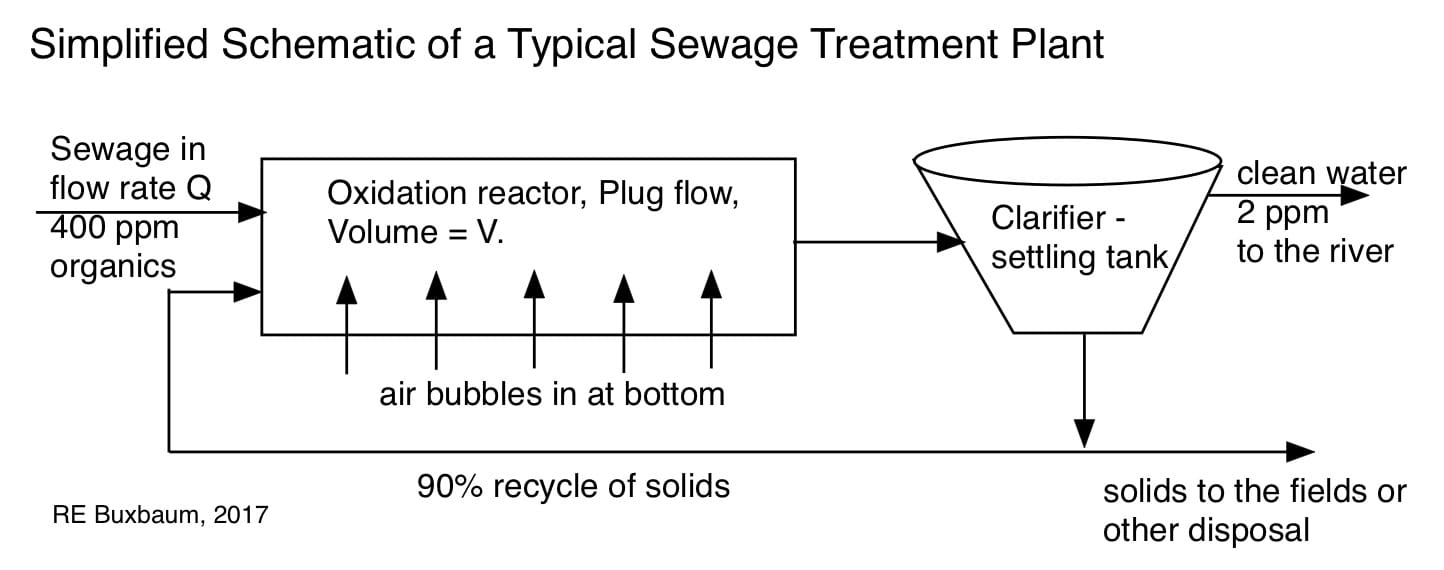
Simplified sewage plant: a plug-flow reactor with a 90+% solids recycle used to maintain a high concentration of bio-catalyst material.

Simplified sewage plant: a bubbling, plug-flow bio-reactor with 90% solids recycle and a settler used to extract floc solids and bio-catalyst material.

In most of the USA, sanitary sewage, the stuff from your toilet, sink, etc. flows separately from storm water to a treatment plant. At the plant, the sewage is first screened (rough filtered) and given a quick settle to remove grit etc. then sent to a bubbling flow, plug-flow bioreactor like the one shown at right. Not all cities use this type of sludge processes, but virtually every plant I’ve seen does, and I’ve come to believe this is the main technology in use today.

The sewage flows by gravity, typically, a choice that provides reliability and saves on operating costs, but necessitates that the sewage plant is located at the lowest point in the town, typically on a river. The liquid effluent of the sewage, after bio-treatment is typically dumped in the river, a flow that is so great more than, during dry season, more than half the flow of several rivers is this liquid effluent of our plants – an interesting factoid. For pollution reasons, it is mandated that the liquid effluent leaves the plant with less than 2 ppm organics; that is, it leaves the plant purer than normal river water. After settling and screening, the incoming flow to the bio-reactor typically contains about 400 ppm of biomaterial (0.04%), half of it soluble, and half as suspended colloidal stuff (turd bits, vegetable matter, toilet paper, etc). Between the activated sludge bio-reactor and the settler following it manage to reduce this concentration to 2 ppm or less. Soluble organics, about 200 ppm, are removed by this cellular oxidation (metabolism), while the colloidal material, the other 200 ppm, is removed by adsorption on the sticky flocular material in the tank (the plug-flow tank is called an oxidation ditch, BTW). The sticky floc is a product of the cells. The rate of oxidation and of absorption processes are proportional to floc concentration, F and to organic concentration, C. Mathematically we can say that

dC/dt = -kFC

where C and F are the concentration of organic material and floc respectively; t is time, and k is a reaction constant. It’s not totally a constant, since it is proportional to oxygen concentration and somewhat temperature dependent, but I’ll consider it constant for now.

As shown in the figure above, the process relies on a high recycle of floc (solids) to increase the concentration of cells, and speed the process. Because of this high recycle, we can consider the floc concentration F to be a constant, independent of position along the reactor length.

The volume of the reactor-ditch, V, is fixed -it’s a concrete ditch — but the flow rate into the ditch, Q, is not fixed. Q is high in the morning when folks take showers, and low at night. It’s also higher — typically about twice as high — during rain storms, the result of leakage and illegal connections. For any flow rate, Q, there is a residence time for a bit of sewage flowing through a tank, τ = V/Q. We can now solve the above equation for the value of τ for an incoming concentration C° = 400 ppm, an outgoing concentration Co of 2 ppm. We integrate the equation above and find that:

ln (C°/Co) = kFτ

Where τ equals the residence time, τ = V/Q. Thus,

ln (C°/Co) = kFV/Q.

The required volume of reactor, V, is related to the flow rate, Q, as follows for typical feed and exit concentrations:

V = Q/kF ln( 400/2) = 5.3 Q/kF.

The volume is seen to be dependent on F. In Oakland county, tank volume V is chosen to be one or two times the maximum expected value of Q. To keep the output organic content to less than 2 ppm, F is maintained so that kF≥ 5.3 per day. Thus, in Oakland county, a 2 million gallon per day sewage plant is built with a 2-4 million gallon oxidation ditch. The extra space allows for growth of the populations and for heavy rains, and insures that most of the time, the effluent contains less than 2 ppm organics.

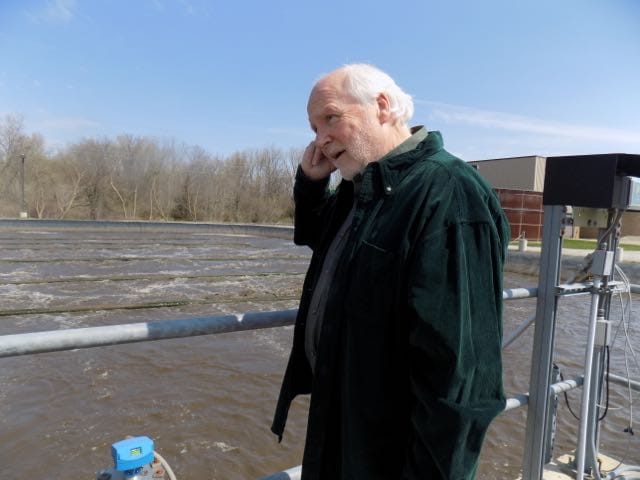
Bob Martin by the South Lyon, MI, Activated Sludge reactor

Bob Martin chief engineer the South Lyon, MI, Activated Sludge plant, 2016. His innovation was to control the air bubblers according to measurements of the oxygen content. The O2 sensor is at bottom; the controller is at right. When I was there, some bubblers were acting up.

As you may guess, the activated sludge process requires a lot of operator control, far more than the rotating disk contractor we described. There is a need for constant monitoring and tweaking. The operator deals with some of the variations in Q by adjusting the recycle amount, with other problems by adjusting the air flow, or through the use of retention tanks upstream or downstream of the reactor, or by adding components — sticky polymer, FeCl3, etc. Finally, in have rains, the settler-bottom fraction itself is adjusted (increased). Because of all the complexity. sewer treatment engineer is a high-pay, in demand, skilled trade. If you are interested, contact me or the county. You’ll do yourself and the county a service.

I’d mentioned that the effluent water goes to the rivers in Oakland county. In some counties it goes to the fields, a good idea, I think. As for the solids, in Oakland county, the solid floc is concentrated to a goo containing about 5% solids. (The goo is called unconsolidated sludge) It is shipped free to farmer fields, or sometimes concentrated to more than 5% (consolidated sludge), and provided with additional treatment, anaerobic digestion to improve the quality and extract some energy. If you’d like to start a company to do more with our solids, that would be very welcome. In Detroit the solids are burned, a very wasteful, energy-consuming process, IMHO. In Wisconsin, the consolidated sludge is dried, pelletized, and sold as a popular fertilizer, Milorganite.

Dr. Robert Buxbaum, August 1, 2017. A colleague of mine owned (owns?) a company that consulted on sewage-treatment and manufactured a popular belt-filter. The name of his company: Consolidated Sludge. Here are some sewer jokes and my campaign song.