Tag Archives: power

Camless valves and the Fiat-500

One of my favorite automobile engine ideas is the use of camless, electronic valves. It’s an idea whose advantages have been known for 100 years or more, and it’s finally going to be used on a mainstream, commercial car — on this year’s Fiat 500s. Fiat is not going entirely camless, but the plan is to replace the cams on the air intake valves with solenoids. A normal car engine uses cams and lifters to operate the poppet valves used to control the air intake and exhaust. Replacing these cams and lifters saves some weight, and allows the Fiat-500 to operate more efficiently at low power by allowing the engine to use less combustion energy to suck vacuum. The Fiat 500 semi-camless technology is called Multiair: it’s licensed from Valeo (France), and appeared as an option on the 2010 Alfa Romeo.

How this saves mpg is as follows: at low power (idling etc.), the air intake of a normal car engine is restricted creating a fairly high vacuum. The vacuum restriction requires energy to draw and reduces the efficiency of the engine by decreasing the effective compression ratio. It’s needed to insure that the car does not produce too much NOx when idling. In a previous post, I showed that the rate of energy wasted by drawing this vacuum was the vacuum pressure times the engine volume and the rpm rate; I also mentioned some classic ways to reduce this loss (exhaust recycle and adding water).

Valeo’s/Fiat’s semi-camless design does nothing to increase the effective compression ratio at low power, but it reduces the amount of power lost to vacuum by allowing the intake air pressure to be higher, even at low power demand. A computer reduces the amount of air entering the engine by reducing the amount of time that the intake valve is open. The higher air pressure means there is less vacuum penalty, both when the valve is open even when the valve is closed. On the Alfa Romeo, the 1.4 liter Multiair engine option got 8% better gas mileage (39 mpg vs 36 mpg) and 10% more power (168 hp vs 153 hp) than the 1.4 liter cam-driven engine.
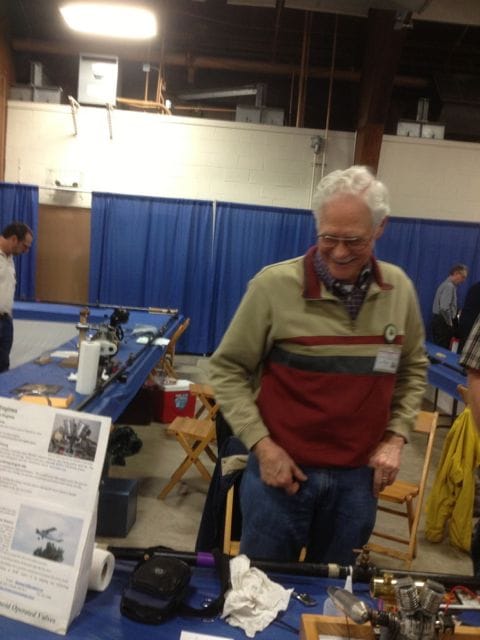
David Bowes shows off his latest camless engines at NAMES, April 2013.

David Bowes shows off his latest camless engines at NAMES, April 2013.

Fiat used a similar technology in the 1970s with variable valve timing (VVT), but that involved heavy cams and levers, and proved to be unreliable. In the US, some fine engineers had been working on solenoids, e.g. David Bowes, pictured above with one of his solenoidal engines (he’s a sometime manufacturer for REB Research). Dave has built engines with many cycles that would be impractical without solenoids, and has done particularly nice work reducing the electric use of the solenoid.

Durability may be a problem here too, as there is no other obvious reason that Fiat has not gone completely camless, and has not put a solenoid-controlled valve on the exhaust too. One likely reason Fiat didn’t do this is that solenoidal valves tend to be unreliable at the higher temperatures found in exhaust. If so, perhaps they are unreliable on the intake too. A car operated at 1000-4000 rpm will see on the order of 100,000,000 cycles in 25,000 miles. No solenoid we’ve used has lasted that many cycles, even at low temperatures, but most customers expect their cars to go more than 25,000 miles without needing major engine service.

We use solenoidal pumps in our hydrogen generators too, but increase the operating live by operating the solenoid at only 50 cycles/minute — maximum, rather than 1000- 4000. This should allow our products to work for 10 years at least without needing major service. Performance car customers may be willing to stand for more-frequent service, but the company can’t expect ordinary customers to go back to the days where Fiat stood for “Fix It Again Tony.”
Nuclear Power: the elephant of clean energy

As someone who heads a hydrogen energy company, REB Research, I regularly have to tip toe about nuclear power, a rather large elephant among the clean energy options. While hydrogen energy looks better than battery energy in terms of cost and energy density, neither are really energy sources; they are ways to transport energy or store it. Among non-fossil sources (sources where you don’t pollute the air massively) there is solar and wind: basically non-reliable, low density, high cost and quite polluting when you include the damage done making the devices.

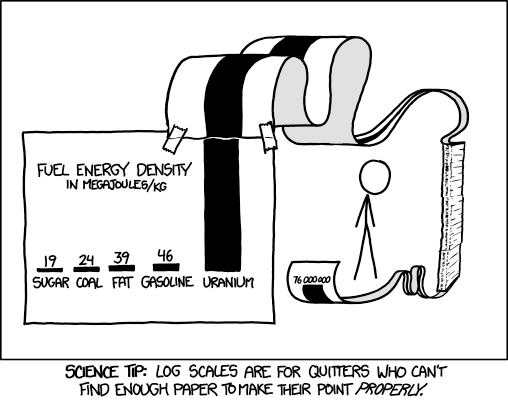
Compared to these, I’m happy to report that the methanol used to make hydrogen in our membrane reactors can come from trees (anti-polluting), even tree farming isn’t all that energy dense. And then there’s uranium: plentiful, cheap and incredibly energy dense. I try to ignore how energy dense uranium is, but the cartoon below shows how hard that is to do sometimes. Nuclear power is reliable too, and energy dense; a small plant will produce between 500 and 1000 MW of power; your home uses perhaps 2 kW. You need logarithmic graph paper just to compare nuclear power to most anything else (including hydrogen):

log_scale

A tiny amount of uranium-oxide, the size of a pencil will provide as much power as hundreds of train cars full of coal. After transportation, the coal sells for about $80/ton; the sells for about $25/lb: far cheaper than the train loads of coal (there are 100-110 tons of coal to a train-car load). What’s more, while essentially all of the coal in a train car ends up in the air after it’s burnt, the waste uranium generally does not go into the air we breathe. The coal fumes are toxic, containing carcinogens, carbon monoxide, mercury, vanadium and arsenic; they are often radioactive too. All this is avoided with nuclear power unless there is a bad accident, and bad accidents are far rarer with nuclear power than, for example, with natural gas. Since Germany started shutting nuclear plants and replacing them with coal, it appears they are making all of Europe sicker).

It is true that the cost to build a nuclear plant is higher than to build a coal or gas plant, but it does not have to be: it wasn’t that way in the early days of nuclear power, nor is this true of military reactors that power our (USA) submarines and major warships. Commercial nuclear reactors cost a lot largely because of the time-cost for neighborhood approval (and they don’t always get approval). Batteries used for battery power get no safety review generally though there were two battery explosions on the Dreamliner alone, and natural gas has been known to level towns. Nuclear reactors can blow up too, as Chernobyl showed (and to a lesser extent Fukushima), but almost any design is better than Chernobyl.

The biggest worry people have with nuclear, and the biggest objection it seems to me, is escaped radiation. In a future post, I plan to go into the reality of the risk in more detail, but the worry is far worse than the reality, or far worse than the reality of other dangers (we all die of something eventually). The predicted death rate from the three-mile island accident is basically nil; Fukushima has provided little health damage (not that it’s a big comfort). Further, bizarre as this seems the thyroid cancer rate in Belarus in the wind-path of the Chernobyl plant is actually slightly lower than in the US (7 per 100,000 in Belarus compared to over 9 per 100,000 in the USA). This is clearly a statistical fluke; it’s caused, I believe, by the tendency for Russians to die of other things before they can get thyroid cancer, but it suggests that the health risks of even the worst nuclear accidents are not as bad as you might think. (BTW, Our company makes hydrogen extractors that make accidents less likely)

The biggest real radiation worry (in my opinion) is where to put the waste. Ever since President Carter closed off the option of reprocessing used fuel for re-use there has been no way to permanently get rid of waste. Further, ever since President Obama closed the Yucca Mountain burial repository there have been no satisfactory place to put the radioactive waste. Having waste sitting around above ground all over the US is a really bad option because the stuff is quite toxic. Just as the energy content of nuclear fuel is higher than most fuels, the energy content of the waste is higher. Burying it deep below a mountain in an area were no-one is likely to live seems like a good solution: sort of like putting the uranium back where it came from. And reprocessing for re-use seems like an even better solution since this gets rid of the waste permanently.

I should mention that nuclear power-derived electricity is a wonderful way to generate electricity or hydrogen for clean transportation. Further, the heat of hot springs comes from nuclear power. The healing waters that people flock to for their health is laced with isotopes (and it’s still healthy). For now, though I’ll stay in the hydrogen generator business and will ignore the clean elephant in the room. Fortunately there’s hardly any elephant poop, only lots and lots of coal and solar poop.

Small hydrogen generators for cooling dynamo generators

A majority of the electricity used in the US comes from rotating dynamos. Power is provided to the dynamos by a turbine or IC engine and the dynamo turns this power into electricity by moving a rotating coil (a rotor) through a non-rotating magnetic field provided by magnets or a non-rotating coil (a stator). While it is easy to cool the magnets or stator, cooling the rotor is challenging as there is no possibility to connect it cooling water or heat transfer paste. One of the more common options is hydrogen gas.

It is common to fill the space between the rotor and the stator with hydrogen gas. Heat transfers from the rotor to the stator or to the walls of the dynamo through the circulating hydrogen. Hydrogen has the lowest density of any gas, and the highest thermal conductivity of any gas. The low density is important because it reduces the power drag (wind drag) on the rotor. The high heat transfer coefficient helps cool the rotor so that it does not burn out at high power draw.

Hydrogen is typically provided to the dynamo by a small hydrogen generator or hydrogen bottle. While we have never sold a hydrogen generator to this market, I strongly believe that our membrane reactor hydrogen generators would be competitive; the cost of hydrogen is lower than that of bottled gas; it is far more convenient and safe; and the hydrogen is purer than from electrolysis.

How hydrogen and/or water can improve automobile mileage (mpg)

In case you’ve ever wondered why it was that performance cars got such poor milage, or why you got such bad milage in the city, the biggest single problem has to do with the vacuum drawn by the engine, some of the problem has to do with the speed of combustion, some has to do with rolling friction, and some with start/stop loss too. Only a very small fraction of the energy is lost on air friction until you reach highway speeds.

Lets consider vacuum loss first as it is likely the worst offender. A typical US car, e.g. a Chevy Malibu, has a 3.5 liter engine (a performance car has an engine that’s much larger). As you toodle down a street at 35 mph, your engine is going at about 2000 rpm, or 33 rps. Since the power required to move the car is far less than the 200 hp that the car could deliver, the air intake is throttled so that the engine is sucking a vacuum of about 75 kpa (10 psi for those using English units). To calculate the power loss this entails, multiply 33*3.5*80; this is about 8662 Watts, or 12 hp. To find the energy use per mile, divide by your average speed, 25 mph (it would be 35 mph, but you sometimes stop for lights). 8 kW/25 mph = .21 kW-hr/mile. One finds, as I’ll show that the car expends more energy sucking this vacuum than pushing the car itself. This is where the majority of the city mpg goes in a normal car, but it’s worse in a high performance car is worse since the engine is bigger. In city driving, the performance mpg will be lower than for a Malibu even if the performance car is lighter, if it has better aerodynamics (it does), and if you never stop at lights.

The two other big places were city mileage goes is overcoming rolling friction and the need to stop and go at lights, stop signs, etc. The energy used for rolling friction is the force it would take to push your car on level ground when in neutral times the distance. For a typical car, the push force is about 70 lbs or 32 kgs or 315 Nt; it’s roughly proportional to the car’s weight. At 35 mph, or 15.5 m/s, the amount of power this absorbs is calculated as the product of force and speed: 15.5*315 = 4882 W, or about 6.5 hp. The energy use is 4.9 kW/35 mph =.14 kWhr/mile. The energy loss from stop lights is similar to this, about .16 kWhr/mile, something you can tell by getting the car up to speed and seeing how far it goes before it stops. It’ll go about 2-3 blocks, a little less distance than you are likely to go without having to stop. Air resistance adds a very small amount at these speeds, about 2000 W, 2.7 hp, or .05 kWhr/mile; it’s far more relevant at 65 mph, but still isn’t that large.

If you add all this together, you find the average car uses about .56 kWhr/mile. For an average density gasoline of 5.6 lb/gal, and average energy-dense gasoline, 18,000 BTU/lb, and an average car engine efficiency of 11000 BTU/kWhr, you can now predict an average city gas mileage of 16.9 mpg, about what you find experimentally. Applying the same methods to highway traffic at 65 mph, you predict .38 kWhr/mile, or 25 mpg. Your rpms are the same on the highway as in the city, but the throttle is open so you get more power and loose less to vacuum.

Now, how do you increase a car’s mpg. If you’re a Detroit automaker you could reduce the weight of the car, or you the customer can clean the junk out of your trunk. Every 35 lbs or so increases the rolling friction by about 1%. These is another way to reduce rolling friction and that’s to get low resistance tires, or keep the tires you’ve got full of air. Still, what you’d really like to do is reduce the loss to vacuum energy, since vacuum loss is a bigger drain on mpg.

The first, simple way to reduce vacuum energy loss is to run lean: that is, to add more air than necessary for combustion. Sorry to say, that’s illegal now, but in the olden days before pollution control you could boost your mpg by adjusting your carburator to add about 10% excess of air. This reduced your passing power and the air pollution folks made it illegal (and difficult) after they noticed that it excess air increased NOx emissions. The oxygen sensor on most cars keeps you from playing with the carburator these days.

Another approach is to use a much smaller engine. The Japanese and Koreans used to do this, and they got good milage as a result. The problem here is that you now had to have a very light car or you’d get very low power and low acceleration — and no American likes that. A recent approach to make up for some of the loss of acceleration is by adding a battery and an electric motor; you’re now making a hybrid car. But the batteries add significant cost, weight and complexity to these cars, and not everyone feels this is worth it. So now on to my main topic: adding steam or hydrogen.

There is plenty of excess heat on the car manifold. A simile use of this heat is to warm some water to the point where the vapor pressure is, for example, 50 kPa. The pressure from this water adds to the power of your engine by allowing a reduction in the vacuum to 50 kPa or less. This cuts the vacuum loss at low speeds. At high speed and power the car automatically increases the air pressure and the water stops evaporating, so there is no loss of power. I’m currently testing this modification on my own automobile partly for the fun of it, and partly as a preface to my next step: using the car engine heat to run the reaction CH3OH + H2O –> CO2 + H2. I’ll talk more about our efforts adding hydrogen elsewhere, but thought you might be interested in these fundamentals.

http://www.rebresearch.com