Tag Archives: oil

Will a cut-off in oil to China spark war?

China is likely the largest economy in the world, 11% lager than the US calculated here based on food purchasing parity They also have a larger army and navy, 754 ships vs 440, with military ambitions for Taiwan and new, man-made islands in the China sea. They continue to add aircraft carriers and submarines (we’re still ahead there), but China fuels all this with oil. They use some 17 million barrels per day: 11.3 million imported by ship, and put another million bb//day per into reserve in case there is a shutoff.

A problem for China is that their internal production, 4.5million bbl/day, is far below their consumption, a big vulnerability. One of their main suppliers, Venezuela, just went off line, sending 800,000 bbl/day of oil to the US that would have gone to China. Two other of their major, sanctioned suppliers, Iran and Russia have had delivery issues too; a disruption in oil could cause a revolt in China. Perhaps this fear will drive China to war with us, similar to the way that a cut off in oil caused Japan went to go to war with us in WWII, see table below. Japan had the choice of war or shutting down their economy and ambitions. Perhaps China may choose the same if Iran and/or Russia goes off-line. That was my worry, I’m no longer that concerned.
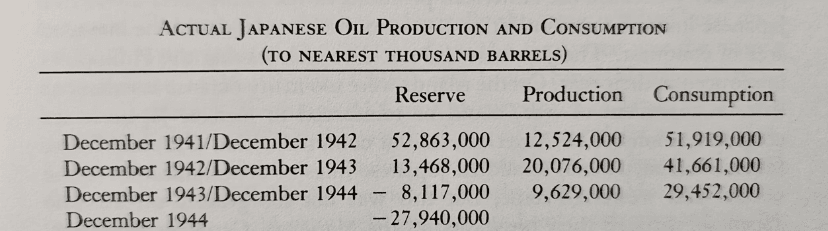
This shows how dependent Japan was on foreign oil, before and during WWII. The cut off of imports sues them to attack Pearl Harbor, source = Sarah Paine, military historian

Currently, China buys most of its imported oil from four countries: Russia, Iran, Saudi Arabia, and Iraq; two of these are under sanction. China used to get another 0.8 million barrels per day from Venezuela, another country under sanction, but that route was closed by Trump last week. Buying from sanctioned countries saves them significantly, and supports the BRICS alliance, an alliance specifically against the US (NAFTA?) and the EU. The money they pay to Russia and Iran supports the war against Ukraine, plus ISIS’, war against us, and the mullahs oppression in Iran.
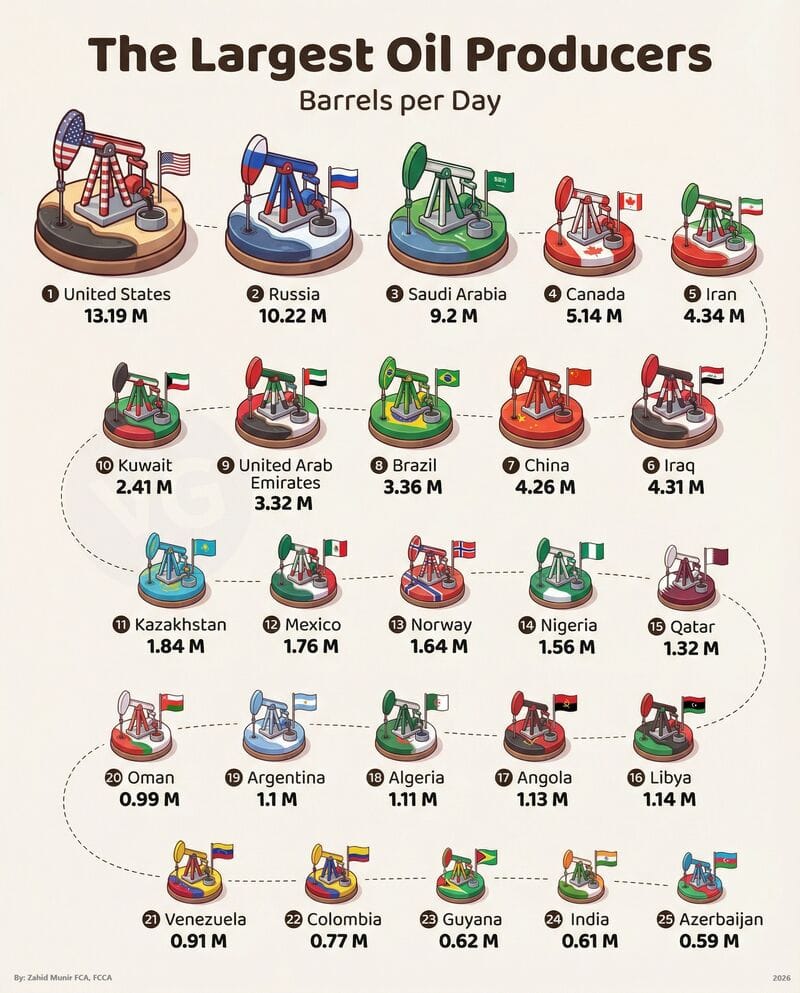
Oil production worldwide, 2024. How much China buys from each varies month to month.

China was buying, from Russia, some 2.2 million barrels of oil and refined products, plus natural gas and coal (China is a big coal user). The rest of Russia’s output goes to India, Turkey, and the EU. The EU buys more than half of eastern Russia’s natural gas output, shamefully it has likely kept Germany from collapsing. The problem for China is that Russian production is under attack from Ukraine. Ukraine sank or disabled several Russian tankers, and we took some more; they’ve blown up pumping stations, including three on the Caspian Sea, set fire, to a large liquid natural gas terminal and damaged the major off-load platform for Kazakh oil. According to the Foundation for Democracy report, here, by October 2025, China was down to getting only 800,000 bbl/day from Russia, a major blow, and Ukraine’s attacks continue.
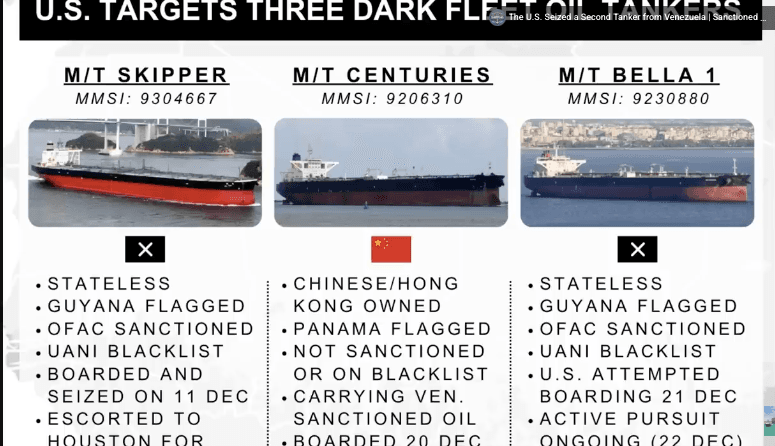
Some dark fleet ships captured by the US navy off of Venezuela, on their way to China with sanctioned oil.

Iran is another major supplier under attack. Up until recently they provided nearly 2 million barrels of oil per day, 90% of Iran’s seaborne export. Much of that went indirectly, going to Indonesia, turkey, Iraq, and Kuwait where it was relabeled, blended or refined to avoid sanction penalties. Everyone makes a profit here, but Iran is in the midst of a revolution. Last week, Trump imposed an across-the board 25% additional tariff on counties that help Iran avoid the sanctions. My guess is that this tariff will be effective and that it will last until the revolution is over. His tariffs have been effective and profitable, it seems.

China has non-sanctioned suppliers. They buy some 1.6 million barrels per day from Saudi Arabia, about 1.2 million bbl/day, from Iraq, about 1.3 million bbl per day from Malaysia, about 700,000/ day from Brazil, and about 900,000/day from the USA. In principle, they could make up any losses by buying more here, but the price would be higher. Worse yet, Trump could cut China off. That would be devastating; it’s the reason China built up a reserve of 2.2 billion barrels amounting to 6 months of current use. Japan did something similar in 1941, building up a year’s worth. They then used all of it in the first year of the war, while conquering Indonesia, a new supplier. For all I know, Trump’s activities in Venezuela and Iran are meant to force a war decision on China before they are strong enough to defeat us. It seems to have been FDR’s logic.

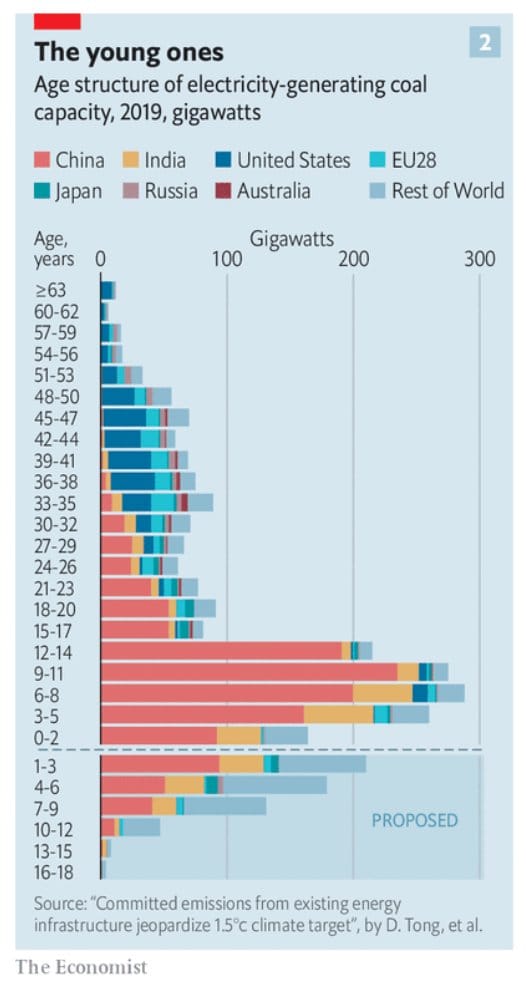
China’s main way to address a possible oil disruption, as best I can tell, has been to push EVs development. They’ve financed some 500 new EV companies who now (late 2025) provide about 50% of new Chinese automobiles. Another 19% are hybrids. In the US, only 8% of new cars are EVs, and 16% hybrids. Large-scale use of EVs lessens the pressure on Chinese leaders to find oil sources, some 40% of oil imports can be assumed to go to fuel automobiles; if China were to go 80% EV, it would save 5.5 million barrels/day, more than it gets from Russia and Iran combined. For now, though, China has a big need for gasoline, and has a big excess in EV manufacturing. It has turned to Canada both as a customer for EVs and as a supplier for oil.

Last week, Canadian PM, Mark Carney visited China and announced a “Strategic Partnership” on Agriculture, energy, finance, and Global governance.” There’s no specific mention of oil, but it’s implied. China gets most favored nation status sending goods, including EVs to Canada at rates lower than on US goods. China will export some 50,000 EVs in 2026, rising to 70,000 by 2030 with tariffs set to 6.1%. US-made cars are tariffed at 25%. Canadians will get visa-free, tourist visits), plus a loan of $1B to be used buying Chinese ships. In Davos last week, “We are in the midst of a Rupture” away from the US. He urged the EU and other “middle powers” to band together. He talks like China is a good, reliable friend to Canada, and like the US isn’t. I would worry more about his comments and the “global governance” phrase, if the EU seemed to be going along, but it is not. Nor do I see a real move in China for war. I see positive effects of increased EV sales for China, Canada, and the world. Even if the quality isn’t great, Go Canada, go peace.

Robert Buxbaum, January 25, 2026. *The plan to attack Pearl Harbor was made in December 1940, a year before it happened and 9 months before we cut off oil shipments. We cut off oil shipments in September, following Japan’s invasion of Indonesia, done to take the oil there. While oil was not Japan’s only aim in WWII, it was an aim and a big participant at every step.

Al Jazeera, a multi billion-dollar influence buyer

Given the hand-wringing over the $300,000 spent by Russia to influence the 2016 US election, I thought it worthwhile to point out that Qatar spent roughly 2.5 billion on influence, mostly through Qatar’s news agency, Al Jazeera. Qatar is a Shiite (Shia) Moslem Emirate solely ruled by a Sunni Emir (king). Here’s a joke to help distinguish Sunni from Shia. It is also the 4th largest exporter of natural gas in the world behind Russia, Norway, and Canada. It’s a solid supporter of leftist political causes from anti-climate change to Hamas and Al Qaeda/ ISIS, and it is the host for the FIFA world cup of soccer, 2022. For more about Qatar and the logic of its behavior, see the American Foreign Policy Analysis. Interesting in general, but I’d like to focus on influence buying.

FILE - In this Aug. 20, 2013 file photo, Al Jazeera America editorial newsroom staff prepare for their first broadcast in New York. Shannon High-Bassalik former head of Al Jazeera America’s documentary unit has sued the news network, claiming it is biased against non-Arabs in stories that it produces and how it treats employees.  (AP Photo/Bebeto Matthews, File)

Al Jazeera America prepares for its first broadcast from New York, August, 2013. AP Photo/Bebeto Matthews.

The Emir of Qatar is the sole owner of Al Jazeera, a news organization, that he uses as profit-losing, influence machine. It allowed him to support leftist politicians who he believes to be pro-Arab, pro-Muslim Brotherhood, anti-Israel, and anti-American. In Europe he pursues pro-immigration, anti-fracking policies. In conservative, Islamic countries, like Saudi Arabia, Egypt, and Iran, he’s used Al Jazeera to supported free elections to unseat the king, Shah, or military president. Al Jazeera uniformly portrays Qatar and its emir well, helping it get rights to host the FIFA world cup. No other country gets anywhere near such uniform, positive support.

A bit of history: Al Jazeera began operations in Doha, the capital of Qatar in 1996, as an antidote to Saudi Arabia’s arabic-language news outlet, MBC (Mid-East Broadcast Company, now called Al Arabia). By 2003, Al Jazeera was broadcasting in Europe in various EU languages, and had an english language version broadcast out of London, Al Jazeera-English. It is available in the US via cable TV, Channels 100, 200, and 300. In 2013, the Emir of Qatar expanded Al Jazeera directly to the US, paying 1/2 billion dollars for an Emmy-winning, non-profitable, cable news company “Current TV”, partially owned by Al Gore. “Current TV” operated out of San Francisco with a left-leaning, pro-environment message and a modest audience. Their shows include The War Room with Jennifer Granholm (Jennifer is the ex-governor of Michigan), Talking Liberally, The Stephanie Miller Show, and  Viewpoint with Eliot SpitzerThe Emir added a news headquarters in New York and gave it a new name: Al Jazeera America, or AJAM. The old Current TV was retained as AJ+, a video arm. Over the next 5 years the emir spent 2 billion dollars setting up 12 news bureaus in the US with instructions that there was no need for profit, but only for “influence”. It is arguable how much influence he got, but it is clear he didn’t make any profit.

Despite what you might imagine would be the opinions of a petro-monarch, AJAM continues to back Gore’s anti-fracking message. I will speculate this is because he is against US gas because it competes with Qatari gas. AJAM also strongly supports the Muslim Brotherhood, Hamas, and ISIS. Perhaps that’s radical chic (radical sheik?). He’s against any authoritarian ruler that isn’t him.

Trump, his daughter, el Sisi, and the King of Saudi Arabia. No Emir of Qatar.

Trump, his daughter, Ibn-Said (king of Saudi Arabia) and el Sisi, (president of Egypt). Global control with no Emir.

Some notable controversies — I got these from Wikipedia –Ahmed Mansour, a prominent Al Jazeera anchor, is quoted saying that Egyptian president, el-Sisi was “a Jew carrying out an Israeli plot.” Faisal al-Qassim, another Al Jazeera presenter, hosted a segment on whether Syria’s Alawite (Shia) population deserved to be killed en-mass, and in 2014, the channel’s Iraqi affairs editor tweeted approvingly about the Islāmic State killing more than 1,500 air-force cadets in Tikrit, singling out those who were Shia and non-Muslim. Closer to home, they charged a half-dozen athletes with doping, including Peyton Manning, hero of the super bowl. In the end, Shannon High-Bassalik, former head of the documentary unit, also sued claiming bias against non-Arabs in stories and in how it treats employees.

Among Republicans, AJAM became to be known as “The Terror Network”, while they retained some good reputation on left. The Emir bought not only the network, but spent liberally on sympathetic experts, and on academic think tanks. Further, it seems that Al Jazeera writers had no fixed budget or expense limit. The Russians are nowhere near this generous.

In April of 2016, with the world cup coming to Qatar, and American oil reviving, the emir cut AJAM staff by 900 workers. Part of the decision may have been that it looked like he had the 2016 election in the bag. Al Jazeera English remains, still operating out of London, and AJ+, the old Current TV, still operating out of San Francisco. And then Donald Trump was elected 45th US president. AJ / AJ+ was shocked (as was I); and called for protests. Trump, in a publicized meeting with el-Sisi of Egypt (the Jewish Spy), and Salmon al-Saud, (above, 2017) issued a set of 13 demands including that the emir stop to support for Hamas and the Brotherhood, and that he shut Al Jazeera. The emir has not complied, and the world cup is still on for Qatar.

I should mention that the Emir and Putin work together on some things and oppose on others. They both support politicians who oppose oil and gas production while opposing each other on pipeline construction. Qatar backs the pan Arabian pipeline to Turkey, while Russia funds Assad and the PKK (Russia-friendly, Kurdish independents) to block such access. The Emir supports ISS, Hamas, and Turkish Kurds, I suspect, as a way to fight Russia. It’s Byzantine politics in both senses of the word. Given how much Qatar has spent buying influence with Clinton and Gore, I don’t understand why the FBI is so focussed on Trump and Russia.

Robert Buxbaum, May 29, 2018.

Beyond oil lies … more oil + price volatility

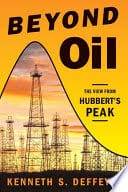
One of many best selling books by Kenneth Deffeyes

One of many best-selling books by Kenneth Deffeyes

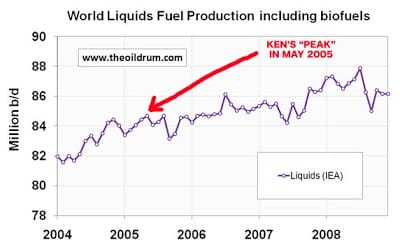
While I was at Princeton, one of the most popular courses was geology 101 taught by Dr. Kenneth S. Deffeyes. It was a sort of “Rocks for Jocks,” but had an unusual bite since Dr. Deffeyes focussed particularly on the geology of oil. Deffeyes had an impressive understanding of oil and oil production, and one outcome of this impressive understanding was his certainty that US oil production had peaked in 1970, and that world oil was about to run out too. The prediction that US oil production had peaked was not original to him. It was called Hubbert’s peak after King Hubbert who correctly predicted (rationalized?) the date, but published it only in 1971. What Deffeyes added to Hubbard’s analysis was a simplified mathematical justification and a new prediction: that world oil production would peak in the 1980s, or 2000, and then run out fast. By 2005, the peak date was fixed to November 24, of the same year: Thanksgiving day 2005 ± 3 weeks.

As with any prediction of global doom, I was skeptical, but generally trusted the experts, and virtually every experts was on board to predict gloom in the near future. A British group, The Institute for Peak Oil picked 2007 for the oil to run out, and the several movies expanded the theme, e.g. Mad Max. I was convinced enough to direct my PhD research to nuclear fusion engineering. Fusion being presented as the essential salvation for our civilization to survive beyond 2050 years or so. I’m happy to report that the dire prediction of his mathematics did not come to pass, at least not yet. To quote Yogi Berra, “In theory, theory is just like reality.” Still I think it’s worthwhile to review the mathematical thinking for what went wrong, and see if some value might be retained from the rubble.

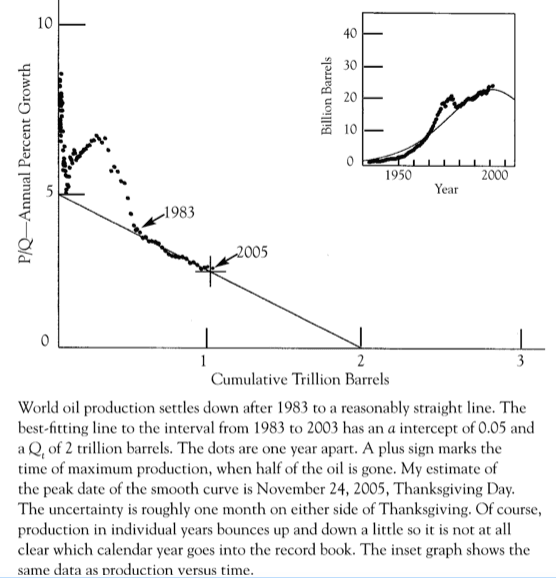
proof of peak oilDeffeyes’s Maltheisan proof went like this: take a year-by year history of the rate of production, P and divide this by the amount of oil known to be recoverable in that year, Q. Plot this P/Q data against Q, and you find the data follows a reasonably straight line: P/Q = b-mQ. This occurs between 1962 and 1983, or between 1983 and 2005. Fro whichever straight line you pick, m and b are positive. Once you find values for m and b that you trust, you can rearrange the equation to read,

P = -mQ2+ bQ

You the calculate the peak of production from this as the point where dP/dQ = 0. With a little calculus you’ll see this occurs at Q = b/2m, or at P/Q = b/2. This is the half-way point on the P/Q vs Q line. If you extrapolate the line to zero production, P=0, you predict a total possible oil production, QT = b/m. According to this model this is always double the total Q discovered by the peak. In 1983, QT was calculated to be 1 trillion barrels. By May of 2005, again predicted to be a peak year, QT had grown to two trillion barrels.

I suppose Deffayes might have suspected there was a mistake somewhere in the calculation from the way that QT had doubled, but he did not. See him lecture here in May 2005; he predicts war, famine, and pestilence, with no real chance of salvation. It’s a depressing conclusion, confidently presented by someone enamored of his own theories. In retrospect, I’d say he did not realize that he was over-enamored of his own theory, and blind to the possibility that the P/Q vs Q line might curve upward, have a positive second derivative.

Aside from his theory of peak oil, Deffayes also had a theory of oil price, one that was not all that popular. It’s not presented in the YouTube video, nor in his popular books, but it’s one that I still find valuable, and plausibly true. Deffeyes claimed the wildly varying prices of the time were the result of an inherent quay imbalance between a varying supply and an inelastic demand. If this was the cause, we’d expect the price jumps of oil up and down will match the way the wait-line at a barber shop gets longer and shorter. Assume supply varies because discoveries came in random packets, while demand rises steadily, and it all makes sense. After each new discovery, price is seen to fall. It then rises slowly till the next discovery. Price is seen as a symptom of supply unpredictability rather than a useful corrective to supply needs. This view is the opposite of Adam Smith, but I think he’s not wrong, at least in the short term with a necessary commodity like oil.

Academics accepted the peak oil prediction, I suspect, in part because it supported a Marxian remedy. If oil was running out and the market was broken, then our only recourse was government management of energy production and use. By the late 70s, Jimmy Carter told us to turn our thermostats to 65. This went with price controls, gas rationing, and a 55 mph speed limit, and a strong message of population management – birth control. We were running out of energy, we were told because we had too many people and they (we) were using too much. America’s grown days were behind us, and only the best and the brightest could be trusted to manage our decline into the abyss. I half believed these scary predictions, in part because everyone did, and in part because they made my research at Princeton particularly important. The Science fiction of the day told tales of bold energy leaders, and I was ready to step up and lead, or so I thought.

By 2009 Dr. Deffayes was being regarded as chicken little as world oil production continued to expand.

By 2009 Dr. Deffayes was being regarded as chicken little as world oil production continued to expand.

I’m happy to report that none of the dire predictions of the 70’s to 90s came to pass. Some of my colleagues became world leaders, the rest because stock brokers with their own private planes and SUVs. As of my writing in 2018, world oil production has been rising, and even King Hubbert’s original prediction of US production has been overturned. Deffayes’s reputation suffered for a few years, then politicians moved on to other dire dangers that require world-class management. Among the major dangers of today, school shootings, Ebola, and Al Gore’s claim that the ice caps will melt by 2014, flooding New York. Sooner or later, one of these predictions will come true, but the lesson I take is that it’s hard to predict change accurately.

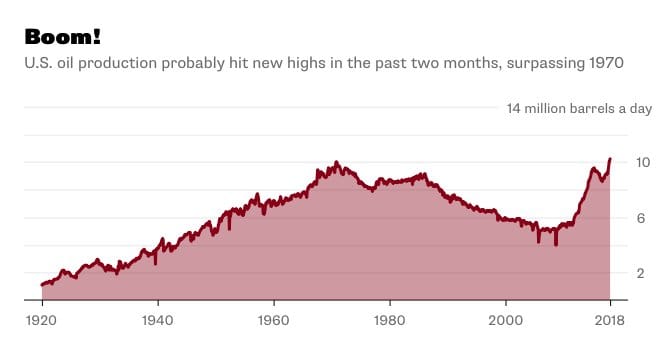
Just when you thought US oil had beed depleted for good, production began rising. It's now higher than the 1970 peak.

Just when you thought US oil was depleted, production began rising. We now produce more than in 1970.

Much of the new oil production you’ll see on the chart above comes from tar-sands, oil the Deffeyes  considered unrecoverable, even while it was being recovered. We also  discovered new ways to extract leftover oil, and got better at using nuclear electricity and natural gas. In the long run, I expect nuclear electricity and hydrogen will replace oil. Trees have a value, as does solar. As for nuclear fusion, it has not turned out practical. See my analysis of why.

Robert Buxbaum, March 15, 2018. Happy Ides of March, a most republican holiday.