Tag Archives: Mexico

James K. Polk, a great president who did what he said and made America great

One of my favorite presidents is James K. Polk. While running for president he claimed we would do four major things –and do them as a one-term president. He then did them, and left office — and died 103 days later at the age of 53. Mr Polk’s four stated objectives were: a reduction in the tariff, an independent treasury, settlement of the Oregon boundary dispute, and acquisition of California. Acquisition of California required admission of Texas, plus a war with Mexico and a cash payment, but he was ready. Settling the Oregon border required a compromise and a cash payment. But he did it and more. Modern professors are not happy with Polk, ranking him far below Obama, Kennedy, or Adams, but his aims were good, and he got hem done. Few presidents do that, and even fewer left office if they had the power to stay. No professor I know has ever willingly left if he had the power to stay, and didn’t have a better job to go to.
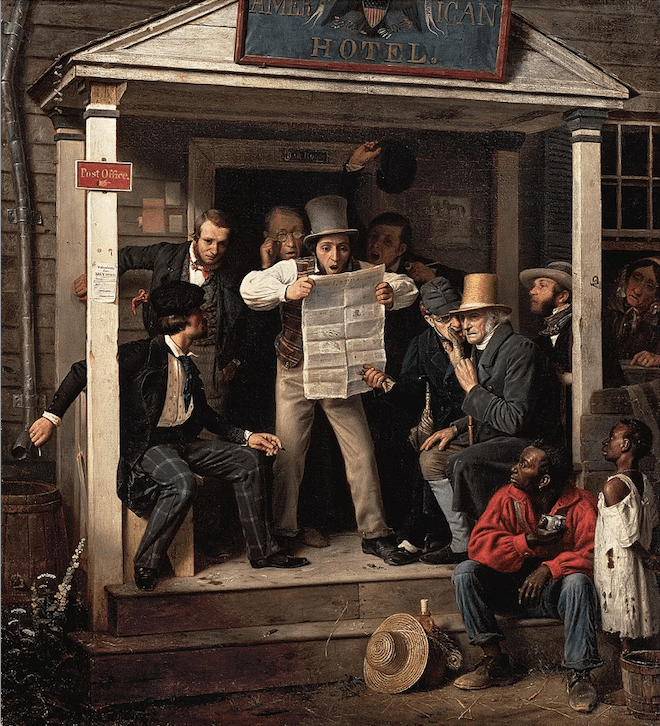
News from Mexico, oil on canvas painting by Richard Caton Woodville Sr., Düsseldorf, 1848. Polk was a god-send for newspaper sales.

I believe that the clarity of Polk’s four objectives was the reason he was a candidate at all, and the reason he won the election, and also the reason he achieved the objectives. There is a magic in clear objectives, repeated often, I find. It’s a formula that got Trump elected that few seem to understand: “Make America Great Again.” “Build the Wall”, “Drill baby Drill” “Deport illegals” “Tariffs. ” Like these ideas or not, you know Trump’s aims. Also, you know that, if. you oppose them, you oppose him. Trump’s pastor, Norman Vincent Peale promoted this approach, one I’ve thought of trying myself. I suspect that Polk died so shortly after leaving office because he had no further goal beyond relaxing; bad water hurt him too.. I suspect that Trump will die shortly after leaving office too- from lack of purpose.

Polk wasn’t expected to be a candidate, but was a “dark horse”, ex-governor of Tennessee, who had lost his past two elections. Martin Van Burin was expected to be the Democrats’ candidate, but he opposed slavery, and most Democrats were for it. What’s more, he was opposing annexation of Texas, at least south of the Nueces River, and many Democrats were for, as were some Whigs.
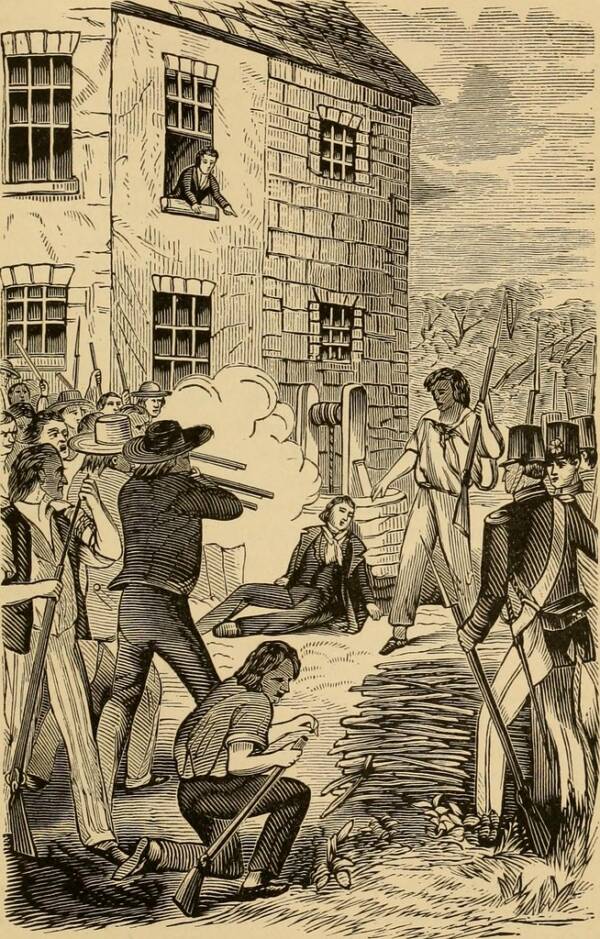
Joseph Smith was shot multiple times while campaigning for president.

Polk was pro-slavery, as was the Whig candidate, Henry Clay. But Polk said repeatedly that he would annex Texas — all the way to the Rio Grande, “no matter what any Mexican said.” He also said he’d fight for California and all of Oregon too: “Fifty four forty or fight”. You might not agree with this, Grant did not, but you knew where he stood. And Polk said he’d serve only one term. Thus, if you didn’t like him, he’d be gone in four years. After a few ballots, Polk became the Democratic Party candidate, with George Dallas as his VP. Like Polk, Dallas was pro Texas – they eventually named a city after him. Clay was Polk’s main opposition, anti Texas, and more vague about everything else.

At first John Tyler, the incumbent, also ran against Polk, but when he saw he was losing, he dropped out to help Polk. Also running for president, 1844 was Joseph Smith, the Mormon founder-profit. he ran as an independent because God told him to. He was shot multiple times, and died while campaigning. Finally there was James G. Birney, the Liberty party candidate. He gained few votes running on an abolitionist ticket. It’s been speculated that Polk won because Birney split the Whig vote. My take is that’s unlikely: Clay was pro-slavery. Polk’s win, I think, was in the power of his clarity.
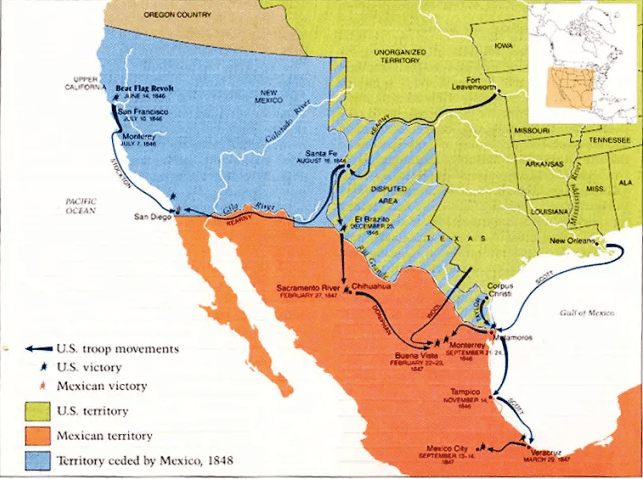
Map of the territory and war.

Once elected, Polk first moved to annex Texas, something he achieved with the help of expresident John Tyler. Tyler sent his Secretary of State, Abel Upsher to negotiat an annexation treaty with Sam Houston, but the Whig-controlled congress rejected it. After the election, Tyler resubmitted the treaty to the new, Democrat-controlled congress, and got two versions passed. The house passed a pro-slavery version, while the senate, pushed by Thomas Hart Benton (a favorite of mine) produced an annexation treaty that divided Texas in half, with a pro-slave and an anti-slave half. Polk liked the pro-slave, House version, returning it to Texas in his first week in office. He instructed the Texas legislature to accept it unconditionally, with no change so he could submit it directly to the Senate. The Texans did so, and congress approved this version later that year. Texas entered the union as one, large, slaveholder state.

With annexation not yet ratified by congress, Polk sent a diplomatic mission to buy California from Mexico along with all of the disputed Texas territory and everything in between for $25 million. Mexico refused, so Polk invited war. He sent 4000 soldiers into disputed Texas territory south of the Nueces River, under command of General Zachary Taylor. Mexican forces attacked them in April 1846, and Polk declared war. The war lasted to 1848, winning all the desired lands including California, and achieving a release of any rights Mexico might have on Oregon.
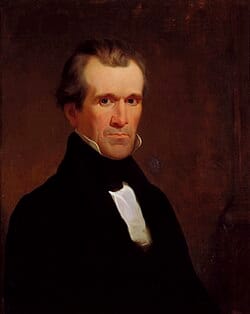
Polk, as governor of Tennessee

The next Polk goal was resolution of the Oregon dispute, ideally with us getting all of it: land that included the current states of Washington, Oregon, and Idaho, plus the Canadian Provence of British Columbia. Britain and Russia also claimed this land, so Polk’s first step was to buy off Russia. The British said they’d fight, noting that they had a larger army and navy and that the US was already at war with Mexico. Polk’s response was to back settlers going to Oregon. Americans had started migrating to Oregon in 1843. In his inaugural address, 1845, Polk said he would defend them “against the British and Indians.” By 1846 Britain recognized the difficulty of fighting US settlers so far from home. On June 15, they agreed to a deal that split the territory along the 49th parallel, giving the US the lower half, except for Vancouver Island, thus allowing Britain an opening to the sea. This deal had been proposed by Edward Everett, Tyler’s minister in London. Polk gave up nothing, beyond an informal agreement to lower tariffs on British goods, something he aimed to do anyway. It’s generally thought that Polk’s willingness for war allowed him to achieve so much without fighting. Polk said, in his inaugural, March 1845: “The world has nothing to fear from military ambition in our government,” a statement that clearly means the opposite of what it claims to say.

Polk’s third goal was lowering the “Black Tariffs”. High and uneven, they were 32% on average, with cut-outs to help specific, northern businesses. Polk’s secretary of the treasury, Robert Walker negotiated a flat advalorum tariff of 25%, with luxury goods, tobacco and alcohol tariffed higher. The “Walker tariff” bill was passed July, 1846, one month after the Oregon agreement. The British, reduced their “corn tariffs” against US grain, benefitting both countries. Our tariffs average 17%, currently, with many cut-outs. I think our tariffs should be more like the Walker tariff, perhaps 20% and simpler.

Polk’s 4th campaign promise was establishing an independent treasury. This was done to weaken “pet” banks, and stabilize the economy. The treasury would now hold all US assets; they would issue most currency, and would pay people directly, either in specie (gold or silver) or notes of debt. Independent banks could still issue notes, but only in amounts over $20. Polk passed this bill August 6, 1846, one week after the Walker Tariff bill. With this, Polk had already achieved all of his goals except California by the mid-term elections, 1846.

Having achieved so much, Polk set out to buy Cuba, but Spain said no. Some other accomplishments: opening the U.S. Naval Academy and the Smithsonian Institution, overseeing the groundbreaking for the Washington Monument, and the issuance of the first United States postage stamp. By the summer of 1848 Polk confirmed that he was satisfied and would not run for re-election. In his address to congress, December 1848, he said, “Peace, plenty, and contentment reign throughout our borders, and our beloved country presents a sublime moral spectacle to the world.” …. “I am heartily rejoiced that my term is so near its close. I will soon cease to be a servant and will become a sovereign.” I trust that was met with applause.

Robert Buxbaum. February 6, 2026. Edward Everett would go on to make the better received speech at Gettysburg. The officer who commanded the 4000 man Texas force, Zachary Taylor, became president in 1849. Like Polk, he died of bad water with too little alcohol added.
If the wall with Mexico were covered in solar cells

As a good estimate, it will take about 130,000 acres of solar cells to deliver the power of a typical nuclear facility, 26 TWhr/year. Since Donald Trump has proposed covering his wall with Mexico with solar cells, I came to wonder how much power these cells would produce, and how much this wall might cost. Here goes.

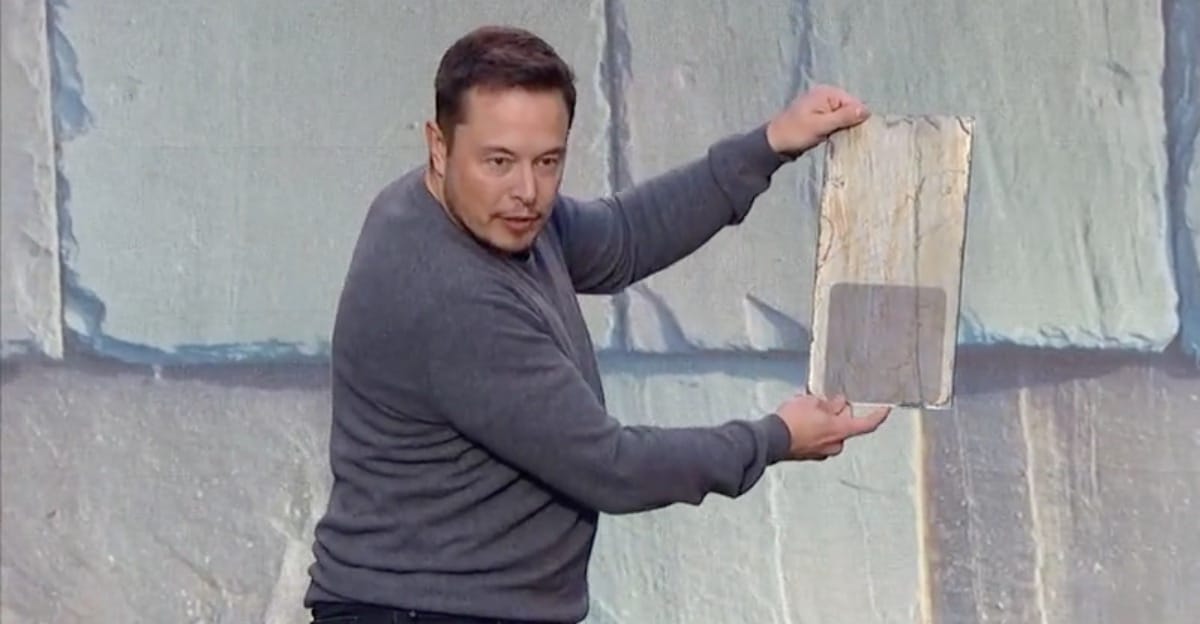
Lets assume that Trump’s building a double wall on a strip of land one chain (66 feet) wide, with a 2 lane road between. Many US roads are designed in chain widths, and a typical, 2 lane road is 1/2 chain wide, 33 feet, including its shoulders. I imagine that each wall is slanted 50° as is typical with solar cells, and that each is 15 to 18 feet high for a good mix of power and security. Since there are 10 square chains to an acre, and 80 chains to a mile we find that it would take 16,250 miles of this to produce 26 TWhr/year. The proposed wall is only about 1/10 this long, 1,600 miles or so, so the output will be only about 1/10 as much, 2.6 TWhr/year, or 600 MW per average daylight hour. That’s not insignificant power — similar to a good-size coal plant. If we aim for an attractive wall, we might come to use Elon Musk’s silica-coated solar cells. These cost $5/Watt or $3 Billion total. Other cells are cheaper, but don’t look as nice or seem as durable. Obama’s, Ivanpah solar farm, a project with durability problems, covers half this area, is rated at 370 MW, and cost $2.2 Billion. It’s thus rated to produce slightly over half the power of the wall, at a somewhat higher price, $5.95/Watt.

Elon Musk with his silica solar panels.

Elon Musk with his, silica-coated, solar wall panels. They don’t look half bad and should be durable.

It’s possible that the space devoted to the wall will be wider than 66 feet, or that the length will be less than 1600 miles, or that we will use different cells that cost more or less, but the above provides a good estimate of design, price, and electric output. I see nothing here to object to, politically or scientifically. And, if we sell Mexico the electricity at 11¢/kWhr, we’ll be repaid $286 M/year, and after 12 years or so, Republicans will be able to say that Mexico paid for the wall. And the wall is likely to look better than the Ivanpah site, or a 20-year-old wind farm.

As a few more design thoughts, I imagine an 8 foot, chain-link fence on the Mexican side of the wall, and imagine that many of the lower solar shingles will be replaced by glass so drivers will be able to see the scenery. I’ve posited that secure borders make a country. Without them, you’re a tribal hoard. I’ve also argued that there is a pollution advantage to controlling imports, and an economic advantage as well, at least for some. For comparison, recent measurement of the Great Wall of China shows it to be 13,170 miles long, 8 times the length of Trump’s wall with China.

Dr. Robert E. Buxbaum, June 14, 2017.

Hamas head deposed, no peace in the middle east

Just about one month ago, the head of the head of Hamas in Syria was removed from his position atop Sheikh Abu Salah Taha’s shoulders. ISIS gave the Sheikh the metaphorical 72 virgins of severance, and his head was given a new post, a wooden pole. Though the fighting has died down since, as it were, we seem no closer to peace. As head of Hamas, Sheik Taha killed many, and ISIS has killed many more. And now, Hamas has pledged Jihad against ISIS, It’s likely ISIS heads will roll, as surviving Hamas members have joined Assad, their murderous enemy of just a few months previous.

Hamas head removed, Sheik Sala, presumed dead.

Hamas head deposed by ISIS. Sheik Salah presumed dead. Prediction: those who killed him will be killed. 

My sense is that bringing peace to the region will require 4 things: (1) one side must have a decisive military victory; (2) They must get the defeated leader to sign a surrender with some clear terms (3) They have to treat the defeated well enough that others will surrender too, and (4) They had to demonstrate the ability to govern. The surrender at Appomattox included all these things, as did Texas independence and the US revolution. By contrast, the history Mexican civil wars suggests that peace becomes near-impossible when you kill the losers, as ISIS has done in Syria. When Santa Ana killed the Texans who surrendered to him at the Alamo and at Goliad, he guaranteed that the Texans would fight on forever, no matter how desperate the odds.

When Santa Anna ordered the execution of all the Texans who surrendered he guaranteed that Texans would not surrender. That's not a road to peace.

When Santa Anna executed the Texans who surrendered at the Alamo and Goliad he guaranteed that Texans would not surrender. That’s not the road to peace.

Governance of any kind is a key distinction between countries and non-countries. In the Middle East, there is a tradition of governance by tyranny and partial genocide, but the rule cemented this way is tenuous at best. About 100 years ago, the Turks cemented their rule over Armenia by killing off many Armenians, and Russia did the same toward to Cossacks, but 70 years later Kasackstan seceded. Sadam Hussain, Bashar Assad, Col’nl Khadaffi, and Ayatollah Khomeini all ruled for reasonable times as murderous tyrants, but two of those ruler’s were killed and three of the kingdoms have descended into chaos. People who’ve seen war will often accept tyranny as a better alternative to chaos in the streets, but eventually they revolt. By contrast, Israel and Jordan have stayed reasonably stable by providing a degree of tolerance and justice.

In the Mid-East peace, we’ve chosen to support tyrants: Hamas and the Iranian Khomeini, even though they are murderously anti-democracy, and even though the Ayatollah has vowed to wipe us out, and even though ISIS seems to be winning. This strategy may work for us temporarily, but I suspect these leaders will fall in a few years, and leave us to deal with anger in the wake. Faced with the options available, I’d prefer to let the war take its course, and only step in when things wind down. This is what Theodore Roosevelt did with the Russo-Japanese war: he waited for it to die down, and then stepped in to make peace when asked to do so. Syria doesn’t seem ready for peace right now, but when it is, I suspect it will be better for us if we take the role of peacemaker later than if we support a losing murder now.

Robert E. Buxbaum, May 7, 2015, edited May 11. I’ve shown previously that there is no peace with zombies until there is a cure. Until then, it’s best to run. For those who don’t know it, Roosevelt was an odd dude: here he is riding a moose.

Winning the peace at Appomattox

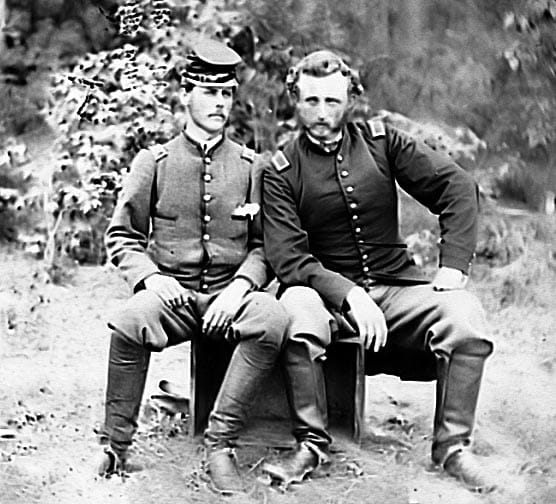
George A. Custer with captured confederate prisoner. Custer was a man of action but not of cruelty.

George A. Custer with a captured confederate prisoner. Custer was a man of action, but not of cruelty.

It is often forgotten that the aim of generalship is not winning a war, but winning a stable peace. In that sense, most generals and most diplomats are failures; their victories benefit only the undertaker; their peace-treaties only provide time to reload. That was the case with the Mexican civil war but not the US civil war. The choices and surrender at Appomattox, 150 years ago lead to a genuine, stable peace. It’s worthwhile, therefore to consider the how that was done here and not in Mexico, perhaps as a lesson for the future.

I begin, near the end of the war with a much-maligned general, George A Custer on April 8, 1865; this  is the day the 13th Amendment passed, four days after Lincoln walked through a defeated, smoldering Richmond, the capital of the south. The war would end soon, but would the result be peace, or chaos. George A. Custer had graduated at the very bottom of his class at West Point, the position known as goat. As is not atypical with goats, he was not particularly suited to following orders during peacetime, but was supremely suited to war and action. Custer liked to attack first and think later, but he was also a man of peace; he become the youngest Union Brevet General in US history. On April 8, with Lee at Appomattox Court House (that’s the name of the town), Custer led a small group of men to attack a nearby town, Appomattox Station, a rail depot three miles to the southwest. There he captured, without a fight, three, rail cars full of desperately needed arms, ammunition and supplies that had been sent to Lee’s army from Lynchburg.

While leaving the station, Custer’s men ran into the artillery unit of Confederate Brig. Gen. Reuben Walker, and attacked (of course) eventually capturing 25 artillery pieces, nearly 1,000 prisoners and all of their supplies. It took several attacks to win, but the results were worth it. Custer took the cannon and his troops, and positioned them on Lee’s likely escape route, on the Richmond-Lynchburg Stage Road south of Appomattox Courthouse. Lee was now nearly trapped, but didn’t know it yet.

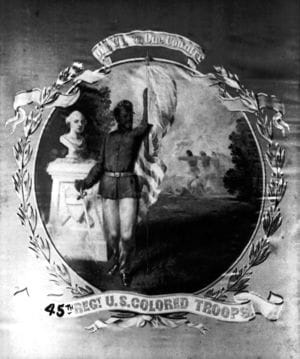
Paining in honor of the 45th regiment colored troops: Afro-American soldier stands with flag before a bust of Washington.

Painting in honor of the 45th regiment colored troops: Afro-American soldier stands, with flag, before a bust of Washington and a depiction of battle (Fair Oaks? Petersburg?)

On the same day, April 8, General Grant sent Lee a proposition to surrender. Lee responded that he was not interested in that, but would like to meet at the McLean House at 10:00 A.M. April 9 to discuss “restoration of peace.” Grant replied that he didn’t have that power but agreed to meet Lee, none the less.

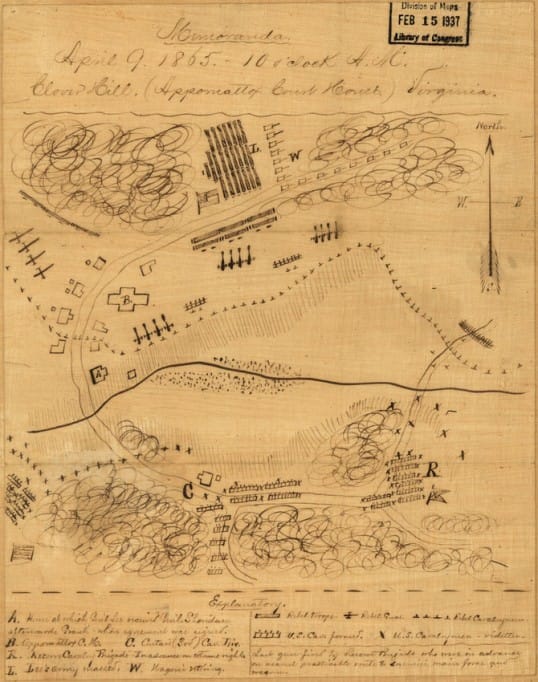
In the meantime, Lee prepared his forces to clear the Stage Road so his forces could escape south-west, to Appomattox station and home. Grant, no newcomer to war, ordered two corps (XXIV and V) under the commands of Maj. Gen. John Gibbon and Bvt. Maj. Gen. Charles Griffin to march all night to the west and north. These corps included 5000 Afro-American troops, mostly in the 45th and 116th U.S. Colored Troop Brigades. On the morning of April 9, Lee attacked to the south and managed to capture the forward pickets defending the Richmond-Lynchburg Stage Road. But when he reached the rise of the hill, he saw his escape was blocked. His 45,000 troops were surrounded by 113,000, better-armed Union soldiers, cannon and cavalry. It was then suggested that Lee disband his troops for an extended guerrilla war, an option he refused as it would lead to murdering bands roaming the county, and would make peace nearly impossible. Instead Lee rode off to discuss surrender to Grant. 

Map of the troop arrangements April 9, 1865. Checkmate. Lee's forces, x or + are out numbered, out gunned and surrounded. The end.

Map of the troop arrangements April 9, 1865. Checkmate. Lee’s forces, x or +, are out numbered, out gunned, and surrounded.

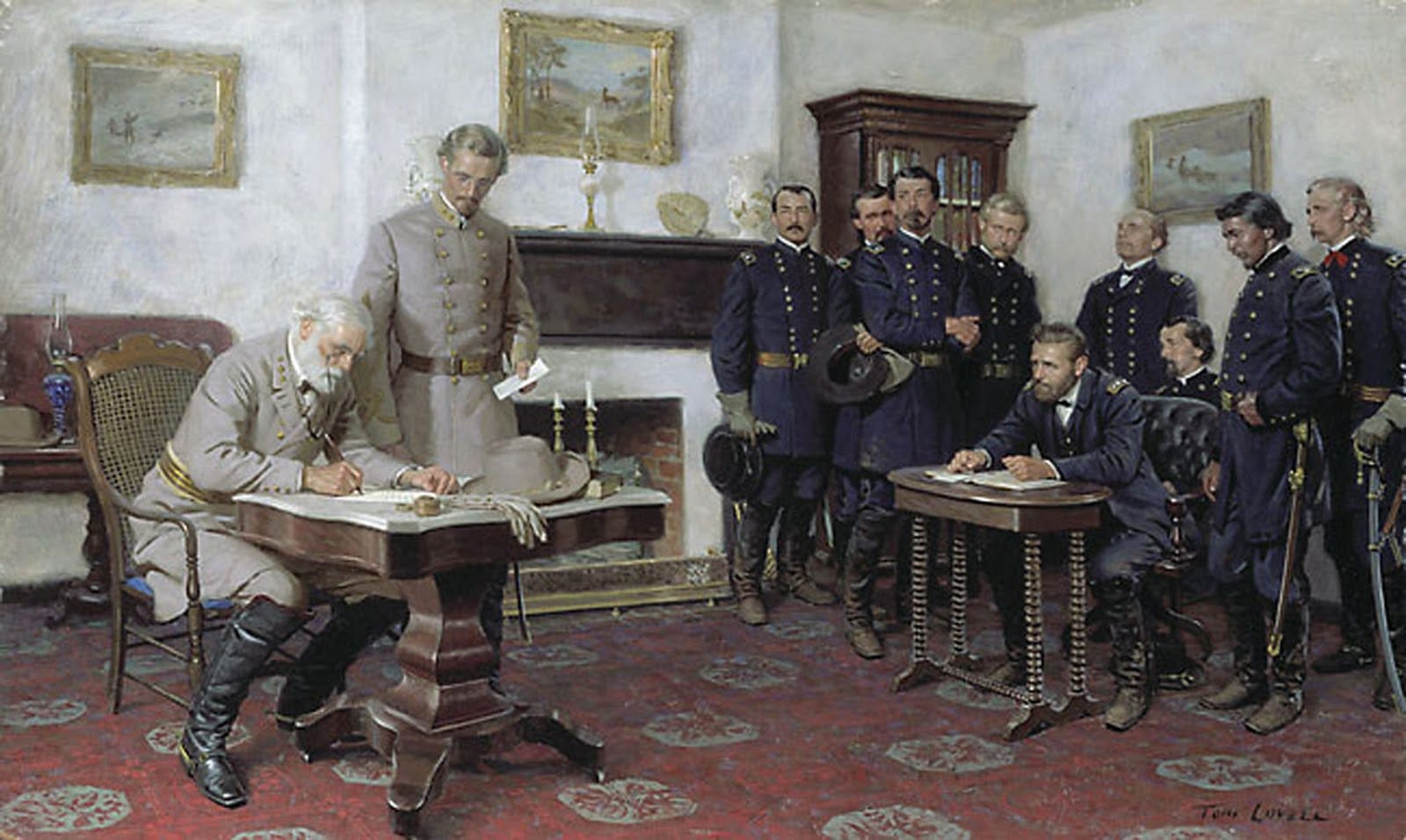
Lee’s surrender, finalized that afternoon, was penned by Grant’s aide-de camp, Lt Col’, Ely S. Parker, a Seneca Indian who had an engineering degree and studied law. The kindness to Indians may have suggested similar kindness to the surrendering Confederates. Parker eventually rose to the rank of general, and then to head of the Bureau of Indian Affairs. The terms of surrender too, were chosen to be unusually generous. Grant did not take the confederates soldiers captive, but instead allowed them to return home, relatively unmolested. Also, he allowed the officers to keep their swords and personal weapons. Kind acts like these may have eased reconstruction. Custer had demanded unconditional surrender from General Beauregard on April 9, something he probably imagined U.S. (Unconditional Surrender) Grant would have wanted; he was over-ruled by his commanding officer, Phillip Sheridan, who probably knew Grant better. 

After the war, most of the confederates swore loyalty to the US. Lee did what he could to promote reconciliation; he supported civil rights and reconstruction, and became president of Washington and Lee College. Some confederate generals and 2500 soldiers headed south to Mexico to join the French/Austrian forces of Emperor, Maximilian I, engaged in a civil war of his own. Maximilian, only 34 years old and a highly decorated Austrian officer, had little local support. He was captured and executed, June 19, 1867. Mexico then descended into chaos: a Pyrrhic victory, and a model to avoid.

Surrender at Appomattox; with Grant are Philip H. Sheridan, Orville E. Babcock, Horace Potter, Edward O.C. Ord, Seth Williams, Theodore S. Bowers, Ely S. Parker and George A. Custer. With Lee is Charles Marshall, his military secretary.

Surrender at Appomattox; with Grant are Philip H. Sheridan, Orville E. Babcock, Horace Potter, Edward O.C. Ord, Seth Williams, Theodore S. Bowers, Ely S. Parker and George A. Custer. With Lee is Charles Marshall, his military secretary. After the signing, most of the furnishings were purchased by Union officers as souvenirs. Lee shook Parker’s hand and said, I’m glad to see a real American here.” Parker replied, “We are all Americans.”

What did Mexico do wrong? For one, in order to win a peace, they failed to get the other side to agree to the peace, with clear documentation about what it is that’s been agreed to (That’s why Parker’s role is so important). Instead of killing Maximilian, they should have had him sign some sort of document and retire him to a farm or college where he could support the peace. In order to win a peace, it’s important to leave a stable country, with stable borders and a strong military, one that can govern itself fairly and well. A stable peace generally involves recognition of your government by other nations, and that too requires not killing your defeated enemy wholesale.

Robert E. Buxbaum, April 7-12, 2015. My sense is that the conditions for building a lasting peace get far too little attention in the study of war and history. I should mention that the 45th were mostly escaped slave volunteers. The 116th were ex-slaves that the Union purchased from Kentucky slave-owners at the beginning of the war to fight for the Union cause. This was thought to be a good emollient for peace, and may have helped keep Kentucky on the Union side. I should note too, that Lee freed his slaves in 1862, near the beginning of the war, a time when Grant still owned some. I’ve noted that men who choose beards tend to show a surprising republican (or communist) generosity. As Lincoln said, “Do I not defeat my enemy when I make him a friend?” For more thoughts on Lincoln’s Gettysburg Address, see here.