Tag Archives: management

How to tell who is productive if work is done in groups

It is a particular skill of management to hog the glory and cast the blame; if a project succeeds, executives will make it understood that the groups’ success was based on their leadership (and their ability to get everyone to work hard for low pay). If the project fails, a executive will cast blame typically on those who spotted the problem some months early. These are the people most likely to blame the executive, so the executive discredits them first.

This being the dynamic of executive oversight, it becomes difficult to look over the work of a group and tell who is doing good and who is coasting. If someone’s got to be fired in the middle of a project, or after, who do you fire? My first thought is that, following a failure, you fire the manager and the guy at the top who drew the top salary. That’s what winning sports teams do. It seems to promote “rebuilding” it’s a warning to those who follow. After the top people are gone, you might get an honest appraisal of what went wrong and what to do next.

A related problem, if you’re looking to hire is who to pick or promote from within. In the revolutionary army, they allowed the conscripts to pick some of their commanders, and promoted others based on success. This may not be entirely fair, as there are many causes to success and failure, but it seemed to work better than the British system, where you picked by birth or education. Here’s a lovely song about the value of university education in a modern major general.

A form of this feedback about who knows what he’d doing and who does not, is to look at who is listened to by colleagues. When someone speaks, do people who know listen. It’s a method I’ve used to try to guess who knew things in a field outside my own. Bull-shitters tend to be ignored when they speak. The major general above is never listened to.

In basketball or hockey, the equivalent method is to see who the other players pass to the most, and who steals the most from the other side. It does not take much watching to get a general sense, but statistics help. With statistics, one can set up a hierarchical system based on who listens to whom, or who passes to whom with a logistic equation as used for chess and dating sites. A lower-paid person at the center-top is a gem who you might consider promoting.

In terms of overall group management, it was the opinion of W Edwards Deming, the name-sake of the Deming prize for quality, that overall group success was typically caused by luck or by some non-human cause. Thus that any manager would be as good as any other. Deming had a lovely experiment to show why this is likely the case– see it here. If one company or team did better year after year, it was common that they were in the right territory, or at the right time. As an example, the person who succeeded selling big computers in New York in the 1960s was not necessarily a good salesman or manager. Anyone could have managed that success. To the extent that this is true, you should not fire people readily, but neither worry that your highest paid manager or salesman is irreplaceable.

Robert Buxbaum, October 9, 2022

Great mistakes: Sultan Mohammed II steals from Temujin, a Mongol also known as Genghis

There are small errors and great mistakes. Small mistakes can derail a career, great mistakes can kill thousands and lose an empire. I’d previously written about the mistakes that caused Britain to lose America — e.g. when General Tarleton started burning colonial churches because he thought the sermons were antimonarchist. They were, but if he thought they were antimonarchist before burning the churches, they were far more so after… He’d misjudged the American character, something that I think the Democrats are doing today with BLM. Another example was the British attack on Bunker Hill. They spent the lives of 600 soldiers, won a hill they didn’t need, and lost the colony. It’s a mistake we would make repeat in Vietnam.

A larger mistake was made by Mohammad II, ruler of Persia and Eastern Islam, from Turkey to Kazakhstan, Uzbekistan, and Afghanistan. He ruled from the great, walled city of Samarkand, supported by an army of 100,000. Mohammed’s uncle, Inalchuq, served as a governor in Kazakhstan. With an army of 40-50,000, he ruled from the walled city of Otrar. A Mongol leader named Temujin contacted them asking to trade goods along the Silk Road. Mohammed II ignored the request, but his uncle accepted it and offered safe passage. When the goods arrived, 100 camels and 450 men, he stole the items and enslaved or killed the men. Inalchuq saw no down-side to this, since Temujin was an infidel who ruled a Mongol community of perhaps 100,000 people. He was 2000 miles away with only a small horse army of perhaps 20,000. But these Mongol horsemen were uncommonly mobile and warlike, and Temujin, also known as Genghis Kahn, was an uncommonly talented leader, not someone to ignore or steal from.

Gate of the mighty, walled city of Otrar. It’s now a ghost town.

At this point, Temujin/ Ghenghis had laid waste to northern China, defeating an army of over 1 million. The Chinese emperor’s lackey had demanded Temujin come to Peking with a grift for the emperor, then bow low and pledge allegiance. That is, Temujin was expected to kowtow, a request that emperors had made to every tribal leader for centuries. Temujin took it as an insult, and defeated the Chinese army using methods that are discussed in Mongol literature, but are almost unknown in the west, or highly perverted, as in Mulan. I’ve written in speculation about the arrows, one aspect of Mongol success here. Another aspect was psychological: Genghis Kahn would surround an enemy town after driving additional locals in – a pseudo kindness. He used the additional locals to co-opt the army, so that they effectively fought for him. I call this feminist warfare in this essay; I noticed that the West Point bookstore and museum had absolutely nothing on the Mongols or their methods.

Temujin’s first trade caravan arrived in 1218 with 100 laden camels and 450 men including an ambassador. Inalchuq executed most of the men, sold the items and the rest of the men as slaves in markets of Bukhara. Mohammed II and his uncle were sure that Temujin would do nothing, but Temujin sent a peace delegation of 3 men directly to Mohmmed II asking for his goods back and for the punishment of those responsible. Mohammad II killed the lead ambassador, blinded one of the others, and had the face of the third disfigured. A year later, 1219, Genghis Kahn showed up in Otrar with siege engines. He arrived from the west, while his sons arrived from the east. Genghis had travelled through Russia to get there.

Otrar held out for 5 months, falling when a traitorous general opened the gates and defected with part of the army. The Mongols took the city and let most people live, though he killed Inalchq and most of his army, as well as the traitorous general. Genghis Kahn figured he could not trust a soldier who defects this way. Inalchq was killed by having molten silver poured into his eyes and ears.

Death of Sultan Mohammed II, Picture from the History of Rashad Al-Din.

Genghis then went after Mohammed II, but first defeated the Assassin sect. Mohammed had the sense to run. It bought him some years of life. When caught, Genghis locked him in a prison fed him gold coins. His death is shown at left. Genghis is supposed to have explained that, had Mohammad II not hoarded this gold, but shared it with his soldiers, they would have fought for him as Genghis’s soldiers had. It was a message, and Genghis Kahn was nothing if not practical.

The Mongols brought many innovations: paper, stirrups, the blast furnace, the number zero, “islamic numerals” (they’re really Mongol /Tibetan numerals), the compass, the printing press, the triangular plow, gun powder, and a new way in war (The Germans called it ‘Blitz Kreig’). I find that schools don’t teach much about Genghis Kahn or our debt to the Mongols, nor do they properly contextualize these innovations as means for a small nation to dominate many larger ones. Perhaps that’s because we find the whole idea of management disturbing, or it’s embarrassing. Western scholars used to write like we invented these things. There are several histories of the Mongols, one was written by Rashid Al-Din (Aladin), vizier over all Persia, the person responsible for renaming it Iran. He wrote an illustrated history of the world, particularly of the Mongols, called Jāmiʿ al-Tawārīkh (“Compendium of Chronicles”). I suspect it would be worthwhile reading but like much of Mongol literature, it is not available in any local library, nor is it referred to by most histories. Another Mongol history, also not available in libraries, is called the Secret History of the Mongols. This was likely written for and by Genghis’s third son, Ogedei, to describe for his children and grandchildren the true story of the early years, the conquests, his father’s and his management methods (some fairly brutal) and as a review of what Ogedei thought worked and what did not. It sounds like an honest book, worthwhile book — the sort modern readers would rather forget exists.

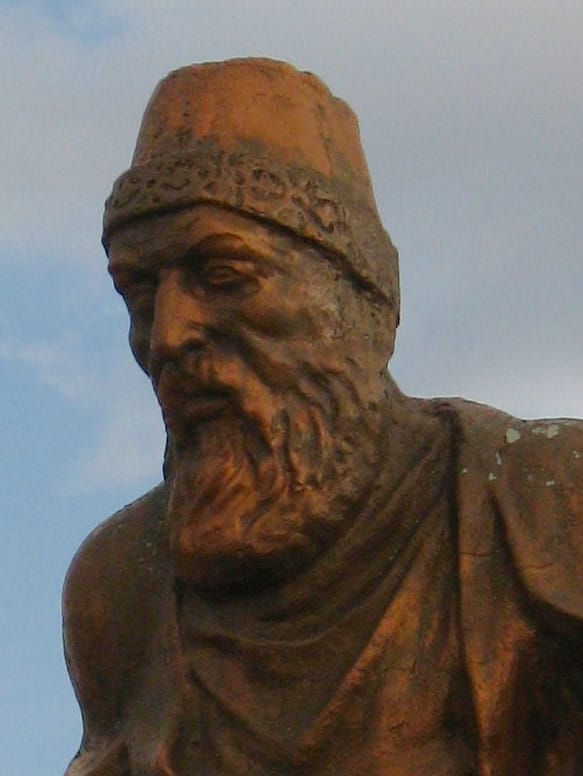
Rashid Al-Din (Aladin), Vizier of Persia. He renamed Persia Iran, and wrote a history of the world from the Mongol perspective. Known as a fictional character, or not at all today.

In general, I find our scholars would like to ignore the more unpleasant lessons of history, including that family matters, and that people like honor over kowtowing, and that they get surly if they’re not rewarded,. Much of our society is built by warriors for the purpose of destruction, as in this engineering joke. We are now in the process of destroying statues of warriors because we find they were often non-nice people who often did not-nice things, or held not-nice views. That’s the way it is with warriors, especially the successful ones. While I’m not a fan of having statues to bums, I think that ignoring successful warriors is worse than honoring them. I discuss the dilemma of military statues here. Without statues to important wars and warriors, modern leaders might repeat the mistake of Mohammed II, or Bunker hill , or of Mohammed IV, or of the Chinese emperor.

Robert Buxbaum, September 20, 2020. I’ve come to wonder if Mohammed II would have fared better if he didn’t steal from the Mongols. He would likely have put off the attack as he learned more about them, and they learned more about him. When the war came, as likely it would, he might have had gun powder, paper, the compass, and the stirrup. Then again, war might have come immediately. The proud Polish officers who collaborated/ surrendered to the Soviet Russians, were quickly murdered in the Katyn forest.

Health vs health administration

One of the great patterns of government is that it continually expands adding overseers over overseers to guarantee that those on the bottom do their work honestly. There are overseers who check that folks don’t overcharge, or take bribes, or under-pay. There are overseers to check shirking, and prevent the hiring of friends, to check that paperwork is done, and to come up with the paperwork, and lots of paperwork to assert that no one is wasting money or time in any way at all. There have been repeated calls for regulation reform, but little action. Reform would require agreement from the overseers, and courage from our politicians. Bureaucracy always wins.

The number of health administrators has risen dramatically; doctors, not so much.

By 2009 the number of health administrators was rising dramatically faster than the number of doctors; it’s currently about 20:1.

The call for reform is particularly strong in healthcare and the current, Obamacare rules are again under debate. As of 2009 we’d already reached the stage where there were fourteen healthcare administrators for every doctor (Harvard Business Review), and that was before Obamacare. By 2013, early in the Obamacare era, the healthcare workforce had increased by 75%, but 95 percent of those new hires were administrators: we added 19 administrators per doctor. Some of those administrators were in government oversight, some worked in hospitals filling out forms, some were in doctors offices, and some were in the government, writing the new rules and checking that the rules were followed. A lot of new employment with no new productivity. Even if these fellows were all honest and alert, there are so many of them, that there seems no way they do not absorb more resources than the old group of moderately supervised doctors would by laziness and cheating.

Overseers fill ever-larger buildings, hold ever-more meetings, and create ever-more rules and paperwork. For those paying out of pocket, the average price of healthcare has risen to $25,826 a year for a family of four. That’s nearly half of the typical family income. As a result people rarely buy healthcare insurance (Obamacare) until after they are too sick to work. Administering the system take so much doctor time that a Meritt Hawkins study finds a sharp decline in service. The hope is that Congress will move to reverse this — somehow.

With more administrators than workers, disagreements among management becomes the new normal.

With more administrators than workers, disagreements among management becomes the new normal. Doctors find themselves operating in “The Dilbert Zone”.

Both Democrats and Republicans have complained about Obamacare and campaigned to change or repeal it, but now that they are elected, most in congress seem content to do nothing and blame each other. If they can not come up with any other change, may I suggest a sharp decrease in the requirements for administrative oversight, with a return to colleague oversight, and a sharp decrease in the amount of computerized documentation. The suggestion of colleague oversight also appears here, Harvard Business Review. Colleague oversight with minimal paperwork works fine for plumbers, and electricians; lawyers and auto-mechanics. It should work fine for doctors too.

Robert Buxbaum, September 19, 2017. On a vaguely similar topic, I ask is ADHD is a real disease, or a disease of definition.

A British tradition of inefficiency and silliness

While many British industries are forward thinking and reasonably efficient, i find Britons take particular pride in traditional craftsmanship. That is, while the Swiss seem to take no particular pride in their coo-coo clocks, the British positively glory in their handmade products: hand-woven, tweed jackets, expensive suits, expensive whiskey, and hand-cut diamonds. To me, an American-trained engineer, “traditional craftsmanship,” of this sort is another way of saying silly and in-efficient. Not having a better explanation, I associate these behaviors with the decline of English power in the 20th century. England went from financial and military preëminence in 1900 to second-tier status a century later. It’s an amazing change that I credit to tradition-bound inefficiency — and socialism.

Queen Elizabeth and Edward VII give the Nazi solute.

Queen Elizabeth and Edward VII give the Nazi solute.

Britain is one of only two major industrial nations to have a monarch and the only one where the monarch is an actual ambassador. The British Monarchy is not all bad, but it’s certainly inefficient. Britain benefits from the major royals, the Queen and crown prince in terms of tourism and good will. In this she’s rather like our Mickey Mouse or Disneyland. The problem for England has to do with the other royals, We don’t spend anything on Mickey’s second cousins or grandchildren. And we don’t elevate Micky’s relatives to military or political prominence. England’s royal leaders gave it horrors like the charge of the light brigade in the Crimean war (and the Crimean war itself), Natzi-ism doing WWII, the Grand Panjandrum in WWII, and the attack on Bunker Hill. There is a silliness to its imperialism via a Busby-hatted military. Britain’s powdered-wigged jurors are equally silly.

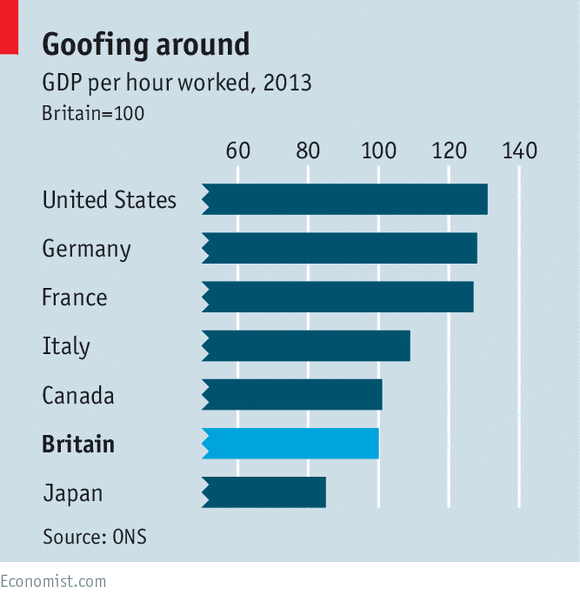
Per hour worker productivity in the industrial world.

Per hour worker productivity in the industrial world.

As the chart shows, England has the second lowest per-hour productivity of the industrial world. Japan, the other industrial giant with a monarch, has the lowest. They do far better per worker-year because they work an ungodly number of hours per year. French and German workers produce 20+% more per hour: enough that they can take off a month each year and still do as well. Much of the productivity advantage of France, Germany, and the US derive from manufacturing and management flexibility. US Management does not favor as narrow a gene pool. Our workers are allowed real input into equipment and product decisions, and are given a real chance to move up. The result is new products, efficient manufacture, and less class-struggle.

The upside of British manufacturing tradition is the historical cachet of English products. Americans and Germans have been willing to pay more for the historical patina of British whiskey, suits, and cars. Products benefit from historical connection. British suits remind one of the king, or of James Bond; British cars maintain a certain style, avoiding fads of the era: fins on cars, or cup-holders, and electric accessories. A lack of change produces a lack of flaws too, perhaps the main things keeping Britain from declining faster. A lack of flaws is particularly worthwhile in some industries, like banking and diamonds, products that have provided an increasing share of Britain’s foreign exchange. The down-side is a non-competitive military, a horrible food industry, and an economy that depends, increasingly on oil.

Britain has a low birthrate too, due in part to low social mobility, I suspect. Social mobility looked like it would get worse when Britain joined the European Union. An influx of foreign workers entered taking key jobs including those that with historical cachet. The Brits reacted by voting to leave the EC, a vote that seems to have taken the upper class by surprise, With Brexit, we can hope to see many years more of manufacturing by the traditional and silly.

Robert Buxbaum, December 31, 2016. I’ve also written about art, good and bad, about the US aesthetic of strength, about the French tradition of innovation, And about European vs US education.

American education sucks, how do we succeed?

Despite my PhD from a top American college, Princeton University, I find I lag ordinary Europeans in languages and history. I can claim to know some math, and a little Latin and a little Greek, but in my case it’s two short friends, Manuel Ramos and Stanos Platsis. It was recently reported that one fourth of college-educated Americans did not know that the earth spun on an axis. With an education system of this sort, how is it that the US has the largest GDP, and nearly the largest per-capita GDP. We have a grosser national product than any European country despite a degree of science ignorance that would be inconceivable there.

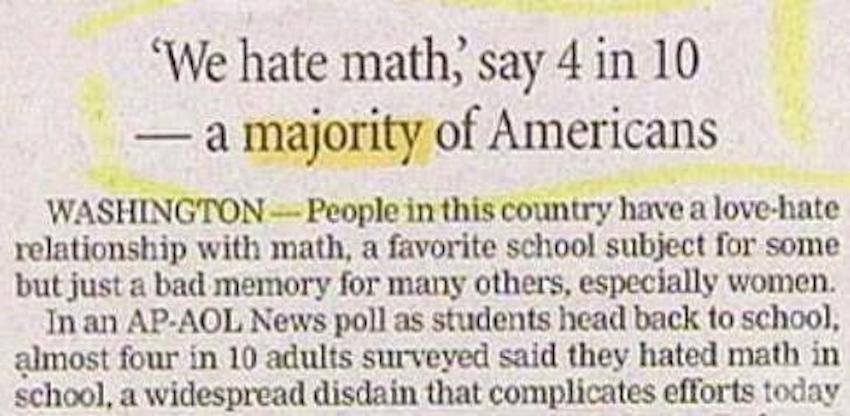
Americans hate math.

Americans hate math.

One part of US success is imported talent, of course. We import Nobel lauriate chemists, Russian dancers, German rocket scientists…, but we don’t import that many. The majority of our immigrants are more in the wretched refuse category, and even these appear to do better here in the US than their colleagues that they left behind. Otto von Bismark once joked that, “God protects children, drunks, and the United States of America.” But I’d like to suggest that our success is based on optimism, pronia: a can-do belief in ourselves that our education provides, at least to our more creative citizens.

Most of the great successful businesses of the USA are not started by the A students, it is clear, but by the C students who develop the greatness of the little they know. Consider Colonel Harlen Sanders, founder of Kentucky Fried Chicken. He believed in the greatness of his chicken recipe, and developed to skills to sell it fast. He did not have to know astronomy, whether the earth goes round the sun. It’s an important fact, but only relevant if you can use it, as Sherlock Holmes points out. I suspect that few Europeans could use the knowledge that the earth spins productively, and suspect that the majority of those that might, lack the confidence to do so (I provide some at the end of this essay).

Benjamin Jowett. His students included the heads of 6 colleges and the head of Eaton

Benjamin Jowett, Master of Balliol College, Oxford.

A classic poem about European education describes Benjamin Jowett, shown at right. It goes: “The first come I, my name is Jowett. There is no knowledge, but that I know it. I am master of this college. What I don’t know isn’t knowledge.” Benjamin Jowett was Master of Balliol College, Oxford. By the time he died in 1893, his ex-student pallbearers included the heads of 6 colleges, and the head of Eaton. Most English heads of state and industry were his students directly or second-hand. All left university with a passing knowledge of Greek, Latin, Plato, law, science, theology, classics, math, rhetoric, logic, and grammar. Only people so educated were deemed suited to run banks or manage backward nations like India or Rhodesia. It worked for a while but showed its limitations, e.g. in the Boer Wars.

In France and continental Europe, the education system is similar, to this day ,to England’s under Jowett. There is a fixed set of knowledge and a fixed rate to learn it. Government and industry jobs go largely to those who’ve demonstrated their ability to give the fixed, correct answers to tests on this knowledge. In schools across France, the same page is turned virtually simultaneously in the every school– no student is left behind, but none jump ahead either or deviate. As new knowledge is integrated, the approved text books are updated and the correct answers are adjusted. Until then, the answers in the book are God’s truth, and those who master it can comfort themselves to have mastered the truth. The European system appears to benefit the many, providing useful skills (and useless tidbits) but it is oppressive to others with forward-thinking, imaginative minds, or who see a new truth a year before the test acknowledges it. College, it is said, “..is a place where pebbles are polished but diamonds are dimmed.” The system work well in areas that barely change like French grammar, geometry, law, and the map of Europe. It does not work so well in music, computers, or the art of war. For creative students, bright or otherwise, schooling is “another brick in the wall.” These students need learning in ‘how to get along without a teacher.’

The American approach leans, or perhaps leaned, towards independence of thought, for good or bad. American graduates can live without the teacher, but leave school knowing no language but English, knowing hardly and maths or science, and hardly any grammar. We can hardly find another country on a map, and often can’t find our own. Teachers will take incorrect answers as correct as a way to build self-esteem, so students leave with the view that there is no such thing as truth. Strangely, this model works, at least in music, engineering, and science where change is fast, creativity is king, and nature itself is a teacher. American graduate-schools are preeminent in these areas. In reading, history and math our graduates might well be described as galumphing ignorants.

Every now and again the US tries to Europeanize education. The “no child left behind” movement was a Republican-led effort to teach on the French model, at least in reading and math. It never caught on. Drugs are a popular approach to making American students less obstreperous, but they work only temporarily. Americans leave school ignorant, but not stupid; respectful of those who can do things, and suspicious of those with lengthy degrees. Without Latin, we do OK as managers of the most complex operations, relying on bumptious optimism and distain for hierarchy.

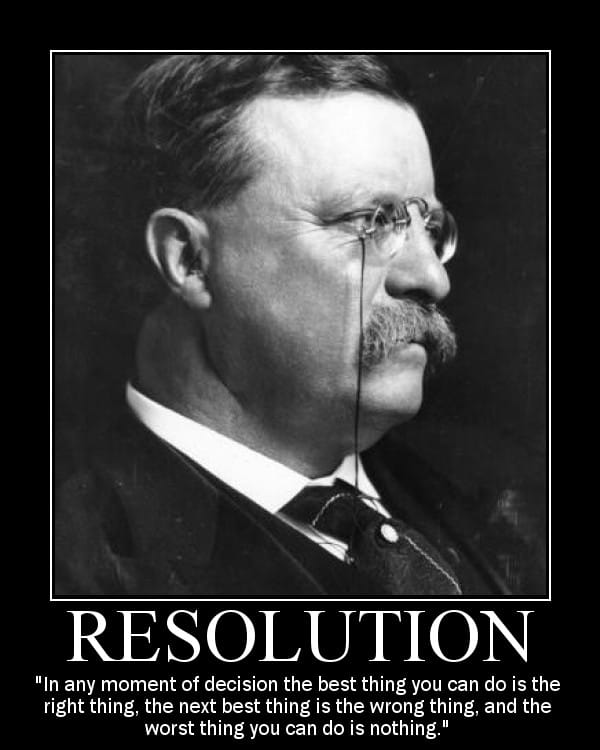
In any moment of decision, the best thing you can do is the right thing, the next bet thing is the wrong thing, and the worst thing you can do is nothing. An American attitude that sometimes blows up, but works surprisingly well at times.

Often the inability to act is worse than acting wrong.

The American-educated boss will do some damage by his ignorance but it is no more than  comes from group-think: non-truths passed as truths. America stopped burning witches far sooner than Europe, and never burned Jews. America dropped nobles quicker, and transitioned to electric lights and motor cars quicker, perhaps because we put less weight on what nobles and universities did. When dealing Europeans, we greet them in a loud, cheerful voice, appoint a subordinate to “get things done,” and get in the way until lunchtime. The Europeans are suitably appalled, both by the crassness and by the random energy.

European scholars accepted that nobility gives one a handle on leadership. This belief held back the talented, non-noble. Since religion was part of education, they accepted that state should have an established religion, Anglican, in England, Catholicism in France; scientific atheism now. They learned from the state, and accepted, that divorce was unnecessary, that homosexuality should be punished by prison or worse, In the early 60s, Turing, a brilliant mathematician and computer scientist, was chemically castrated as a way to cure his homosexuality. In America our “Yankee ingenuity,” as we call it, screwed up too, but in ways like prohibition, McCarthyism, and disco. Such screwups resolved themselves relatively fast. “Ready, fire, aim” is a European description of the American method to any problem. It’s not great, but works better than “steady as she goes.”

The best option, it seems, is when we work together with those “across the pond.” It worked well for us in WWI, WWII, and the American Revolution, benefitting from Lafayette, Baron Von Steuben, Kosciusko, etc. Heading into the world cup of football (fifa soccer) this week, we’re expected to lose badly due to our lack of talent and our general inability to pass, dribble, or strategize. Still, we’ve got enthusiasm, and we’ve got a German coach. The world’s bookies give us 0.05% odds, but our chances are 10 times that, I’d say: 5%. God protects our galumphing corn-fed ignorants when, as in the Revolution, it’s attached to European coaching.

Some businesses where it helps to know the earth spins: rocketry (military and exploratory), communication via geosynchronous satellites (they only work because the earth spins), weather prediction (the spin of hurricanes is because the earth spins), cyclone lifting. It amazes me that people ever thought everything went around the earth, by the way; Mercury and Venus never appear overhead. If authorities could have been so wrong about this for so long, what might they be wrong about today?

Dr. Robert Buxbaum, June 10, 2014 I’ve also written about ADHD on Lincoln’s Gettysburg Address, on Theodore Roosevelt, and how he survived a gun shot.

When to enter a neighbors war or family dispute

As I write this, our favored insurgents in Syria have been over-run by our disfavored insurgents, who may be over-run by the government we are trying to topple. We have also committed to help Japan and Vietnam in their disputes with China. I’ve also had the experience of dealing with a couple going through a bitter divorce. So here are five thoughts for myself and president Obama on getting involved in other people’s problems. I’ll hope that at least one person (me) listens.

1. Learn how to wait without committing to either side so you don’t step in something really smelly. Commiserate with both sides; yes you have grievances, yes what they’ve done isn’t nice. Suggest outside review. Just don’t commit until you feel comfortable sticking with this one side in victory, defeat, or (possible) reconciliation.

In a war, even simple gifts of food or transport are support; avoid these gifts, and especially avoid gifts to both sides. Assume any support to a side will be considered treason from the other side. Supporting both sides just causes havoc, and it’s always possible that your gifts will fall in the hands of the wrong side, as in Syria.

Being helpful isn't always helpful. Matthew Deffee, The New Yorker

Being helpful isn’t always helpful, or appreciated. Learn to wait. Matthew Deffee, The New Yorker

Remind yourself that disputes are a normal part of life, that peace always comes eventually, and that disputes are sometimes good in the long run. Offer sympathy only until you really want to support one side or the other — or until they make peace. When peace comes, it’s possible that the resolution will be better than the status quo-anti. As such, perhaps long-term non-intervention is the best cure. Time often answers what wisdom does not.

2.  If you choose to support a side, only support one that openly, and traditionally supports us. No Syrian leaders have openly pledged support to the US and its allies; why ally with someone who won’t support you? The enemy of your enemy might be another enemy, as with the Taliban. In a marriage dispute, lean to support your close relative or friend — it’s less offensive than the opposite, and less likely to cause hurt. As bad as it is when two sides attack each other, it’s worse when both attack you.

Only support someone who could rule reasonably honestly and well. Chaos is worse than a dictator. Kanin from the New Yorker.

Only support someone who could rule reasonably well. Chaos is worse than a dictator. Kanin from the New Yorker.

3. If you feel it’s important to act in a neighbor’s dispute, you don’t always have to ally with either side. You can retaliate for someone blowing up a ship or killing an advisor, or beating their children by intervening at a distance. Perhaps you can use a missile (ideally against a pointless target), or sanctions, or by the UN or a volunteer force (this tends to work for the US). In family disputes, it’s often best to send a councilor or the police or child protective services. There is room to escalate or de-escalate an action like this depending on how things play out. And it’s easier to distance yourself from a 3rd party’s actions than from one’s own. It is not necessary to support either side to achieve a personal goal or protect children in a divorce.

4.  If you decide to choose sides, make sure to keep in mind the end you seek: what good you want to do, what reasonable peace you seek, then act. Do not worry that you can not do everything, but make sure you target a viable end, and that you support a side that could win and rule. Try to pick a side that’s moral and perceived as legitimate from within, but if you can’t, at least pick one that could rule the country or manage the family without your help. Don’t support a loser, or one who can’t stand on his/her own. Chaos is worse than a crooked dictator; see, for example, the French Revolution. In a fight between parents, make sure the one you support could actually raise the kids. And once the goal is achieved, don’t stay too long. If a friend tells you to go, as in Afghanistan, leave quickly. Independence is the goal we hope for — for our children, our friends, and our neighbors.

Being a fair broker of peace is a great role -- in the proper time. From the New Yorker

Being a fair broker of peace is a great role — but only for the right person in the proper time. From the New Yorker

5. Be willing to serve as an honest broker of the peace. An honest broker is very valuable, and it requires that you’re perceived as unbiassed by both sides. Wait till the right moment before offering this service, and offer it like the precious jewel it is. Offer it when asked or when the fighting dies down. If the offer is refused, be willing to go away and return to the first rule. T. Roosevelt won the Nobel peace prize for ending the Russo-Japanese war because he was a good, honest broker: someone who understood the situation and could stand back when not needed.

Robert E. Buxbaum, Dec 18, 2013. Blessed are the peacemakers.