While a college degree gives most graduates a salary benefit over high school graduates this has to be balanced against the four years of not working. What’s more, a Bureau of Labor statistics study found that the salary benefits disappear if you graduate in the bottom 25% of your class, and if you don’t graduate at all you can end up losing salary money, especially if you go into low-paying fields like child development or physical sciences.
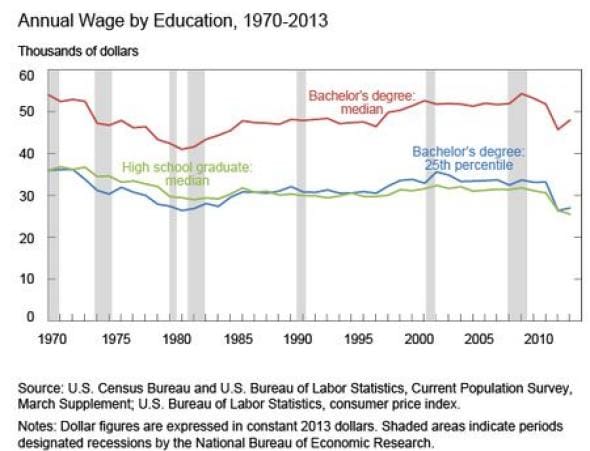
The average college graduate earns significantly more than a high school grad, but not if you attend a pricy school, or graduate in the bottom 1/4 of your class, or have the wrong major.
Most people realize there is a great earnings difference depending on your field of study with graduates in engineering and medicine doing better, financially. Even top graduates in child development or athletic sciences are barely able to justify the tuition and opportunity costs –it’s worse at an expensive college, but what isn’t always realized is that not everyone entering these fields graduates. For them, there is a steep loss when the tuition and four (or more) years of lost income are considered.
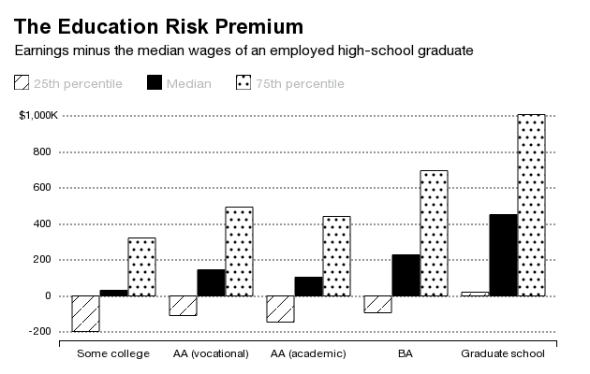
If you don’t graduate or get only an AA or 2 year degree the increase in wages is minimal, and you lose time working and whatever your costs of education. The loss is particularly high if you study social science fields at an expensive college, and don’t graduate, or if you graduate in the bottom of your class.
A report from the New York Federal Reserve finds that the highest pay major is petroleum engineering, mid-career salary $176,300/yr, and the bottom is child development, mid-career salary $36,400/yr (click the report link to check on your major). I’m not sure most students or advisors are aware of the steep salary difference, or that college gives a salary down-grade if one picks the wrong major, or does not complete the degree. In terms of earnings, you’d be better off avoiding even a free college in these areas unless you’re fairly sure you’ll complete the degree, or you really want to work in these fields.
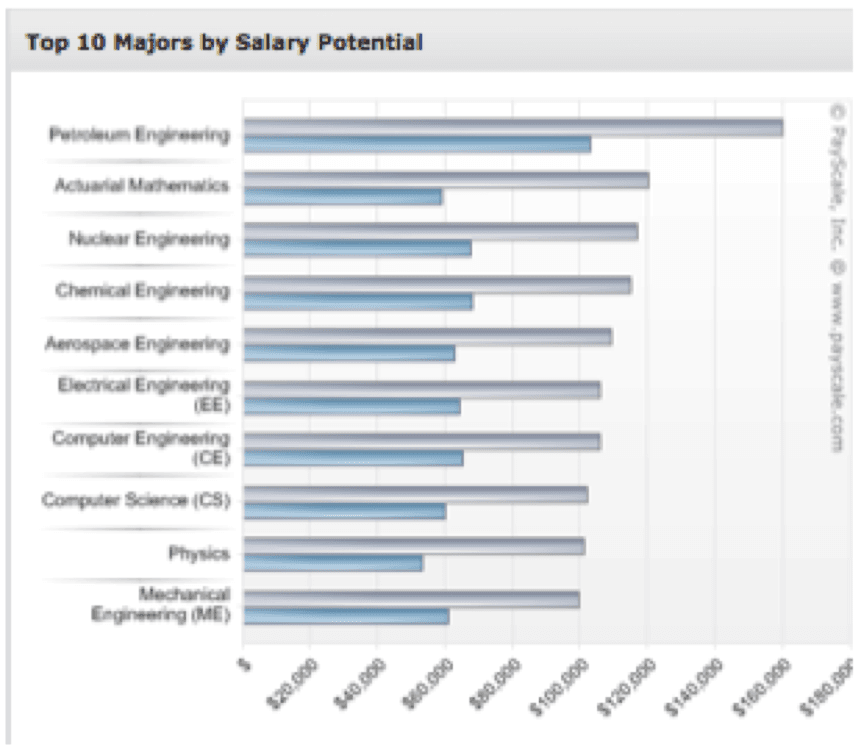
Top earning majors: Majors that pay.
Of course college can provide more than money: knowledge, for instance, and learning: the ability to reason better. But these benefits are likely lost if you don’t work at it, or don’t go in a field you love. They can also come to those who study hard in self-taught reading. In either case, it is the work habits that will make you grow as a person, and leave you more employable. Tough colleges add a lot by exposure to new people and new ways of thinking about great books, and by forced experience in writing essays — but these benefits too are work-dependent and college dependent. If you work hard understanding a great book it will show. If you didn’t work at it, or only exposed yourself to easier fare, that too will show.
Colleges bend education to get students and keep them enrolled, to the detriment of the students. They understand that students don’t like criticism, and that good criticism is hard to give. As a result, many less-demanding colleges give little or no critical feedback, especially for disadvantaged students. This disadvantages them even more. You get is a positive experience, a nice campus, and a dramatic graduation, but this is not learning. Positivity isn’t bad, but is it worth the cost and 4-5 years of your life.
As an alternative to a liberal arts education, I present “Father” Guido Sarduchi, of Saturday Night LIve, and his “5 minute college experience.” To a surprising extent, it provides everything you’ll remember from 4 years of college in 5 minutes, including math, history, political science, and language (Spanish). For many Americans, Father Sarduchi’s 5 minutes may be a better investment than even a free 4 years in college.
Robert. E. Buxbaum. January 21-22, 2015. Education is what you get when you don’t get what you want.