Tag Archives: drainage

Sewage: rain to the river, poop to the fields, nothing to your basement

I’ve written a fair amount about sewage over the years, including the benefits of small dams, and problems of combined sewers, but I thought I’d write here about something really fundamental: sewage has two components, poop and rain, and they should be kept separate. The poop and related liquids are known as sanitary sewage. Ideally it is the treated, saved and used as fertilizer. Rain, known as storm sewage, needs to go to the rivers at a controlled speed, unmixed with sanitary sewage. Sorry to say, in many counties, mine included, the two are mixed following every rain, costing us unnecessary money, and making swimming unsafe, and boating (sometimes) unpleasant.

Our system is not quite mixed, but is semi-separate. It only mixes in a “big” rain, more than 1/2″, something that happens once per month, on average. The Pipes are semi-connected as shown below.

Combined sewer system, like in our county, Oakland MI. We use little dams in the pipe system to semi-separate the flows. Here, showing a rain-induced overflow of combined sewage, a CSO.

The pipes of a sanitary sewage system can be relatively small in diameter as this flow is continuous, but never that large. The cost of treatment is high, per gallon though. Some of this cost can be recovered in fertilizer value.

Stormwater flow, by contrast, requires big pipes because the flow, while episodic and be 10,000 more than the sanitary flow. A city can go for weeks without storm flow as there’re is no rain. A storm will then drop more water in an hour than all the sanitary sewage of the last few weeks. You need large diameter stormwater pipes, and you typically want retention basins so that even these pipes are not overwhelmed, and to provide a little settling. The pipes should direct storm water to the nearest river. In our county we mixed the two for historical reasons. This adds tremendously to the cost of sewage treatment, and we find we regularly overwhelm the treatment facility. When this happens, as shown above, sanitary sewage is flushed into the riveras I described ten years ago in a post focussed on pollution from combined sewers. If the rains are really heavy, they back up “sanitary” sewage into basements as well. More commonly, once or twice a month where I live, we just pollute the river. Several cities with combined sewers have separated them recently. Paris, for example, ahead of the 2024 Summer Olympics.

To get an idea of the relative size of the flows in our county, note that Oakland county is a square 30 miles by 30 miles. That’s 900 square miles, or 25.1 billion square feet. In th4e event of a, not uncommon, 2″ rain on this area, we must deal with 4.2 billion cubic feet of water or 33 billion gallons. Some of this absorbs into the ground, but much of it runs goes to pipes heading to the rivers. Ideally we retain some of it above ground for an hour or more because the pipes can’t handle this flow. Even with retention, our rivers rise some 10 feet typically and begin to flow at many miles per hour after a storm. They can be seen carrying trees along, and massively eroding the soil, even in areas that were prepared appropriately.
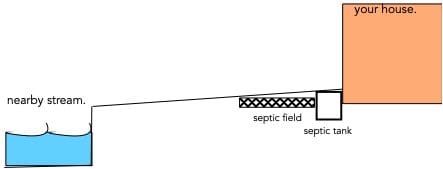
A home based approach to sewage. Many homes near me have this setup — with internal plumbing and a septic field for sewage treatment. Often, these homes are near a stream that flows at least temporarily.

Sanitary sewage flows are far less voluminous. Our county has roughly 1 million people who flush about 100 million gallons per day, generally sending this to our sanitary sewage treatment plants. That averages a mere 4 million gallons per hour, or 500,000 cubic feet. That’s roughly 8000 times less flow than the storm flow. If any significant fraction of the rainwater goes into our sanitary system, it will quickly overwhelm it and back up into our basements.

Many people try to get out of paying the high price for municipal sewage treatment by making their own small system with a septic tank an a septic field. I think this is a great idea, a benefit for them and the county. I will be happy to direct them to appropriate educational materials so that home waste flows to the septic tank where anaerobic bacteria break things down, it should then flow to a septic field that filters the nutrients and allows aerobic bacteria to break things down further. Nutrients in the sewage helps whatever you plant and, as we say, “the grass is always greenest over the septic tank.” As for the county on the whole, I wish we got real value from the fertilizer, as Milwaukee does, and wish we’d separate the sewers.

Robert Buxbaum, February 23, 2025

Rain barrels aren’t much good. Wood chips are better, And I’d avoid rain gardens, even as a neighbor.

A lot of cities push rain barrels as a way to save water and reduce flooding. Our water comes from the Detroit and returns to it as sewage, so I’m not sure there is any water saving, but there is a small cash saving (very small) if you buy 30 to 55 gallon barrels from the city and connect them to the end of your drain spout. The rainwater you collect won’t be pure enough to drink, or safe for bathing, but you can use it to water your lawn and garden. This sounds OK, even patriotic, until you do the math, or the plumbing, or until you consider the wood-chip alternative.

The barrels are not cheap, even when subsidized they cost about $100 each. Add to this the cost and difficulty of setting up the collection system and the distribution hose. Water from your rain barrel will not flow through a normal nozzle as there is hardly any pressure. Expect watering to take a lot longer than you are used to.

40 gallon rain barrels. Two of these give about 70 usable gallons every heavy rain fall. That’s about 70¢ worth.

In Michigan you can not leave the water in your barrel over the winter, the water will freeze and the barrel will crack. You have to drain the tank completely every fall, an almost impossible task, and the tank is attached to a rainspout and the last bit of water is hard to get out. Still, you have to do it, or the barrel will crack. And the savings for all this is minimal. During a rainy month, you don’t need this water. During a dry month, there is no water to use. Even at the best, the The marginal cost of water in our town is less than 1¢ per gallon. For all the work and cost to set up, two complete 40 gallon tanks (like those shown) will give you at most about 70 usable gallons. That’s to say, almost 70¢ per full filling.

How much lawn can you water? Assume you like to water your lawn to the equivalent of 1″ of rain per week, your 70 gallons will water about 154 ft2 of lawn or garden, virtually nothing compared to the typical Michigan 2000 ft2 lawn. You’ll still have to get most of your water from the city’s main. All that work, for so little benefit.

Young trees with chip volcanos, 1 ft high x18″. Spread the chips to the diameter of the leaves.You don’t need more than 2″.

A far better option is wood chips. They don’t cover a lawn, but they’re great for shrubs, trees or a garden. Wood chips are easy to spread, and they stop weeds and hold water. The photo at left shows a wood chips around the shrubs, and a particularly poor use of wood chips around the trees. For shrubs, trees, or a garden, I suggest you put down 1 to 2 inches of wood chips. Surround a young tree at that depth to the diameter of the branches. Do not build a “chip volcano,” as this lazy landscaper has done.

Consider that, covering 500 ft2 of area to a depth of 1.5 inches will take about 60 cubic feet of wood chips. That will cost about $35 dollars at the local Home Depot. This is enough to hold about 1.25″ or rainwater, That’s about 100 ft3 or water or 800 gallons. The chips prevent excess evaporation while preventing weeds and slowly releasing the water to your garden. You do no work. The chips take almost no work to spread, and will keep on working for years, with no fear of frost-damage. A as the chips stop working, they biocompost slowly into fertilizer. That’s a win.

There is a worst option too, called a rain garden. This is often pushed by environmental-gooders. You dig a hole near your downspout, perhaps ten feet in diameter, by two feet deep, and plant native grasses (weeds). When it rains, the hole fills with water creating a mini wetland that will soon smell like the swamp that it is. If you are not lucky, the water will find a way to leak into your basement. If that’s your problem look here. If you are luckier, your mini-swamp will become the home of mosquitos, frogs, and snakes. The plants will grow, then die, and rot, and look awful. It is very hard to maintain native grasses. That’s why people drain swamps and grow trees or turf or vegetables. If you want to see a well-maintained rain garden, they have two on the campus of Lawrence Tech. A wetland isn’t bad, but you want drainage, Make a bioswale or muir.

Robert Buxbaum, May 31, 2023. I ran for water commissioner some years back.

How to avoid wet basements

My house is surrounded my mulch — it absorbs enough rainwater that I rarely have to water.

Generally speaking water gets to your basement from rain, and the basic way you avoid wet basements is by providing some more attractive spot for the rainwater to go to. There are two main options here: divert the water to a lake or mulch-filled spot at least 8 feet away from your home, or divert it to a well-operated street or storm drain. My personal preference is a combination of both.

At right I show a picture of my home taken on a particularly nice day in the spring. Out front is a mulch-filled garden and some grass. On the side, not shown is a driveway. Most of the rain that hits our lawn and gardens is retained in 4 inches of mulch, and waters the plants. Four inches of mulch-covered ground will hold at least four inches of rainwater. Most of the rain that hits the house is diverted to downspouts and flows down the driveway to the street. Keeping some rainwater in the mulch means you don’t have to pay so much to water the trees and shrubs. The tree at the center here is an apple tree. I like fruit trees like this, they really suck up water, and I like the apples. We also have blueberries and roses, and a decorative pear (I like pears too, but they are messy).

In my opinion, you want some slope even in the lawn area, so excess rainwater will run to the sewers and not form a yard-lake, but that’s a professional preferences; it’s not always practical and some prefer a brief (vernal ) lake. A vernal lake is one that forms only in the spring. If you’ve got one, you may want to fill it with mulch or add trees that are more water tolerant than the apple, e.g. swamp oak or red cedar. Trees remove excess water via transpiration (enhanced evaporation). Red Cedars grow “knees” allowing them to survive with their roots completely submerged.

For many homes, the trick to avoiding a flooded basement is to get the water away from your home and to the street or a retention area.

When it comes to rain that falls on your hose, one option is to send it to a vernal lake, the other option is to sent it to the street. If neither is working, and you find water in your basement, your first step is to try to figure out where your rainwater goes and how it got there. Follow the water when it’s raining or right after and see where it goes. Very often, you’ll discover that your downspouts or your driveway drain into unfortunate spots: spots that drain to your basement. To the extent possible, don’t let downspout water congregate in a porous spot near your house. One simple correction is to add extenders on the downspouts so that the water goes further away, and not right next to your wall. At left, I show a simple, cheap extender. It’s for sale in most hardware stores. Plastic or concrete downspout pans work too, and provide a good, first line of defense agains a flood basement. I use several to get water draining down my driveway and away from the house.

Sometimes, despite your best efforts, your driveway or patio slopes to your house. If this is the case, and if you are not quite ready to replace your driveway or patio, you might want to calk around your house where it meets the driveway or patio. If the slope isn’t too great, this will keep rainwater out for a while — perhaps long enough for it to dry off, or for most of the rainwater to go elsewhere. When my driveway was put in, I made sure that it sloped away from the house, but then the ground settled, and now it doesn’t quite. I’ve put in caulk and a dirt-dam at the edge of the house. It keeps the water out long enough that it (mostly) drains to the street or evaporates.

A drain valve. Use this to keep other people’s sewer water out of your basement.

There is one more source of wet basement water, one that hits the houses in my area once a year or so. In our area of Oakland county, Michigan, we have combined storm and sanitary sewers. Every so often, after a big rain, other people’s rainwater and sanitary sewage will come up through the basement drains. This is really a 3rd world sewer system, but we have it this way because when it was put in, in the 1900s, it was first world. One option if you have this is to put in a one-way drain valve. There are various options, and I suggest a relatively cheap one. The one shown at right costs about $15 at Ace hardware. It will keep out enough water, long enough to protect the important things in your home. The other option, cheaper and far more hill-billy, is to stuff rags over your basement drains, and put a brick over the rags. I’ll let you guess what I have in my basement.

Robert Buxbaum, June 13, 2019