Tag Archives: Donald Trump

Everett, the better reviewed Gettysburg speaker

Lincoln’s election was greeted with horror by the educated classes who considered him a western rube. “Honest Ape” he was called in the press. Horace Greeley couldn’t stand him, and blamed the civil war on his reckless speech. Continuing their view that the press is never wrong, Lincoln’s Gettysburg address, November 17, 1863 was given very poor reviews, see my essay on why.

But the press wasn’t all bitterness and gall. A two-hour speech earlier that day by Edward Everett, was a hit with those who’d travelled, some hundreds of miles to hear it. Everett’s showed he was educated and understood the dire situation and causes of the battle. And he presents the conflict in a classical context, as a continuation of Roman and Greek conflicts. Here follows the beginning and end of his two hour address.

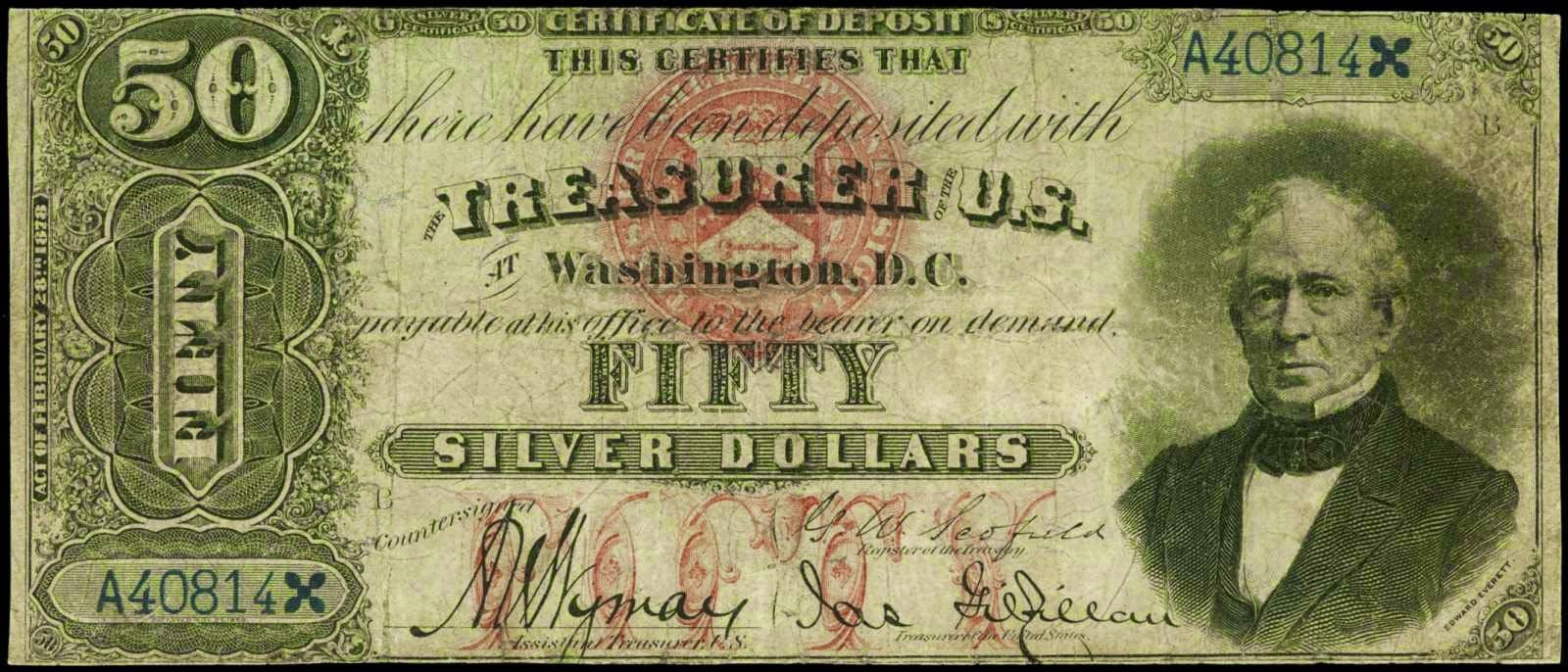
Edward Everett on the Fifty dollar silver certificate.

For nearly fifty years, Edward Everett’s face graced the Fifty dollar silver certificate. Now the world little notes, nor long remembers him. So passes glory.

[1] STANDING beneath this serene sky, overlooking these broad fields now reposing from the labors of the waning year, the mighty Alleghenies dimly towering before us, the graves of our brethren beneath our feet, it is with hesitation that I raise my poor voice to break the eloquent silence of God and Nature. But the duty to which you have called me must be performed;–grant me, I pray you, your indulgence and your sympathy.

[2] It was appointed by law in Athens, that the obsequies of the citizens who fell in battle should be performed at the public expense, and in the most honorable manner. Their bones were carefully gathered up from the funeral pyre where their bodies were consumed, and brought home to the city. There, for three days before the interment, they lay in state, beneath tents of honor, to receive the votive offerings of friends and relatives,–flowers, weapons, precious ornaments, painted vases (wonders of art, which after two thousand years adorn the museums of modern Europe),–the last tributes of surviving affection. Ten coffins of funereal cypress received the honorable deposit, one for each of the tribes of the city, and an eleventh in memory of the unrecognized, but not therefore unhonored, dead, and of those whose remains could not be recovered. On the fourth day the mournful procession was formed: mothers, wives, sisters, daughters, led the way, and to them it was permitted by the simplicity of ancient manners to utter aloud their lamentations for the beloved and the lost; the male relatives and friends of the deceased followed; citizens and strangers closed the train. Thus marshalled, they moved to the place of interment in that famous Ceramicus, the most beautiful suburb of Athens, which had been adorned by Cimon, the son of Miltiades, with walks and fountains and columns,–whose groves were filled with altars, shrines, and temples,–whose gardens were kept forever green by the streams from the neighboring hills, and shaded with the trees sacred to Minerva and coeval with the foundation of the city,–whose circuit enclosed

“the olive grove of Academe,
Plato’s retirement, where the Attic bird
Trilled his thick-warbled note the summer long,”–

whose pathways gleamed with the monuments of the illustrious dead, the work of the most consummate masters that ever gave life to marble. There, beneath the overarching plane-trees, upon a lofty stage erected for the purpose, it was ordained that a funeral oration should be pronounced by some citizen of Athens, in the presence of the assembled multitude.

[3] Such were the tokens of respect required to be paid at Athens to the memory of those who had fallen in the cause of their country. For those alone who fell at Marathon a peculiar honor was reserved. As the battle fought upon that immortal field was distinguished from all others in Grecian history for its influence over the fortunes of Hellas,–as it depended upon the event of that day whether Greece should live, a glory and a light to all coming time, or should expire, like the meteor of a moment; so the honors awarded to its martyr-heroes were such as were bestowed by Athens on no other occasion. They alone of all her sons were entombed upon the spot which they had forever rendered famous. Their names were inscribed upon ten pillars erected upon the monumental tumulus which covered their ashes (where, after six hundred years, they were read by the traveller Pausanias), and although the columns, beneath the hand of time and barbaric violence, have long since disappeared, the venerable mound still marks the spot where they fought and fell,–

“That battle-field where Persia’s victim-horde
First bowed beneath the brunt of Hellas’ sword.”

[4] And shall I, fellow-citizens, who, after an interval of twenty-three centuries, a youthful pilgrim from the world unknown to ancient Greece, have wandered over that illustrious plain, ready to put off the shoes from off my feet, as one that stands on holy ground,–who have gazed with respectful emotion on the mound which still protects the dust of those who rolled back the tide of Persian invasion, and rescued the land of popular liberty, of letters, and of arts, from the ruthless foe,–stand unmoved over the graves of our dear brethren, who so lately, on three of those all-important days which decide a nation’s history,–days on whose issue it depended whether this august republican Union, founded by some of the wisest statesmen that ever lived, cemented with the blood of some of the purest patriots that ever died, should perish or endure,–rolled back the tide of an invasion, not less unprovoked, not less ruthless, than that which came to plant the dark banner of Asiatic despotism and slavery on the free soil of Greece? Heaven forbid! And could I prove so insensible to every prompting of patriotic duty and affection, not only would you, fellow-citizens, gathered many of you from distant States, who have come to take part in these pious offices of gratitude,–you, respected fathers, brethren, matrons, sisters, who surround me,–cry out for shame, but the forms of brave and patriotic men who fill these honored graves would heave with indignation beneath the sod.

[5] We have assembled, friends, fellow-citizens, at the invitation of the Executive of the great central State of Pennsylvania, seconded by the Governors of seventeen other loyal States of the Union, to pay the last tribute of respect to the brave men who, in the hard-fought battles of the first, second, and third days of July last, laid down their lives for the country on these hillsides and the plains before us, and whose remains have been gathered into the cemetery which we consecrate this day. As my eye ranges over the fields whose sods were so lately moistened by the blood of gallant and loyal men, I feel, as never before, how truly it was said of old that it is sweet and becoming to die for one’s country. I feel, as never before, how justly, from the dawn of history to the present time, men have paid the homage of their gratitude and admiration to the memory of those who nobly sacrifice their lives, that their fellow-men may live in safety and in honor. And if this tribute were ever due, to whom could it be more justly paid than to those whose last resting-place we this day commend to the blessing of Heaven and of men?

………………………………….. The speech went on for 58 sections of more-or-less this size and ends by mentioning the achievements of the other union armies and navy saying, “But they, I am sure, will join us in saying, as we bid farewell to the dust of these martyr-heroes, that wheresoever throughout the civilized world the accounts of this great warfare are read, and down to the latest period of recorded time, in the glorious annals of our common country there will be no brighter page than that which relates THE BATTLES OF GETTYSBURG.”

_____________________________________________________________________

I find it long-winded and boring, but the crowd thought this speech wonderful. As grand as Lincoln’s 2 minute coda was plain. Part of the draw of Edward Everett was his cultured demeanor and his wide classical knowledge —  a big contrast to Lincoln. Everett had been president of Harvard, and had been a senator, a congressman, governor of Massachusetts, Secretary of State, and US Ambassador to Great Britain. Lincoln had been a country lawyer and one-term congressman. When states started succeeding, Everett had been the one called on to negotiate a compromise that delayed war until the firing on fort Sumter. All impressive in the day, now mostly forgotten glories. Today, many of his lines ring hollow today, e.g.  ” … that it is sweet and becoming to die for one’s country.” It just sounds weird to my ears. And the classic allusions sound pointless. By the early 20th century, most public pinion had changed; people decided that Lincoln’s was the better presentation, a monument to the spirit of man. The world remembers Lincoln fondly, but little notes, nor long remembers Everett, nor what he said there. The lesson: do not judge hastily. All things exist only in the context of time.

Robert E. Buxbaum, November 14, 2016. A week ago, Tuesday, our nation elected Donald Trump as 45th President of the United States, an individual as disliked and divisive as any since Lincoln. I do not know if he will prove to be honored or hated. There are demonstrations daily to remove him or overthrow the election. There are calls for succession, as when Lincoln took office. At Hampshire college, the flag was lowered in mourning. It’s possible that Trump is as offensive and unqualified as they say– but it is also possible that history will judge him otherwise in time. They did Lincoln.

Lessons of WWI: remove aristocrats and beards

Tzar Nicholas II and King George V.

Tzar Nicholas II and King George V, cousins and allies.

When I was a kid, Veterans day was called Armistice day. It marked the end of WWI. As many people died on all sides (there were many shifting alliances), it’s worthwhile asking what we’ve learned. The main thing, I think, is that aristocrats suck, both hereditary aristocrats, and the aristocrats of thought. Europe entered a world war for no big reason: small gains of land and status gains for a few aristocrats, generals, and thinkers at the top of society. These saw an opportunity to get medals and prove they could lead men in battle. The mass of Europeans cheered for war (see photo below, right) and followed them in battle. Millions were sent running at machine guns and poison gas. Most died, Those who survived returned home feeling less enthused about the ignorant, arrogant hereditary aristocrats, but still honored the generals and thinkers. They executed Tzar Nicolas of Russia and greatly reduce the power of the kings of England, Belgium, Turkey, Holland, and Austria. The thinkers inherited that power, but dropped the monarch’s face hair.

Emperor Franz Joseph

Emperor Franz Joseph II

mehmedv

Calif Mohammet V

Before WWI, virtually all of Europe was ruled by king; generally bearded kings who were believed to rule by divine right, as the will of God. The king generally had aid of a republican congress, a large aristocracy — counts, dukes, marchese, and earls, and the academic élite — professors and generals. All of these avoided association with the masses, except for show, all spent lavishly, and all maneuvered for power. By the end of WWI, no king in Europe retained real power, and the hereditary aristocrats discredited, power went to the intellectual aristocrats, where it resides today: generals, professors, newspapermen, novelists, generally mustached and modern. In 20 years or so, the new aristocrats would bring on WWII, in part because of a fear of war. Their wisdom proved to be little better than the old, but it is hard to say it was worse. The main lessons learned: avoid beards and aristocrats.

Brittains unified and cheering for the start of WWI

Britains unified and cheering for the start of WWI

In his book, “Diplomacy”, Henry Kissinger draws a few more lessons from the Great War. A major one is that balance of power works: it worked for the 100 years until WWI. Another lesson he draws: don’t let mutual defense treaties kick in until an actual invasion has begun: until troops actually cross the border. He blames hair trigger treaties for much of the trouble of WWI. His book is a good read, though, if only as a background his diplomatic approaches.

I write about WWI because of today is Veterans day, and also because two days ago we elected Donald Trump president of the US in a bitterly divisive election. Trump claims he wants “to drain the swamp,” a claim I take to mean that he intends to diminish the power of the intellectual aristocracy, the generals, writers, professors and politicians who think together, vacation together, club together, and control what it means to be educated. The Washington Post calls this removal a threat to western civilization; it removes the intelligentsia, and replaces it with racist boobs, or so they see Trump’s crew. There were anti election demonstrations in Boston, New York, Oakland, Austin, and Detroit. Upon election news a movement was started to impeach Trump, or get him to step down on claims that he stole the election. Officials of Hampshire college lowered the flag to half mast as a sign of mourning for our democracy. These acts of dissent are as heartfelt a reaction as the widespread approval that greeted WWI. I can hope the outcome is better.

For what it’s worth, I do not believe the supporters of Trump are as angry, or as stupid as portrayed: half a basketball of deplorables and irredeemables, the other half needing re-education (to borrow from Ms Clinton). These are the people who fight our wars, and I suspect we’ll be somewhat better off for giving them a voice. As for veterans day, honor the poor blokes who fought for our folly.

Robert E. Buxbaum, November 10, 2016.

Narcissism, a horrible disease except in presidents.

Perhaps the worst sort of employee is a narcissist. A narcissist is in love with an image of himself that he sees, and that he has created. Though his behavior does not match the image — it can not –the narcissist can not, or will not accept the damage he’s caused by insubordination and undercutting. The typical narcissist is always right, and is confident of being right, even when seriously wrong. He can take some (little) advice because he sees himself as humble, but he will not take blame, and thus does not change. He can be charming in his love of you and your ideas. Still, you’ll notice his complete disdain for others and of ideas that (to you) look equally brilliant. And once he accepts your first idea as brilliant, he’s unlikely to change to accept your second, or modified version.

The Great Gatsby created an image of himself, and strove to live it. "He looked at you like the moon and the stars shone out of your eyes."

The Great Gatsby created an image of himself, and strove to live it. “He looked at you like the moon and the stars shone out of your eyes.”

The narcissist friend or boss is somewhat better. He creates a positive mental image of those around him, usually seeing them as kind, holy, or smart people. The Great Gatsby was a classic example of this. It’s nice to be in his presence, “seen as you’d wish to be seen, as if the moon and the stars shone in your eyes”. It’s an image the narcissist does his best maintain, both of you and of him, even if it kills you and him together. This is still a damaging, false image, but it has a tremendous up-side or two in a friend or boss. It’s nice to work with someone who sees you as God’s gift even if you know it’s false. Besides that, the narcissist usually has some general plan of action or knows how to get one (e.g. hire the best, consult the iChing, build a wall). The plan might not be great, but it’s usually better than having no-plan or waiting to consult the consultants at every turn. And unlike most folks, the narcissist knows he must stick to the plan or he looks like a loser. It also helps that he or she, by force of charisma, has the ability to make others stick to the plan. In times of trouble or confusion, that’s usually far better than hopeless paralysis. Also good is that narcissists tend to collect solid followers — a plus when leading a big organization where decisions are important. The leader can not hope to manage all the details of a big organization, and needs to be able to rely on loyal minions to follow general his orders and get the details right.

There are few bigger organizations than government. Government leadership has seen an uncommon concentration of narcissists, and these have done rather well, considering. In the US and elsewhere the best (and worst) leaders have been narcissists, mostly. Napoleon, FDR, Stalin, Churchill, Christ, Mohammed, Hitler, Bill Clinton, Gandhi, and Genghis Kahn; all narcissists as best I can tell. They all saw themselves as great, behaved accordingly, and got people to follow. They made grand plans and carried them out by convincing others to go along: the others providing the necessary blood, sweat, tears, and death. Their approach may appall when seen in quiet times, but it’s absolutely necessary in troubled times when the normal alternatives are confusion and despair. Jimmy Carter, a more-normal type, folded in times of trouble; he dithered in the face of the Ayatollah and of Idi Amin. Twice he started Iranian rescue operations, then called them off — in both cases at the worst possible moments. People died, friends lost hope. Carter was a normal person in a situation that required a narcissist. Meanwhile, the Ayatollah and Idi Amin did as narcissist do, for better or worse.

It’s been pointed out that Donald Trump is a narcissist (he is, congratulations). I strongly suspect that’s true of Cruz, and Sanders too. Trump’s narcissism is unusually blatant because his vision of himself is unusually brash. Cruz and Sanders, have quieter visions of themselves mixing feigned humility with their firm resolve. I don’t see these visions as better, just more normal-looking. Brash visions can be a negative, of course, both in a US president, and in a corporate president, but to have no vision is worse. Apple computer company seems to have no vision now that Steve Jobs is dead, and it’s floundering. Jeb! Bush, similarly seemed to have had no firm vision, and he ended his run as a washed-up flotsam. As for HRC, I don’t know. Fortunately, the US government has the power to rein in any (I think) narcissist, via the constitution’s balance of power. Congress and the supreme court, if they choose to use it, have the power to stop any excess of a narcissist president. The narcissist will fight, but will eventually will bend to them; the one thing the narcissist does not wish is to see himself as, is as a loser, and they have the power to portray him that way. The US will survive whoever gets elected.

Robert Buxbaum, April 10, 2016. I’m not a psychologist and might be dead wrong here, but how I see things at the moment is that Trump’s narcissism is manageable and perhaps advantageous. Besides, I’ve argued in favor of tariffs for some time, so we have some policy agreement. For April Fools day, last year, I described the duel of a famous narcissist president, Andrew Jackson, with his lawyer.

Cross of gold democrats

While it is dangerous to paint a large organization like the Democratic party with a single, broad brush, there are always patterns that appear, in this case in every presidential platform for a century. Beginning in the late 1800s when the Democratic party gave up on slavery, a stated goal of every Democratic platform has been to help the poor and downtrodden. Republicans claim to help too, but claim to target the worthy. For Democrats, by contrast, the common aim is to provide help without reference to individual worth or work — to help just because the individual needs it. All versions of this classic Democratic goal are achieved through forms of wealth redistribution: taking from the rich to give to the poor, Robin Hood style, at least temporarily. There is some inherent tension here: if the recipient can get free money without working, why would he work — a tension that some find insulting, but others accept as part of the comic nature of society. Many Americans accept that helping poor people is such a worthy goal that they knowingly accept the tension and cheating.

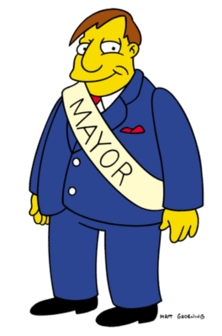
Mayor Quimba of Springfield (from the Simpsons). A classical Democrat, his motto: Corrupts in Extremus

Mayor Quimby of Springfield (from the Simpsons) is a classical Democrat, he has no morals beyond, ‘whatever the public wants’. Quimby is corrupt and an awful manager, but quite likable.

Extracting money from the rich always proves difficult: the rich generally object. The most direct way to extract money is taxation, but Democratic politicians, like Mayor Quimby, right try to shy from this to avoid being branded “tax and spend Democrats.” This year, Bernie Sanders has taken this line, proposing to raise the tax rate on the wealthy to 90% of income so he can do good for the poor and curb the power of rich Republicans. He has no problem with rich Democrats like Ms. Clinton, or perhaps he does, but doesn’t say so. In Britain, under Attlee, the tax rate was raised to 95%, a rate memorialized in The Beatles song “Taxman” (there one for you nineteen for me; 19/20 = 95%). Americans oscillate between accepting high tax rates and acknowledging that the worker and creative must be able to keep most of his/her earnings or he/she will stop working.

Every few years recipient Americans revolt against the way redistribution makes rich Democrats richer, and how high taxes seem to go with crony corruption. The motto of The Simpson’s Mayor Quimby is “corruptus in extremus”, a nod to the observation of how corruption in redistribution favors friends and family of those redistributing the wealth. Redistribution also tends to create poverty. This happened in England, for example. As Quimby says: “I propose that I use what’s left of the town treasury to move to a more prosperous town and run for mayor. And, er, once elected I’ll send for you.”

An alternative many Democrats favor is to print money or borrow it. This appears to be Ms Clinton’s approach, and was proposed famously in the “cross of gold” speech of William Jennings Brian in 1896.  In this speech, one of the finest in American history, Bryan (an unknown until then) proposed to monetize silver and other assets, allowing him to print money. He would spend the money on the poor by debasing the currency, that is by inflation. Bryan claimed that the rich were anyway sitting on unused money: a useless, dangerous pile that he’d inflate away. He also claimed that the poor are the ones who owe money, a burden that he would wipe out with inflation. Bryan’s final line is immortal: “you shall not press down on the people this crown of thorns, you shall not crucify the nation on a cross of gold.” The speech managed to combine God and greed and was an enormous success. Following the speech there was stunned silence, and then whoops and hollers. Bryan was carried around the convention for an hour before being chosen the Democratic candidate for president in 1896, 1900, and 1908. His speech has appeared, to a greater or lesser extent, in the platform of every Democratic candidate since with a greater or lesser reference to God depending on the conservatism of the speaker.

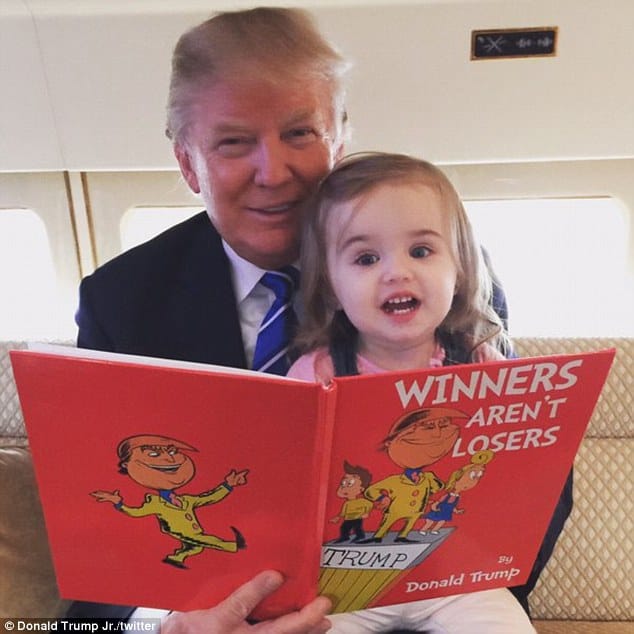
Donald Trump currently the front runner for GOP president reads to his grand-daughter Chloe from that Christmas classic, 'winners aren't lots.' photo by Donald Trump, jr (Chloe's Dad) aboard their car (?) plane (?).

Donald Trump currently the front-runner for GOP president reads to his grand-daughter, Chloe from ‘winners aren’t losers.’ photo by Donald Trump, jr., Chloe’s Dad. Trump seems to revel in the lovable, rich jerk persona as no Liberal or Democrat could.

Republicans have traditionally supported property rights and harder money: gold in the old days, a balanced budget today. They claim that low inflation is good for the rich and poor alike, and especially for the small businessman. Entrepreneurs are pictured as more virtuous than the idle, wastrel Democrats. Free money, the Republicans note, discourages work. Of course, distinguishing worthy from wastrel is easier said than done. Republicans are accused of being uncharitable, and of helping the idle rich once they get into office. Presidential candidate, Donald Trump claimed that until now he’d give big donations to candidates of the left and right so they would repay the favor with interest at a later date. No one knows if it will change when he gets in office, but so far he’s avoided the major rich donors. He’s doing well running as a lovable, rich, jerk who’d do things different.

Inflation is a dangerous mistress, the middle class generally doesn’t like the way it wipes out debts and savings, while supporting a class of rich wastrels, drunks and the chronically unemployed. Many of the poor and middle class save, while the rich tend to build up debts. The rich have better credit ratings than the poor, and thus borrow more. They are also better positioned to increase their borrowing if they think inflation is coming. The money they borrow is invested in hard assets: land, homes, and businesses. When inflation slows, they can sell these assets. And if they pick wrong, the government bails them out!. William Jennings Bryan lost all three of his runs at the presidency, twice to McKinley and once to William H. Taft, who stood for doing nothing.

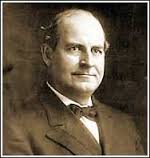
William Jennings Bryan: for inflation and silver; against alcohol. Lost twice to McKinley and gold.

William Jennings Bryan: for inflation and silver; against alcohol. Lost twice to McKinley and gold.

I think the American people want a balance in all things. They want a balance between helping everyone, and helping only the deserving; between high taxes to help folks, and allowing folks to keep their wealth. They don’t quite know where to draw the line, and will even help the wastrels, even those who refuse to work, because they don’t want them starving in the street. They also seem to accept rich folks getting richer, especially when a big project is needed — a ship or a bridge, for example. We elect an alternating mix of Democrats and Republicans; conservatives, and liberals to avoid false paradoxes, achieve some liberty, and establish one of the richest states known.

As for me, you might as well know, I’m a liberal Republican. I favor low income taxes, but some welfare; taxing imports (tariffs), and low inflation –“bread currency,” I like Peter Cooper, and the Greenback Party, 1876. Cooper claimed that the dollar should always have the same value “for the same reason that the foot should always have 12 inches and the pound 16 ounces.” I also think enforcing morality is a job for preachers, not politicians. For 160 years students of Peter Cooper’s union were getting a free college education and I’m one of those engineering students, see my biography of Peter Cooper.

Robert E. Buxbaum, December 30, 2015. See my view of Scrooge’s economic education in the Christmas Carol.

Marie de Condorcet and the tragedy of the GOP

This is not Maire de Condorcet, it's his wife Sophie. Marie (less attractive) was executed by Robespierre for being a Republican.

Marie Jean is a man’s name. This is not he, but his wife, Sophie de Condorcet. Marie Jean was executed for being a Republican in Revolutionary France.

During the French Revolution, Marie Jean de Condorcet proposed a paradox with significant consequence for all elective democracies: It was far from clear, de Condorcet noted, that an election would choose the desired individual — the people’s choice — once three or more people could run. I’m sorry to say, this has played out often over the last century, usually to the detriment of the GOP, the US Republican party presidential choices.

The classic example of Condorcet’s paradox occurred in 1914. Two Republican candidates, William H. Taft and Theodore Roosevelt, faced off against a less-popular Democrat, Woodrow Wilson. Despite the electorate preferring either Republican to Wilson, the two Republicans split the GOP vote, and Wilson became president. It’s a tragedy, not because Wilson was a bad president, he wasn’t, but because the result was against the will of the people and entirely predictable given who was running (see my essay on tragedy and comedy).

The paradox appeared next fifty years later, in 1964. President, Democrat Lyndon B. Johnson (LBJ) was highly unpopular. The war in Vietnam was going poorly and our cities were in turmoil. Polls showed that Americans preferred any of several moderate Republicans over LBJ: Henry Cabot Lodge, Jr., George Romney, and Nelson Rockefeller. But no moderate could beat the others, and the GOP nominated its hard liner, Barry Goldwater. Barry was handily defeated by LBJ.

Then, in 1976; as before the incumbent, Gerald Ford, was disliked. Polls showed that Americans preferred Democrat Jimmy Carter over Ford, but preferred Ronald Regan over either. But Ford beat Reagan in the Republican primary, and the November election was as predictable as it was undesirable.

Voters prefer Bush to Clinton, and Clinton to Trump, but Republicans prefer Trump to Bush.

Voters prefer Bush to Clinton, and Clinton to Trump, but Republicans prefer Trump to Bush.

And now, in 2015, the GOP has Donald Trump as its leading candidate. Polls show that Trump would lose to Democrat Hillary Clinton in a 2 person election, but that America would elect any of several Republicans over Trump or Clinton. As before,  unless someone blinks, the GOP will pick Trump as their champion, and Trump will lose to Clinton in November.

At this point you might suppose that Condorcet’s paradox is only a problem when there are primaries. Sorry to say, this is not so. The problem shows up in all versions of elections, and in all versions of decision-making. Kenneth Arrow demonstrated that these unwelcome, undemocratic outcomes are unavoidable as long as there are more than two choices and you can’t pick “all of the above.” It’s one of the first great applications of high-level math to economics, and Arrow got the Nobel prize for it in 1972. A mathematical truth: elective democracy can never be structured to deliver the will of the people.

This problem also shows up in business situations, e.g. when a board of directors must choose a new location and there are 3 or more options, or when a board must choose to fund a few research projects out of many. As with presidential elections, the outcome always depends on the structure of the choice. It seems to me that some voting systems must be better than others — more immune to these problems, but I don’t know which is best, nor which are better than which. A thought I’ve had (that might be wrong) is that reelections and term limits help remove de Condorcet’s paradox by opening up the possibility of choosing “all of the above” over time. As a result, many applications of de Condorcet’s are wrong, I suspect. Terms and term-limits create a sort of rotating presidency, and that, within limits, seems to be a good thing.

Robert Buxbaum, September 20, 2015. I’ve analyzed the Iran deal, marriage vs a PhD, and (most importantly) mustaches in politics; Taft was the last of the mustached presidents. Roosevelt, the second to last.