Simple electroplating of noble metals

Electro-coating gold onto a Pd tube by dissolving an iron wire.

Electro-coating gold onto at Pd-coated tube by dissolving an iron wire at REB Research.

Here’s a simple trick for electroplating noble metals: gold, silver, copper, platinum. I learned this trick at Brooklyn Technical High School some years ago, and I still use it at REB Research as part of our process to make hydrogen permeation barriers, and sulfur tolerant permeation membranes.  It’s best used to coat reasonably inactive, small objects,  e.g. to coat copper on a nickel or silver on a penny for a science fair.

As a first step, you make a dilute acidic solution of the desired noble metal. Dissolve a gram or so of copper sulphate, silver nitrate, or gold chloride per 250 ml of water. Make sure the solution is acidic using pH paper, add acid if needed aiming for a pH of 3 to 4. Place some solution into a test tube or beaker of a size that will hold the object you want to coat. As a next step, attach an iron or steel wire to the object, I typically use bailing wire from the hardware store wrapped several times about the top of the object, and run the length of the object; see figure. Place the object into your solution and wait for 5 to 30 minutes. Coating works without the need for any other electric source or any current control.

The iron wire creates the electricity used in electroplating the noble metal. Iron has a higher electro-motive potential than hydrogen and hydrogen has a higher potential than the noble metals. In acid solution, the iron wire dissolves but (it’s hoped) the substrate does not. Each iron atom gives up two electrons, becoming Fe++. Some of these electrons go on to reduce hydrogen ions making H2 (2H+ 2e –> H2), but most should go to reduce the noble metal ions in the solution to form a coat of metallic gold, silver, or copper on both the wire and the object. See an example of how I do calculations regarding voltage, electron number, and Gibbs free energy.

Transferring electrons requires you have good electrical contact between the wire and the object. Most of the noble metal coats the object, not the wire since the object is bigger, typically. Thanks to my teachers at Brooklyn Technical High School for teaching me. For a uniform coat, it helps to run the wire down parallel to the entire length of tube; I think this is a capacitance, field effect. For a larger object, you may want several wires if you are plating a larger object. For a thicker coat, I found you are best off making many thin coats and heating them. This reduces tension forces in the coat, I think.

The picture shows a step in the process we use making our sulfur-resistant hydrogen permeation membranes (buy them here), used, e.g. to concentrate impurities in a hydrogen stream for improved gas chromatography. The next step is to dissolve the gold or copper into the palladium.

Go here for a great periodic table cup from REB Research, or for the rest of our REB Research products. I occasionally make silver-coated pennies for schoolchildren, but otherwise use this technology only for in-house production.

R.E. Buxbaum, July 20, 2013.

yet another quantum joke

Why do you get more energy from a steak than from the same amount of hamburger?


Hamburger is steak in the ground state.


Is funny because….. it’s a pun on the word ground. Hamburger is ground-up meat, of course, but the reference to a ground state also relates to a basic discovery of quantum mechanics (QM): that all things exist in quantized energy states. The lowest of these is called the ground state, and you get less energy out of a process if you start with things at this ground state. Lasers, as an example, get their energy by electrons being made to drop to their ground state at the same time; you can’t get any energy from a laser if the electrons start in the ground state.

The total energy of a thing can be thought of as having a kinetic and a potential energy part. The potential energy is usually higher the more an item moves from its ideal (lowest potential point). The kinetic energies of though tends to get lower when more space is available because, from Heisenberg uncertainty, ∆l•∆v=h. That is, the more space there is, the less uncertainty of speed, and thus the less kinetic energy other things being equal. The ground energy state is the lowest sum of potential and kinetic energy, and thus all things occupy a cloud of some size, even at the ground state. Without this size, the world would cease to exist. Atoms would radiate energy, and shrink until they vanished.

In grad school, I got into understanding thermodynamics, transport phenomena, and quantum mechanics, particularly involving hydrogen. This lead to my hydrogen production and purification inventions, what my company sells.

Click here for a quantum cartoon on waves and particles, an old Heisenberg joke, or a joke about how many quantum mechanicians it takes to change a lightbulb.

R. E. Buxbaum, July 16, 2013. I once claimed that the unseen process that maintains existence could be called God; this did not go well with the religious.


Crime: US vs UK and Canada

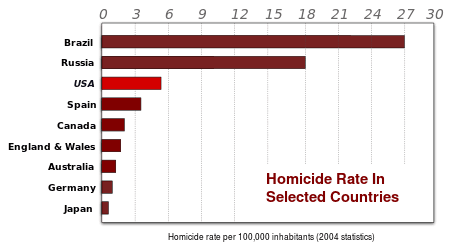
The US has a lot of guns and a lot of murders compared to England, Canada, and most of Europe. This is something Piers Morgan likes to point out to Americans who then struggle to defend the wisdom of gun ownership and the 2nd Amendment: “How do you justify 4.8 murders/year per 100,000 population when there are only 1.6/year per 100,000 in Canada, 1.2/year per 100,000 in the UK, and 1.0/year per 100,000 in Australia — countries with few murders and tough anti-gun laws?,” he asks. What Piers doesn’t mention, is that these anti-gun countries have far higher contact crime (assault) rates than the US, see below.

Contact Crime Per Country

Contact crime rates for 17 industrialized countries. From the Dutch Ministry of Justice. click here for details about the survey and a breakdown of crimes.

The differences narrow somewhat when considering most violent crimes, but we still have far fewer than Canada and the UK. Canada has 963/year per 100,000 “most violent crimes,” while the US has 420/year per 100,000. “Most violent crimes” here are counted as: “murder and non-negligent manslaughter,” “forcible rape,” “robbery,” and “aggravated assault” (FBI values). England and Wales classify crimes somewhat differently, but have about two times the US rate, 775/year per 100,000, if “most violent crimes” are defined as: “violence against the person, with injury,” “most serious sexual crime,” and “robbery.”

It is possible that the presence of guns protects Americans from general crime while making murder more common, but it’s also possible that gun ownership is a murder deterrent too. Our murder rate is 1/5 that of Mexico, 1/4 that of Brazil, and 1/3 that of Russia; all countries with strong anti-gun laws but a violent populous. Perhaps the US (Texan) penchant for guns is what keeps Mexican gangs on their, gun-control side of the border. Then again, it’s possible that guns neither increase nor decrease murder rates, so that changing our laws would not have any major effect. Switzerland (a country with famously high gun ownership) has far fewer murders than the US and about 1/2 the rate of the UK: 0.7 murders/ year per 100,000. Japan, a country with low gun ownership has hardly any crime of any sort — not even littering. As in the zen buddhist joke, change comes from within.

Homicide rate per country

Homicide rate per country

One major theory for US violence was that drugs and poverty were the causes. Remove these by stricter anti-drug laws and government welfare, and the violent crime would go away. Sorry to say, it has not happened; worse yet, murder rates are highest in cities like Detroit where welfare is a way of life, and where a fairly high fraction of the population is in prison for drugs.

I suspect that our welfare payments have hurt Detroit as much as they’ve helped, and that Detroit’s higher living wage, has made it hard for people to find honest work. Stiff drug penalties have not helped Detroit either, and may contribute to making crimes more violent. As Thomas More pointed out in the 1500s, if you are going to prison for many years for a small crime, you’re more likely to use force to avoid risk capture. Perhaps penalties would work better if they were smaller.

Charity can help a city, i think, and so can good architecture. I’m on the board of two charities that try to do positive things, and I plant trees in Detroit (sometimes).

R. E. Buxbaum, July 10, 2013. To make money, I sell hydrogen generators: stuff I invented, mostly.

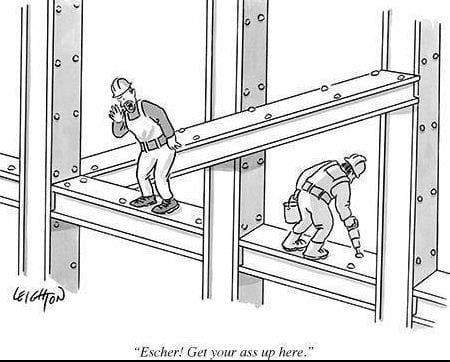
Escher Architecture – joke?

Caption will say where this is from.

Robert  Leighton, from the New Yorker,

Is funny because …. there’s an Escher-like impossible structure and a dirty word (ass, tee hee). Besides that, this joke highlights a fundamental conflict between the architect and the client (customer): what is good architecture?

Typically the customer whats a home or office that “looks nice”, “doesn’t cost too much”, and “works,” perhaps as an advertisement for the company. Often the architect wants to make a statement for him/herself, or wants to produce a work of art. Left to their own, architects can produce expensive monuments that no one can live in.

A wonderful (horrible) case concerns The Cooper Union, my alma mater, and more-or-less the only free college in America. The Cooper Union was founded by an inventive mechanic, Peter Cooper, see my biography, who invented jello, and rolled steel, laid the transatlantic cable, founded AT&T, and managed to give free education to a century and a half of students. The trustees of the school tore down the old, serviceable building, sold the land, and built a $270,000,000 dollar monstrosity. Hailed by the New York Times as great architecture, it bankrupted the school, and is unusable for the sort of hands-on education that Peter Cooper devised.

In hopes of attracting a rich donor, Cooper Union borrowed $175 million to erect this grotesque building for its engineering department. No donor materialized, and, as a result, the school’s 155-year-old policy of free tuition has vaporized.

In hopes of attracting a rich donor, Cooper Union sold its engineering building and borrowed $175 million to erect this replacement. No donor materialized, and, with it, a 155-year-old policy of free tuition.

Here’s a surrealist jokean engineer joke, and a thought on control engineering. Here too is a  sculpture I put on top of my building; the eyes follow you.

R.E. Buxbaum, July 8, 2013; I do consulting on hydrogen, and my company makes hydrogen products.

Control engineer joke

What made the control engineer go crazy?

He got positive feedback.

Is funny because …… it’s a double entente, where both meanings are true: (1) control engineers very rarely get compliments (positive feedback); the aim of control is perfection, something that’s unachievable for a dynamic system (and generally similar to near perfection: the slope at a maximum is zero). Also (2) systems go unstable if the control feedback is positive. This can happen if the controller was set backwards, but more usually happens when the response is too fast or too extreme. Positive feedback pushes a system further to error and the process either blows up, or (more commonly) goes wildly chaotic, oscillating between two or more “strange attractor” states.

It seems to me that hypnosis, control-freak love, and cult behaviors are the result of intentionally produced positive feedback. Palsies, economic cycles, and global warming are more likely the result of unintentional positive feedback. In each case, the behavior is oscillatory chaotic.

The  normal state of Engineering is lack of feedback. Perhaps this is good because messed up feedback leads to worse results. From xykd.

Our brains give little reliable feedback on how well they work, but that may be better than strong, immediate feedback, as that could lead to bipolar instability. From xkcd. For more on this idea, see Science and Sanity, by Alfred Korzbski (mini youtube)

Control engineers tend to be male (85%), married (80%), happy people (at least they claim to be happy). Perhaps they know that near-perfection is close enough for a complex system in a dynamic world, or that one is about as happy as believes ones-self to be. It also helps that control engineer salaries are about $95,000/ year with excellent benefits and low employment turnover.

Here’s a chemical engineer joke I made up, and an older engineering joke. If you like, I’ll be happy to consult with you on the behavior of your processes.

By Dr. Robert E. Buxbaum, July 4, 2013

Thermodynamics of hydrogen generation

Perhaps the simplest way to make hydrogen is by electrolysis: you run some current through water with a little sulfuric acid or KOH added, and for every two electrons transferred, you get a molecule of hydrogen from one electrode and half a molecule of oxygen from the other.

2 OH- –> 2e- + 1/2 O2 +H2O

2H2O + 2e- –>  H2 + 2OH-

The ratio between amps, seconds and mols of electrons (or hydrogen) is called the Faraday constant, F = 96500; 96500 amp-seconds transfers a mol of electrons. For hydrogen production, you need 2 mols of electrons for each mol of hydrogen, n= 2, so

it = 2F where and i is the current in amps, and t is the time in seconds and n is the number electrons per molecule of desired product. For hydrogen, t = 96500*2/i; in general, t = Fn/i.

96500 is a large number, and it takes a fair amount of time to make any substantial amount of hydrogen by electrolysis. At 1 amp, it takes 96500*2 = 193000 seconds, 2 days, to generate one mol of hydrogen (that’s 2 grams Hor 22.4 liters, enough to fill a garment bag). We can reduce the time by using a higher current, but there are limits. At 25 amps, the maximum current of you can carry with house wiring it takes 2.14 hours to generate 2 grams. (You’ll have to rectify your electricity to DC or you’ll get a nasty H2 /O2 mix called Brown’s gas, While normal H2 isn’t that dangerous, Browns gas is a mix of H2 and O2 and is quite explosive. Here’s an essay I wrote on separating Browns gas).

Electrolysis takes a fair amount of electric energy too; the minimum energy needed to make hydrogen at a given temperature and pressure is called the reversible energy, or the Gibbs free energy ∆G of the reaction. ∆G = ∆H -T∆S, that is, ∆G equals the heat of hydrogen production ∆H – minus an entropy effect, T∆S. Since energy is the product of voltage current and time, Vit = ∆G, where ∆G is the Gibbs free energy measured in Joules and V,i, and t are measured Volts, Amps, and seconds respectively.

Since it = nF, we can rewrite the relationship as: V =∆G/nF for a process that has no energy losses, a reversible process. This is the form found in most thermodynamics textbooks; the value of V calculated this way is the minimum voltage to generate hydrogen, and the maximum voltage you could get in a fuel cell putting water back together.

To calculate this voltage, and the power requirements to make hydrogen, we use the Gibbs free energy for water formation found in Wikipedia, copied below (in my day, we used the CRC Handbook of Chemistry and Physics or a table in out P-chem book). You’ll notice that there are two different values for ∆G depending on whether the water is a gas or a liquid, and you’ll notice a small zero at the upper right (∆G°). This shows that the values are for an imaginary standard state: 20°C and 1 atm pressure. You can’t get 1 atm steam at 20°C, it’s an extrapolation; behavior at typical temperatures, 40°C and above is similar but not identical. I’ll leave it to a reader to send this voltage as a comment.

Liquid H2O formation∆G° =-237.14
Gaseous H2O formation∆G° =-228.61

The reversible voltage for creating liquid water in a reversible fuel cell is found to be -237,140/(2 x 96,500) = -1.23V. We find that 1.23 Volts is about the minimum voltage you need to do electrolysis at 0°C because you need liquid water to carry the current; -1.18 V is about the maximum voltage you can get in a fuel cell because they operate at higher temperature with oxygen pressures significantly below 1 atm. (typically). The minus sign is kept for accounting; it differentiates the power out case (fuel cells) from power in (electrolysis). It is typical to find that fuel cells operate at lower voltages, between about .5V and 1.0V depending on the fuel cell and the power load.

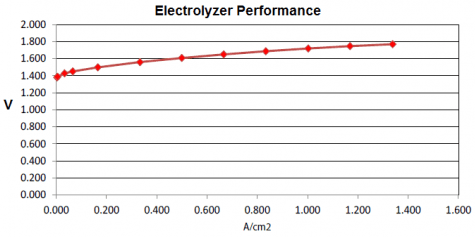
Most electrolysis is done at voltages above about 1.48 V. Just as fuel cells always give off heat (they are exothermic), electrolysis will absorb heat if run reversibly. That is, electrolysis can act as a refrigerator if run reversibly. but electrolysis is not a very good refrigerator (the refrigerator ability is tied up in the entropy term mentioned above). To do electrolysis at reasonably fast rates, people give up on refrigeration (sucking heat from the environment) and provide all the entropy needed for electrolysis in the electricity they supply. This is to say, they operate at V’ were nFV’ ≥ ∆H, the enthalpy of water formation. Since ∆H is greater than ∆G, V’ the voltage for electrolysis is higher than V. Based on the enthalpy of liquid water formation,  −285.8 kJ/mol we find V’ = 1.48 V at zero degrees. The figure below shows that, for any reasonably fast rate of hydrogen production, operation must be at 1.48V or above.

Electrolyzer performance; C-Pt catalyst on a thin, nafion membrane

Electrolyzer performance; C-Pt catalyst on a thin, nafion membrane

If you figure out the energy that this voltage and amperage represents (shown below) you’re likely to come to a conclusion I came to several years ago: that it’s far better to generate large amounts of hydrogen chemically, ideally using a membrane reactor like my company makes.

The electric power to make each 2 grams of hydrogen at 1.5 volts is 1.5 V x 193000 Amp-s = 289,500 J = .080 kWh’s, or 0.9¢ at current rates, but filling a car takes 20 kg, or 10,000 times as much. That’s 800 kW-hr, or $90 at current rates. The electricity is twice as expensive as current gasoline and the infrastructure cost is staggering too: a station that fuels ten cars per hour would require 8 MW, far more power than any normal distributor could provide.

By contrast, methanol costs about 2/3 as much as gasoline, and it’s easy to deliver many giga-joules of methanol energy to a gas station by truck. Our company’s membrane reactor hydrogen generators would convert methanol-water to hydrogen efficiently by the reaction CH3OH + H2O –> 3H2 + CO2. This is not to say that electrolysis isn’t worthwhile for lower demand applications: see, e.g.: gas chromatography, and electric generator cooling. Here’s how membrane reactors work.

R. E. Buxbaum July 1, 2013; Those who want to show off, should post the temperature and pressure corrections to my calculations for the reversible voltage of typical fuel cells and electrolysis.

Chemist v Chemical Engineer joke

What’s the difference between a chemist and a chemical engineer?

How much they make.

I made up this joke up as there were no other chemical engineer jokes I knew. It’s an OK double entente that’s pretty true — both in terms of product produced and the amount of salary (there’s probably a cause-and-effect relation here). Typical of these puns, this joke ignores the internal differences in methodologies and background (see my post, How is Chemical engineering?). If you like, here’s another engineering joke,  a chemistry joke, and a dwarf joke.

R.E. Buxbaum –  June 28, 2013.

What’s Holding Gilroy on the Roof

We recently put a sculpture on our roof: Gilroy, or “Mr Hydrogen.” It’s a larger version of a creepy face sculpture I’d made some moths ago. Like it, and my saber-toothed tiger, the eyes follow you. A worry about this version: is there enough keeping it from blowing down on the cars? Anyone who puts up a large structure must address this worry, but I’m a professional engineer with a PhD from Princeton, so my answer is a bit different from most.

Gilroy (Mr Hydrogen) sculpture on roof of REB Research & Consulting. The eyes follow you.

Gilroy (Mr Hydrogen) sculpture on roof of REB Research & Consulting. The eyes follow you. Aim is that it should withstand 50 mph winds.

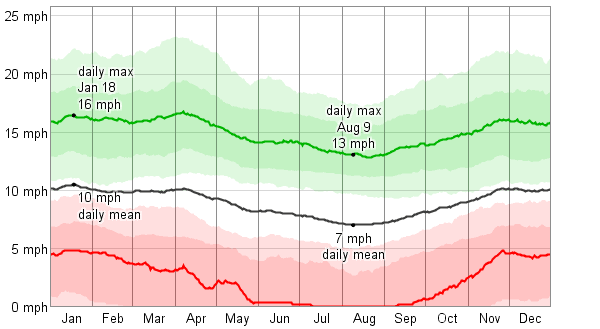
The main force on most any structure is the wind (the pyramids are classic exceptions). Wind force is generally proportional to the exposed area and to the wind-speed squared: something called form-drag or quadratic drag. Since force is related to wind-speed, I start with some good statistics for wind speed, shown in the figure below for Detroit where we are.

The highest Detroit wind speeds are typically only 16 mph, but every few years the winds are seen to reach 23 mph. These are low relative to many locations: Detroit has does not get hurricanes and rarely gets tornadoes. Despite this, I’ve decided to brace the sculpture to withstand winds of 50 mph, or 22.3 m/s. On the unlikely chance there is a tornado, I figure there would be so much other flotsam that I would not have to answer about losing my head. (For why Detroit does not get hurricanes or tornadoes, see here. If you want to know why tornadoes lift things, see here).

The maximum area Gilroy presents is 1.5 m2. The wind force is calculated by multiplying this area by the kinetic energy loss per second 1/2ρv2, times a form factor.  F= (Area)*ƒ* 1/2ρv2, where ρ is the density of air, 1.29Kg/m3, and v is velocity, 22.3 m/s. The form factor, ƒ, is about 1.25 for this shape: ƒ is found to be 1.15 for a flat plane, and 1.1 to 1.3 a rough sphere or ski-jumper. F = 1.5*1.25* (1/2 *1.29*22.32) = 603 Nt = 134 lb.; pressure is this divided by area. Since the weight is only about 40 lbs, I find I have to tie down the sculpture. I’ve done that with a 150 lb rope, tying it to a steel vent pipe.

Wind speed for Detroit month by month. Used to calculate the force. From http://weatherspark.com/averages/30042/Detroit-Michigan-United-States

Wind speed for Detroit month by month. Used to calculate the force. From http://weatherspark.com/averages/30042/Detroit-Michigan-United-States

It is possible that there’s a viscous lift force too, but it is likely to be small given the blunt shape and the flow Reynolds number: 3190. There is also the worry that Gilroy might fall apart from vibration. Gilroy is made of 3/4″ plywood, treated for outdoor use and then painted, but the plywood is held together with 25 steel screws 4″ long x 1/4″ OD. Screws like this will easily hold 134 lbs of steady wind force, but a vibrating wind will cause fatigue in the metal (bend a wire often enough and it falls apart). I figure I can leave Gilroy up for a year or so without worry, but will then go up to replace the screws and check if I have to bring him/ it down.

In the meantime, I’ll want to add a sign under the sculpture: “REB Research, home of Mr Hydrogen” I want to keep things surreal, but want to be safe and make sales.

by Robert E. Buxbaum, June 21, 2013

Another Quantum Joke, and Schrödinger’s waves derived

Quantum mechanics joke. from xkcd.

Quantum mechanics joke. from xkcd.

Is funny because … it’s is a double entente on the words grain (as in grainy) and waves, as in Schrödinger waves or “amber waves of grain” in the song America (Oh Beautiful). In Schrödinger’s view of the quantum world everything seems to exist or move as a wave until you observe it, and then it always becomes a particle. The math to solve for the energy of things is simple, and thus the equation is useful, but it’s hard to understand why,  e.g. when you solve for the behavior of a particle (atom) in a double slit experiment you have to imagine that the particle behaves as an insubstantial wave traveling though both slits until it’s observed. And only then behaves as a completely solid particle.

Math equations can always be rewritten, though, and science works in the language of math. The different forms appear to have different meaning but they don’t since they have the same practical predictions. Because of this freedom of meaning (and some other things) science is the opposite of religion. Other mathematical formalisms for quantum mechanics may be more comforting, or less, but most avoid the wave-particle duality.

The first formalism was Heisenberg’s uncertainty. At the end of this post, I show that it is identical mathematically to Schrödinger’s wave view. Heisenberg’s version showed up in two quantum jokes that I explained (beat into the ground), one about a lightbulb  and one about Heisenberg in a car (also explains why water is wet or why hydrogen diffuses through metals so quickly).

Yet another quantum formalism involves Feynman’s little diagrams. One assumes that matter follows every possible path (the multiple universe view) and that time should go backwards. As a result, we expect that antimatter apples should fall up. Experiments are underway at CERN to test if they do fall up, and by next year we should finally know if they do. Even if anti-apples don’t fall up, that won’t mean this formalism is wrong, BTW: all identical math forms are identical, and we don’t understand gravity well in any of them.

Yet another identical formalism (my favorite) involves imagining that matter has a real and an imaginary part. In this formalism, the components move independently by diffusion, and as a result look like waves: exp (-it) = cost t + i sin t. You can’t observe the two parts independently though, only the following product of the real and imaginary part: (the real + imaginary part) x (the real – imaginary part). Slightly different math, same results, different ways of thinking of things.

Because of quantum mechanics, hydrogen diffuses very quickly in metals: in some metals quicker than most anything in water. This is the basis of REB Research metal membrane hydrogen purifiers and also causes hydrogen embrittlement (explained, perhaps in some later post). All other elements go through metals much slower than hydrogen allowing us to make hydrogen purifiers that are effectively 100% selective. Our membranes also separate different hydrogen isotopes from each other by quantum effects (big things tunnel slower). Among the uses for our hydrogen filters is for gas chromatography, dynamo cooling, and to reduce the likelihood of nuclear accidents.

Dr. Robert E. Buxbaum, June 18, 2013.

To see Schrödinger’s wave equation derived from Heisenberg for non-changing (time independent) items, go here and note that, for a standing wave there is a vibration in time, though no net change. Start with a version of Heisenberg uncertainty: h =  λp where the uncertainty in length = wavelength = λ and the uncertainty in momentum = momentum = p. The kinetic energy, KE = 1/2 p2/m, and KE+U(x) =E where E is the total energy of the particle or atom, and U(x) is the potential energy, some function of position only. Thus, p = √2m(E-PE). Assume that the particle can be described by a standing wave with a physical description, ψ, and an imaginary vibration you can’t ever see, exp(-iωt). And assume this time and space are completely separable — an OK assumption if you ignore gravity and if your potential fields move slowly relative to the speed of light. Now read the section, follow the derivation, and go through the worked problems. Most useful applications of QM can be derived using this time-independent version of Schrödinger’s wave equation.

Paint your factory roof white

Standing on the flat roof of my lab / factory building, I notice that virtually all of my neighbors’ roofs are black, covered by tar or bitumen. My roof was black too until three weeks ago; the roof was too hot to touch when I’d gone up to patch a leak. That’s not quite egg-frying hot, but I came to believe my repair would last longer if the roof stayed cooler. So, after sealing the leak with tar and bitumen, we added an aluminized over-layer from Ace hardware. The roof is cooler now than before, and I notice a major drop in air conditioner load and use.

My analysis of our roof coating follows; it’s for Detroit, but you can modify it for your location. Sunlight hits the earth carrying 1300 W/m2. Some 300W/m2 scatters as blue light (for why so much scatters, and why the sky is blue, see here). The rest, 1000 W/m2 or 308 Btu/ft2hr, comes through or reflects off clouds on a cloudy day and hits buildings at an angle determined by latitude, time of day, and season of the year.

Detroit is at 42° North latitude so my roof shows an angle of 42° to the sun at noon in mid spring. In summer, the angle is 20°, and in winter about 63°. The sun sinks lower on the horizon through the day, e.g. at two hours before or after noon in mid spring the angle is 51°. On a clear day, with a perfectly black roof, the heating is 308 Btu/ft2hr times the cosine of the angle.

To calculate our average roof heating, I integrated this heat over the full day’s angles using Euler’s method, and included the scatter from clouds plus an absorption factor for the blackness of the roof. The figure below shows the cloud cover for Detroit.

Average cloud cover for Detroit, month by month.

Average cloud cover for Detroit, month by month; the black line is the median cloud cover. On January 1, it is strongly overcast 60% of the time, and hardly ever clear; the median is about 98%. From http://weatherspark.com/averages/30042/Detroit-Michigan-United-States

Based on this and an assumed light absorption factor of σ = .9 for tar and σ = .2 after aluminum. I calculate an average of 105 Btu/ft2hr heating during the summer for the original black roof, and 23 Btu/ft2hr after aluminizing. Our roof is still warm, but it’s no longer hot. While most of the absorbed heat leaves the roof by black body radiation or convection, enough enters my lab through 6″ of insulation to cause me to use a lot of air conditioning. I calculate the heat entering this way from the roof temperature. In the summer, an aluminum coat is a clear winner.

Detroit High and Low Temperatures Over the ear

High and Low Temperatures For Detroit, Month by Month. From http://weatherspark.com/averages/30042/Detroit-Michigan-United-States

Detroit has a cold winter too, and these are months where I’d benefit from solar heat. I find it’s so cloudy in winter that, even with a black roof, I got less than 5 Btu/ft2hr. Aluminizing reduced this heat to 1.2 Btu/ft2hr, but it also reduces the black-body radiation leaving at night. I should find that I use less heat in winter, but perhaps more in late spring and early fall. I won’t know the details till next year, but that’s the calculation.

The REB Research laboratory is located at 12851 Capital St., Oak Park, MI 48237. We specialize in hydrogen separations and membrane reactors. By Dr. Robert Buxbaum, June 16, 2013