Lincoln’s Gettysburg address, not as bad as first thought.

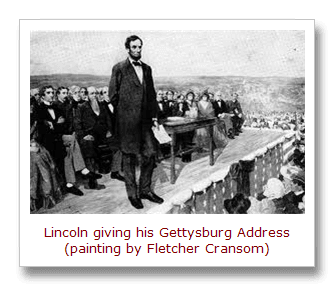
Three score days ago, The Harrisburg Patriot & Union retracted its unflattering 1863 review of Lincoln’s Gettysburg address. But this retraction deserves more attention, I think, than that the editors reconsidered. The Patriot & Union was a Republican journal; it carried an accurate account of the speech, and so it’s worthwhile to ask why its editors labeled this great speech, “silly remarks”, deserving “a veil of oblivion”; “without sense.” Clearly the editors saw a serious lack that we do not see today. It’s worth asking then, what made them think it was silly and lacking in sense?

The Union & Patriot has retracted their review of this 1863 speech.

Lincoln in 1863; The Union & Patriot has retracted their review of this Gettysburg speech — in the fullness of time, they’ve come to reconsider their original review.

Lincoln spoke a few words in honor of the dead, but Edward Everett spoke on this topic for two hours before Lincoln rose. This lack does not appear to be what bothered the editors: “To say of Mr. Everett’s oration that it rose to the height which the occasion demanded, or to say of the President’s remarks that they fell below our expectations, would be alike false. Neither the orator nor the jester surprised or deceived us. Whatever may be Mr. Everett’s failings he does not lack sense – whatever may be the President’s virtues, he does not possess sense. Mr. Everett failed as an orator, because the occasion was a mockery, and he knew it, and the President succeeded, because he acted naturally, without sense and without constraint, in a panorama which was gotten up more for his benefit and the benefit of his party than for the glory of the nation and the honor of the dead.” The editors came to Gettysburg (I think) to hear Lincoln to hear things that only LIncoln could provide — his real thoughts on slavery and an update on his efforts at peace. As best I can tell, it was in these areas that they saw “a veil of oblivion.” Even so, for them to call this address, “silly remarks” there must be more going on. Here are my thoughts.

Lincoln had freed southern slaves a few months earlier by the emancipation proclamation, but no one knew their status; there had been a riot over this a few days previous. Did Lincoln claim equality for these ex-slaves, and if not, what were his thoughts on the extent of their in-equality. They were confiscated as war booty; would Lincoln return them to their owners after the war was over? If so, they were not free at all. Along with this, what was Lincoln doing to end the war? It was far from clear that the North could win in 1863. Lee had many victories, and now England had entered in support of the Confederacy. In my opinion, it was Ericsson’s Monitors that allowed the North to stop the British and win, but it appears that, in 1863, only the British navy realized that their power had been neutralized, and the south was lost.

By 1863 Ericsson was turning out two of these Monitor-type sips per month, enough to keep the British from any major port in America

The North’s Monitor, right, fights the Confederate Merrimac, left, to a draw over control of Norfolk harbor. Ericsson turned out two Monitor ships per month. In my opinion is was these ships that stopped the British and won the war.

Lincoln was cryptically brief when it came to slavery or peace: 271 words. About half the speech is devoted to the brave men who struggled here; the other half speaks of “the Nation,” or the “government.” Not the United States, the Union, the North, the South, but an undefined entity that Lincoln claims came into existence 70 years earlier, in 1776. Most educated people would have said that 1776 created no nation or government, only a confederation of independent states as described by the articles of confederation. Under these articles, these 13 states could only act by consensus and had the right to leave at will. To the extent that anyone held the South was bound now, it was because of the Constitution, signed ten years later, but Lincoln does not mention the Constitution at all– perhaps because most Democrats, understood the Constitution to allow departure. Also, to the extent the Constitution mentions slavery, it’s not to promote equality, but to give each slave 3/5 the vote-power of a free man. If “created equal” is to come from anywhere, it’s the Declaration, but most people understood the intent of the Declaration differently from the vision Lincoln now presented.

As far as most people understood it, The Declaration claimed the God-given right to separate from England and gain us a measure of self-rule — something that the South now claimed for itself, but Lincoln opposed. Further, we claimed in The Declaration, that British mis-management made the separation necessary, and listed the abhorrent offenses including suspension of habeas corpus, and the confiscation of property without process of law — things Lincoln was doing even now. Even the introductory phrase, created equal, was not understood to imply that everyone was equal. Rather, as Stephen Douglass pointed out in their 1858 Chicago debate, we’d created a nation “by the white man, for the benefit of the white man, to be administered by white men, in such a manner as they should determine.”

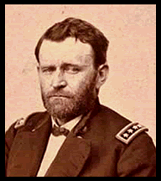
Ulysses Grant had a slave who he freed in 1859, and had control of his wife's slaves, who became free only in 1865. Lee's slaves were freed in 1862.

Ulysses Grant had a slave he freed in 1859; his wife held slaves till 1865. Lee freed his in 1862.

Where was Lincoln coming from? What was he saying that November day? It’s been speculated that Lincoln was proposing a secular religion of administered freedom. There appears to be some legitimacy here, but more I suspect Lincoln was referring to the UNANIMITY requirement behind the Declaration — by agreement all the states had to agree to independence, or we would all stay bound to Britain. If we had to unanimously bind ourselves, we must have unanimously bound ourselves to some shared vision of the union or democracy, -presumably that all were created equal. Five years earlier, William Herndon, Lincoln’s law partner, had given Lincoln a book of the sermons of Theodore Parker, a Boston Unitarian. That volume includes the following section marked by Lincoln in reference to what the unanimous binding entailed: “‘Democracy is direct self-government, over all the people, for all the people, by all the people.” Whether Lincoln was now speaking in direct reference to this line, or more-likely, as I suspect, to a more general refutation of the claims of Southern separation and Douglas’s 1858 white man claim, Lincoln’s sense of the import of the Declaration was one that few understood or agreed with. The North still had slaves — Grant’s wife for example, and there was no obvious desire for a new birth of freedom, just an end to the war. Lincoln’s words thus must have sounded like gobbledygook to the majority of learned ears.

Based on the events and issues of the time, and the un-obvious point of the speech, I’d say the editors were justified in their ill review. Further, the issues that bothered them then, abuse of power, citizen and states’ rights, remain as relevant today as ever. Do the current editors see any import of the 9th and 10th amendment limiting the power of federal government? If so, what. Thus, I’m a bit disappointed that the Union & Patriot retracted its review of Lincoln’s short speech with nothing more than claiming to see things differently today. We stand on LIncoln’s shoulders now, and though we see the nation, and the Declaration, through his eyes, their issues remain, and the original review gives perspective on the nation as it looked at a very different time. Thus, while I understand the editors desire to look correct in retrospect, I’d prefer if the current editors would have left the review, or at least addressed the points that bothered their earlier colleagues. It’s a needed discussion. When every person thinks alike, nobody thinks very much.

January 6, 2014 by Robert E. Buxbaum, a doctor of Philosophy (in Chemical Engineering). Here is a translation of the Address into Jive. And into yeshivish. I’ve also written an essay on a previous retraction (regarding GM food). If Lincoln had a such a long address, how did he ever get mail?

Fractal power laws and radioactive waste decay

Here’s a fairly simple model for nuclear reactor decay heat versus time. It’s based on a fractal model I came up with for dealing with the statistics of crime, fires, etc. The start was to notice that radioactive waste is typically a mixture of isotopes with different decay times and different decay heats. I then came to suspect that there would be a general fractal relation, and that the fractal relation would hold through as the elements of the mixed waste decayed to more stable, less radioactive products. After looking a bit, if seems that the fractal time characteristic is time to the 1/4 power, that is

heat output = H° exp (-at1/4).

Here H° is the heat output rate at some time =0 and “a” is a characteristic of the waste. Different waste mixes will have different values of this decay characteristic.

If nuclear waste consisted of one isotope and one decay path, the number of atoms decaying per day would decrease exponentially with time to the power of 1. If there were only one daughter product produced, and it were non-radioactive, the heat output of a sample would also decay with time to the power of 1. Thus, Heat output would equal  H° exp (-at) and a plot of the log of the decay heat would be linear against linear time — you could plot it all conveniently on semi-log paper.

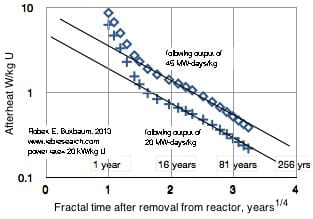
But nuclear waste generally consists of many radioactive components with different half lives, and these commpnents decay into other radioactive isotopes, all of whom have half-lives that vary by quite a lot. The result is that a semi-log plot is rarely helpful.  Some people therefore plot radioactivity on a log-log plot, typically including a curve for each major isotope and decay mode. I find these plots hardly useful. They are certainly impossible to extrapolate. What I’d like to propose instead is a fractal variation of the original semi-log plot: a  plot of the log of the heat rate against a fractal time. As shown below the use of time to the 1/4 power seems to be helpful. The plot is similar to a fractal decay model that I’d developed for crimes and fires a few weeks ago

Afterheat of fuel rods used to generate 20 kW/kg U; Top graph 35 MW-days/kg U; bottom graph 20 Mw-day /kg  U. Data from US NRC Regulatory Guide 3.54 - Spent Fuel Heat Generation in an Independent Spent Fuel Storage Installation, rev 1, 1999. http://www.nrc.gov/reading-rm/doc-collections/reg-guides/fuels-materials/rg/03-054/

After-heat of nuclear fuel rods used at 20 kW/kg U; Top graph 35 MW-days/kg U; bottom graph 20 Mw-day /kg U. Data from US NRC Regulatory Guide 3.54. A typical reactor has 200,000 kg of uranium.

A plausible justification for this fractal semi-log plot is to observe that the half-life of daughter isotopes relates to the parent isotopes. Unless I find that someone else has come up with this sort of plot or analysis before, I’ll call it after myself: a Buxbaum Mandelbrot plot –Why not?

Nuclear power is attractive because it is a lot more energy dense than any normal fuel. Still the graph at right illustrates the problem of radioactive waste. With nuclear, you generate about 35 MW-days of power per kg of uranium. This is enough to power an average US home for 8 years, but it produces 1 kg of radioactive waste. Even after 81 years the waste is generating about 1/2 W of decay heat. It should be easier to handle and store the 1 kg of spent uranium than to deal with the many tons of coal-smoke produced when 35 MW-days of electricity is made from coal, still, there is reason to worry about the decay heat.

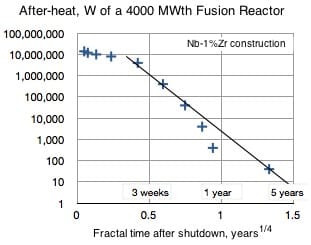
I’ve made a similar plot of decay heat of a fusion reactor, see below. Fusion looks better in this regard. A fission-based nuclear reactor to power 1/2 of Detroit, would hold some 200,000 kg of uranium that would be replaced every 5 years. Even 81 years after removal, the after-heat would be about 100 kW, and that’s a lot.

Afterheat of a 4000 MWth Fusion Reactor, from UMAC III Report. Nb-1%Zr is a fairly common high-temerature engineering material of construction.

After-heat of a 4000 MWth Fusion Reactor built from niobium-1%zirconium; from UWMAC III Report. The after heat is far less than with normal uranium fission.

The plot of the after-heat of a similar power fusion reactor (right) shows a far greater slope, but the same time to the1/4 power dependence. The heat output drops from 1 MW at 3 weeks to only 100 W after 1 year and far less than 1 W after 81 years. Nuclear fusion is still a few years off, but the plot at left shows the advantages fairly clearly, I. think.

This plot was really designed to look at the statistics of crime, fires, and the need for servers / checkout people.

Dr. R.E. Buxbaum, January 2, 2014, edited Aug 30, 2022. *A final, final thought about theory from Yogi Berra: “In theory, it matches reality.”

Toxic chemistry you can do at home

I got my start on science working with a 7 chemical, chemistry set that my sister got me when I was 7 years old (thanks Beverly). The chemicals would never be sold by a US company today — too much liability. What if your child poisons himself/herself or someone else, or is allergic, or someone chokes on the caps (anything the size of a nut has to be labeled as a hazard). Many of the experiments were called magic, and they were, in the sense that, if you did them 200 years earlier, you’d be burnt as a witch. There were dramatic color changes (phenolphthalein plus base, Prussian Blue) a time-delay experiment involving cobalt, and even an experiment that (as I recall) burst into fire on its own (glycerine plus granulated potassium permanganate).

Better evil through science. If you get good at this, the military may have use of your services.

“Better the evil you know.” If you get good at this, the military may have use of your services. Yes, the American military does science.

Science kits nowadays don’t do anything magically cool like that, and they don’t really teach chemistry, either, I think. Doing magical things requires chemicals that are reasonably reactive, and that means corrosive and/or toxic. Current kits use only food products like corn-starch or baking soda, and the best you can do with these is to make goo and/ or bubbles. No one would be burnt at the stake for this, even 300 years ago. I suppose one could design a program that used these materials to teach something about flow, or nucleation, but that would require math, and the kit producers fear that any math will turn off kids and stop their parents from spending money. There is also the issue of motivation. Much of historical chemistry was driven by greed and war; these are issues that still motivate kids, but that modern set-makers would like to ignore. Instead, current kits are supposed to be exciting in a cooperative way (whatever that means), because the kit-maker says so. They are not. I went through every experiment in my first kit in the first day, and got things right within the first week — showing off to whoever would watch. Modern kits don’t motivate this sort of use; I doubt most get half-used in a lifetime.

There are some foreign-made chemistry sets still that are pretty good. Here is a link to a decent mid-range one from England. But it’s sort of pricy, and already somewhat dumbed down. Instead, here are some cheaper, more dangerous, American options: 5 experiments you can do (kids and parents together, please) using toxic household chemicals found in our US hardware stores. These are NOT the safest experiments, just cheap ones that are interesting. I’ll also try to give some math and explanations — so you’ll understand what’s happening on a deeper level — and I’ll give some financial motivation — some commercial value.

1) Crystal Drano + aluminum. Crystal Drano is available in the hardware store. It’s mostly lye, sodium hydroxide, one of the strongest bases known to man. It’s a toxic (highly poisonous) chemical used to dissolve hair and fat in a drain. It will also dissolve some metals and it will dissolve you if you get it on yourself (if you do get it on yourself, wash it off fast with lots of water). Drano also contains ammonium nitrate (an explosive) and bits of aluminum. For the most part, the aluminum is there so that the Drano will get hot in the clogged drain (heat helps it dissolve the clog faster). I’ll explain the ammonium nitrate later. For this experiment, you’re going to want to work outside, on a dinner plate on the street. You’ll use additional aluminum (aluminum foil), and you’ll get more heat and fun gases. Fold up a 1 foot square of aluminum foil to 6″ x 4″ say, and put it on the plate (outside). Put an indent in the middle of the foil making a sort of small cup — one that can stand. Into this indent, put a tablespoon or two of water plus a teaspoon of Drano. Wait about 5 minutes, and you will see that the Drano starts smoking and the aluminum foils starts to dissolve. The plate will start to get hot and you will begin to notice a bad smell (ammonia). The aluminum foil will turn black and will continue to dissolve till there is a hole in the middle of the indent. Draino

The main reaction is 2 Al + 3 H2O –> Al2O3 + H2; that is, aluminum plus water gives you aluminum oxide (alumina), and hydrogen. The sodium hydroxide (lye) in the Drano is a catalyst in this reaction, something that is not consumed in this reaction but makes it happen faster than otherwise. The hydrogen you produce here is explosive and valuable (I explain below). But there is another reaction going on too, the one that makes the bad smell. When ammonium nitrate is heated in the presence of sodium hydroxide, it reacts to make ammonia and sodium nitrate. The reaction formula is: NH4-NO3 + NaOH –> NH3 + NaNO3 + H2O. The ammonia produced gives off a smell, something that is important for safety — the smell is a warning — and (I think) helps keep the aluminum gunk from clogging the drain by reacting with the aluminum oxide to form aluminum amine hydroxide Al2O3(NH3)2. It’s a fun experiment to watch, but you can do more if you like. The hydrogen and ammonia are flammable and is useful for other experiments (below). If you collect these gases, you can can make explosions or fill a balloon that will float. Currently the US military, and several manufacturers in Asia are considering using the hydrogen created this way to power motorcycles by way of a fuel cell. There is also the Hindenburg, a zeppelin that went around the world in the 1930s. It was kept aloft by hydrogen. The ammonia you make has value too, though toxic; if bubbled into water, it makes ammonium hydroxide NH3 + H2O –> NH4OH. This is a common cleaning liquid. Just to remind you: you’re supposed to do these experiments outside to dissipate the toxic gases and to avoid an explosion in your house. A parent will come in handy if you get this stuff on your hand or in your eye.

Next experiment: check that iron does not dissolve in Drano, but it does in acid (that’s experiment 5; done with Muriatic acid from the hardware store). Try also copper, and solder (mostly tin, these days). Metals that dissolve well in Drano are near the right of the periodic table, like aluminum. Aluminum is nearly a non-metal, and thus can be expected to have an oxide that reacts with hydroxide. Iron and steel have oxides that are bases themselves, and thus don’t react with lye. This is important as otherwise Drano would destroy your iron drain, not only the hair in it. It’s somewhat hard on copper though, so beware if you’ve a copper drain.

Thought problem: based on the formulas above figure out the right mix of aluminum, NaOH, water and Ammonium nitrate. Answer: note that, for every two atoms of aluminum you dissolve, you’ll need three molecules of water (for the three O atoms), plus at least two molecules of ammonium nitrate (to provide the two NH2 (amine) groups above. You’ll also want at least 2 molecules of NaOH to have enough Na to react with the nitrate groups of the ammonium nitrate. As a first guess, assume that all atoms are the same size. A better way to do this involves molecular weights (formula weights), read a chemistry book, or look on the internet.

Four more experiments can be seen here. This post was getting to be over-long.As with this experiment, wear gloves and eye protection; don’t drink the chemicals, and if you get any chemicals on you, wash them off quick.

Here are a few more experiments in electrochemistry and biology, perhaps I’ll add more. In the meantime, if you or your child are interested in science, I’d suggest you read science books by Mr Wizard, or Isaac Asimov, and that you learn math. Another thought, take out a high school chemistry text-book at the library — preferably an old one with experiments..

Robert Buxbaum, December 29, 2013. If you are interested in weather flow, by the way, here is a bit on why tornadoes and hurricanes lift stuff up, and on how/ why they form. 

Genetically modified food not found to cause cancer.

It’s always nice when a study is retracted, especially so if the study alerts the world to a danger that is found to not exist. Retractions don’t happen often enough, I think, given that false positives should occur in at least 5% of all biological studies. Biological studies typically use 95% confidence limits, a confidence limit that indicates there will be false positives 5% of the time for the best-run versions (or 10% if both 5% tails are taken to be significant). These false positives will appear in 5-10% of all papers as an expected result of statistics, no matter how carefully the study is done, or how many rats used. Still, one hopes that researchers will check for confirmation from other researchers and other groups within the study. Neither check was not done in a well publicized, recent paper claiming genetically modified foods cause cancer. Worse yet, the experiment design was such that false positives were almost guaranteed.

Séralini published this book, “We are all Guinea Pigs,” simultaneously with the paper.

As reported in Nature, the journal Food and Chemical Toxicology retracted a 2012 paper by Gilles-Eric Séralini claiming that eating genetically modified (GM) maize causes cancerous tumors in rats despite “no evidence of fraud or intentional misrepresentation.” I would not exactly say no evidence. For one, the choice of rats and length of the study was such that a 30% of the rats would be expected to get cancer and die even under the best of circumstances. Also, Séralini failed to mention that earlier studies had come to the opposite conclusion about GM foods. Even the same journal had published a review of 12 long-term studies, between 90 days and two years, that showed no harm from GM corn or other GM crops. Those reports didn’t get much press because it is hard to get excited at good news, still you’d have hoped the journal editors would demand their review, at least, would be referenced in a paper stating the contrary.

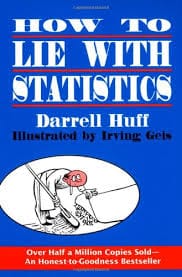
A wonderful book on understanding the correct and incorrect uses of statistics.

A wonderful book on understanding the correct and incorrect uses of statistics.

The main problem I found is that the study was organized to virtually guarantee false positives. Séralini took 200 rats and divided them into 20 groups of 10. Taking two groups of ten (one male, one female) as a control, he fed the other 18 groups of ten various doses of genetically modified grain, either alone of mixed with roundup, a pesticide often used with GM foods. Based on pure statistics, and 95% confidence, you should expect that, out of the 18 groups fed GM grain there is a 1- .9518 chance (60%) that at least one group will show cancer increase, and a similar 60% chance that at least one group will show cancer decrease at the 95% confidence level. Séralini’s study found both these results: One group, the female rats fed with 10% GM grain and no roundup, showed cancer increase; another group, the female rats fed 33% GM grain and no roundup, showed cancer decrease — both at the 95% confidence level. Séralini then dismissed the observation of cancer decrease, and published the inflammatory article and a companion book (“We are all Guinea Pigs,” pictured above) proclaiming that GM grain causes cancer. Better editors would have forced Séralini to acknowledge the observation of cancer decrease, or demanded he analyze the data by linear regression. If he had, Séralini would have found no net cancer effect. Instead he got to publish his bad statistics, and (since non of the counter studies were mentioned) unleashed a firestorm of GM grain products pulled from store shelves.

Did Séralini knowingly design a research method aimed to produce false positives? In a sense, I’d hope so; the alternative is pure ignorance. Séralini is a long-time, anti GM-activist. He claims he used few rats because he was not expecting to find any cancer — no previous tests on GM foods had suggested a cancer risk!? But this is mis-direction; no matter how many rats in each group, if you use 20 groups this way, there is a 60% chance you’ll find at least one group with cancer at the 95% confidence limit. (This is Poisson-type statistics see here). My suspicion is that Séralini knowingly gamed the experiments in an effort to save the world from something he was sure was bad. That he was a do-gooder twisting science for the greater good.

The most common reason for retraction is that the article has appeared elsewhere, either as a substantial repeat from the authors, or from other authors by plagiarism or coincidence. (BC Comics, by Johnny Hart, 11/25/10).

It’s important to cite previous work and aspects of the current work that may undermine the story you’d like to tell; BC Comics, Johnny Hart.

This was not the only major  retraction of the month, by the way. The Harrisburg Patriot & Union retracted its 1863 review of Lincoln’s Gettysburg Address, a speech the editors originally panned as “silly remarks”, deserving “a veil of oblivion….” In a sense, it’s nice that they reconsidered, and “…have come to a different conclusion…” My guess is that the editors were originally motivated by do-gooder instinct; they hoped to shorten the war by panning the speech.

There is an entire blog devoted to retractions, by the way:  http://retractionwatch.com. A good friend, Richard Fezza alerted me to it. I went to high school with him, then through under-grad at Cooper Union, and to grad school at Princeton, where we both earned PhDs. We’ll probably end up in the same old-age home. Cooper Union tried to foster a skeptical attitude against group-think.

Robert Buxbaum, Dec 23, 2013. Here is a short essay on the correct way to do science, and how to organize experiments (randomly) to make biassed analysis less likely. I’ve also written on nearly normal statistics, and near poisson statistics. Plus on other random stuff in the science and art world: Time travel, anti-matter, the size of the universe, Surrealism, Architecture, Music.

When to enter a neighbors war or family dispute

As I write this, our favored insurgents in Syria have been over-run by our disfavored insurgents, who may be over-run by the government we are trying to topple. We have also committed to help Japan and Vietnam in their disputes with China. I’ve also had the experience of dealing with a couple going through a bitter divorce. So here are five thoughts for myself and president Obama on getting involved in other people’s problems. I’ll hope that at least one person (me) listens.

1. Learn how to wait without committing to either side so you don’t step in something really smelly. Commiserate with both sides; yes you have grievances, yes what they’ve done isn’t nice. Suggest outside review. Just don’t commit until you feel comfortable sticking with this one side in victory, defeat, or (possible) reconciliation.

In a war, even simple gifts of food or transport are support; avoid these gifts, and especially avoid gifts to both sides. Assume any support to a side will be considered treason from the other side. Supporting both sides just causes havoc, and it’s always possible that your gifts will fall in the hands of the wrong side, as in Syria.

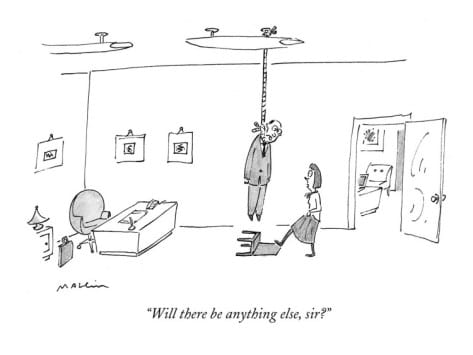
Being helpful isn't always helpful. Matthew Deffee, The New Yorker

Being helpful isn’t always helpful, or appreciated. Learn to wait. Matthew Deffee, The New Yorker

Remind yourself that disputes are a normal part of life, that peace always comes eventually, and that disputes are sometimes good in the long run. Offer sympathy only until you really want to support one side or the other — or until they make peace. When peace comes, it’s possible that the resolution will be better than the status quo-anti. As such, perhaps long-term non-intervention is the best cure. Time often answers what wisdom does not.

2.  If you choose to support a side, only support one that openly, and traditionally supports us. No Syrian leaders have openly pledged support to the US and its allies; why ally with someone who won’t support you? The enemy of your enemy might be another enemy, as with the Taliban. In a marriage dispute, lean to support your close relative or friend — it’s less offensive than the opposite, and less likely to cause hurt. As bad as it is when two sides attack each other, it’s worse when both attack you.

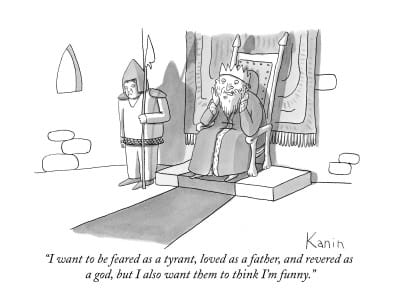
Only support someone who could rule reasonably honestly and well. Chaos is worse than a dictator. Kanin from the New Yorker.

Only support someone who could rule reasonably well. Chaos is worse than a dictator. Kanin from the New Yorker.

3. If you feel it’s important to act in a neighbor’s dispute, you don’t always have to ally with either side. You can retaliate for someone blowing up a ship or killing an advisor, or beating their children by intervening at a distance. Perhaps you can use a missile (ideally against a pointless target), or sanctions, or by the UN or a volunteer force (this tends to work for the US). In family disputes, it’s often best to send a councilor or the police or child protective services. There is room to escalate or de-escalate an action like this depending on how things play out. And it’s easier to distance yourself from a 3rd party’s actions than from one’s own. It is not necessary to support either side to achieve a personal goal or protect children in a divorce.

4.  If you decide to choose sides, make sure to keep in mind the end you seek: what good you want to do, what reasonable peace you seek, then act. Do not worry that you can not do everything, but make sure you target a viable end, and that you support a side that could win and rule. Try to pick a side that’s moral and perceived as legitimate from within, but if you can’t, at least pick one that could rule the country or manage the family without your help. Don’t support a loser, or one who can’t stand on his/her own. Chaos is worse than a crooked dictator; see, for example, the French Revolution. In a fight between parents, make sure the one you support could actually raise the kids. And once the goal is achieved, don’t stay too long. If a friend tells you to go, as in Afghanistan, leave quickly. Independence is the goal we hope for — for our children, our friends, and our neighbors.

Being a fair broker of peace is a great role -- in the proper time. From the New Yorker

Being a fair broker of peace is a great role — but only for the right person in the proper time. From the New Yorker

5. Be willing to serve as an honest broker of the peace. An honest broker is very valuable, and it requires that you’re perceived as unbiassed by both sides. Wait till the right moment before offering this service, and offer it like the precious jewel it is. Offer it when asked or when the fighting dies down. If the offer is refused, be willing to go away and return to the first rule. T. Roosevelt won the Nobel peace prize for ending the Russo-Japanese war because he was a good, honest broker: someone who understood the situation and could stand back when not needed.

Robert E. Buxbaum, Dec 18, 2013. Blessed are the peacemakers. 

My failed process for wood to green gasoline

Most researchers publish the results of their successful projects, and ignore the rest. It’s an understandable failing given the cost and work to publish and the general sense that the project that flops indicated a loser – researcher. Still, it’s a shame, and I’d like to break from it here to describe a worthwhile project of mine that failed — turning wood into green gasoline. You may come to believe the project worthwhile too, and figure that you might learn from my story some pathways to avoid if you decide to try it. Besides I figure that it’s an interesting tale. All success stories are similar, I find; failure can come in many ways.

Failure can come from incorrect thinking – assumptions that are wrong. One basis of my thinking was the observation that gasoline, for the most part, was crude-oil that had been fluffed up with hydrogen. The density you buy weighs about 5.5 lb/gallon while crude oil weighs 9 lb/gallon. The difference is hydrogen. Perhaps wood too could be turned into gasoline if hydrogen were added. Another insight was that the structure of wood was the structure of a long chain -alcohol,  —(CHOH)-(CHOH)-(CHOH)—. My company had long experience breaking alcohols to make hydrogen. I figured we could do something similar with wood, fluffing up the wood by breaking the long-chain alcohols to short ones.

A possible first reaction step would be to break a C-O-C bond, a ketone bond, with hydrogen:

—(CHOH)-(CH2O)-(CHOH)— + H2 –>  —(CHOH)-CH2OH + CH2OH—

The next reaction step, I imagined was de-oxygenation:

—(CHOH)-CH2OH  +  H2 –>  —(CHOH)-CH3  + H2O

At this point, we are well on the way to making gasoline, or making a gasoline-relevant alcohol like C6H11-OH. The reactions I wanted were exothermic, meaning they would probably “go” — in actuality -∆G is the determinate of reaction favorability, but usually a -∆H and -∆G go together. Of course there are other reactions that I could have worried about –Ones that produce nasty goop. Among these:

–(CHOH)-(CH2O)-(CHOH)—  –> –(CO)-(C)-(CHOH)— + H2O +H2

I didn’t worry about these reactions because I figured I could outrun them using the right combination of a high hydrogen pressure, the right (low) temperature and the right catalyst. I may have been wrong. Then again, perhaps I picked the wrong catalyst – Fe2O3/ rust, or the wrong set of conditions. I picked Fe2O3 because it was cheap and active.

I convinced myself that Fe2O3 was sufficiently specific to get the product to a good 5-6 carbon compounds for gasoline. Wood celluloses are composed of five and six-carbon ring structure, and the cost of wood is very low per energy. What could go wrong? I figured that starting with these 5-6 carbon ring structures, virtually guaranteed getting high octane products. With the low cost and all the heat energy of the wood, wood + H2 seemed like a winning way to store and transport energy. If i got 6 carbon alcohols and similar compounds they’d have high-octane and the right vapor pressures and the products should be soluble in ordinary gasoline.

And the price was right; gasoline was about $3.50/ gallon, while wood was essentially free.  Hydrogen isn’t that expensive, even using electrolysis, and membrane reactors (a major product of our company) had the potential to make it cheaper. Wood + Hydrogen seemed like the cheaper version of syngas: CO +H2, and rust is similar to normal Fischer Tropsch catalyst. My costs would be low, and I’d expected to get better conversion since I should get fewer low molecular weight products like methane, ethane and methanol. Everything fundamental looked like it was in my favor.

With all the fundamentals in place, I figured my only problem would be to design a reasonably cheap reactor. At first I considered a fluidized bed reactor, but decided on a packed bed reactor instead, 8″ long by 3/4″ OD. This was a tube, filled with wood chips and iron oxide as a catalyst. I introduced high pressure hydrogen via a 150 psi hydrogen + 5% He mix. I hoped to see gasoline and water come out the other end. (I had the hydrogen – helium mix left over from a previous experiment, and was paying rental; otherwise I would have used pure hydrogen). I used heat tape and a controller to keep the temperature near-constant.

Controlling the temperature was key, I thought, to my aim of avoiding dehydration and the formation of new carbon-carbon bonds. At too high a temperature, the cellulose molecules would combine and lose water to form a brown high molecular weight tar called bio-oil, as well as methane and char. Bio-oil is formed the same way you form caramel from sugar, and as with sugar, it’s nothing you’d want to put in a car. If I operated at too low a temperature (or with the wrong catalyst) the reaction would be too slow, and the capital costs would be excessive. I could keep the temperature in the right (Goldilocks) temperature, I thought with the right catalyst and the right (high) hydrogen pressure.

No matter how I did this, I knew that I’d get some carbon-carbon bond formation, and perhaps a little char, but so long as it wasn’t too much it should be manageable. I figured I could hydrogenate the tar and remove the char at the end of the process. Most of the gasoline energy would come from the trees, and not the hydrogen, and there would be little hydrogen wasted forming methane. Trees would always be cheap: they grow quickly, and are great at capturing solar energy. Many cities pay for disposal of their tree waste, so perhaps a city would pay us to take their wood chips. With cheap wood, the economics would be good so long as used all the hydrogen I put in, and got some reasonable fraction of energy from the wood. 

i began my reaction at 150°C with 50 psi hydrogen. At these conditions, I saw no reaction; I then raised the temperature to 200°C, then raised the pressure to 100 psi (still nothing) and then tried 250°C, still at 100psi. By now we were producing water but it was impossible to tell if we were hydrogenating the cellulose to gasoline, or dehydrating the cellulose to bio-oil.

As it turned out we were getting something worse that bio-oil: bio-oil gunk. Instead of the nasty brown liquid that’s made when wood is cooked to dehydration (water removal, caramelization), I got something that was nastier than I’d imagined possible. The wood molecules did not form nice chains but combined to form acidic, aromatic gunk (aromatic in both senses: benzine-type molecules and smelly) that still contained unreacted wood as a sort of press-board. The gunk was corrosive and reactive; it probably contained phenol, and seemed bent on reacting to form a phenolic glue. I found the gunk was insoluble in most everything: water, gasoline, oil, methanol (the only exception was ethanol). As best I can tell, you can not react this gunk with hydrogen to make gasoline as it is non-volatile, and almost impossible to get out of my clogged reactor. Perhaps a fluidized bed would be would be better, but I’m afraid it would form wood clumps even there. 

I plan to try again, perhaps using higher pressure hydrogen and perhaps a liquid hydrogen carrier, to get the hydrogen to the core of the wood and speed the catalysis of the desired products. The key is finding a carrier that is not too expensive or that can be easily recovered.

Robert E. Buxbaum, Dec 13, 2013. Here’s something on a visit to my lab, on adding hydrogen to automobile engines, and on the right way to do science. And here’s my calculation for how much wood a woodchuck chucks if a woodchuck could chuck wood, (100 lbs/ night) plus why woodchucks do not chuck wood like beavers.

Near-Poisson statistics: how many police – firemen for a small city?

In a previous post, I dealt with the nearly-normal statistics of common things, like river crests, and explained why 100 year floods come more often than once every hundred years. As is not uncommon, the data was sort-of like a normal distribution, but deviated at the tail (the fantastic tail of the abnormal distribution). But now I’d like to present my take on a sort of statistics that (I think) should be used for the common problem of uncommon events: car crashes, fires, epidemics, wars…

Normally the mathematics used for these processes is Poisson statistics, and occasionally exponential statistics. I think these approaches lead to incorrect conclusions when applied to real-world cases of interest, e.g. choosing the size of a police force or fire department of a small town that rarely sees any crime or fire. This is relevant to Oak Park Michigan (where I live). I’ll show you how it’s treated by Poisson, and will then suggest a simpler way that’s more relevant.

First, consider an idealized version of Oak Park, Michigan (a semi-true version until the 1980s): the town had a small police department and a small fire department that saw only occasional crimes or fires, all of which required only 2 or 4 people respectively. Lets imagine that the likelihood of having one small fire at a given time is x = 5%, and that of having a violent crime is y =5% (it was 6% in 2011). A police department will need to have to have 2 policemen on call at all times, but will want 4 on the 0.25% chance that there are two simultaneous crimes (.05 x .05 = .0025); the fire department will want 8 souls on call at all times for the same reason. Either department will use the other 95% of their officers dealing with training, paperwork, investigations of less-immediate cases, care of equipment, and visiting schools, but this number on call is needed for immediate response. As there are 8760 hours per year and the police and fire workers only work 2000 hours, you’ll need at least 4.4 times this many officers. We’ll add some more for administration and sick-day relief, and predict a total staff of 20 police and 40 firemen. This is, more or less, what it was in the 1980s.

If each fire or violent crime took 3 hours (1/8 of a day), you’ll find that the entire on-call staff was busy 7.3 times per year (8x365x.0025 = 7.3), or a bit more since there is likely a seasonal effect, and since fires and violent crimes don’t fall into neat time slots. Having 3 fires or violent crimes simultaneously was very rare — and for those rare times, you could call on nearby communities, or do triage.

In response to austerity (towns always overspend in the good times, and come up short later), Oak Park realized it could use fewer employees if they combined the police and fire departments into an entity renamed “Public safety.” With 45-55 employees assigned to combined police / fire duty they’d still be able to handle the few violent crimes and fires. The sum of these events occurs 10% of the time, and we can apply the sort of statistics above to suggest that about 91% of the time there will be neither a fire nor violent crime; about 9% of the time there will be one or more fires or violent crimes (there is a 5% chance for each, but also a chance that 2 happen simultaneously). At least two events will occur 0.9% of the time (2 fires, 2 crimes or one of each), and they will have 3 or more events .09% of the time, or twice per year. The combined force allowed fewer responders since it was only rarely that 4 events happened simultaneously, and some of those were 4 crimes or 3 crimes and a fire — events that needed fewer responders. Your only real worry was when you have 3 fires, something that should happen every 3 years, or so, an acceptable risk at the time.

Before going to what caused this model of police and fire service to break down as Oak Park got bigger, I should explain Poisson statistics, exponential Statistics, and Power Law/ Fractal Statistics. The only type of statistics taught for dealing with crime like this is Poisson statistics, a type that works well when the events happen so suddenly and pass so briefly that we can claim to be interested in only how often we will see multiples of them in a period of time. The Poisson distribution formula is, P = rke/r! where P is the Probability of having some number of events, r is the total number of events divided by the total number of periods, and k is the number of events we are interested in.

Using the data above for a period-time of 3 hours, we can say that r= .1, and the likelihood of zero, one, or two events begin in the 3 hour period is 90.4%, 9.04% and 0.45%. These numbers are reasonable in terms of when events happen, but they are irrelevant to the problem anyone is really interested in: what resources are needed to come to the aid of the victims. That’s the problem with Poisson statistics: it treats something that no one cares about (when the thing start), and under-predicts the important things, like how often you’ll have multiple events in-progress. For 4 events, Poisson statistics predicts it happens only .00037% of the time — true enough, but irrelevant in terms of how often multiple teams are needed out on the job. We need four teams no matter if the 4 events began in a single 3 hour period or in close succession in two adjoining periods. The events take time to deal with, and the time overlaps.

The way I’d dealt with these events, above, suggests a power law approach. In this case, each likelihood was 1/10 the previous, and the probability P = .9 x10-k . This is called power law statistics. I’ve never seen it taught, though it appears very briefly in Wikipedia. Those who like math can re-write the above relation as log10P = log10 .9 -k.

One can generalize the above so that, for example, the decay rate can be 1/8 and not 1/10 (that is the chance of having k+1 events is 1/8 that of having k events). In this case, we could say that P = 7/8 x 8-k , or more generally that log10P = log10 A –kβ. Here k is the number of teams required at any time, β is a free variable, and Α = 1-10 because the sum of all probabilities has to equal 100%.

In college math, when behaviors like this appear, they are incorrectly translated into differential form to create “exponential statistics.” One begins by saying ∂P/∂k = -βP, where β = .9 as before, or remains some free-floating term. Everything looks fine until we integrate and set the total to 100%. We find that P = 1/λ e-kλ for k ≥ 0. This looks the same as before except that the pre-exponential always comes out wrong. In the above, the chance of having 0 events turns out to be 111%. Exponential statistics has the advantage (or disadvantage) that we find a non-zero possibility of having 1/100 of a fire, or 3.14159 crimes at a given time. We assign excessive likelihoods for fractional events and end up predicting artificially low likelihoods for the discrete events we are interested in except going away from a calculus that assumes continuity in a world where there is none. Discrete math is better than calculus here.

I now wish to generalize the power law statistics, to something similar but more robust. I’ll call my development fractal statistics (there’s already a section called fractal statistics on Wikipedia, but it’s really power-law statistics; mine will be different). Fractals were championed by Benoit B. Mandelbrot (who’s middle initial, according to the old joke, stood for Benoit B. Mandelbrot). Many random processes look fractal, e.g. the stock market. Before going here, I’d like to recall that the motivation for all this is figuring out how many people to hire for a police /fire force; we are not interested in any other irrelevant factoid, like how many calls of a certain type come in during a period of time.

To choose the size of the force, lets estimate how many times per year some number of people are needed simultaneously now that the city has bigger buildings and is seeing a few larger fires, and crimes. Lets assume that the larger fires and crimes occur only .05% of the time but might require 15 officers or more. Being prepared for even one event of this size will require expanding the force to about 80 men; 50% more than we have today, but we find that this expansion isn’t enough to cover the 0.0025% of the time when we will have two such major events simultaneously. That would require a 160 man fire-squad, and we still could not deal with two major fires and a simultaneous assault, or with a strike, or a lot of people who take sick at the same time. 

To treat this situation mathematically, we’ll say that the number times per year where a certain number of people are need, relates to the number of people based on a simple modification of the power law statistics. Thus:  log10N = A – βθ  where A and β are constants, N is the number of times per year that some number of officers are needed, and θ is the number of officers needed. To solve for the constants, plot the experimental values on a semi-log scale, and find the best straight line: -β is the slope and A  is the intercept. If the line is really straight, you are now done, and I would say that the fractal order is 1. But from the above discussion, I don’t expect this line to be straight. Rather I expect it to curve upward at high θ: there will be a tail where you require a higher number of officers. One might be tempted to modify the above by adding a term like but this will cause problems at very high θ. Thus, I’d suggest a fractal fix.

My fractal modification of the equation above is the following: log10N = A-βθ-w where A and β are similar to the power law coefficients and w is the fractal order of the decay, a coefficient that I expect to be slightly less than 1. To solve for the coefficients, pick a value of w, and find the best fits for A and β as before. The right value of w is the one that results in the straightest line fit. The equation above does not look like anything I’ve seen quite, or anything like the one shown in Wikipedia under the heading of fractal statistics, but I believe it to be correct — or at least useful.

To treat this politically is more difficult than treating it mathematically. I suspect we will have to combine our police and fire department with those of surrounding towns, and this will likely require our city to revert to a pure police department and a pure fire department. We can’t expect other cities specialists to work with our generalists particularly well. It may also mean payments to other cities, plus (perhaps) standardizing salaries and staffing. This should save money for Oak Park and should provide better service as specialists tend to do their jobs better than generalists (they also tend to be safer). But the change goes against the desire (need) of our local politicians to hand out favors of money and jobs to their friends. Keeping a non-specialized force costs lives as well as money but that doesn’t mean we’re likely to change soon.

Robert E. Buxbaum  December 6, 2013. My two previous posts are on how to climb a ladder safely, and on the relationship between mustaches in WWII: mustache men do things, and those with similar mustache styles get along best.

Masculinist history of the modern world, pt. 2: WWII mustaches

Continuing my, somewhat tongue in cheek, Masculinist history, part 1: beards, I thought I’d move on to mustache history, centering on WWII. I see the conflict as big mustaches vs little mustaches leading to a peace of no face hair at all. First consider that, at the start of the war, virtually all the leaders had mustaches, with similar mustached men allied. Consider that Hitler was weird and hi’s mustache was weird, and that, within a few years of peace, virtually no major leader had a hairy lip. Why?

Let me begin by speculating that the mustache is worn by the man who wishes to be seen as manly, but who also wants to appear civilized. The message of the mustache, then: I’m a leader of great vision within a civilized society. Thus visionaries like Albert Einstein, Duke Ellington, S. Dali, and T. Roosevelt, all decided to grow mustaches. The mustache may not make men into champions of a new vision, but a man with the will to champion something new will tend to wear a mustache. It is thus no surprise that a world war would begin when all the world leaders had mustaches, or why a crazy person like Hitler would wear a crazy mustache, but why is it that so few world leaders have been mustached since. Where have all the mustaches gone? Read onward.

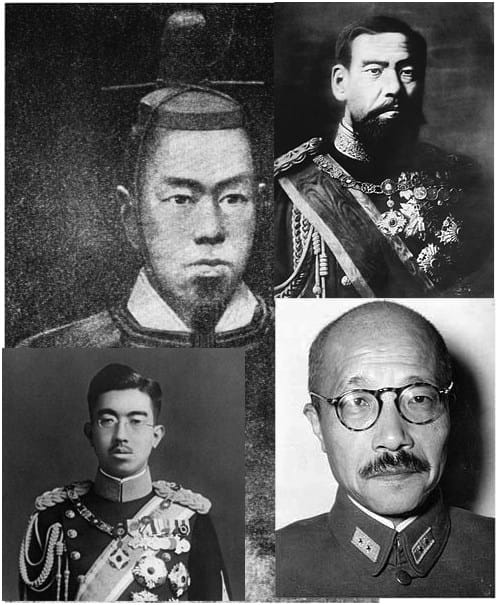
Emperor Akihito, center, had to open Japan; Emperor Meiji, upper right, a wild beard and terror who defeated China and Russia; Emperor Hirohito, bottom left, crafty mustache. Caveat Emperor. Tojo, bottom right, the man to lead the fight and pay the price.

Emperor Akihito, upper left was induced to open Japan; Emperor Meiji, upper right, defeated China and Russia; WWII Emperor Hirohito, bottom left; General Tojo, bottom right, the man to take the fall. Caveat Emperor.

As WWII begins with the Japanese, lets look at the face hair on several Japanese  emperors’ faces. At the upper left, Mikado (Emperor) Akihito. He had no vision, drive or mustache, and was induced to open Japan to the west in 1854 in response to his advisors and Admiral Perry who sailed 4 black warships into Tokyo harbor. His successor, Emperor Meiji (upper right, bearded) won wars against China and Russia in the late 1800s (see the significance of warlike beards). Emperor Hirohito, bottom left, wore the mustache and authorized the beginning of WWII including the bombing of Pearl Harbor and the rape of Nanking. His associate, General Tojo, bottom right, also mustached lead the actual deeds and took the blame. Akihito looks feminine and unhappy, as one might understand. Meiji looks like a holy terror; and both Hirohito and his general wear mustaches trimmed in the British style. My interpretation: their goal was to build a sea-land empire based on the British model.

After Emperor Meiji defeated China and Russia, his obvious next step should have been to attack the USA, but Meiji did not. Large-mustachioed, US President, Th. Roosevelt noticed the danger and used his “talk softly and carry a big stick” deterrent. He was a man of civilization and sent a “peace delegation” of white-pained warships to Tokyo Harbor. They were painted white for peace, and to differentiate the modern, civilized Roosevelt from President Tyler of the Black warships. The message seems to have gotten through to Meiji, and we had no more trouble from him, nor from his son (no face hair). But Meiji’s grandson, Hirohito joined with Tojo, and realized that all Americans were not like Th. Roosevelt. He ceased the opportunity of American isolationism and tried to get the job done as his grandfather would have wanted. They figured, correctly, that we didn’t want war, and incorrectly, that we would give up in the face of a single military victory. Hirohito had studied in England and admired the British empire. Seeing the power of bearded George V, he came to believe that a small, but unified island nation could take and hold a mighty empire so long as the nation was strong enough and understood modern organizational management. Surely it was time Japan made its empire by taking Hong Kong from England, Vietnam from France, The Philippines from the US, and (most importantly) Malaysia from the Dutch (Malaysia had oil). What’s the worst that could happen?

Hirohito built a world-power army and navy, and invaded China successfully. He fought Chiang Kai Shek (trimmed, British mustache; he was a modernizer himself). Meanwhile, for 15 years the Japanese military developed for empire. The military college planned an attack on Pearl Harbor based on careful organization and management. When carried out Dec. 7, 1941, the attack was brilliantly successful. The next day, Dec 8-9, the same “zero” planes that had hit Hawaii, helped destroy both the British navy near Hong Kong and the US airbase in the Philippines. We never even thought to prepare as we didn’t think the Japanese were organized or advance enough. The Mitsubishi “zero” was an advanced version of a Fiat design (see my piece on Fiat’s latest). As with other Fiat products, it was small, fast, maneuverable, efficient, and unreliable.

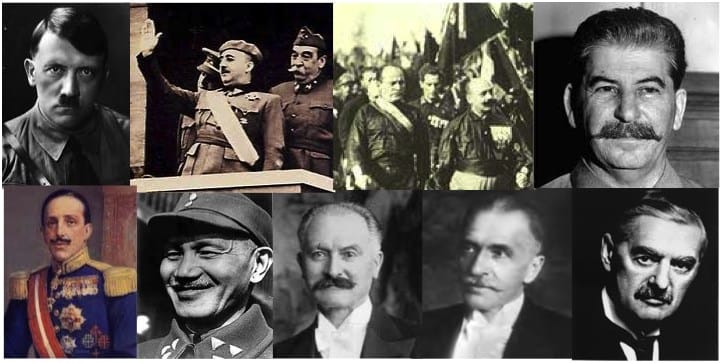
Now look at the European leaders, axis and allies, below. In the late 1930s, all sport mustaches except for Mussolini. This might suggest a world ripe for war that would benefit Mussolini: everyone’s vision can’t come to be, and most everyone might want to ally with a feminine peace-nick. At first, that’s what happened: modern military mustached Franco took over Spain from the old-fashioned, up-mustached king of Spain and his incompetent government. Mussolini was a passive ally. Big mustached Stalin took over the Baltic countries; Mussolini was his national-socialist friend. Half-mustache Hitler then allied with Mussolini and armed the Rhineland. This scares old-fashioned mustached Giraud (France) and British Chamberlain into giving him eastern Czechoslovakia. Mussolini looks on. Chamberlain comes to believe that he has achieved peace in our time, but he has not. Now, the big mustached king of Italy, Victor Emanuel chooses no-mustache Mussolini to restore Italian unity. Mussolini goes to war and takes Libya on his second try. He almost takes Greece too. Useless, clean-shaven, general Badoglio resigns. These conquests do not lead to world war or condemnation of Italy (or Germany, or Russia) The mustachioed socialists of France, Poland, England and the US have quite a lot in common with the national socialists of Germany and Italy. We hold, like they do, that the state must make the jobs if it is to pull out of the depression, and that the state must be strong, pure, and united — something best achieved by socialism and keeping immigrants out. The theme of the New York Word’s Fair in 1939 is Peace through Progress, a theme of unrealistic optimism. For now, though, the US is neutral, and all the nations have exhibitions in NY.

War of the mustache men. Top row: axis leaders at the beginning of WWII; l-r: Hitler, Franco (Spain), King Victor Emanuel and Mussolini (Italy), and Stalin (Russia, an early ally of Hitler). Bottom row: allied leaders, l-r; King Alfonso (Spain); Chang Kai Shek (China), François Lebrun (France), Ignazy Moscicki (Poland); N. Chamberlain (UK). All are mustached except Mussolini.

Top row: axis leaders at the beginning of WWII; l-r: Hitler, Franco (Spain), King Victor Emanuel and Mussolini (Italy), and Stalin Bottom row: allied leaders, l-r; King Alfonso (Spain); Chiang Kai Shek (China), François Lebrun (France), Ignazy Moscicki (Poland); N. Chamberlain (UK). All are mustached except Mussolini.

But peace isn’t in the cards as one could tell by the mustaches. Big mustache Stalin hatches a secret pact with small-mustache Hitler. They invade Poland together in September 1939. The mustache of the masses and the mustache of the pure race join to destroy Poland in a week. Because of treaties, England and France are now at war too, but they do nothing till May 1940. Not understanding that mustaches must war, they assume no war exists. This changes when Hitler sweeps his armies through Belgium and into Paris. England rejects the mustached enemies, and elects clean-shaved Winston Churchill, a Labor liberal turned Conservative. He sports a big-stick policy and wears a big-stick cigar. His cigar is like a flaming mustache, but far more mobile.

Churchill’s policies are just as mobile as his mustache. He confidently tells the masses, “We will fight them on the beaches.” And confidently tells the elites: “Remember gentlemen, it’s not just France we’re fighting for, it’s Champaign.” A cigar, unlike a mustache, can be warlike of peaceful: in your face or out depending on the group. A Republican with at cigar is a diplomat, not a dogmatist.

Churchill finds an ally in clean-shaven, cigarette holder, segregationist FDR. “Meeting FDR is like opening your first bottle of Champaign,” says Churchill, “Getting to know him is like drinking it.” The two english-speaking countries share a special relationship and similar smoking preferences. FDR, still vowing neutrality, lends England ships tanks, and money, but sends no troupes except volunteers (the Lafayette squadron). With this diplomatic, middle road in place, FDR handily defeats the shaven, cigarette smoking, war-monger, Wendell Wilkie in the 1940 election (Wilkie used to be a Democrat). The Free French take to small mustache, Charles De Gaulle, in preference to the larger mustache, Philippe Petain, or the similarly mustached Edourd Deladier and Maurice Gamelin.

De Gaulle and Churchill do not get along. De Gaulle (small mustache) wants action. He becomes the liberation of French Africa. Meanwhile, Churchill talks war, but only to defend “this rock, this England.” De Gaulle describes the differences this way:  “I get angry when I’m right, and Churchill gets angry when he’s wrong; therefore we are angry at each other quite a lot.” Churchill claims that “going to war without the French is like going hunting without your bagpipe.”

Roosevelt has much in common with Churchill as might be guessed from the lack of face hair and the similar smoking choices. The two major clean-shaven leaders meet and pray together abroad the HMS Prince of Wales in August 1941. Roosevelt meets too and gets along with Mrs. Chiang Kai Shek (no face hair, needless to say). He sends Madame Chiang a less-than-well funded, volunteer force, The American Volunteer Group, otherwise known as The Flying Tigers. This group is given 99 obsolete planes that the French had ordered, and is put under the command of Claire Chennault, a mustached WWI flier, and self-appointed colonel. Chennault recruits the drunken dregs of the US army air corps with the promise of $500 per Japanese plane. In the few months before WWII, The Flying Tigers destroy nearly 200 Japanese planes while heavily outnumbered and out gunned. Most of the flyers are mustached. Ad-hoc Volunteer forces seem to work for the USA: T. Roosevelt had success as a self-appointed Lt. Colonel 40 years earlier. Eventually, The flying Tigers are re-absorbed into the Army Air Corps; Chennault and his Tigers take a shave and join the regulars.

Meanwhile, mustached, long haired, Albert Einstein (a visionary if ever there was one) comes to understand the potential of the atom bomb. While most of the world still believes that matter and energy and independent entities, Einstein realizes that even a small amount of mass converted to energy can destroy a city. Speaking of science and art, he says, “Everything that is really great and inspiring is created by individuals who labor in freedom.” Within 5 years, his visionary ideas will help end the war, and few scientists will sport face hair or labor in freedom. Einstein encourages FDR to build the A-bomb. FDR spends $3 billion ($70B in 2013 dollars) under the management of visionary, mustachioed General Leslie Groves. The best physicists and engineers of the US and Europe join together to build the device Einstein described; it’s the A Bomb built by the A Team.

Meanwhile back in Europe, weird mustached, Hitler attacks his ally Stalin and despite massive deaths seems to be winning (c.f. Napoleon, 140 years earlier). Stalin joins the shaven allies (for now) against Germany, and immediately sets to steal the secret of the A Bomb. Churchill doesn’t trust him, a good call since Stalin is still allied with the mustached Mikado of Japan in the East against Britain. And then the Pearl Harbor attack, December 7, 1941, and everything changes. On December 8 Congress declares war on Japan, and Hitler declares war on us (perhaps the stupidest move of the 20th century). Churchill says he had the first good night’s sleep in years, but does nothing to protect the English navy or air force from Japan’s zero fighters. The HMS Prince of Wales is sunk December 10. The Canadian cost and California oil tanks are attacked by Japanese submarine-fired cannon. And what about Stalin? Through all of this, he remains allied with Japan and with us (what a man). It’s something you might have expected from his mustache.

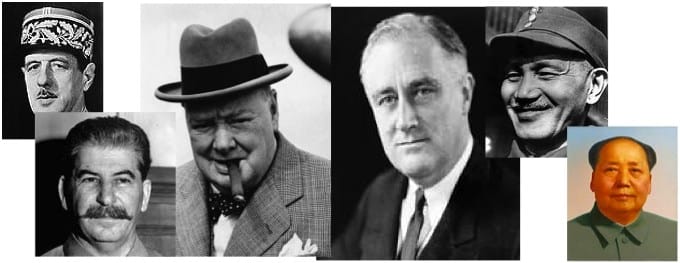
Allied leaders toward the end of WWII. De Gaulle, Stalin, Churchill, FDR, Chiang Kai Shek, Mao Tze Tung. Only de Gaulle and Stalin have mustaches; Stalin is still an ally of Japan; Mao and Chiang at war. The US and UK share a special relationship.

Decline of the mustache. Allied leaders early 1945. l-r: De Gaulle, Stalin, Churchill, FDR, Chiang Kai Shek, Mao Tze Tung. Only de Gaulle and Stalin have mustaches; Stalin is still an ally of Japan; Mao and Chiang at war over China. The US and UK share a special relationship.

US dollars and Russian manpower turn the tide in Europe. Hitler kills himself and is replaced by clean-shaven Keitel who sues for peace (too little, too late). Mussolini flees Italy for Switzerland, and gets help killing himself. Fascist-free Italy turns to a mustache-free leader: General Badoglio of the failed Greek invasion. Stalin takes over Poland, Romania, Czechoslovakia, Yugoslavia, Hungary, and East Germany. Churchill objects and is tossed out of office while negotiating at Yalta. He’s replaced by small mustached Clement Attlee who sees no problem with Stalin’s expansion. His is a  grand (socialist) vision for England.

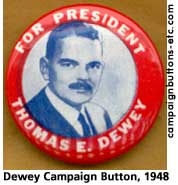
Civil-rightist Republican from NY, Tom Dewey is the major presidential candidate to host a mustache.

Civil-rightist NY Republican, Tom Dewey, the last mustached presidential hopeful, loses.

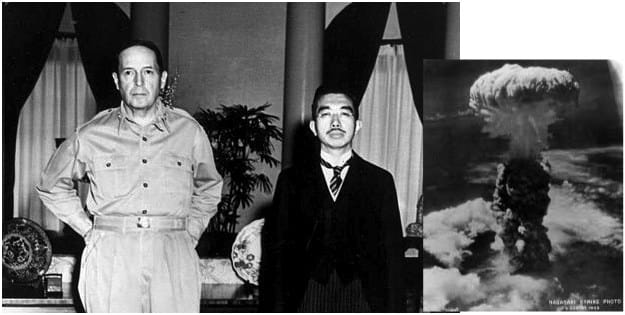
Fresh-faced, smoker, FDR dies in a liaison with a woman not his wife, and is followed by feisty, fresh-faced, non-smokier, Harry S. Truman, who continues FDR’s vision and drops two A-Bombs on Japan as twice pay-back for Pearl harbor. Stalin switches sides, sort of, for now: Japan is now his enemy, but Mao, not Chiang is a friend. Hirohito sees the new (atomic) light and the Russian army; he surrenders to the Americans. His mustache is much reduced at surrender (see below). Hirohito, still the visionary, admits he’s not a god, nor is he the gate to God (Mikado means heavenly gate; the title stops being used except for light opera). Tojo takes the blame for the war, and is executed. Mao Tze Tung conquers China after Chang Kai Shek flees to Taiwan. Stalin turns on his hairless, hapless, ex-allies. He keeps eastern Europe in contravention of the Yalta agreements, and kills a few million of his troupes: a peacetime army is dangerous. Franco keeps power in Spain.

Small-mustache Attlee builds a British A-Bomb, and takes over most of British business including The Bank of England, civil aviation, the coal mines, the steel industry, the railways, most road haulage, canals, cable and wireless, electricity and gas, and The Thomas Cooke travel agency. His grand vision provides England full employment, better work conditions, and health care, but also rationing, starvation and a lack of fuel. Attlee tries to stop Jewish migration to Israel and the formation of the state. He remains in power till 1950, becoming the last, and perhaps greatest, of several great, mustached, British prime ministers. Churchill’s shaven face returns to oversee England’s stagnation. Click for Churchill-Attlee jokes, jibes and insights.

In the US, clean-shaven Truman wins re-election against the last mustachioed presidential candidate, New York, civil-rightist, Republican, Thomas Dewey. De Gaulle is tossed out of office, but returns to build France’s A- bomb and reject NATO. De Gaulle’s little mustache is the last face hair seen on the leader of a nuclear nation.

The war ends here. Hirohito, McArthur, and Mr A-Bomb. Hirohito now has a smaller stature and mustache. Tojo gets executed.

The war ends here. Hirohito, McArthur, and Mr. A-Bomb. Hirohito now has a smaller stature and a much smaller mustache (looks like Tom Dewey, or every racist Japanese depiction). Tojo gets executed for Hirohito’s crimes. And the world moves to cautious shaven leaders and the ever-present nuclear threat.

And now the key question: why do mustaches lose favor so fast? My thought is that the Bomb is to blame. That, and the relative failures of mustached leaders in Europe. It’s a new dangerous world, with no place for men with big plans who might use the A-bomb to get-the-job-done. This is a weapon that kills more than soldiers and civilians; it could kill elites too, and no elitist wants a leader who might kill one of the elite. The A-Bomb is never again used in war, but it is always in the war room. Nuclear leaders must stay calm, and give the image of one who will use the bomb only as a last resort, to protect the home-land, or never. China, Pakistan, India, North Korea (and Israel) get “defensive” A-bombs but make no move to use them in anger. Goldwater claims he might, and is handily defeated in 1964. After WWII, all nuclear power leaders are more-or-less feminine looking, if not more feminist. Is this the future? Check out pt 1: Beards, Republicans, and Communists.

Dr. Robert E. Buxbaum, Nov. 28, 2013. I’m not sure if these post is ridiculous, or if it’s brilliant. At the least, it’s an observation of a pattern, and any observed pattern may lead to truth. I’ve written on modern architectureart how to climb a ladder without falling off, plus on guns, curtains, crimehealthcare, heat bills, nuclear power, and the minimum wage.

The 2013 hurricane drought

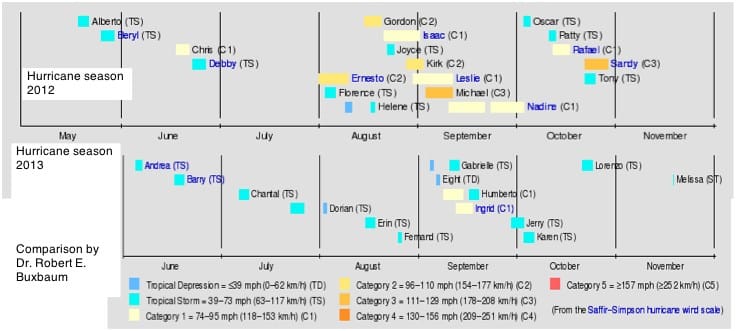
News about the bad weather that didn’t happen: there were no major hurricanes in 2013. That is, there was not one storm in the Atlantic Ocean, the Caribbean Sea, or the Gulf of Mexico with a maximum wind speed over 110 mph. None. As I write this, we are near the end of the hurricane season (it officially ends Nov. 30), and we have seen nothing like what we saw in 2012; compare the top and bottom charts below. Barring a very late, very major storm, this looks like it will go down as the most uneventful season in at least 2 decades. Our monitoring equipment has improved over the years, but even with improved detection, we’ve seen nothing major. The last time we saw this lack was 1994 — and before that 1986, 1972, and 1968.

Hurricanes 2012 -2013. This year looks like it will be the one with the lowest number and strength of modern times.

Hurricanes 2012 -2013. This year there were only two hurricanes, and both were category 1 The last time we had this few was 1994. By comparison, in 2012 we saw 5 category 1 hurricanes, 3 Category 2s, and 2 Category 3s including Sandy, the most destructive hurricane to hit New York City since 1938.

In the pacific, major storms are called typhoons, and this year has been fairly typical: 13 typhoons, 5 of them super, the same as in 2012.  Weather tends to be chaotic, but it’s nice to have a year without major hurricane damage or death.

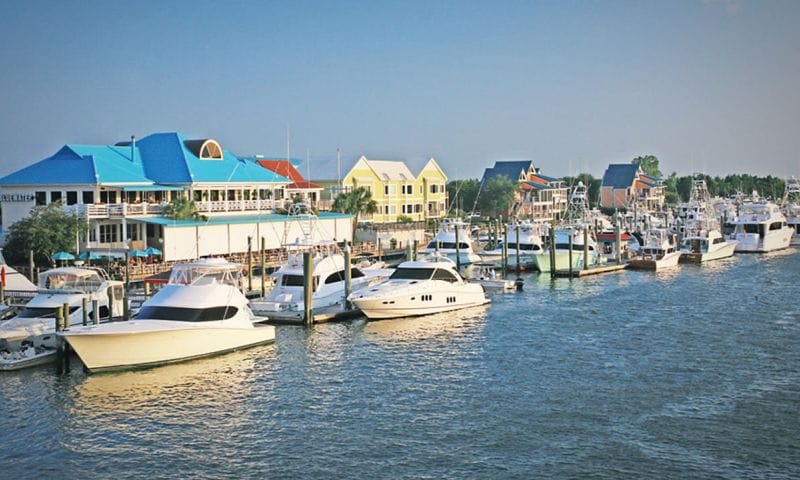
In the news this month, no major storm lead to the lack of destruction of the boats, beaches and stately homes of the North Carolina shore.

In the news, a lack of major storms lead to the lack of destruction of the boats, beaches, and stately homes of the North Carolina shore.

The reason you have not heard of this before is that it’s hard to write a story about events that didn’t happen. Good news is as important as bad, and 2013 had been predicted to be one of the worst seasons on record, but then it didn’t happen and there was nothing to write about. Global warming is supposed to increase hurricane activity, but global warming has taken a 16 year rest. You didn’t hear about the lack of global warming for the same reason you didn’t hear about the lack of storms.

Here’s why hurricanes form in fall and spin so fast, plus how they pick up stuff (an explanation from Einstein). In other good weather news, the ozone hole is smaller, and arctic ice is growing (I suggest we build a northwest passage). It’s hard to write about the lack of bad news, still Good science requires an open mind to the data, as it is, or as it isn’t. Here is a simple way to do abnormal statistics, plus why 100 year storms come more often than once every 100 years.

Robert E. Buxbaum. November 23, 2013.

Physics of no fear, no fall ladders

I recently achieved a somewhat mastery over my fear of heights while working on the flat roof of our lab building / factory. I decided to fix the flat roof of our hydrogen engineering company, REB Research (with help from employees), and that required me to climb some 20 feet to the roof to do some work myself and inspect the work of others. I was pretty sure we could tar the roof cheaper and better than the companies we’d used in the past, and decided that the roof  should be painted white over the tar or that silvered tar should be used — see why. So far the roof is holding up pretty well (looks good, no leaks) and my summer air-conditioning bills were lowered as well.

Perhaps the main part of overcoming my fear of heights was practice, but another part was understanding the physics of what it takes to climb a tall ladder safely. Once I was sure I knew what to do, I was far less afraid. As Emil Faber famously said, “Knowledge is good.”

me on tall ladder

Me on tall ladder and forces. It helps to use the step above the roof, and to have a ladder that extends 3-4′ feet past roof level

One big thing I learned (and this isn’t physics), was to not look down, especially when you are going down the ladder. It’s best to look at the ladder and make sure your hands and feet are going where they should. The next trick I learned was to use a tall ladder — one that I could angle at 20° and extends 4 feet above the roof, see figure. Those 4 feet gave me something to hold on to, and something to look at while going on and off the ladder. I found I preferred to go to or from the roof from a rung that was either at the level of the roof, or a half-step above (see figure). By contrast, I found it quite scary to step on a ladder rung that was significantly below roof level even when I had an extended ladder. I bought my ladder from Acme Ladder of Capital St. in Oak Park; a fiberglass ladder, light weight and rot-proof.

I preferred to set the ladder level (with the help of a shim if needed) at an angle about 20° to the wall, see figure. At this angle, I felt certain the ladder would not tip over from the wind or my motion, and that it would not slip at the bottom, see calculations below.

if the force of the wall acts at right angles to the ladder (mostly horizontally), the wall force will depend only on the lever angle and the center of mass for me and the ladder. It will be somewhat less than the total weight of me and the ladder times sin 20°. Since sin 20° is 0.342, I’ll say the wall force will be less than 30% of the total weight, about 65lb. The wall force provides some lift to the ladder, 34.2% of the wall force, about 22 lb, or 10% of the total weight. Mostly, the wall provides horizontal force, 65 lb x cos 20°, or about 60 lbs. This is what keeps the ladder from tipping backward if I make a sudden motion, and this is the force that must be restrained by friction from the ladder feet. At a steeper angle the anti-tip force would be less, but the slip tendency would be less too.

The rest of the total weight of me and the ladder, the 90% of the weight that is not supported by the roof, rests on the ground. This is called the “normal force,” the force in the vertical direction from the ground. The friction force, what keeps the ladder from slipping out while I’m on it, is this “normal force” times the ‘friction factor’ of the ground. The bottom of my ladder has rubber pads, suggesting a likely friction factor of .8, and perhaps more. As the normal force will be about 90% of the total weight, the slip-restraining force is calculated to be at least 72% of this weight, more than double the 28% of weight that the wall pushes with. The difference, some 44% of the weight (100 lbs or so) is what keeps the ladder from slipping, even when I get on and off the ladder. I find that I don’t need a person on the ground for physics reasons, but sometimes found it helped to steady my nerves, especially in a strong wind.

Things are not so rosy if you use a near vertical ladder, with <10° to the wall, or a widely inclined one, >40°. The vertical ladder can tip over, and the widely inclined ladder can slip at the bottom, especially if you climb past the top of the roof or if your ladder is on a slippery surface without rubber feet.

Robert E. Buxbaum Nov 20, 2013. For a visit to our lab, see here. For some thoughts on wind force, and comments on Engineering aesthetics. I owe to Th. Roosevelt the manly idea that overcoming fear is a worthy achievement. Here he is riding a moose. Here are some advantages of our hydrogen generators for gas chromatography.