Grammar on the high seas, pirate joke, trans ready

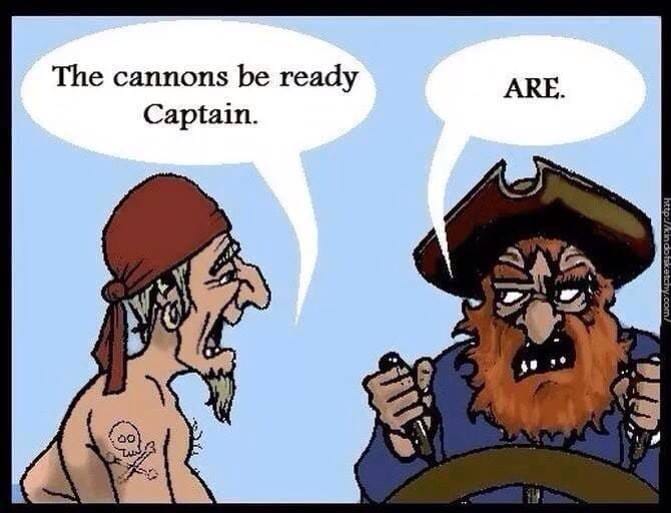
Grammar Pirate by Scott Clark, 2013.

Grammar Pirate by Scott Clark, 2013.

Pirate grammar has a special place in American English. The father of our country’s navy was likely John Paul Jones, a pirate; he redesigned our ships, captured some 16 British merchant vessels in the Revolution, and helped supply Washington’s army with guns and powder. Jean Lafitte, pirate hero of the war of 1812, may have been Jewish! The state of Michigan officially celebrates “Talk LIke a Pirate Day” September 19, the day before national pickle day.

No other country states in their constitution that a purpose of the government is to give out letters of marque — that is to mint pirates. Piracy is a great way to fight a war –severely underestimated. ISIS does it quite well. By taking supplies from the other side you weaken them while strengthening yourself. Assuming you need the stuff, you avoid the cost of manufacture, shipping, and logistics, and even if you don’t need some of it, you can usually trade these items you for items you need. It’s a great way to make foreign friends and allies. Ben Franklin sold our pirates’  captured stuff for them during the American Revolution making himself and us better liked — we had no direct need for red uniforms, for example. Pirates should not kill captured merchant seamen, I think, but ransom them , or put them to service in the cause. The Somali pirates do this; not everyone is impressed. Pirate beards may encourage bravery by showing commitment to a revolution. Here’s a song relating beards to piracy: mannen met baarden (men with beards). Bet your aaars, it’s in Dutch.

Pirate grammar is a dialect, not a sign of poor education or lack of success. I suspect that pirate grammar is more useful than standard for referring to people on the fringes of society. For example, how would you introduce a patent lawyer who’s a some-time cross-dresser? It’s simple in pirate-speak: ‘Ms Smith, pleased to meet Johnson, arrrgh patent lawyer.’ Pirate speak can also avoid the uncomfortable he/she by use of the pirate “e”: ‘E’s a scurvy sea dog, e is.’

Robert Buxbaum, July 2, 2014. I think I’ll be havin’ a rum now, and toast to Arrrgh country.

High minimum wages hurt the poor; try a negative tax

It is generally thought (correctly I suspect) that welfare is a poor way to help the poor as it robs them of the dignity of work. Something like welfare is needed to keep the poor from starving, and the ideal alternative to welfare seems to be a minimal job — that is one that is easy enough for a minimally skilled worker to do it, and high-paying enough so that this worker is able to support a family of 4. Such jobs are hard to produce, and hard to sell to those currently getting welfare — that is those getting paid the same amount for no work at all. I’d like to propose something better, a negative tax along with the removal of our minimum wage.

I suspect that our current system of minimum wage hurts the desperate poor and middle class at least as much as it helps the working poor. One problem with it is that it flattens the wage structure, hurting the ego and incentive of those who work harder or with higher skills. The minimum wage encourages lax work, and reduces the incentive of workers to improve. A higher talented or more experienced worker should make more than an unskilled beginner, but with the current minimum wages they hardly do. Our high minimum wage also hurts the desperate poor by cutting the lower rungs off of the employment ladder. Poor, unskilled, young folks are not hired because it will take a while before they’re productive enough to justify the minimum wage. And anyway, why should the minimum wage number assume that every worker lives independently (or should) and that every job deserves to support a family of four. Most unskilled workers are neither independent nor are they supporting a family of four. Most unskilled workers are not independent, nor are they the sole support of a family.

I suspect that people push for high minimum wages as a way to help without giving themselves. The cost is borne by the company, and companies are seen as evil, faceless oppressors. They prefer not to notice that the a high minimum wage creates high unemployment in central cities and other low skill areas, like Detroit before bankruptcy, and Puerto Rico today. In Detroit before bankruptcy, the living wage was set so high that companies could not compete and went bankrupt or fled. The ones that stayed hired so selectively that the unskilled were basically unemployable. Even the city couldn’t pay its wages and bills.

A high minimum wage increases the need for welfare, as some workers will be unemployable — because of disability, because of lack of skill, or from an ingrained desire to not work. The punishments a community can mete out are limited, and sooner or later some communities stop working and stop learning as they see no advantage.

The difficulties of taking care of the genuinely needy and disabled while the lazy and unskilled has gotten even some communist to reconsider wealth as a motivator. The Chinese have come to realize that workers work better at all levels if there is a financial reward to experience and skill at all levels. But that still leaves the question of who should pay to help those in need and how.  Currently the welfare system only helps the disabled and the “looking” unemployed, but I suspect they should do more replacing some of the burden that our minimum wage laws places on the employers of unskilled labor. But I suspect the payment formula should be such that the worker ends up richer for every additional hour of work. That is, each dollar earned by a welfare recipient should result in less than one dollar reduction in welfare payment. Welfare would thus be set up as a negative tax that would continue to all levels of salary and need so that there is no sudden jump when the worker suddenly starts having to pay taxes. The current and proposed tax / welfare structure is shown below:

Currently someone's welfare check decreases by $1 for each dollar earned. I propose a system of negative tax (less than 100%) so each dollar earned puts a good fraction in his/her pocket.

Currently (black) someone’s welfare check decreases by $1 for each dollar earned, then he enters a stage of no tax — one keeps all he earns, and then a graduated tax. I propose a system of negative tax (red) so each dollar earned adds real income.

The system I propose (red line) would treat identically someone who is  incapacitated as someone who decided not to work, or to work at a job that paid $0/hr (e.g. working for a church). In the current system treats them differently, but there seems to be so much law and case-work and phony doctor reports involved in getting around it all that it hardly seems worth it. I’d use money as the sole motivator (all theoretical, and it may not work, but hang with me for now).

In the proposed system, a person who does not work would get some minimal income based on family need (there is still some need for case workers). If they are employed the employer would not have to pay minimum wage (or there would be a low minimum wage — $3/hr) but the employer would have to report the income and deduct, for every dollar earned some fraction in tax — 40¢ say. The net result would be that the amount of government subsidy received by the worker (disabled or not) would decrease by, for 40¢ for every dollar earned. At some salary the worker would discover that he/she was paying net tax and no longer receiving anything from the state. With this system, there is always an incentive to work more hours or develop more skills. If the minimum wage were removed too, there would be no penalty to hiring a completely unskilled worker.

At this point you may ask where the extra money will come from. In the long run, I hope the benefit comes from the reduced welfare rolls, but in the short-term, let me suggest tariffs. Tariffs can raise income and promote on-shore production. Up until 1900 or so, they were the main source of revenue for the USA. As an experiment, to see if this system works, it could be applied to enterprise zones, e.g. in Detroit.

R. E. Buxbaum, June 27, 2014. I worked out the math for this while daydreaming in an economics lecture. It strikes me as bizarre, by the way, that one can contract labor for barter, pay a pizza for two hours labor, but you can’t contract labor for less than the minimum cash-rate $7.45/hr. You can go to jail by paying less than this in cash, but not in food. In Canada they have something even more bizarre: equal wages for equal skills — a cook and a manager must earn the same, independent of how well the cook cooks or how needed the work is. No wonder violent crime is higher in Canada.

17+ years of no climate change

Much of the data underlying climate change is bad, as best I can tell, and quite a lot of the animosity surrounding climate legislation comes from the failure to acknowledge this. Our (US) government likes to show the climate increasing at 4-6°C/century, or .05°C/year, but this is based on bad data of average global temperatures, truncated conveniently to 1880, and the incorrect assumption that trends always continue — a bad idea for stock investing too. We really don’t have any good world-wide temperature going back any further the 1990s, something the Canadian ice service acknowledges (see chart below) but we do not. Worse yet, we adjust our data to correct for supposed errors.

Theory vs experiment in climate change data

Theory vs experiment in climate change data; 17 years with no change.

High quality observations begin only about 10 years ago, and since then we have seen 17+ years of no significant climate change, not the .05°C per year predicted. Our models predicted an ice-free Arctic by 2013, but we had one of the coldest winters of the century. Clearly the models are wrong. Heat can’t hide, and in particular it can’t hide in the upper atmosphere where the heat is supposed to be congregating. The predictive models were not chaotic, and weather is, but instead show regular, slow temperature rises based on predictions of past experimental data.

In Canada and Australia, the climate experts are nice enough to put confidence bars on the extrapolated data before publishing it. Some researchers are also nice enough to provide data going back further, to late Roman times when the weather was really warm, or 20,000 years ago, when we had an ice age (it’s unlikely that the ice age ended because of automobile traffic).

Canada's version of Ice coverage data. The grey part is the error bar. Canada is nice enough to admit they know relatively little of what the climate was like in the 70s and 80s. We do not.

Canada’s version of Ice coverage data. The grey part is the error bar. Canada is nice enough to admit they don’t know what it was like in the 70s and 80s. We do not.

So what’s so wrong about stopping US coal use, even if it does not cause global warming. For one, it’s bad diplomatically — it weakens us and strengthens countries that hate us (like Iran), and countries like China that burn lots of coal and really pollute the air. It also diverts the US from real air pollution and land use discussions. If you want less air pollution, perhaps nuclear is the way to go. Finally, there you have to ask, even if we could adjust the earth’s temperature at will, who would get control of the thermostat? Who would decide if this summer should be warm or cold, or who should get rains, or sun. With great power comes great headaches.

Robert Buxbaum, June 21, 2014

My solution to the world’s problems: better people

Most of the problems of the world are caused by people. Look at war, it’s caused by people; look at pollution, people; look at overeating, or welfare, or gun violence. You name it, the problem is people. My simple solution, then: better people. Immigration is a simple solution for a county that can do it selectively (take in the best, leave the rest); it’s worked for the US and it doesn’t have to beggar the third world. Education is another way to help, but we’re not quite sure what sort of education makes people better. “An uneducated man may steel from a boxcar, an educated one may steal the whole railroad.” Theodore Roosevelt is supposed to have quipped.

Those who claim they are uncommonly moral and good at teaching have barely any proof that they are. American schools produce financially successful people, but not particularly moral ones; Europe’s approach is different, but there’s no indication they’ve done better at moral education. We look to the 18th century, or the Greeks, but they were no more moral than us, as best I can tell. The Taliban, the communists, or similar fundamentalists claim moral superiority over the west, but from my perspective, they look even worse. 

I notice that people learn morality from one another — that is each person acts like his neighbor. I also note that people tend to act better when they are involved, and feel part of whatever country, city or group they are in. Targeted immigration might bring in better people–honest, hard working, non-violent — and these people might help improve and motivate the locals. And even if we don’t improve by interaction, perhaps lazy Americans will ride on the backs of the hard-working immigrants. But it strikes me that the disconnect between world problems of high unemployment, world hunger, and lots of open, US jobs is a moral problem that could be solved by targeted love. Allowing some increased mobility from country to country and job to job (plus better preaching?). If you can move you are more-likely to find a job or place where you feel fulfilled, and you are likely to do better and more there. Even the countries and jobs that are left might benefit by being rid of their malcontents. And we don’t have to take everyone.

From "Hispanic-hope."

From “Hispanic-hope.”, an interesting combination of Bible-study and immigration morality.

Living in America is desirable for most people from most countries. Far more people want to live here than we can accept. As a result, we are in a position to target the bright, honest, hard-working Peoples from virtually any country. These folks are helpful to industry and to the US tax base as these immigrants tend to work out — or get deported. In the short-term they might displace Americans or depress salaries, but even that is not certain. There is no fixed slate of US jobs nor a fixed amount of work need. Yesterday’s job taker is tomorrow’s job creator. Our country is built on immigrants, and has not suffered from it. We should not take those who hate the US, or those who hate freedom, or have no skills, criminals and the sick. Nor should we give citizenship immediately. But that still leaves plenty who we’d want, and who want to be here. Th. Roosevelt said, “you can not take in too many of the right people, and even one of the wrong type is too many.” I suspect this is true.

I suspect we’d have 90+% odds picking good people from a crowd. The Immigration system does a good job now, and the great colleges have done better for years. The past is usually a great indicator. If someone is well, and has worked for years, or has been here in school; if they’ve managed to stay productive and out of trouble, he/she is a good candidate. A first step would be a work permit, and in a few years they can apply for permanent residence or citizenship. Many of the most successful people in America are either immigrants or descendents of immigrants. The founders of Google and Facebook; the builders and the shakers. These people have the ‘get-up and go.’ You can tell because they’ve gotten up and gone.

Dr. Robert Buxbaum, June 16, 2014. I’m a child of an immigrant, went to public school, got a PhD at Princeton, have built my own company, and have (so far) avoided arrest, imprisonment or serious scandal. With the help of my Canadian-immigrant wife, I’ve produced three Buxbaum clones, my biggest contribution to improving the US and the world.

American education sucks, how do we succeed?

Despite my PhD from a top American college, Princeton University, I find I lag ordinary Europeans in languages and history. I can claim to know some math, and a little Latin and a little Greek, but in my case it’s two short friends, Manuel Ramos and Stanos Platsis. It was recently reported that one fourth of college-educated Americans did not know that the earth spun on an axis. With an education system of this sort, how is it that the US has the largest GDP, and nearly the largest per-capita GDP. We have a grosser national product than any European country despite a degree of science ignorance that would be inconceivable there.

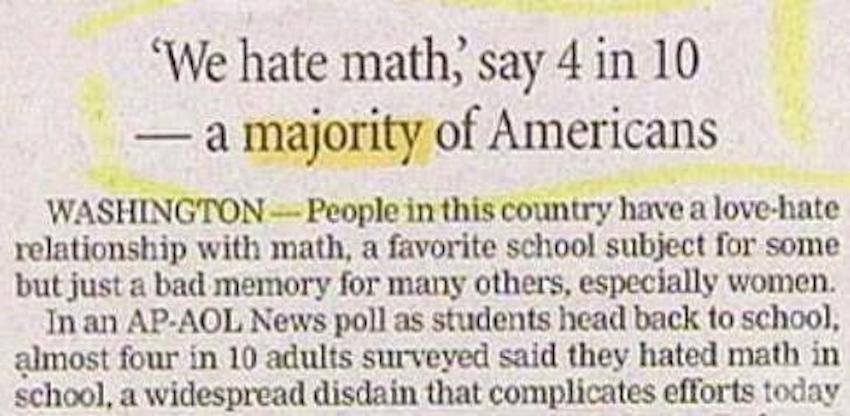
Americans hate math.

Americans hate math.

One part of US success is imported talent, of course. We import Nobel lauriate chemists, Russian dancers, German rocket scientists…, but we don’t import that many. The majority of our immigrants are more in the wretched refuse category, and even these appear to do better here in the US than their colleagues that they left behind. Otto von Bismark once joked that, “God protects children, drunks, and the United States of America.” But I’d like to suggest that our success is based on optimism, pronia: a can-do belief in ourselves that our education provides, at least to our more creative citizens.

Most of the great successful businesses of the USA are not started by the A students, it is clear, but by the C students who develop the greatness of the little they know. Consider Colonel Harlen Sanders, founder of Kentucky Fried Chicken. He believed in the greatness of his chicken recipe, and developed to skills to sell it fast. He did not have to know astronomy, whether the earth goes round the sun. It’s an important fact, but only relevant if you can use it, as Sherlock Holmes points out. I suspect that few Europeans could use the knowledge that the earth spins productively, and suspect that the majority of those that might, lack the confidence to do so (I provide some at the end of this essay).

Benjamin Jowett. His students included the heads of 6 colleges and the head of Eaton

Benjamin Jowett, Master of Balliol College, Oxford.

A classic poem about European education describes Benjamin Jowett, shown at right. It goes: “The first come I, my name is Jowett. There is no knowledge, but that I know it. I am master of this college. What I don’t know isn’t knowledge.” Benjamin Jowett was Master of Balliol College, Oxford. By the time he died in 1893, his ex-student pallbearers included the heads of 6 colleges, and the head of Eaton. Most English heads of state and industry were his students directly or second-hand. All left university with a passing knowledge of Greek, Latin, Plato, law, science, theology, classics, math, rhetoric, logic, and grammar. Only people so educated were deemed suited to run banks or manage backward nations like India or Rhodesia. It worked for a while but showed its limitations, e.g. in the Boer Wars.

In France and continental Europe, the education system is similar, to this day ,to England’s under Jowett. There is a fixed set of knowledge and a fixed rate to learn it. Government and industry jobs go largely to those who’ve demonstrated their ability to give the fixed, correct answers to tests on this knowledge. In schools across France, the same page is turned virtually simultaneously in the every school– no student is left behind, but none jump ahead either or deviate. As new knowledge is integrated, the approved text books are updated and the correct answers are adjusted. Until then, the answers in the book are God’s truth, and those who master it can comfort themselves to have mastered the truth. The European system appears to benefit the many, providing useful skills (and useless tidbits) but it is oppressive to others with forward-thinking, imaginative minds, or who see a new truth a year before the test acknowledges it. College, it is said, “..is a place where pebbles are polished but diamonds are dimmed.” The system work well in areas that barely change like French grammar, geometry, law, and the map of Europe. It does not work so well in music, computers, or the art of war. For creative students, bright or otherwise, schooling is “another brick in the wall.” These students need learning in ‘how to get along without a teacher.’

The American approach leans, or perhaps leaned, towards independence of thought, for good or bad. American graduates can live without the teacher, but leave school knowing no language but English, knowing hardly and maths or science, and hardly any grammar. We can hardly find another country on a map, and often can’t find our own. Teachers will take incorrect answers as correct as a way to build self-esteem, so students leave with the view that there is no such thing as truth. Strangely, this model works, at least in music, engineering, and science where change is fast, creativity is king, and nature itself is a teacher. American graduate-schools are preeminent in these areas. In reading, history and math our graduates might well be described as galumphing ignorants.

Every now and again the US tries to Europeanize education. The “no child left behind” movement was a Republican-led effort to teach on the French model, at least in reading and math. It never caught on. Drugs are a popular approach to making American students less obstreperous, but they work only temporarily. Americans leave school ignorant, but not stupid; respectful of those who can do things, and suspicious of those with lengthy degrees. Without Latin, we do OK as managers of the most complex operations, relying on bumptious optimism and distain for hierarchy.

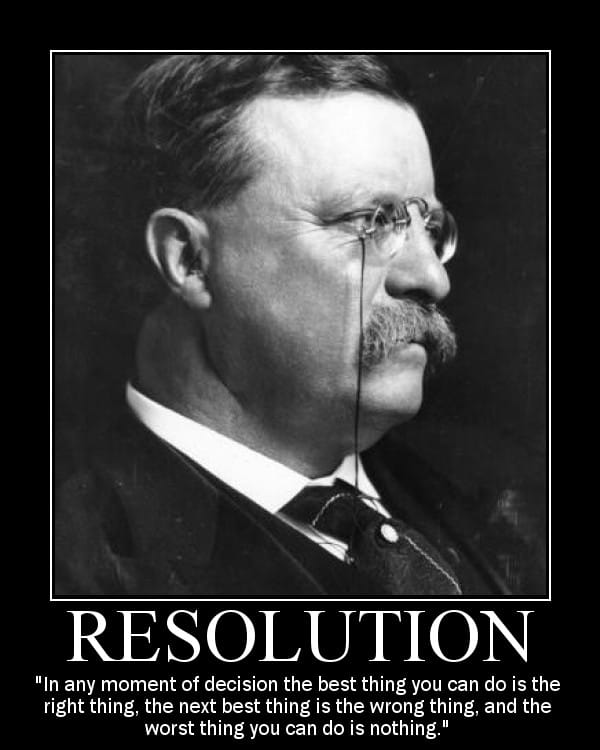
In any moment of decision, the best thing you can do is the right thing, the next bet thing is the wrong thing, and the worst thing you can do is nothing. An American attitude that sometimes blows up, but works surprisingly well at times.

Often the inability to act is worse than acting wrong.

The American-educated boss will do some damage by his ignorance but it is no more than  comes from group-think: non-truths passed as truths. America stopped burning witches far sooner than Europe, and never burned Jews. America dropped nobles quicker, and transitioned to electric lights and motor cars quicker, perhaps because we put less weight on what nobles and universities did. When dealing Europeans, we greet them in a loud, cheerful voice, appoint a subordinate to “get things done,” and get in the way until lunchtime. The Europeans are suitably appalled, both by the crassness and by the random energy.

European scholars accepted that nobility gives one a handle on leadership. This belief held back the talented, non-noble. Since religion was part of education, they accepted that state should have an established religion, Anglican, in England, Catholicism in France; scientific atheism now. They learned from the state, and accepted, that divorce was unnecessary, that homosexuality should be punished by prison or worse, In the early 60s, Turing, a brilliant mathematician and computer scientist, was chemically castrated as a way to cure his homosexuality. In America our “Yankee ingenuity,” as we call it, screwed up too, but in ways like prohibition, McCarthyism, and disco. Such screwups resolved themselves relatively fast. “Ready, fire, aim” is a European description of the American method to any problem. It’s not great, but works better than “steady as she goes.”

The best option, it seems, is when we work together with those “across the pond.” It worked well for us in WWI, WWII, and the American Revolution, benefitting from Lafayette, Baron Von Steuben, Kosciusko, etc. Heading into the world cup of football (fifa soccer) this week, we’re expected to lose badly due to our lack of talent and our general inability to pass, dribble, or strategize. Still, we’ve got enthusiasm, and we’ve got a German coach. The world’s bookies give us 0.05% odds, but our chances are 10 times that, I’d say: 5%. God protects our galumphing corn-fed ignorants when, as in the Revolution, it’s attached to European coaching.

Some businesses where it helps to know the earth spins: rocketry (military and exploratory), communication via geosynchronous satellites (they only work because the earth spins), weather prediction (the spin of hurricanes is because the earth spins), cyclone lifting. It amazes me that people ever thought everything went around the earth, by the way; Mercury and Venus never appear overhead. If authorities could have been so wrong about this for so long, what might they be wrong about today?

Dr. Robert Buxbaum, June 10, 2014 I’ve also written about ADHD on Lincoln’s Gettysburg Address, on Theodore Roosevelt, and how he survived a gun shot.

Criminal Punishment Theory

I’ve often wondered about the theory of criminal punishment. How long should sentences be? For which crimes and external circumstances should people be let off, for which should there be alternative punishments, like civic work, or a fine instead of jail time. I’ve a few ideas, but here are some thought cases:

Someone steals an expensive handbag from a clothing store. What should the punishment be for (a) a ghetto black with no job, (b) a middle-class, college sophomore (c) a famous actress? Should it be the same for all? Is jail the best punishment — it costs money, and doesn’t help the criminal or the store. If jail, how long is appropriate? Should the length of stay correspond to the cost of the bag? If the punishment is money or civic service, how should the fine vary with the wealth of the thief, or if the person is a repeat offender? Many countries have corporal punishment — why or why not?

My sense is that sentences should be shorter for less-expensive items, and longer for more expensive. My sense is that a fine or civic service is appropriate for most first offenses, and while jail seems necessary for serious crimes, if only to keep criminals off the streets, the sentences should be reasonably short and include rehabilitation. I suspect that long sentences don’t help the criminal or society. I suspect that victimless crimes, e.g. prostitution or drug sales should have very short sentences or non-jail punishments, and I’m not quite sure what to do if the thief reforms in prison or appears to.

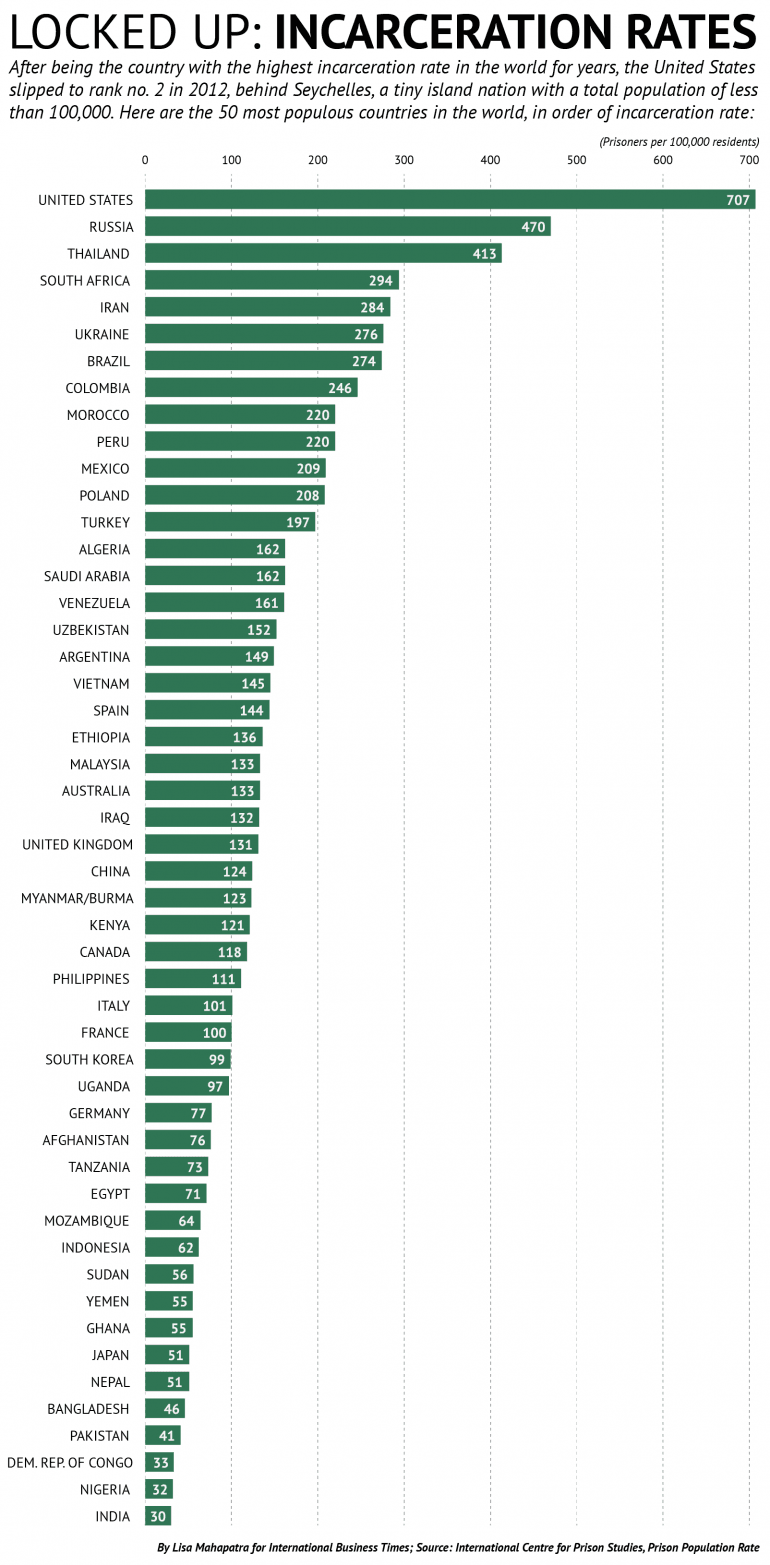
The US leads Russia, China, South Africa, and all of Europe in terms of percent of population is prison.

The US leads Russia, China, Cuba, India, and all of Europe in terms of percent of population in prison. It’s caused byvery long sentences, a product of fixed minimums. Strangely, our crime rate is low. Chart from the international business times.

Regarding prostitution perhaps it should be policed by the clergy, that’s why they get tax breaks. And why is sex between consenting adults punished as prostitution if money changes hands but not otherwise, or if the only pay is dinner? Why should the professional offender (the prostitute) pay more than the casual (the john). Why is drug use punished more than alcohol. Many drug and alcohol users live happy productive lives. To the extent that these crimes should be punished, it seems to me that fines, community service, or corporal punishment might be appropriate — I can not see prison healing a moral failing or reforming a victimless criminal.

And then there is rape. As a crime, the definition of rape has a long slippery slope, but the punishment does not. It isn’t quite clear where consensual become criminal, but the punishment is strict and undivided. We treat some cases as extreme crimes and others are let completely free. We have cases where the sex-criminal man or woman marries his or her underage partner, but is still guilty of statutory rape, and is then listed forever as a sex-criminal.

Children under 21 can not drink alcohol in the US, but they can in many other countries, and in some countries even older people can not drink at all. Is Saudi Arabia a very productive country; is Germany falling apart because of young drinkers? It seems not, so why is 21 the drinking age when you can choose to marry or join the army at 18. Soldiers are allowed to drink earlier than non-soldiers, but young marrieds are not afforded the same benefit. I don’t see why. The punishment for underage drinking varies too, as does the punishment for underage driving.

The Bible has some enlightened ideas on punishment, prescribing the use of fines of double or four or five times the value going to the victim (the thief pays 4 times for a stolen sheep, 5 times for a stolen cow, for example), but in other cases, it’s positively draconian prescribing death for homosexuality, violating the sabbath or for taking God’s name in vain. A seducer has to marry his seducee, but can not divorce her (assuming she agrees) but what if it’s an unhappy marriage? There is no room for judicial leniency in the bible, but there is in traditional applications; I’m not sure that’s not an improvement.

Robert E. Buxbaum, May 30, 2014. I’ve been wondering about the theory of appropriate punishment for at least 35 years. Are we protecting society, extracting vengeance, helping the criminal or doing some vague combination. My sense is we’re just bumbling blindly, and sorry to say, I have no answers.

Buddhists, Hindus and dentists joke

At the dentists’ office, Buddhist and Hindu monks don’t need anesthesia to have their teeth worked on. They transcend dental medication.

It’s funny because it’s a 3 word pun, and because there is something magical about the ability of people to conquer pain through meditation.

Focussed meditation can keep you from worry and other pain.

Focused meditation can keep you from worry and some physical pain. As for thugs, that’s more controversial. It’s possible that laughter, or looking at a spot will do as much. Gahan Wilson

The types of meditation, as I understand it, are two which are four. The two are focused and non-focused. focused meditation is supposed to allow you to conquer pain, both physical and spiritual. You concentrate on your breathing, or some other rhythmic action and thought; and whenever you realize that your mind is wandering you bring it back. A popular version is called square breathing: you breath in, hold, breath out, hold, etc. In time there is a sense of calm with the world. In theory, you can transcend dental medication, but I use the normal western practice of Novocaine plus gas. Meditation practitioners claim that directed meditation can also protect you from villains and bring peace in the world; I suspect that’s true, but also suspect that humor, or staring at a spot will do as much. I suspect that Dr Seuss has done wonders for peace in the world.

The second major version of mediation is non-focused; it can bring enlightenment if you use it right. You repeat a mantra slowly and let your mind wander along some general paths. The classic incantatory mantra is OM, and the classic paths include: what am I doing with my life, imagine a stick with one end, what is the sound of a hand clapping. The enlightenment that is supposed to arise is supposed to promote non-violence, charity, and a sense of oneness with the all. In general, I’ve found that letting one’s mind wander is a great way to solve difficult problems and to help one decide whether certain situations are worth being involved with. To the extent I’ve used a mantra, it’s versions of “radiator not leaking, mind leaking,” or “computer solution not unstable, mind unstable.” In the calm of realizing there is a solution, I’ve generally been able to find a solution.

Enlightenment can be as simple as realizing that you're there already or that you shouldn't manage a country that's unlike you and dislikes you.

Enlightenment can be as simple as realizing that you’re there already.

As for the other 2 types of meditation, it depends. To some, it involves rocking to the sound of the one hand clapping (or not). To some, it’s realizing you’re there already, or that you really don’t want to get involved in an Asian war to defend and manage a country that’s completely unlike yours, and that dislikes yours as well, or that it’s OK to use Novocaine and gas when you have your teeth worked on. That’s what they are there for.

Robert E. Buxbaum, May 24, 2014. Some wisdom from the Jewish mystics: Wherever you go, there you are, as for your baggage, who knows? Tea, with the first sip joy, with the second, satisfaction, with the third, Danish.

The future of steamships: steam

Most large ships and virtually all locomotives currently run on diesel power. But the diesel  engine does not drive the wheels or propeller directly; the transmission would be too big and complex. Instead, the diesel engine is used to generate electric power, and the electric power drives the ship or train via an electric motor, generally with a battery bank to provide a buffer. Current diesel generators operate at 75-300 rpm and about 40-50% efficiency (not bad), but diesel fuel is expensive. It strikes me, therefore that the next step is to switch to a cheaper fuel like coal or compressed natural gas, and convert these fuels to electricity by a partial or full steam cycle as used in land-based electric power plants

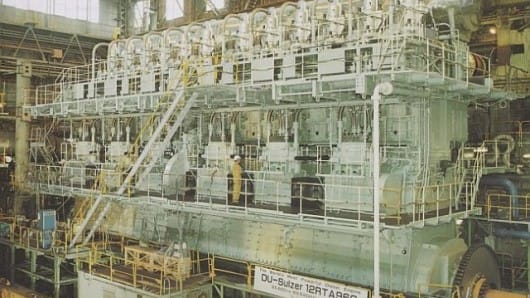
Ship-board diesel engine, 100 MW for a large container ship

Diesel engine, 100 MW for a large container ship

Steam powers all nuclear ships, and conventionally boiled steam provided the power for thousands of Liberty ships and hundreds of aircraft carriers during World War 2. Advanced steam turbine cycles are somewhat more efficient, pushing 60% efficiency for high pressure, condensed-turbine cycles that consume vaporized fuel in a gas turbine and recover the waste heat with a steam boiler exhausting to vacuum. The higher efficiency of these gas/steam turbine engines means that, even for ships that burn ship-diesel fuel (so-called bunker oil) or natural gas, there can be a cost advantage to having a degree of steam power. There are a dozen or so steam-powered ships operating on the great lakes currently. These are mostly 700-800 feet long, and operate with 1950s era steam turbines, burning bunker oil or asphalt. US Steel runs the “Arthur M Anderson”, Carson J Callaway” , “John G Munson” and “Philip R Clarke”, all built-in 1951/2. The “Upper Lakes Group” runs the “Canadian Leader”, “Canadian Provider”, “Quebecois”, and “Montrealais.” And then there is the coal-fired “Badger”. Built in 1952, the Badger is powered by two, “Skinner UniFlow” double-acting, piston engines operating at 450 psi. The Badger is cost-effective, with the low-cost of the fuel making up for the low efficiency of the 50’s technology. With larger ships, more modern boilers and turbines, and with higher pressure boilers and turbines, the economics of steam power would be far better, even for ships with modern pollution abatement.

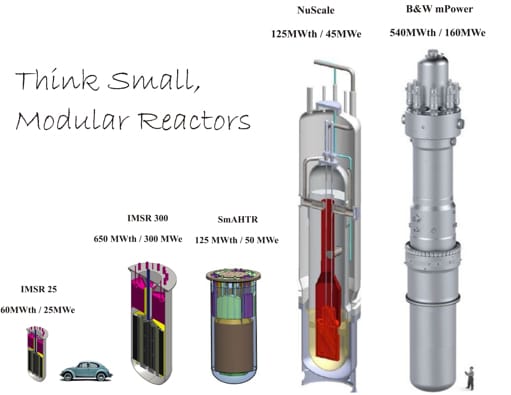
Nuclear steam boilers can be very compact

Nuclear steam boilers can be very compact

Steam powered ships can burn fuels that diesel engines can’t: coal, asphalts, or even dry wood because fuel combustion can be external to the high pressure region. Steam engines can cost more than diesel engines do, but lower fuel cost can make up for that, and the cost differences get smaller as the outputs get larger. Currently, coal costs 1/10 as much as bunker oil on a per-energy basis, and natural gas costs about 1/5 as much as bunker oil. One can burn coal cleanly and safely if the coal is dried before being loaded on the ship. Before burning, the coal would be powdered and gassified to town-gas (CO + H2O) before being burnt. The drying process removes much of the toxic impact of the coal by removing much of the mercury and toxic oxides. Gasification before combustion further reduces these problems, and reduces the tendency to form adhesions on boiler pipes — a bane of old-fashioned steam power. Natural gas requires no pretreatment, but costs twice as much as coal and requires a gas-turbine, boiler system for efficient energy use.

Todays ships and locomotives are far bigger than in the 1950s. The current standard is an engine output about 50 MW, or 170 MM Btu/hr of motive energy. Assuming a 50% efficient engine, the fuel use for a 50 MW ship or locomotive is 340 MM Btu/hr; locomotives only use this much when going up hill with a heavy load. Illinois coal costs, currently, about $60/ton, or $2.31/MM Btu. A 50 MW engine would consume about 13 tons of dry coal per hour costing $785/hr. By comparison, bunker oil costs about $3 /gallon, or $21/MM Btu. This is nearly ten times more than coal, or $ 7,140/hr for the same 50 MW output. Over 30 years of operation, the difference in fuel cost adds up to 1.5 billion dollars — about the cost of a modern container ship.

Robert E. Buxbaum, May 16, 2014. I possess a long-term interest in economics, thermodynamics, history, and the technology of the 1800s. See my steam-pump, and this page dedicated to Peter Cooper: Engineer, citizen of New York. Wood power isn’t all that bad, by the way, but as with coal, you must dry the wood, or (ideally) convert it to charcoal. You can improve the power and efficiency of diesel and automobile engines and reduce the pollution by adding hydrogen. Normal cars do not use steam because there is more start-stop, and because it takes too long to fire up the engine before one can drive. For cars, and drone airplanes, I suggest hydrogen/ fuel cells.

If hot air rises, why is it cold on mountain-tops — and what of global warming?

This is a child’s question that’s rarely answered to anyone’s satisfaction. To answer it well requires college level science, and by college the child has usually been dissuaded from asking anything scientific that would likely embarrass teacher — which is to say, from asking most anything. By a good answer, I mean here one that provides both a mathematical, checkable prediction of the temperature you’d expect to find on mountain tops, and one that also gives a feel for why it should be so. I’ll try to provide this here, as previously when explaining “why is the sky blue.” A word of warning: real science involves mathematics, something that’s often left behind, perhaps in an effort to build self-esteem. If I do a poor job, please text me back: “if hot air rises, what’s keeping you down?”

As a touchy-feely answer, please note that all materials have internal energy. It’s generally associated with the kinetic energy + potential energy of the molecules. It enters whenever a material is heated or has work done on it, and for gases, to good approximation, it equals the gas heat capacity of the gas times its temperature. For air, this is about 7 cal/mol°K times the temperature in degrees Kelvin. The average air at sea-level is taken to be at 1 atm, or 101,300  Pascals, and 15.02°C, or 288.15 °K; the internal energy of this are is thus 288.15 x 7 = 2017 cal/mol = 8420 J/mol. The internal energy of the air will decrease as the air rises, and the temperature drops for reasons I will explain below. Most diatomic gases have heat capacity of 7 cal/mol°K, a fact that is only explained by quantum mechanics; if not for quantum mechanics, the heat capacities of diatomic gases would be about 9 cal/mol°K.

Lets consider a volume of this air at this standard condition, and imagine that it is held within a weightless balloon, or plastic bag. As we pull that air up, by pulling up the bag, the bag starts to expand because the pressure is lower at high altitude (air pressure is just the weight of the air). No heat is exchanged with the surrounding air because our air will always be about as warm as its surroundings, or if you like you can imagine weightless balloon prevents it. In either case the molecules lose energy as the bag expands because they always collide with an outwardly moving wall. Alternately you can say that the air in the bag is doing work on the exterior air — expansion is work — but we are putting no work into the air as it takes no work to lift this air. The buoyancy of the air in our balloon is always about that of the surrounding air, or so we’ll assume for now.

A classic, difficult way to calculate the temperature change with altitude is to calculate the work being done by the air in the rising balloon. Work done is force times distance: w=  ∫f dz and this work should equal the effective cooling since heat and work are interchangeable. There’s an integral sign here to account for the fact that force is proportional to pressure and the air pressure will decrease as the balloon goes up. We now note that w =  ∫f dz = – ∫P dV because pressure, P = force per unit area. and volume, V is area times distance. The minus sign is because the work is being done by the air, not done on the air — it involves a loss of internal energy. Sorry to say, the temperature and pressure in the air keeps changing with volume and altitude, so it’s hard to solve the integral, but there is a simple approach based on entropy, S.

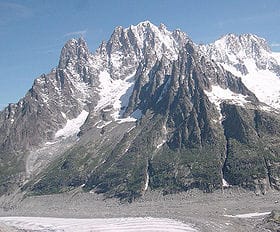
Les Droites Mountain, in the Alps, at the intersect of France Italy and Switzerland is 4000 m tall. The top is generally snow-covered.

Les Droites Mountain, in the Alps, at the intersect of France Italy and Switzerland is 4000 m tall. The top is generally snow-covered.

I discussed entropy last month, and showed it was a property of state, and further, that for any reversible path, ∆S= (Q/T)rev. That is, the entropy change for any reversible process equals the heat that enters divided by the temperature. Now, we expect the balloon rise is reversible, and since we’ve assumed no heat transfer, Q = 0. We thus expect that the entropy of air will be the same at all altitudes. Now entropy has two parts, a temperature part, Cp ln T2/T1 and a pressure part, R ln P2/P1. If the total ∆S=0 these two parts will exactly cancel.

Consider that at 4000m, the height of Les Droites, a mountain in the Mont Blanc range, the typical pressure is 61,660 Pa, about 60.85% of sea level pressure (101325 Pa). If the air were reduced to this pressure at constant temperature (∆S)T = -R ln P2/P1 where R is the gas constant, about 2 cal/mol°K, and P2/P1 = .6085; (∆S)T = -2 ln .6085. Since the total entropy change is zero, this part must equal Cp ln T2/T1 where Cp is the heat capacity of air at constant pressure, about 7 cal/mol°K for all diatomic gases, and T1 and T2 are the temperatures (Kelvin) of the air at sea level and 4000 m. (These equations are derived in most thermodynamics texts. The short version is that the entropy change from compression at constant T equals the work at constant temperature divided by T,  ∫P/TdV=  ∫R/V dV = R ln V2/V1= -R ln P2/P1. Similarly the entropy change at constant pressure = ∫dQ/T where dQ = Cp dT. This component of entropy is thus ∫dQ/T = Cp ∫dT/T = Cp ln T2/T1.) Setting the sum to equal zero, we can say that Cp ln T2/T1 =R ln .6085, or that 

T2 = T1 (.6085)R/Cp

T2 = T1(.6085)2/7   where 0.6065 is the pressure ratio at 4000, and because for air and most diatomic gases, R/Cp = 2/7 to very good approximation, matching the prediction from quantum mechanics.

From the above, we calculate T2 = 288.15 x .8676 = 250.0°K, or -23.15 °C. This is cold enough to provide snow  on Les Droites nearly year round, and it’s pretty accurate. The typical temperature at 4000 m is 262.17 K (-11°C). That’s 26°C colder than at sea-level, and only 12°C warmer than we’d predicted.

There are three weak assumptions behind the 11°C error in our predictions: (1) that the air that rises is no hotter than the air that does not, and (2) that the air’s not heated by radiation from the sun or earth, and (3) that there is no heat exchange with the surrounding air, e.g. from rain or snow formation. The last of these errors is thought to be the largest, but it’s still not large enough to cause serious problems.

The snow cover on Kilimanjaro, 2013. If global warming models were true, it should be gone, or mostly gone.

Snow on Kilimanjaro, Tanzania 2013. If global warming models were true, the ground should be 4°C warmer than 100 years ago, and the air at this altitude, about 7°C (12°F) warmer; and the snow should be gone.

You can use this approach, with different exponents, estimate the temperature at the center of Jupiter, or at the center of neutron stars. This iso-entropic calculation is the model that’s used here, though it’s understood that may be off by a fair percentage. You can also ask questions about global warming: increased CO2 at this level is supposed to cause extreme heating at 4000m, enough to heat the earth below by 4°C/century or more. As it happens, the temperature and snow cover on Les Droites and other Alp ski areas has been studied carefully for many decades; they are not warming as best we can tell (here’s a discussion). By all rights, Mt Blanc should be Mt Green by now; no one knows why. The earth too seems to have stopped warming. My theory: clouds. 

Robert Buxbaum, May 10, 2014. Science requires you check your theory for internal and external weakness. Here’s why the sky is blue, not green.

Getting rid of hydrogen

Though most of my company’s business is making hydrogen or purifying it, or consulting about it, we also provide sorbers and membranes that allow a customer to get rid of unwanted hydrogen, or remove it from a space where it is not wanted. A common example is a customer who has a battery system for long-term operation under the sea, or in space. The battery or the metal containment is then found to degas hydrogen, perhaps from a corrosion reaction. The hydrogen may interfere with his electronics, or the customer fears it will reach explosive levels. In one case the customer’s system was monitoring deep oil wells and hydrogen from the well was messing up its fiber optic communications.

img505

Pd-coated niobium screws used to getter hydrogen from electronic packages.

For many of these problems, the simplest solution is an organic hydrogen getter of palladium-catalyst and a labile unsaturated hydrocarbon, e.g. buckminsterfullerene. These hydrogen getters are effective in air or inert gas at temperatures between about -20°C and 150°C. When used in an inert gas the organic is hydrogenated, there is a finite amount of removal per gram of sober. When used in air the catalyst promotes the water-forming reaction, and thus there is a lot more hydrogen removal. Depending on the organic, we can provide gettering to lower temperatures or higher. We’ve a recent patent on an organo-palladium gel to operate to 300°C, suitable for down-well hydrogen removal.

At high temperatures, generally above 100*C, we generally suggest an inorganic hydrogen remover, e.g. our platinum ceria catalyst. This material is suitable for hydrogen removal from air, including from polluted air like that in radioactive waste storage areas. Platinum catalyst works long-term at temperatures between about 0°C and 600°C. The catalyst-sorber also works without air, reducing Ce2O3 to CeO and converting hydrogen irreversibly to water (H2O). As with the organo-Pd getters, there is a finite amount of hydrogen removal per gram when these materials are used in a sealed environment.

Low temperature, Pd-grey coated, Pd-Ag membranes made for the space shuttle to remove hydrogen from the drinking water at room temperature. The water came from the fuel cells.

Low temperature, metal membranes made for NASA to remove H2 from  drinking water at room temperature.

Another high temperature hydrogen removal option is metallic getters, e.g. yttrium or vanadium-titanium alloy. These metals require temperatures in excess of 100°C to be effective, and typically do not work well in air. They are best suited for removing hydrogen a vacuum or inert gas, converting it to metallic hydride. The thermodynamics of hydriding is such that, depending on the material, these getters can extract hydrogen even at temperatures up to 700°C, and at very low hydrogen pressures, below 10-9 torr. For operation in air or at 100-400°C we typically provide these getters coated with palladium to increase the hydrogen sorption rate. A fairly popular product is palladium-coated niobium screws 4-40 x 1/4″. Each screw will remove over 2000 sec of hydrogen at temperatures up to 400°C. We also provide oxygen, nitrogen and water getters. They work on the same principle, but form metallic oxides or nitrides instead of hydrides.

Our last, and highest-end, hydrogen-removal option is to provide metallic membranes. These don’t remove the hydrogen as such, but transfer it elsewhere. We’ve provided these for the space shuttle, and to the nuclear industry so that hydrogen can be vented from nuclear reactors before it has a chance to build up and case damage or interfere with heat transfer. Because nothing is used up, these membranes work, essentially forever. The Fukushima reactor explosions were from corrosion-produced hydrogen that had no acceptable way to vent.

Please contact us for more information, e.g. by phone at 248-545-0155, or check out the various sorbers in our web-siteRobert Buxbaum, May 5, 2014.