Everett, the better reviewed Gettysburg speaker

Lincoln’s election was greeted with horror by the educated classes who considered him a western rube. “Honest Ape” he was called in the press. Horace Greeley couldn’t stand him, and blamed the civil war on his reckless speech. Continuing their view that the press is never wrong, Lincoln’s Gettysburg address, November 17, 1863 was given very poor reviews, see my essay on why.

But the press wasn’t all bitterness and gall. A two-hour speech earlier that day by Edward Everett, was a hit with those who’d travelled, some hundreds of miles to hear it. Everett’s showed he was educated and understood the dire situation and causes of the battle. And he presents the conflict in a classical context, as a continuation of Roman and Greek conflicts. Here follows the beginning and end of his two hour address.
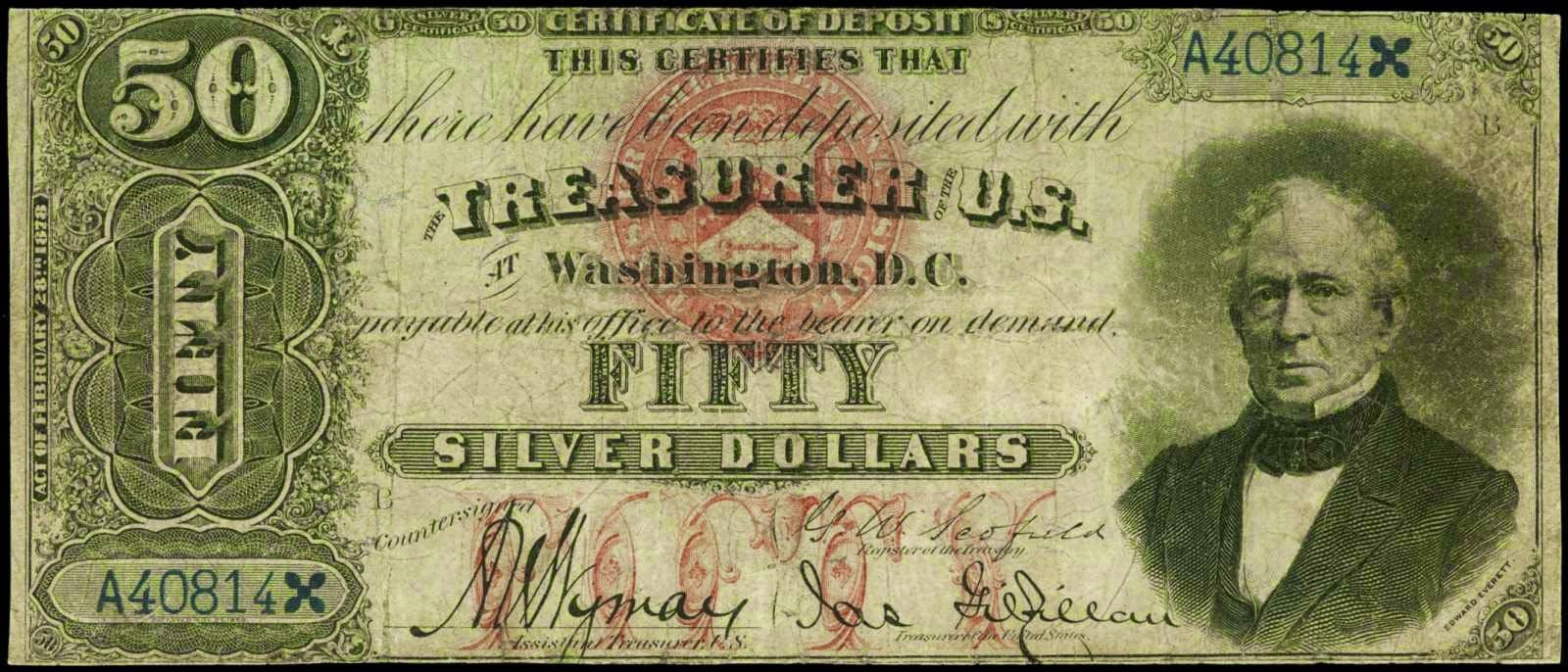
Edward Everett on the Fifty dollar silver certificate.

For nearly fifty years, Edward Everett’s face graced the Fifty dollar silver certificate. Now the world little notes, nor long remembers him. So passes glory.

[1] STANDING beneath this serene sky, overlooking these broad fields now reposing from the labors of the waning year, the mighty Alleghenies dimly towering before us, the graves of our brethren beneath our feet, it is with hesitation that I raise my poor voice to break the eloquent silence of God and Nature. But the duty to which you have called me must be performed;–grant me, I pray you, your indulgence and your sympathy.

[2] It was appointed by law in Athens, that the obsequies of the citizens who fell in battle should be performed at the public expense, and in the most honorable manner. Their bones were carefully gathered up from the funeral pyre where their bodies were consumed, and brought home to the city. There, for three days before the interment, they lay in state, beneath tents of honor, to receive the votive offerings of friends and relatives,–flowers, weapons, precious ornaments, painted vases (wonders of art, which after two thousand years adorn the museums of modern Europe),–the last tributes of surviving affection. Ten coffins of funereal cypress received the honorable deposit, one for each of the tribes of the city, and an eleventh in memory of the unrecognized, but not therefore unhonored, dead, and of those whose remains could not be recovered. On the fourth day the mournful procession was formed: mothers, wives, sisters, daughters, led the way, and to them it was permitted by the simplicity of ancient manners to utter aloud their lamentations for the beloved and the lost; the male relatives and friends of the deceased followed; citizens and strangers closed the train. Thus marshalled, they moved to the place of interment in that famous Ceramicus, the most beautiful suburb of Athens, which had been adorned by Cimon, the son of Miltiades, with walks and fountains and columns,–whose groves were filled with altars, shrines, and temples,–whose gardens were kept forever green by the streams from the neighboring hills, and shaded with the trees sacred to Minerva and coeval with the foundation of the city,–whose circuit enclosed

“the olive grove of Academe,
Plato’s retirement, where the Attic bird
Trilled his thick-warbled note the summer long,”–

whose pathways gleamed with the monuments of the illustrious dead, the work of the most consummate masters that ever gave life to marble. There, beneath the overarching plane-trees, upon a lofty stage erected for the purpose, it was ordained that a funeral oration should be pronounced by some citizen of Athens, in the presence of the assembled multitude.

[3] Such were the tokens of respect required to be paid at Athens to the memory of those who had fallen in the cause of their country. For those alone who fell at Marathon a peculiar honor was reserved. As the battle fought upon that immortal field was distinguished from all others in Grecian history for its influence over the fortunes of Hellas,–as it depended upon the event of that day whether Greece should live, a glory and a light to all coming time, or should expire, like the meteor of a moment; so the honors awarded to its martyr-heroes were such as were bestowed by Athens on no other occasion. They alone of all her sons were entombed upon the spot which they had forever rendered famous. Their names were inscribed upon ten pillars erected upon the monumental tumulus which covered their ashes (where, after six hundred years, they were read by the traveller Pausanias), and although the columns, beneath the hand of time and barbaric violence, have long since disappeared, the venerable mound still marks the spot where they fought and fell,–

“That battle-field where Persia’s victim-horde
First bowed beneath the brunt of Hellas’ sword.”

[4] And shall I, fellow-citizens, who, after an interval of twenty-three centuries, a youthful pilgrim from the world unknown to ancient Greece, have wandered over that illustrious plain, ready to put off the shoes from off my feet, as one that stands on holy ground,–who have gazed with respectful emotion on the mound which still protects the dust of those who rolled back the tide of Persian invasion, and rescued the land of popular liberty, of letters, and of arts, from the ruthless foe,–stand unmoved over the graves of our dear brethren, who so lately, on three of those all-important days which decide a nation’s history,–days on whose issue it depended whether this august republican Union, founded by some of the wisest statesmen that ever lived, cemented with the blood of some of the purest patriots that ever died, should perish or endure,–rolled back the tide of an invasion, not less unprovoked, not less ruthless, than that which came to plant the dark banner of Asiatic despotism and slavery on the free soil of Greece? Heaven forbid! And could I prove so insensible to every prompting of patriotic duty and affection, not only would you, fellow-citizens, gathered many of you from distant States, who have come to take part in these pious offices of gratitude,–you, respected fathers, brethren, matrons, sisters, who surround me,–cry out for shame, but the forms of brave and patriotic men who fill these honored graves would heave with indignation beneath the sod.

[5] We have assembled, friends, fellow-citizens, at the invitation of the Executive of the great central State of Pennsylvania, seconded by the Governors of seventeen other loyal States of the Union, to pay the last tribute of respect to the brave men who, in the hard-fought battles of the first, second, and third days of July last, laid down their lives for the country on these hillsides and the plains before us, and whose remains have been gathered into the cemetery which we consecrate this day. As my eye ranges over the fields whose sods were so lately moistened by the blood of gallant and loyal men, I feel, as never before, how truly it was said of old that it is sweet and becoming to die for one’s country. I feel, as never before, how justly, from the dawn of history to the present time, men have paid the homage of their gratitude and admiration to the memory of those who nobly sacrifice their lives, that their fellow-men may live in safety and in honor. And if this tribute were ever due, to whom could it be more justly paid than to those whose last resting-place we this day commend to the blessing of Heaven and of men?

………………………………….. The speech went on for 58 sections of more-or-less this size and ends by mentioning the achievements of the other union armies and navy saying, “But they, I am sure, will join us in saying, as we bid farewell to the dust of these martyr-heroes, that wheresoever throughout the civilized world the accounts of this great warfare are read, and down to the latest period of recorded time, in the glorious annals of our common country there will be no brighter page than that which relates THE BATTLES OF GETTYSBURG.”

_____________________________________________________________________

I find it long-winded and boring, but the crowd thought this speech wonderful. As grand as Lincoln’s 2 minute coda was plain. Part of the draw of Edward Everett was his cultured demeanor and his wide classical knowledge —  a big contrast to Lincoln. Everett had been president of Harvard, and had been a senator, a congressman, governor of Massachusetts, Secretary of State, and US Ambassador to Great Britain. Lincoln had been a country lawyer and one-term congressman. When states started succeeding, Everett had been the one called on to negotiate a compromise that delayed war until the firing on fort Sumter. All impressive in the day, now mostly forgotten glories. Today, many of his lines ring hollow today, e.g.  ” … that it is sweet and becoming to die for one’s country.” It just sounds weird to my ears. And the classic allusions sound pointless. By the early 20th century, most public pinion had changed; people decided that Lincoln’s was the better presentation, a monument to the spirit of man. The world remembers Lincoln fondly, but little notes, nor long remembers Everett, nor what he said there. The lesson: do not judge hastily. All things exist only in the context of time.

Robert E. Buxbaum, November 14, 2016. A week ago, Tuesday, our nation elected Donald Trump as 45th President of the United States, an individual as disliked and divisive as any since Lincoln. I do not know if he will prove to be honored or hated. There are demonstrations daily to remove him or overthrow the election. There are calls for succession, as when Lincoln took office. At Hampshire college, the flag was lowered in mourning. It’s possible that Trump is as offensive and unqualified as they say– but it is also possible that history will judge him otherwise in time. They did Lincoln.

Lessons of WWI: remove aristocrats and beards

Tzar Nicholas II and King George V.

Tzar Nicholas II and King George V, cousins and allies.

When I was a kid, Veterans day was called Armistice day. It marked the end of WWI. As many people died on all sides (there were many shifting alliances), it’s worthwhile asking what we’ve learned. The main thing, I think, is that aristocrats suck, both hereditary aristocrats, and the aristocrats of thought. Europe entered a world war for no big reason: small gains of land and status gains for a few aristocrats, generals, and thinkers at the top of society. These saw an opportunity to get medals and prove they could lead men in battle. The mass of Europeans cheered for war (see photo below, right) and followed them in battle. Millions were sent running at machine guns and poison gas. Most died, Those who survived returned home feeling less enthused about the ignorant, arrogant hereditary aristocrats, but still honored the generals and thinkers. They executed Tzar Nicolas of Russia and greatly reduce the power of the kings of England, Belgium, Turkey, Holland, and Austria. The thinkers inherited that power, but dropped the monarch’s face hair.

Emperor Franz Joseph

Emperor Franz Joseph II

mehmedv

Calif Mohammet V

Before WWI, virtually all of Europe was ruled by king; generally bearded kings who were believed to rule by divine right, as the will of God. The king generally had aid of a republican congress, a large aristocracy — counts, dukes, marchese, and earls, and the academic élite — professors and generals. All of these avoided association with the masses, except for show, all spent lavishly, and all maneuvered for power. By the end of WWI, no king in Europe retained real power, and the hereditary aristocrats discredited, power went to the intellectual aristocrats, where it resides today: generals, professors, newspapermen, novelists, generally mustached and modern. In 20 years or so, the new aristocrats would bring on WWII, in part because of a fear of war. Their wisdom proved to be little better than the old, but it is hard to say it was worse. The main lessons learned: avoid beards and aristocrats.

Brittains unified and cheering for the start of WWI

Britains unified and cheering for the start of WWI

In his book, “Diplomacy”, Henry Kissinger draws a few more lessons from the Great War. A major one is that balance of power works: it worked for the 100 years until WWI. Another lesson he draws: don’t let mutual defense treaties kick in until an actual invasion has begun: until troops actually cross the border. He blames hair trigger treaties for much of the trouble of WWI. His book is a good read, though, if only as a background his diplomatic approaches.

I write about WWI because of today is Veterans day, and also because two days ago we elected Donald Trump president of the US in a bitterly divisive election. Trump claims he wants “to drain the swamp,” a claim I take to mean that he intends to diminish the power of the intellectual aristocracy, the generals, writers, professors and politicians who think together, vacation together, club together, and control what it means to be educated. The Washington Post calls this removal a threat to western civilization; it removes the intelligentsia, and replaces it with racist boobs, or so they see Trump’s crew. There were anti election demonstrations in Boston, New York, Oakland, Austin, and Detroit. Upon election news a movement was started to impeach Trump, or get him to step down on claims that he stole the election. Officials of Hampshire college lowered the flag to half mast as a sign of mourning for our democracy. These acts of dissent are as heartfelt a reaction as the widespread approval that greeted WWI. I can hope the outcome is better.

For what it’s worth, I do not believe the supporters of Trump are as angry, or as stupid as portrayed: half a basketball of deplorables and irredeemables, the other half needing re-education (to borrow from Ms Clinton). These are the people who fight our wars, and I suspect we’ll be somewhat better off for giving them a voice. As for veterans day, honor the poor blokes who fought for our folly.

Robert E. Buxbaum, November 10, 2016.

The straight flush and strong shower

I’m not the wildest libertarian, but I’d like to see states rights extended to Michigan’s toilets and showers. Some twenty years ago, the federal government mandated that the maximum toilet flush volume could be only 1.6 gallons, the same as Canada. They also mandated a maximum shower-flow law, memorialized in this Seinfeld episode. Like the characters in those shows, I think this is government over-reach of states rights covered by the 10th amendment. As I understand it, the only powers of the federal government over states are in areas specifically in the constitution, in areas of civil rights (the 13th Amendment), or in areas of restraint of trade (the 14th Amendment). None of that applies here, IMHO. It seems to me that the states should be able to determine their own flush and shower volumes.

If this happen to you often, you might want to use more water for each flush, or  at least a different brand of toilet paper.

If your toilet clogs often, you might want to use more flush water, or at least a different brand of toilet paper.

There is a good reason for allowing larger flushes, too in a state with lots of water. People whose toilets have long, older pipe runs find that there is insufficient flow to carry their stuff to the city mains. Their older pipes were designed to work with 3.5 gallon flushes. When you flush with only 1.6 gallons, the waste only goes part way down and eventually you get a clog. It’s an issue known to every plumber – one that goes away with more flush volume.

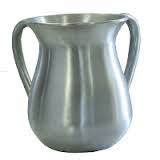
Given my choice, I’d like to change the flush law through the legislature, perhaps following a test case in the Supreme court. Similar legislation is in progress with marijuana decriminalization, but perhaps it’s too much to ask folks to risk imprisonment for a better shower or flush. Unless one of my readers feels like violating the federal law to become the test case, I can suggest some things you can do immediately. When it comes to your shower, you’ll find you can modify the flow by buying a model with a flow restrictor and “ahem” accidentally losing the restrictor. When it comes to your toilet, I don’t recommend buying an older, larger tank. Those old tanks look old. A simpler method is to find a new flush cistern with a larger drain hole and flapper. The drain hole and flapper in most toilet tanks is only 2″ in diameter, but some have a full 3″ hole and valve. Bigger hole, more flush power. Perfectly legal. And then there’s the poor-man solution: keep a bucket or washing cup nearby. If the flush looks problematic, pour the extra water in to help the stuff go down. It works.

A washing cup.

A washing cup. An extra liter for those difficult flushes.

Aside from these suggestions, if you have clog trouble, you should make sure to use only toilet paper, and not facial tissues or flushable wipes. If you do use these alternatives, only use one sheet at a flush, and the rest TP, and make sure your brand of wipe is really flushable. Given my choice, I would like see folks in Michigan have freedom of the flush. Let them install a larger tank if they like: 2 gallons, or 2.5; and I’d like to see them able to use Newman’s Serbian shower heads too, if it suits them. What do you folks think?

Dr. Robert E. Buxbaum, November 3, 2016. I’m running for Oakland county MI water resources commissioner. I’m for protecting our water supply, for better sewage treatment, and small wetlands for flood control. Among my less-normative views, I’ve also suggested changing the state bird to the turkey, and ending daylight savings time.

What I liked most about superman: the non-disguise

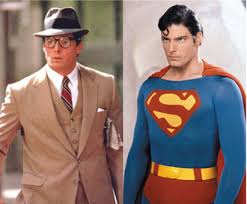
Superman's costume, like Clark's, is mostly affect.

Superman’s costume, like Clark’s, is his affect.

I find that the current movie versions of Superman miss the points, and humor that I most liked in the comics and movies of the 60s and 70s. The thing that most impressed me about Superman, back then, was the disguise, or the lack of one: the key was his affect, looking down or up. Though Clark Kent wore glasses and a conservative suit, the key part of this as a disguise was that he kept his head down. His shlumpy affect was what kept people from realizing this fellow was super strong and from a different planet. Superman, by contrast, wore a fancy outfit of bright, primary colors and stood with his chin bizarrely up. The cape was there as a distraction. Superman was careful to keep his hands on his hips or outstretched in front when he flew. Standing and dressed this way, distracted folks from recognizing him as Clark Kent, and they instantly liked him too; everyone except for Luthor, it seemed. It’s an immigrant fantasy: being able to blend in when you want, and being able to stand out for the good when you want. As best I could tell, this was the main (Jewish) fantasy of the series and of the time: to think that you’d be liked if you stood erect and affected confidence, and that you could pass un-noticed if you wore a suit and slumped over. The current movies get rid of all of this affect and all this fantasy, the desire to blend it as Clark, and stand out as superman. Superman no longer flies with his hands out, and Clark is no longer a schlump. You have to wonder why no one suspects that Clark Kent is Superman. And I have to wonder what people find attractive about the movies. Where’s the fantasy?

This didn't happen in the comics of my day except as teasers.

This didn’t happen in the comics of my day except as teasers.

Another fun aspect of the comics that the movies have dismissed was the love triangle of Clark, Superman, and Lois. Or, if you like, of Superman, Supergirl, and Lois. In the comic books of my era, it was clear that Lois is attracted to Superman but feels nothing for Clark, or feminist revulsion. Meanwhile, in the comics, Superman clearly felt no attraction for Lois, not in his guise as Superman nor as Clark Kent. There is a sort of paternal affection, but nothing more. Humorously, this paternalism attracts Lois when it comes from Superman, and repeals her when it’s from Clark, the schlump. There’s probably something Freudian there, and it makes perfect sense in context too: You, the reader, know that Lois and Clark are different species. Clark/ superman would just as soon fall for her as for an orangoutang or a rare potted plant. It’s funny and comforting that he cares nothing for her physically in the comics since she’s such a weaker species that, if they were to mate, the Super Sperm would probably cut Lois in half, or impregnate the entire city. It’s funny because Lois is entirely oblivious to how hopeless her case is and this causes narrative tension. All this tension is removed in the current movies and comics: Lois and Clark, as it were, are a sexual pair, and there is no super sperm disaster.

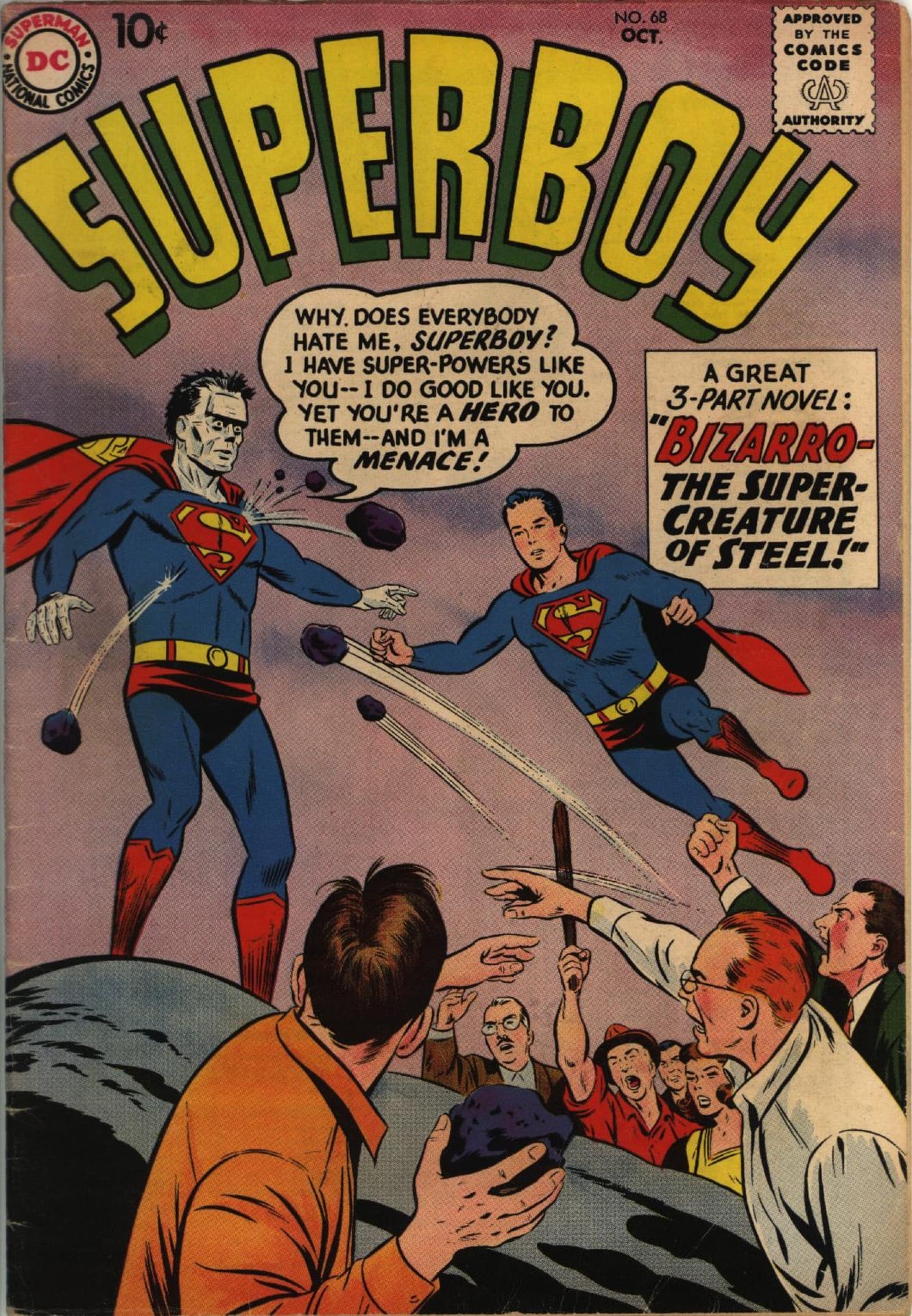
Bizarro Superman is hated on earth for no reason, just as normal superman is loved for no reason. There is a morality lesson here.

Bizarro Superman is hated on earth for no reason, while normal superman is loved for no reason. There is a moral lesson here.

Highlighting the humor of the interspecies romance, occasionally Superboy or Supergirl would show up in the comic books of my day. The comics of my day showed a chemistry between the two supers that did not appear between Lois and Clark/ Superman. Furthering the humor, it is clear that Supergirl does not share Superman’s affection for mankind. She has an alien morality and it shows. Supergirl generally can’t understand why superboy/ superman takes such care of the humans, and Supergirl finds Superman’s “Truth, Justice, etc. ” morality childish. It’s like she sees him as a grown man playing with toy soldiers or with an ant farm. Super girl makes sense here, by the way. Why would someone from a distant planet share the same morality that we have unless they shared Clark’s Kansas upbringing.

Lois, true to form, is totally oblivious to the interspecies morality difference, and is jealous of supergirl. It’s super fun, made somewhat better when super-dog shows up (he’s a dog in a cape). There is no super-dog in the movies, and no super girl or superboy, so far. Super girl is supposed to appear soon, but it’s hard to guess why.

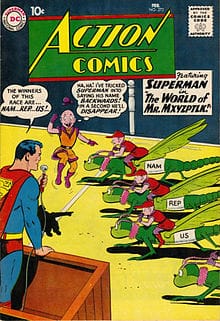
Mr Mxyzptlk gets superman to say his name backwards. Why? It’s fun.

And then there are the villains. In the comics of my day, the villains were there to develop the humor. Except for Luther, they were aliens and thus didn’t need a real motive for their mischief. Take Mr Mxyzptlk, a favorite of mine and of may others. He meant no harm, but was an alien from the 5th dimension who just wanted to have fun (don’t we all?). Like Superman, Mxyzptlk was super powerful, and Superman had to defeat him with his wits.

Another favorite super villain was Bizzaro Superman. He was a Superman variant of another planet or dimension and , as seemed perfectly reasonable, he has a completely opposite morality from Superman. He’s happy go lucky, robs banks and does other crimes (why would you think otherwise — it’s normal on his planet.) Interestingly, Bizzaro does not keep his head up, and has none of Superman’s charisma, Bizzaro is there, I think, to emphasize the fantasy of Superman’s non-disguise and semi-human morality. And as such he was a favorite.

These musings on the morality and charisma are all left out of the current movies. There is no Bizzaro, or Mxyzptlk. Instead, Lex Luther is the universal villain and he’s crazy-evil. In the current movies, it’s hard to guess why Lex Luther doesn’t like superman as strongly as he does, or why he puts so much effort into fighting him to no effect. In the comics of my day, Lex’s job was much simpler, get kryptonite and hit superman with it, and his motivations seemed reasonably normal. I’d be put off too by a super-strong flying guy in blue tights who foils my illegal plans. As soon as Lex discovers kryptonite and realizes Superman has an Achilles heal, Lex goes about using it. It seemed normal enough to me then. Why does Luther now have to be a psychopath now.

Robert Buxbaum, October 20, 2016. The original super-costume was super Freudian too. It was supposed to be his baby blanket sewn by his mother in Kansas with design input from dear old dad. As a result the original costume looked soft and puffy, like a baby blanket. Nonetheless, Superman wears it with pride — in the open when saving the world and under his Clark Kent clothes at all other times. it seems he’s a momma’s boy clutching his baby blanket. It what way are the modern movie changes better than the original Freudy cat.

Most flushable wipes aren’t flushable.

I’m a chemical engineer running for Oakland county water resources commissioner, and as the main job of the office is sewage, and as I’ve already written on the chemistry, I thought I might write about an aspect of the engineering. Specifically about toilet paper. Toilet paper is a remarkable product: it’s paper, compact and low in cost; strong enough to clean you, smooth on your bum, and beyond that, it will disintegrate in turbulent water so it doesn’t clog pipes. The trick to TP’s dry strength and wet-weakness, is that the paper pulp, wood cellulose, is pounded very thin, yet cast fluffy. For extra softness, the paper is typically coated with aloe or similar. Sorry to say, the same recipe does not work for wet-wipes, paper towels or kleenex (facial tissues); all of these products must have wet-strength, and this can cause problems with sewer clogs.

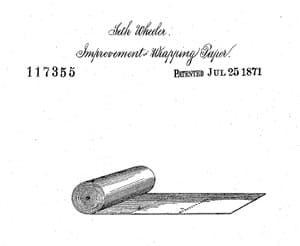
Patent 117355 for perforated toilet paper claimed it as an improved wrapping paper.

Patent 117,355 for perforated toilet paper on a roll. It’s claimed as an improved wrapping paper.

Before there was toilet paper, the world was a much sadder, and smellier place. Much of the world used sticks, stones, leaves, or corn cobs, and none of these did a particularly thorough job. Besides, none of these is particularly smooth, or particularly disposable, nor did it fall apart — not that most folks had indoor plumbing. Some rich Romans had plumbing, and these cleaned themselves with a small sponge on the end of a stick. They dipped the sponge end in water for each use. It was disgusting, but didn’t clog the pipes. I’ve seen this in use on a trip to Turkey 25 years ago — not in actual use, but the stick and sponge was there in a smelly bucket next to the hole in the ground that served as the commode.

The first reasonably modern toilet was invented in 1775 by Alexander Cummings, and by 1852 the first public flush toilets were available. The design looked pretty much like it looks today and the cost was 1¢. You got a towel and a shoe-shine too for that penny, but there was no toilet paper as such. Presumably one used a Roman sponge or some ordinary, standard paper. A popular wipe, back in the day was the Sears-Roebuck catalog. It came free to most homes and included a convenient hole in the corner allowing one to hang it in and outhouse or near the commode. It was rough on the bum, and didn’t fall apart. My guess is that it clogged the pipes too, for those who used it with flush toilets. The first toilet-specific paper wasn’t invented till 1859. Joseph Gayetty, an American, patented a product from pulverized hemp, a relatively soft fiber, softened further with aloe. This paper was softer than standard, and had less tendency to clog pipes.

Toilet paper has to be soft

Toilet paper is either touted to be soft or strong; Modern Charmin touts wet strength, while Cottonelle touts completeness of wipe: ‘go commando.”

The next great innovation was to make toilet paper as a perforated product on a roll. These novelties appear as US Patent #117,355 awarded to Seth Wheeler of Albany, NY 25 July 1871 (Wheeler also invented the classic roll toilet paper dispenser). Much of the sales pitch was that a cleaner bum would prevent the spread of cholera, typhoid, and other plagues and that is a legitimate claim. As the  market expanded, advertising followed. Some early brands touted their softness, others their strength. Facial tissues, e.g. Kleenex, were sold specifically as a soft TP-like product that does not fall apart when wet. Sorry to say, this tends to go along with clogged toilets; do not flush more than one kleenex down at a flush. Kleenex is made with the same short fibers and aloe as toilet paper, but it contains binders (glue) to give it wet-strength. My guess is that Charmin is made the same way and that it isn’t great on your plumbing.

Paper towels and most baby wipes are worse to flush than Kleenex. They are made with lots of binder and they really don’t fall apart in water. Paper towels should never be flushed, and neither should most baby wipes, even brands that claim to be ‘flushable.” When flushed, these items tend to soak up fat and become fat bergs – the bane of sewer workers everywhere. There is a class action law suit against flushable wipe companies, and New York City is pursuing legislation to prevent them from claiming to be flushable. Still, as with everything, there are better and worse moist-wipe options. “Cottonelle” brand by Kleenex, and Scott flushable wipes are the best currently. In a day or less they will dissolve in water. These products are made with binders like kleenex, but the binder glue is a type that dissolves in any significant amount of water. As a result, these brands fall apart eventually. For now, these are the only flushable brands I’d recommend flushing, and even then I suggest you only flush one at a time. In tests by Consumer Reports, other brands, e.g. Charmin and Equate flushable wipes do not dissolve. These manufacturers either have not quite figured out how to make dissolvable binders, or they can’t get around Kleenex’s patents.

Robert Buxbaum. October 10, 2016. If you live in Oakland County, MI, vote for me for water commissioner. Here’s my web-site with other useful essays. I should mention Thomas Crapper, too. He invented the push-button flush and made some innovations in the water cistern, and he manufactured high-end commodes for Parliament and the royal family, but he’s irrelevant to the story here.

just water over the dam

Some months ago, I posted an engineering challenge: figure out the water rate over an non-standard V-weir dam during a high flow period (a storm) based on measurements made on the weir during a low flow period. My solution follows. Weir dams of this sort are erected mostly to prevent flooding. They provide secondary benefits, though by improving the water and providing a way to measure the flow.

A series of weir dams on Blackman Stream, Maine. These are thick, rectangular weirs.

A series of compound, rectangular weir dams in Maine.

The problem was stated as follows: You’ve got a classic V weir on a dam, but it is not a knife-edge weir, nor is it rectangular or compound as in the picture at right. Instead it is nearly 90°, not very tall, and both the dam and weir have rounded leads. Because the weir is of non-standard shape, thick and rounded, you can not use the flow equation found in standard tables or on the internet. Instead, you decide to use a bucket and stopwatch to determine the flow during a relatively dry period. You measure 0.8 gal/sec when the water height is 3″ in the weir. During the rain-storm some days later, you measure that there are 12″ of water in the weir. Give a good estimate of the storm-flow based on the information you have.

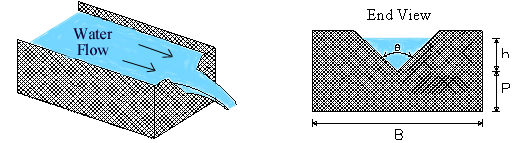
A V-notch weir, side view and end-on.

A V-notch weir, side view and end-on.

I also gave a hint, that the flow in a V weir is self-similar. That is, though you may not know what the pattern will be, you can expect it will be stretched the same for all heights.

The upshot of this hint is that, there is one, fairly constant flow coefficient, you just have to find it and the power dependence. First, notice that area of flow will increase with height squared. Now notice that the velocity will increase with the square root of hight, H because of an energy balance. Potential energy per unit volume is mgH, and kinetic energy per unit volume is 1/2 mv2 where m is the mass per unit volume and g is the gravitational constant. Flow in the weir is achieved by converting potential height energy into kinetic, velocity energy. From the power dependence, you can expect that the average v will be proportional to √H at all values of H.

Combining the two effects together, you can expect a power dependence of 2.5 (square root is a power of 0.5). Putting this another way, the storm height in the weir is four times the dry height, so the area of flow is 16 times what it was when you measured with the bucket. Also, since the average height is four times greater than before, you can expect that the average velocity will be twice what it was. Thus, we estimate that there was 32 times the flow during the storm than there was during the dry period; 32 x 0.8 = 25.6 gallons/sec., or 92,000 gal/hr, or 3.28 cfs.

The general equation I derive for flow over this, V-shaped weir is

Flow (gallons/sec) = Cv gal/hr x(feet)5/2.

where Cv = 3.28 cfs. This result is not much different to a standard one  in the tables — that for knife-edge, 90° weirs with large shoulders on either side and at least twice the weir height below the weir (P, in the diagram above). For this knife-edge weir, the Bureau of Reclamation Manual suggests Cv = 2.49 and a power value of 2.48. It is unlikely that you ever get this sort of knife-edge weir in a practical application. Be sure to measure Cv at low flow for any weir you build or find.

Robert Buxbaum, vote for me for water commissioner. Here are some thoughts on other problems with our drains.

1939, when East and West became friends and partners

Forward Marx

The large mustache, Soviet Socialist it seems is very much like his neighbor, the small mustache, National Socialist.

In August, 1939, just about 77 years ago to the day, Germany and the Soviet union signed a non-aggression pact — The Molotov von Ribbentrop agreement. The open text suggested peace, but there was a secret rider that was made widely available. The large mustache soviet socialist and the small mustache national socialist had divided up the land between them. “In case there was war,” Russia would get Lithuania, Finland, Eastern Poland, and Bessarabia (Northern Romania). Germany would get Denmark, Western Poland, and Greece.

Commemoration of the Soviet -German non-aggression pact, August 1939.

Commemoration of the Soviet – German non-aggression pact, August 1939.

Up till then, we in the US assumed that these nations were bitter enemies and that their enmity would protect us. It turned out they were friends, or at least that they had the common goal of conquest and domination. Both were socialists in the sense that they did not respect the property rights of their neighbors. In the cartoon at right, Uncle Sam is standing on the battlements, looking stupid, holding his useless umbrella (The League of Nations? US foreign policy?). The title, “Watchman, What of the Night.” Is from Isaiah. In August, 1939 night was most definitely coming along with a combined storm of aggression from Germany and the USSR.

I’m posting this as a reminder that East and West are more similar than is generally believed. That left and right too are often useless distinctions. That folks will generally seek their own advantage over philosophical purity, and over the advantage of the US. Internationalism, thus, is not a panacea for peace. Generally speaking, I suspect that Flavius’s dictum still applies: “if you wish for peace, prepare for war.” Also, I had these great cartoons, courtesy of my friend, Jim Wald.

Robert Buxbaum, August 25, 2016. People often forget/ ignore that the USSR started its part of WWII by invading Finland and Poland. Finland resisted invasion a lot better than Poland. So well that, when Germany broke the agreement and Russia became our friend, Finland became our enemy– sort-of. They were still fighting Russia. And, in the East, Russia remained an ally of Japan for another year, even briefly after Japan attacked Pearl Harbor. This made sending aid to Russia problematic, though Roosevelt did it. I’ve written about WWII in terms of mustaches because, to me, it makes as much sense as anything, and more sense than east vs west.

More French engineering, the Blitzkrieg motorcycle.

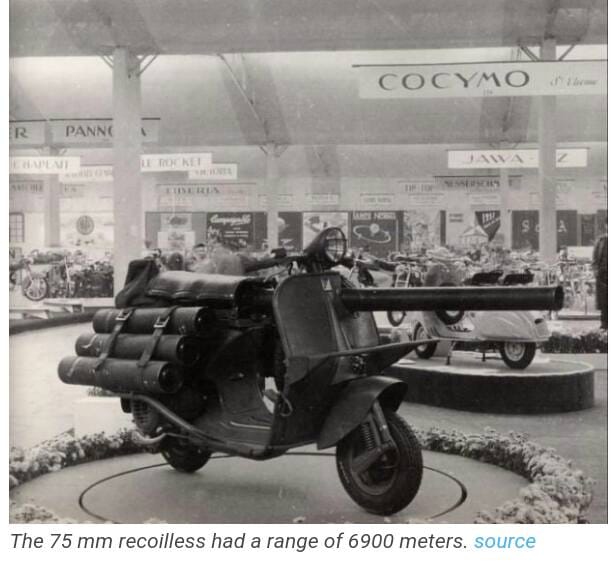
There’s something fascinating that I find in French engineering. I wrote a previous essay about French cars, bridges, and the Eiffel tower. Here’s a picture or two more. Things I wanted to include but didn’t. First here’s a Blitzkrieg Vespa motorcycle; the French built some 800 of these from 1947 to 1962 and used them in Vietnam and Algeria. What’s remarkable is how bizarrely light and unprotected it is. It’s a design aesthetic that follows no one, and that American engineers would not follow.

French Blitzkrieg Vespa used in Vietnam

French Blitzkrieg Vespa used in Vietnam; cannon range is 4.5 miles.

The key engineering insight that allows this vehicle to make sense is that recoil-less rifles are really recoil-less if you design them right. Thus, one can (in theory) mount them on something really light, like a Vespa. Another key (French) insight is that a larger vehicle may make the soldier more vulnerable rather than less by slowing him down and by requiring more gasoline and commissariat services.

Americans do understand the idea of light and mobile, but an American engineers idea of this is a jeep or an armored truck; not a Vespa. From my US engineering perspective, the French went way overboard here. The French copy no one, and no one copies the French, as they say. Still, these things must have worked reasonably well or they would not have made 800 of them over 15 years. A Vespa is certainly cheaper than a Jeep, and easier to transport to the battle zone….

Robert Buxbaum, February 18, 2016. The Italians have a somewhat similar design aesthetic to the French: they like light and cheap, but also like maneuverable and favor new technology. See my blog about a favorite Fiat engine.

Boy-Girl physics humor

Girl breaking up with her boyfriend: I just need two things, more space, and time.

Atoms try to understand themselves.

Atoms build physicists in an attempt to understand themselves. That’s also why physicists build physics societies and clubs.

Boyfriend: So, what’s the other thing?


Robert Buxbaum. And that, dear friend, is why science majors so rarely have normal boyfriends / girlfriends.

A female engineer friend of mine commented on the plight of dating in the department: “The odds are good, but the goods are odd.”

By the way, the solution to Einstein’s twin paradox resides in understanding that time is space. Both twins see the space ship moving at the same pace, but space shrinks for the moving twin in the space ship, not for the standing one. Thus, the moving twin finishes his (or her) journey in less time than the standing one observes.

The game is rigged and you can always win.

A few months ago, I wrote a rather depressing essay based on Nobel Laureate, Kenneth Arrow’s work, and the paradox of de Condorcet. It is mathematically shown that you can not make a fair election, even if you wanted to, and no one in power wants to. The game is rigged.

To make up for that insight, I’d like to show from the work of John Forbes Nash (A Beautiful Mind) that you, personally, can win, basically all the time, if you can get someone, anyone to coöperate by trade. Let’s begin with an example in Nash’s first major paper, “The Bargaining Problem,” the one Nash is working on in the movie— read the whole paper here.  Consider two people, each with a few durable good items. Person A has a bat, a ball, a book, a whip, and a box. Person B has a pen, a toy, a knife, and a hat. Since each item is worth a different amount (has a different utility) to the owner and to the other person, there are almost always sets of trades that benefit both. In our world, where there are many people and everyone has many durable items, it is inconceivable that there are not many trades a person can make to benefit him/her while benefiting the trade partner.

Figure 3, from Nash’s, “The bargaining problem.” U1 and U2 are the utilities of the items to the two people, and O is the current state. You can improve by barter so long as your current state is not on the boundary. The parallel lines are places one could reach if money trades as well.

Good trades are even more likely when money is involved or non-durables. A person may trade his or her time for money, that is work, and any half-normal person will have enough skill to be of some value to someone. If one trades some money for durables, particularly tools, one can become rich (slowly). If one trades this work for items to make them happy (food, entertainment) they can become happier. There are just two key skills: knowing what something is worth to you, and being willing to trade. It’s not that easy for most folks to figure out what their old sofa means to them, but it’s gotten easier with garage sales and eBay.

Let us now move to the problem of elections, e.g. in this year 2016. There are few people who find the person of their dreams running for president this year. The system has fundamental flaws, and has delivered two thoroughly disliked individuals. But you can vote for a generally positive result by splitting your ticket. American society generally elects a mix of Democrats and Republicans. This mix either delivers the outcome we want, or we vote out some of the bums. Americans are generally happy with the result.

A Stamp act stamp. The British used these to tax every transaction, making it impossible for the ordinary person to benefit by small trade.

A Stamp act stamp,. Used to tax every transaction, the British made it impossible for ordinary people to benefit by small trades.

The mix does not have to involve different people, it can involve different periods of time. One can elect a Democrat president this year, and an Republican four years later. Or take the problem of time management for college students. If a student had to make a one time choice, they’d discover that you can’t have good grades, good friends, and sleep. Instead, most college students figure out you can have everything if you do one or two of these now, and switch when you get bored. And this may be the most important thing they learn.

This is my solution to Israel’s classic identity dilemma. David Ben-Gurion famously noted that Israel had the following three choices: they could be a nation of Jews living in the land of Israel, but not democratic. They could be a democratic nation in the land of Israel, but not Jewish; or they could be Jewish and democratic, but not (for the most part) in Israel. This sounds horrible until you realize that Israel can elect politicians to deliver different pairs of the options, and can have different cities that cater to thee options too. Because Jerusalem does not have to look like Tel Aviv, Israel can achieve a balance that’s better than any pure solution.

Robert E. Buxbaum, July 17-22, 2016. Balance is all, and pure solutions are a doom. I’m running for water commissioner.