Peace killed the Indian, ended Spain’s golden age

The why of history is always more speculative than the what. Yet, to write about only the what, is to do only half of the job, if that. The what is largely interchangeable: the names of kings and generals, the dates and locals of battles and treaties. It’s the why that adds interest, and provides whatever lessons one can take forward. With this as background, I’d like to speculate on the cause of: the destruction of the American Indian, and the end of the golden age of Spain. For both and some others, I suggest an unusual villain, peace: too much peace. It’s a speculative why, but bear with me.

Lets start with the American Indian. In the mid 1700s, Indians controlled the majority of the continent. They had an advanced society of six main nations, held together by mutual treaty. The Indians had few guns, but were not less intelligent than the Japanese or Chinese, suggesting that they could have learned to make them if they desired (or realized they needed to desire). The Japanese did so in short order. Indians addressed the Continental assemblies, and though they were not integrated, quite, they were not segregated either. But this first period of co-existence ended, as best i can tell, in the years of and following the French and Indian war. In the war, some Indians supported the French and some the British, and each side looked after their Indians. After peace was established, however, English leaders like Lord Jeffery Amherst set up to wipe out the Indians of both sides, “this execrable race,” with blankets infected with smallpox, and good old-fashioned cruelty. His activities are memorialized, on the cafeteria china used at Amherst Colleges till the 1960s.

Cup from the cafeteria of Amherst College shows Lord Jeff pursuing the Indians.

Cup from the cafeteria of Amherst College, used till the 1960s, shows Lord Jeffery Amherst pursuing a band of Indians. Purple and white are the Amherst colors. 

My thought of why he did it, and why he succeeded, is that the Indians had outlived their usefulness. The ones on the French side had been enemies, and might be again. The ones on his, English side were annoying and might turn in the next conflict. Besides, Lord Jeffery and his ilk had idle military power. Removing the Indians was something they could do. The army at peace could otherwise get destructive, or turn on him (I’m speculating here on motives).

This pattern appeared again in the Revolutionary war and in the War of 1812. During each war, Indians were befriended by both sides, and recruited. Indians fought important battles in each war, now mostly forgotten; the defense of Canada was largely by Indians. After each war, these Indians were largely betrayed. In the War of 1812, the Shawnee, Potawatomi, Ojibwa, and Creek mostly sided with the British, led by the fierce Shawnee general, Tecumseh. The Muscogee, Creek, Seminole, Choctaw, Cherokee, and Chickasaw, mostly sided with the US. Iroquois fought on both sides. In the years following the wars, these and these were sent west of the Mississippi. Those who had been allies with the US were paid for their land, those that sided with the British were not. A good price, but it was a forced sale none-the-less. I will speculate that they were exiled because they retained a government structure independent of the US, making them a threat. Also (I speculate) the military, Generals Harrison, Jackson, etc., had nothing better to do with an army that might have mutinied otherwise. By 1846, there was no serious future for the American Indian east of the Mississippi, and besides, there was an external enemy to fight — The Mexicans. My speculation: the Indians were destroyed by “the era of good feelings” that follows war.

In the case of Spain, I note that the Inquisition and Jewish expulsion followed suddenly after 300 years of science, art, literature, and coöperation. I also note that the Alhambra decrees (March 1492) followed almost immediately after the defeat the last major Moslem-held citadel, Granada in December, 1491, and the peace treaty of Granada (January 2, 1492). The Alhambra decrees of March 31, 1492 mandated that all Jews must convert or leave Spain, and gave free-reign to the Inquisition to punish heresy. At the time, the financier of the Spanish crown was a Jew, Don Isaac Abarbanel. And some years earlier another Jew, Shmuel HaNagged hand been vizier (2nd) to the king. My theory of the cause for the sudden switch is that it was not a sudden surge in religion, as some have suggested, but rather that the king and queen no longer needed an army or Jewish or Moslem allies, but they still had an army that might turn against them if not otherwise occupied.

In the interwar, peace years, Stalin removed 3 of the 5 top generals, 13 of 15 below them; 8 of 9 admirals, 50 of 57 army corps commanders, 154 out of 186 division commanders, 16 of 16 army commissars, and 25 of 28 army corps commissars.

In the interwar, peace years, Stalin removed 3 of the 5 top generals, 13 of 15 below them; 8 of 9 admirals, 50 of 57 army corps commanders, 154 out of 186 division commanders, 16 of 16 army commissars, and 25 of 28 army corps commissars. Peace is hell.

I’m reminded that peace is the background to intrigue in at least six of Shakespeare’s historical plays: Macbeth, Hamlet, Richard III, Lear, Julius Caesar, and Othello. Richard III explains his behavior as follows (Act I, Scene 1):  “Why, I, in this weak piping time of peace, have no delight to pass away the time, unless to spy my shadow in the sun and descant on mine own deformity.”

A few other examples: After WWI, most of Europe removed their bearded aristocracy, and Stalin used the peacetime to remove much of the communist leadership including many of his generals and former friends – this was especially so after signing a peace treaty with Germany. And, in the US after WWII, we entered a period of communist witch hunts — a mini Inquisition directed at the writers and artists who provided Allied propaganda during the war. Even a general good, like peace can leave casualties.

Robert Buxbaum, July 7, 2017. I like to speculate on the why of history, and like to imagine my speculations are partially true, at least.
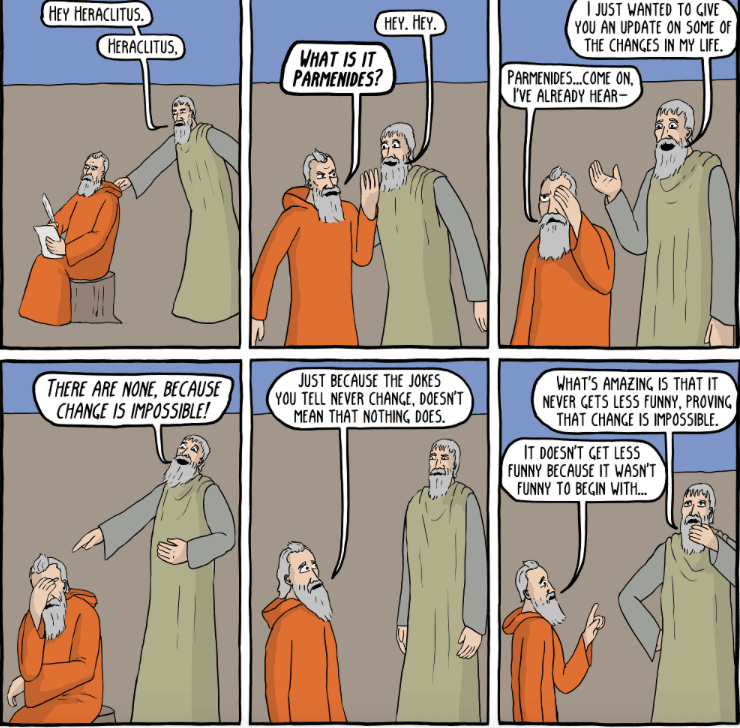
Heraclitus and Parmenides, time jokes

From Existential Commics

From Existential Comics; Parmenides believed that nothing changed, nor could it.

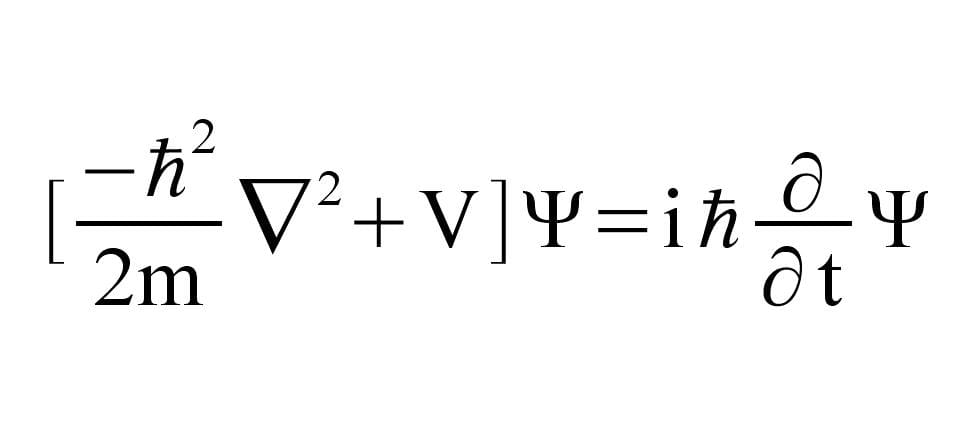
For those who don’t remember, Heraclitus believed that change was the essence of life, while  Parmenides believed that nothing ever changes. It’s a debate that exists to this day in physics, and also in religion (there is nothing new under the sun, etc.). In science, the view that no real change is possible is founded in Schrödinger’s wave view of quantum mechanics.

Schrödinger's wave equation, time dependent.

Schrödinger’s wave equation, time dependent.

In Schrödinger’s wave description of reality, every object or particle is considered a wave of probability. What appears to us as motion is nothing more than the wave oscillating back and forth in its potential field. Nothing has a position or velocity, quite, only random interactions with other waves, and all of these are reversible. Because of the time reversibility of the equation, long-term, the system is conservative. The wave returns to where it was, and no entropy is created, long-term. Anything that happens will happen again, in reverse. See here for more on Schrödinger waves.

Thermodynamics is in stark contradiction to this quantum view. To thermodynamics, and to common observation, entropy goes ever upward, and nothing is reversible without outside intervention. Things break but don’t fix themselves. It’s this entropy increase that tells you that you are going forward in time. You know that time is going forward if you can, at will, drop an ice-cube into hot tea to produce lukewarm, diluted tea. If you can do the reverse, time is going backward. It’s a problem that besets Dr. Who, but few others.

One way that I’ve seen to get out of the general problem of quantum time is to assume the observed universe is a black hole or some other closed system, and take it as an issue of reference frame. As seen from the outside of a black hole (or a closed system without observation) time stops and nothing changes. Within a black hole or closed system, there is constant observation, and there is time and change. It’s not a great way out of the contradiction, but it’s the best I know of.

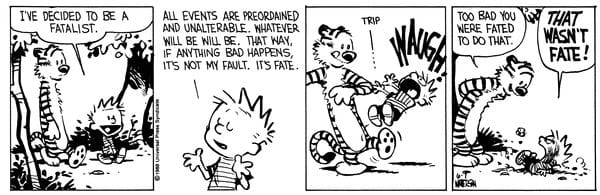
Predestination makes a certain physics and religious sense, it just doesn't match personal experience very well.

Predestination makes a certain physics and religious sense, it just doesn’t match personal experience very well.

The religion version of this problem is as follows: God, in most religions, has fore-knowledge. That is, He knows what will happen, and that presumes we have no free will. The problem with that is, without free-will, there can be no fair judgment, no right or wrong. There are a few ways out of this, and these lie behind many of the religious splits of the 1700s. A lot of the humor of Calvin and Hobbes comics comes because Calvin is a Calvinist, convinced of fatalistic predestination; Hobbes believes in free will. Most religions take a position somewhere in-between, but all have their problems.

Applying the black-hole model to God gives the following, alternative answer, one that isn’t very satisfying IMHO, but at least it matches physics. One might assume predestination for a God that is outside the universe — He sees only an unchanging system, while we, inside see time and change and free will. One of the problems with this is it posits a distant creator who cares little for us and sees none of the details. A more positive view of time appears in Dr. Who. For Dr. Who time is fluid, with some fixed points. Here’s my view of Dr. Who’s physics.  Unfortunately, Dr. Who is fiction: attractive, but without basis. Time, as it were, is an issue for the ages.

Robert Buxbaum, Philosophical musings, Friday afternoon, June 30, 2017.

West’s Batman vs Zen Batmen

“Holy kleenex Batman, it was right under our noses and we blew it.” I came of age with Adam West’s Batman on TV and a relatively sane Batman in the comic books. Batman was a sort of urban cowboy: a loner, but a law-abiding, honest loner. A proud American who was polite to the police and to the ordinary citizen. He was both good, and “nice.” Back then, as today, no one died by the hand of Batman, but that was largely because he worked with the police who made the final arrests

bat-buddah

More recent Batmen have been not nice, and arguably not good either. They do not work with the police but act above the law. Their ethos is not from US civics class, but from dark training in eastern monasteries by masters of kung fu. It’s a morality no one quite understands, not least himself. Quite literally, ‘He is a dark and stormy knight.’

A few days ago, I found this plastic Batman-Buddah for sale on e-Bay and I started wondering about how far our current movie Batmen have moved from those of the 60s. And on the deep, Zen thoughts that Batman now expounds on life and crime. These zen thoughts are pretty messed up, as psychologists have noted.

Example. In a recent Batman movie, Batman beats up an invasive wannabe wearing hockey pads. He gets asked: “What gives you the right? What’s the difference between you and me?” The response, “I’m not wearing hockey pads.” This is to say, the current Batman believe his physical prowess makes him above the law. Some more comments:
“Sometimes it’s only madness that makes us what we are.”
“That mask — it’s not to hide who I am, but to create what I am.”
“I won’t kill you, but I don’t have to save you.”

When he speaks to the Joker, it’s not clear which one is crazier. E.g.. Batman tells the Joker that he doesn’t kill because, “If you kill a killer, the number of killers remains the same.” To which Joker replies: “Unless you kill more than one….” That sounds sane to me.

By contrast. consider Adam West as Batman in the 1960s: “Underneath this garb, we’re perfectly ordinary Americans.” Another quote: “A reporter’s lot is not easy, making exciting stories out of plain, average, ordinary people like Robin and me.” Though this comment is “off” it’s nice to see that this Batman feels for peoples’ problems, respects their professions, and does not profess to be better than they are. He’s weird, but not a psychopath, and he leaves Gotham city pretty much the way you find it at the beginning of a comic or episode.

Not a classic Batmobile, but I like the concept.

Not a classic Batmobile, but I like it. Adam West’s Batman always strove to be socially responsible.

By contrast, the current, dark, depressive Batmen always leave Gotham City in shambles, with piles of dead and destroyed buildings and infrastructure. Given the damage Batman does, you wonder why anyone calls for Batman; current Batmen never works with the police, quite.

And where’s Robin. To the extent that Robin appears at all, his relationship with Batman is more frenemy than ally. Batgirl too is mostly absent, and has changed. The original Batgirl was connected to the police. She was Barbara Gordon, Police Commissioner Gordon’s daughter, a positive female with a good relationship with her supportive, non-sexist father (an early version of Kim Possible’s dad) and with society as a whole. The current Batgirl appears is the butler’s daughter, and except for one brief appearance, you never see her, not at Wayne Manor, not anywhere. Somehow she’s Batgirl though it’s presented that didn’t know what her dad was up to.

Here are some real interactions between Adam West as Batman with Robin. He shows an interest in Robin’s education and well-being, something currently lacking:

AW Batman: “Haven’t you noticed how we always escape the vicious ensnarements of our enemies?” Robin: “Yeah, because we’re smarter than they are!”  Batman: “I like to think it’s because our hearts are pure.”

AW Batman: “Better put 5 cents in the meter.” Robin: “No policeman’s going to give the Batmobile a ticket.” Batman: “This money goes to building better roads. We all must do our part.”

Robin: “You can’t get away from Batman that easy!” AW Batman: “Easily.” Robin: “Easily.”
“Good grammar is essential, Robin.” Robin: “Thank you.” Batman: “You’re welcome.”

Robin/Dick: “What’s so important about Chopin?” Batman: “All music is important, Dick. It’s the universal language. One of our best hopes for the eventual realization of the brotherhood of man.” Dick: “Gosh Bruce, yes, you’re right. I’ll practice harder from now on.”

AW Batman: “That’s one trouble with dual identities, Robin. Dual responsibilities.”

“Even crime fighters must eat. And especially you. You’re a growing boy and you need your nutrition.”

“What took you so long, Batgirl?” Batgirl: “Rush hour traffic, plus all the lights were against me. And you wouldn’t want me to speed, would you?” Robin: “Your good driving habits almost cost us our lives!” Batman: “Rules are rules, Robin. But you do have a point.”

And finally, AW Batman: “I think you should acquire a taste for opera, Robin, as one does for poetry and olives.”

Clearly this Batman takes an interest in Robin’s health and education, and in Batgirl’s. Robin is his ward, after all, a foster child. And Batgirl is a protege, as well as the daughter of a friend.

The modern Batman claims, “It’s not who I am underneath, but what I do that defines me.” It’s, more or less, a quote from Karl Jung that shows pride in one’s art, but it also shows an attachment to job over self. This approach appeared in the olden days, in the form of Catwoman, a woman with her own moral code, and proud of it. Batman found her odious, abhorrent, and “insegrievious”. The only difference between her and the Joker, he says, is the amount of damage done. I’m sorry to find that recent, Zen Batmen and Supermen might as well be Cat-women, or Jokers. To quote Robin: “Holy strawberries, Batman, we’re in a jam.”

Robert Buxbaum, June 26, 2017. Insegeivious is a made-up word, and I love it. I also love the humor of Robin’s “holy xxx” comments.

Race and suicide

Suicide is generally understood as a cry of desperation. If so, you’d expect that the poorer, less-powerful, less-mobile members of society — black people, Hispanics, and women — would be the most suicidal. The opposite is true. While black people and Hispanics have low savings, and mobility, they rarely commit suicide. White Protestants and Indians are the most suicidal groups in the US; Blacks, Hispanics, Jews, Catholics, Moslems, Orientals, are significantly less prone. And black, non-Hispanic women are the least suicidal group of all — something I find rather surprising.

US, Race-specific suicide, all ages, Center for Disease control 2002-2012

US, Race-specific suicide, all ages, Center for Disease control 2002-2012

Aha, I hear you say: It’s the stress of upward mobility that causes suicide. If this were true, you’d expect Asians would have a high suicide rate. They do not, at least not American Asians. Their rate (male + female) is only 6.5/100,000, even lower than that for Afro-Americans. In their own countries, it’s different, and Japanese, Chinese, and Koreans commit suicide at a frightening rate. My suspicion is that American Asians feel less trapped by their jobs, and less identified too. They do not feel shame in their company’s failures, and that’s a good, healthy situation. In Korea, several suicides were related to the Samsung phones that burst into flames. While there is some stress from upward mobility, suggested by the suicide rates for Asian-American females being higher than for other woman, it’s still half that of non-hispanic white women, and for women in China and Korea. This suggests, to me, that the attitude of Asian Americans is relatively healthy.

The only group with a suicide rate that matches that of white protestants is American Indians, particularly Alaskan Indians. You’d figure their rate would be high given the alcoholism, but you’d expect it to be similar to that for South-American Hispanics, as these are a similar culture, but you’d be wrong, and it’s worthwhile to ask why. While men in both cultures have similar genes, suffer financially, and are jailed often, American Indians are far more suicidal than Mexican Americans. It’s been suggested that the difference is religiosity or despair. But if Indians despair, why don’t Mexicans or black people? I find I don’t have a completely satisfactory explanation, and will leave it at that.

Age-specific suicide rates.

Age-specific suicide rates, US, all races, 2012, CDC.

Concerning age, you’d probably guess that teenagers and young adults would be most suicidal — they seem the most depressed. This is not the case. Instead, middle age men are twice as likely to commit suicide as teenage men, and old men, 85+, are 3.5 times more suicidal. The same age group, 85+ women, is among the least suicidal. This is sort-of surprising since they are often in a lot of pain. Why men and not women? My suspicion is that the difference, as with the Asians has to do with job identification. I note that middle age is a particularly important time for job progress, and note that men are more-expected to hold a job and provide than women are. When men feel they are not providing –or worse –see themselves as a drag on family resources, they commit suicide. At least, this is my explanation.

It’s been suggested that religion is the consolation of women and particularly of black women and Catholics. I find this explanation doubtful as I have no real reason to think that old women are more religious than old men, or that Protestants and Indians are less religious than Hispanics, Asians, Moslems, and Jews. Another difference that I (mostly) reject is that access to guns is the driver of suicide. Backing this up is a claim in a recent AFSP report, that women attempt suicide three times more often than men. That men prefer guns, while women prefer pills and other, less-violent means is used to suggest that removal of guns would (or should) reduce suicide. Sorry to say, a comparison between the US and Canada (below) suggests the opposite.

A Centers for Disease Control study (2012) found that people doing manual labor jobs are more prone to suicide than are people in high-strew, thinking jobs. That is, lumberjacks, farmers, fishermen, construction workers, carpenters, miners, etc. All commit suicide far more than librarians, doctors, and teachers, whatever the race. My suspicion is that it’s not the stress of the job so much, as the stress of unemployment between gigs. The high suicide jobs, it strikes me, are jobs one would identify with (I’m a lumberjack, I’m a plumber, etc. ) and short term. I suspect that the men doing these jobs (and all these are male-oriented jobs) tend to identify with their job, and tend to fall into a deadly funk when their laid off. They can not sit around the house. Then again, many of these jobs go hand in hand with heavy drinking and an uncommon access to guns, poison, and suicidal opportunities.

zc-percentage-total-suicides-by-method-2000-2003-ca-2007-us

Canadians commit suicide slightly more often than Americans, but Canadians do it mostly with rope and poison, while more than half of US suicides are with guns.

I suspect that suicide among older men stems from the stress of unemployment and the boredom of sitting around feeling useless. Older women tend to have hobbies and friends, while older men do not. And older men seem to feel they are “a burden” if they can no-longer work. Actor Robin Williams, as an example, committed suicide, supposedly, because he found he could not remember his lines as he had. And Kurt Gödel (famous philosopher) just stopped eating until he died (apparently, this is a fairly uncommon method). My speculation is that he thought he was no longer doing productive work and concluded “if I don’t produce, I don’t deserve to eat.” i’m going to speculate that the culture of women, black men, Hispanics, Asians, etc. are less bound to their job, and less burdened by feelings of worthlessness when they are not working. Clearly, black men have as much access to guns as white men, and anyone could potentially fast himself to death.

I should also note that people tend to commit suicide when they lose their wife or husband; girlfriend or boyfriend. My thought is that this is similar to job identification. It seems to me that a wife, husband, or loved one is an affirmation of worth, someone to do for. Without someone to do for, one may feel he has nothing to live for. Based on the above, my guess about counseling is that a particularly good approach would be to remind people in this situation that there are always other opportunities. Always more fish in the sea, as it were. There are other women and men out there, and other job opportunities. Two weeks ago, I sent a suicidal friend a link to the YouTube of Stephen Foster’s song, “there are plenty of fish in the sea” and it seemed to help. It might also help to make the person feel wanted, or needed by someone else — to involve him or her is some new political or social activity. Another thought, take away the opportunity. Since you can’t easily take someone’s gun, rope, or pills — they’d get mad and suspicious –I’d suggest taking the person somewhere where these things are not — a park, the beach, a sauna or hot-tub, or just for a walk. These are just my thoughts, I’m a PhD engineer, so my thinking may seem odd. I try to use numbers to guide my thought. If what I say makes sense, use it at your own risk.

Robert Buxbaum, June 21, 2017.Some other odd conclusions: that Hamilton didn’t throw away his shot, but tried to kill Burr. That tax day is particularly accident prone, both in the US and Canada, and that old people are not particularly bad drivers, but they drive more dangerous routes (country roads, not highways).

If the wall with Mexico were covered in solar cells

As a good estimate, it will take about 130,000 acres of solar cells to deliver the power of a typical nuclear facility, 26 TWhr/year. Since Donald Trump has proposed covering his wall with Mexico with solar cells, I came to wonder how much power these cells would produce, and how much this wall might cost. Here goes.

Lets assume that Trump’s building a double wall on a strip of land one chain (66 feet) wide, with a 2 lane road between. Many US roads are designed in chain widths, and a typical, 2 lane road is 1/2 chain wide, 33 feet, including its shoulders. I imagine that each wall is slanted 50° as is typical with solar cells, and that each is 15 to 18 feet high for a good mix of power and security. Since there are 10 square chains to an acre, and 80 chains to a mile we find that it would take 16,250 miles of this to produce 26 TWhr/year. The proposed wall is only about 1/10 this long, 1,600 miles or so, so the output will be only about 1/10 as much, 2.6 TWhr/year, or 600 MW per average daylight hour. That’s not insignificant power — similar to a good-size coal plant. If we aim for an attractive wall, we might come to use Elon Musk’s silica-coated solar cells. These cost $5/Watt or $3 Billion total. Other cells are cheaper, but don’t look as nice or seem as durable. Obama’s, Ivanpah solar farm, a project with durability problems, covers half this area, is rated at 370 MW, and cost $2.2 Billion. It’s thus rated to produce slightly over half the power of the wall, at a somewhat higher price, $5.95/Watt.

Elon Musk with his silica solar panels.

Elon Musk with his, silica-coated, solar wall panels. They don’t look half bad and should be durable.

It’s possible that the space devoted to the wall will be wider than 66 feet, or that the length will be less than 1600 miles, or that we will use different cells that cost more or less, but the above provides a good estimate of design, price, and electric output. I see nothing here to object to, politically or scientifically. And, if we sell Mexico the electricity at 11¢/kWhr, we’ll be repaid $286 M/year, and after 12 years or so, Republicans will be able to say that Mexico paid for the wall. And the wall is likely to look better than the Ivanpah site, or a 20-year-old wind farm.

As a few more design thoughts, I imagine an 8 foot, chain-link fence on the Mexican side of the wall, and imagine that many of the lower solar shingles will be replaced by glass so drivers will be able to see the scenery. I’ve posited that secure borders make a country. Without them, you’re a tribal hoard. I’ve also argued that there is a pollution advantage to controlling imports, and an economic advantage as well, at least for some. For comparison, recent measurement of the Great Wall of China shows it to be 13,170 miles long, 8 times the length of Trump’s wall with China.

Dr. Robert E. Buxbaum, June 14, 2017.

Sewage jokes, limericks, and a song.

I ran for water commissioner (sewer commissioner) of Oakland county, Michigan last year, lost, but enjoyed my run. It’s a post that has a certain amount of humor built-in. If you can’t joke about yourself, you’ve got no place in the sewer. So here are some sewage jokes, and poems, beginning with an old favorite; one I used often in my campaign:3b37b9cab2d27693de2aa7004a3d90ef

Why was Piglet staring into the toilet?
He was looking for Poo.

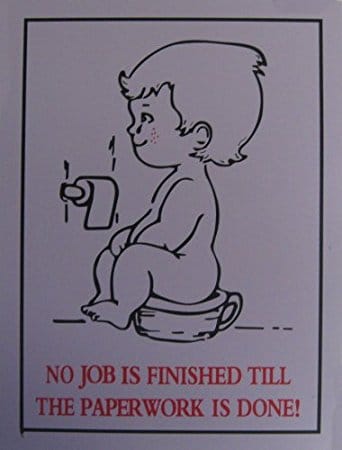
Last week someone broke into the police station and stole all the toilets. The cops are still searching. So far, they have nothing to go on.paperwork

On administration: In life as on the toilet, the job isn’t done until the paperwork is finished.

Speaking of toilet paper: do you know why Star Trek is like toilet paper? They both go past Uranus and capture Klingons. I wrote an essay on Toilet paper — really. 

Here’s my campaign song and video. It’s sung by Art Carney (I’ve no rights, but figure they’ve expired). The pictures are of me, my daughter, and various people we met visiting sewage treatment plants around the county. Great men and a few great women who don’t mind getting their hands dirty. 

septic12

The Turd Burglar, We’re No.1 in the No. 2 business. What a motto!

And now for sewage Limericks:

There once was a man named McBride.
Who fell in the sewer and died.
The same day his brother
Fell in another,
And they were interred side by side.

There is a double intent in that Limerick, in case you missed it

By the sewer she lived, by the sewer she died. Some said t’was disease, but I say, Suicide

sewage treatment

sewage treatment plant in Pontiac, MI — the county’s largest.

How do you describe a jocular sewage joker? pun gent.

Life is like a sewer, what you get out of it is what you put into it (Tom Lehrer). And sometimes it stinks.

Robert E. Buxbaum, June 4, 2017. There is just one more sewage joke I know, but I thought I’d leave it out. It concerns the sewage backup at the prom. Unfortunately, the punchline stinks.

A clever, sorption-based, hydrogen compressor

Hydrogen-powered fuel cells provide weight and cost advantages over batteries, important e.g. for drones and extended range vehicles, but they require highly compressed hydrogen and it’s often a challenge compressing the hydrogen. A large-scale solution I like is pneumatic compression, e.g. this compressor. One would combine it with a membrane reactor hydrogen generator, to fill tanks for fuel cells. The problem is that this pump is somewhat complex, and would likely add air impurities to the hydrogen. I’d now like to describe a different, very clever hydrogen pump, one that suited to smaller outputs, but adds no impurities and and provides very high pressure. It operates by metallic hydride sorption at low temperature, followed by desorption at high temperature.

Hydride sorption -desorption pressures vs temperature.

Hydride sorption -desorption pressures vs temperature, from Dhinesh et al.

The metal hydriding reaction is M + nH2 <–> MH2n. Where M is a metal or metallic alloy and MH2n is the hydride. While most metals will undergo this reaction at some appropriate temperature and pressure, the materials of practical interest are exothermic hydrides that is hydrides that give off heat on hydriding. They also must undergo a nearly stoichiometric absorption or desorption reaction at reasonable temperatures and pressures. The plot at right presents the plateau pressure for hydrogen absorption/ desorption in several, exothermic metal hydrides. The most attractive of these are shown in the red box near the center. These sorb or desorb between 1 and 10 atmospheres and 25 and 100 °C.

In this plot, the slope of the sorption line is proportional to the heat of sorption. The most attractive materials for this pump are the ones in the box (or near) with a high slope to the line implying a high heat of sorption. A high heat of sorption means you can get very high compression without too much of a temperature swing.

To me, NaAlH4 appears to be the best of the materials. Though I have not built a pump yet with this material, I’d like to. It certainly serves as a good example for how the pump might work. The basic reaction is:

NaAl + 2H2 <–> NaAlH4

suggesting that each mol of NaAl material (50g) will absorb 2 mols of hydrogen (44.8 std liters). The sorption line for this reaction crosses the 1 atm horizontal line at about 30°C. This suggests that sorption will occur at 1 am and normal room temperature: 20-25°C. Assume the pump contains 100 g of NaAl (2.0 mols). Under ideal conditions, these 100g will 4 mols of hydrogen gas, about 90 liters. If this material in now heated to 226°C, it will desorb the hydrogen (more like 80%, 72 liters) at a pressure in excess of 100 atm, or 1500 psi. The pressure line extends beyond the graph, but the sense is that one could pressure in the neighborhood of 5000 psi or more: enough to use filling the high pressure tank of a hydrogen-based, fuel cell car.

The problem with this pump for larger volume H2 users is time. It will take 2-3 hours to cycle the sober, that is, to absorb hydrogen at low pressure, to heat the material to 226°C, to desorb the H2 and cycle back to low temperature. At a pump rate of 72 liters in 2-3 hours, this will not be an effective pump for a fuel-cell car. The output, 72 liters is only enough to generate 0.12kWh, perhaps enough for the tank of a fuel cell drone, or for augmenting the mpg of gasoline automobiles. If one is interested in these materials, my company, REB Research will be happy to manufacture some in research quantities (the prices blow are for materials cost, only I will charge significantly more for the manufactured product, and more yet if you want a heater/cooler system).

Properties of Metal Hydride materials; Dhanesh Chandra,* Wen-Ming Chien and Anjali Talekar, Material Matters, Volume 6 Article 2

Properties of Metal Hydride materials; Dhanesh Chandra,* Wen-Ming Chien and Anjali Talekar, Material Matters, Volume 6 Article 2

One could increase the output of a pump by using more sorbent, perhaps 10 kg distributed over 100 cells. With this much sorbent, you’ll pump 100 times faster, enough to take the output of a fairly large hydrogen generator, like this one from REB. I’m not sure you get economies of scale, though. With a mechanical pump, or the pneumatical pump,  you get an economy of scale: typically it costs 3 times as much for each 10 times increase in output. For the hydride pump, a ten times increase might cost 7-8 times as much. For this reason, the sorption pump lends itself to low volume applications. At high volume, you’re going to want a mechanical pump, perhaps with a getter to remove small amounts of air impurities.

Materials with sorption lines near the middle of the graph above are suited for long-term hydrogen storage. Uranium hydride is popular in the nuclear industry, though I have also provided Pd-coated niobium for this purpose. Materials whose graph appear at the far, lower left, titanium TiH2, can be used for permanent hydrogen removal (gettering). I have sold Pd-niobium screws for this application, and will be happy to provide other shapes and other materials, e.g. for reversible vacuum pumping from a fusion reactor.

Robert Buxbaum, May 26, 2017 (updated Apr. 4, 2022). 

Future airplane catapults may not be electric

President Trump got into Hot Water with the Navy this week for his suggestion that they should go “back to god-damn steam” for their airplane catapults as a cure for cost over-runs and delays with the Navy’s aircraft carriers. The Navy had chosen to go to a more modern catapult called EMALS (electromagnetic, aircraft launch system) based on a traveling coil and electromagnetic pulses. This EMAL system has cost $5 Billion in cost over-runs, has added 3 years to the program, and still doesn’t work well. In response to the president’s suggestion (explosion), the Navy did what the rest of Washington has done: blame Trump’s ignorance, e.g. here, in the Navy Times. Still, for what it’s worth, I think Trump’s idea has merit, especially if I can modify it a bit to suggest high pressure air (pneumatics) instead of high pressure steam.


Tests of the navy EMALS, notice that some launches go further than others; the problem is electronics, supposedly.

If you want to launch a 50,000 lb jet fighter at 5 g acceleration, you need to apply 250,000 lbs of force uniformly throughout the launch. For pneumatics, all that takes is 250 psi steam or air, and a 1000 square inch piston, about 3 feet in diameter. This is a very modest pressure and a quite modest size piston. A 50,000 lb object accelerated this way, will reach launch speed (130 mph) in 1.2 seconds. It’s very hard to get such fast or uniform acceleration with an electromagnetic coil since the motion of the coil always produces a back voltage. The electromagnetic pulses can be adjusted to counter this, but it’s not all that easy, as the Navy tests show. You have to know the speed and position of the airplane precisely to get it right, and have to adjust the firing of the pushing coils accordingly. There is no guarantee of smooth acceleration like you get with a piston, and the EMALS control circuit will always be vulnerable to electromagnetic and cyber attack. As things stand, the control system is thought to be the problem.

A piston is invulnerable to EM and cyber attack since, if worse comes to worse, the valves can be operated manually, as was done with steam-catapults throughout WWII. And pistons are very robust — far more robust than solenoid coils — because they are far less complex. As much force as you put on the plane, has to be put on the coil or piston. Thus, for 5 g acceleration, the coil or piston has to experience 250,000 lbs of horizontal force. That’s 3 million Newtons for those who like SI units (here’s a joke about SI units). A solid piston will have no problem withstanding 250,000 lbs for years. Piston steamships from the 50s are still in operation. Coils are far more delicate, and the life-span is likely to be short, at least for current designs. 

The reason I suggest compressed air, pneumatics, instead of steam is that air is not as hot and corrosive as steam. Also an air compressor can be located close to the flight deck, connected to the power center by electric wires. Steam requires long runs of steam pipes, a more difficult proposition. As a possible design, one could use a multi-stage, inter-cooled air compressor connected to a ballast tank, perhaps 5 feet in diameter x 100 feet long to guarantee uniform pressure. The ballast tank would provide the uniform pressure while allowing the use of a relatively small compressor, drawing less power than the EMALS. Those who’ve had freshman physics will be able to show that 5 g acceleration will get the plane to 130 mph in only 125 feet of runway. This is far less runway than the EMALS requires. For lighter planes or greater efficiency, one could shut off the input air before 120 feet and allow the remainder of the air to expand for 200 feet of the piston.

The same pistons could be used for capturing an airplane. It could start at 250 psi, dead-ended to the cylinder top. The captured airplane would push air back into the ballast tank, or the valve could be closed allowing pressure to build. Operated that way, the cylinder could stop the plane in 60 feet. You can’t do that with an EMAL. I should also mention that the efficiency of the piston catapult can be near 100%, but the efficiency of the EMALS will be near zero at the beginning of acceleration. Low efficiency at low speed is a problem found in all electromagnetic actuators: lots of electromagnetic power is needed to get things moving, but the output work,  ∫F dx, is near zero at low velocity. With EM, efficiency is high at only at one speed determined by the size of the moving coil; with pistons it’s high at all speeds. I suggest the Navy keep their EMALS, but only as a secondary system, perhaps used to launch drones until they get sea experience and demonstrate a real advantage over pneumatics.

Robert Buxbaum, May 19, 2017. The USS Princeton was the fanciest ship in the US fleet, with super high-tech cannons. When they mis-fired, it killed most of the cabinet of President Tyler. Slow and steady wins the arms race.

Nestle pays 1/4,000 what you pay for water

When you turn on your tap or water your lawn, you are billed about 1.5¢ for every gallon of water you use. In south-east Michigan, this is water that comes from the Detroit river, chlorinated to remove bacteria, e.g. from sewage, and delivered to you by pipe. When Nestle’s Absopure division buys water, it pays about 1/4000 as much — $200/ year for 218 gallons per minute, and they get their water from a purer source, a pure glacial aquifer that has no sewage and needs no chlorine. They get a far better deal than you do, in part because they provide the pipes, but it’s mostly because they have the financial clout to negotiate the deal. They sell the Michigan water at an average price around $1/gallon, netting roughly $100,000,000 per year (gross). This allows them to buy politicians — something you and I can not afford.

Absopure advertises that I t will match case-for-case water donations to Flint. Isn't that white of them.

Absopure advertises that I t will match case-for-case water donations to Flint. That’s awfully white of them.

We in Michigan are among the better customers for the Absopure water. We like the flavor, and that it’s local. Several charities purchase it for the folks of nearby Flint because their water is near undrinkable, and because the Absopure folks have been matching the charitable purchases bottle-for bottle. It’s a good deal for Nestle, even at 50¢/gallon, but not so-much for us, and I think we should renegotiate to do better. Nestle has asked to double their pumping rate, so this might be a good time to ask to increase our payback per gallon. So far, our state legislators have neither said yes or no to the proposal to pump more, but are “researching the matter.” I take this to mean they’re asking Nestle for campaign donations — the time-honored Tammany method. Here’s a Detroit Free Press article.

I strongly suspect we should use this opportunity to raise the price by a factor of 400 to 4000, to 0.15¢ to 1.5¢ per gallon, and I would like to require Absopure to supply a free 1 million gallons per year. We’d raise $300,000 to $3,000,000 per year and the folks of Flint would have clean water (some other cities need too). And Nestle’s Absopure would still make $200,000,000 off of Michigan’s, clean, glacial water.

Robert Buxbaum, May 15, 2017. I ran for water commissioner, 2016, and have occasionally blogged about water, E.g. fluoridationhidden rivers, and how you would drain a swamp, literally.

Why did Hamilton wear his glasses at the duel?

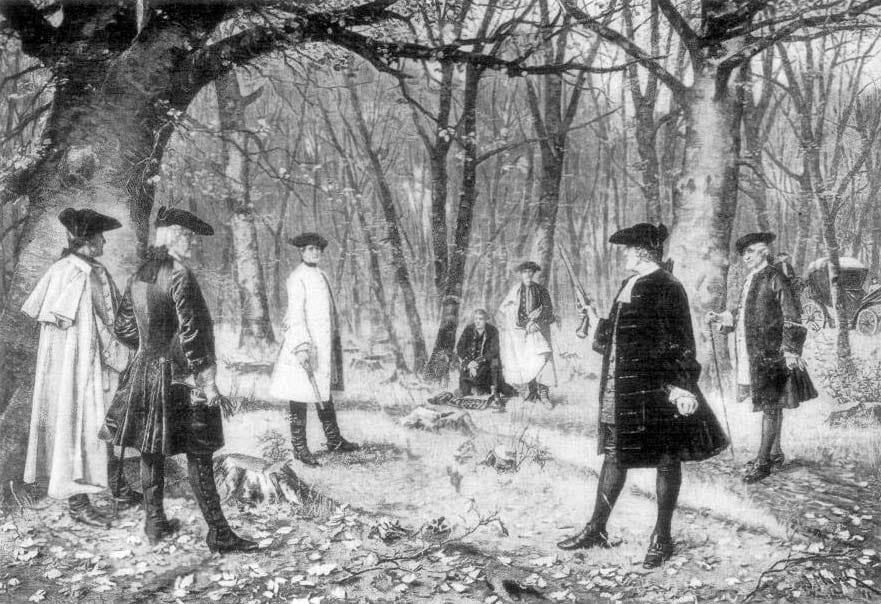
The musical play “Hamilton” ends with his duel with Burr. A song leading up to it, the world was wide enough tells the audience that Hamilton “wore his glasses” at the duel, and that he “methodically fiddled with the trigger.” It doesn’t say why, but tries to imply a sort of death-wish where Hamilton “threw away his shot” (fired into the air) because he didn’t want to kill his first friend, or because he thought of his son, who died near the spot. The theory is supported by popular myth, though the details of the events are, by necessity, muddy. All the witnesses testified that they looked away before the shooting started –customary in duels at the time.

There are some problems I find with this theory, and I’d like to present another: that Hamilton was so eager to kill Burr that he over-stacked the deck in his favor. The witnesses noted that Hamilton performed some provocative actions that seem out of character for someone who wants to commit suicide: “As they were taking their places, he (Hamilton) asked that the proceedings stop, adjusted his spectacles, and slowly, repeatedly, sighted along his pistol to test his aim”[1]. This seems like a taunt, if anything. As I reading the letters too, I find Hamilton taunting Burr to duel. He could have bowed out in many ways, as Washington always had, or been neutral. Why taunt? Why wear glasses and fiddle with the trigger? Why test your aim and then throw away your shot?

The choice of guns is important too, along with where the shot actually went. First the shot: While Hamilton’s second originally thought Hamilton had shot in the air, when the seconds went back the next day they found the shot in a cedar limb, “at an elevation of about twelve feet and a half, perpendicularly from the ground, between thirteen and fourteen feet from the mark on which General Hamilton stood, and about four feet wide of the direct line between him and Col. Burr, on the right side”.[2] The men stood 10 paces apart (16-18 feet), so apparently the shot hit about 6 feet above Burr’s head on a line reasonably towards him. That’s not quite shooting in the air.

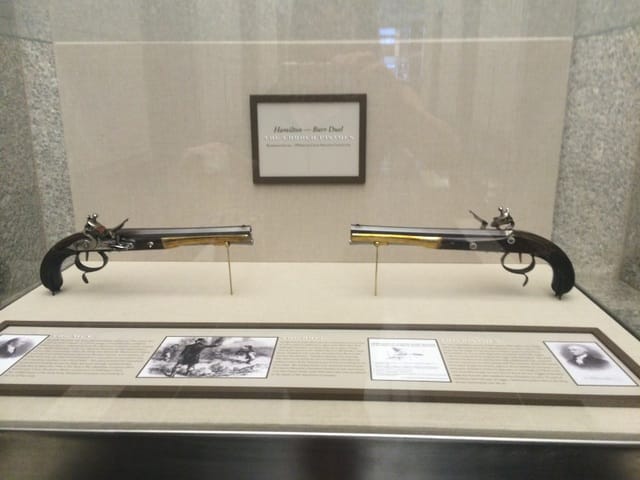
The pair of Wogdon dueling pistols used in the Hamilton - Burr duel.

The Wogdon pistols used in the Hamilton – Burr duel. Currently the property of the JP Morgan Chase Manhattan Bank, in 1976 they were found to have a hidden hair trigger, something Hamilton knew, but Burr would not have known.

The choice of pistols is also suggestive. The pistols were the property of John Church, a brother-in-law to Hamilton, and a business partner of both men. Church had fought a duel with Burr some years before and, using Burr’s pistols, shot a button off Burr’s coat. Burr missed completely. Church then bought these new pistols in London — Wogdon pistols, with an extra-large bore and sights. Sights were not considered “sporting” for duels, and not ordinarily allowed. With sights on the pistols, one could not miss if one aimed. As for the bigger bore, this too was unusual. If you hit, you killed; most gentlemen preferred a less-deadly duel. Hamilton chose to use these pistols even though he owned two, “legal” pistols (smaller bore, no sight). As the challenged party, it was his right. Still, why not choose your own, if not to make use of the sight and the large-bore. And, according to his second, he seems to have practiced with the pistols beforehand [4].

Analysis of the guns, done in the late 1970s [3] turned up another illegal feature. While they appear to be normal dueling pistols, these guns have a hidden feature. If you move the trigger a fraction of an inch forward it sets a hidden, hair-trigger. It’s a hidden feature that Hamilton knew about [3] but Burr almost certainly did not. If Hamilton surreptitiously set the hair-trigger, it would give him a tremendous advantage. He would be able to shoot more quickly and more accurately, with a much lighter squeeze on the trigger. The sights ensured it would be a kill. Burr’s gun, unset, would have required the normal, heavy, 10-15 pound pull. His shot would have been slower and less accurate. As it was, it seems Burr fired second.

Ten paces is not very far apart. People missed because of the 10-20 lb pull and lack of sights made it hard to hit. Besides, many people who were hit survived.

Ten paces is not very far apart. People missed because of the 10-20 lb pull and the lack of sights made it hard to hit anyone. Besides, with a small bore, you didn’t kill.

There are a couple of problems with using hair-trigger pistols, though. They can go off prematurely, even if you know the trigger’s been set [4], and it’s worse if you are not quite sure you’ve set the trigger. The Wogdon guns intentionally made it hard to tell if you have set the trigger or not, and made it impossible to unset the trigger without firing. I suspect that Hamilton cleaned his glasses, fiddled with the trigger, and sighted his aim because he was unsure whether he’d set the hair-trigger. My theory is he came to the wrong conclusion. According to the seconds, Burr’s shot was almost simultaneous, but his apparently achieved a lucky/ un-lucky hit. Burr killed his rival, but also killed his own political career, the unhappy end to a beautiful animosity, discussed in the play, and discussed by me from a different angle. [5]

References:

1. Testimony at trial, Centinel of Freedom, November 24, 1807, cited in Winfield, 1874, p. 220.

2.  Nathanial Pendelton’s Amended testimony of Nathaniel Pendleton and William P. Ness’s Statement of July 11, 1804. Amended after the pair revisited the site and found the bullet.

3. “Pistols shed light on famed duel”, Merrill Lindsay, Smithsonian Magazine. 1976.

4. ibid. Hamilton told his second not to set the hair-trigger, and then seems to have set his own. Linsay’s theory is that Hamilton knew he’d set the trigger, but squeezed it too early.

5. Since the witnesses looked away, you might think of another explanation: that Burr fired first and Hamilton’s gun then went off in death throw, in the general direction of Burr. A couple of problems with this theory: for the gun to go off like that, Hamilton would have had to set the hair-trigger. The ordinary 10-15 lb trigger would require a determined squeeze. Also, for the bullet to hit the tree like that, Hamilton would have had to raise his gun past Burr, though not to the side or down as one might if he wished to throw away his shot. And Burr would have to have set the trigger himself to shoot so fast and so well. Randall’s book, “Alexander Hamilton, a life”, claims he did, p. 424, but looking at this video of the hair-trigger mechanism, I find the mechanism is too cleverly hidden for Burr to have noticed. It escaped detection for 170 years. Finally, for Burr to shoot to kill without provocation, would require that he murder in cold blood, and Burr shows no evidence of that. Besides, Burr would have had to worry that the witnesses might turn around and see his dastardly deed. As it was, even with Hamilton’s gun going off, Burr’s reputation was ruined. I reject this theory, and assert as others have: “Hamilton did fire his weapon intentionally, and he fired first.”

Robert E. Buxbaum, May 10, 2017. You may like these other songs from Hamilton, “your obedient servant,” and “the ten duel commandments.” And you may like this essay about Burr, Tammany Hall and the Manhattan bank.