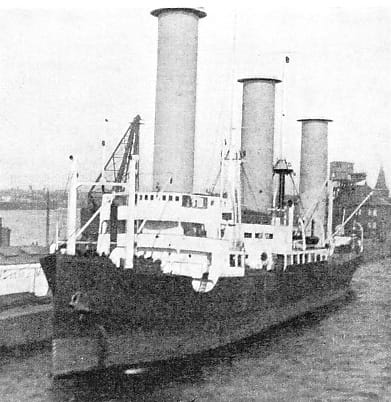
Sailing ships are wonderfully economic and non-polluting. They have unlimited range because they use virtually no fuel, but they tend to be slow, about 5-12 knots, about half as fast as Diesel-powered ships, and they can be stranded for weeks if the wind dies. Classic sailing ships also require a lot of manpower: many skilled sailors to adjust the sails. What’s wanted is an easily manned, economical, hybrid ship: one that’s powered by Diesel when the wind is light, and by a simple sail system when the wind blows. Anton Flettner invented an easily manned sail and built two ships with it. The Barbara above used a 530 hp Diesel and got additional thrust, about an additional 500 hp worth, from three, rotating, cylindrical sails. The rotating sales produced thrust via the same, Magnus force that makes a curve ball curve. Barbara went at 9 knots without the wind, or about 12.5 knots when the wind blew. Einstein thought it one of the most brilliant ideas he’d seen.

The source of the force can be understood with help of the figure at left and the graph below. When a simple cylinder sits in the wind, with no spin, α=0, the wind force is only drag, calculated as 1/2 the wind speed squared, times the cross-sectional area of the cylinder, Dh, times the density of air, times. a drag coefficient, CD. Here, CD is about 1 for a non-spinning cylinder, increasing to about 2 for a fast spinning cylinder. In any case, FD= CDDhρv2/2.
A spinning cylinder has lift force too. FL= CLDhρv2/2.
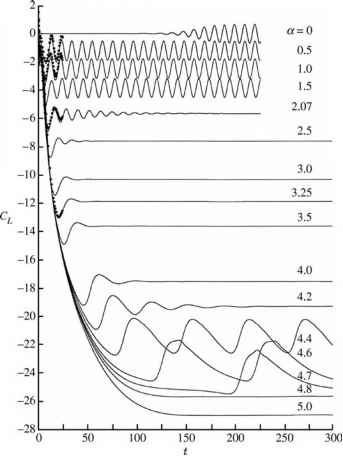
The lift on the ship, the force you want is calculated the same way, FL= CLDhρv2/2, where the coefficient of lift, CL is graphed in the figure at right. When there is no spin, it is effectively zero with sustained vibrations; that’s at, α=0. Vibrations are useless for propulsion, and can be damaging to the sail, though they are helpful in baseball pitching, producing the erratic flight of knuckle balls. If you spin the cylindrical mast at α>2.1 there are no vibrations, and you get significant lift, CL> 6. At α = 2.1 the fast side of the cylinder moves in the direction of the wind at 2.1 times the wind speed. The other side of the rotor moves opposite: 1.1 times as fast as the wind, but backwards. Even at this, relatively low rotation speed, the coefficient of lift, CL= 6, is more than twice that found with a typical, triangular, non-rotating sail. Drag is higher too, but not as much. The lift is about 4 times the drag, far better than in a typical sail. Another plus is that the ship can be propelled forward or backward -just reverse the spin direction. This is very good for close-in sailing.
The sail lift, and lift to drag ratio, increases with rotation speed reaching very values of 10 to 18 at α values of 3 to 4. Flettner considered α=3.5. optimal. At this α -value you get far more thrust than with a normal sail, and you can go faster than the wind, and far closer to the wind than with any normal sail. You don’t want α values above 4.2 because you start seeing vibrations again. Also more rotation power is needed (rotation power goes as ω2); unless the wind is strong, you might as well use a normal propeller.
The driving force is always at right angles to the perceived wind, called the “fair wind”, and the fair wind moves towards the front as the ship speed increases. Controlling the rotation speed is somewhat difficult but important. Flettner sails were no longer used by the 1930s because fuel became cheaper and control was difficult. Normal sails weren’t being used either for the same reasons.

In the early 1980s, there was a return to the romantic. Famous underwater explorer, Jacques Cousteau, revived a version of the Flettner sail for his exploratory ship, the Alcyone. He used aluminum sails, and an electric motor for rotation. He claimed that the ship drew more than half of its power from the wind, and claimed that, because of computer control, it could sail with no crew. This claim was likely bragging, but he bragged a lot. Even with today’s computer systems, people are needed to steer and manage things in case something goes wrong. The energy savings were impressive, though, enough so that some have begun to put Flettner sails on cargo ships, as a right. This is an ideal use since cargo ships go about as fast as a typical wind, 10- 20 knots. It’s reported that, Flettner- powered cargo ships get about 20% of their propulsion from wind power, not an insignificant amount.
And this gets us to the reason your curve ball does not curve: it’s likely you’re not spinning it fast enough. To get a good curve, you want the ball to spin at α =3, or about 1.5 times the rate you’d get by rolling the ball off your fingers. You have to snap your wrist hard to get it to spin this fast. As another approach, you can aim for α=0, a knuckle ball, achieved with zero rotation. At α=0, the ball will oscillate. It’s hard to do, but your pitch will be nearly impossible to hit or catch. Good luck.
Robert Buxbaum, March 22, 2023. There are also Flettner airplane designs where horizontal, cylindrical “wings” rotate to provide high lift with short wings and a relatively low power draw. So-far, these planes are less efficient and slower than a normal helicopter. The idea could bear more development work, IMHO. Einstein had an eye for good ideas.
Pingback: Sailors, boaters, and motor sailing at the hull speed. | REB Research Blog