Category Archives: Science: Physics, Astronomy, etc.

Eliquis, over-prescribed but better than Coumadin.

Eliquis (apixaban) is blood thinner shown to prevent stroke with fewer side effects than Warfarin (Coumadin). Aspirin does the same, but not as effectively for people over 75. My problem with eliquis is that it’s over-prescribed. The studies favoring it over aspirin found benefits for those over 75, and for those with A-Fib. And even in this cohort the advantage over aspirin is small or non-existent because eliquis has far more serious side effects; hemorrhage, or internal bleeding.

Statistically, the AVERROES study (Apixaban Versus Acetylsalicylic Acid to Prevent Stroke in AF Patients Who Have Failed or Are Unsuitable for Vitamin K Antagonist Treatment) found that apixaban is substantially better than aspirin at preventing stroke in atrial fibrillation patients, but worse at preventing heart attack.

Taking 50 mg of Eliquis twice a day, reduces the risk of stroke in people with A-Fib by more than 50% and reduces the rate of heart attack by about 15%. By comparison, taking 1/2 tablet of aspirin, 178 mg, reduces the risk of stroke by 17% and of heart attack by 42%. The benefits were higher in the elderly, those over 75, and non existent in those with A-Fib under 75, see here, and figure. Despite this, doctors prescribe Eliquis over aspirin, even to those without A-Fib and those under 75. I suspect the reason is advertising by the drug companies, as I’ve claimed earlier with Atenolol.

The major deadly side-effect is hemorrhage, brain hemorrhage and GI (stomach) hemorrhage. Here apixaban is far worse than with aspirin (but better than Warfarin). The net result is that in the AVERROES random-double blind study there was no difference in all-cause mortality between apixaban and aspirin for those with A-fib who were under 75, see here. Or here.

To reduce your chance of GI hemorrhage with Eliquis, it is a very good idea to take a stomach proton pump drug like Pantoprazole. If you have A-Fib, the combination of Eliquis and pantoprazole seems better than aspirin alone, even for those under 75. If you have no A-Fib and are under 75, I see no benefit to Eliquis, especially if you find you have headaches, stomach aches, back pain, or other signs of internal bleeding, you might switch to aspirin or choose a reduced dose.

A Japanese study found that half the normal dose of Eliquis, was approximately as effective as the full dose, 50 mg twice a day. I was prescribed Eliquis, full dose twice a day, but I’m under 70 and I have no A-Fib since my ablation.

Life expectancy has dropped in the US to undeveloped world levels. Biden blames COVID and racism. I think it’s too much drugs, and too few opportunities.

I’m struck by the fact that US life expectancy is uncommonly low, lower than in most developed countries. Lower too than in many semi-developed countries, and our life expectancy is decreasing while other countries are not seeing the same. It dropped by about 3 years over the last 2 years as shown. I wonder why the US has suffered more than other countries, and suspect we are over-prescribed. Too much of a good thing, typically isn’t good.

Robert Buxbaum, September 16, 2022. As a side issue, low dose aspirin may forestall Alzheimers and other dementias. See current article here. Also another study here.

Of covalent bonds and muon catalyzed cold fusion.

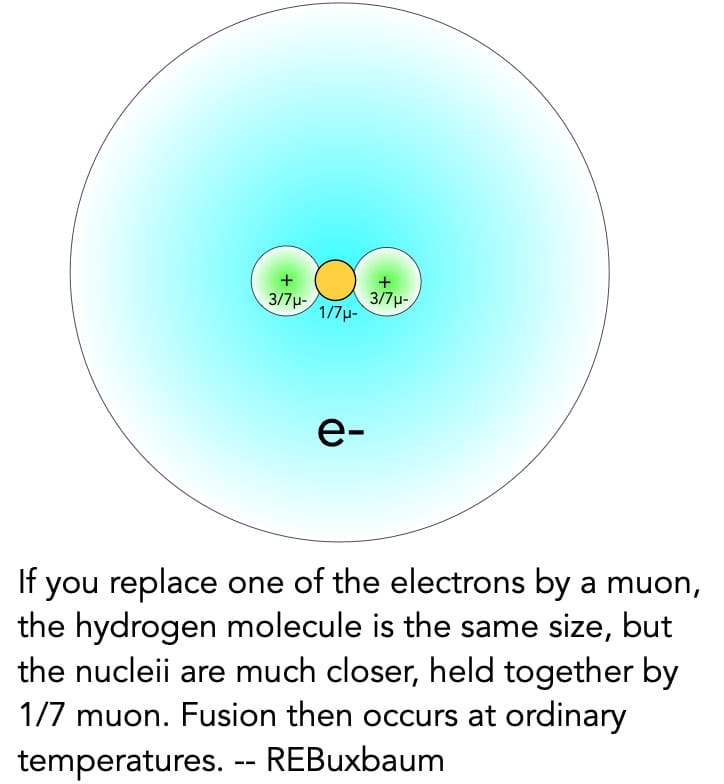
A hydrogen molecule consists of two protons held together by a covalent bond. One way to think of such bonds is to imagine that there is only one electron is directly involved as shown below. The bonding electron only spends 1/7 of its time between the protons, making the bond, the other 6/7 of the time the electron shields the two protons by 3/7 e each, reducing the effective charge of each proton to 4/7e+.

We see that the two shielded protons will repel each other with the force of FR = Ke (16/49 e2 /r2) where e is the charge of an electron or proton, r is the distance between the protons (r = 0.74Å = 0.74×10⁻¹⁰m), and Ke is Coulomb’s electrical constant, Ke ≈ 8.988×10⁹ N⋅m2⋅C−2. The attractive force is calculated similarly, as each proton attracts the central electron by FA = – Ke (4/49) e2/ (r/2)2. The forces are seen to be in balance, the net force is zero.

It is because of quantum mechanics, that the bond is the length that it is. If the atoms were to move closer than r = 0.74Å, the central electron would be confined to less space and would get more energy, causing it to spend less time between the two protons. With less of an electron between them, FR would be greater than FA and the protons would repel. If the atoms moved further apart than 0.74Å, a greater fraction of the electron would move to the center, FA would increase, and the atoms would attract. This is a fairly pleasant way to understand why the hydrogen side of all hydrogen covalent bonds are the same length. It’s also a nice introduction to muon-catalyzed cold fusion.

Most fusion takes place only at high temperatures, at 100 million °C in a TOKAMAK Fusion reactor, or at about 15 million °C in the high pressure interior of the sun. Muon catalyzed fusion creates the equivalent of a much higher pressure, so that fusion occurs at room temperature. The trick to muon catalyzed fusion is to replace one of the electrons with a muon, an unstable, heavy electron particle discovered in 1936. The muon, designated µ-, behaves just like an electron but it has about 207 times the mass. As a result when it replaces an electron in hydrogen, it forms form a covalent bond that is about 1/207th the length of a normal bond. This is the equivalent of extreme pressure. At this closer distance, hydrogen nuclei fuse even at room temperature.

In normal hydrogen, the nuclei are just protons. When they fuse, one of them becomes a neutron. You get a deuteron (a proton-neutron pair), plus an anti electron and 1.44 MeV of energy after the anti-electron has annihilated (for more on antimatter see here). The muon is released most of the time, and can catalyze many more fusion reactions. See figure at right.

While 1.44MeV per reaction is a lot by ordinary standards — roughly one million times more energy than is released per atom when hydrogen is burnt — it’s very little compared to the energy it takes to make a muon. Making a muon takes a minimum of 1000 MeV, and more typically 4000 MeV using current technology. You need to get a lot more energy per muon if this process is to be useful.

You get quite a lot more energy when a muon catalyzes deuterium fusion or deuterium- fusion. With these reactions, you get 3.3 to 4 MeV worth of energy per fusion, and the muon will be ejected with enough force to support about eight D-D fusions before it decays or sticks to a helium atom. That’s better than before, but still not enough to justify the cost of making the muon.

The next reactions to consider are D-T fusion and Li-D fusion. Tritium is an even heavier isotope of hydrogen. It undergoes muon catalyzed fusion with deuterium via the reaction, D+T –> 4He +n +17.6 MeV. Because of the higher energy of the reaction, the muons are even less likely to stick to a helium atom, and you get about 100 fusions per muon. 100 x 17.6 MeV = 1.76 GeV, barely break-even for the high energy cost to make the muon, but there is no reason to stop there. You can use the high energy fusion neutrons to catalyze LiD fusion. For example, 2LiD +n –> 34He + T + D +n producing 19.9 MeV and a tritium atom.

With this additional 19.9 MeV per DT fusion, the system can start to produce usable energy for sale. It is also important that tritium is made in the process. You need tritium for the fusion reactions, and there are not many other supplies. The spare neutron is interesting too. It can be used to make additional tritium or for other purposes. It’s a direction I’d like to explore further. I worked on making tritium for my PhD, and in my opinion, this sort of hybrid operation is the most attractive route to clean nuclear fusion power.

Robert Buxbaum, September 8, 2022. For my appraisal of hot fusion, see here.

Arctic Ice has shrunk 1.5% since ’99 and Gore’s inconvenient truth. Is this bad?

At the 1999 Copenhagen Climate Change Summit, Al Gore announced an inconvenient truth: “There is a 75 per cent chance that the entire north polar ice cap, during the summer months, could be completely ice-free within five to seven years.” It was a bold prediction, part of a campaign that got Mr Gore a Nobel Prize and motivated the US to devote billions to stopping global warming. Supposedly 98% of scientists agreed with Mr. Gore and his remedies. Prince Charles and Bill Gates too. Twenty three years later there is still arctic ice, 98.5% as much as in 1999. Two questions arise: 1. Is the ice loss bad? and 2. Why were those 98% of scientists so wrong?

Arctic sea ice extent 1999-2021
Arctic sea ice extent when Al Gore spoke (1999) and since. Not much change, nor clearly for the worse

The second question is far easier than the first: the 98% number was bogus, a lie, like many other climate lies that followed. it was effective at stopping argument, and could not be checked immediately. It bullied scientists who argued that global warming wasn’t bad, or wasn’t man-made, and it gave do-gooders the ability to label their opponents “liars” and “science deniers”. The claim of 98% was used to silence scientists with long, prominent careers. Deniers lost their funding and were no longer published. Other scientists learned to keep quiet. Twenty years later, when the arctic ice wasn’t gone and antarctic ice hit a record extent, the deniers’ careers largely were gone.

Scientists are not stupid, nor independently rich, for the most part. They are dependent on government funding and their employers, the universities are too. As a group they (we) are incapable of stemming the tide of public opinion. This week Biden signed a nearly 1 trillion dollar bill to stop climate change. Every scientist with a chance to get the money will go for it. Whether or not they think a colder earth is good, they will claim it is in their proposals, and imply that their work can stop the natural chaos that is climate. They will ask for their share of the $1T to study the appropriate things: solar cells, corn-based power, and wind turbines. The proposals will not mention the huge costs in mining or land use. Scientists already know they can not get funded for nuclear power, though it works and produces no CO2, nor should can scientists benefit by criticizing China, as the largest source of CO2. That is seen as undermine the green effort at home. When we stop manufacturing at home, BTW, we end up buying the same materials manufactured in China, where they really generate lots of pollution. When asked about this, Biden’s climate chief said not to worry about it, we had to do our part, and Biden would speak to the Chinese. The result is the biggest buildup in coal-fired power plants in the world, with more coming on line.

This second question is at least as important as the first one: is less arctic ice bad? Or, asking more generally, is a warm earth bad? It’s an opinion question; it’s in no way science, impossible to answer definitively. Cold weather is bad for food production, and that’s bad for people, in general. Most people prefer to live where it’s warm, I find. Supposedly polar bears prefer it cold, but I don’t know for sure. I’m not keen to go back to the climate of the ice ages, 10,000- 100,000 years ago when ice covered Canada and you could walk from France to England. I’m not convinced that life was better when the world was 1°C colder. The sea was lower in 1900, but had been higher in the year zero. Less arctic ice means easier shipping. For all I know we may want to make a Northwest Passage. More food and a easier shipping are the convenient truths about global warming.

Robert Buxbaum, August 19, 2022. If you believe any of what I said about Gore/Biden’s green energy, you may like a movie by Michael Moore, Planet of the Humans, see it here. The political greens are not saving energy or cooling the planet, and they know it. It’s a money maker.

Atenolol, not good for the heart, maybe good for the doctor.

Atenolol and related beta blockers have been found to be effective reducing blood pressure and heart rate. Since high blood pressure is a warning sign for heart problems, doctors have been prescribing atenolol and related beta blockers for all sorts of heart problems, even problems that are not caused by high blood pressure. I was prescribed metoprolol and then atenolol for Atrial Fibrillation, A-Fib, beginning 2 yeas ago, even though I have low-moderate blood pressure. For someone like me, it might have been deadly. Even for patients with moderately high blood pressure (hypertension) studies suggest there is no heart benefit to atenolol and related ß-blockers, and only minimal stroke and renal benefit. As early as 1985 (37 years ago) the Medical Research Council trial found that “ß blockers are relatively ineffective for primary treatment of hypertensive outcomes.”

End point. Relative risk. 95% CI. All-cause mortality Cardiovascular mortality MI Stroke Carlberg B et al. Lancet 2004; 364:1684–1689.

There lots of adverse side-effects to atenolol, as listed at the end of this post. More recent studies (e.g. Carlsberg et al., at right) continue to find no positive effects on the heart, but lots of negatives. A review in Lancet (2004) 364,1684–9 was titled, “Review: atenolol may be ineffective for reducing cardiovascular morbidity or all cause mortality in hypertension” (link here). “In patients with essential hypertension, atenolol is not better than placebo or no treatment for reducing cardiovascular morbidity or all cause mortality.” It further concluded that, “compared to other antihypertensive drugs, it [atenolol] may increase the risk of stroke or death.” I showed this and related studies to my doctor, and pointed out that I have averaged to low blood pressure, but he persisted in pushing this drug, something that seems common among medical men. My guess is that the advertising or doctor subsidies are spectacular. By contrast, aspirin has long been known to be effective for heart problems; my doctor said to go off aspirin.

The graph at right is from “Trial of Secondary Prevention with Atenolol after transient Ischemic Attack or Nondisabling Ischemic Stroke”, published in Stroke, 24 4 (1993), (see link here). a Thje study involved 1473 at-risk patients, randomly prescribed atenolol or placebo. It found no outcome benefit from atenolol, and several negatives. After 3 years, in two equal-size randomized groups, there were 64 deaths among the atenolol group, 58 among the placebo group; there were 11 fatal strokes with atenolol, versus 8 with placebo. There were somewhat fewer non-fatal strokes with atenolol, but the sum-total of fatal and non-fatal strokes was equal; there were 81 in each group.

“Trial of Secondary Prevention with Atenolol after transient Ischemic Attack or Nondisabling Ischemic Stroke”, published in Stroke, 24 4 (1993).

Newer beta blockers seem marginally better, as in “Effect of nebivolol or atenolol vs. placebo on cardiovascular health in subjects with borderline blood pressure: the EVIDENCE study.” “Nebivolol (NEB) in contrast to atenolol (ATE) may have a beneficial effect on endothelial function …. there was no significant change in the ATE and PLAC groups.” My question: why not use one of these, or better yet aspirin. Aspirin is shown to be beneficial, and relatively side-effect free. If you tolerate aspirin, and most people do, beneficial has to be better than maybe beneficial.

Among atenolol’s ugly side effects, as listed by the Mayo Clinic, there are: tiredness, sweating, shortness of breath, confusion, loss of sex drive, cold fingers and toes, diarrhea, nausea, and general confusion. I had some of these. There was no increase in heart stability (decrease in A-fib). My heart rate went as low at 32 bpm at night. My doctor was unconcerned, but I was. I suspected the low heart rate put me at extreme risk. Eventually, the same doctor gave me ablation therapy, and that seemed to cure the A-Fib.

Following my ablation, I was told I could get off atenolol. I then discovered another negative effect of atenolol: you have to ease off it or your heart will race. If you have A-fib, or modest hypertension, consider aspirin, eliquis, ablation, or exercise. If you are prescribed atenolol for heart issues and don’t have symptoms of very-high blood pressure, consider other options and/or changing doctors.

Robert Buxbaum, August 14, 2022

Three identical strangers, and the genetics of personality

Inheritability of traits is one of the greatest of insights; it’s so significant and apparent, that one who does not accept it may safely be called a dullard. Personal variation exists, but most everyone accepts that if your parents are tall, you are likely to be tall; If they are dark, you too will likely be dark, etc., but when it comes to intelligence, or proclivities, or psychological leanings, it is more than a little impolite to acknowledge that genetics holds sway. This unwillingness is glaringly apparent in the voice-over narration of a popular movie about three identical triplets who were raised separately without knowing of one another and who turned out virtually identical. The movie is “Three identical strangers”, and it recounts their separate upbringing, their meeting, and their lives afterwards.

Triplets, raised separately, came out near identical.

Although raised separately, one in a rich family, one in a poor family, and one middling, the three showed near identical intelligence, and near identical proclivities. Two of them picked the same out-of-the way college. All of them liked the same sort of clothes and had the same taste in women. There were differences too, showing that genetics isn’t everything: one was more outgoing, one less, and depressed, but in many ways, they were identical. Meanwhile, the voice-over kept saying things like, “isn’t it a shame that we never saw any results on nature/nurture from this study.” The movie looked at some twins, raised separately, saw the same commonalities, and restated that they saw nothing remarkable. My clear takeaway was genetics applies to psychology too. That it’s not all genetics, but it is at least as influential as upbringing/ nurture.

This movie also included pairs of identical twins, raised separately, they also showed strong personality similarities. It’s a finding that is well replicated in broader studies involving siblings raised separately, and unrelated adoptees raised together. Blood, it seems, is stronger than nurture. See for example the research survey paper, “Genetic Influence on Human Psychological Traits” Journal of the American Psychological Society 13-4, pp 148-151 (2004). A table from that paper appears below. Genetics plays a fairly strong role in all personal traits including intelligence, personality, self-control, mental illness, criminality, political views (even mobile phone use). The role is age-dependent, though so that intelligence (test determined) is strongly environment-dependent in 5 year olds, almost entirely genetic in 25-50 year olds. One area that is not strongly genetic, it seems, is religion.

In a sense, the only thing surprising about this result is that anyone is surprised. Genetics is accepted as crucial for all things physical, so why not mental and social. As an example of the genetic influence on sports, consider Jewish chess genius, Lazlo Polgar: he decided to prove that anyone could be great at chess, and decided to train his three daughters: he got two grand masters and an international master. By comparison, there are only 2 chess grand masters in all of Finland. Then consider that there are five all-star, baseball players named Alou, all from the same household, including the three brothers below. The household has seven pro baseball players in all.

Most people are uncomfortable with such evidence of genetic proclivity. The movie has been called “deeply disturbing” as any evidence of proclivity contradicts the promise of education: that all men are equal, blank slates at birth that can be fashioned into whatever you want through education. What we claim we want is leaders — lots of them, and we expect that education will produce equal ratios of woman and men, black and white and Hispanic, etc. and we expect to be able to get there without testing for skills, — especially without blind testing. I notice that the great universities have moved to have testing optional, instead relying on interviews and related measures of leadership. I think this is nonsense, but then I don’t run Harvard. As a professor, I’ve found that some kids have an aptitude and a burning interest, and others do not. You can tell a lot by testing, but the folks who run the universities disagree.

The All star Alou brothers share an outfield.

University heads claim that blind testing is racist. They find that some races score poorly on spacial sense, for example, or vocabulary suggesting that the tests are to blame. There is some truth to these concerns, but I find that the lack of blind testing is more racist. Once the test is eliminated, academia finds a way to elevate their friends, and the progeny of the powerful.

The variety of proclivities plays into an observation that you can be super intelligent in one area, and super stupid in others. That was the humor of some TV shows: “Big Bang Theory” and “Fraser”. That was also the tragedy of Bobby Fischer. He was brilliant in chess (and the child of brilliant parents), but was a blithering idiot in all other areas of life. Finland should not feel bad about their lack of great chess players. The country has produced two phone companies, two strong operating systems, and the all time top sniper.

Robert Buxbaum, May 15, 2022

Induction

Most of science is induction. Scientists measure correlation, for example that fat people don’t run as much as thin people. They then use logic to differentiate cause from effect that is do they not run because they are fat, or are they fat because they don’t run, or is everything base on some third factor, like genetics. At every step this is all inductive logic, but that’s how science is done.

The lack of certainty shows up especially commonly in health work. Many of our cancer cures are found to not work when studied under slightly different conditions. Similarly with weight los, or heart health. I’d mentioned previously that CPAPs reduce heart fibrillation, and heart filtration is correlated with shortened life, but then we find that CPAP use does not lengthen life, but seems to shorten it. (see a reason here). That’s the problem with induction; correlation isn’t typically predictive in a useful way.

Despite these problems, this is how science works. You look for patterns, use induction, find an explanation, and try to check your results. I have an essay on the scientific methods, with quotes from Sherlock Holmes. His mysteries are a wonderful guide, and his inductive leaps are almost always true. Meanwhile, the inductive leaps of Watson and Lastrade are almost always false.

Robert Buxbaum, May 9, 2022

A more accurate permeation tester

There are two ASTM-approved methods for measuring the gas permeability of a material. The equipment is very similar, and REB Research makes equipment for either. In one of these methods (described in detail here) you measure the rate of pressure rise in a small volume.This method is ideal for high permeation rate materials. It’s fast, reliable, and as a bonus, allows you to infer diffusivity and solubility as well, based on the permeation and breakthrough time.

Exploded view of the permeation cell.

For slower permeation materials, I’ve found you are better off with the other method: using a flow of sampling gas (helium typically, though argon can be used as well) and a gas-sampling gas chromatograph. We sell the cells for this, though not the gas chromatograph. For my own work, I use helium as the carrier gas and sampling gas, along with a GC with a 1 cc sampling loop (a coil of stainless steel tube), and an automatic, gas-operated valve, called a sampling valve. I use a VECO ionization detector since it provides the greatest sensitivity differentiating hydrogen from helium.

When doing an experiment, the permeate gas is put into the upper chamber. That’s typically hydrogen for my experiments. The sampling gas (helium in my setup) is made to flow past the lower chamber at a fixed, flow rate, 20 sccm or less. The sampling gas then flows to the sampling loop of the GC, and from there up the hood. Every 20 minutes or so, the sampling valve switches, sending the sampling gas directly out the hood. When the valve switches, the carrier gas (helium) now passes through the sampling loop on its way to the column. This sends the 1 cc of sample directly to the GC column as a single “injection”. The GC column separates the various gases in the sample and determines the components and the concentration of each. From the helium flow rate, and the argon concentration in it, I determine the permeation rate and, from that, the permeability of the material.

As an example, let’s assume that the sample gas flow is 20 sccm, as in the diagram above, and that the GC determines the H2 concentration to be 1 ppm. The permeation rate is thus 20 x 10-6 std cc/minute, or 3.33 x 10⁻⁷ std cc/s. The permeability is now calculated from the permeation area (12.56 cm2 for the cells I make), from the material thickness, and from the upstream pressure. Typically, one measures the thickness in cm, and the pressure in cm of Hg so that 1 atm is 76cm Hg. The result is that permeability is determined in a unit called barrer. Continuing the example above, if the upstream hydrogen is 15 psig, that’s 2 atmospheres absolute or or 152 cm Hg. Lets say that the material is a polymer of thickness is 0.3 cm; we thus conclude that the permeability is 0.524 x 10⁻¹⁰ scc/cm/s/cm2/cmHg = 0.524 barrer.

This method is capable of measuring permeabilities lower than the previous method, easily lower than 1 barrer, because the results are not fogged by small air leaks or degassing from the membrane material. Leaks of oxygen, and nitrogen show up on the GC output as peaks that are distinct from the permeate peak, hydrogen or whatever you’re studying as a permeate gas. Another plus of this method is that you can measure the permeability of multiple gas species simultaneously, a useful feature when evaluating gas separation polymers. If this type of approach seems attractive, you can build a cell like this yourself, or buy one from us. Send us an email to reb@rebresearch.com/blog/, or give us a call at 248-545-0155.

Robert Buxbaum, April 27, 2022.

C-PAPs do not help A-Fib, and seem to make heart health worse.

In this blog-post, I’d like to report on the first random study of patients with Atrial fabulation, A-Fib, and sleep apnea, comparing the health outcome of those who use a C-PAP, a “Continuous Positive Airway Pressure” device, to the outcome those who do not. The original study was published in May, 2021 (read it here) in the American Journal of Respiratory and Critical Care Medicine. The American Journal, Pulmonary Advisor published a more-popular version here.

As a background, if you are over 65 and overweight, there is a 25% chance or so that your heart rate will begin to surge semi-randomly, and that it will flutter. This is Atrial fabulation, A-Fib. It tends to get worse and tends to lead to heart attacks and strokes. People with A-fib tend to be treated with drugs, aspirin, warfarin, beta blockers, and anti arrhythmics. They also tend to be prescribed a C-PAP because overweight, older folks tend to snore and wake up a lot during the night (several times per hour: apnea).

A C-PAP definitely stops the snoring and the Apnea, and the assumption was that it would help your heart as well, if only by giving you a better night’s sleep. As it turns out, the C-PAP seems to decrease heart health — significantly.

For this study, adult patients between 18 and 75 years old diagnosed with paroxysmal A-Fib (that’s occasional AF) were screened for moderate to severe sleep apnea. Those who agreed to participate were randomly assigned to either a treatment of C-PAP plus usual care (drugs mostly) or just usual care for the next 5 months. Of the 109 who enrolled in the study, 55 got the C-PAP plus usual care, 54 got usual care alone. The outcome was that there were 9 serious, adverse heart events (strokes and heart attacks); 7 were in the C-PAP group.

The CPAP pressure was, on average, 6.8 cm H2O; mean time of use was 4.4±1.9 hours per night. The C-PAPs did their jobs on the apnea too, reducing residual apnea-hypopnea to 2.3±1.9 events per hour for those in the C-PAP group.

There was a non-statistically significant reduction is AF among the C-PAP group. They reduced their time in AF by 0.6 percentage points compared to the control group  (95% CI, -2.55 to 1.30; P =.52). That not a statistically significant difference, and is most likely random.

There was a statistically significant decrease in heart health, though. A total of 7 serious adverse events occurred in the C-PAP group and only 2 in the control group. A total of 9 is a relatively small number of events, but there is a strong statistical difference between 7 and 2.

The authors conclude: “CPAP treatment does not seem to reduce or prevent paroxysmal AF.” They should also have concluded that it reduced heart health with a statistical confidence of ~82%: (1-2(36+10)/512) =82%. See more on this type of statistics.

A possible explanation of why a C-PAP would would make heart health worse is an outcome of the this recent sleep study (link here). It appears that the C-PAP helps restore breathing, but by doing so, it interferes with a mechanism the body uses to deal with A-fib. It seems that, for people with A-Fib, their bodies use breathing stoppages to get their heart back into rhythm. For these people, many of their breathing stoppage are not obstructive, but a bio-pathway to raise the CO2 level in the blood and thus regulate heart rate. The use of a C-PAP prevents this restorative mechanism and this seem to be the reason it is destructive to the heart-health of patients with A-fib. On the other hand, a C-PAP does improve the sleep those patients whose apnea is obstructive. It seems to me that sleep studies should do a better job distinguishing the two causes of apnea. C-PAPs seem counter-indicated for patients with A-fib.

Robert Buxbaum, March 30, 2022. I was diagnosed with apnea and A-Fib some years ago. The sleep doctor prescribed a C-PAP and was adamant that I had to use it to keep my heart healthy. There were no random studies backing him up or contradicting him until now.

Deadly incurable viruses abound: The plagues to come.

As we discuss the effectiveness of the various COIVD vaccines, and ask if we will need another booster in a year, this time for the delta variant, or epsilon, it’s worth noticing that none of these is that deadly, especially if you’ve had a previous version. There are far worse viruses out there, like Ebola-Zaire, for example. This virus kills 60-90% of the people infected, typically by causing the body’s connective tissue to dissolve. Now that’s a deadly virus; imagine an ebola pandemic.

We live surrounded by many really deadly viruses, most of them incurable. In general our protection from them is that they usually show a slow infection rate or a slow progress to death. Drug resistant leprosy is one of these. Here’s the beginnings of a list of deadly viruses we could worry about: Lassa, Rift Vally, Oropouche, Rocio Q Guanarito, VEE, Marburg, Herpes B, Monkey Pox, Dengue, Chikunguanya, Hantavirus, Machupo, Junin, Rabies-like Mokola, drug-resistant leprosy, Duvenhage, LeDantec, Kyasanur, Forest Brain virus, HIV-AIDs, Simliki, Crimean-Congo virus, Sindbis, O’nyongnyong, Sao Paulo, SARS, Ebola Sudan, Ebola Zaire, Ebola Reston, Mid-East Respiratory (MERS), Zika, Delta-COVID. (I got 2/3 of this list from a 1993 book called “The Hot Zone” about the first US outbreak of Ebola — Washington DC in 1989 — a good book, worth a read).

Ebola is a string-like virus with loops. It causes your body to dissolve and bleed out from every pore. The strings form crystals that are virtually immortal.

As an ilk, these viruses are far older than we are, older than the first cellular creatures, and far tougher. They are neither dead nor alive, and can last for years generally without air, water or food if the temperature is right. Though they do not move on their own, nor eat in any normal sense, they do reproduce, and they do so with a vengeance. They also manage to evolve by an ingenious sexual mechanism. In a sense, they are the immune system of the earth, protecting the earth from man or any other invasive life form. We humans have only survived the virus for 100,000 years or so. Long term, the viruses are likely to win.

Zika is a ball-shaped virus. Incurable, it causes encephala. Ball-viruses are not as immortal as string viruses. COVID is a ball virus with spikes, a crown virus.

Some viruses are string shaped; Marburg and Ebola are examples. Such viruses can crystalize and live virtually forever on dry surfaces. Other viruses are ball-shaped, COVID and Zika, for example. These are more easily attacked on surfaces, e.g. by iodine. They become inactive after just a few minutes in air– and are killed instantly by iodine, alcohol, bleach, or peroxide.

Most viruses enter by cuts and body fluids. This is the case with AIDS and herpes. Others, like measles, shingles, and Zika, enter by way of surfaces and the hands. Virus-laden droplets collect on surfaces and are brought to a new host when the surface is touched and hand-transported to the nose or eyes. A few viruses, like SARS, Ebola, and COVID-19 can enter the body by breathing too. I’ve collected some evidence in favor of Iodine as a surface wipe, a hand wipe and as mouthwash in this previous essay.

Dr. Robert E. Buxbaum, November 3, 2021. The US has three facilities where they deal with the most deadly, contagious viruses. One is in Washington DC; they had leak in 1989, a part of the ebola outbreak. China has only one such facility, in Wuhan, China. It’s one block from where the COVID-19 outbreak supposedly originated. Have a nice day.

Low temperature hydrogen removal

Platinum catalysts can be very effective at removing hydrogen from air. Platinum promotes the irreversible reaction of hydrogen with oxygen to make water: H2 + 1/2 O2 –> H2O, a reaction that can take off, at great rates, even at temperatures well below freezing. In the 1800s, when platinum was cheap, platinum powder was used to light town-gas, gas street lamps. In those days, street lamps were not fueled by methane, ‘natural gas’, but by ‘town gas’, a mix of hydrogen and carbon monoxide and many impurities like H2S. It was made by reacting coal and steam in a gas plant, and it is a testament to the catalytic power of Pt that it could light this town gas. These impurities are catalytic poisons. When exposed to any catalyst, including platinum, the catalyst looses it’s power to. This is especially true at low temperatures where product water condenses, and this too poisons the catalytic surface.

Nowadays, platinum is expensive and platinum catalysts are no longer made of Pt powder, but rather by coating a thin layer of Pt metal on a high surface area substrate like alumina, ceria, or activated carbon. At higher temperatures, this distribution of Pt improves the reaction rate per gram Pt. Unfortunately, at low temperatures, the substrate seems to be part of the poisoning problem. I think I’ve found a partial way around it though.

My company, REB Research, sells Pt catalysts for hydrogen removal use down to about 0°C, 32°F. For those needing lower temperature hydrogen removal, we offer a palladium-hydrocarbon getter that continues to work down to -30°C and works both in air and in the absence of air. It’s pretty good, but poisons more readily than Pt does when exposed to H2S. For years, I had wanted to develop a version of the platinum catalyst that works well down to -30°C or so, and ideally that worked both in air and without air. I got to do some of this development work during the COVID downtime year.

My current approach is to add a small amount of teflon and other hydrophobic materials. My theory is that normal Pt catalysts form water so readily that the water coats the catalytic surface and substrate pores, choking the catalyst from contact with oxygen or hydrogen. My thought of why our Pd-organic works better than Pt is that it’s part because Pd is a slower water former, and in part because the organic compounds prevent water condensation. If so, teflon + Pt should be more active than uncoated Pt catalyst. And it is so.

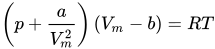
Think of this in terms of the  Van der Waals equation of state:{\displaystyle \left(p+{\frac {a}{V_{m}^{2}}}\right)\left(V_{m}-b\right)=RT}

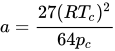
where V_{m} is molar volume. The substance-specific constants a and b can be understood as an attraction force between molecules and a molecular volume respectively. Alternately, they can be calculated from the critical temperature and pressure as
{\displaystyle a={\frac {27(RT_{c})^{2}}{64p_{c}}}}{\displaystyle b={\frac {RT_{c}}{8p_{c}}}.}

Now, I’m going to assume that the effect of a hydrophobic surface near the Pt is to reduce the effective value of a. This is to say that water molecules still attract as before, but there are fewer water molecules around. I’ll assume that b remains the same. Thus the ratio of Tc and Pc remains the same but the values drop by a factor of related to the decrease in water density. If we imagine the use of enough teflon to decrease he number of water molecules by 60%, that would be enough to reduce the critical temperature by 60%. That is, from 647 K (374 °C) to 359 K, or -14°C. This might be enough to allow Pt catalysts to be used for H2 removal from the gas within a nuclear wast casket. I’m into nuclear, both because of its clean power density and its space density. As for nuclear waste, you need these caskets.

I’ve begun to test of my theory by making hydrogen removal catalyst that use both platinum and palladium along with unsaturated hydrocarbons. I find it works far better than the palladium-hydrocarbon getter, at least at room temperature. I find it works well even when the catalyst is completely soaked in water, but the real experiments are yet to come — how does this work in the cold. Originally I planned to use a freezer for these tests, but I now have a better method: wait for winter and use God’s giant freezer.

Robert E. Buxbaum October 20, 2021. I did a fuller treatment of the thermo above, a few weeks back.