Among TV psychiatrists, the universal opinion of Trump, Putin, and Musk, that these individuals are narcissists, a psychological disease related to “toxic masculinity.” Musk, for his part claims the excuse of Asperger’s disease, high-functioning Autism. I half agree with the Narcissist diagnosis, and I’m confused by the Asperger’s claim because I don’t believe these folks are diseased. My sense is they have a leadership personality trait, common in all visionary leaders including Disney, Martin Luther King, and Genghis Khan. I’ve argued that it is important for a president to be a narcissist, and have explained Trump’s vision, “Make America great again” as independence.
Psychological narcissism, short for Narcissistic Personality Disorder, is a disease when it hurts the narcissists life. It is defined as a pattern of exaggerated feelings of self-importance, along with an excessive need for admiration. If it just annoys people it/s a disease, but it’s found among leaders, suggesting it’s not all bad. To get you to follow them, leaders present themselves as mini-messiahs, and try to get you to see them that way. They have a plan, a vision. If it’s successful, they’re visionaries. They fight to bring the vision into reality, which is very annoying to anyone who doesn’t see it or want it. But that’s leadership. Without it nothing big gets done.
Disney’s vision. Not everyone was pleased; quite a few considered him a tyrant.
For the narcissist to succeed, he or she must sell the vision, and his ability to get it done. The plan to get there is often vague and unattractive. These details are shared with only a few. You must see the leader there and yourself too, if you’re to fight for it. Disney was particularly visual, see photo. He got folks to buy into a building a magical kingdom with a private police force, where everyone is happy and cartoon characters glide among the paying visitors.
The majority of those who run into a narcissist reject both the vision and the narcissist. They fear any change, and fear that the success of the visionary will diminish them. For that reason, they run to no-bodies. But some see it, and follow, others throw stones. Disney got state officials to exempt him from state laws, and extend normal copyrights. Others smirked, and worked to stop him, but with less energy: it’s hard to be enthusiastic about no Disneyland. The conflict between doers and the smirkers is the subject of several Ayn Rand books, including The Fountainhead and Atlas Shrugged. She calls the opposing smirkers, “parasites”, “looters”, “moochers,” and my favorite: “do gooders.” It’s for the common good that the narcissist should fail, they claim.
Often these opponents have good reasons to oppose. The Ayatollah Khomeini had a vision similar to Disney: an Islamic Republic in Iran where everyone is happy being a devout Muslim of his stripe. The opponents feared, correctly, that everyone who was not happy would be flogged, hanged, or beheaded. I think it’s legitimate to not want to be forced to be devout. Similarly, with Genghis Khan, or Vladimir Putin. Putin compares himself to Peter the Great who expanded Russia and conquered Crimea. The opponents have legitimate fears of WWII and claim that Ukrainian independence is semi legit. Regarding Musk’s plans to colonize Mars, I note that Neil Armstrong and Gene Cernan have come out against it. There is no right or wrong here, but I have a soft spot for the visionaries, and a suspicion of the “smirkers” and “do gooders.”
Genghis Khan. He saw himself as a world changer. Some followed, some didn’t. Those who followed didn’t think he was crazy.
The smirkers and do-gooders include the most respectable people of today. They are thought leaders, who lose status if someone else exceeds them. They are surprised and offended by Martin Luther King’s dream, and Musk’s, Khomeini’s, Trump’s, and Lenin’s. Trump became president against formidable odds, and the smirkers said it was a fluke, he then lost, and they claimed it showed they were right. He may get a second term, though, and Musk may yet build a community on Mars. To the extent that the visionary succeeds, the smirkers claim it was easy; that they could have done the same, but faster and better. They then laud some fellow smirker, and point out aspects of the vision that failed. In any case, while the narcissist is definitely abnormal, it’s not a disease, IMHO. It’s what makes the world go round.
Our galaxy may have two arms, or perhaps four. It was thought to be four until 2008, when it was reduced to two. Then, in 2015, it was expanded again to four arms, but recent research suggests it’s only two again. About 70% of galaxies have arms, easily counted from the outside, as in the picture below. Apparently it’s hard to get a good view from the inside.
Four armed, spiral galaxy, NGC 2008. There is a debate over whether our galaxy looks like this, or if there are only two arms. Over 70% of all galaxies are spiral galaxies.
Logically speaking, we should not expect a galaxy to have arms at all. For a galaxy to have arms, it must rotate as a unit. Otherwise, even if the galaxy had arms when it formed, it would lose them by the time the outer rim rotated even once. As it happens we know the speed of rotation and age of galaxies; they’ve all rotated 10 to 50 times since they formed.
For stable rotation, the rotational acceleration must match the force of gravity and this should decrease with distances from the massive center. Thus, we’d expect that the stars should circle much faster the closer they are to the center of the galaxy. We see that Mercury circles the sun much faster than we do, and that we circle much faster than the outer planets. If stars circled the galactic core this way, any arm structure would be long gone. We see that the galactic arms are stable, and to explain it, we’ve proposed the existence of lots of unseen, dark matter. This matter has to have some peculiar properties, behaving as a light gas that doesn’t spin with the rest of the galaxy, or absorb light, or reflect. Some years ago, I came to believe that there was only one gas distribution that fit, and challenged folks to figure out the distribution.
The mass of the particles that made up this gas has to be very light, about 10-7 eV, about 2 x 10¹² lighter than an electron, and very slippery. Some researchers had posited large, dark rocks, but I preferred to imagine a particle called the axion, and I expected it would be found soon. The particle mass had to be about this or it would shrink down to the center of he galaxy or start to spin, or fill the universe. Ina ny of these cases, galaxies would not be stable. The problem is, we’ve been looking for years, and not only have we not seen any particle like this. What’s more, continued work on the structure of matter suggests that no such particle should exist. At this point, galactic stability is a bigger mystery than it was 40 years ago.;
So how to explain galactic stability if there is no axion. One thought, from Mordechai Milgrom, is that gravity does not work as we thought. This is an annoying explanation: it involves a complex revision of General Relativity, a beautiful theory that seems to be generally valid. Another, more recent explanation is that the dark matter is regular matter that somehow became an entangled, super fluid despite the low density and relatively warm temperatures of interstellar space. This has been proposed by Justin Khoury, here. Either theory would explain the slipperiness, and the fact that the gas does not interact with light, but the details don’t quite work. For one, I’d still think that the entangled particle mass would have to be quite light; maybe a neutrino would fit (entangled neutrinos?). Super fluids don’t usually exist at space temperatures and pressures, and long distances (light years) should preclude entanglements, and neutrinos don’t seem to interact at all.
Sabine Hossenfelder suggests a combination of modified gravity and superfluidity. Some version of this might fit observations better, but doubles the amount of new physics required. Sabine does a good science video blog, BTW, with humor and less math. She doesn’t believe in Free will or religion, or entropy. By her, the Big Bang was caused by a mystery particle called an inflateon that creates mass and energy from nothing. She claims that the worst thing you can do in terms of resource depletion is have children, and seems to believe religious education is child abuse. Some of her views I agree with, with many, I do not. I think entropy is fundamental, and think people are good. Also, I see no advantage in saying “In the beginning an inflateon created the heavens and the earth”, but there you go. It’s not like I know what dark matter is any better than she does.
There are some 200 billion galaxies, generally with 100 billion stars. Our galaxy is about 150,000 light years across, 1.5 x 10¹⁸ km. It appears to behave, more or less, as a solid disk having rotated about 15 full turns since its formation, 10 billion years ago. The speed at the edge is thus about π x 1.5 x 10¹⁸ km/ 3 x 10¹⁶ s = 160km/s. That’s not relativistic, but is 16 times the speed of our fastest rockets. The vast majority of the mass of our galaxy would have to be dark matter, with relatively little between galaxies. Go figure.
Robert Buxbaum, May 24, 2023. I’m a chemical engineer, PhD, but studied some physics and philosophy.
The hydrogen economy is generally thought to come in some distant future, where your car (and perhaps your home) runs on hydrogen, and the hydrogen, presumably, is made by clean nuclear or renewable solar or wind power. This is understood to be better than the current state of things where your car runs on dirty gasoline, and your home runs on coal or gas, except when the sun is shining bright and the wind is blowing hard. Our homes and cars can not run on solar or wind alone, although solar cells have become quite cheap, because solar power is only available in the daytime, basically for 6 hours, from about 9AM to 3PM. Hydrogen has been proposed as a good way to store solar and wind energy that you can’t use, but it’s not easy to store hydrogen — or is it? I’d like to suggest that, to a decent extent, we already store green hydrogen and use it to run our trucks. We store this hydrogen in the form of Diesel fuel, so you don’t realize it’s hydrogen.
Much of the oil in the United States these days comes from tar sands and shale. It doesn’t flow well at room temperature, and is too heavy and gooey for normal use. We could distill this crude oil and use only the light parts, but that would involve throwing away a huge majority of the oil. Instead we steam reform it to gasoline, ethylene and other products. The reaction is something like this, presuming an input feed of naphtha, C10H8:
C10H8 + 2 H2O –> C7H8 + C2H4 + CO2.
The C2H4 component is ethylene. We use it to make plastics. The C7H8 is called toluene. It is a component of high octane gasoline (octane rating about 114). The inventor of the process, Eugene Jules Houdry claimed to have won WWII for the allies because his secret process (Houdryflow catalytic cracking) allowed high production of lots of gasoline of very high octane, giving US and British planes and trucks higher mpg than the Germans or Japanese had. It was a great money maker, but companies can make even more by adding hydrogen.
Schematic of the hydrocracking process, from the US energy information agency
Over the last 2-3 decades, refineries have been adding catalytic hydrogenation processes. These convert high octane aromatic products, like toluene to low -octane diesel and jet fuel. These products sell for more. Aromatic toluene is exposed to hydrogen at about 500°C and 300 psi (20 bar) to produce heptane, an excellent diesel fuel with about 7% more energy content than toluene per gallon.
C7H8 + 4H2 –> C7H16.
Diesel fuel sell for about 20% more than gasoline per gallon, in part because of the higher energy content, and because Diesel engines are more efficient than gas engines. What’s more, toluene expands as it’s converted to heptane. One gallon of toluene converts to 1.16 gallons of heptane. As a result hydrogenation adds about 40% to the sales price per molecule. Refineries have found that they can make significant money this way if they can buy cheap hydrogen. Over the last few years, several refineries in Norway and Texas (high sun and wind areas) have added hydrogenators along with electrolysis units to produce the cheap hydrogen when no one needs the unwanted electricity generated when supply exceeds demand. Here is an analysis of the thermodynamics of this type of hydrogen generation.
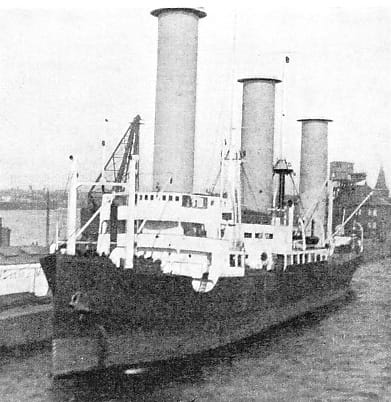
Sailing ships are wonderfully economic and non-polluting. They have unlimited range because they use virtually no fuel, but they tend to be slow, about 5-12 knots, about half as fast as Diesel-powered ships, and they can be stranded for weeks if the wind dies. Classic sailing ships also require a lot of manpower: many skilled sailors to adjust the sails. What’s wanted is an easily manned, economical, hybrid ship: one that’s powered by Diesel when the wind is light, and by a simple sail system when the wind blows. Anton Flettner invented an easily manned sail and built two ships with it. The Barbara above used a 530 hp Diesel and got additional thrust, about an additional 500 hp worth, from three, rotating, cylindrical sails. The rotating sales produced thrust via the same, Magnus force that makes a curve ball curve. Barbara went at 9 knots without the wind, or about 12.5 knots when the wind blew. Einstein thought it one of the most brilliant ideas he’d seen.
Force diagram of Flettner rotor (Lele & Rao, 2017)
The source of the force can be understood with help of the figure at left and the graph below. When a simple cylinder sits in the wind, with no spin, α=0, the wind force is only drag, calculated as 1/2 the wind speed squared, times the cross-sectional area of the cylinder, Dh, times the density of air, times. a drag coefficient, CD. Here, CD is about 1 for a non-spinning cylinder, increasing to about 2 for a fast spinning cylinder. In any case, FD= CDDhρv2/2.
A spinning cylinder has lift force too. FL= CLDhρv2/2.
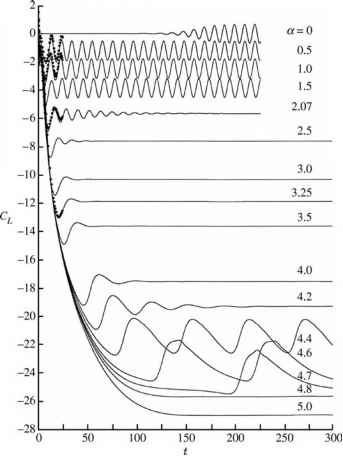
Numerical lift coefficients versus time, seconds for different ratios of surface speed to wind speed, a. (Mittal & Kumar 2003), Journal of Fluid Mechanics.
The lift on the ship, the force you want is calculated the same way, FL= CLDhρv2/2, where the coefficient of lift, CL is graphed in the figure at right. When there is no spin, it is effectively zero with sustained vibrations; that’s at, α=0. Vibrations are useless for propulsion, and can be damaging to the sail, though they are helpful in baseball pitching, producing the erratic flight of knuckle balls. If you spin the cylindrical mast at α>2.1 there are no vibrations, and you get significant lift, CL> 6. At α = 2.1 the fast side of the cylinder moves in the direction of the wind at 2.1 times the wind speed. The other side of the rotor moves opposite: 1.1 times as fast as the wind, but backwards. Even at this, relatively low rotation speed, the coefficient of lift, CL= 6, is more than twice that found with a typical, triangular, non-rotating sail. Drag is higher too, but not as much. The lift is about 4 times the drag, far better than in a typical sail. Another plus is that the ship can be propelled forward or backward -just reverse the spin direction. This is very good for close-in sailing.
The sail lift, and lift to drag ratio, increases with rotation speed reaching very values of 10 to 18 at α values of 3 to 4. Flettner considered α=3.5. optimal. At this α -value you get far more thrust than with a normal sail, and you can go faster than the wind, and far closer to the wind than with any normal sail. You don’t want α values above 4.2 because you start seeing vibrations again. Also more rotation power is needed (rotation power goes as ω2); unless the wind is strong, you might as well use a normal propeller.
The driving force is always at right angles to the perceived wind, called the “fair wind”, and the fair wind moves towards the front as the ship speed increases. Controlling the rotation speed is somewhat difficult but important. Flettner sails were no longer used by the 1930s because fuel became cheaper and control was difficult. Normal sails weren’t being used either for the same reasons.
In the early 1980s, there was a return to the romantic. Famous underwater explorer, Jacques Cousteau, revived a version of the Flettner sail for his exploratory ship, the Alcyone. He used aluminum sails, and an electric motor for rotation. He claimed that the ship drew more than half of its power from the wind, and claimed that, because of computer control, it could sail with no crew. This claim was likely bragging, but he bragged a lot. Even with today’s computer systems, people are needed to steer and manage things in case something goes wrong. The energy savings were impressive, though, enough so that some have begun to put Flettner sails on cargo ships, as a right. This is an ideal use since cargo ships go about as fast as a typical wind, 10- 20 knots. It’s reported that, Flettner- powered cargo ships get about 20% of their propulsion from wind power, not an insignificant amount.
And this gets us to the reason your curve ball does not curve: it’s likely you’re not spinning it fast enough. To get a good curve, you want the ball to spin at α =3, or about 1.5 times the rate you’d get by rolling the ball off your fingers. You have to snap your wrist hard to get it to spin this fast. As another approach, you can aim for α=0, a knuckle ball, achieved with zero rotation. At α=0, the ball will oscillate. It’s hard to do, but your pitch will be nearly impossible to hit or catch. Good luck.
Robert Buxbaum, March 22, 2023. There are also Flettner airplane designs where horizontal, cylindrical “wings” rotate to provide high lift with short wings and a relatively low power draw. So-far, these planes are less efficient and slower than a normal helicopter. The idea could bear more development work, IMHO. Einstein had an eye for good ideas.
We’re surrounded by undesired bacteria, molds, and viruses. Some are annoying, making our feet smell, our teeth rot, and our wine sour. Others are killers, particularly for the middle aged and older. Despite little evidence, the US government keeps pushing masks and inoculations with semi-active vaccine that does nothing to stop the spread. Among the few things one can do to stop the spread of disease, and protect yourself, is to kill the bacteria, molds and viruses with iodine. Iodine is cheap, effective even at very low doses, 0.1% to 10 parts per million, and it lasts a lot longer than alcohol. Dilute iodine will not dye your skin, and it does not sting. A gargle of iodine will kill COVID and other germs (e.g. thrush) and it has even been shown to be a protective, stopping COVID 19 and flu even if used before exposure. On a more practical level. I also use it to cleanse my barrels before making beer — It’s cheaper than the Camden they sell in stores.
Iodine is effective when used on surfaces, and most viruses spread by surfaces. A sick person coughs. Droplets end up on door knobs, counters, or in your throat, leaving virus particles that do not die in air. You touch the surface, and transfer the virus to your eyes and nose. Here’s a video I made. A mask doesn’t help because you rub your eyes around the mask. But iodine kills the virus on the surface, and on your hands, and lasts there far longer than alcohol does. Vaccines always come with side-effects, but there are no negative side effects to sanitization with dilute iodine. Here is a video I did some years ago on the chemistry of iodine.
Robert Buxbaum, February 1, 2023. I don’t mean to say that all bacteria and fungi are bad, it’s just that most of them are smelly. Even the good ones that give us yogurt, beer, blue cheese, and sour kraut tend to be smelly. They have the annoying tendency to causing your wine to taste and smell like sour kraut or cheese, and they cause your breath and feet to smell the same. If you’re local, I’ll give you some free iodine solution. Otherwise, you’ll have to buy it through REB Research.
The main products of my company, REB Research, involve metallic membranes, often palladium-based, that provide 100% selective hydrogen filtering or long term hydrogen storage. One way to understand why these metallic membrane provide 100% selectivity has to do with the fact that metallic atoms are much bigger than hydrogen ions, with absolutely regular, small spaces between them that fit hydrogen and nothing else.
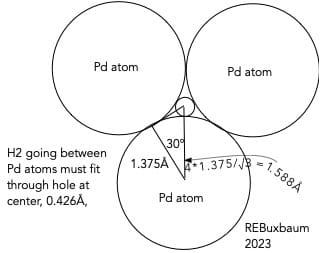
Palladium atoms are essentially spheres. In the metallic form, the atoms pack in an FCC structure (face-centered cubic) with a radius of, 1.375 Å. There is a cloud of free electrons that provide conductivity and heat transfer, but as far as the structure of the metal, there is only a tiny space of 0.426 Å between the atoms, see below. This hole is too small of any molecule, or any inert gas. In the gas phase hydrogen molecules are about 1.06 Å in diameter, and other molecules are bigger. Hydrogen atoms shrink when inside a metal, though, to 0.3 to 0.4 Å, just small enough to fit through the holes.
The reason that hydrogen shrinks has to do with its electron leaving to join palladium’s condition cloud. Hydrogen is usually put on the upper left of the periodic table because, in most cases, it behaves as a metal. Like a metal, it reacts with oxygen, and chlorine, forming stoichiometric compounds like H2O and HCl. It also behaves like a metal in that it alloys, non-stoichiometrically, with other metals. Not with all metals, but with many, Pd and the transition metals in particular. Metal atoms are a lot bigger than hydrogen so there is little metallic expansion on alloying. The hydrogen fits in the tiny spaces between atoms. I’ve previously written about hydrogen transport through transition metals (we provide membranes for this too).
No other atom or molecule fits in the tiny space between palladium atoms. Other atoms and molecules are bigger, 1.5Å or more in size. This is far too big to fit in a hole 0.426Å in diameter. The result is that palladium is basically 100% selective to hydrogen. Other metals are too, but palladium is particularly good in that it does not readily oxidize. We sometime sell transition metal membranes and sorbers, but typically coat the underlying metal with palladium.
We don’t typically sell products of pure palladium, by the way. Instead most of our products use, Pd-25%Ag or Pd-Cu. These alloys are slightly cheaper than pure Pd and more stable. Pd-25% silver is also slightly more permeable to hydrogen than pure Pd is — a win-win-win for the alloy.
There was a major advance in nuclear fusion this month at the The National Ignition Facility of Lawrence Livermore National Laboratory (LLNL), but the press could not figure out what it was, quite. They claimed ignition, and it was not. They claimed that it opened the door to limitless power. It did not. Some heat-energy was produced, but not much, 2.5 MJ was reported. Translated to the English system, that’s 600 kCal, about as much heat in a “Big Mac”. That’s far less energy went into lasers that set the reaction off. The importance wasn’t the amount in the energy produced, in my opinion, it’s that the folks at LLNL fired off a small hydrogen bomb, in house, and survived the explosion. 600 kCal is about the explosive power of 1.5 lb of TNT.
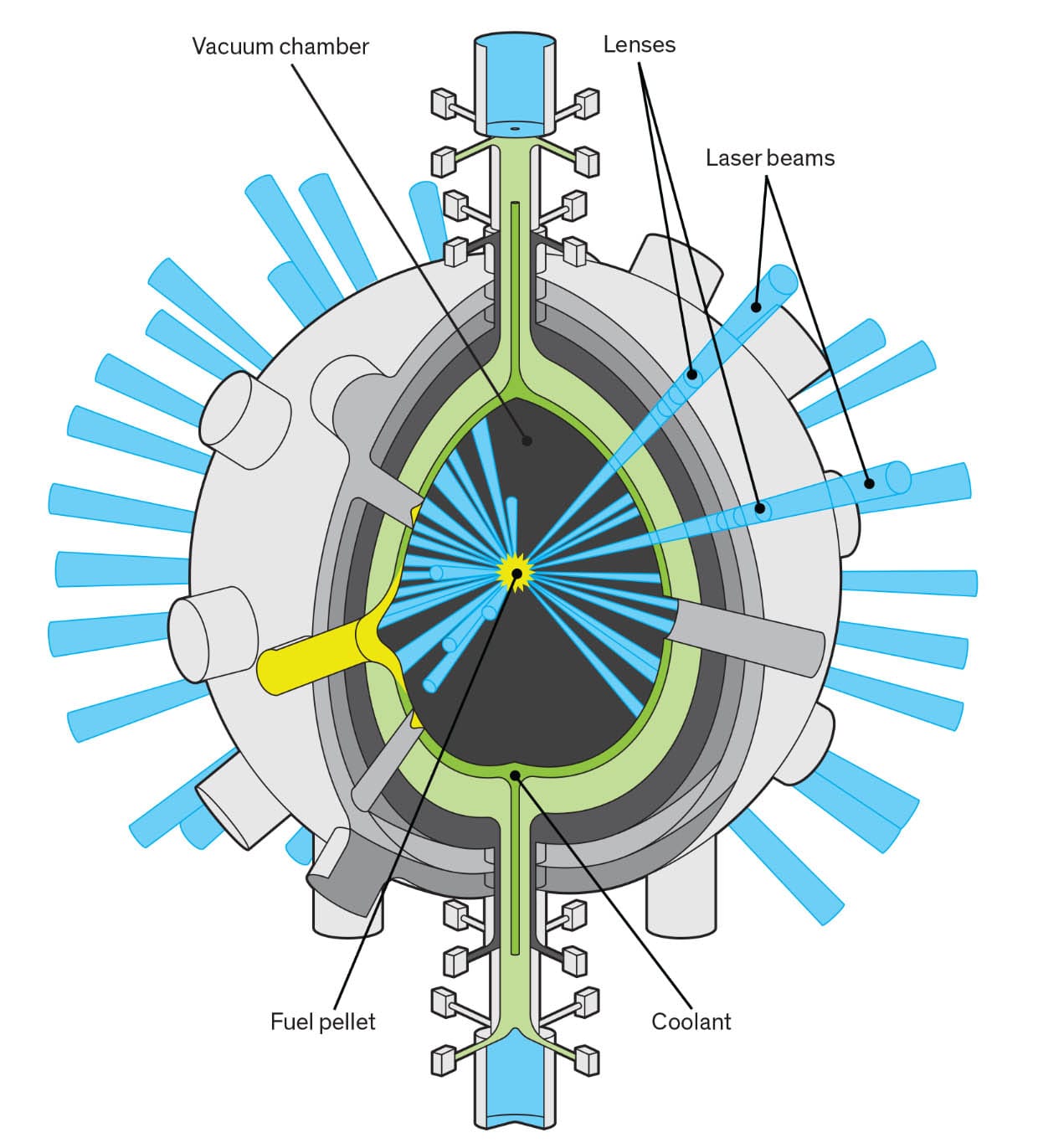
Many laser beams converge on a droplet of deuterium-tritium setting off the explosion of a small fraction of the fuel. The explosion had about the power of 1.2 kg of TNT. Drawing from IEEE Spectrum
The process, as reported in the Financial Times, involved “a BB-sized” droplet of holmium -enclosed deuterium and tritium. The folks at LLNL fast-cooked this droplet using 100 lasers, see figure of 2.1MJ total output, converging on one spot simultaneously. As I understand it 4.6 MJ came out, 2.5 MJ more than went in. The impressive part is that the delicate lasers survived the event. By comparison, the blast that bought down Pan Am flight 103 over Lockerbie took only 2-3 ounces of explosive, about 70g. The folks at LLNL say they can do this once per day, something I find impressive.
The New York Times seemed to think this was ignition. It was not. Given the size of a BB, and the density of liquid deuterium-tritium, it would seem the weight of the drop was about 0.022g. This is not much but if it were all fused, it would release 12 GJ, the equivalent of about 3 tons of TNT. That the energy released was only 2.5MJ, suggests that only 0.02% of the droplet was fused. It is possible, though unlikely, that the folks at LLNL could have ignited the entire droplet. If they did, the damage from 5 tons of TNT equivalent would have certainly wrecked the facility. And that’s part of the problem; to make practical energy, you need to ignite the whole droplet and do it every second or so. That’s to say, you have to burn the equivalent of 5000 Big Macs per second.
You also need the droplets to be a lot cheaper than they are. Today, these holmium capsules cost about $100,000 each. We will need to make them, one per second for a cost around $! for this to make any sort of sense. Not to say that the experiments are useless. This is a great way to test H-bomb designs without destroying the environment. But it’s not a practical energy production method. Even ignoring the energy input to the laser, it is impossible to deal with energy when it comes in the form of huge explosions. In a sense we got unlimited power. Unfortunately it’s in the form of H-Bombs.
Four years ago, when the average lifespan of American men was 3.1 years longer than today, the American Heart Association and the American College of Cardiology dropped the standard for normal- acceptable blood pressure for 50+ years olds from 140/90 to 120/80. The new standard of normal was for everyone regardless or age or gender despite the fact that virtually no one over 50 now reached it. Normal is now quite un-common.
By the new definition, virtually everyone over 50 now is diagnosed with high blood pressure or hypertension. Almost all require one or two medications — no more baby aspirin. Though the evidence for aspirin’s benefit is strong, it doesn’t lower blood pressure. AHA guidance is to lower a patients blood pressure to <140/90 mmHg or at least treat him/her with 2–3 antihypertensive medications.4
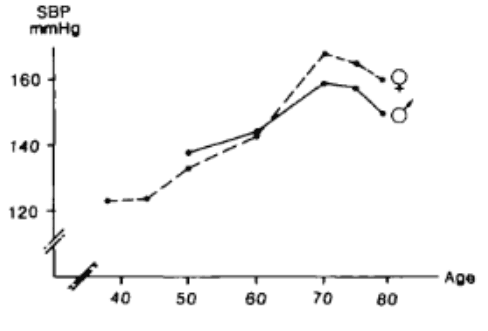
Average systolic blood pressures for long-lived populations of men and women without drugs.
The graphs shows the average blood pressures, without drugs in a 2008 study of the longest-lived, Scandinavian populations. These were the source of the previous targets: the natural pressures for the healthiest populations at the time, based on the study of 1304 men (50-79 years old) and 1246 women (38-79 years old) observed for up to 12 years. In this healthy population, the average untreated systolic pressure is seen till age 70, reaching 154 for men, and over 160 for women. By the new standards, these individuals would be considered highly unhealthy, though they live a lot longer than we do. The most common blood-pressure drug prescribed in the US today is atenolol, a beta blocker. See my essay on Atenolol. It’s good at lowering blood pressure, but does not decrease mortality.
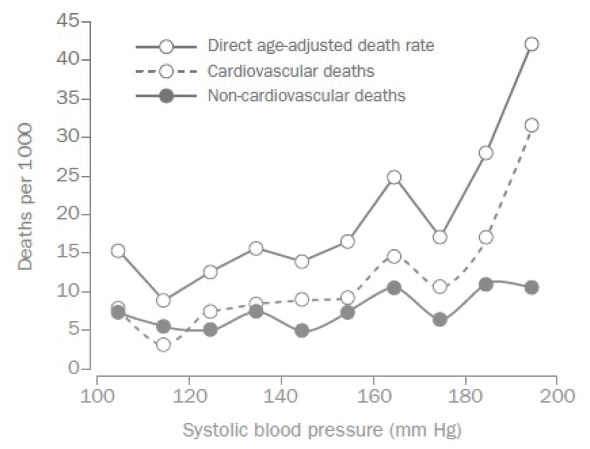
The plot at left shows the relationship between systolic blood pressure and death. There is a relationship, but it is not clear that the one is the cause of the other, especially for individuals with systolic pressure below 160. Those with pressures of 170 and above have significantly higher mortality, and perhaps should take atenolol, but even here it might be that high cholesterol, or something else, is causing both the high blood pressure and the elevated death risk.
The death-risk difference between 160 and 100 mmHg is small and likely insignificant. The minimum at 110 is rather suspect too. I suspect it’s an artifact of a plot that ignores age. Only young people have this low number, and young people have fewer heart attacks. Artificially lowering a person’s blood pressure, even to this level does not make him young, [2][3] and brings some problems. Among the older-old, 85 and above, a systolic blood pressure of 180 mmHg is associated with resilience to physical and cognitive decline, though it is also associated with higher death rate.
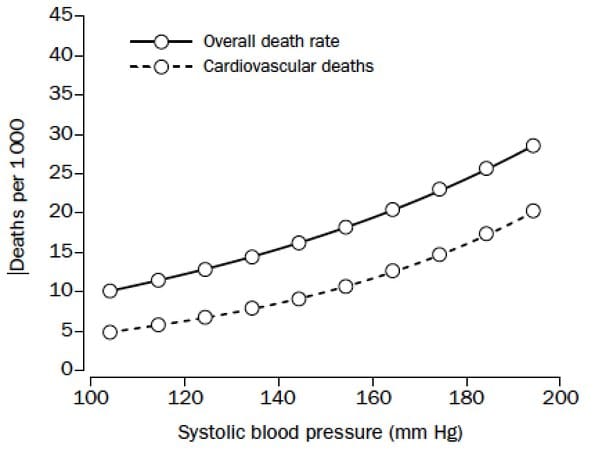
The AHA used a smoothed version of the life risk graph above to justify their new standards, see below. In this version, any blood pressure looks like it’s bad. The ideal systolic pressure seems to be 100 or below. This is vastly too low a target, especially for a 60 year old. Based on the original graph, I would think that anything below 155 is OK.
smoothed chart of deaths per 1000 vs blood pressure. According to this chart, any blood pressure is bad. There is no optimum.
I suspect that the Scandinavians live longer because they drink mildly, exercise mildly, have good healthcare (but not too good), and have a low crime rate. They seem to have dodged the COVID problem too, even Sweden that did next to nothing. it’s postulated that the problem is over medication, including heart medication.
Robert Buxbaum, January 4, 2023. The low US lifespan is startling. Despite spending more than any other developed countries on heath treatments, we have horribly lower lifespans, and it’s falling fast. A black man in the US has the same expected lifespan as in Rwanda. Causes include heart attacks and strokes, accidents, suicide, drugs, and disease. Opioids too, especially since the COVID lockdowns.
Much of health research is a search for simple, bio-molecular causes for our medical problems. These can result in pill-solutions. Diseases tend to be more complex, but Alzheimers seemed to work that way, until this summer when it turned out that the data supporting the simple theory was faked. Alzheimer’s is a devastating cognitive disease that is accompanied by a degenerating brain, with sticky, beta-amyloid plaques and tangles. About 16 years ago, this report, published in Nature seemed to show that a beta-amyloid, Aβ*56, caused the plaques and caused cognitive decline independent of any other Alzheimers indicators.
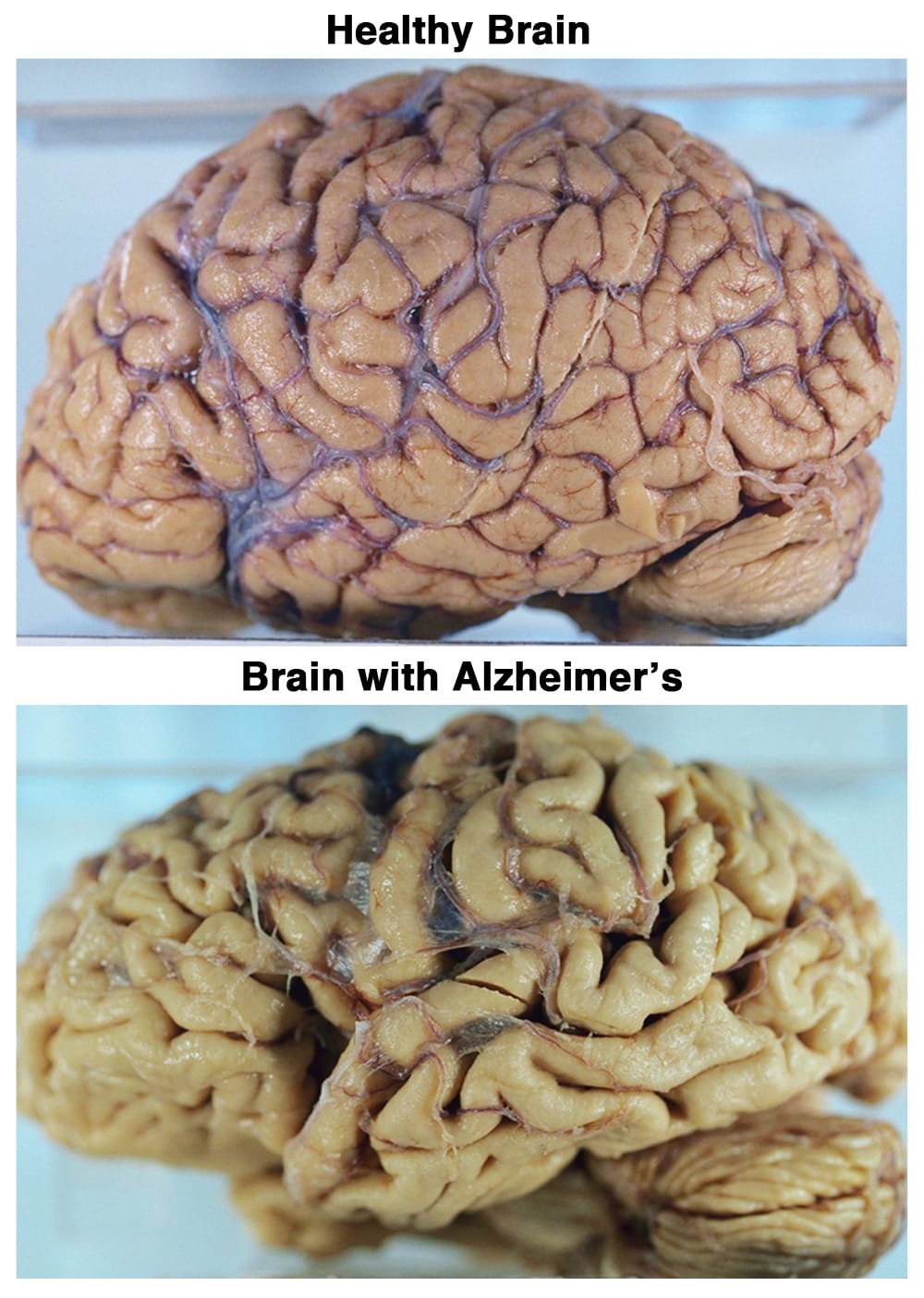
The visual difference between an Alzheimer brain and a normal brain is that the former has shrunk. Maybe fat is relevant, fat body leads to a fat brain, and less AZ, maybe?
We were on the way to a cure, or so it seemed. Several studies by this group backed the initial results, and much of Alzheimer’s research was directed into an effort to fill in the story, and find ways to reduce the amount and bonding of this amyloid and others like it. Several other groups claimed they could not find the amyloid at all, or show that amyloids caused the symptoms described. But most negative results went unpublished. The theory was so satisfying, and the evidence from a few so strong, that the NIH poured billions into this approach, over $1B in this year alone. The FDA approved aducanumab, a drug from Biogen, on the assumption that it should work, even though it showed little to no benefit, and had some deadly side effects. Other firms followed, asking for approval of related anti-amyloid drugs that should work.
When news of the fraud came out, detected by Matthew Scragg and a few lone curmudgeons, stock prices plummeted in the drug companies. It now appears that the original work was made up, presented to journals and to the NIH using photoshopped images. For the group that did the fake work, it may mean jail time, for most other groups, the claim is that their work is still relevant. Doctors still prescribe the medications as they have nothing better to offer (Aducanumab therapy costs $50,000 per year). Maybe it’s time to start looking at alternative approaches and theories, sidelined over the last 16 years.
Some alternative theories posit that another molecule is responsible, particularly tau, associated with the tangles. Another sidelined theory is that amyloids are good. For example, that it’s the loss of soluble amyloids that causes Alzheimer’s. Alternately, that inflammation is the root cause, and that the amyloid plaques and tangles are a response to the inflammation, a bandage, perhaps. These theories could explain why the anti-amyloid drugs so often resulted in patient death.
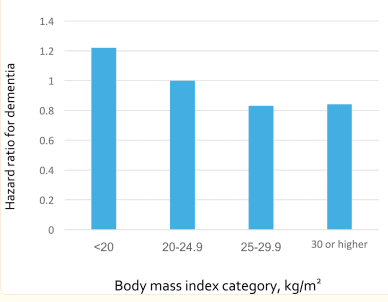
It could be that high bmi protects from dementia. Either that or the diseases that cause weight loss cause dementia. It’s debated here.
It’s also possible that the inability of nerve cells to dispose of waste is the cause of AZ. In heathy people, waste is removed through acidic enzymes within lysosomes. Patients with decreased acid activity have a buildup of waste that includes amyloids. Perhaps the cure is to restore the acid enzymes.
My favorite theory is based on statistical data that shows that fat people are less likely to develop Alzheimers. This might lead to a junk-food cure. The fitness industry is very much against this theory–It’s debated here. They tend to support the inflammation model, claiming that diseases cause Alzheimer’s and cause patients to loose weight first. Could be. I note that Henry Kissinger is the only active politician of my era, the early 70s, still alive and writing intelligently.
Robert Buxbaum, November 17-19, 2022. I hope that Matthew Schragg comes out OK, by the way. Ben Franklin pointed out, that “No good deed goes unpunished.”