Category Archives: health

Statistics of death and taxes — death on tax day

Strange as it seems, Americans tend to die in road accidents on tax-day. This deadly day is April 15 most years, but on some years April 15th falls out on a weekend and the fatal tax day shifts to April 16 or 17. Whatever weekday it is, about 8% more people die on the road on tax day than on the same weekday a week earlier or a week later; data courtesy of the US highway safety bureau and two statisticians, Redelmeier and Yarnell, 2014.

Forest plot of individuals in fatal road crashes over 30 years. X-axis shows relative increase in risk on tax days compared to control days expressed as odds ratio. Y-axis denotes subgroup (results for full cohort in final row). Column data are counts of individuals in crashes. Analytic results expressed with 95% confidence intervals setting control days as referent. Results show increased risk on tax day for full cohort, similar increase for 25 of 27 subgroups, and all confidence intervals overlapping main analysis. Recall that odds ratios are reliable estimates of relative risk when event rates are low from an individual driver’s perspective.

Forest plot of individuals in fatal road crashes for the 30 years to 2008  on US highways (Redelmeier and Yarnell, 2014). X-axis shows relative increase in risk on tax days compared to control days expressed as odds ratio. Y-axis denotes subgroup (results for full cohort in final row). Column data are counts of individuals in crashes (there are twice as many control days as tax days). Analytic results are 95% confidence intervals based on control days as referent. Dividing the experimental subjects into groups is a key trick of experimental design.

To confirm that the relation isn’t a fluke, the result of well-timed ice storms or football games, the traffic death data was down into subgroups by time, age, region etc– see figure. Each groups showed more deaths than on the average of the day a week before and after.

The cause appears unrelated to paying the tax bill, as such. The increase is near equal for men and women; with alcohol and without, and for those over 18 and under (presumably those under 18 don’t pay taxes). The death increase isn’t concentrated at midnight either, as might be expected if the cause were people rushing to the post office. The consistency through all groups suggests this is not a quirk of non-normal data, nor a fluke but a direct result of  tax-day itself.Redelmeier and Yarnell suggest that stress — the stress of thinking of taxes — is the cause.

Though stress seems a plausible explanation, I’d like to see if other stress-related deaths are more common on tax day — heart attack or stroke. I have not done this, I’m sorry to say, and neither have they. General US death data is not tabulated day by day. I’ve done a quick study of Canadian tax-day deaths though (unpublished) and I’ve found that, for Canadians, Canadian tax day is even more deadly than US tax day is for Americans. Perhaps heart attack and stroke data is available day by day in Canada (?).

Robert Buxbaum, December 12, 2014. I write about all sorts of stuff. Here’s my suggested, low stress income tax structure, and a way to reduce/ eliminate income taxes: tariffs– they worked till the Civil war. Here’s my thought on why old people have more fatal car accidents per mile driven.

Seniors are not bad drivers.

Seniors cause accidents, but need to get places too

Seniors are often made fun of for confusion and speeding, but it’s not clear they speed, and it is clear they need to get places. Would reduced speed limits help them arrive alive?

Seniors have more accidents per-mile traveled than middle age drivers. As shown on the chart below, older Canadians, 75+, get into seven times more fatal accidents per mile than 35 to 55 year olds. At first glance, this would suggest they are bad drivers who should be kept from the road, or at least made to drive slower. But I’m not so sure they are bad drivers, and am pretty certain that lower speed limits should not be generally imposed. I suspect that a lot of the problem comes from the a per-mile basis comparison with folks who drive long distances on the same superhighways instead of longer, leisurely drives on country roads. I suspect that, on a per-hour basis, the seniors would look a lot safer, and on a per highway-mile basis they might look identical to younger drivers.

Canadian Vehicle Survey, 2001, Statistics Canada, includes drivers of light duty vehicles.

Deaths per billion km. Canadian Vehicle Survey, 2001, Statistics Canada, includes light duty vehicles.

Another source of misunderstanding, I find, is that comparisons tend to overlook how very low the accident rates are. The fatal accent rate for 75+ year old drivers sounds high when you report it as 20 deaths per billion km. But that’s 50,000,000 km between fatalities, or roughly one fatality for each 1300 drives around the earth. In absolute terms it’s nothing to worry about. Old folks driving provides far fewer deaths per km than 12-29 year olds walking, and fewer deaths per km than for 16-19 year olds driving.

When starting to research this essay, I thought I’d find that the high death rates were the result of bad reaction times for the elderly. I half expected to find that reduced speed limits for them helped. I’ve not found any data directly related to reduced speeds, but now think that lowered speed limits would not help them any more than anyone else. I note that seniors drive for pleasure more than younger folks and do a lot more short errand drives too — to the stores, for example. These are places where accidents are more common. By contrast, 40 to 70 year olds drive more miles on roads that are relatively safe.

Don't walk, especially if you're old.

Don’t walk, especially if you’re old. Netherlands data, 2001-2005 fatalities per billion km.

The Netherlands data above suggest that any proposed solution should not involve getting seniors out of their cars. Not only do seniors find walking difficult, statistics suggest walking is 8 to 10 times more dangerous than driving, and bicycling is little better. A far better solution, I suspect, is reduced speeds for everyone on rural roads. If you’re zipping along a one-lane road at the posted 40, 55, or 60 mph and someone backs out of a driveway, you’re toast. The high posted speeds on these roads pose a particular danger to bicyclists and motorcyclists of all ages – and these are folks who I suspect drive a lot on the rural roads. I suspect that a 5 mph reduction would do quite a lot.

For automobiles on super-highways, it may be worthwhile to increase the speed limits. As things are now, the accident fatality rates are near zero, and the main problem may be the time wasted behind the wheel – driving from place to place. I suspect that an automobile speed limit raise to 80 mph would make sense on most US and Canadian superhighways; it’s already higher on the Autobahn in Germany.

Robert Buxbaum, November 24, 2014. Expect an essay about death on tax-day, coming soon. I’ve also written about marijuana, and about ADHD.

Change your underwear, bomber; of mites and men

The underware bomber mites make it right.

Umar, the underwear bomber.

For those who don’t know it, the underwear bomber, Umar Farook Abdulmutallab, wore his pair of explosive underwear for 3 weeks straight before trying to detonate them while flying over Detroit in 2009. They didn’t go off, leaving him scarred for life. It’s quite possible that the nasty little mites that live in underwear stopped the underwear bomber. They are a main source of US allergens too.

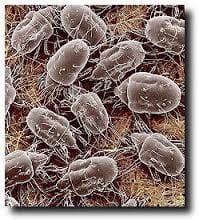
Dust mite, skin, and pollen seen with a light  microscope. Gimmie some skin.

Dust mite, skin, and pollen seen with a light microscope. Gimmie some skin.

If you’ve ever used an electron microscope to look at household objects, you’ll find them covered with brick-like flakes of dried out skin-cells: yours and your friends’. Each person sheds his or her skin every month, on average. The outer layer dries out and flakes off as new skin grows in behind it. Skin flakes are the single largest source of household dust, and if not for the fact that these flakes are the main food for mites, your house would be chock full of your left over skin. When sunlight shines in your window, you see the shimmer of skin-flakes hanging in the air. Under the electron microscope, the fresh skin flakes look like bricks, but mite-eaten skin flakes look irregular. Less common, but more busy are the mites.

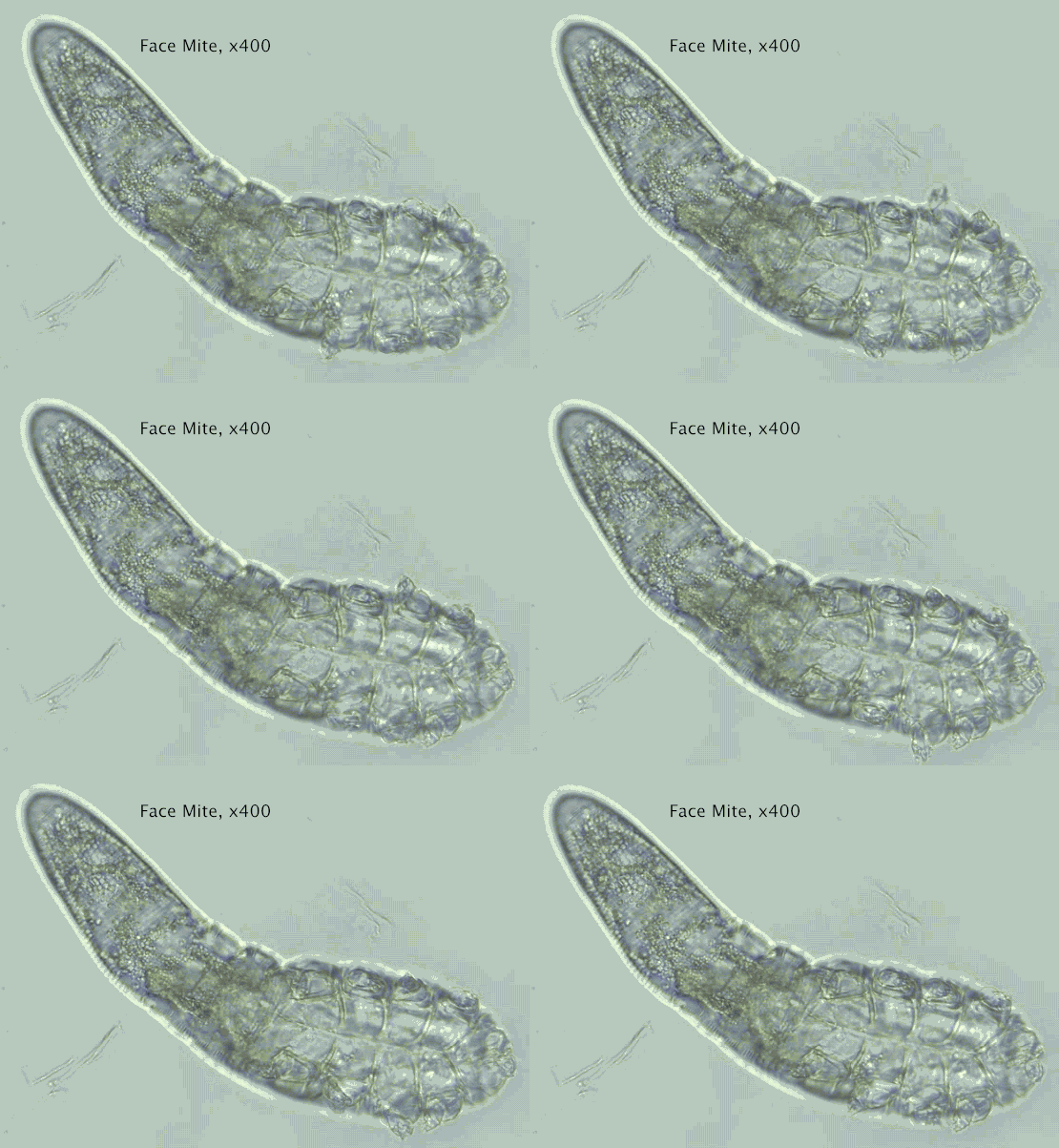
The facial mite movie. They live on in us, about 1 per hair follicle, particularly favoring eyelashes. Whenever you shower, your shower with a friend.

The facial mite movie. They live on in us, about 1 per hair follicle, particularly favoring eyelashes. Whenever you shower, you shower with a friend.

Dry skin is mostly protein (keratin), plus cholesterol and squalene. This provides great nutrition for dust mites and their associated bacteria. In warm, damp environments, as in your underwear or mattress, these beasties multiply and eat the old skin. The average density of dust mites on a mattress is greater than 2500/gram of dust.[1]  The mites leave behind excrement and broken off mite-limbs: nasty bits that are the most common allergens in the US today.

An allergy to dust shows up as sneezing, coughing, clogged lungs, and eczema. The most effective cure is a high level of in-home hygiene; mites don’t like soap or dry air. You’ve go to mop and vacuum regularly. Clean and change your clothing, particularly your undergarments; rotate your mattresses, and shake the dust out of your bedding. Vacuuming is less-effective as a significant fraction of the nasties go through the filter and get spread around by the vacuum blower.

As it turns out, dust mites and their bacteria eat more than skin. They also eat dried body fluids, poop residue, and the particular explosive used by Umar Farook, pentaerythritol tetra nitrate, PETN (humans can eat and metabolize this stuff too — it’s an angina treatment). The mites turn PETN into less-explosive versions, plus more mites.

Mighty mites as seen with electron microscopy. They eat more than skin.

Mighty mites as seen with electron microscopy. They eat more than skin.

There are many varieties of mite living on and among us. Belly button mites, for example, and face mites as shown above (click on the image to see it move). On average, people have one facial mite per hair follicle. It’s also possible that the bomber was stopped by poor quality control engineering and not mites at all. Religion tends to be at odds with a science like quality control, and followers tend to put their faith in miracles.

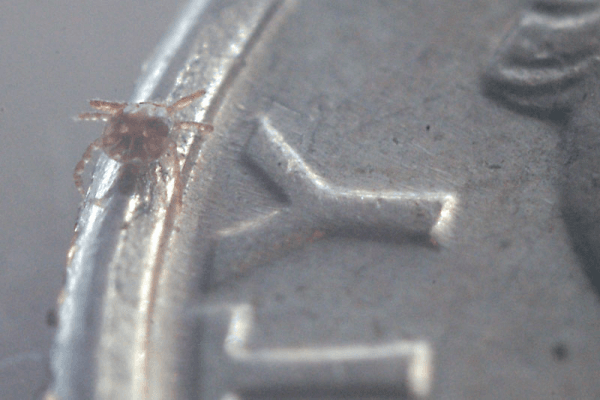
Chigger turning on a dime

Chigger turning on a dime

larger than the dust mite is the chigger, shown at left. Chiggers leave visible bites, particularly along the underwear waste-band. There are larger-yet critters in the family: lice, bed bugs, crabs. Bathing regularly, and cleaning your stuff will rid yourself of all these beasties, at least temporarily. Keeping your hair short and your windows open helps too. Mites multiply in humid, warm environments. Opening the windows dries and cools the air, and blows out mite-bits that could cause wheezing. Benjamin Franklin and took air-baths too: walking around naked with the windows open, even in winter. It helped that he lived on the second floor. Other ways to minimize mite growth include sunlight, DOT (a modern version of DDT), and eucalyptus oil. At the very minimum, change your underwear regularly. It goes a long way to reduce dust embarrassing moments at the jihadist convention.

Dr. Robert E. Buxbaum, Sept 21, 2014. Not all science or life is this weird and wonderful, but a lot is, and I prefer to write about the weird and wonderful bits. See e.g. the hazards of health food, the value of sunshine, or the cancer hazard of living near a river. Or the grammar of pirates.

In praise of openable windows and leaky construction

It’s summer in Detroit, and in all the tall buildings the air conditioners are humming. They have to run at near-full power even on evenings and weekends when the buildings are near empty, and on cool days. This would seem to waste a lot of power and it does, but it’s needed for ventilation. Tall buildings are made air-tight with windows that don’t open — without the AC, there’s be no heat leaving at all, no way for air to get in, and no way for smells to get out.

The windows don’t open because of the conceit of modern architecture; air tight building are believed to be good design because they have improved air-conditioner efficiency when the buildings are full, and use less heat when the outside world is very cold. That’s, perhaps 10% of the year. 

No openable windows, but someone figured you should suffer for art

Modern architecture with no openable windows. Someone wants you to suffer for his/her art.

Another reason closed buildings are popular is that they reduce the owners’ liability in terms of things flying in or falling out. Owners don’t rain coming in, or rocks (or people) falling out. Not that windows can’t be made with small openings that angle to avoid these problems, but that’s work and money and architects like to spend time and money only on fancy facades that look nice (and are often impractical). Besides, open windows can ruin the cool lines of their modern designs, and there’s nothing worse, to them, than a building that looks uncool despite the energy cost or the suffering of the inmates of their art.

Most workers find sealed buildings claustrophobic, musty, and isolating. That pain leads to lost productivity: Fast Company reported that natural ventilation can increase productivity by up to 11 percent. But, as with leading clothes stylists, leading building designers prefer uncomfortable and uneconomic to uncool. If people in the building can’t smell an ocean breeze, or can’t vent their area in a fire (or following a burnt burrito), that’s a small price to pay for art. Art is absurd, and it’s OK with the architect if fire fumes have to circulate through the entire building before they’re slowly vented. Smells add character, and the architect is gone before the stench gets really bad. 

No one dreams of working in an unventilated glass box.

No one dreams of working in a glass box. If it’s got to be an office, give some ventilation.

So what’s to be done? One can demand openable windows and hope the architect begrudgingly obliges. Some of the newest buildings have gone this route. A simpler, engineering option is to go for leaky construction — cracks in the masonry, windows that don’t quite seal. I’ve maintained and enlarged the gap under the doors of my laboratory buildings to increase air leakage; I like to have passive venting for toxic or flammable vapors. I’m happy to not worry about air circulation failing at the worst moment, and I’m happy to not have to ventilate at night when few people are here. To save some money, I increase the temperature range at night and weekends so that the buildings is allowed to get as hot as 82°F before the AC goes on, or as cold as 55°F without the heat. Folks who show up on weekends may need a sweater, but normally no one is here. 

A bit of air leakage and a few openable windows won’t mess up the air-conditioning control because most heat loss is through the walls and black body radiation. And what you lose in heat infiltration you gain by being able to turn off the AC circulation system when you know there are few people in the building (It helps to have a key-entry system to tell you how many people are there) and the productivity advantage of occasional outdoor smells coming in, or nasty indoor smells going out.

One irrational fear of openable windows is that some people will not close the windows in the summer or in the dead of winter. But people are quite happy in the older skyscrapers (like the empire state building) built before universal AC. Most people are nice — or most people you’d want to employ are. They will respond to others feelings to keep everyone comfortable. If necessary a boss or building manager may enforce this, or may have to move a particularly crusty miscreant from the window. But most people are nice, and even a degree of discomfort is worth the boost to your psyche when someone in management trusts you to control something of the building environment.

Robert E. Buxbaum, July 18, 2014. Curtains are a plus too — far better than self-darkening glass. They save energy, and let you think that management trusts you to have power over your environment. And that’s nice.

Buddhists, Hindus and dentists joke

At the dentists’ office, Buddhist and Hindu monks don’t need anesthesia to have their teeth worked on. They transcend dental medication.

It’s funny because it’s a 3 word pun, and because there is something magical about the ability of people to conquer pain through meditation.

Focussed meditation can keep you from worry and other pain.

Focused meditation can keep you from worry and some physical pain. As for thugs, that’s more controversial. It’s possible that laughter, or looking at a spot will do as much. Gahan Wilson

The types of meditation, as I understand it, are two which are four. The two are focused and non-focused. focused meditation is supposed to allow you to conquer pain, both physical and spiritual. You concentrate on your breathing, or some other rhythmic action and thought; and whenever you realize that your mind is wandering you bring it back. A popular version is called square breathing: you breath in, hold, breath out, hold, etc. In time there is a sense of calm with the world. In theory, you can transcend dental medication, but I use the normal western practice of Novocaine plus gas. Meditation practitioners claim that directed meditation can also protect you from villains and bring peace in the world; I suspect that’s true, but also suspect that humor, or staring at a spot will do as much. I suspect that Dr Seuss has done wonders for peace in the world.

The second major version of mediation is non-focused; it can bring enlightenment if you use it right. You repeat a mantra slowly and let your mind wander along some general paths. The classic incantatory mantra is OM, and the classic paths include: what am I doing with my life, imagine a stick with one end, what is the sound of a hand clapping. The enlightenment that is supposed to arise is supposed to promote non-violence, charity, and a sense of oneness with the all. In general, I’ve found that letting one’s mind wander is a great way to solve difficult problems and to help one decide whether certain situations are worth being involved with. To the extent I’ve used a mantra, it’s versions of “radiator not leaking, mind leaking,” or “computer solution not unstable, mind unstable.” In the calm of realizing there is a solution, I’ve generally been able to find a solution.

Enlightenment can be as simple as realizing that you're there already or that you shouldn't manage a country that's unlike you and dislikes you.

Enlightenment can be as simple as realizing that you’re there already.

As for the other 2 types of meditation, it depends. To some, it involves rocking to the sound of the one hand clapping (or not). To some, it’s realizing you’re there already, or that you really don’t want to get involved in an Asian war to defend and manage a country that’s completely unlike yours, and that dislikes yours as well, or that it’s OK to use Novocaine and gas when you have your teeth worked on. That’s what they are there for.

Robert E. Buxbaum, May 24, 2014. Some wisdom from the Jewish mystics: Wherever you go, there you are, as for your baggage, who knows? Tea, with the first sip joy, with the second, satisfaction, with the third, Danish.

Dada, or it’s hard to look cool sucking on a carrot.

When it’s done right, Dada art is cool. It’s not confusing or preachy; it’s not out there, or sloppy; just cool. And today I found the most wonderful Dada piece: “Attention”, by Gabriel -Belladonna, shown below from “deviant art” (sorry about the water-mark).

At first glance it’s an advertisement against smoking, drinking, and eating sweets. The smoker has blackened lungs, the drinker has an enlarged liver, and the eater of sweets a diseased stomach. But something here isn’t right; the sinners are happy and young. These things are clearly bad for you but they’re enjoyable too and “cool” — Smoking is a lot cooler than sucking on a carrot.

Dada at it's best: Attention by Mio Belladonna. The sinners are happy.

Dada at it’s best: “Attention” by Dadaist Gabriel (Mio) Belladonna, 2012; image from deviant art. If I were to choose the title it would be “But it’s hard to look cool sucking on a carrot.”

At its best, Dada turns advertising and art on its head; it uses the imagery of advertising to show the shallowness of that, clearly slanted medium, or uses art-museum settings to show the narrow definition of what we’ve come to call “art”. In the above you see the balance of life- reality and the mind control of advertising.

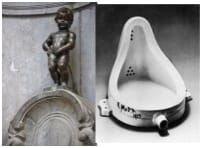
Marcel Duchamp's fountain and "Manikken Pis" Similar idea, Manikken is better executed, IMHO.

Marcel Duchamp’s fountain and “Manikken Pis.”

Any mention of dada should also, I suppose, mention Duchamp’s fountain (at right, signed fancifully by R. Mutt). In 2004, fountain was voted “the most influential artwork of the 20th century” by a panel of artists and art historians. The basic idea was to show the slight difference between art and not-art (to be something, there has to be a non-something, as in this joke). Beyond this, the idea would be that same as for the Manikken Pis sculpture in Brussels. Duchamp’s was done with a lot less work — just by signing a “found object.” He submitted the work for exhibition in 1917, but it was rejected as not being art — proving, I guess, the point. Fountain is related to man: his life, needs, and vain ambitions; it’s sort-of beautiful, so why ain’t it art? (It has something to do with skill, I’d say.)

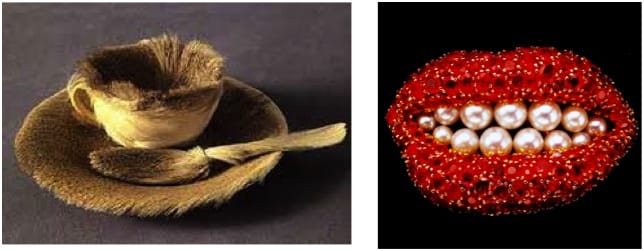
Duchamp designed two major surrealist exhibitions — a similar approach, but surrealism typically employs more skill and humor than Dada, with less shock. Below is another famous work of dada, Oppenheim’s fur-lined tea-cup (Breakfast in fur — see it at the Modern Museum in NYC) compared to a wonderful (and in my mind similar) surreal work, “Ruby lips” by Dali. Oppenheim made the tea-cup and spoon disgusting by making it out of a richer material, fur. That’s really cool, and sort-of shocking, even today.

Duchap's tea cup (left), and Dali's ruby lips (right). Similar ideas treated as Dada or Surreal.

Meret Oppenheim’s fur tea-cup (Breakfast in fur) and Dali’s ruby lips; the same idea (I think); dada vs surreal.

Dali’s “ruby libs” brooch took more skill than gluing fur to a cup and spoon; that adds to the humor, I’d say, but took from the shock. It’s made from real rubies and pearls: hard materials for something that should be soft; it’s sort of disgusting this way, and the message is more or less the same as Oppenheim’s, I’d say, but the message gets a little lost in the literal joke (pearly teeth, ruby lips…). I could imagine someone wearing Dali’s brooch, but no one would use the fur-lined cup. 

There is a lot of bad dada, too unfortunately, and it tends to be awful: incomprehensible, trite, or advertising. An unfortunate tendency is to collect some found pieces of garbage, and set it out in an attempt to scandalize the art world, or put down “the man” for his closed mindset. But that’s fountain, and it’s been done. A key way to tell if it’s good dada — is it cool; is it something that makes you say “Wow.” Christo’s surrounded islands certainly have the wow-cool factor, IMHO. 

Christo's wrapped Islands. Islands near Miami Beach wrapped in pink (fuscha) plastic.

Christo’s surrounded Islands: Islands near Miami Beach wrapped in pink (fuchsia) plastic.

A nice thing about Christo is that he takes it down 2 weeks or so after he makes the sculptures. Thus, the wow factor of his work never has a chance to go stale. Sorry to say, most dada stays around. Duchamp’s “fountain” sits in a museum and has grown stale, at least to me and Duchamp. What was scandalous and shocking in 1917 is passé and boring in 2014. The decline in shock is somewhat less for “breakfast in fur,” I think because the work is better crafted, a benefit I see in “Attention” too; skill matters.

Paris Street art. I don't know the artist, but it's cool.

Paris Street art; it’s just cool.

At the height of his success, Duchamp left art for 30 years and played chess. He became a chess grand master (life is as strange as art) and played for France in international tournaments. He later came back to art and did one, last, final piece, a very fine one, seen only through a peephole. Here’s some further thoughts on good vs bad modern art, and on surrealism, and on the aesthetic of strength in engineering: what materials to use; how strong should it be, and on architecture humor

Robert E. Buxbaum. April 4-7, 2014. Here is a link to my attempt at good Dada: Kilroy with eyes that follow you, and at right some Paris street art that I consider good dada too. As far as what the word “dada” means, I translate it as “cool,” “wow,” “gnarly,” or “go go.” It’s dada, man, y’ dig?

Nerves are tensegrity structures and grow when pulled

No one quite knows how nerve cells learn stuff. It is incorrectly thought that you can not get new nerves in the brain, nor that you can get brain cells to grow out further, but people have made new nerve cells, and when I was a professor at Michigan State, a Physiology colleague and I got brain and sensory nerves to grow out axons by pulling on them without the use of drugs.

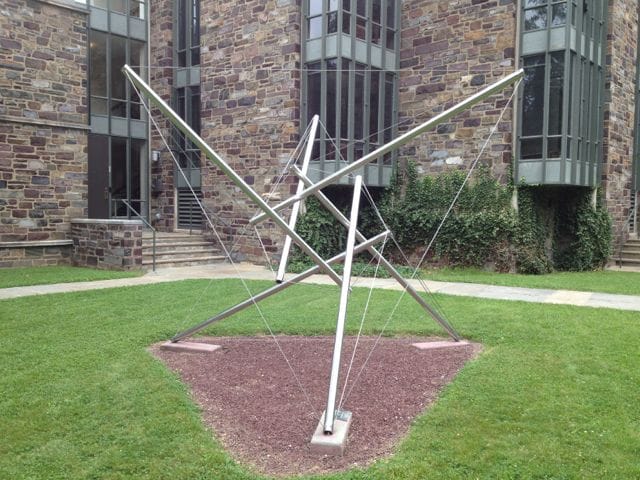
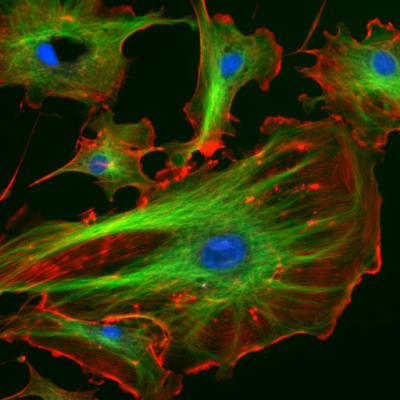
I had just moved to Michigan State as a fresh PhD (Princeton) as an assistant professor of chemical engineering. Steve Heidemann was a few years ahead of me, a Physiology professor PhD from Princeton. We were both new Yorkers. He had been studying nerve structure, and wondered about how the growth cone makes nerves grow out axons (the axon is the long, stringy part of the nerve). A thought was that nerves were structured as Snelson-Fuller tensegrity structures, but it was not obvious how that would relate to growth or anything else. A Snelson-Fuller structure is shown below the structure stands erect not by compression, as in a pyramid or igloo, but rather because tension in the wires helps lift the metal pipes, and puts them in compression. The nerve cell, shown further below is similar with actin-protein as the outer, tensed skin, and a microtubule-protein core as the compress pipes. 

A Snelson-Fuller tensegrity sculpture in the graduate college courtyard at Princeton, where Steve and I got our PhDs

A Snelson-Fuller tensegrity sculpture in the graduate college courtyard at Princeton, an inspiration for our work.

Biothermodynamics was pretty basic 30 years ago (It still is today), and it was incorrectly thought that objects were more stable when put in compression. It didn’t take too much thermodynamics on my part to show otherwise, and so I started a part-time career in cell physiology. Consider first how mechanical force should affect the Gibbs free energy, G, of assembled microtubules. For any process at constant temperature and pressure, ∆G = work. If force is applied we expect some elastic work will be put into the assembled Mts in an amount  ∫f dz, where f is the force at every compression, and ∫dz is the integral of the distance traveled. Assuming a small force, or a constant spring, f = kz with k as the spring constant. Integrating the above, ∆G = ∫kz dz = kz2; ∆G is always positive whether z is positive or negative, that is the microtubule is most stable with no force, and is made less stable by any force, tension or compression. 

A cell showing what appears to be tensegrity. The microtubules in green surrounded by actin in red. If the actin is under tension the microtubules are in compression. From here.

A cell showing what appears to be tensegrity. The microtubules (green) surrounded by actin (red). In nerves Heidemann and I showed actin is in tension the microtubules in compression.

Assuming that microtubules in the nerve- axon are generally in compression as in the Snelson-Fuller structure, then pulling on the axon could potentially reduce the compression. Normally, this is done by a growth cone, we posited, but we could also do it by pulling. In either case, a decrease in the compression of the assembled microtubules should favor microtubule assembly.

To calculate the rates, I used absolute rate theory, something I’d learned from Dr. Mortimer Kostin, a most-excellent thermodynamics professor. I assumed that the free energy of the monomer was unaffected by force, and that the microtubules were in pseudo- equilibrium with the monomer. Growth rates were predicted to be proportional to the decrease in G, and the prediction matched experimental data. 

Our few efforts to cure nerve disease by pulling did not produce immediate results; it turns out to by hard to pull on nerves in the body. Still, we gained some publicity, and a variety of people seem to have found scientific and/or philosophical inspiration in this sort of tensegrity model for nerve growth. I particularly like this review article by Don Ingber in Scientific American. A little more out there is this view of consciousness life and the fate of the universe (where I got the cell picture). In general, tensegrity structures are more tough and flexible than normal construction. A tensegrity structure will bend easily, but rarely break. It seems likely that your body is held together this way, and because of this you can carry heavy things, and still move with flexibility. It also seems likely that bones are structured this way; as with nerves; they are reasonably flexible, and can be made to grow by pulling.

Now that I think about it, we should have done more theoretical or experimental work in this direction. I imagine that  pulling on the nerve also affects the stability of the actin network by affecting the chain configuration entropy. This might slow actin assembly, or perhaps not. It might have been worthwhile to look at new ways to pull, or at bone growth. In our in-vivo work we used an external magnetic field to pull. We might have looked at NASA funding too, since it’s been observed that astronauts grow in outer space by a solid inch or two, and their bodies deteriorate. Presumably, the lack of gravity causes the calcite in the bones to grow, making a person less of a tensegrity structure. The muscle must grow too, just to keep up, but I don’t have a theory for muscle.

Robert Buxbaum, February 2, 2014. Vaguely related to this, I’ve written about architecture, art, and mechanical design.

Physics of no fear, no fall ladders

I recently achieved a somewhat mastery over my fear of heights while working on the flat roof of our lab building / factory. I decided to fix the flat roof of our hydrogen engineering company, REB Research (with help from employees), and that required me to climb some 20 feet to the roof to do some work myself and inspect the work of others. I was pretty sure we could tar the roof cheaper and better than the companies we’d used in the past, and decided that the roof  should be painted white over the tar or that silvered tar should be used — see why. So far the roof is holding up pretty well (looks good, no leaks) and my summer air-conditioning bills were lowered as well.

Perhaps the main part of overcoming my fear of heights was practice, but another part was understanding the physics of what it takes to climb a tall ladder safely. Once I was sure I knew what to do, I was far less afraid. As Emil Faber famously said, “Knowledge is good.”

me on tall ladder

Me on tall ladder and forces. It helps to use the step above the roof, and to have a ladder that extends 3-4′ feet past roof level

One big thing I learned (and this isn’t physics), was to not look down, especially when you are going down the ladder. It’s best to look at the ladder and make sure your hands and feet are going where they should. The next trick I learned was to use a tall ladder — one that I could angle at 20° and extends 4 feet above the roof, see figure. Those 4 feet gave me something to hold on to, and something to look at while going on and off the ladder. I found I preferred to go to or from the roof from a rung that was either at the level of the roof, or a half-step above (see figure). By contrast, I found it quite scary to step on a ladder rung that was significantly below roof level even when I had an extended ladder. I bought my ladder from Acme Ladder of Capital St. in Oak Park; a fiberglass ladder, light weight and rot-proof.

I preferred to set the ladder level (with the help of a shim if needed) at an angle about 20° to the wall, see figure. At this angle, I felt certain the ladder would not tip over from the wind or my motion, and that it would not slip at the bottom, see calculations below.

if the force of the wall acts at right angles to the ladder (mostly horizontally), the wall force will depend only on the lever angle and the center of mass for me and the ladder. It will be somewhat less than the total weight of me and the ladder times sin 20°. Since sin 20° is 0.342, I’ll say the wall force will be less than 30% of the total weight, about 65lb. The wall force provides some lift to the ladder, 34.2% of the wall force, about 22 lb, or 10% of the total weight. Mostly, the wall provides horizontal force, 65 lb x cos 20°, or about 60 lbs. This is what keeps the ladder from tipping backward if I make a sudden motion, and this is the force that must be restrained by friction from the ladder feet. At a steeper angle the anti-tip force would be less, but the slip tendency would be less too.

The rest of the total weight of me and the ladder, the 90% of the weight that is not supported by the roof, rests on the ground. This is called the “normal force,” the force in the vertical direction from the ground. The friction force, what keeps the ladder from slipping out while I’m on it, is this “normal force” times the ‘friction factor’ of the ground. The bottom of my ladder has rubber pads, suggesting a likely friction factor of .8, and perhaps more. As the normal force will be about 90% of the total weight, the slip-restraining force is calculated to be at least 72% of this weight, more than double the 28% of weight that the wall pushes with. The difference, some 44% of the weight (100 lbs or so) is what keeps the ladder from slipping, even when I get on and off the ladder. I find that I don’t need a person on the ground for physics reasons, but sometimes found it helped to steady my nerves, especially in a strong wind.

Things are not so rosy if you use a near vertical ladder, with <10° to the wall, or a widely inclined one, >40°. The vertical ladder can tip over, and the widely inclined ladder can slip at the bottom, especially if you climb past the top of the roof or if your ladder is on a slippery surface without rubber feet.

Robert E. Buxbaum Nov 20, 2013. For a visit to our lab, see here. For some thoughts on wind force, and comments on Engineering aesthetics. I owe to Th. Roosevelt the manly idea that overcoming fear is a worthy achievement. Here he is riding a moose. Here are some advantages of our hydrogen generators for gas chromatography.