Category Archives: Princeton

Seeing entropy, the most important pattern in life

One evening at the Princeton grad college a younger fellow (an 18-year-old genius) asked the most simple, elegant question I had ever heard, one I’ve used ever since: “tell me”, he asked, “something that’s important and true.” My answer was that the entropy of the universe is always increasing. It’s a fundamentally important pattern, one I discovered to have a lot of applications and meaning. Let me explain the concept and why it’s true and useful. After that, why I find it’s meaningful.
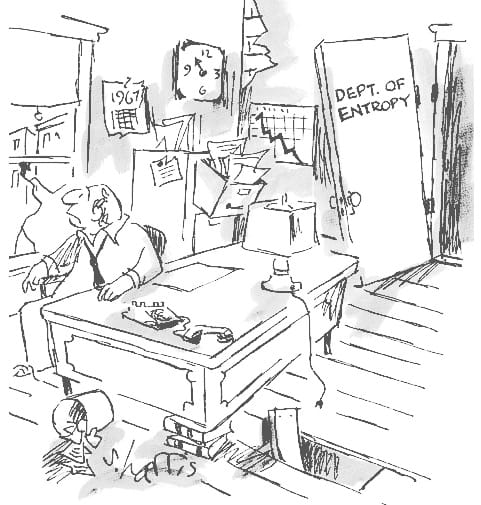
Famous entropy cartoon, Harris

Famous entropy cartoon, Harris

The entropy of the universe is not something you can measure directly, but indirectly, from the availability of work in any corner of it. It’s related to randomness and the arrow of time. If you have, for example, an ice cube and a hot cup of water, you can get useful work from these by way of a thermocouple placed between them. You’ll get work until the two are at the same temperature. To get useful work out, you’ll have to add some other item.

Now, here’s how you can tell if time is moving forward: put an ice-cube into hot water, if the cube dissolves and the water becomes cooler, time is moving forward — or, at least it’s moving in the same direction as you are. If you can reach into a cup of warm water and pull out an ice-cube while making the water hot, time is moving backwards. — or rather, you are living backwards. Within any closed system, one where you don’t add things or energy (sunlight say), you can tell that time is moving forward because the forward progress of time always leads to the lack of availability of work. In the case above, you generated some electricity from the ice-cube and the hot water, but could not from the glass of warm water at the end.
You can not extract work from a heat source alone; to extract work some heat must be deposited in a cold sink. At best the entropy of the universe remains unchanged. More typically, it increases.

You can not extract work from a heat source alone; to extract work some heat must be deposited in a cold sink. At best the entropy of the universe remains unchanged.

This observation is about as general and fundamental as any to understanding the world; it is the basis of the second law of thermodynamics: you can never extract useful work from a uniform temperature item, by making that item cooler say. To get useful work, you always need to make something else hotter, or colder, or you have to provide some chemical, altitude or other change that can not be reversed without adding more energy back. Thus, so long as time moves forward, everything “runs down” in terms of work availability.

The concept of entropy is the result of this observation along with another observation that energy is conserved. That is, if you want to heat some uniform substance, you must put in work and/or heat in any combination. And, if you want to cool something back to the original state, that same amount of heat + work must be taken out. In equation form, we say that, for any change, q +w is constant, where q is heat, and w is work. It’s the sum that’s constant, not the individual values so long as you count every 4.174 Joules of work as if it were 1 calorie of heat. If you input more heat, you have to add less work, and visa versa, but it’s always the same sum. When adding heat or work to the substance, we say that q or w is positive; when extracting heat or work, we say that q or w are negative quantities. So long as each 4.174 joules counts as if it were 1 calorie you get the same temperature change. This conservation of energy observation is called the first law of thermodynamics.

Now, since for every path between two states, q +w is the same, we say that q + w represents a path-independent quantity for the system, one we call internal energy, U where ∆U = q + w. This is a mathematical form of the first law of thermodynamics: you can’t take q + w out of nothing, or add it to something without making a change in the properties of the thing. The only way to leave things the same is if q + w = 0. We notice also that for any pure thing or uniform mixture undergoing a temperature change, the sum q +w that is needed to make that temperature change is proportional to the mass of the stuff. We can thus say that internal energy is an intensive quality. q + w = n ∆u where n is the grams of material, and ∆u is the change in internal energy per gram.

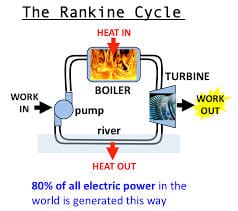
We are now ready to put the first and second laws together. We find we can extract work from a system if we take heat from a hot body (the hot water, say) and deliver some of it to something at a lower temperature (the ice-cube say). This can be done with a thermocouple, as above, or with a steam engine (Rankine cycle, shown above), or a Sterling engine, etc. These engines extract work only when there is a difference of temperatures. It’s is similar to a water wheel: a water wheel can extract work only when there is a flow of water from a high level to low; similarly in a heat engine, you only get work by taking heat energy from a hot heat-source and exhausting some of it to at a lower temperature. The remainder of that heat energy leaves the engine as work. That is, q1 -q2 = w. energy is always conserved. If you returned the amount of heat and work, you could return the hot source to its original condition. The second law isn’t violated either; there is no way you could run the engine without the cold sink. Accepting this as reasonable, we can now derive some very interesting, non-obvious truths.

We begin with the famous Carnot cycle. The Carnot cycle is an idealized heat engine with the interesting feature that it can be made to operate reversibly. That is, you can make it run forwards, taking a certain amount of work from a hot source, producing a certain amount of work and delivering a certain amount of heat to the cold sink; and you can run the same process backwards, as a refrigerator, taking in the same about of work and the same amount of heat from the cold sink and delivering the same amount to the hot source. Carnot showed by the following proof that all other reversible engines would have the same efficiency as his cycle and no engine, reversible or not, could be more efficient. The proof: if an engine could be designed that will extract a greater percentage of the heat as work when operating between a given hot source and cold sink it could be used to drive his Carnot cycle backwards. If the pair of engines were now combined so that the less efficient engine removed exactly as much heat from the sink as the more efficient engine deposited, the excess work produced by the more efficient engine would leave with no effect besides cooling the source. This combination would be in violation of the second law, something that we’d said was impossible.

Now let us try to understand the relationship that drives useful energy production. The ratio of heat in to heat out has got to be a function of the in and out temperatures alone. That is, q1/q2 = f(T1, T2). Similarly, q2/q1 = f(T2,T1) Now lets consider what happens when two Carnot cycles are placed in series between T1 and T2, with the middle temperature at Tm. For the first engine, q1/qm = f(T1, Tm), and similarly for the second engine qm/q2 = f(Tm, T2). Combining these we see that q1/q2 = (q1/qm)x(qm/q2) and therefore f(T1, T2) must always equal f(T1, Tm)x f(Tm/T2) =f(T1,Tm)/f(T2, Tm). In this relationship we see that the second term Tm is irrelevant; it is true for any Tm. We thus say that q1/q2 = T1/T2, and this is the limit of what you get at maximum (reversible) efficiency. You can now rearrange this to read q1/T1 = q2/T2 or to say that work, W = q1 – q2 = q2 (T1 – T2)/T2.

A strange result from this is that, since every process can be modeled as either a sum of Carnot engines, or of engines that are less-efficient, and since the Carnot engine will produce this same amount of reversible work when filled with any substance or combination of substances, we can say that this outcome: q1/T1 = q2/T2 is independent of path, and independent of substance so long as the process is reversible. We can thus say that for all substances there is a property of state, S such that the change in this property is ∆S = ∑q/T for all the heat in or out. In a more general sense, we can say, ∆S = ∫dq/T, where this state property, S is called the entropy. Since as before, the amount of heat needed is proportional to mass, we can say that S is an intensive property; S= n s where n is the mass of stuff, and s is the entropy change per mass. 

Another strange result comes from the efficiency equation. Since, for any engine or process that is less efficient than the reversible one, we get less work out for the same amount of q1, we must have more heat rejected than q2. Thus, for an irreversible engine or process, q1-q2 < q2(T1-T2)/T2, and q2/T2 is greater than -q1/T1. As a result, the total change in entropy, S = q1/T1 + q2/T2 >0: the entropy of the universe always goes up or stays constant. It never goes down. Another final observation is that there must be a zero temperature that nothing can go below or both q1 and q2 could be positive and energy would not be conserved. Our observations of time and energy conservation leaves us to expect to find that there must be a minimum temperature, T = 0 that nothing can be colder than. We find this temperature at -273.15 °C. It is called absolute zero; nothing has ever been cooled to be colder than this, and now we see that, so long as time moves forward and energy is conserved, nothing will ever will be found colder.

Typically we either say that S is zero at absolute zero, or at room temperature.

We’re nearly there. We can define the entropy of the universe as the sum of the entropies of everything in it. From the above treatment of work cycles, we see that this total of entropy always goes up, never down. A fundamental fact of nature, and (in my world view) a fundamental view into how God views us and the universe. First, that the entropy of the universe goes up only, and not down (in our time-forward framework) suggests there is a creator for our universe — a source of negative entropy at the start of all things, or a reverser of time (it’s the same thing in our framework). Another observation, God likes entropy a lot, and that means randomness. It’s his working principle, it seems.

But before you take me now for a total libertine and say that since science shows that everything runs down the only moral take-home is to teach: “Let us eat and drink,”… “for tomorrow we die!” (Isaiah 22:13), I should note that his randomness only applies to the universe as a whole. The individual parts (planets, laboratories, beakers of coffee) does not maximize entropy, but leads to a minimization of available work, and this is different. You can show that the maximization of S, the entropy of the universe, does not lead to the maximization of s, the entropy per gram of your particular closed space but rather to the minimization of a related quantity µ, the free energy, or usable work per gram of your stuff. You can show that, for any closed system at constant temperature, µ = h -Ts where s is entropy per gram as before, and h is called enthalpy. h is basically the potential energy of the molecules; it is lowest at low temperature and high order. For a closed system we find there is a balance between s, something that increases with increased randomness, and h, something that decreases with increased randomness. Put water and air in a bottle, and you find that the water is mostly on the bottom of the bottle, the air is mostly on the top, and the amount of mixing in each phase is not the maximum disorder, but rather the one you’d calculate will minimize µ.
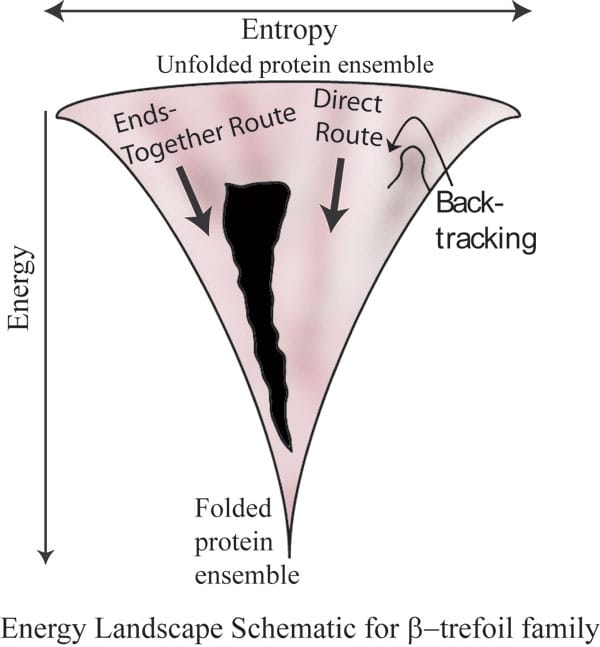
As the protein folds its randomness and entropy decrease, but its enthalpy decreases too; the net effect is one precise fold that minimizes µ.

As a protein folds its randomness and entropy decrease, but its enthalpy decreases too; the net effect is one precise fold that minimizes µ.

This is the principle that God applies to everything, including us, I’d guess: a balance. Take protein folding; some patterns have big disorder, and high h; some have low disorder and very low h. The result is a temperature-dependent  balance. If I were to take a moral imperative from this balance, I’d say it matches better with the sayings of Solomon the wise: “there is nothing better for a person under the sun than to eat, drink and be merry. Then joy will accompany them in their toil all the days of the life God has given them under the sun.” (Ecclesiastes 8:15). There is toil here as well as pleasure; directed activity balanced against personal pleasures. This is the µ = h -Ts minimization where, perhaps, T is economic wealth. Thus, the richer a society, the less toil is ideal and the more freedom. Of necessity, poor societies are repressive. 

Dr. Robert E. Buxbaum, Mar 18, 2014. My previous thermodynamic post concerned the thermodynamics of hydrogen production. It’s not clear that all matter goes forward in time, by the way; antimatter may go backwards, so it’s possible that anti matter apples may fall up. On microscopic scale, time becomes flexible so it seems you can make a time machine. Religious leaders tend to be anti-science, I’ve noticed, perhaps because scientific miracles can be done by anyone, available even those who think “wrong,” or say the wrong words. And that’s that, all being heard, do what’s right and enjoy life too: as important a pattern in life as you’ll find, I think. The relationship between free-energy and societal organization is from my thesis advisor, Dr. Ernest F. Johnson.
Nuclear fusion

I got my PhD at Princeton University 33 years ago (1981) working on the engineering of nuclear fusion reactors, and I thought I’d use this blog to rethink through the issues. I find I’m still of the opinion that developing fusion is important as the it seems the best, long-range power option. Civilization will still need significant electric power 300 to 3000 years from now, it seems, when most other fuel sources are gone. Fusion is also one of the few options for long-range space exploration; needed if we ever decide to send colonies to Alpha Centauri or Saturn. I thought fusion would be ready by now, but it is not, and commercial use seems unlikely for the next ten years at least — an indication of the difficulties involved, and a certain lack of urgency.

Oil, gas, and uranium didn’t run out like we’d predicted in the mid 70s. Instead, population growth slowed, new supplies were found, and better methods were developed to recover and use them. Shale oil and fracking unlocked hydrocarbons we thought were unusable, and nuclear fission reactors got better –safer and more efficient. At the same time, the more we studied, the clearer it came that fusion’s technical problems are much harder to tame than uranium fission’s.

Uranium fission was/is frighteningly simple — far simpler than even the most basic fusion reactor. The first nuclear fission reactor (1940) involved nothing more than uranium pellets in a pile of carbon bricks stacked in a converted squash court at the University of Chicago. No outside effort was needed to get the large, unstable uranium atoms split to smaller, more stable ones. Water circulating through the pile removed the heat released, and control was maintained by people lifting and lowering cadmium control rods while standing on the pile.

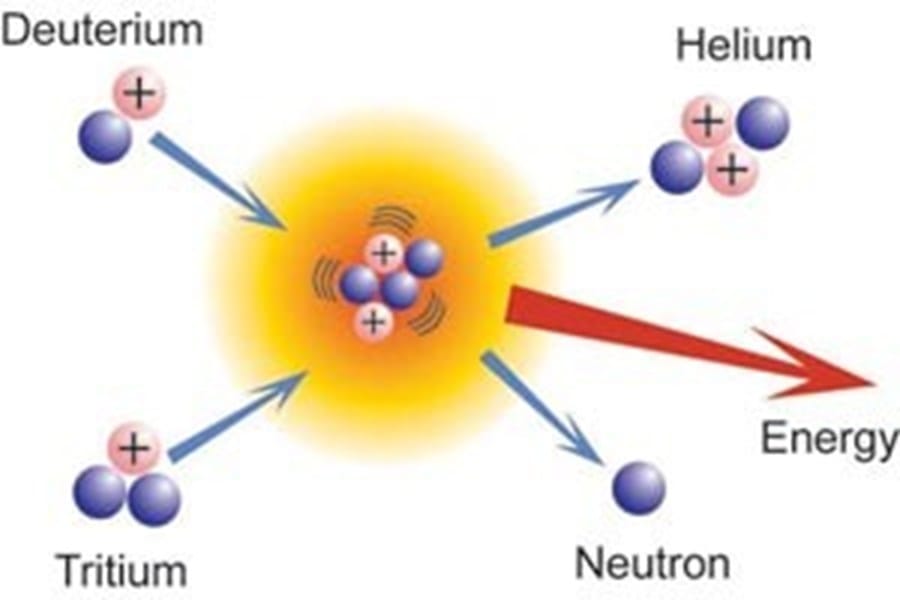
A fusion reactor requires high temperature or energy to make anything happen. Fusion energy is produced by combining small, unstable heavy hydrogen atoms into helium, a bigger more stable one, see figure. To do this reaction you need to operate at the equivalent of about 500,000,000 degrees C, and containing it requires (typically) a magnetic bottle — something far more complex than a pile of graphic bricks. The reward was smaller too: “only” about 1/13th as much energy per event as fission. We knew the magnetic bottles were going to be tricky, e.g. there was no obvious heat transfer and control method, but fusion seemed important enough, and the problems seemed manageable enough that fusion power seemed worth pursuing — with just enough difficulties to make it a challenge.

Basic fusion reaction: deuterium + tritium react to give helium, a neutron and energy.

Basic fusion reaction: deuterium + tritium react to give helium, a neutron and energy.

The plan at Princeton, and most everywhere, was to use a TOKAMAK, a doughnut-shaped reactor like the one shown below, but roughly twice as big; TOKAMAK was a Russian acronym. The doughnut served as one side of an enormous transformer. Hydrogen fuel was ionized into a plasma (a neutral soup of protons and electrons) and heated to 300,000,000°C by a current in the TOKOMAK generated by varying the current in the other side of the transformer. Plasma containment was provided by enormous magnets on the top and bottom, and by ring-shaped magnets arranged around the torus.

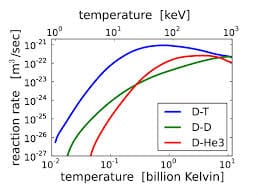
As development went on, we found we kept needing bigger and bigger doughnuts and stronger and stronger magnets in an effort to balance heat loss with fusion heating. The number density of hydrogen atoms per volume, n, is proportional to the magnetic strength. This is important because the fusion heat rate per volume is proportional to n-squared, n2, while heat loss is proportional to n divided by the residence time, something we called tau, τ. The main heat loss was from the hot plasma going to the reactor surface. Because of the above, a heat balance ratio was seen to be important, heat in divided by heat out, and that was seen to be more-or-less proportional to nτ. As the target temperatures increased, we found we needed larger and larger nτ reactors to make a positive heat balance. And this translated to ever larger reactors and ever stronger magnetic fields, but even here there was a limit, 1 billion Kelvin, a thermodynamic temperature where the fusion reaction went backward and no energy was produced. The Princeton design was huge, with super strong, super magnets, and was operated at 300 million°C, near the top of the reaction curve. If the temperature went above or below this temperature, the fire would go out. There was no room for error, but relatively little energy output per volume — compared to fission.

Fusion reaction options and reaction rates.

Fusion reaction options and reaction rates.

The most likely reaction involved deuterium and tritium, referred to as D and T. This was the reaction of the two heavy isotopes of hydrogen shown in the figure above — the same reaction used in hydrogen bombs, a point we rarely made to the public. For each reaction D + T –> He + n, you get 17.6 million electron volts (17.6 MeV). This is 17.6 million times the energy you get for an electron moving over one Volt, but only 1/13 the energy of a fission reaction. By comparison, the energy of water-forming, H2 + 1/2 O2 –> H2O, is the equivalent of two electrons moving over 1.2 Volts, or 2.4 electron volts (eV), some 8 million times less than fusion.

The Princeton design involved reacting 40 gm/hr of heavy hydrogen to produce 8 mol/hr of helium and 4000 MW of heat. The heat was converted to electricity at 38% efficiency using a topping cycle, a modern (relatively untried) design. Of the 1500 MWh/hr of electricity that was supposed to be produced, all but about 400 MW was to be delivered to the power grid — if everything worked right. Sorry to say, the value of the electricity did not rise anywhere as fast as the cost of the reactor and turbines. Another problem: 1100 MW was more than could be easily absorbed by any electrical grid. The output was high and steady, and could not be easily adjusted to match fluctuating customer demand. By contrast a coal plant’s or fuel cell’s output could be easily adjusted (and a nuclear plant with a little more difficulty).

Because of the need for heat balance, it turned out that at least 9% of the hydrogen had to be burnt per pass through the reactor. The heat lost per mol by conduction to the wall was, to good approximation, the heat capacity of each mol of hydrogen ions, 82 J/°C mol, times the temperature of the ions, 300 million °C divided by the containment time, τ. The Princeton design was supposed to have a containment of about 4 seconds. As a result, the heat loss by conduction was 6.2 GW per mol. This must be matched by the molar heat of reaction that stayed in the plasma. This was 17.6 MeV times Faraday’s constant, 96,800 divided by 4 seconds (= 430 GW/mol reacted) divided by 5. Of the 430 GW/mol produced in fusion reactions only 1/5 remains in the plasma (= 86 GW/mol) the other 4/5 of the energy of reaction leaves with the neutron. To get the heat balance right, at least 9% of the hydrogen must react per pass through the reactor; there were also some heat losses from radiation, so the number is higher. Burn more or less percent of the hydrogen and you had problems. The only other solution was to increase τ > 4 seconds, but this meant ever bigger reactors.

There was also a material handling issue: to get enough fuel hydrogen into the center of the reactor, quite a lot of radioactive gas had to be handled — extracted from the plasma chamber. These were to be frozen into tiny spheres of near-solid hydrogen and injected into the reactor at ultra-sonic velocity. Any slower and the spheres would evaporate before reaching the center. As 40 grams per hour was 9% of the feed, it became clear that we had to be ready to produce and inject 1 pound/hour of tiny spheres. These “snowballs-in-hell” had to be small so they didn’t dampen the fire. The vacuum system had to be able to be big enough to handle the lb/hr or so of unburned hydrogen and ash, keeping the pressure near total vacuum. You then had to purify the hydrogen from the ash-helium and remake the little spheres that would be fed back to the reactor. There were no easy engineering problems here, but I found it enjoyable enough. With a colleague, I came up with a cute, efficient high vacuum pump and recycling system, and published it here.

Yet another engineering challenge concerned the difficulty of finding a material for the first-wall — the inner wall of the doughnut facing the plasma. Of the 4000 MW of heat energy produced, all the conduction and radiation heat, about 1000 MW is deposited in the first wall and has to be conducted away. Conducting this heat means that the wall must have an enormous coolant flow and must withstand an enormous amount of thermal stress. One possible approach was to use a liquid wall, but I’ve recently come up with a rather nicer solid wall solution (I think) and have filed a patent; more on that later, perhaps after/if the patent is accepted. Another engineering challenge was making T, tritium, for the D-T reaction. Tritium is not found in nature, but has to be made from the neutron created in the reaction and from lithium in a breeder blanket, Li + n –> He + T. I examined all possible options for extracting this tritium from the lithium at low concentrations as part of my PhD thesis, and eventually found a nice solution. The education I got in the process is used in my, REB Research hydrogen engineering business.

Man inside the fusion reactor doughnut at ITER. He'd better leave before the 8,000,000°C plasma turns on.

Man inside the fusion reactor doughnut at ITER. He’d better leave before the 8,000,000°C plasma turns on.

Because of its complexity, and all these engineering challenges, fusion power never reached the maturity of fission power; and then Three-mile Island happened and ruined the enthusiasm for all things nuclear. There were some claims that fusion would be safer than fission, but because of the complexity and improvements in fission, I am not convinced that fusion would ever be even as safe. And the long-term need keeps moving out: we keep finding more uranium, and we’ve developed breeder reactors and a thorium cycle: technologies that make it very unlikely we will run out of fission material any time soon.

The main, near term advantage I see for fusion over fission is that there are fewer radioactive products, see comparison.  A secondary advantage is neutrons. Fusion reactors make excess neutrons that can be used to make tritium, or other unusual elements. A need for one of these could favor the development of fusion power. And finally, there’s the long-term need: space exploration, or basic power when we run out of coal, uranium, and thorium. Fine advantages but unlikely to be important for a hundred years.

Robert E. Buxbaum, March 1, 2014. Here’s a post on land use, on the aesthetics of engineering design, and on the health risks of nuclear power. The sun’s nuclear fusion reactor is unstable too — one possible source of the chaotic behavior of the climate. Here’s a control joke.

Tiger Sculpture at REB Research

Here’s the latest REB Research sculpture: a saber-toothed tiger:

Saber-toothed Tiger sculpture at REB Research; the face follows you (sort of). Another sculpture, a bit of our 3 foot geodesic is shown in the foreground.

Saber-toothed Tiger sculpture at REB Research; the face follows you. A bit of our 3 foot geodesic dome is shown in the foreground.

It’s face follows you (somewhat); It was inspired by my recent visit to Princeton Univ — they had lots of tiger statues, but none that looked eerie enough as you walked by. Click here for: YouTube movie.

Normally, by the way, REB Research makes hydrogen generators and other hydrogen stuff. May 1, 2013

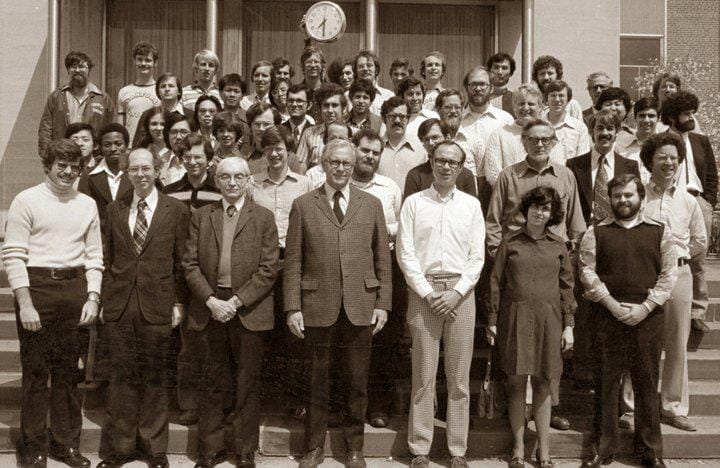
Here are the Princeton PhD group of 1980. I’m the hairy bearded fellow at right who’s looking the wrong way. My thesis advisor, Ernest Johnson is the suited fellow just left of center. Dave Ollis is in front of me, and Joe Calo is in front of him, etc. Visit my Facebook page to see how my friends tagged themselves. 35 years ago!
Princeton Chemical Engineering Grad-students, late 1970s. My thesis advisor is the tall fellow at center; I'm the bearded fellow at right looking the wrong way.

Princeton Chemical Engineering Grad-students, late 1970s. My thesis advisor is the tall fellow at center; I’m the bearded fellow at right looking the wrong way.

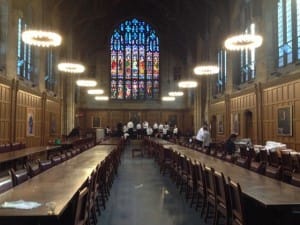
The dining room, and my room at the Princeton Grad College.

I took these pictures at reunions this year 2012; the first shot is the dining room at the Princeton Grad college. They favored robes for formal dinners when I started; the fellows in white are waiters– and we had stewards to help clean up our rooms. (Mine knew Einstein). The second photo shows the courtyard looking towards two of my dorm rooms. One year I was in the second floor room at left with the bay window. One year in the second floor room at upper right (barely visible).

GC dining 2 my dormroom

And here is the Grad Tower — Otherwise known as “Cleveland Tower” to honor Princeton alumnus, Grover Cleveland, and here’s the fireplace in the dining room. Reminds one of The School of Witchcraft and Wizardry, in that book by JK Rowling– Boar-scabs, I think. The motto: bonus entra, melior exi: good coming, better leaving.

Grad tower  GC dining fireplace

Here’s my PhD class; at first glance, you would not think we belong.

Robert Buxbaum, June, 2012