Category Archives: war

Everett, the better reviewed Gettysburg speaker

Lincoln’s election was greeted with horror by the educated classes who considered him a western rube. “Honest Ape” he was called in the press. Horace Greeley couldn’t stand him, and blamed the civil war on his reckless speech. Continuing their view that the press is never wrong, Lincoln’s Gettysburg address, November 17, 1863 was given very poor reviews, see my essay on why.

But the press wasn’t all bitterness and gall. A two-hour speech earlier that day by Edward Everett, was a hit with those who’d travelled, some hundreds of miles to hear it. Everett’s showed he was educated and understood the dire situation and causes of the battle. And he presents the conflict in a classical context, as a continuation of Roman and Greek conflicts. Here follows the beginning and end of his two hour address.

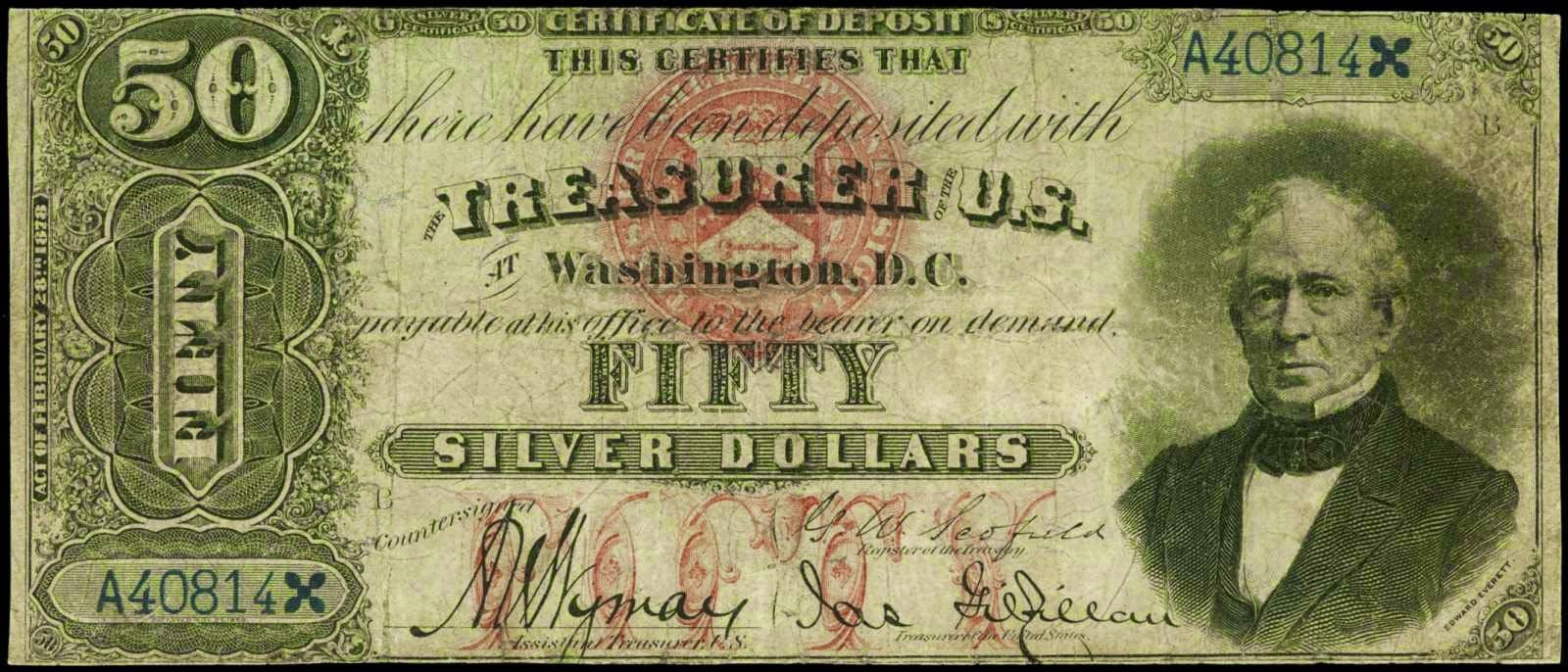
Edward Everett on the Fifty dollar silver certificate.

For nearly fifty years, Edward Everett’s face graced the Fifty dollar silver certificate. Now the world little notes, nor long remembers him. So passes glory.

[1] STANDING beneath this serene sky, overlooking these broad fields now reposing from the labors of the waning year, the mighty Alleghenies dimly towering before us, the graves of our brethren beneath our feet, it is with hesitation that I raise my poor voice to break the eloquent silence of God and Nature. But the duty to which you have called me must be performed;–grant me, I pray you, your indulgence and your sympathy.

[2] It was appointed by law in Athens, that the obsequies of the citizens who fell in battle should be performed at the public expense, and in the most honorable manner. Their bones were carefully gathered up from the funeral pyre where their bodies were consumed, and brought home to the city. There, for three days before the interment, they lay in state, beneath tents of honor, to receive the votive offerings of friends and relatives,–flowers, weapons, precious ornaments, painted vases (wonders of art, which after two thousand years adorn the museums of modern Europe),–the last tributes of surviving affection. Ten coffins of funereal cypress received the honorable deposit, one for each of the tribes of the city, and an eleventh in memory of the unrecognized, but not therefore unhonored, dead, and of those whose remains could not be recovered. On the fourth day the mournful procession was formed: mothers, wives, sisters, daughters, led the way, and to them it was permitted by the simplicity of ancient manners to utter aloud their lamentations for the beloved and the lost; the male relatives and friends of the deceased followed; citizens and strangers closed the train. Thus marshalled, they moved to the place of interment in that famous Ceramicus, the most beautiful suburb of Athens, which had been adorned by Cimon, the son of Miltiades, with walks and fountains and columns,–whose groves were filled with altars, shrines, and temples,–whose gardens were kept forever green by the streams from the neighboring hills, and shaded with the trees sacred to Minerva and coeval with the foundation of the city,–whose circuit enclosed

“the olive grove of Academe,
Plato’s retirement, where the Attic bird
Trilled his thick-warbled note the summer long,”–

whose pathways gleamed with the monuments of the illustrious dead, the work of the most consummate masters that ever gave life to marble. There, beneath the overarching plane-trees, upon a lofty stage erected for the purpose, it was ordained that a funeral oration should be pronounced by some citizen of Athens, in the presence of the assembled multitude.

[3] Such were the tokens of respect required to be paid at Athens to the memory of those who had fallen in the cause of their country. For those alone who fell at Marathon a peculiar honor was reserved. As the battle fought upon that immortal field was distinguished from all others in Grecian history for its influence over the fortunes of Hellas,–as it depended upon the event of that day whether Greece should live, a glory and a light to all coming time, or should expire, like the meteor of a moment; so the honors awarded to its martyr-heroes were such as were bestowed by Athens on no other occasion. They alone of all her sons were entombed upon the spot which they had forever rendered famous. Their names were inscribed upon ten pillars erected upon the monumental tumulus which covered their ashes (where, after six hundred years, they were read by the traveller Pausanias), and although the columns, beneath the hand of time and barbaric violence, have long since disappeared, the venerable mound still marks the spot where they fought and fell,–

“That battle-field where Persia’s victim-horde
First bowed beneath the brunt of Hellas’ sword.”

[4] And shall I, fellow-citizens, who, after an interval of twenty-three centuries, a youthful pilgrim from the world unknown to ancient Greece, have wandered over that illustrious plain, ready to put off the shoes from off my feet, as one that stands on holy ground,–who have gazed with respectful emotion on the mound which still protects the dust of those who rolled back the tide of Persian invasion, and rescued the land of popular liberty, of letters, and of arts, from the ruthless foe,–stand unmoved over the graves of our dear brethren, who so lately, on three of those all-important days which decide a nation’s history,–days on whose issue it depended whether this august republican Union, founded by some of the wisest statesmen that ever lived, cemented with the blood of some of the purest patriots that ever died, should perish or endure,–rolled back the tide of an invasion, not less unprovoked, not less ruthless, than that which came to plant the dark banner of Asiatic despotism and slavery on the free soil of Greece? Heaven forbid! And could I prove so insensible to every prompting of patriotic duty and affection, not only would you, fellow-citizens, gathered many of you from distant States, who have come to take part in these pious offices of gratitude,–you, respected fathers, brethren, matrons, sisters, who surround me,–cry out for shame, but the forms of brave and patriotic men who fill these honored graves would heave with indignation beneath the sod.

[5] We have assembled, friends, fellow-citizens, at the invitation of the Executive of the great central State of Pennsylvania, seconded by the Governors of seventeen other loyal States of the Union, to pay the last tribute of respect to the brave men who, in the hard-fought battles of the first, second, and third days of July last, laid down their lives for the country on these hillsides and the plains before us, and whose remains have been gathered into the cemetery which we consecrate this day. As my eye ranges over the fields whose sods were so lately moistened by the blood of gallant and loyal men, I feel, as never before, how truly it was said of old that it is sweet and becoming to die for one’s country. I feel, as never before, how justly, from the dawn of history to the present time, men have paid the homage of their gratitude and admiration to the memory of those who nobly sacrifice their lives, that their fellow-men may live in safety and in honor. And if this tribute were ever due, to whom could it be more justly paid than to those whose last resting-place we this day commend to the blessing of Heaven and of men?

………………………………….. The speech went on for 58 sections of more-or-less this size and ends by mentioning the achievements of the other union armies and navy saying, “But they, I am sure, will join us in saying, as we bid farewell to the dust of these martyr-heroes, that wheresoever throughout the civilized world the accounts of this great warfare are read, and down to the latest period of recorded time, in the glorious annals of our common country there will be no brighter page than that which relates THE BATTLES OF GETTYSBURG.”

_____________________________________________________________________

I find it long-winded and boring, but the crowd thought this speech wonderful. As grand as Lincoln’s 2 minute coda was plain. Part of the draw of Edward Everett was his cultured demeanor and his wide classical knowledge —  a big contrast to Lincoln. Everett had been president of Harvard, and had been a senator, a congressman, governor of Massachusetts, Secretary of State, and US Ambassador to Great Britain. Lincoln had been a country lawyer and one-term congressman. When states started succeeding, Everett had been the one called on to negotiate a compromise that delayed war until the firing on fort Sumter. All impressive in the day, now mostly forgotten glories. Today, many of his lines ring hollow today, e.g.  ” … that it is sweet and becoming to die for one’s country.” It just sounds weird to my ears. And the classic allusions sound pointless. By the early 20th century, most public pinion had changed; people decided that Lincoln’s was the better presentation, a monument to the spirit of man. The world remembers Lincoln fondly, but little notes, nor long remembers Everett, nor what he said there. The lesson: do not judge hastily. All things exist only in the context of time.

Robert E. Buxbaum, November 14, 2016. A week ago, Tuesday, our nation elected Donald Trump as 45th President of the United States, an individual as disliked and divisive as any since Lincoln. I do not know if he will prove to be honored or hated. There are demonstrations daily to remove him or overthrow the election. There are calls for succession, as when Lincoln took office. At Hampshire college, the flag was lowered in mourning. It’s possible that Trump is as offensive and unqualified as they say– but it is also possible that history will judge him otherwise in time. They did Lincoln.

Lessons of WWI: remove aristocrats and beards

Tzar Nicholas II and King George V.

Tzar Nicholas II and King George V, cousins and allies.

When I was a kid, Veterans day was called Armistice day. It marked the end of WWI. As many people died on all sides (there were many shifting alliances), it’s worthwhile asking what we’ve learned. The main thing, I think, is that aristocrats suck, both hereditary aristocrats, and the aristocrats of thought. Europe entered a world war for no big reason: small gains of land and status gains for a few aristocrats, generals, and thinkers at the top of society. These saw an opportunity to get medals and prove they could lead men in battle. The mass of Europeans cheered for war (see photo below, right) and followed them in battle. Millions were sent running at machine guns and poison gas. Most died, Those who survived returned home feeling less enthused about the ignorant, arrogant hereditary aristocrats, but still honored the generals and thinkers. They executed Tzar Nicolas of Russia and greatly reduce the power of the kings of England, Belgium, Turkey, Holland, and Austria. The thinkers inherited that power, but dropped the monarch’s face hair.

Emperor Franz Joseph

Emperor Franz Joseph II

mehmedv

Calif Mohammet V

Before WWI, virtually all of Europe was ruled by king; generally bearded kings who were believed to rule by divine right, as the will of God. The king generally had aid of a republican congress, a large aristocracy — counts, dukes, marchese, and earls, and the academic élite — professors and generals. All of these avoided association with the masses, except for show, all spent lavishly, and all maneuvered for power. By the end of WWI, no king in Europe retained real power, and the hereditary aristocrats discredited, power went to the intellectual aristocrats, where it resides today: generals, professors, newspapermen, novelists, generally mustached and modern. In 20 years or so, the new aristocrats would bring on WWII, in part because of a fear of war. Their wisdom proved to be little better than the old, but it is hard to say it was worse. The main lessons learned: avoid beards and aristocrats.

Brittains unified and cheering for the start of WWI

Britains unified and cheering for the start of WWI

In his book, “Diplomacy”, Henry Kissinger draws a few more lessons from the Great War. A major one is that balance of power works: it worked for the 100 years until WWI. Another lesson he draws: don’t let mutual defense treaties kick in until an actual invasion has begun: until troops actually cross the border. He blames hair trigger treaties for much of the trouble of WWI. His book is a good read, though, if only as a background his diplomatic approaches.

I write about WWI because of today is Veterans day, and also because two days ago we elected Donald Trump president of the US in a bitterly divisive election. Trump claims he wants “to drain the swamp,” a claim I take to mean that he intends to diminish the power of the intellectual aristocracy, the generals, writers, professors and politicians who think together, vacation together, club together, and control what it means to be educated. The Washington Post calls this removal a threat to western civilization; it removes the intelligentsia, and replaces it with racist boobs, or so they see Trump’s crew. There were anti election demonstrations in Boston, New York, Oakland, Austin, and Detroit. Upon election news a movement was started to impeach Trump, or get him to step down on claims that he stole the election. Officials of Hampshire college lowered the flag to half mast as a sign of mourning for our democracy. These acts of dissent are as heartfelt a reaction as the widespread approval that greeted WWI. I can hope the outcome is better.

For what it’s worth, I do not believe the supporters of Trump are as angry, or as stupid as portrayed: half a basketball of deplorables and irredeemables, the other half needing re-education (to borrow from Ms Clinton). These are the people who fight our wars, and I suspect we’ll be somewhat better off for giving them a voice. As for veterans day, honor the poor blokes who fought for our folly.

Robert E. Buxbaum, November 10, 2016.

1939, when East and West became friends and partners

Forward Marx

The large mustache, Soviet Socialist it seems is very much like his neighbor, the small mustache, National Socialist.

In August, 1939, just about 77 years ago to the day, Germany and the Soviet union signed a non-aggression pact — The Molotov von Ribbentrop agreement. The open text suggested peace, but there was a secret rider that was made widely available. The large mustache soviet socialist and the small mustache national socialist had divided up the land between them. “In case there was war,” Russia would get Lithuania, Finland, Eastern Poland, and Bessarabia (Northern Romania). Germany would get Denmark, Western Poland, and Greece.

Commemoration of the Soviet -German non-aggression pact, August 1939.

Commemoration of the Soviet – German non-aggression pact, August 1939.

Up till then, we in the US assumed that these nations were bitter enemies and that their enmity would protect us. It turned out they were friends, or at least that they had the common goal of conquest and domination. Both were socialists in the sense that they did not respect the property rights of their neighbors. In the cartoon at right, Uncle Sam is standing on the battlements, looking stupid, holding his useless umbrella (The League of Nations? US foreign policy?). The title, “Watchman, What of the Night.” Is from Isaiah. In August, 1939 night was most definitely coming along with a combined storm of aggression from Germany and the USSR.

I’m posting this as a reminder that East and West are more similar than is generally believed. That left and right too are often useless distinctions. That folks will generally seek their own advantage over philosophical purity, and over the advantage of the US. Internationalism, thus, is not a panacea for peace. Generally speaking, I suspect that Flavius’s dictum still applies: “if you wish for peace, prepare for war.” Also, I had these great cartoons, courtesy of my friend, Jim Wald.

Robert Buxbaum, August 25, 2016. People often forget/ ignore that the USSR started its part of WWII by invading Finland and Poland. Finland resisted invasion a lot better than Poland. So well that, when Germany broke the agreement and Russia became our friend, Finland became our enemy– sort-of. They were still fighting Russia. And, in the East, Russia remained an ally of Japan for another year, even briefly after Japan attacked Pearl Harbor. This made sending aid to Russia problematic, though Roosevelt did it. I’ve written about WWII in terms of mustaches because, to me, it makes as much sense as anything, and more sense than east vs west.

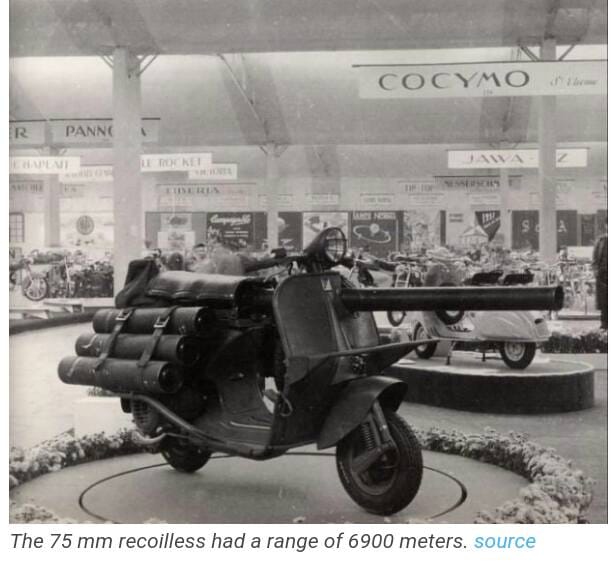
More French engineering, the Blitzkrieg motorcycle.

There’s something fascinating that I find in French engineering. I wrote a previous essay about French cars, bridges, and the Eiffel tower. Here’s a picture or two more. Things I wanted to include but didn’t. First here’s a Blitzkrieg Vespa motorcycle; the French built some 800 of these from 1947 to 1962 and used them in Vietnam and Algeria. What’s remarkable is how bizarrely light and unprotected it is. It’s a design aesthetic that follows no one, and that American engineers would not follow.

French Blitzkrieg Vespa used in Vietnam

French Blitzkrieg Vespa used in Vietnam; cannon range is 4.5 miles.

The key engineering insight that allows this vehicle to make sense is that recoil-less rifles are really recoil-less if you design them right. Thus, one can (in theory) mount them on something really light, like a Vespa. Another key (French) insight is that a larger vehicle may make the soldier more vulnerable rather than less by slowing him down and by requiring more gasoline and commissariat services.

Americans do understand the idea of light and mobile, but an American engineers idea of this is a jeep or an armored truck; not a Vespa. From my US engineering perspective, the French went way overboard here. The French copy no one, and no one copies the French, as they say. Still, these things must have worked reasonably well or they would not have made 800 of them over 15 years. A Vespa is certainly cheaper than a Jeep, and easier to transport to the battle zone….

Robert Buxbaum, February 18, 2016. The Italians have a somewhat similar design aesthetic to the French: they like light and cheap, but also like maneuverable and favor new technology. See my blog about a favorite Fiat engine.

Comic Colonialism II: of Busbys and Bear Skins.

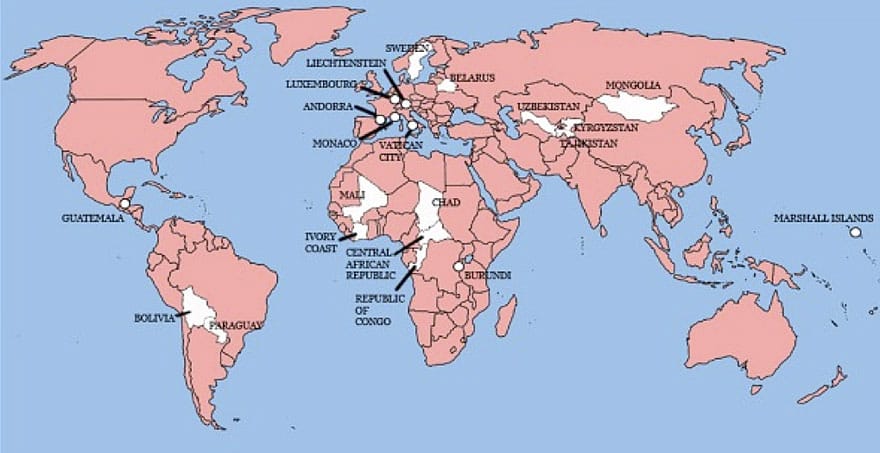
The map below shows, in white, all the countries that England has not invaded.

The white spots on this map are the countries that England has not invaded.

The white spots on this map are the countries that England has not invaded.

England now controls virtually none of these countries. In most of these, English is the national language, or the language of business, and defeating the British is hailed as the central national experience. Still, many have opted to become part of the British Commonwealth, a loose organization of ex-British states. Generally this requires agreeing to the rule of the Queen, despite having nominally free states. Entering Canada, for example, one finds a picture of Elisabeth II, Queen of Canada, And there are royal colleges where inventions belong to her. The same with Australia and New Zealand. The question to ask, then, the question despots have asked, is how did the English manage it –or perhaps, how can I extend my despotism the same way. Part of the answer, it seems to me, is that England used tall, silly hats: Busbys and Bearskins.

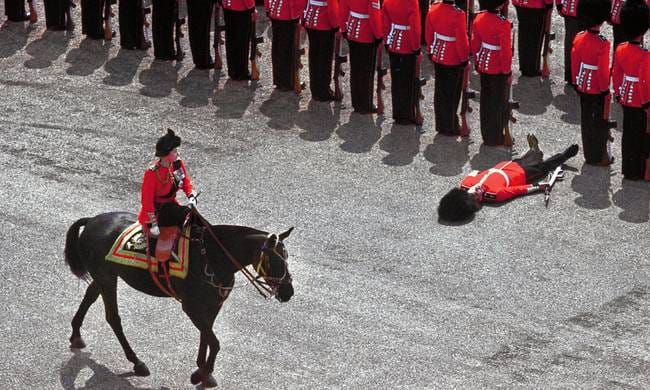
The Queen of Canada reviews her troops. She's wearing a Busby; he's in a bearskin.

The Queen of Canada reviews her troops. She’s wearing a Busby; he’s in a bearskin.

The Bearskin hat is perhaps the silliest hat in worldwide military use, and certainly the largest. The bearskin is made of the complete skin of a black or a brown (grisly) bear dyed black, The skin is shaped over a wicker frame to stand 16″ tall (a black bear skin is used for enlisted men, and a grisly bear for officers). It is heavy, quite fuzzy, and completely non-aerodynamic and protects the head not at all. As best American military experts have found, it only makes the person wearing it a better target for being shot. And yet, Britons have striven to be given the honor of wearing this thing. There is also a slightly shorter, slightly fuzzier version of the Bearskin worn by officers. It’s called a Busby, and it’s made from beaver skin. Even in this day of social correctness, skins are found for this use, and “harvested”, mostly in Canada.

The front-line British soldiers in the American Revolution wore these hats when they marched in ranks to attack the colonials at Lexington and Concord, and again at Bunker Hill, and again, in the war of 1812 at New Orleans. It made them slow, impressive, and dead. Because of their weight, these hats are often worn with a leather collar to help support them. The collar makes it hard for soldiers to look down, a plus for soldiers on parade, but a minus when walking over uneven ground, e.g. when attacking Bunker Hill. You’d think the British would have given up on these weird hats long ago, but the British won in many conflicts and have come to dominate many countries. They seem to credit the hat, I’m beginning to think it deserves more attention than it’s gotten.

The hat they wore through the war of 1812, through the Crimean war and the Boer war; in the heat of the Indian revolts, in Africa, and to this day for show makes British soldiers look taller, and more elegant. It makes them stand straighter than most, and gives guards an other-worldly appearance. American soldiers uniformly reminisced how hard it was to shoot someone who marched so elegantly. The Queen likes them, and she, after all is nothing if not elegant. Perhaps the unworldly elegance of the bearskin give soldiers the courage to invade countries and die in the name of a sovereign who reigns by Devine right as expressed through the sword Excalibur ‘of pure Semite’, whatever that is. It’s a story that not one adult Britain believes, yet they die for (why?) Perhaps it’s the honor of mass craziness. Perhaps, because they see simple folks are impressed by soldiers wearing the tall funny hats (I guess thats why some US marching bands use them). And then again, it might be pure luck, superstition, and stupidity. The method of science would be to ask if other countries or team bands do better while wearing the silly hats. I suspect not, but it deserves statistical analysis.

Robert Buxbaum, March 30, 2016. Comic colonialism 1 dealt with the mistakes leading to the US capture of Guam. Catch also my essays, the greatest blunders of the US revolution, and mustaches and WWII: similar mustaches foreshadow stable alliances.

Comic colonialism I: How the US got Guam without a fight.

America is often criticized for land it acquired by war e.g. Guam in the Spanish-American War. Though Spanish were corrupt and incompetent, and had (it seems) sunk the USS Maine by accident, the idea is that conquest is bad. Well, for better or worse, here’s how the US acquired Guam in a comic bloodless non-battle that provides an example of God laughing as he protects children, fools, and the U.S. of A.

It’s mid June, 1898, the Spanish-American War has raged for two months, and Theodore Roosevelt is in Cuba. Four ships lead by the USS Charleston leave Hawaii on a secret mission with orders to be opened only at sea. Captain Glass of the Charleston find he is to try to take Guam and destroy its fortress before proceeding to the Philippines for the major battle of the war. Glass is informed that Guam Harbor is defended Spanish warships plus a thick-walled fort housing many heavy cannon. A land assault will face, he’s told, over 1000 fighting men, dug in, heavily armed, and thoroughly familiar with the terrain. As it happens, military intelligence had vastly overstated the challenge. There are only 56 soldiers on Guam, and Span has neglected to tell the garrison that there’s a war on.

USS Charleston

The USS Charleston, victor of the non-battle of Guam.

Expecting a fierce battle, our soldiers and naval gunners practice shooting at towed targets and get excellently proficient, or so Glass believes. Fortunately, he’s wrong. On June 20, 1898, The Charleston steams into Guam’s harbor and finds no resistance. The only major ship is a Japanese trader sitting at anchor. No shots are fired, and there is no apparent activity on shore. In some confusion, Captain Glass order that 13 shots be fired at the fort. As it happens, it’s a fortuitous number. Also fortuitous, is that all the shots miss. In complete ignorance, the folks on shore think it is a 13 gun salute: that the Charleston is here for an official, state visit.

Now, the normal response would be for folks on Guam to return the 13 gun salute. If they had, it would have likely begun a cycle of death and destruction. But God is the protector of fools, and the fortress is out of gunpowder. The Spanish send an officer to the Charleston to ask for gunpowder and apologize for not returning the salute. After what must have been a most uncomfortable parlé, it is agreed that our nations were at war; that the officer was now a captured prisoner; and that he is being released to request surrender.

Coins celebrating our colonial territories.

Coins celebrating our colonial territories. None have senators or congressmen. Only DC gets to vote for president, a result of the 23rd amendment, 1961.

As soon as he is sent off, captain Glass begins to worry: maybe this is a trap. Maybe the guns are now focussed on him and his men? Maybe he should resume fire on the fort! Right about then, a friendly whaleboat sails by flying the American flag. It’s captained by Francisco “Frank”Portusach-Martinez from Chicago, an old friend of an officer aboard the Charleston. Captain Portusach comes on board, shows his US bona-fides, and explains that it’s no trap, just ignorance. Taking his advice, Captain Glass lands with a small party, arrests all 56 soldiers without a fight, and raises the American flag. The Star Spangled Banner is played, and Glass doesn’t quite know what to do next. What would you do in his shoes?

Captain Henry Glass

Captain Henry Glass, man with a mustache.

Having no experience or other orders, Captain Glass appoints Portusach as the first US Governor of Guam, and leaves to join Dewey in the Philippines. He does not destroy the fort as he finds it in such poor repair that he can claim it’s already destroyed. And that’s how we got Guam. Credit to Captain Glass for not screwing things up or angering the locals needlessly. One hundred and eighteen years later, Guam is still a US territory, though there have been movements for statehood, for union with Hawaii, and for independence. Until the folks on Guam decide otherwise, they are US citizens, but can not vote for president or have representation in congress. They pay federal income taxes, but not state taxes. Bill Clinton is the only US president to ever visit Guam.

Dr. Robert E. Buxbaum. February 1, 2016. I’ve written previously on the ways of peace, and on what makes a country, and on beards: why only communists and Republicans have them. Stay tuned for “Comic Colonialism II: Canada’s Queen.”

A day of thanksgiving during the civil war

At the height of the civil war, Abraham Lincoln proclaimed a day of thanksgiving for the last Thursday of November, 1863. It’s the first time Thanksgiving was proclaimed for the date we now keep every year. The war was not going well. The Union defeat at Chickamauga, Sept. 19-20 1863, left 35,000 dead, the bloodiest two days in US history. Most citizens would have called for a day of fasting and prayer, but in Lincoln’s view, things were good, and there was a need for joy and thanksgiving:

“to thank the Almighty God” …for.. “the blessings of fruitful fields and healthful skies… “for peace that…. “has been preserved with all nations.” [That] “harmony has prevailed everywhere except in the theatre of military conflict….  “a day of Thanksgiving and Praise to our beneficent Father who dwelleth in the Heavens”…. and for … “the care all those who have become widows, orphans, mourners or sufferers in the lamentable civil strife.”  (see the whole proclamation here.)

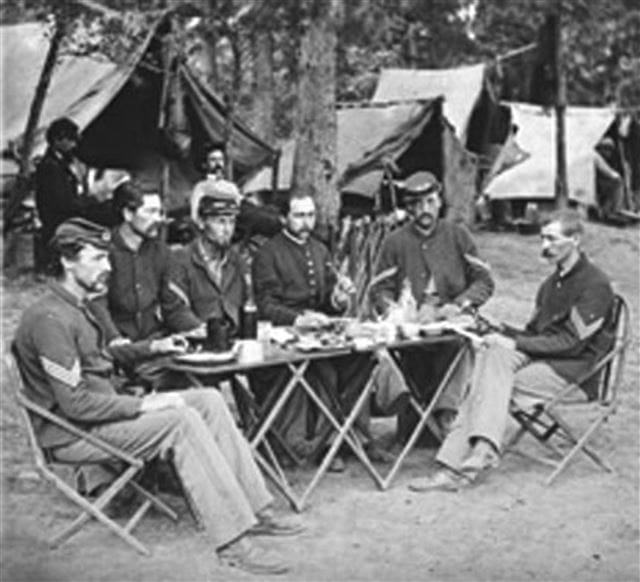
A Civil War Thanksgiving. It's fellowship that makes peace possible.

A Civil War Thanksgiving. It’s fellowship that makes peace possible.

His was an interesting view, as important then as now. There is a need to remember that the good we have is more than the bad, and that there is a source of the good. As of today (2015) the economy is good in Michigan and the US. We are at peace with our neighbors and have civil obedience in our streets; we have food on our tables and clothes on our backs. We have cleaner air and cleaner water than in decades, blue skies, and plentiful rain. The ozone hole has shrunk, and global warming seems to have stopped. We have so much food that hardly anyone in our country suffers starvation, but only the hunger for finer, fancy things. We have roads without bandits, lighting at the flip of a switch, water at the turn of a tap, indoor heat, and (for most) indoor cooling in the summer. We have telephone communication, and radio, and television, and music at our fingertips. We have libraries with books, and free childhood education. We have a voice in our government, and information from the far ends of the earth. All these call for joy and thanksgiving.

And we can even find a cause for thanks in the things we don’t have: space travel and the diseases we can’t cure, for example. The things we don’t have provide a reason to wake up in the morning, and a motivation to do great things. We live in a country where we can change things, and it’s nice to know there are things worth changing. For ideas that lack expression, we can provide it. For diseases, we can still search for a cure. For those who lack happiness and friendship, we can help provide both (a joyful celebration is a good occasion to do so). For those who lack a job, we can help. And to those who feel a lack of meaning in life, perhaps the best answer is a celebration to explore the source of all blessings. Let us reach out to “all those who have become widows, orphans, mourners or sufferers.” A lesson Scrooge learned from the ghosts is that joy and generous celebration are self-sustaining and attractive. Let joy and good fellowship extend to all. God Bless us each and every one.

Robert Buxbaum, Detroit, November 18, 2015, The anniversary of Lincoln’s Gettysburg address is tomorrow, Nov. 19th (it wasn’t well received). As for Black Friday shopping, lets not get up from the table of thanks to jostle each other for some useless trinket.

Sept. 11, 1683: Army of Islam attacks Vienna.

In the US, September 11 is mostly known for the 2001 attacks on the World Trade Center and the Pentagon. But to the wider world wide, I think it’s mostly known for the Battle of Vienna, the high-water mark of many battles where army of Islam tried to take over the ‘corrupt’ western world, the Dar al-Harab. This is not the first time that Islamic armies tried to make Vienna part of the world of Islāmic peace, the Dar al-Islam. Suleiman the Magnificent had tried unsuccessfully in 1526. In 1682, Caliph Mohamed IV set out to do what Suleiman had not. He broke the Treaty of Vasvár, and collected an army of 150,000 under the generalship of his Grand Vizier, Kara Mustafa Pasha.

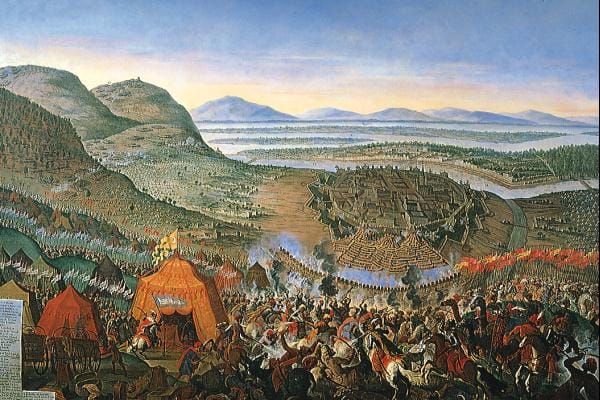
The forces of Mohamet IV surround Vienna, September 11, 1683.

The forces of the Caliph surround Vienna, the city of good wine, September, 1683.

Mohamed IV’s army spent a year on the march to Vienna. On the way, they conquered or subdued Rumania, Bulgaria, Serbia, Croatia, and Hungary. But the western leaders did not sit idly by. Emperor Leopold I and Charles V, Duke of Lorraine left Vienna to be defended by only 24,000 under command of Ernst Rüdiger von Starhemberg. Meanwhile, they scoured Europe for allies. By the time Kara Mustafa army arrived, July 14 1883, Leopold had gotten a pledge of financial support from the pope, and a mutual defense treaty with the Polish-Lithuanians, and with Saxony, Baden, Bavaria, Swabia and Franconia. it was good work, but none of these armies were at Vienna yet.

Fortunately (for Vienna), Kara Mustafa did not attack immediately but instead laid siege to the city, and to nearby Perchtoldsdorf (Petersdorf). Perchtoldsdorf surrendered, and Kara Mustafa massacred the entire Christian population who did not convert, some 30,000 people in the city square, and took their booty. This move did nothing to encourage a Viennese surrender. It took until September, 1683 for the armies of Leopold, Charles V, and John III Sobieski (Poland) to arrive. Kara Mustafa finally attacked on September 11, but it was too late. In the counter attack, his Islamic army was defeated. Kara Mustafa was put to death by the caliph for his failure to take Vienna (I guess he won’t make that mistake again).

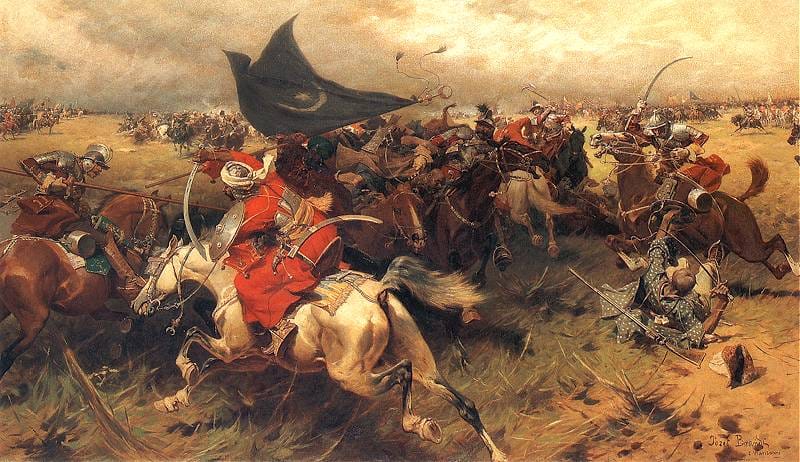
Cavalry fighting at the Battle of Vienna, 1683

The Polish cavalry at the Battle of Vienna, 1683

The loss at Vienna was the beginning of a long retreat for Mohamed IV and for Islam. Hapsburg rulers captured Romania, Bulgaria, and Hungary; Russia conquered the Ukraine from the Mongol-Tartars (the Golden Hoard). The victorious Viennese established a feast day for September 11, the Day of the Holy Name, and created a crescent-shaped sweet roll in the shape of the Moslem crescent as a remembrance. In France, these crescent rolls are called “Viennoise.”

I suspect that many believing Moslems find the breads and holiday offensive, as they believe Vienna is, by right part of the Dar al-Islam. My guess is that this is why Osama bin Laden picked September 11. Osama had traveled in Europe as a teen, and his bookshelf included titles suggesting he would have known about the date, e.g. , “The Rise and Fall of the Great Powers (Paul Kennedy)”. I note that the US embassy in Benghazi, was attacked September 11 (2012). Perhaps this was similar revenge on the earlier Sept 11’s, and not, as Ms Clinton claims, a response to a Jewish-made, Hollywood film.

It seems clear that not every Islāmic leader understands the obligation to conquer the Dar al Harab as one of armies, swords, and bombs. In the last year, the Iranian leader, Ayatollah Ali Khamenei has explained that his slogan, “Death to America,” does not mean death to the American people, but “death to U.S. policies and arrogance.” He claims this struggle is “backed by the reason and wisdom,” of the Koran.

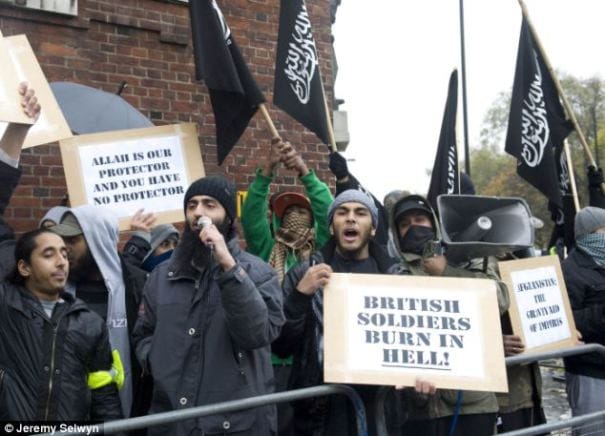
"Muslims against Crusaders" chanting during the two minutes of Remembrance Day (Armistice Day) silence, 2010.

“Muslims against Crusaders” chanting during the two minutes of Remembrance Day (Armistice Day) silence, 2010, “Our soldiers are in paradise, yours burn in Hell.”

As I understand it, The Ayatollah is saying that aim of the Iran’s missiles and atom bomb program is our benefit: to save us from Hell, and make our countries part of the Dar al Islam, the Moslem world of peace. Even at our best, our infidel Dar al-Harab is considered evil because of our arrogance and independence. We compete with each other in a world of chaotic commerce. As they see it, each infidel tries to wrest wealth from his fellow in an economic struggle that can only be ended by Caliphate-control that must include Iraq, Saudi Arabia, and Israel.

The Ayatollah does not mention that the Dar al-Islam has been in turmoil for the last 1000 years but perhaps acknowledges it in private as a slight embarrassment. To me, it seems more like Aesop’s fable of the toad physician who claimed he could heal everyone, but could not heal himself. I note that many other religions have the same jaundiced view of commerce, and have fought over it. Many Islamic thinkers find this to be a flaw in Christianity, and they are right. All major religions, it seems, claim to seek peace, and claim to love their fellows as themselves. They then go on to enforce this peace and love by killing.

If you find errors in my thinking, please tell me; I’m an engineer, not a historian or a theologian. I know enough Hebrew/Aramaic to know what the above phrases mean, and boost my claim by the public comments of the Ayatollah, who I take to be a spokesperson for practical Isalm.  In case you have not guessed, I think that a world of economic chaos is  better, and more satisfying, than any world of statist religious rule. I’d say that G-d likes entropy in all its forms, and that chaos is a gift of God, producing an odd stability.

Robert E. Buxbaum, Friday, November 13, 2015.

Why I don’t like the Iran deal

Treaties, I suspect, do not exist to create love between nations, but rather to preserve, in mummified form, the love that once existed between leaders. They are useful for display, and as a guide to the future, their main purpose is to allow a politician to help his friends while casting blame on someone else when problems show up. In the case of the US Iran-deal that seems certain to pass in a day or two with only Democratic-party support, and little popular support, I see no love between the nations. On a depressingly regular basis, Iranian leaders promise Death to America, and Death to America’s sometime-ally Israel. Iran has acted on these statements too, funding Hezbollah missiles and suicide bombers, and hanging its dissidents: practices that lead it to become something of a pariah among its neighbors. They also display the sort of nuclear factories and ICBMs (long-range rockets) that could make them much bigger threats if they choose to become bigger threats. The deal just signed by US Secretary of State and his counterpart in Iran (read in full here) seems to preserve this state. It releases to Iran $100,000,000,000 to $150,000,000,000 that it claims it will use against Israel, and Iran claims to have no interest in developing multi-point compression atom bombs. This is a tiny concession given that our atom bomb at Hiroshima was single-point compression, first generation, and killed 90,000 people.

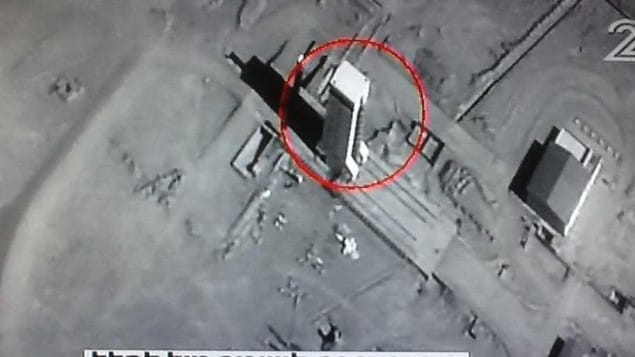
Iranian intercontinental ballistic missile, several stories high, brought out during negotiations. Should easily deliver nuclear weapons far beyond Israel, and even to the USA.

Iranian intercontinental ballistic missile, new for 2015. Should easily deliver warheads far beyond Israel -even to the US.

The deal itself is about 170 pages long and semi-legalistic, but I found it easy to read. The print is large, Iran has few obligations, and the last 100 pages or so are a list companies that will no longer be sanctioned. The treaty asserts that we will defend Iran against attacks including military and cyber attacks, and sabotage –presumably from Israel, but gives no specifics. Also we are to help them with oil, naval, and fusion technology, while leaving them with 1500 kg of 20% enriched U235. That’s enough for quick conversion to 8 to 10 Hiroshima-size A-bombs (atom bombs) containing 25-30 kg each of 90% U235. The argument in favor of the bill seems to be that, by giving Iran the money and technology, and agreeing with their plans, Iran will come to like us. My sense is that this is wishful-thinking, and unlikely (as Jimmy Carter discovered). The unwritten contract isn’t worth the paper it’s written on.

As currently written, Iran does not recognize Israel’s right to exist. To the contrary, John Kerry has stated that a likely consequence is further attacks on Israel. Given Hezbollah’s current military budget is only about $150,000,000 and Hamas’s only about $15,000,000 (virtually all from Iran), we can expect a very significant increase in attacks once the money is released — unless Iran’s leaders prove to be cheapskates or traitors to their own revolution (unlikely). Given our president’s and Ms Clinton’s comments against Zionist racism, I assume that they hope to cow Israel into being less militant and less racist, i.e. less Jewish. I doubt it, but you never know. I also expect an arms race in the middle east to result. As for Iran’s statements that they seek to kill every Jew and wipe out the great satan, the USA: our leaders may come to regret hat they ignore such statements. I guess they hope that none of their friends or relatives will be among those killed.

Kerry on why we give Iran the ability to self-inspect.

Kerry on why we give Iran the ability to self-inspect.

I’d now like to turn to fusion technology, an area I know better than most. Nowhere does the treaty say what Iran will do with nuclear fusion technology, but it specifies we are to provide it, and there seem to be only two possibilities of what they might do with it: (1) Build a controlled fusion reactor like the TFTR at Princeton — a very complex, expensive option, or (2) develop a hydrogen fusion bomb of the sort that vaporized the island of Bimini: an H-bomb. I suspect Iran means to do the latter, while I imagine that, John Kerry is thinking the former. Controlled fusion is very difficult; uncontrolled fusion is a lot easier. With a little thought, you’ll see how to build a decent H-bomb.

My speculation of why Iran would want to make an H-bomb is this: they may not trust their A-bombs to win a war with Israel. As things stand, their A-bomb scientists are unlikely to coax more than 25 to 100 kilotons of explosive power out of each bomb, perhaps double that of Hiroshima and Nagasaki. But our WWII bombs “only” killed 70,000 to 90,000 people each, even with the radiation deaths. Used against Israel, such bombs could level the core of Jerusalem or Tel Aviv. But most Israelis would survive, and they would strike back, hard.

To beat the Israelis, you’d need a Megaton-size, hydrogen bomb. Just one Megaton bomb would vaporize Jerusalem and it’s suburbs, kill a million inhabitants at a shot, level the hills, vaporize the artifacts in the jewish museum, and destroy anything we now associate with Israel. If Iran did that, while retaining a second bomb for Tel-Aviv, it is quite possible Israel would surrender. As for our aim, perhaps we hope Iran will attack Israel and leave us alone. Very bright people pushed for WWI on hopes like this.

Robert E. Buxbaum. September 9, 2015. Here’s a thought about why peace in the middle east is so hard to achieve,

Winning at Bunker Hill lost America for Britain.

The greatest single victory of the American Revolution in terms of British soldiers killed or wounded was the battle of Bunker Hill. It was won without global strategy, or any real sense of victory. The British captured the hill but their loss of soldiers and reputation was such that one can echo British General, George Clinton’s comment: “A few more such victories would have shortly put an end to British dominion in America.” How the British came to blunder this way is a lesson in group-think management; it lead to the destruction of an army of the finest soldiers on earth by a band of untrained, leader-less rabble.

A map of metropolitan Boston in May 1775 shows that it was already a major port with far less dry land than it has today. It consisted of a knob-hill peninsula, British-controlled Boston city, cut off from the rest of the colonies except for one narrow road, called “The Neck,” or The Roxbury Neck. The later name was used to distinguish it from a similar neck road that connected the colonies to nearby Charlestown peninsula; Bunker Hill is on Charlestown peninsula. Following the rumpus battles of Lexington and Concord, Boston’s suburbs were over-filled by 15,000, ill-clad, undisciplined colonials who ate, drank, and shot at random stuff in plain view of Boston’s 6000 trained soldiers and four Generals. The Colonials set up barriers and cannon at their end of the Neck road. These were not particularly good barriers, and the British army could leave at any time by the neck to control of the colonies, but only at a cost in men. This potential cost  kept rising as more colonials came to camp around Boston. What would you do?

The British had sea-power that they felt they could use: excellent ships and excellent admirals; the colonies had neither. The British navy could attack anywhere on the American coast, but only at a risk of further alienating the colonials. They thus used their power judicially. E.g., for the attack on Lexington, April ’75, navy ships took the 2000 soldiers from Boston, landing them at Charlestown, at the foot of Breed’s hill. The army then marched out over the Charlestown neck to Lexington and Concord, but not to a smashing success. Many soldiers lost their lives, and not much was captured.

Back in Boston, the four British generals: Gage, Burgoyne, Howe, and Clinton, decided that, to quash the revolt/revolution, they had to break out of Boston and quarter in Massachusetts proper, on some easily defended ground on the mainland, preferably high ground. They needed to establish a base with good connections to the rest of colonies, plus good access to the sea. Looking about, the obvious spot for this base was the heights of Dorchester, a set of hills that overlooked Boston Harbor from the south. Eventually the British would flee Boston because George Washington would capture and hold these heights. The reason the British didn’t capture the heights or at least defend them was the result of group-think ignorance, on the morning of June 17. The British changed their goals, and decided to attack at Charlestown (Breed’s Hill) instead of Dorchester. Capturing Charlestown left Britain with many dead and no good connection to the colonies; it was just another isolated peninsula barely attached to the mainland by an easily defended road.

Why did four, trained Generals attack this worthless spot instead of Dorchester? It was the luck of American disarray and mob-rule. Looking at the Colonials disarray, each of the four generals saw an opportunity for personal glory; the colonials were inept and would never improve. The same British group-think that reawakeneded in the Crimean war with Russia. The American defense of Charleston and Breeds Hill was done so incredibly poorly that the Americans were left as sitting ducks, waiting to be taken. A poor location was chosen for the fort and only 1200 Colonials came to defend it. We’d meant to build a fort on a better location, Bunker Hill, the tall hill overlooking Boston, and we’d meant to build a minor respite foxhole on Breeds hill, but we screwed up.

Our soldiers were digging  at night, fueled with much rum and little or no leadership. When the sun rose on June 17, we found that we’d built next to nothing on Bunker hill, and a vastly too-large, uselessly deep, square hole at Breed’s Hill: a doubtful redoubt. The square was open at back, and too large for the number of soldiers. It was also too deep for people to shoot out of easily. Looking with spyglasses from Boston, the British generals saw that we had no idea what we were doing. Gage and co., thought to show us the consequences of our incompetence. A few thousand British soldiers could easily take this redoubt and its 1200 defenders, and that thought clouded his mind and the minds of his fellows. They forgot that this was not a hill worth taking, and never imagined that we might fix our defenses. Even if Gage could win without a single lost man, he should have realized that a victory would leave him in a worse position than before. His forces would then be divided between two peninsulas both separated from the mainland, and separated from each other by neck-roads. Coordinating an attack from this position would be a logistic nightmare, and any one of the co-Generals should have alerted him to this.

The attack was supposed to work this way: a sea landing at Moulton's hill. two side actions, SA, at the fronts of the Colonial defenses, and a sweeping main attack, MA, at the edge.

The attack was supposed to work this way: a sea landing at Moulton’s hill. two side actions, SA, at the fronts of the Colonial defenses, and a sweeping main attack, MA, at the edge.

But four generals working together were stupider than Gage alone. Their glee at our incompetence made them forget why Dorchester Heights was the right military target. The prospect of personal glory made attacking Charlestown and its hills too tempting to ignore. Their superior force of trained men would land and march forward to an easy victory. They might even do it with bayonets alone, as the Continentals had too few men, no training, and no bayonets. If the Continentals were able to muster together at all (unlikely), they were unlikely to reload fast enough to shoot more than once — that took special guns and training. Under pressure, the colonials would likely miss with most of the only shot they got, and would find themselves over-run before they could reload. The British force could shoot therebels at close range, or they could hold their fire and spear them with bayonets as the rebels tried to reload, or run out of the hole they were in.

It was a perfect plan with only a minor problem, easily addressed: the Americans had a cannon brought to the hill, and a trained cannoneer could kill many with a few follies of grape-shot. Gage and co. thus decided on a complex attack that would avoid the cannon. It included a feint to the front and a side run. This “wheeling motion” was completely unnecessary: the Americans had little powder and no idea what to do with a cannon, the generals didn’t know that.  The plan was to form a single line across from the fort (hole), fake a frontal attack to draw American shots while staying out of range, and then wheel right. That is, on command, every British soldier was to turn right and march, as a column, north to the trench’s right side (the left side if you look as a Colonial). They’d avoid the cannon rifle shots, and take the redoubt from the north side, perhaps without taking a single loss. It should have been a piece of cake, but was not.

Landing the British troops and forming them up took longer than expected, as often happens, and during this time, more Colonials showed up, and some of them took pot-shots at the British officers. What’s more, the rebels began to fix the more-glaring flaws in their defenses. Potshots from Charlestown windows slowed British efforts at mustering into an appropriate line while the Continentals built up the left (north) side of their redoubt — the side the British wished to attack. The colonials added triangular sub forts (Friches) at both sides of their square trench, somewhat in front, and added a wooden fence rail from the hill to the sea somewhat behind. The British naval commander wasted yet more time with a cannon barrage from his ships. He imagined he was softening the defense, but the barrage managed to kill only one colonial, decapitated by a cannon-ball, while providing time for the colonials to build their friches and fence, and allowing for more sniper work. Col. Stark put colonials at the sense with shot markers at 100 feet in front. He then passed the now-famous instruction: don’t shoot till they passed these markers and you see the whites of their eyes.  He needed to preserve ammunition, and assumed that, at 50 to 100 feet, his colonials would not miss, and could fall back. Any British who passed the fence would be taken out by defenders shooting down from Bunker Hill, or up from the hole.

The second attack at Breeds Hill

The second attack at Breeds Hill

At first the British tried the frontal feint attack with a wheel to the north. When this attack failed to heavy losses, they tried again before realizing this attack was ill-suited to the terrain and troops. The British front line was composed of crack Hessians who marched perfectly in step, wearing bright red coats and heavy bear-skin, “Busby hats” to make them look more formidable. It might have worked on even ground, this ground was uneven and mucky, and the hats kept the Hessians from looking down at the brambles and rocks. Their stumbling motion, always aligned, was so slow that the colonials had time to fire and reload. The Hessians who survived the first shots never managed to wheel. Meanwhile, the main British attack, the one at the rail fence, failed because a colonial fired early by mistake. The British force should have ignored it, but instead, stopped and fired back. Hearing the shooting, more Colonials showed up and shot at British soldiers (more or less in range) using the fence to steady their aim. Only a few British got past the fence and these were shot by the retreating Americans and by the garrison on Bunker Hill. The attack was called back, allowing the British to re-muster while the Americans reloaded and repositioned.

Before the second British attack, more colonials wandered onto the peninsula, and built a quick platform in the redoubt so they could shoot better over the top. Some defenders of Bunker Hill — folks who’d seen little action so far — moved forward to get better shots, defending at the fence, and some Colonials wandered off, too. There was still no one in charge. Just everyone doing what seemed right to him.

meanwhile, the generals burnt Charlestown as a way of stopping the snipers, and mustered their men for a simpler attack with a simpler troop arrangement, see map above and picture below. Three ranks of soldiers were set to march straight at the fort without trying to wheel. Those with Busby hats were largely dead or wounded, so the attackers could see where they were stepping. Still, without the wheel, the result was many British dead or wounded, and this second attack was called off.

The second attack: Three ranks and no Busby hats this time, with Charlestown burning in the background. Their's not to question why, their's but to do and die.

The second attack: Three ranks and no Busby hats this time, with the dead strewn around and Charlestown burning in the background. Their’s not to question why; their’s but to do and die. Painting by Pyle.

About at this time, the British should have decided to go home and attack elsewhere (Dorchester), but they persisted, not willing to accept defeat. For the third attack, the soldiers were told to attack as two single, long columns. The generals added some 400 marines (ship-board soldiers) plus some 200 wounded who were now ordered to re-muster. The columns waled straight up to the fort. The folks in front pushed by those behind; the soldiers at the front were killed, but the attack worked, sort of. The British took the fort, but most of the defenders avoided capture. They retreated across the neck and rejoined the main mob. The British captured or killed some 400 at the expense of 1,054 men lost; 226 were killed in the immediate battle, including most of the junior officers, with the rest lost as a result of wounds. The soldiers also lost the sense of invincibility; unorganized colonials could fight, inflicting serious damage at minimal cost.

There arose a myth of the backwoods shooter, but it was largely a myth. The Colonials were able to pick off British officers because the officers dressed to be noticed. It was a mistake the British would keep making. At Bunker Hill, the British lost 1 lieutenant colonel (killed), 5 majors (3 killed), 34 captains (7 killed) 41 lieutenants (9 killed), 57 sergeants (15 killed), and 13 drummers (1 killed). A lesson we learned: don’t dress so fancy. Tactically, the British victory at Bunker hill left their forces divided between two peninsulas. The men defending these peninsulas were unavailable for any attack at Dorchester heights. Thus the British forces lost the opportunity to escape Boston and take positions that could hold the colonies. By January, 1776 Washington Controlled Dorchester heights, and the British left Boston and Charlestown by ship. They would try taking Dorchester again in 1776 and 1777, but by then the continental army was more of an army, less of a rabble with rifles. A life lesson: only fight for something that you really want, a pointless win can be a lost opportunity.

After the battle, the back-stabbing and group think continued among the British generals, while the colonials got a single commander, General Washington. Meanwhile,  a new British general arrived, Burgoyne, who blamed Generals Clinton, Howe, and Gage for the loss of men and opportunity. Burgoyne got to lead an attack from Canada, but stung by Burgoyne’s blame-game, Clinton and Howe did not come his aid at Albany in June 1777. Instead, Clinton left Burgoyne to fend for himself (and be captured) while Howe was sent to attack the continental congress at Philadelphia. Burgoyne lost his army and reputation, and Howe captured Philadelphia, restoring his reputation, sort-of.  The Continental Congress fled Philadelphia ahead of the Brits, and Burgoyne’s defeat led to the French joining in on our side. Burgoyne blamed Clinton and Howe for his defeat, but was really done in by over confidence. He could not see that the chaotic leadership of a rabble was better than a fixed command without real communication, even with the best generals and soldiers.

The colonial chaos was horrible, but workable. The fixed-command mistakes on the British side were not as bad, but disastrous, since they required a coordinated effort that could not be produced. Had there been fewer British generals and a simpler plan, the better-trained British army would have won at Charlestown, or they would have left and attacked at Dorchester and won the war. One on one, General Howe’s forces repeatedly beat Washington, meeting in New York and New Jersey in the summer and fall of 1776. These were the same soldiers who lost at Bunker Hill, but with a simple command structure: one general not four. It was only George Washington’s genius that saved some semblance of an army to keep fighting into 1777.

This is not to say that chaos is good, but that it can work, especially with Americans. We tolerate chaos and fractured leadership better than most, I think, because we are, by nature, chaotic. As Bismarck put it: “God protects children, fools, and the United States of America.”

Robert Buxbaum, August 16, 2015 (edited June, 2024). There were several other howler mistakes of the American Revolution discussed here.  British generals took useless victories while losing opportunities that mattered. Don’t fight readily; only to win something of value that can be won.