The United States has more people in prison, per-capita, than any other developed nation, see graph below. Our rate is double Russia’s, and barely below Cuba’s. About 38% of our prisoners are black. That’s a sign of cultural differences or systemic racism; perhaps both.
A major reason for our high prison rate is our huge minimum sentences. In Michigan, as most states, if you possess a firearm when committing a felony or an attempted felony, two years minimum are added to your sentence. The judge’s only allowed input is to add time, or to drop the felony charge. By law, two years minimum have to be added before (not during) the sentence for the underlying felony. It increases to 5 years minimum if you have a prior conviction, and 10 years if you have two or more prior convictions – on top of whatever the Judge decides for the crime. Typically, for a repeat offender, the judge will sentence zero for the felony, because 10 years is enough. Or he will drop the felony charge. The standard penalty, is either the huge minimum, or zero. About 25% of those in Michigan prison, are serving this minimum. Many others who should have gotten a month, or a year, were let go with nothing to avoid giving the minimum -crazy.
Countries with the highest prison population per 100,000 as of January 2023 (from statistica). No country in Europe makes this chart, Russia included.
These laws are specific to guns. No other deadly weapon is treated this way. A knife assailant serves the sentence for the assault only with adding 2 to 10 years minimum. We could go a long way to reduce the prison population if this add-on were moved or severely shortened. I’d like it shortened to 3 months, and broadened to all deadly weapons.
Minimums serve a purpose, I think, preventing violent felons from going free with a good sob-story. But our minimums too long to prevent crime and now only prevent rehabilitation. After ten years in prison, released felons have no life to return to, and no family. The only life they have is crime. It’s been speculated that our huge minimums make felons more violent. Saint Thomas Moore theorized this in the 1500s: A criminal facing a long prison sentence might as well kill the witnesses and hope to escape.
The Michigan State shooter,who killed 3 last week was a felon whose charge was dropped to avoid sending a mentally unstable black man to prison for 2 years. Anthony McRae, had a history as “a hell-raiser,” and was known to be mentally unstable. He had been shooting his gun outdoors near his home, and upon arrest was in possession of a concealed, loaded gun with no permit. These could be changed as firearm felonies, punished by 2 years minimum, or the Judge could drop the case, leaving McRae with his gun. The judge dropped the case, and returned the gun. McRae went on to kill with it. If the minimum were lower, 3 months say, I believe the judge would have convicted Mr McRae’s to that minimum, and taken his gun.
As it was, the judge was faced with the choice of ordering 2 years or nothing.
Our drug sentencing minimums are too high too, especially for “bad drugs.” These carry a 5 to 10 year minimum sentence with no chance for parole. But “dad drugs” are often the ones black people take: LSD, Crack, Heroin, and Methamphetamine. The drugs white politicians take are treated leniently, e.g. mayor Ford of Toronto, or Hunter Biden. I think we’d do everyone a favor by reducing drug minimums, even for bad drugs; for this, too, 2-3 month minimums should do with the judge having discretion to add.
There should be a maximum sentence too, I think, to stop hanging judges. And there should be rehabilitation, but it’s not clear we can manage that. The unions have opposed work-rehabilitation, calling it slave labor. Leader Dogs for the Blind allow prisoners to train guide dogs; it does wonderfully, but something bigger is needed. Lacking good rehabilitation, the smallest sentence that serves as a deterrent is what we should aim for.
Robert Buxbaum February 22, 2023. The original design of Sing-sing included work-rehabilitation in many crafts. The unions complained, and rehabilitation was stopped. Sentencing is a tough balancing act.
The Dead Sea in Israel is a popular tourist attraction and health resort-area. It is also the lowest point on the planet, with a surface about 430m below sea level. Its water is saturated with an alkaline salt, and quite devoid of life, and it’s shrinking fast, loosing about 1 m in height every year. The Jordan river water that feeds the sea is increasingly drawn off for agriculture, and is now about 10% of what it was in the 1800s. The Dead Sea is disappearing fast, a story that is repeated with other inland seas: the Aral Sea, the Great Salt Lake, etc. In theory, one could reverse the loss using sea water. In theory, you could generate power dong this too: 430m is seven times the drop-height of Niagara Falls. The problem is the route and the price.
Five (or six) semi-attractive routes have been mapped out to bring water to the Dead Sea, as shown on the map at right. The shortest, and least expensive is route “A”. Here, water from the Mediterranean enters a 12 km channel near Haifa; it is pumped up 50m and travels in a pipe for about 52 km over the Galilean foothills, exiting to a power station as shown on the elevation map below. In the original plan the sea water feeds into the Jordan river, a drop of about 300m. The project had been estimated to cost $3 B. Unfortunately, it would make much of the Jordan river salty. It was thus deemed unacceptable. A variation of this would run the seawater along the Jordan in a pipe or an open channel. This would add to the cost, and would likely diminish the power that could be extracted, but you would not contaminate the Jordan.
A more expensive route, “B”, is shorter but it requires extensive tunneling under Jerusalem. Assuming 20 mies of tunnel at $500 MM/mile, this would cost $10B. It also requires the sea water to flow through the Palestinian West Bank on its way to the sea. This is politically sensitive and is unlikely to be acceptable to the West Bank Palestinians.
Vertical demand of the northern route
Two other routes, labeled “C” and “D” are likely even more expensive than route B. They require the water to be pumped over the Judaean hills near Bethlehem, south of Jerusalem. That’s perhaps 600m up. The seawater would flow from Ashkalon or Gaza and would enter the Dead Sea at Sodom, near Masada. Version C is the most politically acceptable, since it’s short and does not go through Palestinian land. Also, water enters the dead sea at its saltiest point so there is no disruption of the environment. Route D is similar to C, somewhat cheaper, but a lot more political. It goes through Gaza.
The longest route, “E” would go through Jordan taking water from the Red Sea. Its price tag is said to be $10 B. It’s a relatively flat route, but still arduous, rising 210m. As a result it’s not clear that any power would be generated. A version of this route could send the water entirely through Israel. It’s not clear that this would be better than Route C. Looking things over, it was decided that only routes that made sense are those that avoided Palestinian land. An agreement was struck with Jordan to go ahead with route D, with construction to begin in 2021. The project has been on hold though because of cost, COVID, and governmental inertia.
In order to make a $5-10B project worthwhile, you’ll have to generate $500MM to $1B/year. Some of this will come from tourism, but the rest must come from electrical power generation. As an estimate of power generation, let’s assume that that the flow is 65 m3/s, just enough to balance the evaporation rate. Assuming a 400 m power drop and an 80% efficient turbine, we should generate 80% of 255 MWe = about 204 MWe on average. Assuming a value of electricity of 10¢/kWh, that translates to $20,000/ hour, or $179 million per year. This is something, but not enough to justify the cost. We might increase the value of the power by including an inland pond for water storage. This would allow power production to be regulated to times of peak load, or it could be used for recreation, fish-farming, or cooling a thermal power station up to 1000 MWe. These options almost make sense, but with the tunnel prices quoted, the project is still too expensive to make sense. It is “on hold” for now.
It’s not like the sea will disappear if nothing is done. With 10% of the original in-flow of water to the Dead Sea, it will shrink to 10% its original size, and then stop shrinking. At that point evaporation will match in-flow. One could add more fresh water by increasing the flow from the sea of Galilee, but that water is needed. When more water is available, more is taken out for farming. This is what’s happened to the Arial Sea — it’s now about 10% the original size, and quite salty.
Elon Musk besides the prototype 12 foot diameter tunnel.
There’s a now a new tunnel option though and perhaps these routes deserve a second look: Elon Musk claims his “Boring company” can bore long tunnels of 12 foot diameter, for $10-20 MM/mile. This should be an OK size for this project. Assuming he’s right about the price, or close to right, the Dead Sea could be raised for $1B or so. At that price-point, it makes financial sense. It would even make sense if one built multiple seapools, perhaps one for swimming and one for energy storage, to be located before the energy-generating drop, and another for fish after. There might even be a pool that would serve as coolant for a thermal power plant. Water in the desert is welcome, even if it’s salt water.
China passed us in life-expectancy in 2022, and also in fertility, going the other way. In China lifespan at birth increased to 77.3 years. In the US it dropped an additional 0.9 years, to 76.8. US lifespans suffered from continuing COVID and an increase in accidents, heart disease, suicide, drugs, and alcohol abuse. Black men were hit particularly hard, so that today, a black man in the US has the same life expectancy as he would in Rwanda. China seems to have avoided this, but should expect problems due to declining fertility and birth rates.
China passed us in life expectancy in 2022.
Fertility rates will eventually burden the US too, as US fertility is only slightly greater than in China, 1.78 children per woman, lifetime, compared to 1.702 in China. But China has far fewer people of childbearing ages, relatively, and only 47% are women. Three decades of one child policy resulted in few young adults and a tendency to abort girls. Currently, the birthrate in China is barely more than half ours: 6.77 per 1000, compared to 12.01 per 1000. And the proportion of the aged keeps rising. China will soon face a severe shortage of care-givers, and an excess of housing.
Years of low birthrate preceded the “Lost decades” of financial crisis in Japan and the USSR. Between 1990 and 2011, business stagnated and house prices dropped. China faces the same; few workers and more need for care: it’s not a good recipe.
Beginning about 1991, Japan saw a major financial collapse with banks failing, and home values falling. China seems over-due.
Few children also signals a psychic lack of confidence in the country, and suggests that, going forward, there will be a lack of something to work for. Already Chinese citizens don’t trust the state to allow them to raise healthy children. They have stopped getting married, especially in the cities, and look more to have fun.
Affluent women claim they can’t find a good man to marry: one who’s manly, who will love them, and who will reliably raise their standard of life. Women seem less picky in China’s rural areas, or perhaps they find better men there. However it goes, urban women get married late and have few children, both in China and here. China produces great, sappy, soap operas though: a country girl or secretary in a high-power job meets a manly, urban manager who lovers her intensely. A fine example is “The Eternal Love” (watch it here). It involves time travel, and a noble romance from the past. Japan produced similar fiction before the crisis. And a crisis seems to be coming.
While Japan and Korea responded quietly to crisis and “the lost decades,” allowing banks to fail and home values to fall, Russia’s response was more violent. It went to war with Chechnya, then with Belarus and Ukraine, and now with NATO. I fear that China will go to war too — with Taiwan, Japan, and the US. It’s a scary thought; China is a much tougher enemy than Russia. There is already trouble brewing over new islands that they are building.
Robert Buxbaum January 25, 2023. If you want to see a Korean soap opera on the Secretary – manager theme, watch: “What’s wrong with Secretary Kim”. (I credit my wife with the research here.) I suspect that Americans too would like sappy shows like this.
Four years ago, when the average lifespan of American men was 3.1 years longer than today, the American Heart Association and the American College of Cardiology dropped the standard for normal- acceptable blood pressure for 50+ years olds from 140/90 to 120/80. The new standard of normal was for everyone regardless or age or gender despite the fact that virtually no one over 50 now reached it. Normal is now quite un-common.
By the new definition, virtually everyone over 50 now is diagnosed with high blood pressure or hypertension. Almost all require one or two medications — no more baby aspirin. Though the evidence for aspirin’s benefit is strong, it doesn’t lower blood pressure. AHA guidance is to lower a patients blood pressure to <140/90 mmHg or at least treat him/her with 2–3 antihypertensive medications.4
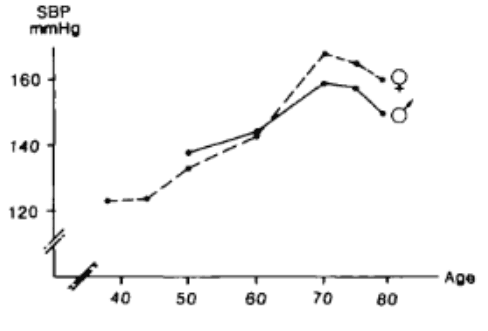
Average systolic blood pressures for long-lived populations of men and women without drugs.
The graphs shows the average blood pressures, without drugs in a 2008 study of the longest-lived, Scandinavian populations. These were the source of the previous targets: the natural pressures for the healthiest populations at the time, based on the study of 1304 men (50-79 years old) and 1246 women (38-79 years old) observed for up to 12 years. In this healthy population, the average untreated systolic pressure is seen till age 70, reaching 154 for men, and over 160 for women. By the new standards, these individuals would be considered highly unhealthy, though they live a lot longer than we do. The most common blood-pressure drug prescribed in the US today is atenolol, a beta blocker. See my essay on Atenolol. It’s good at lowering blood pressure, but does not decrease mortality.
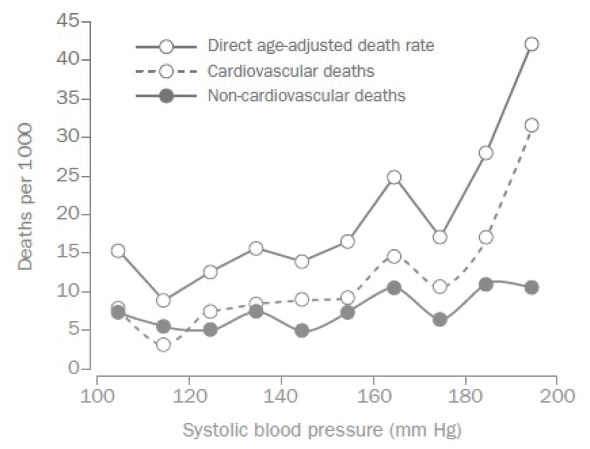
The plot at left shows the relationship between systolic blood pressure and death. There is a relationship, but it is not clear that the one is the cause of the other, especially for individuals with systolic pressure below 160. Those with pressures of 170 and above have significantly higher mortality, and perhaps should take atenolol, but even here it might be that high cholesterol, or something else, is causing both the high blood pressure and the elevated death risk.
The death-risk difference between 160 and 100 mmHg is small and likely insignificant. The minimum at 110 is rather suspect too. I suspect it’s an artifact of a plot that ignores age. Only young people have this low number, and young people have fewer heart attacks. Artificially lowering a person’s blood pressure, even to this level does not make him young, [2][3] and brings some problems. Among the older-old, 85 and above, a systolic blood pressure of 180 mmHg is associated with resilience to physical and cognitive decline, though it is also associated with higher death rate.
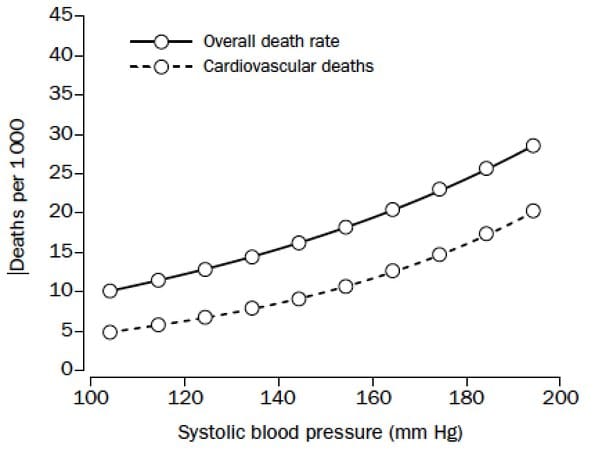
The AHA used a smoothed version of the life risk graph above to justify their new standards, see below. In this version, any blood pressure looks like it’s bad. The ideal systolic pressure seems to be 100 or below. This is vastly too low a target, especially for a 60 year old. Based on the original graph, I would think that anything below 155 is OK.
smoothed chart of deaths per 1000 vs blood pressure. According to this chart, any blood pressure is bad. There is no optimum.
I suspect that the Scandinavians live longer because they drink mildly, exercise mildly, have good healthcare (but not too good), and have a low crime rate. They seem to have dodged the COVID problem too, even Sweden that did next to nothing. it’s postulated that the problem is over medication, including heart medication.
Robert Buxbaum, January 4, 2023. The low US lifespan is startling. Despite spending more than any other developed countries on heath treatments, we have horribly lower lifespans, and it’s falling fast. A black man in the US has the same expected lifespan as in Rwanda. Causes include heart attacks and strokes, accidents, suicide, drugs, and disease. Opioids too, especially since the COVID lockdowns.
Humans are funny little creatures. I suspect that God keeps us around for our entertainment value. Each culture provides God its own entertainment. The British by invading basically every country on earth wearing tall, furry hats. We Americans provide grand stunts, like landing on the moon, or an automobile race around the world in 1908 when there were no roads or gas stations. And the French took love, dining, and dueling to a high, almost comic level. In France, the great and near great dueled well into the 20th century. The great French mathematician, Galois dueled to the death over love or politics. The great rationalist philosopher, Descartes, fought a duel, disarmed his opponent, and forgave him because of love. The science fiction writing philosopher, Cyrano de Bergerac, was famous for many duels, typically over the insults in his writing (or his nose).
In France, the great and near-great dueled well into the 20th century.
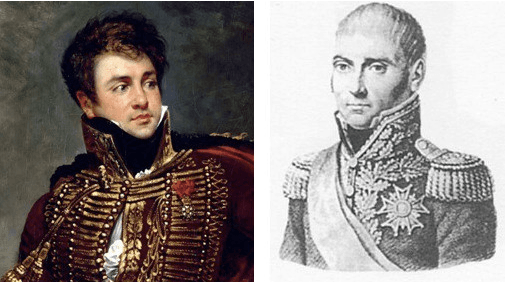
Instead of writing about those fellows, this post is about two Napoleonic generals, Pierre Dupont de l’Étang and François Fournier-Sarlovèze, who fought 30 duels with each other over 19 years writing a contract to kill each other whenever possible. They didn’t start as generals, of course, but rose through the ranks, though dueling was illegal, in theory, most of the time. They dueled on foot and horseback, mostly with swords, but also with pistols, and managed to wound each other at every meeting. They never quite managed to kill one another, or settle things, but they kept going at it till they became friends, of a sort. They were not that bad dualists, Fournier was a crack shot with a pistol and had killed others in duels. DuPont was better with the sword, but both were good at dodging death by blocking their vital organs.
The antaganism started with a duel, as one might expect. Fournier, a lieutenant at the time, had just killed a popular Strasbourg townsman named Blumm in a pistol duel. The townsman had no experience with pistols so this was sort-of murder, and resented. There was to be a party that evening, and Fournier’s commanding officer sent captain DuPont with a message to Fournier to keep him away until tempers subsided. Fournier attempted to attend anyway, and felt insulted by DuPont’s efforts to keep him out. Fournier challenged DuPont, and DuPont accepted, choosing military swords. Fournier would have challenged the commanding officer, but one does challenge so far above one’s station in France.
They met the next day at dawn. DuPont won the first duel, injuring Fournier by a severe cut to the shoulder. At this point, first blood, most American dualists would have called it quits, and might have become friends. In the duel between Thomas Hart Benton and Andrew Jackson, Benton put two bullets into Jackson but didn’t kill them, and they went on to become friends, and colleagues in congress. But for these two, one deadly meeting was not enough. They decided to duel again as soon as Fournier recovered. That took a month. Fournier rechallenged, they fought again with military swords. This time DuPont was injured. At the next duel, both were injured. Again and again, whenever they met, with swords, cutlases, lances, rapiers, and at last with pistols.
Fournier (left) and DuPont (right). Fournier fought for Napoleon in the Spanish and Russian campaigns, and went on to help write the military code of conduct. DuPont fought in the Austrian, Dutch, and Spanish campaigns, eventually becoming Minister of War for Louis XVIII and deputy of the Charente “The Dualsts” film was shot in and around Fournier’s home town. The painting at left hangs in city hall.
They drew up a contract that they would try to kill each other whenever they were 30 leagues from each other (90 miles) and not otherwise occupied with a war. The duels would pause whenever one of them was promoted since one didn’t duel with someone of higher rank. The two proved to be excellent officers and advanced at a good rate, with occasional stops in prison because of the political turmoil of the time, but not because of their dueling. Fournier went to jail for financial mismanagement and for insulting Napoleon after the Russian Campaign, DuPont went to jail too, for losing to the Spanish, and later for supporting the Royalists. They were released because the army always needs good officers who are brave and successful (Read about their lives on Wikipedia, or here).
Sometimes they would meet by accident and try to kill each other in bars, restaurants, and hotels. Mostly they would meet by arrangement at appointed times in the woods, sharing a hearty meal and good insults before dueling. Sometimes they chatted with each other through the duels. They appreciated each others skill and complimented each other on promotions, especially when it allowed them to try to kill one another (there is a comic movie like this — Mr and Mrs Smith?). During one encounter, DuPont stuck Fournier to the wall through the neck with his sword, and Fournier requested that he move closer so they could continue fighting this way. Now that’s dedication.
Eventually, DuPont got engaged and they decided to fight to the death, hunting each other in a woods with pistols (two each). As it happened, DuPont disarmed Fournier, and forced him to agree to fight no more. It was a happy ending suitable to a movie. Actually, a movie made about them, “The Dualists, 1967.” DuPont became minister for War for Louis XVIII (released for being too royalist), and wrote poetry including “the art of war”. Fournier helped write the French code of military conduct.
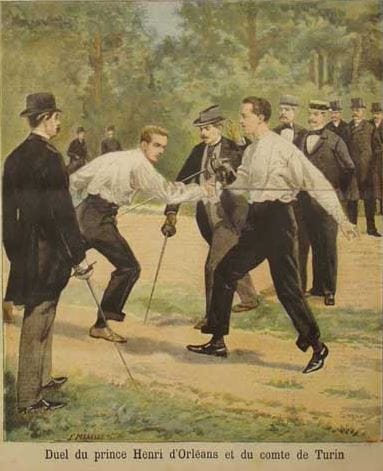
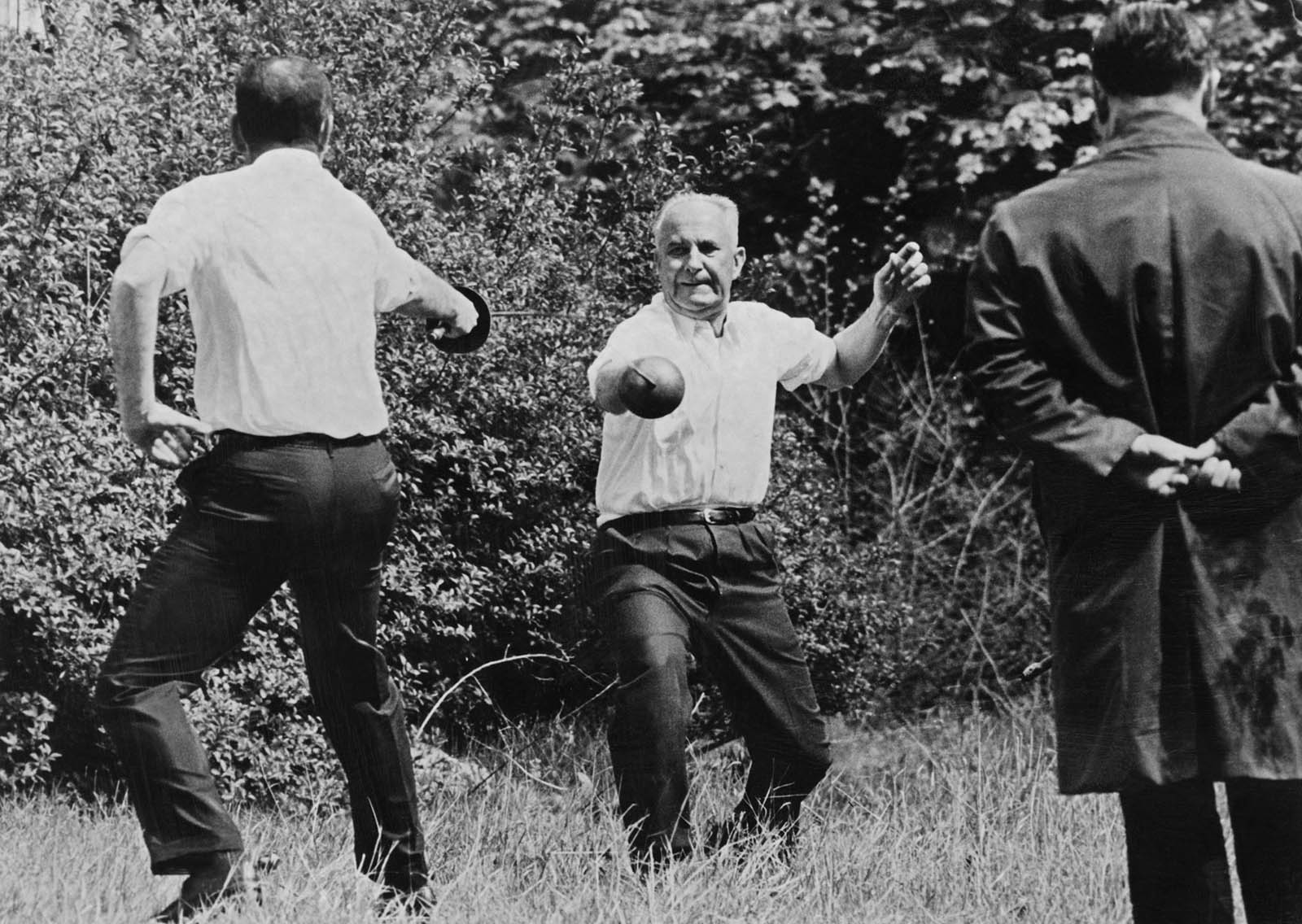
Dueling didn’t stop here, but continued in France well into the 20th century. The last dual between members of the government was in 1967, see photo below. René Ribière, Gaullist speaker of the National Assembly fought Gaston Differe, Mayor of Marseilles and Socialist candidate for the French presidency. They used epees, long, sharp swords. Differe wounded Ribiére twice, both times in the arm, and Jean de Lipkowskiin called an end to the duel “. Several French duels of the 20th century, are caught on film.
Le député maire socialiste de Marseille et bon escrimeur Gaston Defferre (C) et le député gaulliste du Val d’Oise René Ribière s’affrontent en duel le 21 avril 1967 dans le jardin d’une maison de Neuilly sous le regard d’un des témoins M. Cassagne (de dos). René Ribière avait demandé réparation par les armes à la suite d’un différend survenu à l’Assemblé nationale au cours duquel Defferre l’ayant traité d'”abruti” avait refusé de lui présenter des excuses. / AFP PHOTO
The point of this essay, assuming there is one, is the love of God for us. A less loving God would have had the comedy of the generals end after only two or three duals, or after one killed the other. Here, He allowed them to fight till friendship prevailed. Also of note is that that French are not surrender monkeys, as some claim. They are masters of honor and history, and we love them.
Robert E. Buxbaum, December 28, 2022. In the US, dueling is more like gang warfare, I include here pirates like William Kidd and John Lafitte, the Hamilton-Burr duel with trick pistols, the western shootouts of Jim Bowie, Wyatt Earp, etc., the Chicago rivalries of the 1930s and the drug wars of Detroit. At present, Detroit has four shootings per day, but only one death per day. The movie “8 Mile” includes fights, shooting, and several rap duels, fought with deadly words. If you won’t fight for something, there is a sense that it isn’t worth much.
This week, the Artemis I, Orion capsule splashed down to general applause after circling the moon with mannequins. The launch cost $4.1 Billion, and the project, $50 Billion so far, of $93 Billion expected. Artemis II will carry people around the moon, and Artemis III is expected to land the first woman and person of color. The goal isn’t one I find inspiring, and I feel even less inspired by the technology. I see few advances in Artemis compared to the Saturn V of 50 years ago. And in several ways, it looks like a step backwards.
The graphic below compares the Artemis I SLS (Space Launch System) to the Saturn V. The SLS is 10% lighter, but the payload is lighter, too. It can carry 27 tons to the moon, while the Saturn V sent 50 tons to the moon. I’d expect more weight by now. We have carbon fiber and aramids, and they did not. Add to this that the cost per flight is higher, $4.1 B, versus $1.49 B in 2022 dollars for a Saturn V ($185 million in 1969 dollars). What’s more there was no new engine development or production, so the flight numbers are limited: Each SLS launch throws away five, space shuttle engines. When they are all gone, the project ends. We have no plans or ability to make more engines.
Comparison of Apollo Saturn V and Artemis SLS. The SLS has less lift weight and costs more per launch.
As it happens, there was a better alternative available, the Falcon heavy from SpaceX. The Falcon heavy has been flying for 5 years now, and costs only $141 million per launch, about 1/30 as much as an Artemus launch. The rocket is largely reusable, with 3D printed engines, and boosters that land on their tails. Each SLS is expensive because it’s essentially a new airplane built specially for each flight. Every part but the capsule is thrown away. Adding to the cost of SLS launches is the fuel; hydrogen, the same fuel as the space shuttle. Per energy it’s very expensive. The energy cost for the SLS boosters is high too, and the efficiency is low; each SLS booster costs $290M, more than the cost of two Falcon heavy launches. Falcon launches are cheap, in part because the engines burn kerosine, as did the Saturn V at low altitude. Beyond cost hydrogen has low thrust per flow (low momentum), and is hard to handle; hydrogen leaks caused two Artemis scrubs, and numerous Shuttle delays. I discussed the physics of rocket engines in a post seven years ago.
This graph of $/kg to low earth orbit is mostly from futureblind.com. I added the data for Artemis SLS. Saturn V and Falcon use cheaper fuel and a leaner management team.
It might be argued that Artemis SLS is an inspirational advance because it can lift an entire moon project in one shot, but the Saturn V lifted that and more, all of Skylab. Besides, there is no need to lift everything on one launch. Elon Musk has proposed lifting in two stages, sending the moon rocket and moon lander to low earth orbit with one launch, then lifting fuel and the astronauts on a second launch. Given the low cost of a Falcon heavy launch, Musk’s approach is sure to save money. It also helps develop space refueling, an important technology.
Musk’s Falcon may still reach the moon because NASA still needs a moon lander. NASA has awarded the lander contract to three companies for now, Jeff Bezos’s Blue Origin, Dynetics-Aerodyne makers of the Saturn V, and Musk’s SpaceX. If the SpaceX version wins, a modified Falcon will be sent to the moon on a Falcon heavy along with a space station. Artemis III will rendezvous with them, astronauts will descend to the moon on the lander, and will use the lander to ascend. They’ll then transfer to an Orion capsule for the return journey. NASA has also contracted with Bezos’s Blue origin for planetary, Earth observation, and exploration plans. I suspect that Musk’s lander will win, if only because of reliability. There have been 59 Falcon launches this year, all of them with safe landings. By contrast, no Blue Origin or Dynetics rocket has landed, and Blue Origin does not expect to achieve orbital velocity till 2025.
As best I can tell, the reason we’re using the Artemis SLS with its old engines is inspiration. The Artemis program director, Charlie Blackwell-Thompson is female, and an expert in space shuttle engines. Previous directors were male. Previous astronauts too were mostly male. Musk is not only male, but his products suffer from him being considered a horrible person, a toxic male, in the Tony Stark (Iron Man) mold. Even Jeff Bezos and Richard Branson are considered better, though their technology is worse. See my comparison of SpaceX, Virgin Blue, and Blue Origin.
To me, the biggest blocks to NASA’s inspirational aims, in my opinion, are the program directors who gave us the moon landing. These were two Nazi SS commanders (SS Sturmbannführers), Arthur Rudolph and Wernher Von Braun. Not only were they male and white, they were barely Americanized Nazis, elevated to their role at NASA after killing off virtually all of their 20,000, mostly Jewish, slave workers making rockets for Hitler. Here’s a song about Von Braun, by Tom Lehrer. Among those killed was Von Braun’s professor. In his autobiography, Von Braun showed no sign of regret for any of this, nor does he take blame. The slave labor camp they ran, Dora-Mittelbau, had the highest death rate of all slave labor camps, and when some workers suggested that they could work better if they were fed, the directors, Rudolph and Von Braun had 80 machine gunned to death. Still, Von Braun got us to the moon, and his inspirational comments line the walls at NASA, Kennedy. Blackwell-Thompson and Bezos are surely more inspirational, but their designs seem like dead ends. We may still have to use Musk’s SpaceX if we want a lander or a moon program after the space shuttle’s engines are used up. As Von Braun liked to point out, “Sacrifices have to be made.”
Some years ago, I thought to help my daughter understand statistics by reanalyzing the data from a 2004 study on coffee and Parkinson’s disease mortality, “Coffee consumption, gender, and Parkinson’s disease mortality in the cancer prevention study II cohort: the modifying effects of estrogen” , Am J Epidemiol. 2004 Nov 15;160(10):977-84, see it here
For the study, a cohort of over 1 million people was enrolled in 1982 and assessed for diet, smoking, alcohol, etc. Causes of deaths were ascertained through death certificates from January 1, 1989, through 1998. Death certificate data suggested that coffee decreased Parkinson’s mortality in men but not in women after adjustment for age, smoking, and alcohol intake. They used a technique I didn’t like though, ANOVA, analysis of variance. That is they compare the outcome of those who drank a lot of coffee (4 cups or more) to those who drank nothing. Though women in the coffee cohort had about 49% the death rate, it was not statistically significant by the ANOVA measure (p = 0.6). The authors of the study understood estrogen to be the reason for the difference.
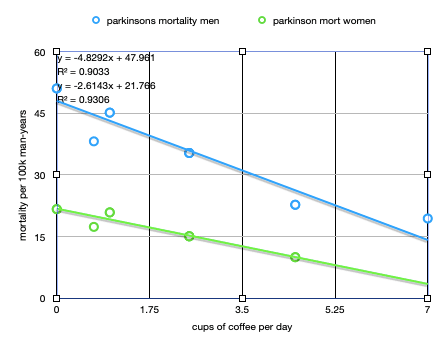
Based on R2, coffee appears to significantly decrease the risk of Parkinson’s mortality in both men and women.
I thought we could do a better by graphical analysis, see plot at right, especially using R2 to analyze the trend. According to this plot it appears that coffee significantly reduces the likelihood of death in both men and women, confidence better than 90%. Women don’t tend to drink as much coffee as men, but the relative effect per cup is stronger than in men, it appears, and the trend line is clearer too. In the ANOVA, it appears that the effect in women is small because women are less prone Parkinson’s.
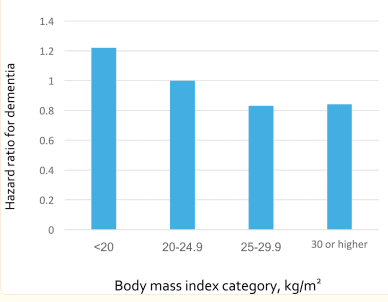
There is a confounding behavior that I should note, it’s possible that people who are genetically inclined to Parkinson’s don’t drink coffee, or the those who feel signs of Parkinson’s stop drinking it. I doubt this is what’s going on, given the study’s design, but it’s worth a mention. The same confounding is present in a previous analysis I did that suggested that being overweight protected from dementia, and from Alzheimer’s. Maybe pre-dementia people start loosing weight long before other symptoms appear.
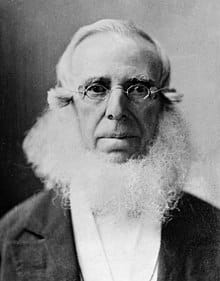
It’s good to have hero, someone whose approach to life, family and business you admire that you might reasonably be able to follow. As an engineer, inventor, I came to regard Peter Cooper of New York as a hero. He made his own business and was a success, in business and with his family without being crooked. This is something that is not as common as you might think. When I was in 4th grade, we got weekly assignments to read a biography and write about it. I tended to read about scientists and inventors then and after. I quickly discovered that successful inventors tended to die broke, estranged from their family and friends. Edison, Tesla, Salk, Goodyear, and Ford are examples. Tesla didn’t marry. Henry Ford’s children were messed up. Salk had a miserable marriage. Almost everyone working on the Atom Bomb had issues with the government. Most didn’t benefit financially. They died hated by the press as mass-murderers, and pursued by the FBI as potential spies. It was a sad pattern for someone who hoped to be an inventor -engineer.
The one major exception I found was Peter Cooper, an inventor, industrialist, and New York politician who was honest, and who died wealthy and liked with a good family. One result of reading about him was to conclude that some engineering areas are better than others; generally making weapons is not a path to personal success.
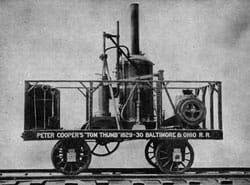
Tom Thumb, the blower at right is the secret to its light weight per power.
Peter Cooper was different, both in operation and outcome. Though he made some weapons (gun barrels) and inverted a remote control torpedo, these were not weapons of mass killing. Besides he but thee for “the good side” of the Civil War. And, when Cooper made an invention or a product, he made sure to have the capital available to make a profit on it too. He worked hard to make sure his products were monopolies, using a combination of patents and publicity to secure their position.
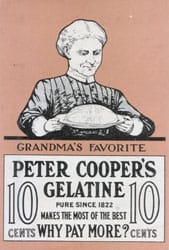
Brand management helps.
Cooper was a strong family man who made sure to own his own business, and made sure to control the sources of key materials too. He liked to invest in other businesses, but only as the controlling share-holder, or as a bond holder, believing that minor share-holders tend to be cheated. He was pro monopoly, pro trusts, and a big proponet of detailed contracts, so everyone knew where they stood. A famous invention of Cooper’s was Jello, a flavored, light version of his hide-glue, see the patent here. Besides patenting it, he sold the product with his brand, thus helping to maintain the monopoly.
Cooper was generous with donations to the poor, but not to everyone, and not with loans. And he would not sign anyone’s note as a guarantor. Borrowers tended to renege, he found, and they resent you besides. You lose your money, and lost them as a friend. He founded two free colleges, Cooper Union, and the Cooper-Limestone Institute, plus an inventor’s institute. (I got my education, free from Cooper Union.) Cooper ran these institutions in his lifetime, not waiting till he was dead to part with his money. Many do this in the vain hope that others will run the institution as they would.
Peter Cooper always sought a monopoly, or a near monopoly, patenting his own inventions, or buying the rights to others’ patents to help make it so. He believed that monopolies were good, saying they were the only sort of business that made money while allowing him to treat his workers well. If an invention would not result in a monopoly, Peter Cooper gave the rights away.
The list of inventions he didn’t patent include the instruments to test the quality of glue and steel (quality control is important), and a tide-powered ferry in New York. Perhaps his most famous unpainted invention was a lightweight, high power steam locomotive, “The Tom Thumb”, made in 1840. Innovations included beveled wheels to center the carriage on its rails, and a blower on the boiler fire, see photo above. The blower meant he could generate high-power in a small space at light weight. These are significant innovations, but Cooper did not foresee having a monopoly, so he didn’t pursue these ideas. Instead, he focussed on making rails and wire rope; he patented the process to roll steel, and the process for making coke from coal. Also on his glue/jello business. Since he made these items from dead cows and horses, he found he could also sell “foot oil” and steam-pounded leather, “Chamois”. He also pursued a telephone/ telegraph business across the Atlantic, more on that below, but only after getting monopoly rights for 50 years.
Cooper managed to stay friends with those he competed with by paying license fees for any patents he used (he tried to negotiate low rates), or buying or selling the patent rights as seemed appropriate. He also licensed his patents, and rented out buildings he didn’t need. He rented at a rate of 7% of the sale price, a metric I’ve used myself, considering rental to be like buying on loan. There is a theory of stock-buying that matches this.
The story the telegraph cable across the Atlantic is instructive to seeing how the pieces fit together. The first significant underwater cable was not laid by Cooper, by a Canadian inventor, Frederick Gisborne. It was laid in 1852 between Prince Edward Island and New Brunswick. Through personal connections, Gisborne’s company got exclusive rights for 30 years, for this and for a cable that would go to Newfoundland, but he didn’t have the money or baking to make it happen. The first cable failed, and Gisborne ran out of money and support. Only his exclusive rights remained. This is the typical story of an inventor/ engineer/businessman who has to rely on other peoples’ money and patience.
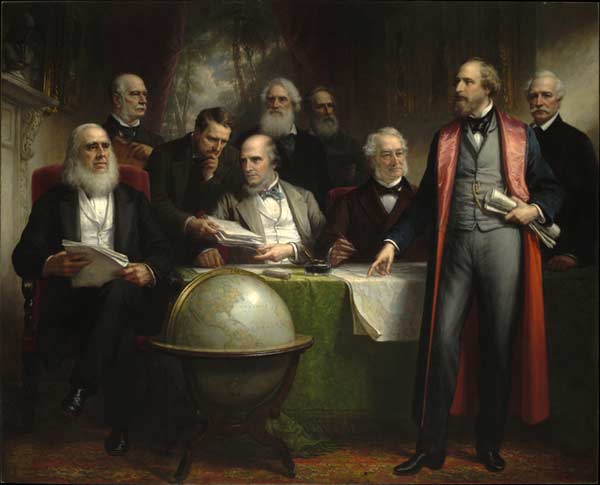
A few months after the failure, a friend of Cooper’s, Cyrus Field, convinced Cooper that good money could be made, and public good could be done, if Cooper could lay such a cable all the way to London. One thing that attracted Cooper to the project was that the cable could be made as an insulated iron-copper rope in Cooper’s own factory. Cooper, Field, and some partners (see painting below) bought Gisborne’s company, along with their exclusive rights, and formed a new company, The New York, Newfoundland & London Telegraph Company, see charter here. The founders are imagined* with a globe and a section of cable sitting on their table. Gisborne, though not shown in the painting, was a charter member, and made chief engineer. Cooper was president. He also traveled on the boat with Gisborne to lay the cable across the St. Lawrence – just to be sure he knew what was going on. This cable provided a trial for The Trans Atlantic cable.
The founding individuals to lay a transatlantic cable. Peter Cooper at left is the chairman, Cyrus Field is standing, Samuel Morse is at the back. Frederic Gisborne, a founder, does not appear in the paining. Typical.
Samuel Morse was hired as an electrician; he is pictured in the painting, but was not a charter member. Part of the problem with Morse was that he owned the patent on Morse-telegraphy, and Cooper didn’t want to pay his “exorbitant” fees. So Cooper and Field bought an alternative telegraph patent from David Hughes, a Kentucky school teacher. This telegraph system used tones instead of clicks and printed whole letters at a time. By hiring Morse, but not his patents, Cooper saved money, while retaining Morse’s friendship and expertise. The alternative could have been a nasty spat. Their telegraph company sub-licensed Hughes’s tone-method a group of western telegraph owners, “The Western Union,” who used it for many years, producing the distinctive Western Union Telegrams. With enough money in hand and credibility from the Canadian trial, the group secured 50 years monopoly rights for a telegraph line across the Atlantic. Laying the cable took many years, with semi-failed attempts in 1857, 1858, and 1865. When the eventual success came in 1866, the 50 years’ monopoly rights they’d secured meant that they made money from the start. They could treat workers fairly. Marconi would discover that Cooper wrote a good contract; his wireless telegraph required a widely different route.
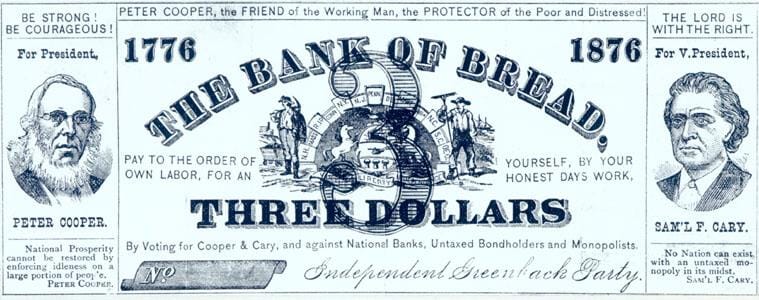
I should also note that Peter Cooper was politically active: he started as a Democrat, helped form the Republican Party, bringing Lincoln to speak in NY for the first time, and ended up founding the Greenback-Labor Party, running for president as a Greenback. He was strongly for tariffs, and strongly against inflation. He said that the dollar should have the same value for all time for the same reason that the foot should have the same length and the pound the same weight. I have written in favor of tariffs off and on. They help keep manufacturing in America, and help insure that those who require French wine or German cars pay the majority of US taxes. They are also a non-violent vehicle for foreign policy.
Operating under these principles, through patents and taxed monopolies, Peter Cooper died wealthy, and liked. Liked by his workers, liked by much of the press, and by his family too, with children who turned out well. The children of rich people often turn out poorly. Carnegie’s children fought each other in court, Ford’s were miserable. Cooper’s children continued in business and politics, successfully and honorably, and in science/ engineering (Peter Coper Hewitt invented the power rectifier, sold to Westinghouse). The success of Peter Cooper’s free college, Cooper Union, influenced many of his friends to open similar institutions. Among his friends who did this were Carnegie, Pratt, Stevens, Rensselaer, and Vanderbilt. He stayed friends with them and with other inventors of the day, despite competing in business and politics. Most rich folks can not do this; they tend to develop big egos, and few principles.
Robert Buxbaum, November 30, 2022. I find the painting interesting. Why was it painted? Why is Gisborne not in it and Morse in the painting — sometimes described as vice President? The charter lists Morse as “electrician”, an employee. Chandler White, holding papers next to Cooper, was Vice President. My guess is that the painting was made to help promote the company and sell stock. They made special cigars with this image too. This essay started as a 5th grade project with my son. See a much earlier version here.
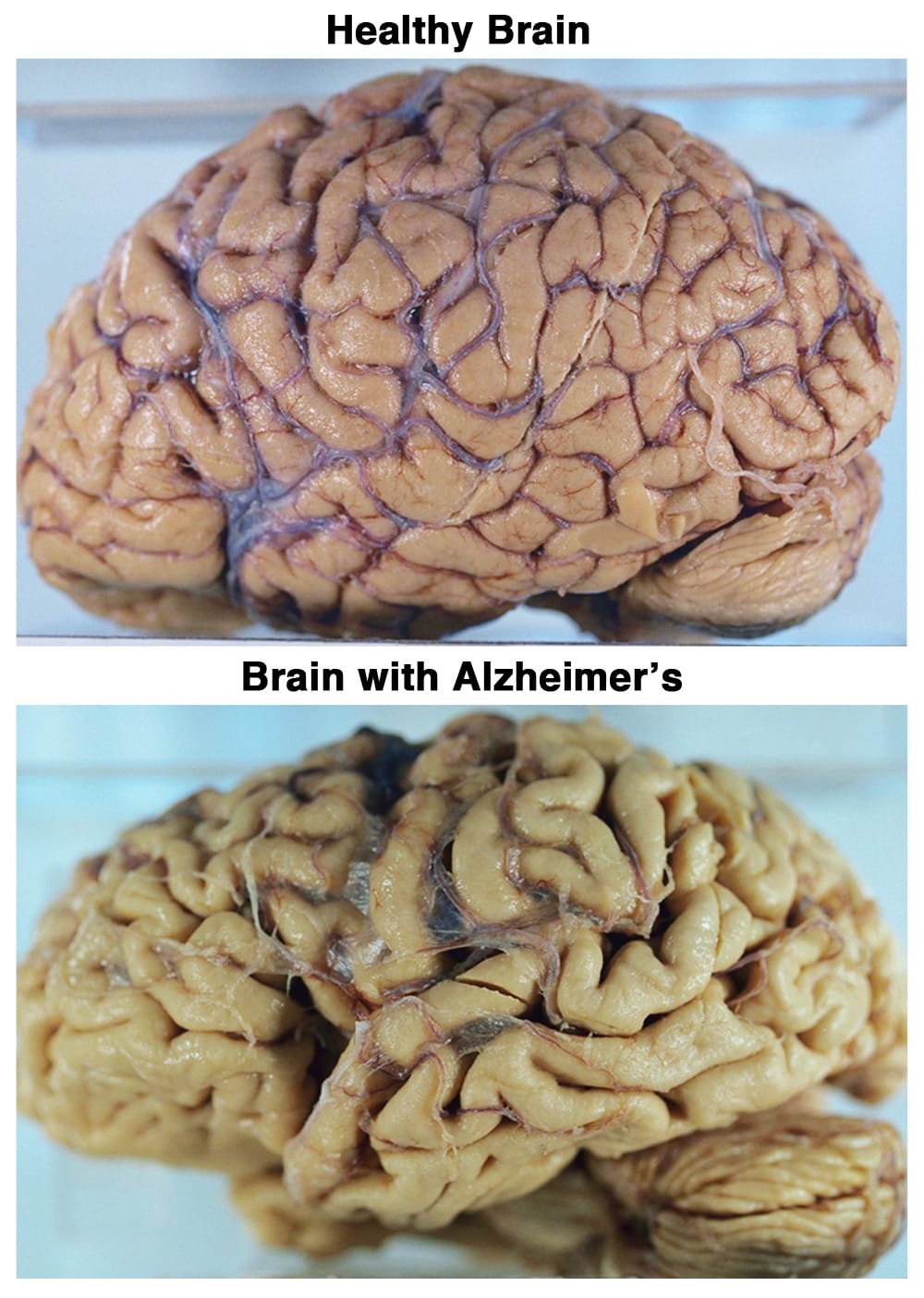
Much of health research is a search for simple, bio-molecular causes for our medical problems. These can result in pill-solutions. Diseases tend to be more complex, but Alzheimers seemed to work that way, until this summer when it turned out that the data supporting the simple theory was faked. Alzheimer’s is a devastating cognitive disease that is accompanied by a degenerating brain, with sticky, beta-amyloid plaques and tangles. About 16 years ago, this report, published in Nature seemed to show that a beta-amyloid, Aβ*56, caused the plaques and caused cognitive decline independent of any other Alzheimers indicators.
The visual difference between an Alzheimer brain and a normal brain is that the former has shrunk. Maybe fat is relevant, fat body leads to a fat brain, and less AZ, maybe?
We were on the way to a cure, or so it seemed. Several studies by this group backed the initial results, and much of Alzheimer’s research was directed into an effort to fill in the story, and find ways to reduce the amount and bonding of this amyloid and others like it. Several other groups claimed they could not find the amyloid at all, or show that amyloids caused the symptoms described. But most negative results went unpublished. The theory was so satisfying, and the evidence from a few so strong, that the NIH poured billions into this approach, over $1B in this year alone. The FDA approved aducanumab, a drug from Biogen, on the assumption that it should work, even though it showed little to no benefit, and had some deadly side effects. Other firms followed, asking for approval of related anti-amyloid drugs that should work.
When news of the fraud came out, detected by Matthew Scragg and a few lone curmudgeons, stock prices plummeted in the drug companies. It now appears that the original work was made up, presented to journals and to the NIH using photoshopped images. For the group that did the fake work, it may mean jail time, for most other groups, the claim is that their work is still relevant. Doctors still prescribe the medications as they have nothing better to offer (Aducanumab therapy costs $50,000 per year). Maybe it’s time to start looking at alternative approaches and theories, sidelined over the last 16 years.
Some alternative theories posit that another molecule is responsible, particularly tau, associated with the tangles. Another sidelined theory is that amyloids are good. For example, that it’s the loss of soluble amyloids that causes Alzheimer’s. Alternately, that inflammation is the root cause, and that the amyloid plaques and tangles are a response to the inflammation, a bandage, perhaps. These theories could explain why the anti-amyloid drugs so often resulted in patient death.
It could be that high bmi protects from dementia. Either that or the diseases that cause weight loss cause dementia. It’s debated here.
It’s also possible that the inability of nerve cells to dispose of waste is the cause of AZ. In heathy people, waste is removed through acidic enzymes within lysosomes. Patients with decreased acid activity have a buildup of waste that includes amyloids. Perhaps the cure is to restore the acid enzymes.
My favorite theory is based on statistical data that shows that fat people are less likely to develop Alzheimers. This might lead to a junk-food cure. The fitness industry is very much against this theory–It’s debated here. They tend to support the inflammation model, claiming that diseases cause Alzheimer’s and cause patients to loose weight first. Could be. I note that Henry Kissinger is the only active politician of my era, the early 70s, still alive and writing intelligently.
Robert Buxbaum, November 17-19, 2022. I hope that Matthew Schragg comes out OK, by the way. Ben Franklin pointed out, that “No good deed goes unpunished.”
Hillary Clinton famously called Trump supporters “a basket of deplorables” and went on to explain that half of them were “unredeemable”, Nazis and Klansmen, while the other half “needed reeducation.” Her statement was applauded on the left, and taken as an insult on the right. To this day, Biden and his group make the claim that Republicans are antisemites and a threat to American democracy. The proof here is a 2017 video of Klansmen carrying torches, saying “Jews will not replace us,” as they protested the removal of a statue of Robert E. Lee in Virginia. A further claim is that the rise in antisemitic incidents, shootings, beatings, etc., are the result of Trump and the Republicans. Things are not quite so black and white, or course, e.g. during the ANTIFA protests/riots four synagogs were attacked in LA alone, and the Crown-Heights neighborhood of Brooklyn was torched. Many of the attackers of Jews have Islamic names and left association, things that don’t suggest Republicans but Democrats.
CNN has claimed that the difference is intent: Trump’s intent is evil, while ANTIFA’s is to elevate black and Moslem lives by allowing them to vent their righteous anger (on Jews). The Moslems who attacked Jews in Monsey, India, Paris and elsewhere are acting for justice, while the marchers in Charlottesville march for hate. In a special program on “Antisemitism in American”, CNN made the claim that no Jew should support the Republicans or Jewish Israel, an apartheid, colonial occupation in their view. This appears to be the view of the Biden White House too. They have yet to congratulate the winner of Israeli presidential elections, 5 days after the election. They contacted Mahmoud Abbas, the Palestinian leader instead, to discuss joint efforts to enhance Palestinian security. Obama did the same, seven years ago, not congratulating the Israeli election winner (Netanyahu), and snubbed the Israeli delegation on their visit, leaving them to sit alone without food or photographs.
According to the CNN expert on Antisemitism, the lefts’ dismissal of Israel’s leaders is because European Jews are not Jews at all, but Russians with no connection to the land. To my thinking claims like this against a group’s identity are horribly hurtful — CNN’s expert was claiming, essentially, that the jews were lying about everything since the beginning. If Jews are not from Israel, why have we prayed in that direction for return, and in the language of that land. If we did not build the old synagogs, when did we displace the builders and take over their language and culture? Attacks on Jewish identity are more serious, in my mind, than any march for Robert E. Lee. (I’ve written in favor of the peace hammered out between Grant and Lee).
Perhaps even more damaging is the left’s attack on Jewish education. The New York Times ran three-page article claiming that Jewish education abuses the students by not teaching real science or history, and by enforcing religious and sexual norms that are counter to the children’s rights — rights that include LGBQT+ expression. While it is true that Jewish education is not a fan of LGBQT+, but neither is Moslem education, or Catholic, or Mormon. Education is how a culture survives. Some Catholic leaders have noted that they have a stake in this.
The left is anti Israel and anti Jewish education, yet claims to be the defenders of Jews because they can’t stand Trump.
Speaking of survival, about half of all Jews now live in Israel, a state established by the UN in 1947 in part as a response to the mass murder of Jews in Europe. Along with Europeans, about half of the Israelis today are exiles from communities wiped out by Moslem governments: from Egypt, Tunisia, Iran, Iraq, Turkey, and Yemen. If Israel becomes Islamic as Obama favored, they are likely to exile all the Jews as they did in 1968 in Jerusalem, and as the surrounding countries have done. Where would the Jews go? It’s not a problem for Obama-Biden, but it’s a survival problem for Israelis. My sense is that the left is, by far, the more antisemitic, both in terms of culture and physical safety.