Category Archives: politics

Rain barrels aren’t much good. Wood chips are better, And I’d avoid rain gardens, even as a neighbor.

A lot of cities push rain barrels as a way to save water and reduce flooding. Our water comes from the Detroit and returns to it as sewage, so I’m not sure there is any water saving, but there is a small cash saving (very small) if you buy 30 to 55 gallon barrels from the city and connect them to the end of your drain spout. The rainwater you collect won’t be pure enough to drink, or safe for bathing, but you can use it to water your lawn and garden. This sounds OK, even patriotic, until you do the math, or the plumbing, or until you consider the wood-chip alternative.

The barrels are not cheap, even when subsidized they cost about $100 each. Add to this the cost and difficulty of setting up the collection system and the distribution hose. Water from your rain barrel will not flow through a normal nozzle as there is hardly any pressure. Expect watering to take a lot longer than you are used to.

40 gallon rain barrels. Two of these give about 70 usable gallons every heavy rain fall. That’s about 70¢ worth.

In Michigan you can not leave the water in your barrel over the winter, the water will freeze and the barrel will crack. You have to drain the tank completely every fall, an almost impossible task, and the tank is attached to a rainspout and the last bit of water is hard to get out. Still, you have to do it, or the barrel will crack. And the savings for all this is minimal. During a rainy month, you don’t need this water. During a dry month, there is no water to use. Even at the best, the The marginal cost of water in our town is less than 1¢ per gallon. For all the work and cost to set up, two complete 40 gallon tanks (like those shown) will give you at most about 70 usable gallons. That’s to say, almost 70¢ per full filling.

How much lawn can you water? Assume you like to water your lawn to the equivalent of 1″ of rain per week, your 70 gallons will water about 154 ft2 of lawn or garden, virtually nothing compared to the typical Michigan 2000 ft2 lawn. You’ll still have to get most of your water from the city’s main. All that work, for so little benefit.

Young trees with chip volcanos, 1 ft high x18″. Spread the chips to the diameter of the leaves.You don’t need more than 2″.

A far better option is wood chips. They don’t cover a lawn, but they’re great for shrubs, trees or a garden. Wood chips are easy to spread, and they stop weeds and hold water. The photo at left shows a wood chips around the shrubs, and a particularly poor use of wood chips around the trees. For shrubs, trees, or a garden, I suggest you put down 1 to 2 inches of wood chips. Surround a young tree at that depth to the diameter of the branches. Do not build a “chip volcano,” as this lazy landscaper has done.

Consider that, covering 500 ft2 of area to a depth of 1.5 inches will take about 60 cubic feet of wood chips. That will cost about $35 dollars at the local Home Depot. This is enough to hold about 1.25″ or rainwater, That’s about 100 ft3 or water or 800 gallons. The chips prevent excess evaporation while preventing weeds and slowly releasing the water to your garden. You do no work. The chips take almost no work to spread, and will keep on working for years, with no fear of frost-damage. A as the chips stop working, they biocompost slowly into fertilizer. That’s a win.

There is a worst option too, called a rain garden. This is often pushed by environmental-gooders. You dig a hole near your downspout, perhaps ten feet in diameter, by two feet deep, and plant native grasses (weeds). When it rains, the hole fills with water creating a mini wetland that will soon smell like the swamp that it is. If you are not lucky, the water will find a way to leak into your basement. If that’s your problem look here. If you are luckier, your mini-swamp will become the home of mosquitos, frogs, and snakes. The plants will grow, then die, and rot, and look awful. It is very hard to maintain native grasses. That’s why people drain swamps and grow trees or turf or vegetables. If you want to see a well-maintained rain garden, they have two on the campus of Lawrence Tech. A wetland isn’t bad, but you want drainage, Make a bioswale or muir.

Robert Buxbaum, May 31, 2023. I ran for water commissioner some years back.

Right to work is a right.

In 26 states you can work in a unionized industry without joining a union. You can even cross a union strike line if you like. It’s called “right to work.” Michigan allowed it up till last month, but no longer. Immediately following the Democrats’ taking majority of the MI legislature, they voted to make non-union membership illegal. The claim was that those who do not want to be represented by the state-acknowledged union is misguided, or worse.

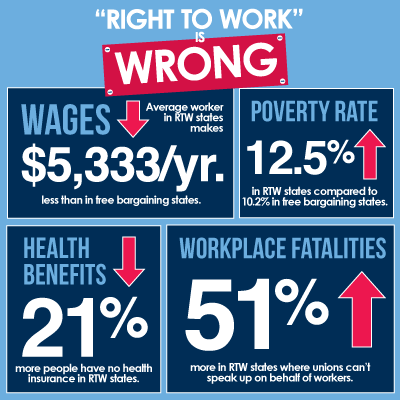
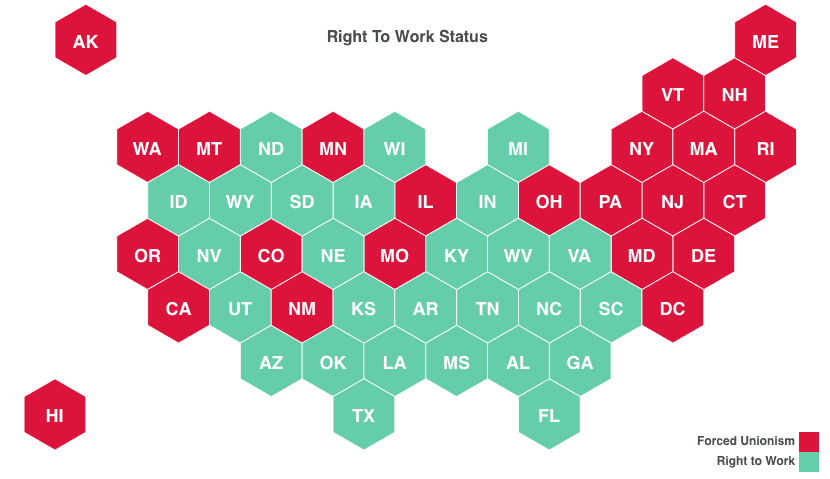
The argument for making union membership mandatory is presented in the poster at right. It notes that states that banned right to work are richer, with workers getting higher pay and benefits. These include California, New York, NJ, Washington, Alaska,.. See the map below. Although these states, on average have higher yearly wages, they also have higher taxes, higher costs of living, and more high-tech jobs. The cause and effect implied by this poster is erroneous, I think: The claim is that if you are forced to join a union you will be paid more with more benefits. I strongly suspect that the reality is that these states have high wages and high benefits and a lot of people working in safe fields, programming for example. They then force workers to work for one union so they’ll be easier managed, not because they want a strong opposition.

Another thing, even if you could guarantee higher wages by forced union membership, and you could avoid the high taxes and high cost of living that you find in NY and California, no person should be forced to accept representation by a group that they don’t get to choose, or who supports social goals that the worker doesn’t support. I don’t believe this is fair, or moral, but that’s how it is. It’s the law in most every state with a Democrat as governor and where Democrats control the legislature.

Right to work as of last month, before Michigan forced unionism.

Union membership had been declining in Michigan for years, but it took a particular nose dive in 2016 when the unions spent heavily for Clinton while blue collar workers supported Trump. It was 14% or workers before the law changed. Workers claimed that their unions were working against them, and complained about how their dues were spent. It also came out that some of the Michigan union bosses had stolen money from their funds to build fancy private houses — using non-union labor to do it. When the union bosses tried to show their muscle by calling strikes, the strikes accomplished little, or went on for months. The results were two-tier salaries, layoffs, and business failures. The working for the local newspapers teamsters struck, and one newspaper collapsed. The other chose non-union drivers. The teamsters are still on strike, 10 years later. I’d think a worker should be able to leave a union like this.

I’m a fan of unions, but think the worker should be able to choose. I’m a particular fan of craft unions that work to improve the quality of their work along with the quality of their workers lives. This helps everyone. I suspect that unions should not be able to support political parties too. See my thoughts on unions, here.

Michigan has a particularly strong history of crooked union bosses. When Jimmy Hoffa challenged the Teamster bosses over how the retirement fund was spent, he vanished. The union’s bosses seem to have had him killed. The last place where he was seen alive is an Andiamo Restaurant near my home. He was picked up by someone he knew, perhaps his nephew. No one’s talking and his remains were never found. In Michigan you used to be able to choose your union just as you chose your political club and your own lawyer, or you could choose none at all. Nowadays, the law says otherwise. Maybe you don’t like this law. Maybe you don’t like the union boss or how he’s spending. Maybe you’d like to visit with Jimmy Hoffa.

Robert Buxbaum May 19, 2023. Aside from everything else, you have a right to have a state that isn’t high-wage, high-tax, even if you could prove people were happier in such states. Freedom is a good, in and of itself.

Canada’s doctor-assisted suicide killed 10,064 in 2021

Canada’s healthcare is free to the user. It’s paid for by taxes, and it includes a benefit you can’t get in the US: free, doctor assisted suicide, euthanasia. This is a controversial benefit, forbidden in the Hippocratic oath because it’s close to murder, and includes the strong possibility of misuse of trust. Assistance by a trusted professional can be a bit likes coercion, and that starts to look like murder — especially since the professional often has a financial incentive to see you off.

From Charlie Hebdot (a French, humor magazine): The medical association refuses to participate in euthanasia — Why? People are already dining quite well on their own waiting in the emergency room.

In 2021, according to Statistics Canada, Canada assisted the suicide of 10,064 people, 3.3% of all Canadian deaths. There were about 4,000 more, non-assisted suicides. In Quebec, the Canadian Provence where Medical Assistance in Dying (MAiD) is most popular, 5.1% of deaths result from MAID. The Netherlands has a similar program that results in 4.8% of deaths. In Belgium, it’s 2.3%. These countries’ suicide rates are far higher than in the US, and account for far more deaths, per capita than from guns in the US. My guess is that suicide is common because it is free and professional. It’s called “Dignity in Dying,” in Europe, a title that suggests that old folks who don’t die this way are undignified.

In Canada, about 80% of those who requested MAiD were approved. A lot of the remainder were folks who died or changed their mind before receiving the fatal dose. If you attempt suicide on your own, it’s likely you won’t succeed, and you may not try again. With doctor assisted suicide, you’re sure to succeed (even if you change your mind after you get your lethal shot?)

In Canada you don’t have to be terminally ill to get MAiD, you just have to be in pain, and extreme psychological pain counts. Beginning March 17, 2024, depression will be added as a legitimate reason. According to Canadian TV news, depressives are lining up (read some interviews here). Belgium and Netherlands allows elders to be euthanized for dementia, and children to be euthanized on the recommendation of their parents. France passed similar legislation, but the doctors refused to go along, see cartoon. I applaud the French doctors.

Rodger Foley says he’s being pressured to ask for medical suicide, picture from the NY Post

There have been persistent claims that Canadian doctors and nurses push assisted suicide on poor patients, telling them how much bother they are and how much resources they are using. There has been an outcry in British and American newspapers, e.g. here in the Guardian, and in the NY Post, but not in Canada, so far. Rodger Foley, a patient interviewed by the NY Post, recorded conversations where his doctors and nurses put financial pressure on him. “They asked if I want an assisted death. I don’t. I was told that I would be charged $1,800 per day [for hospital care]. “I have $2 million worth of bills. Nurses here told me that I should end my life.” He claims they went so far as to send a collection agency to further pressure him. In another case, a disabled Canadian veteran asked for a wheelchair ramp, and was told to apply for MAiD.

Even without outside pressure, many people seeking MAiD often cite financial need as part of the reason. A 40 year old writer interviewed by Canadian television said that he can’t work and lives in poverty on a disability payment of just under $1,200 a month. “You know what your life is worth to you. And mine is worthless.”

The center of the argument is the value of a person in a social healthcare state when their economic value is less than the cost of keeping them alive. Here, Sabine Hossenfelder, an excellent physicist, argues that the best thing one could do for global warm and to preserve resources is to have fewer people. Elon Musk says otherwise, but Ms Hossenfelder claims this only shows he is particularly unworthy. There’s a Germanic logic here that gave us forced euthanasia in the 1940s.

I find euthanasia abhorrent, especially when it’s forced on children, the elderly, and depressed folks. I also reject the scary view of global warming, that it is the death of the earth. I’ve argued that a warm earth is good, and that a cold earth is bad. Also, that people are good, that they are the reason for the world, not its misfortune. It seems to me that, if suicide aid must be provided, state-funded hospitals should not provide it. They have a financial incentive to drop non-paying, annoying patients. That seems to be happening in Canada. A patient must be able to trust his or her doctor, and that requires a belief that the doctor’s advice is for his or her good. Unfortunately, Canadian politicians have decided otherwise. I say hurray for the doctors of France for not going along.

Robert Buxbaum, April 25, 2023. The medical profession is shady even when you pay for services, see Elvis Presley’s prescription. There’s always a financial interest. Even based on old data, the US is not a particularly high-murder country if suicide is considered murder.

China won’t invade Taiwan, perhaps Vietnam

For 2000 years Chinese rulers have either fixed the problems caused by their predecessors, or become the absolute ruler who brings new problems and a war. Eighteen times over the last 2000 years, the absolute ruler has chosen is to invade Vietnam. Chairman Xi Jinping took full power over China five years ago, and as I predicted then, purged the party of all other competent leaders, including his predecessor, Hu. He now has to do something, and that’s typically a war. Xi talks like he’d like to invade Taiwan, but I believe he’ll invade Vietnam instead, as so many others did before him. Taiwan (Formosa) is separated from mainland China by 100 miles of open sea. There’s been only two successful, modern invasions; by the Qing Chinese in 1683 with the help of the Dutch fleet, and in 1895 by Japan against the 5 month old Republic of Taiwan. Vietnam is much easer to invade: you just have to walk in.

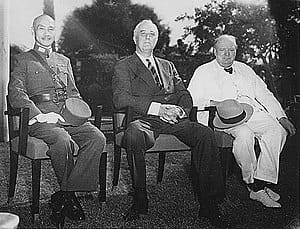
Chiang KaiShek with Roosevelt and Churchill. He took power after WWII.Taiwan is now a Republic

Here’s my brief summary of 60 years of cyclical Chinese history: In the last decade of his life, 1966-76, Mao Zedung brought a horrible cultural revolution, killing 100 million or so by violence and famine, targeting anyone who might disagree with him. He was followed by Hua Kuofeng, Hu Yaobang, and Zhao Ziyang. They removed “the Gang of Four” and brought reform, toleration, and some rapprochement with the west. Hu also returned some autonomy to Tibet. Deng Xiaoping followed, put Zhao under house arrest, removed Hua and Hu (only recently buried), absorbed Tibet, invaded Vietnam, instituted a brutal on-child policy with, forced abortions and sterilizations, and put down the Tiananmen uprising 1989 -an uprising caused by the removal of Hu. Deng was followed by Jiang Zemin and Hu Jintao who exited Vietnam, lightened the one-child policy, and brought back some measure of freedom. This lead to Xi Jinping who appears to be in the mold of Mao and Deng. He’s removed Hu publicly during a communist party meeting, has taken absolute control, arrested China’s business innovators, and (likely) caused a pandemic by unsafe research at the Wuhan bio-research facility. His response to the pandemic is worthy of Mao: he welded people into their homes. Xi now needs a war to unify the country, and talks like he’ll invade Taiwan. Xi might do it; he has increased military spending by 2.5 times, to double that of the EU (equal to US spending). His army is likely to be used somewhere soon. But where?

At first glance, it makes some sense to think he’ll invade Taiwan. He has the same justification as Deng had for Vietnam, “to punish the wayward province.” Taiwan is small, 23 million people, and very rich (GDP = $1.3T, 10-15% of China). It’s especially rich in high-tech areas that Xi seems to want, and China ruled the island (Formosa) for 212 years between 1683 and its brief independence in 1895. I expect that Xi will invade Vietnam though, for many of the same reasons that Deng did: it’s easier, and the invasion won’t destroy US trade. Vietnam will not be super easy to conquer, of course, Putin’s invasion of Ukraine looks like it will go on for years, but Xi has 100 million men of military age. Driving these men into Vietnam is a lot easier than an amphibious invasion. Vietnam now, as then, has few friends -perhaps only India -while Taiwan has many (The US and Japan, primarily), and they have naval breakwaters that would make an amphibious landing difficult. Vietnam is only about half as rich as Taiwan (GDP = $650 B), but it has two things China needs more than technology: oil and food.

The Japanese invasion of independent Taiwan, The Republic of Formosa, in 1895. It took 5 months despite lopsided advantages. Plus 7 years to pacify the population.

Japan’s invasion of the Republic of Formosa in 1895 would have to be the model for a Chinese invasion today, assuming that’s the route Xi would take. Japan used a small force of 20,000 highly trained men, and a surprise landing at two sites. The formosan army of 75,000 was hardly armed, but it still took the Japanese 5 months to defeat them. It took another 7 years to pacify the population. Taiwan today is a lot better prepared than it was, with modern missiles and drones, a well-trained army of 500,000, and an active navy. Japan, Philippines, and the US would likely try to resupply Taiwan, and would have to be blockaded to prevent delivery. This is not so easy, since the nearest Japanese island is closer to Taiwan than Taiwan is to mainland China, and the Philippines is not far either. Then there are the sanctions that would follow an invasion of Taiwan, but not an invasion of Vietnam: the freezing of assets and the closing of markets. Susch sanctions have been tough on Russia but they would be devastating to China since China imports most of its oil and half of its food, much of it by sea. Whatever Xi gets from invading Taiwan will not match these losses, and I think Xi know it.

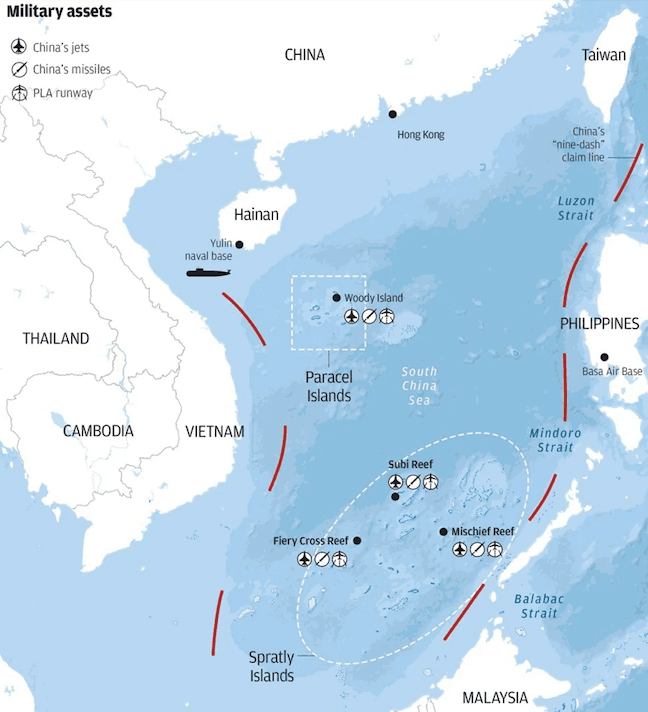
China’s new military bases are located around Vietnam, not around Taiwan

I suspect that Xi has already concluded that Vietnam is the smart place to invade. Supporting this view is a look at his preparations. Xi has not built the landing fleet that he’d need for Taiwan, but has instead militarized Hainan Island, plus four other, newly constructed, illegal islands in the South China Sea. These islands surround Vietnam, and are well suited to cut off the country from western aid. They are too far south to be effective in an action against Taiwan. You can tell a lot about what a person will do from what he has done, and what Xi has done is to prepare for an invasion of Vietnam.

Robert Buxbaum, April 27, 2023.

Of walking sticks, canes, scepters, and wands.

Franklin’s walking stick, willed to General Washington. Now in the Smithsonian.

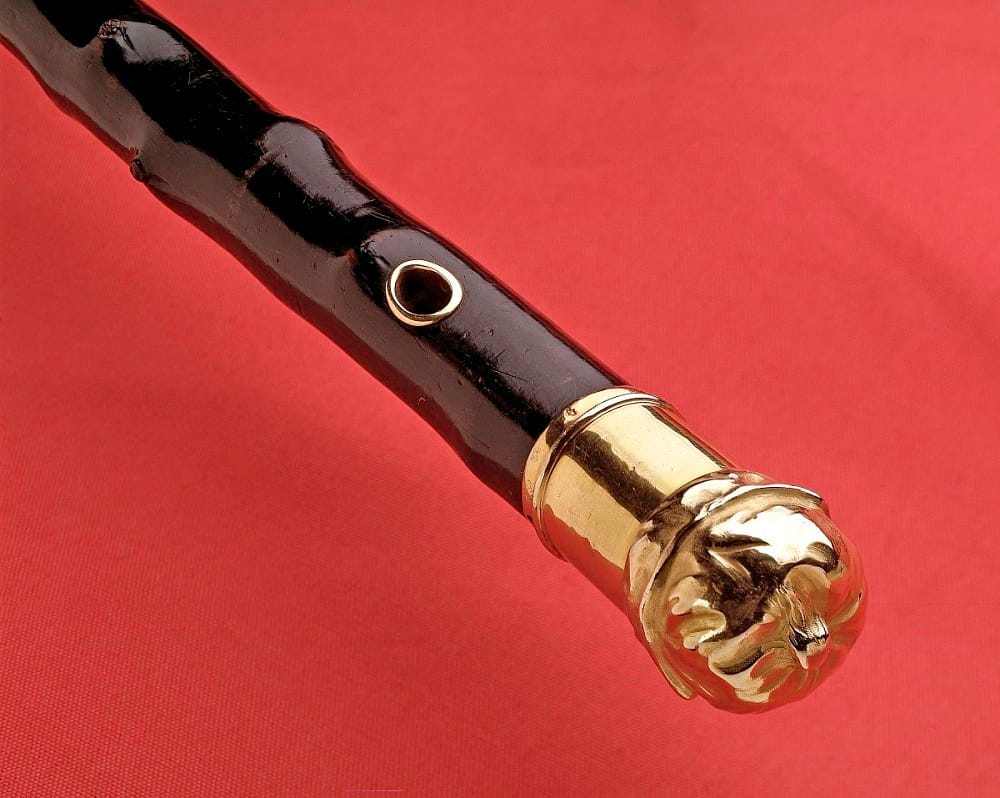
Many famous people carried walking sticks Washington, Churchill, Moses, Dali. Until quite recently, it was “a thing”. Benjamin Franklin willed one, now in the Smithsonian, to George Washington, to act as a sort of scepter: “My fine crab-tree walking stick, with a gold head curiously wrought in the form of the cap of liberty, I give to my friend, and the friend of mankind, General Washington. If it were a Scepter, he has merited it, and would become it. It was a present to me from that excellent woman, Madame de Forbach, the dowager Duchess of Deux-Ponts”. A peculiarity of this particular stick is that the stick is uncommonly tall, 46 1/2″. This is too tall for casual, walking use, and it’s too fancy to use as a hiking stick. Franklin himself, used a more-normal size walking stick, 36 3/8″ tall, currently in the collection of the NY Historical Society. Washington too seems to have favored a stick of more normal length.

Washington with walking stick

Walking sticks project a sort of elegance, as well as providing personal protection. Shown below is President Andrew Jackson defending himself against an assassin using his walking stick to beat off an assassin. He went on to give souvenir walking sticks to friends and political supporters. Sticks remained a common political gift for 100 years, at least through the election of Calvin Coolidge.

Andrew Jackson defends himself.

I started making walking sticks a few years back, originally for my own use, and then for others when I noticed that many folks who needed canes didn’t carry them. It was vanity, as best I could tell: the normal, “old age” cane is relatively short, about 32″. Walking with it makes you bend over; you look old and decrepit. Some of the folks who needed canes, carried hiking sticks, I noticed, about 48″. These are too tall to provide any significant support, as the only way to grasp one was from the side. Some of my canes are shown below. They are about 36″ tall, typically with a 2″ wooden ball as a head. They look good, you stand straight, and they provides support and balance when going down stairs.

Some of my walking sticks.

I typically make my sticks of American Beech, a wood of light weight, with good strength, and a high elastic modulus of elasticity, about 1.85 x10⁶ psi. Oak, hickory, and ash are good options, but they are denser, and thus more suited to self-defense. Wood is better than metal for many applications, IMHO, as I’ve discussed elsewhere. The mathematician Euler showed the the effective strength of a walking stick does not depend on the compressive strength but rather on elastic constant via “the Euler buckling equation”, one of many tremendously useful equations developed by Leonhard Euler (1707-1783).

For a cylindrical stick, the maximum force supported by a stick is: F = π3Er4/4L2, where F is the force, r is the radius, L is the length, and E is the elastic modulus. I typically pick a diameter of 3/4″ or 7/8″, and fit the length to the customer. For a 36″ beech stick, the buckling strength is calculated to be 221 or 409 pounds respectively. I add a rubber bottom to make it non–scuff and less slip-prone. I sometimes add a rope thong, too. Here is a video of Fred Astaire dancing with this style of stick. It’s called “a pin stick”, in case you are interested because it looks like a giant pin.

Country Irishmen are sometimes depicted with a heavy walking stick called a Shillelagh. It’s used for heavier self-defense than available with a pin-stick, and is generally seen being used as a cudgel. There are Japanese versions of self defense using a lighter, 36″ stick, called a Han-bo, as shown here. There is also the wand, as seen for example in Harry Potter. It focuses magical power. Similar to this is Moses’s staff that he used in front of Pharaoh, a combination wand and hiking stick as it’s typically pictured. It might have been repurposed for the snake-on-a-stick that protects against dark forces. Dancing with a stick, Astaire style, can drive away emotional forces, while the more normal use is elegance, and avoiding slips.

Robert Buxbaum, April 20, 2023.

Abortion and Childbirth in the US vs China

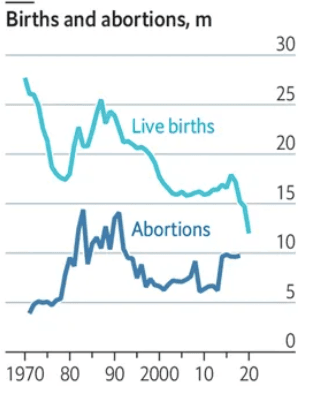
There are a lot of abortions in China, and not many births. Last year, there were about 9.7 million abortions in the major clinics and almost 12 million live births. That’s about 8.5 live births per 1000 Chinese population and 79.7 abortions per 100 live births. If you include the minor clinics and the abortion pill, it’s likely that there are more abortions than live births in China. It’s the preferred method of birth control. In the US, the ratio of abortions to births has grown but we have only about 1/4 as many abortions as births.

Births and abortions per year in China to 2020, from The Economist, 2023. The biggest change is decreased births, not increased abortions.

The birthrate in China is low and decreasing. China had pushed for one-child families as a cure for overpopulation and a route to a richer China with abortion promoted as a safe, painless way to end an unwanted pregnancy. Billboard ads continue to show happy women who are leading their best life now that they’ve had an abortion. Of course, during the one-child years, if you had that extra baby, the state might take your baby him or her. Condom ads were forbidden, and remain so to this day.

China seems to have succeeded too well. The population has leveled out, and has began to decline this year — likely too fast. Meanwhile the economy has grown by an average of 10% per year for 40 years, so that China is now, likely the second largest economy on the planet, but has such an old population that this is unlikely to continue. One down-side of the heavy reliance on abortion is that it’s produced a severe sex imbalance. The Chinese chose to abort mostly girls. It’s also resulted in an active sex trade. I’ve claimed it will lead to war, famine, or an economic collapse in the next ten years.

Add for a Chinese abortion clinic. See how happy the lady is. Chinese ads have English because it’s cool — it suggests that this clinic serves Americans and British too.

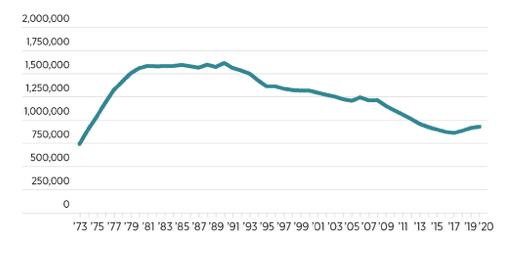
In the US, there were 3,664,000 births in 2022, 12.012 births per 1000 people. That’s 1.5 times the birth rate of China, and a 1% increase from 2020, but significantly below the birthrate of the boomer generation. In the last year, there were 928,000 abortions, see graph below, or 25.3 abortions per 100 live births. Our population is as old as China’s, but the additional children suggests that our society will continue longer.

In America, the case for abortion is that it’s a woman’s right, see ad below. Anti-abortion is presented as slavery and a Republican plot for male domination. Politically, this has been a winning argument for Democrats; helping them win big in elections. They made good on the argument and amended the Michigan constitution to allow abortion till birth with the father having no say. The legal and religious establishment has gone along. They may want some limitations, but there is no consensus on what the limitation should be.

Abortions per year, US, Guttmacher Inst. report, 2022.

It’s been suggested that a good way to lower the abortion rate would be higher taxes to provide more healthcare and child benefits. That may be, though I’m not sure it’s the direct, sure route. China has free healthcare and benefits. I suspect that the preachers should do more personally to deal with the vulnerable. Another thought is to promote is rural living. In the US and China, rural areas have higher birth rates, while the cities have low birth rates and high abortion rates. The highest abortion rate in the US is in Washington DC.

In the US, abortion is presented as a right, and as a Republican anti-woman plot.

My overall sense is that Children are good: Admittedly, they are expensive hobbies, but they are worth it, for the parents, for the nation, and in particular for the child. Children are a beautiful part of life and a beautiful part of any environment, IMHO. They like to grow amid sunshine and fresh air.

Robert Buxbaum, March 14, 2023

Germany is the biggest loser in a long Ukraine war

Early in the Ukraine War with Russia, Poland sent 200 T-72 battle tanks to Ukraine. Most other NATO members joined in, sending tanks, missiles, guns, supplies and technology. Germany sent nothing and have continued to avoid helping Ukraine as much as possible while the war dragged on for a year. Germany seems to have hoped for a quick Russian victory leading to a quick return to the pre-war state of affairs. That’s not likely. Even early on, the war looked like a slow, long slog. Reluctantly, this month, Germany promised to send 18 Leopard tanks to Ukraine, requesting, as replacements, mothballed tanks from Switzerland.

Germany is currently the 4th largest economy in the world, just behind Japan, and ahead of India (for now). They also have the 3rd oldest population. Their place as the leading economic and political power in Europe rests on a close relationship with Russia that is fading. They import Russian raw materials and use them to manufacture products for export.

Before the war, Germany imported most of its oil and 65% of its natural gas from Russia. Much of the gas came via two Nord Stream direct pipelines, that bypassed the rest of Europe. Well into the war, while the rest of Europe disengaged, Germany is still buying its supplies from Russia and funneling it west: steel, aluminum, titanium, ammonia and platinum. Some Russian natural gas too, by way of Poland. The German economy is based on turning these materials into cars, high tech machines, and chemicals for export to the US, the EU, and China. Because of their old population and generous benefits, Germany manufactures using cheap labor from low wage, EU nations and abroad. These transient workers do not get citizenship or retirement benefits, enriching Germany at the expense of their neighbors. The current war presents Germany with more potential workers, Ukrainian refugees, but far fewer Russian supplies. As a result, the German economy is shrinking, and so far the Ukrainian refugees are mostly left unemployed. German industrial production is down by about 4% this year leaving its GPD at about $4T/year, about where it was in 2018. The US economy and the rest of Europe has grown.

Ex German Chancellor, Gerhard Schroeder, with Putin. He’s now head of Nordstream and Rosneft.

Emblematic of Germany’s peculiar ties with Russia is Germany’s ex-chancellor, Gerhard Schroeder, shown at left with Putin. Schroder remains a leader in the ruling German SDP party, the party of Ms Merkel and of the current chancellor, and also the chairman of the board for Nord Stream AG and of Rosneft, (Russian aerospace). He also sits on the board for Gasprom (Russia’s energy conglomerate). He’s also on the board of Rothschild, a prominent International bank, and is chairman of the board of the Hannover 96 football club.

These attachments are not problematic, as the rest of the EU, along with the rest of the developed world, has come to hate Putin and Russia; they’re not too fond of Rothchild either. Europe is unlikely to tolerate Germany’s Russian imports, including titanium (65% of Airbus titanium comes from Russia) or natural gas. Germany has asked for a titanium exception, and been denied. What’s more, three of the four Nord Stream pipelines have been blown up (by whom?) forcing Germany to buy natural gas from its NATO allies: Norway, Britain, France Holland, and the US. Gas purchases are expensive for Germany but helps its NATO neighbors. Germany has asked to be subsidized for this (unlikely, imho). It has also restarted old coal-burning power plants, an insult to the EU given how hard Germany pushed them on climate change. Russia is barely harmed since it can export to the other BRICS nations: China, India, Iran, Brazil.

Germany is now near recession. Much of Europe is close, but Germany is worse-off since they are buying from the rest.

Percent of population over 65, CIA Factbook.

German inflation averaged 8.5% last year (9.2% in January). That is not hyperinflation, but a shock for a country that’s averaged 1% inflation over the last 25 years. US inflation, by comparison was 7.5% last year — due to excess spending by the Democrats (imho) via the so- called “inflation reduction act,” — but at least the US economy grew, along with the US population. The German population shrank. It seems to me that, without Russian supplies, Germany will continue to slip versus the world and versus the EU.

Excess mortality for European countries has been very high for the last 6 months, especially in Germany. Death rates are up by 25% or so. Much of it is heart-related. Perhaps it’s COVID, or long COVID, or air pollution, or vaccines, or depression.

The German population is among the oldest in the world, with among the highest percent over 65, see map. The death rate has spiked 25% over the last 6 months, in part because of COVID, but also because of alcoholism, drugs, pollution, vaccines, or depression. The rest of the EU saw similar spikes, but earlier in the pandemic. Sweden has largely avoided these problems – they treated COVID differently.

Germany has been propping up its inefficient industries with low cost loans. The hope is that things will go back to normal soon with Russia, and that the companies will make good. Until then, the loans discourage competition and modernization, and it becomes ever more likely that these inefficient German companies will default. If the do, they could take down their lenders. This happened in Japan in the 90s, and with Lehman Bros. in the US. Default seems likely for many Chinese companies too.

It becomes ever more likely that these inefficient German companies will default.

Even if the war ended tomorrow, it’s not clear that Germany could go back to its pre-war status. The blown Nord Stream pipelines will need a year or more to repair. And may never restart, as sanctions might remain long after the fighting ends, as with Cuba or North Korea. Russia seems to have recognized this, and is selling more titanium, gas, oil, aluminum, and food to Iran, India, and China. Iran, in return, has become a major supplier of drones and consumer goods to Russia. In the last two years, the Iranian GDP has doubled to about $2T/year, nearly half the size of Germany’s. Iran is growing while Germany shrinks.

Russia’s trade with India and China has grown, via their “dark fleet,” and the Trans-Iranian railroad that would allow easy shipments from Russia to India and China via the port of Tehran. The first direct shipment of this sort was completed in July 2022– Caspian Sea containers to an Iranian train to ship to India and China. If the war goes on, Iran, India, and China will benefit at the expense of Germany, it seems. India, in particular. India’s economy is already approaching the size of Germany’s, and will probably pass it with the help of Russia’s energy and raw materials. Meanwhile, Germany is left with an aging population and aging industries; with few suppliers, and no obvious competitive advantages. The rest of Europe is almost as badly positioned, but they have better demographics, and can still sell to Germany. As for Ukraine, it seems to be doing well, despite the war — or because of it. They still grow and export food and energy. They are holding their own in the war, for now despite destruction in the east. Ukraine get money and technical aide, and might come out stronger from the war, as happened with South Korea and Vietnam. It is hard to see how Germany comes out well. This, at least, is how I see things today.

Robert Buxbaum, March 8, 2023.

Our Jail Minimums are Huge, or non-existent

The United States has more people in prison, per-capita, than any other developed nation, see graph below. Our rate is double Russia’s, and barely below Cuba’s. About 38% of our prisoners are black. That’s a sign of cultural differences or systemic racism; perhaps both.

A major reason for our high prison rate is our huge minimum sentences. In Michigan, as most states, if you possess a firearm when committing a felony or an attempted felony, two years minimum are added to your sentence. The judge’s only allowed input is to add time, or to drop the felony charge. By law, two years minimum have to be added before (not during) the sentence for the underlying felony. It increases to 5 years minimum if you have a prior conviction, and 10 years if you have two or more prior convictions – on top of whatever the Judge decides for the crime. Typically, for a repeat offender, the judge will sentence zero for the felony, because 10 years is enough. Or he will drop the felony charge. The standard penalty, is either the huge minimum, or zero. About 25% of those in Michigan prison, are serving this minimum. Many others who should have gotten a month, or a year, were let go with nothing to avoid giving the minimum -crazy.

Countries with the highest prison population per 100,000 as of January 2023 (from statistica). No country in Europe makes this chart, Russia included.

These laws are specific to guns. No other deadly weapon is treated this way. A knife assailant serves the sentence for the assault only with adding 2 to 10 years minimum. We could go a long way to reduce the prison population if this add-on were moved or severely shortened. I’d like it shortened to 3 months, and broadened to all deadly weapons.

Minimums serve a purpose, I think, preventing violent felons from going free with a good sob-story. But our minimums too long to prevent crime and now only prevent rehabilitation. After ten years in prison, released felons have no life to return to, and no family. The only life they have is crime. It’s been speculated that our huge minimums make felons more violent. Saint Thomas Moore theorized this in the 1500s: A criminal facing a long prison sentence might as well kill the witnesses and hope to escape.

The Michigan State shooter,who killed 3 last week was a felon whose charge was dropped to avoid sending a mentally unstable black man to prison for 2 years. Anthony McRae, had a history as “a hell-raiser,” and was known to be mentally unstable. He had been shooting his gun outdoors near his home, and upon arrest was in possession of a concealed, loaded gun with no permit. These could be changed as firearm felonies, punished by 2 years minimum, or the Judge could drop the case, leaving McRae with his gun. The judge dropped the case, and returned the gun. McRae went on to kill with it. If the minimum were lower, 3 months say, I believe the judge would have convicted Mr McRae’s to that minimum, and taken his gun.

As it was, the judge was faced with the choice of ordering 2 years or nothing.

Our drug sentencing minimums are too high too, especially for “bad drugs.” These carry a 5 to 10 year minimum sentence with no chance for parole. But “dad drugs” are often the ones black people take: LSD, Crack, Heroin, and Methamphetamine. The drugs white politicians take are treated leniently, e.g. mayor Ford of Toronto, or Hunter Biden. I think we’d do everyone a favor by reducing drug minimums, even for bad drugs; for this, too, 2-3 month minimums should do with the judge having discretion to add.

There should be a maximum sentence too, I think, to stop hanging judges. And there should be rehabilitation, but it’s not clear we can manage that. The unions have opposed work-rehabilitation, calling it slave labor. Leader Dogs for the Blind allow prisoners to train guide dogs; it does wonderfully, but something bigger is needed. Lacking good rehabilitation, the smallest sentence that serves as a deterrent is what we should aim for.

Robert Buxbaum February 22, 2023. The original design of Sing-sing included work-rehabilitation in many crafts. The unions complained, and rehabilitation was stopped. Sentencing is a tough balancing act.

Plans to Raise-the-Dead-Sea

The Dead Sea in Israel is a popular tourist attraction and health resort-area. It is also the lowest point on the planet, with a surface about 430m below sea level. Its water is saturated with an alkaline salt, and quite devoid of life, and it’s shrinking fast, loosing about 1 m in height every year. The Jordan river water that feeds the sea is increasingly drawn off for agriculture, and is now about 10% of what it was in the 1800s. The Dead Sea is disappearing fast, a story that is repeated with other inland seas: the Aral Sea, the Great Salt Lake, etc. In theory, one could reverse the loss using sea water. In theory, you could generate power dong this too: 430m is seven times the drop-height of Niagara Falls. The problem is the route and the price.

Five (or six) semi-attractive routes have been mapped out to bring water to the Dead Sea, as shown on the map at right. The shortest, and least expensive is route “A”. Here, water from the Mediterranean enters a 12 km channel near Haifa; it is pumped up 50m and travels in a pipe for about 52 km over the Galilean foothills, exiting to a power station as shown on the elevation map below. In the original plan the sea water feeds into the Jordan river, a drop of about 300m. The project had been estimated to cost $3 B. Unfortunately, it would make much of the Jordan river salty. It was thus deemed unacceptable. A variation of this would run the seawater along the Jordan in a pipe or an open channel. This would add to the cost, and would likely diminish the power that could be extracted, but you would not contaminate the Jordan.

A more expensive route, “B”, is shorter but it requires extensive tunneling under Jerusalem. Assuming 20 mies of tunnel at $500 MM/mile, this would cost $10B. It also requires the sea water to flow through the Palestinian West Bank on its way to the sea. This is politically sensitive and is unlikely to be acceptable to the West Bank Palestinians.

Vertical demand of the northern route

Two other routes, labeled “C” and “D” are likely even more expensive than route B. They require the water to be pumped over the Judaean hills near Bethlehem, south of Jerusalem. That’s perhaps 600m up. The seawater would flow from Ashkalon or Gaza and would enter the Dead Sea at Sodom, near Masada. Version C is the most politically acceptable, since it’s short and does not go through Palestinian land. Also, water enters the dead sea at its saltiest point so there is no disruption of the environment. Route D is similar to C, somewhat cheaper, but a lot more political. It goes through Gaza.

The longest route, “E” would go through Jordan taking water from the Red Sea. Its price tag is said to be $10 B. It’s a relatively flat route, but still arduous, rising 210m. As a result it’s not clear that any power would be generated. A version of this route could send the water entirely through Israel. It’s not clear that this would be better than Route C. Looking things over, it was decided that only routes that made sense are those that avoided Palestinian land. An agreement was struck with Jordan to go ahead with route D, with construction to begin in 2021. The project has been on hold though because of cost, COVID, and governmental inertia.

In order to make a $5-10B project worthwhile, you’ll have to generate $500MM to $1B/year. Some of this will come from tourism, but the rest must come from electrical power generation. As an estimate of power generation, let’s assume that that the flow is 65 m3/s, just enough to balance the evaporation rate. Assuming a 400 m power drop and an 80% efficient turbine, we should generate 80% of 255 MWe = about 204 MWe on average. Assuming a value of electricity of 10¢/kWh, that translates to $20,000/ hour, or $179 million per year. This is something, but not enough to justify the cost. We might increase the value of the power by including an inland pond for water storage. This would allow power production to be regulated to times of peak load, or it could be used for recreation, fish-farming, or cooling a thermal power station up to 1000 MWe. These options almost make sense, but with the tunnel prices quoted, the project is still too expensive to make sense. It is “on hold” for now.

It’s not like the sea will disappear if nothing is done. With 10% of the original in-flow of water to the Dead Sea, it will shrink to 10% its original size, and then stop shrinking. At that point evaporation will match in-flow. One could add more fresh water by increasing the flow from the sea of Galilee, but that water is needed. When more water is available, more is taken out for farming. This is what’s happened to the Arial Sea — it’s now about 10% the original size, and quite salty.

Elon Musk besides the prototype 12 foot diameter tunnel.

There’s a now a new tunnel option though and perhaps these routes deserve a second look: Elon Musk claims his “Boring company” can bore long tunnels of 12 foot diameter, for $10-20 MM/mile. This should be an OK size for this project. Assuming he’s right about the price, or close to right, the Dead Sea could be raised for $1B or so. At that price-point, it makes financial sense. It would even make sense if one built multiple seapools, perhaps one for swimming and one for energy storage, to be located before the energy-generating drop, and another for fish after. There might even be a pool that would serve as coolant for a thermal power plant. Water in the desert is welcome, even if it’s salt water.

Robert Buxbaum, February 14, 2023.

Birth dearth in China => collapse? war?

China passed us in life-expectancy in 2022, and also in fertility, going the other way. In China lifespan at birth increased to 77.3 years. In the US it dropped an additional 0.9 years, to 76.8. US lifespans suffered from continuing COVID and an increase in accidents, heart disease, suicide, drugs, and alcohol abuse. Black men were hit particularly hard, so that today, a black man in the US has the same life expectancy as he would in Rwanda. China seems to have avoided this, but should expect problems due to declining fertility and birth rates.

China passed us in life expectancy in 2022.

Fertility rates will eventually burden the US too, as US fertility is only slightly greater than in China, 1.78 children per woman, lifetime, compared to 1.702 in China. But China has far fewer people of childbearing ages, relatively, and only 47% are women. Three decades of one child policy resulted in few young adults and a tendency to abort girls. Currently, the birthrate in China is barely more than half ours: 6.77 per 1000, compared to 12.01 per 1000. And the proportion of the aged keeps rising. China will soon face a severe shortage of care-givers, and an excess of housing.

Years of low birthrate preceded the “Lost decades” of financial crisis in Japan and the USSR. Between 1990 and 2011, business stagnated and house prices dropped. China faces the same; few workers and more need for care: it’s not a good recipe.

Beginning about 1991, Japan saw a major financial collapse with banks failing, and home values falling. China seems over-due.

Few children also signals a psychic lack of confidence in the country, and suggests that, going forward, there will be a lack of something to work for. Already Chinese citizens don’t trust the state to allow them to raise healthy children. They have stopped getting married, especially in the cities, and look more to have fun.

Affluent women claim they can’t find a good man to marry: one who’s manly, who will love them, and who will reliably raise their standard of life. Women seem less picky in China’s rural areas, or perhaps they find better men there. However it goes, urban women get married late and have few children, both in China and here. China produces great, sappy, soap operas though: a country girl or secretary in a high-power job meets a manly, urban manager who lovers her intensely. A fine example is “The Eternal Love” (watch it here). It involves time travel, and a noble romance from the past. Japan produced similar fiction before the crisis. And a crisis seems to be coming.

While Japan and Korea responded quietly to crisis and “the lost decades,” allowing banks to fail and home values to fall, Russia’s response was more violent. It went to war with Chechnya, then with Belarus and Ukraine, and now with NATO. I fear that China will go to war too — with Taiwan, Japan, and the US. It’s a scary thought; China is a much tougher enemy than Russia. There is already trouble brewing over new islands that they are building.

Robert Buxbaum January 25, 2023. If you want to see a Korean soap opera on the Secretary – manager theme, watch: “What’s wrong with Secretary Kim”. (I credit my wife with the research here.) I suspect that Americans too would like sappy shows like this.