Category Archives: politics

98% Certainty that Trump has reduced crime in DC

It’s been 24 days since Trump sent the national guard into DC, and the crime rate has dropped by a factor of six. The murder rate went from 101 murders per year in 2024, one murder every 3.6 days, to one murder in 24 days. I find that the odds of this being coincidence is less than 2%. Car theft and other crime has dropped as well. I consider murder rate the best metric for crime because no murders go unreported, and none get misclassified as altercations or misunderstandings.

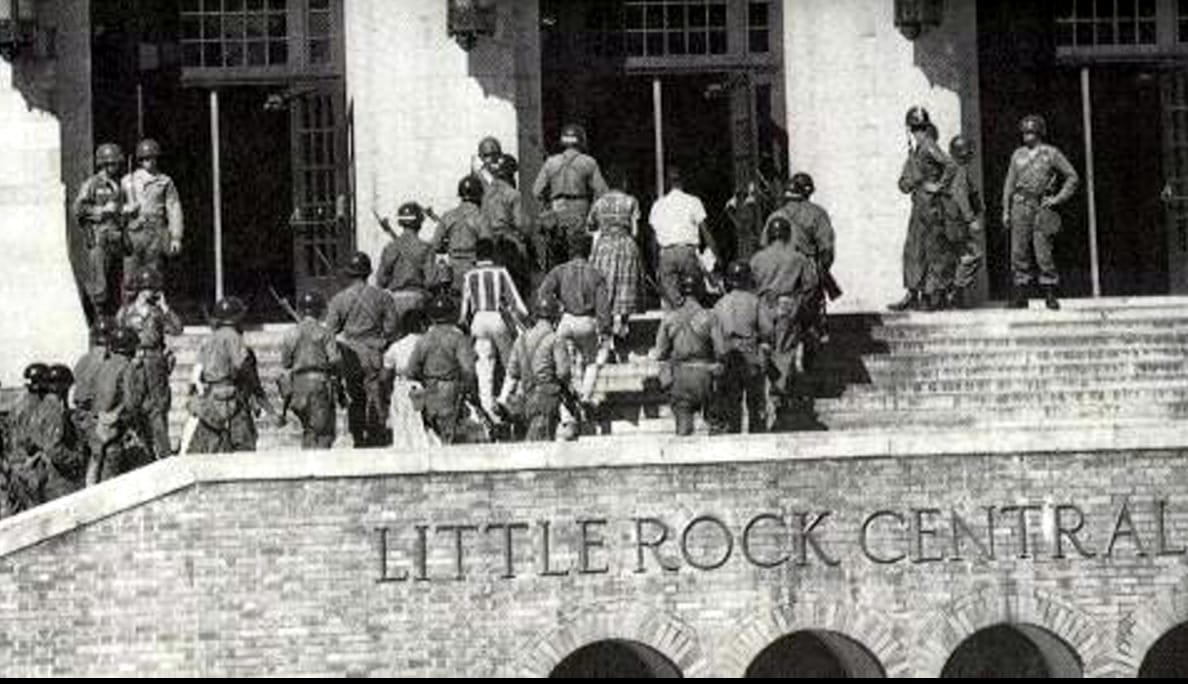
Using the National Guard to maintain order is not that unusual. Eisenhower sent them to Arkansas in opposition to the governor to ensure desegregation. LBJ sent them to Chicago to protect the Democratic convention of 1968.

To figure the odds that this improvement is coincidence, consider that the odds of a murder on any one day is 101/365 = .277. Based on this, the odds of no murder on any of particular days is, 1-.277 = .723. On any given day in DC it’s more likely to have no murders than to have a murder, but the odds get much lower for going many days without a murder, or for 24 days with only one. The chance of of having 24 days without murder, for example beginning at some set-start, would be (.773)24 = .0021 = 0.21%. The odds of having only one murder in this time is calculated similarly, as 24(.277)(.773)23 = 1.8%. This is to say that there is a 98.2% chance that the drop in crime rate is not accidental.

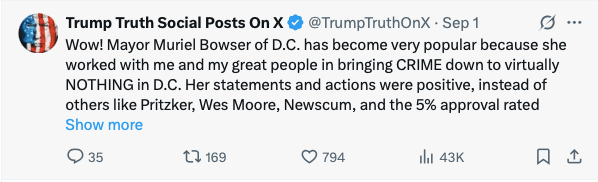
The D.C. Mayor Muriel Bowser had originally objected to the guard, but now is happy, or so Trump claims. If she removed them now on, she would have to argue that high crime rates are good. Other mayors may not want to be in this position.

A federal judge, Charles Breyer, just declared the use of the national guard illegal, by the way, a violation of the Posse Comitatus act of 1878 see the complete statement here. The Posse Comitatus act bars the use of federal troops for police activities, except federally related ones. Judge Breyer, decides that there is no federal justification and demands that the national guard leave within 10 days. Trump claims that various riots in DC and LA (and Chicago) constitute an insurrection, and adds that attacks on federal ICE agents and federal buildings makes it federal. Judge Breyer recognizes that many other presidents have used the guard for law and order, even in opposition to the governor. Eisenhower for example, or LBJ to protect the Democratic National Convention 1968, but sees no justification, here or (it seems) for Eisenhower or LBJ either. Judge Breyer seems to believe they all acted illegally. I don’t know enough law to judge, but recognize that allowing Trump to reduce the crime rate makes mayors and governors look bad. Detroit crime is awful, as is LAs, Chicago’s…

Robert E. Buxbaum September 4, 2025.

Tariffs on German cars are inflationary, but not for you.

As things stand, the major export of Germany to the US is high end cars: Mercedes, Audis, Porsches, BMWs, $100,000+ on average. The lower end models are made in the US, Mexico, and Canada. These high end cars are the biggest profit centers of their makers and of the German economy. Currently, they face an import tax (tariff) of 15%, the same as everything from Germany (or Italy or Japan). Liberal economists are furious at this; they claim it’s a tax and that it is inflationary. They are right on both counts except that this is only a tax and inflationary for the few Americans who buy new, high end cars.

The Americans who buy such cars are typically rich folks — poor and middle class folks can’t afford them. They are also folks with ‘taste’, folks who need a BMW, and would not be caught dead behind the wheel of a US car. Normally liberal economists would favor taxing such people, but these are often the who hire economists. They run the TV programs and newspapers, universities and hedge funds. They choose the economists and the economists are eager to see things their way.

Another high tariff item imported from Europe is art. Modern art for $1 million dollars that ends up in museums. For the average Americans the tariff on this, or on art is irrelevant or beneficial. The income it generates is used to offset other taxes, allowing Trump to remove the tax on tips, for example. That this tariff falls on rich people and replaces a tax that otherwise fell on poor workers. Liberal economists should favor of this, but their opinions are not their own.

A side benefit of these tariffs for ordinary folks, is that that they cause some buyers to switch to American-made products, cars and art. Perhaps not for themselves, but for for their children. They may buy a German car made in the US, rather than one made in Germany, or art from an American. This provides jobs for US workers — and an opportunity for Detroit to retool for the future. Detroit auto workers seem to understand this; they voted for Trump in 2016 and 2024. Detroit’s union leaders opposed tariffs. In Michigan, the union leaders get their power mostly from MI politicians, Democrats, who force union membership.

This is not to ignore the suffering of those who buy foreign products, the buyers of new BMWs, or French cheese, or high end art. As things stand, Columbian coffee is tariffed at 10%, and that may add 50¢/lb. Mexican coffee is not taxed, but many average Americans prefer Columbian. I hope they can be consoled by Trump’s tax breaks.

Some months ago, Trump showed off a tariff schedule that he considered ideal, with rates targeted to reduce our trade deficit by half. I derive here, Trump’s formula and rates, and give my opinions of the target. By the formula he presented, the EU tariff should be higher than it is, 20%. Trump has it at 15%, I think, for diplomatic leverage, to goad the EU into lowering their tariffs on us goods, now 15%. He’s also pushed them to spend more on defense, and pushed to end the war between Cambodia and Thailand. He threatened them with near 100% tariffs if they didn’t stop fighting.

Robert Buxbaum, September 2, 2025. Here’s a Bob Dylan song, union sundown, making a musical case against free trade. Once upon a time that was a liberal view. Now not. The NY appeals court ruled to block Trump’s tariffs to stop the horrible damage being done. My guess is the judges drink high-end coffee, eat French cheese, and drive new, German cars.

Trump’s temporary (permanent?) peace between Thailand and Cambodia

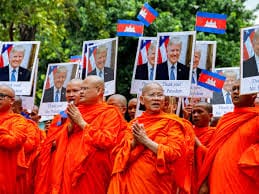
Four weeks ago, Trump managed to pause (perhaps end?) a century long war between Thailand and Cambodia that had flared up with F16s, rocket attacks, drones, invasion, and hundreds of dead. He did it by threatening to block trade with both countries if they didn’t sign a ceasefire. Within the day, they did. Perhaps, all they needed was a good excuse to stop fighting. The peace has lasted four weeks, though nasty words continue to flow. Some 70,000 Buddhist monks are very appreciative.

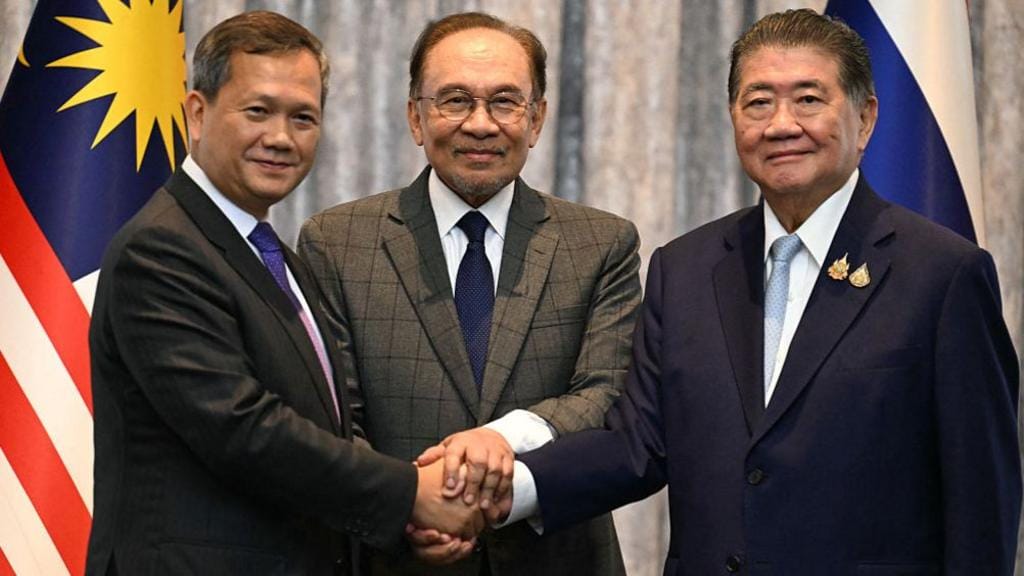
Malaysian PM Anwar Ibrahim (center) hosted the peace talks in Putrajaya as chairman of the Asian regional block, Official Photo.

Thailand and Cambodia have had had significant empires with overlapping land claims going back to the days of the kingdom of Siam and the collapse of the Khmer empire. A peace treaty was concluded between 1904 and 1908, but it involved ill- drawn, conflicting French maps. Several major Buddhist temples are in the disputed areas; they appear to be part of Siam in the earlier map, but part of Cambodia in latter documents. Siam complained weakly about the later documents, perhaps signaling accent, or signaling that they had the weaker army.

The problem festered this way until WWII when Siam allied with Japan and took back the territory it claimed, plus some more. After Japan lost the war, French Cambodia took back the territory, but Siam / Thailand re-armed and re-took in when the French left. It didn’t help Cambodia’s claims that it collapsed into a rein of terror under the Khmer Rouge. As things stand, the International Court of justice favors Cambodia’s claims. Then again Thailand now has the larger army, and has used it to occupy the disputed areas.

Buddhist thank Trump for peace request he gets the Nobel Prize. Photo from USA Today. Sometimes all it takes is a hard push.

A May-July, 2025 flareup in fighting resulted in about 200 dead and/or captured, mostly in the area of the historic temples, plus 135,000 displaced. The Malaysian PM, Anwar Ibrahim, tired to achieve peace, and on July 28, 2025 Donald Trump stepped in and calling both leaders in the midst of tariff negotiations and informed them that they would be banned from US trade if they didn’t stop fighting. With Malaysian help, they signed a ceasefire that day. The presidents thanked Trump; 70,000 Buddhists marched and asked that he get the Nobel Prize. It’s the power of tariffs, and of personality.

Will the peace last? It has for four weeks now, and seems to be holding. The press downplays the significance saying that Trump only got involved because he wants the Nobel Prize. Maybe, but people are not dying who would be. Peace is good and surprisingly hard. I would not mind seeing Trump get the prize, shared with Ibrahim. My guess is that it was motivated more by ego than real hopes of gain. They were in a position to push effectively, and did so. The push was a convent excuse for sanity. A month later, Trump brokered another peace deal, this time between Armenia and Azerbaijan. The press isn’t impressed with this either, nor with Trump’s efforts to end the war in Ukraine; they’re upset over his efforts to reduce the crime rate in DC.

Robert Buxbaum, August 28, 2025. Liberals have a happiness deficit. Here are some sayings of Zen Judaism, vaguely like Zen Buddhism.

Trump may have made peace between Azerbaijan and Armenia; Or it might be a horrible mistake.

Relief poster during Armenian genocide

The Turks and Armenians have been at war for centuries. Perhaps the major event in the war was in the years leading to WWI. The Turks invaded the Armenian region of their empire, killing about 1 million. More recently, Armenia invaded Turkish Azerbaijan, taking territory including the Negorno Karabakh region, while killing and exiling 50,000. Armenia had allied in its fight with Iran and Russia while Azerbaijan had allied with Turkey and Israel. Fighting had continuing until last week when Trump signed a peace deal that involved the US private industry (Trump) building a corridor, modestly named the Trump Road for International Peace and Prosperity (TRIPP). No normal diplomat or investor would indulge in such a deal, and no normal person would commit to it. It seems certain to fail, but then again, it might bring peace to the region and money for Trump.

From the economist

The logic of the deal, and why it might work, is that the wars may have not been so much wars of religion, but wars of geography. The Armenian, Christian communities are dispersed within the Muslim Turkish and Azerbaijani communities. Without their help the Armenians can not communicate with each other nor sell or receive goods. Turkish and Azerbaijani communities are dispersed within Armenia and Iran. Azerbaijan is divided in half, while Negorno Karabakh is entirely within Azerbaijan. The proposed Trump Road would allow transit and trade. Trump and colleagues would to build and defend this road, allowing trade, in particular allowing the flow of oil and gas from eastern Azerbaijan to western, and perhaps even to Turkey, implied is also free trade with Negorno Karabakh. It seems good, and the leaders of Armenia and Azerbaijan have signed their agreement. As presented, the road would be Armenian territory, but would allow free transit, though not likely of weapons from Iran.

Official photo of the signing; Donald Trump (C), Azerbaijani President Ilham Aliyev (L), and Armenian Prime Minister Nikol Pashinyan (R), August 8, 2025.

Could it work? Trump is a magician, and sometimes he does what seems impossible. Still there is a lot that could go wrong. Even if this conflict isn’t religious, there are long simmering hatreds, and deep distrust. This is, at best couples therapy, and the one who typically loses is the peace maker. The Armenian Daily Journal has already complained that Armenia gets too little economic benefit, “just crumbs.” There is no way to please both sides, 100%.

There is also a trouble maker, Iran. Iran is in the middle of a 1000 year long religious war for control of the region. Iran sells oil and gas to Turkey and Syria, while funding revolutionaries, Hezboalh. They are not willing to see their trade displaced by Azerbaijan and the US. Iran’s leaders have threatened war to maintain their control. Iran was more threatening two months previously, but Trump punctured Iran’s nuclear program, and joined with Turkey and Israel in the removal of Hezbollah from Syria. Iran still has one card more, but it’s weaker than it was. As a member of BRICS, they have called on their BRICS allies, China, India, and Russia to help them keep the US out. So far, nothing. In a region like this, no normal person would get involved, but Trump is no normal person, and peace is good, if only for a few years (or weeks).

Robert Buxbaum August 23, 2025; A week prior to this peace agreement, Trump seems to have forced a peace between Cambodia and Thailand by refusing to negotiate trade with either until they make peace. Here’s the BBC’s take.

Liberals are unhappy, every demographic less happy than conservatives.

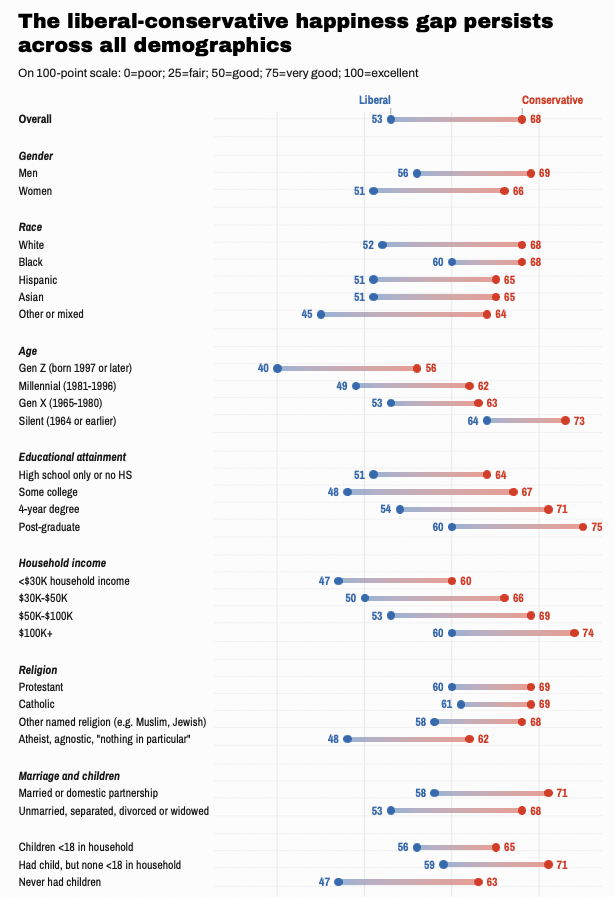
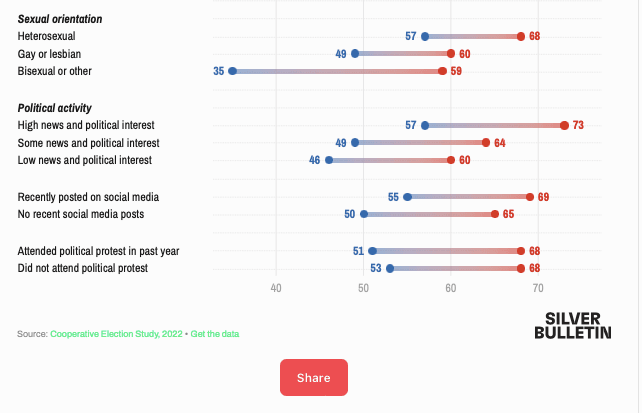
Liberals are less happy than conservatives, a finding that has been found consistently in every study since the first in 1972. It persists for Americans whether Democrats or Republicans are in control in Washington, and holds true for both sexes, and all sexualities, all ages, all races and incomes, all education levels. An example is the 2022 Cooperative Election Study from Tufts University. According to the survey, organized by Nate Silver for his silver bulletin, here, liberals of every demographic are significant less happy than conservatives in that demographic, with an average difference of 15 points on a 0 to 100 scale.

Graphic from Nate Silver’s “Silver bulletin,” based on data from the 2022 cooperative election survey.

I note that 2020-2022 was the height of the Biden administration, with Democrats in control of the entire government.

Some of this can be explained perhaps by self-selection: A liberal may considered a person who don’t like the current situation, and wants it changed, while a conservative, in some sense is someone happy with the status quo. Of course this isn’t the full story, since conservatives too generally want to see change — smaller government, less regulation and taxes, and the like. The real gap in happiness, then seems to come from a difference in perception of how important the change is, or how bad things are now. Liberals, on TV at least, claim that America is awful, among the worst countries ever: racist, sexist, colonialist, violent, stupid, fascist. They blame the US for warm temperatures and suffering Iranian women, finding half of their fellow Americans – those who don’t agree– “a basket of deplorables,” to quote Hillary Clinton, where half of these conservatives needed re-education, in her view, and the other half were beyond re-education. Conservatives are just not as unhappy. They still think that they can “Make America Great Again”, perhaps by capturing something of the good old days (1945, say).

Devyn Brandt (They/Them) orientation advisor for Washington University. My guess is liberal, and not very happy.

The happiness gap has increased with time and extends into mental health. In the 2022 Cooperative Election Study  found that, 16% of all Americans who voted for Joe Biden had depression in 2020. Going further, 45% of self-described liberals said their mental health was poor. By contrast 51% of conservatives said their mental health was excellent, and only 19% said it was poor. This might be self-delusion, still it is consistent year to year. A year later this 2023 depression study from Columbia University found only 20% of liberals who believed they had excellent mental health while 51% of conservatives believed their mental health was excellent. Presenting this another way, among voters who said their mental health was poor, 45% identified as liberal, and 19% as conservative. The remaining 36% were either independent, or decided not to answer the question.

Going back to an older Pew study 2008, 47% of Republicans said they were “very happy” compared to 28% of liberal Democrats. All of the advances since then, have not made liberals less unhappy, if this 2019 study is to be trusted, they keep looking for meaning in their lives, and things to be unhappy about.

Some things make liberals happy, though, and one of them is money. The highest income liberals (>$100k per household) are happier than poorer liberals, but only as happy as the lowest income conservatives (<$30k/ household), 60% in both cases. Education helps too, but not as much, and religion. Political activism only makes things worse, both for liberals and conservatives. My advice for the summer: try ice cream. It always works for me. And this song from the musical Iolanthe, where the guard outside the parliament confides that political stance is inborn, with particular opinions handed down by others, including a band of mischievous fairies.

Robert Buxbaum, June 24, 2025

Deriving Trump’s tariff formula, and correcting it.

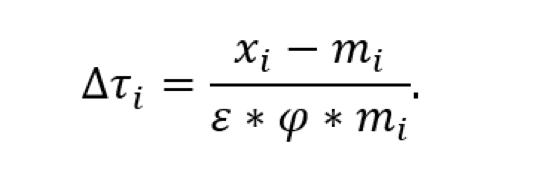
We have a trade imbalance with many countries, it causes a loss of American jobs, and a transfer of currency abroad. This imbalance is not all negative, of course, it provides US consumers with cheaper consumer goods. Trump would like to eliminate the imbalance using tariffs. He hopes that this will create jobs, and that the money raised will help balance the US budget. He’s already moved to end income taxes on tips expecting to replace that tax with tariff income. Trump claims that the tariffs are not inflationary compared to current the tax system that he claims has been hacked by the elites. In past essays, I’ve discussed the pluses and minuses of tariffs here, and here. Now I’d now like to derive the formula Trump uses, see below. The proposed tariff for any country or region, i, he calls ∆τi.

In the equation at left, χi = our exports to country, i. Similarly, mi = our imports from that country. The difference between these two is our trade imbalance, something he’d like to set to zero. There are two other greek terms that I will discuss, ε and φ. These are the elasticity of elasticity of consumption to price, and the elasticity of price to tariffs. Trump uses an asterix here to indicate multiplication. I will use a, more normal, “dot” symbol, •, to the same purpose. For most countries, he takes the two elasticities to cancel to 2, and produces a chart.

Let’s say that the dollar amount we currently buy from some country, i, = m = ni • Pi, where ni is the number of items bought from this country, and Pi is the average price. The intended effect of tariffs is to reduce mby raising Pi, the price consumers pay for goods from that country. This increase is certainly inflationary in terms of the consumer: a consumer of French wine will pay more per bottle unless he/she switches to US wine. Typically this price rise is not inflationary in terms of the country as a whole, because the producer likely swallows some of the tariff, so for the country as a whole, we pay less per bottle of French wine. The customer does not see that, but it’s worth noting. Trump sees things this way.

Back to the formula, we need to figure out how much the price will go up and how much sales will change. Economists have elasticity numbers for both these relations, denoted φ and ε. We can say that, for any country, I, the rise in the price of the average product is ∆Pi = Pi•∆τi •φ. Where Pi is the original price, ∆τi is the tariff, and φ is the fraction of this tariff that gets passed on to the consumer. A typical value is φ= 1/2 though some claim less. Assuming φ= 1/2 , if we add a 20%=∆τi tariff, as on on French wine, the consumer price will rise by 10%, a change that will cause him/her to buy less.

How much less will the consumer buy? That’s determined by the elasticity of sales, ε. This is the fractional decrease in the number items bought per fractional rise in the price. In math terms, ∆ni /ni = -ε∆Pi/Pi where ε is the elasticity. Now, since ∆Pi = Pi•∆τi •φ, we find that:

∆ni = -ni•ε•∆τi •φ.

There is evidence to suggest that, for the average product, ε equals about 2, and also evidence that it’s 4. Trump prefers 4, and uses it for his calculations. I prefer 2, and will get nearly the same tariffs at the end. Whatever our preferred value for ε, our next step is to use the following approximation, accurate for small ∆(mi);

∆mi  = ∆(ni•Pi) = ∆ni•Pi, +  ni•∆Pi

Trump seems to ignore the second term. Perhaps because it can either be positive or negative, as I’d mentioned above, depending on whether you look at things in terms of the customer or of the US as a whole. I’ll keep it in, writing this term in lighter text. In the end I will calculate a fairly similar tariff to Trump:

∆mi = -ni•ε•∆τi •φ•Pi  + ni•Pi•∆τi •φ.

Rearranging the above, and recalling that ni•Pi• =mi, you can find the appropriate tariff to eliminate the trade imbalance.

∆τi =   -∆m/(ε • φ• mi  + φ•mi) .

To make the trade imbalance go away, you need -∆mi = χi-mi . Thus,

∆τi =   χi-m /(ε • φ • mi  + φ•mi)

This is the Trump formula with an extra term in light text. If you ignore that term and use the values Trump prefers, ε =4 and φ=1/2, you get the exact values of the tariffs he listed on the chart for most countries — those with positive trade imbalances.

∆τi =   χi-m/ 2 mi  

Now, I’d like to put back in the missing term, and use the (better) values, values I would trust, ε =2 and φ=1/2. Using those values, I find the tariff should be slightly higher.

∆τi =   χi-m/ 3/2 mi  .

I should note that some countries are creating to these trips by raising their own tariffs, and some are lowering theirs. This will cause a change in the imbalance of trade, and Trump will have to change the tariff schedule periodically to keep up.

Robert Buxbaum, April 10, 2025.

Making semi-traditional STAM ink using walnuts.

Jewish tradition requires certain holy items that have to be written on parchment with kosher, opaque, black ink. These items are abbreviated, STAM, books of the Torah (Sifre Torah, in Hebrew), Philactaries (Tefillin in Hebrew), and Mezzuzos for the doorpost. To be kosher the ink must be made from kosher sources: plant matter, soot, water, and/or inorganic chemicals. That leaves a lot of options, and it is likely that black Sharpie would be kosher, at least after the fact. Ideally, the ink should wash off in water too, based on Numbers 5:23 (Also, Rambam, Hilchos Tefilin 1:4, and Shulchan Aruch, YD 271:6).

There are ancient recipes, and I decided to semi-follow one, using walnuts instead of the classic gall nut and copper vitriol instead of iron. The aim was an ink that’s dark, long lasting, compatible with animal-skin parchment, and dissolvable. Some vegetable inks rot or fade, and most iron-based inks become permanent, like paint, they do not re-dissolve in water. If you don’t want to go through all this, you can buy kosher iron ink, e.g. here, knowing that this ink isn’t ideal, but it’s the type most people use for the practical reason that it looks nicer and permanent is a comfort.

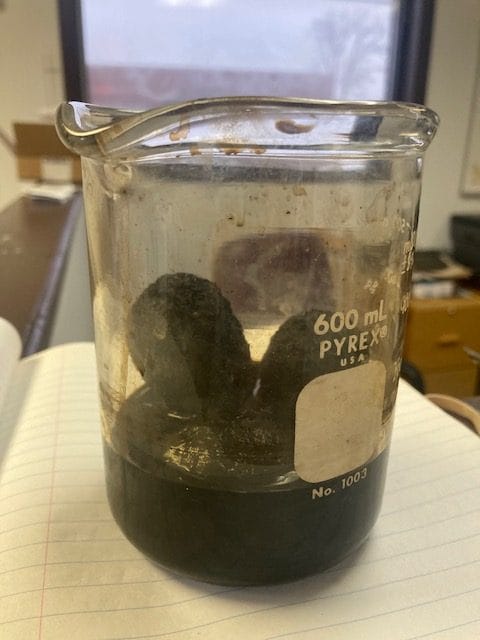
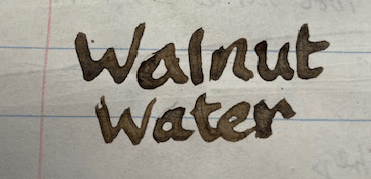
The classical recipes for STAM ink is based on using the shell of gall nuts, a tree-growth (not really a nut) found in the Mid-east. As an experiment, I’ve tried to make a respectable, kosher ink with walnuts instead. Walnut trees grow readily in the midwest. I collected a dozen walnuts with their husks from a tree near my home. The outer husk had been green originally, but had turned black by the time I picked them (mid November). Rather than extract the inner shell, I used the walnuts as I found them, and tried boiling them in denatured alcohol, and also in water. Boiling in alcohol didn’t work well, producing the weak ink shown below, left. Boiling in water (below right) produced a much darker liquid. I used this as the basis of my ink.

Boiling walnuts in water produced a dark liquid, walnut water.
I boiled walnuts in alcohol. The water-ink runs and isn’t dark.

The traditional recipe begins by boiling gall nuts in water to produce a brownish ink-wash that looks hardly darker than my alcohol-wash ink. You then add soot and “green vitriol”. Perhaps that is copper sulphate, or perhaps iron sulphate. Copper sulphate is a dark blue, while iron sulphate is a light green. With gall nut water, it turns out that iron vitriol works ‘better’, reacting with tannin in the gallnut water to make a nice, black color that becomes a permanent ink. When tried the two types of vitriol with my walnut water, I saw no color advantage to iron over copper, and no real color change.

I put the walnuts in a beaker as shown, nearly covering them with water, and put a piece of foil on top. The longer I simmered the darker it got. In the end, I left the mix on a hotplate, on low for nearly a day as shown above. The ink-wash, by itself is a reasonably good ink, as shown below left.

The traditional recipe that I’ worked off o’m modifying includes three more ingredients, so I experimented with them. These were vitriol, soot, and gum Arabic, in proportions shown below, in the form of a poem in Arabic written about 900AD. The first of these additions I tested was vitriol. I first tried copper sulphate, half as much as walnut water, and found that it darkens the color a little and makes the combination a bit thicker thought the ink is still watery. Copper sulphate is an antimicrobial too, so even without changing the color much, I imagined this was a worthwhile addition. I also tried making the walnut ink with iron sulphate. This makes the ink slightly darker too, perhaps, but not thicker. I have less confidence about iron’s antimicrobial properties, and there were concerns that it could harm a parchment over time. I also worried that it would make the ink permanent.

Ink made from walnut water, copper sulphate, and soot. Perhaps better?

The next ingredient was soot. It’s used to make the ink darker, and perhaps thicker. Traditional soot is made from burning olive oil. One collects the soot by placing a plate over the smoky oil fire. I tried a bit of this, but it was slow, and I had some chemically produced soot in my lab, bought from MER corp, leftovers from making buckminsterfullerene. I added as much soot as vitriol as in the poem below, and as expected found it increased the blackness of the ink. It also changed the texture, making the ink gritty and harder to write with. I had trouble dissolving the soot into the ink too, and apparently I’m not the first to have this trouble. Some suggested heating, and some suggested honey. I tried both, and heating helped more than honey. I also tried using a drop of dish soap. The result, above left, was blacker than the original, but the writing is not professional grade, IMHO. The ink does not write well, and it still doesn’t cover 100%. I moved on to the next ingredient, gum Arabica.

The recipe for ink, musclé, via a poem by Mukla Farsi, 900AD from blog of the Bodlieian Libraries at Oxford.

The mixing ratios in this poem are not exactly clear. The amount of soot is the same as of vitriol, and half that of gall, but is this the weight of the gall nuts, or volume, or the weight of the dried extract. I used volume of walnut water and volume of soot, and have the sense that this is too much soot. Also soot is messy and hard to dissolve; use gloves and a lab jacket. the soot does not come out easily.

My final ingredient is gum Arabic, the gum of the acacia tree. This seems to be used as a thickener. Gum Arabic is available in the US, on Amazon as an edible “candy”, so I bought some. It wasn’t expensive, but took about 10 days to get here. In the meantime, I tried honey as a thickener. It appears in some ancient recipes, but didn’t really help here, and left the page sort of sticky. Gum arabic is solider, so I hoped for for lasting product. When the Gum Arabic came, I found that it was solid, crystalline, with has hardly any taste. Maybe Arabs add sugar? I figure there might be a mystical advantage to gum Arabic since it comes from the Acacia tree, the type of tree used to make the Ark of the Covenant. My expectation was that it might also make the ink darker, and that it might help dissolve the soot.

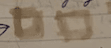
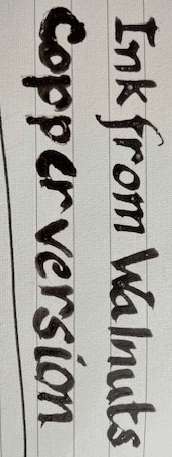
As it happens, gum Arabic doesn’t dissolve in cold water. But it did dissolve in hot water if I mixed it in and stirred for 5 minutes. The gum helped dissolve the soot too; gum Arabic seemed to do a better job than honey in this respect. Once the gum ink dried it was nice and solid, with the dried letters standing off the page a bit; they’re raised letters, and I really like that. The ink was still sort of grainy, perhaps from the walnut bits. I then tried dipping a written on parchment into some water and found the ink-letters dissolved easily. My understanding is that the ink I’d made was highly kosher for STAM, but as a follow-up experiment, I’m carrying some inked parchment in my breast pocket to see if it rots or fades. So far, no change. Some samples of writing are at left. The upper words are with the iron-vitriol version (iron sulphate), the lower with the copper vitriol (copper sulphate). You can sense why scribes might prefer the iron ink.

Robert Buxbaum, December 22, 2024. Scribes of 2000 years ago used wooden pens, it seems, as feather quills and fountain pens hadn’t been invented. I used a wood pen on some samples above, made by carving a popsicle stick. The better-looking letters, and longer passages, were written with a metal, calligraphy “quill.”

Sleepwalking into WWI, and WWIII

A remarkable book by Christopher Clark on WWI posits that WWI was an accident, entered into, by sleepwalk. That is, it was not brought on by the elaborate plan of an evil aggressor, Germany or Britain, acting for dominance or economic gain, but rather that many individuals precipitated the deadly conflict through a series of ever-more dangerous, unplanned steps. The great diplomats went on vacation following the June 28, 1914 assassination, and each minor actor felt a need to push for a previous status quo, emboldened by the certainty that nothing bad would happen, since none of the last acts had caused any serious harm, at least not to them. There was, in Clark’s view, a general numbness caused by earlier wars: in China and Russia, in Serbia and Albania, and by Italy’s invasion of Africa, and the fact that there had not been a major, deadly conflict since the Crimean war. In this environment, one nation shoving another was seen as normal conflict until a war broke out that killed millions and toppled four empires: the Russian, Austrian, German, and Ottoman.

Princip shoots Count Ferdinand, June 28, 914. Getty Immage.

Clark points out, too that the Serbs, the folks who started the war, benefited from it. They escaped from imperial control by Austria and from The Ottoman Empire. Self determination was the motivation for the assassination, and it worked too, for the Czechs, Croats, Poles, and communists. In just a few years, the former group got their own countries, and the communists took Russia, something that no one saw coming in June, 1914.

The key sleep-walk steps to war were as follows: In response to the assassination, and a decade of earlier insults, Austria-Hungary, demanded harsh cocessions from Serbia that Serbia found unacceptable. Austria Hungary, backed by Germany and Italy, declared war on Serbia. Russia then mobilized its troops for war with Germany, so Germany declared war on Russia. France, an ally of Russia, then mobilized for war with Germany, so on August 2 – 3, Germany declared war on France and invaded Luxembourg and Belgium. Why Luxembourg and Belgium — because they would not allow free transport of German troupes to attack France. This forced Great Britain to declare war on Germany, which, finally, on August 6, brought Austria-Hungary to declared war on Russia, and effectively on the rest of the Allies. Over the next few years, we (the US) were dragged in along with Japan, on our side.

What a mess, but I fear we may be sleepwalking to the same, grim altercation via our wars in Ukraine and Syria. As at the beginning of WWI, there are two big power alliances: NATO including The US and most of Europe, versus a BRICS alliance of Brazil, Russia, India, Iran, China, and South Africa, along with a few minor others. The alliances are now three years into a proxy war in Ukraine, and another one in Syria. So far the declared combatants are Russia vs Ukraine, and Turkey vs Syria, but both sides keeps harassing the other at a higher and higher pace. So far, the sleep-walk steps were that Russia invaded Crimea, in response to some insult, and then attempted to take Kiev. The NATO alliance responded provided limited weapons to Ukraine. But, as these proved insufficient, we (NATO) provided greater and more deadly weapons, plus some volunteer troops. Meanwhile Russia’s BRICS allies are selling drones and missiles into the conflict in return for Russian gold, wheat, and raw materials. One of us, perhaps Ukraine, then cut the RussianGerman gas pipeline, while China seems to have cut important communications cables in the Baltic Sea.

North Korea began sending troops, 12,000 apparently, to fight on the Russian side, while Biden has sent long-range missiles to be used for strikes deep into Russian territory, on logistic centers, train depots, food stores, airports, etc. Putin has threatened a nuclear response, but has done nothing so far beyond sending a few long range, hypersonic missiles against civilian targets and against Ukraine’s power grid. He’s lost some 600,000 Russians, and has lost control of Syria and Armenia, so he has reason to be upset. Ukraine has lost some 400,000, and is still losing territory, but is still demanding total victory, the removal of all Russian forces, including those in Crimea.

The fight has spread to Syria, where the US, Israel, and Turkey have bombed in recent days, something I would call an act of offensive war against a sovereign unstable government. It’s not totally unprevoked, of course. Syria and Iran had been attacking Israel for years from Lebanon, by way of Hezbollah jihadists. Recently Israel took out a major fraction of Hezbollah, and the jihadists (Sunni) seems to have gone back to Syria, and have removed Assad, Syria’s Shia president for life, with help from Turkey, another Sunni Moslem country. This too is an act of war. Assad retains a sliver on the coast where the Russian bases are, the red areas in the map below, but he isn’t popular with anyone at the moment. The rebel leader, Abu Mohammed al Jolani, was a member of Al Quada till 2006, and then member of ISIS (ISIL) under Abu Baghdadi till 2016 at least. He’s still on our terrorist list, though he now claims to be a progressive Moslem. Not everyone is convinced, or happy with him. Syria is divided into seven (or more) control zones, shown on the map below. He could bring peace to Syria, but his path to peace is clearly further war.

On the legal and PR front, we’ve called Russian president Putin a madman and war criminal, we support Turkey’s efforts to overthrow Assad, but complain about his attacks on the Kurds, the yellow areas, and dark green at right, and we both applaud and condemn Israeli President Netanyahu for attacking Syria in the south, and in the red sliver, destroying Syria’s navy. Meanwhile, we (the US) have taken it upon ourselves to attack ISIS (ISIL) camps in central Syria, the grey areas, as well as attacking troops (Iranian Shia) entering from Iraq. By normal definition, this would put us at war with Syria, and perhaps with Turkey since we support the Kurds in their war against Turks.

Recently we’ve decided that the rebel leader, al Jolani, might be taken off the terrorist list subject to a few conditions (I wonder which). We (Biden, Shumer) along with the International Criminal Court have called for the arrest and imprisonment of Israel’s PM Netanyahu. The Turks too have join in on this, while somewhat cheering Israel’s destruction of Assad’s navy. The Druze, allies of Israel (and us?) seem to be at war with al Jolani, and likely the Turks and Iran. They’re in south-east Syria, near Deraa, not shown by a color on the map. Meanwhile, Russia is trying to make peace with al Jolani, to secure their military bases, while Iran (Shia) has reached out to al Jolani (Sunni) in an effort to join with him in a war against Israel. It’s not quite tipped into world war, but it seems awfully close.

One possible peace maker might be the incoming US president, Trump, but the outgoing president, Biden, has done his best to tie his hands, branding him as a felon and seditionist, as well as claiming he’s a Russian asset. European leaders don’t like him either. France’s Macron might a peacemaker, but Macron’s government has fallen. The Germans or Turks might be peacemakers, but the government of Germany has nearly fallen, the economy of Germany is hurting, and Turkey is a combatant, at war with the Kurds and Druze. Iran, and Russia, though not combatants, are directly involved in the fighting, and both countries are under sanction by the US and EU, and the UN is discredited from it’s years helping Hezbolla. I thus see no clear path to peace and no peacemaker who will dial back the drama before we sleep-march into WWIII.

Robert Buxbaum, December 11, 2024

This is not the most important election, 1860 was

Every year we hear the same claim: that this the most important election of America’s history. This year is among the more contentious than most, but the issues dividing the candidates are few. Both, for example, claim they will protect the border and spur the economy. In lieu of issues, there’s name calling. Trump claims Harris is as incompetent buffoon and Harris claims Trump is a fascist dictator. The rancor practically guarantees as they’ll be riots whoever wins but, as these things go, the election is less important, and divisive than ’64 and ’68, and in particular, the election of 1860.

Following the 1860 election, election seven states ceded from the union and we had a Civil War. Even the most bleak prediction for 2024-25 is for a more peaceful transfer of power. The election of 1860 had two major issues on the ballot; one was slavery or rather the expansion of slavery to the territories, and the other was implementation of the Morrill tariffs. These import taxes, proposed by Justin Morrill and passed but not yet implemented, would have raised the average agricultural duty from 15% to to 47%. Duties on durable goods wool rise to 65%, with the burden falling disproportionately on the southern states. Duties on durable goods. There was also a price schedule that would have prevented British shippers from minimizing the effect by falsely claiming a price far below market, something China currently does. In September 1860, Republican Leader Thaddeus Stevens told a New York City audience that “the Tariff would impoverish the southern and western states, but that was essential for advancing national greatness and the prosperity of industrial workers.”

Matching the two sides to the two major issues of the day, there were four major candidates for president in 1860. All of them won states. Lincoln carried the greatest number, 18, and won the most electoral votes, 180. He was for high tariffs and against the expansion of slavery. Second was John Breckinridge, the Southern Democrat, who carried 11 states and got 72 electoral votes. He was for the expansion of slavery and against the higher tariffs. Then there was Stephen Douglas, the Northern Democrat, who was for allowing the expansion of slavery, considering it a “states right,” and also for the higher tariffs. Douglas carried only one state, Missouri, with 12 electoral votes. Finally, there was John Bell, the Constitutional Union candidate, who carried three states, Virginia, Tennessee, and Kentucky, representing 39 electoral votes. He opposed the expansion of slavery and also the increased tariff, but he generally believed that compromise was always possible. This was the worst vote split in US history. The worst split I’ve seen was 1968, when three candidates carried states.

Had either Bell or Douglas won, I suspect that the Civil War could have been avoided, at least temporarily. Virginia, the most important of the slave states, had shown it was willing to accept an anti-slavery president so long as he did not impose high tariffs — tariffs that benefitted the northern industrial workers and manufacturers at the expense of southern consumers and agricultural producers. Lincoln’s victory precipitated the immediate secession of 3 states. Another 4 seceded after inauguration.

The south imagined they could walk away because that’s how they read the constitution before the 13th amendment. They imagined they could win a civil war because they imagined they had British military support. “Cotton was king,” they claimed. The UK prime minister, Lord Palmerston, had told secretary Adams, “We do not like slavery, but we want cotton, and we dislike very much your Morrill tariff.” As it was, the British stayed on the sidelines, in part because of diplomacy. Besides, the gunship Monitor showed that the North could sink most any British ship that entered US waters.

As for 2024, I expect there will be riots whoever wins, but nothing more. The parties are realigning significantly, as happened in 1964-68, and neither side much understands the appeal of the other. This seems like less of a wrenching election than in 1964 and 1968, though. In ’64-’68 US boys were dying in Vietnam in numbers, and black folks and their white friends were being lynched in the south. Nothing like that is happening today. Today’s riots have been fueled by nothing more than name-calling, fear, and the occasional assassination attempt. Mild, even compared to 1968.

Robert Buxbaum, November 4, 2024. Justin Morrill is mostly remembered today for the Land-grant college act of 1862. This created an agricultural -technical college in each state. I taught at Michigan State University, Michigan’s land grant university. I’m generally a fan of tariffs, both as an aid to the domestic economy and as a tool of foreign policy. I present these views here. I got these views from Peter Cooper.

China’s space station and the ISS, a comparison

It gets so little notice from the news agencies that many will be surprised to find that China has a space station. It’s known alternately as the Tiangong Space Station or the CSS, Chinese Space Station; it’s smaller than the International Space Station, ISS, but it’s not small. Here is a visual and data comparison, both from Wikipedia.

China’s space station is smaller than the ISS, but just about as capable. Cooperation leads to messiness (and peace?)

The ISS has far more solar panels, but the power input is similar because the CSS panels are of higher efficiency. As shown in the table below, the mass of the ISS is about 4.5 times that of CSS but the habitable volume is only 3 times greater than of CSS, and the claimed crew size is similar, of 3 to 6 compared to 7. The CSS is less messy, less noisy, with less mass, and more energy efficiency. Part of the efficiency comes from that the CSS uses ion propulsion thrusters to keep the station in orbit, while the ISS uses chemical rockets. The CSS thus seems better, on paper. To some extent that’s because it’s more modern.

Another reason that the ISS is more messy is that it’s a collaboration. A major part of its mission is to develop peaceful cooperation between the US, Europe and Russia. It’s been fairly successful at this, especially in the first two decades, and part of making sure parts from The US, Russia, Europe, Japan, and Canada all work together is that many different standards must be tolerated and connected. The ISS tolerates different space suits, different capsules, different connections, and different voltages. The result is researchers communicate, and work together on science, sending joint messages of peace to the folks on earth. Peace is an intended product.

By contrast, the Chinese space station is solely Chinese. There are no interconnection issues, but also no peace dividend. It has a partially military purpose too, including operation of killer satellites, and some degree of data mining. This was banned for ISS. So far the CSS has hosted Chinese astronauts. No Chinese astronauts have visited the ISS, either.

Long march 6A rocket set to supply the CSS. It is very similar to the Delta IV.

India was asked to join the ISS, but has declined, wishing to follow China’s path of space independence. The Indian Space Research Organization plans to launch a small space station on its own, Gaganyaan, in 2025, and after that, a larger version. That’s a shame, though it’s not clear how long cooperation will continue on the ISS, either. See the movie I.S.S. (2023) for how this might play out. Currently, there is a tradition of cooperation about ISS, and it’s held despite the War in Ukraine. The various nations manage to work together in space and on the ground, launching people and materials to the ISS, and working together reliability.

Although it isn’t a direct part of the space stations, I should mention the troubles of the Boeing Star-liner capsule that took two astronauts to the ISS compared to the apparently flawless record of the CSS. The fact is, I’m not bothered by failures, so long as we learn from them. I suspect Boeing will learn, and suspect that this and other flailing projects would be in worse shape without the ISS. Besides, the ISS has been a major catalyst in the development of SpaceX, a US success story that China seems intent on trying to copy. SpaceX was originally funded, at low level, to serve as a backup to Boeing, but managed to bypass them. They now provide cheaper, more reliable travel through use of reusable boosters. The program supplying CSS uses traditional, disposable rockets, the Long March 5 and 6 and 7. These resemble the Atlas V, Delta IV and Delta IV Heavy. They appear to be reliable, but I suspect they are costly too. China is currently developing a series of reusable rocket systems. The Long March 9, for example will have the same lift capacity as SapceX’s Starship, we’re told. Will the Indian program choose this rocket to lift their space station, or will they choose SpaceX, or something else? The advantages of a reusable product mostly show up when you get to reuse it, IMHO.

Robert Buxbaum, September 10, 2024.