Category Archives: politics

What happened to Jack Kelly of Newsies

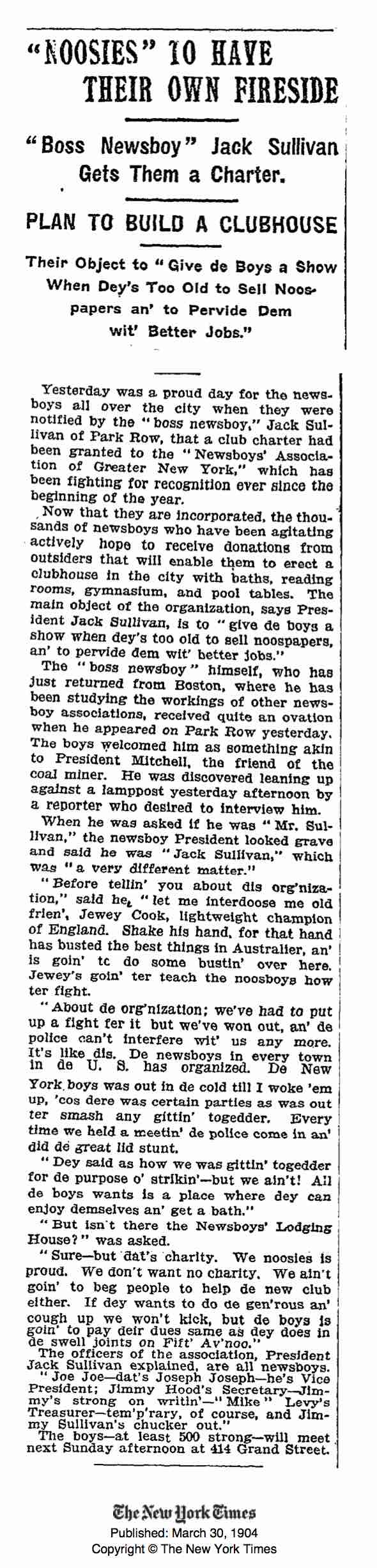
As my daughters are fans of the Disney play and movie, “Newsies,” and as I’ve taken interest in the early 20th century, they’ve asked me to find out what happened to Jack Kelly, the main character of the play/movie. If you’ve never seen it, Newsies is a musical about the New York newsboy strike of 1899. According to the play/ movie, as soon as the strike ends (the newsboys win), the strike leader, “cowboy” Jack Kelly goes off with Theodore Roosevelt, presumably headed to Santa Fé, New Mexico to become a real cowboy. But a simple search did not reveal what actually happened to the real Jack Kelly; here’s what I found. Noosies NYT

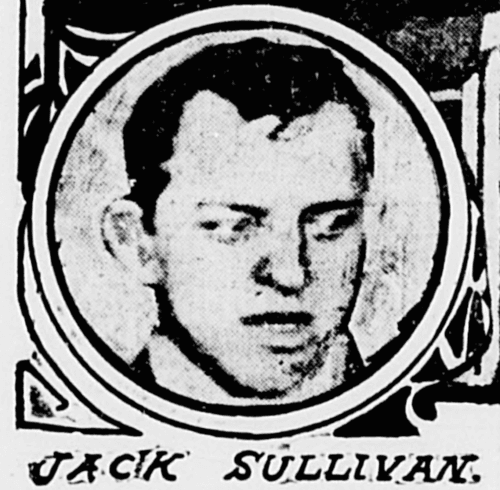
Without looking, I told my daughters that, if Jack Kelly had gone to Santa Fé in 1899, he would have found something very interesting: a cowboy school for young men. As it happened one of Roosevelt’s rough riders from the battle of San Juan Hill, retired to Santa Fé and set up a cowboy school for boys in the mountains above the town. He built a very outdoorsy operation in an area called “Los Alamos”. It ran until 1942 when the location was taken over to become “Site Y” of the Manhattan Project. This is where J. Robert Oppenheimer and co designed and built the first Atom Bombs. That Jack would have gone there would make for a nice, tidy story, but the truth appears to have been more messy, and more interesting. Jack got involved with William Hearst and George M. Cohan, the Titanic, a famous murder, and eventually with the fall of Tammany Hall. Here’s a picture.

Jack Sullivan

Jack Sullivan, head Newsie. He isn’t ugly, but isn’t Christian Bale either.

First, there was an actual newsboy strike in 1899; it was about raising the price the newsboys paid per paper, but the problem was that the price had been raised earlier, for the Spanish-American War, and not decreased after the war ended. The newsboys did win, and there was a leader named Jack, but according to the papers, the name of the leader was “Jack Sullivan”, not Jack Kelly or Francis Sullivan. The New York Tribune, July 22, 1899, lists Jack Sullivan as the leader of the strike Arbitration Committee and a leader of “the first group of newsboys to declare and demand their rights.” There are other leaders too: Louis “Kid Blink” Baletti, and David “Dave/ Yaller” Simmons. “Kid Blink” (he wore an eye patch and appears in the movie) got an award from the newsboys for making the best speech. I’ll guess that the Dave “the mouth” character is based on David “Yaller” Simmons, but it is not clear that he had any close relationship with Sullivan.

As for the movie showing Jack leaving with T. Roosevelt. it might have suited Roosevelt, but the real Jack appears to have stayed in New York, and appears to have taken a job as a bodyguard for William Randolph Hearst, one of the newspaper moguls who’d raised his rates and precipitated the strike. But it doesn’t end there. In 1904, Jack Sullivan, “the Boss Noosie” has gotten a charter for a Newsies Club to be set-up on 4th street in lower New York (the Bowery). A New York Times article (at left) includes an interview with Jack that fans should find pleasing, if only for his grammar. He uses the word, “papes” instead of papers or newspapers. I suspect this is a put-on affect for benefit of Times-readers, but who knows? It is sometimes the height of wisdom to appear stupid.

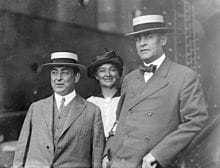
By 1909, Jack has lost control of his newsboy’s club. He appears to have used the club to teach boxing (how crude) and on at least one occasion used club assets to post bail for women accused of “loitering,” a jail-able offense in corrupt, Tammany-era New York. The club closed 2 years later. And then Jack gets married (November 27, 1910), and it appears that Jack’s real name was not Sullivan at all, but Reich. He marries Sarah Siegel at the Ohav Tzedek synagogue as “Jacob Reich”. The name Jacob Reich appears on his marriage license, on his death certificate, and on various court records, though he still appears as Jack Sullivan in other activities. Jack/ Jacob appears to have chosen the Irish-sounding name “Sullivan” as an homage to the leader of the Tammany (Democratic) machine, “Big Tim” Sullivan, shown in the photo below.

Turn of the century Tammany boss, "Big Tim" Sullivan, shown at right.

Turn of the century Tammany boss, “Big Tim” Sullivan, shown at right.

By March, 1912, Jack appears again in the news, this time suing two film companies for use of his story and likeness without payment to him. It’s a film called “the Gangsters.” It would be interesting to see if a copy still exists.

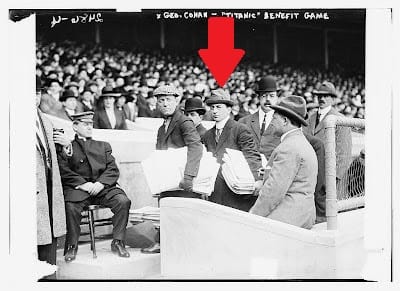
A month later, April 15, 1912, The unsinkable Titanic goes down, and six days after that, April 21, 1912, Jack is selling papers at a charity baseball game to benefit the survivors. The game takes place on a Sunday, normally prohibited by New York blue laws, between The New York Giants and The New York Yankees (the Yankees are still called the Highlanders in those days, but are already wearing pinstripes). In the picture below, Jack is under the red arrow with lots of “papes” under his arm, just behind famous song-writer, playwright, George M. Cohan. Both are dressed as newsies. George M. Cohan, known for the WWI song “Over there”, had four plays on Broadway at the time. He is one of the very few successful New Yorkers to have avoided major attachment to the crooked, New York political machine.

Jack Sullivan with George M Cohan, April 1912 selling a special newspaper to help survivors of the Titanic.

Jack Sullivan (arrow) with George M Cohan, April 1912 selling a special newspaper to help survivors of the Titanic.

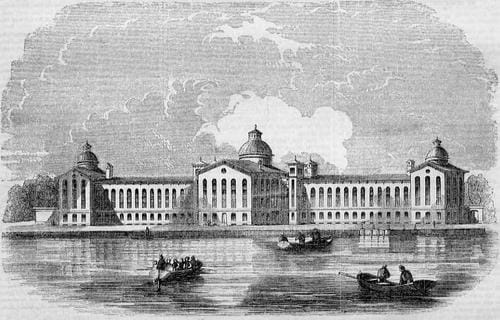
New York Refuge

The New York house of refuge

And now Jack Kelly / Sullivan/ Reich enters history as a tragic bystander. When he got married, Jack borrowed $1000, from a Jewish gambler and gambling hall owner, Herman (Beansy) Rosenthal. Rosenthal was a good friend of his, and of “Big Tim” Sullivan, but he (and Sullivan) had enemies. Among them, the crooked police Lieutenant, Charles Becker, who headed the city vice squad and delighted in shaking down the gamblers, pimps, etc for protection money. Becker wanted Rosenthal dead, in part to keep him from going to the newspapers with stories of police corruption.

By 1912, “Big Tim” lost control of the Tammany organization and was put in seclusion under Tammany guard. Within a year he’d be dead. Someone (Becker?) then hired four hit men to kill Rosenthal (1:30 AM, July 16, 1912 in front of The Metropole Hotel). It’s an event recounted in “The Great Gatsby.” Several beat-policemen were there to see the shooting, but every one looked away. Not one shot back or took the license of the car. In fact, the police did nothing to catch the murderers except to lock up the only honest witness to keep him from testifying. Before the shooting, Becker took Jack Sullivan out for an evening at Madison Square Garden; he then dropped Jack at the Metropole just before the 1:30 shooting. Becker and the police then blamed Jack and four others for the murder based on testimony that they had concocted. In the end, Jack was acquitted, but not the other four, or Becker. All five went to the electric chair; all five protested their innocence.

Becker was the first US police lieutenant to be put to death for murder. It seems unlikely that he was innocent, but was he a murderer, or just an accomplice. As for the other four, perhaps they were guilty, perhaps not; it’s hard to tell from Tammany-era records. The judge was crooked; Police chief Devery was at least as crooked as Becker in terms of shaking down hoodlums. And Devery had as much motive as Becker to want Rosenthal dead. The witnesses were lying from a script they’d been given — that’s what justice was like in those days. Within a year of the murder, Big Tim was dead and Charles Francis Murphy had gained firm control of Tammany Hall. The police spent the next decade in criminal activities while trying to pin something on Jack, now a cigar store owner. He was busted for gambling and related offenses, but nothing much came of it. Jack cleared his name from the charge of murder only in 1936, two years before his death — three years after Fiorello La Guardia was elected mayor. Republican/ Fusion candidate, La Guardia ran against Tammany and did much to end their police corruption.

As for The Refuge, The New York House of Refuge is a real place. It sat on Randal’s Island between Manhattan, The Bronx, and Queens. The Island is now famous as the center of The Triborough Bridge. There is now a park where The Refuge was. Was The Refuge run honestly? If it was, it would have been virtually the only public institutions to run that way. Tammany was corrupt to the core.

Robert E. Buxbaum, October 25, 2015. Much of the information here comes from a tumbler exchange called, “newsies historical research.” I organized it and added some background about Baseball, Tammany, etc. If you like Newsies, or the era, I can recommend the novel (and movie), The Great Gatsby, or Fiorello!, a musical version of La Guardia’s unlikely rise to power. Hearst is treated somewhat positively in Newsies, but less-so as “Citizen Kane.” If someone’s seen, or has a link to “The Gangsters” please tell me.

Republicans vs conservatives

Most of the great divides of the 1800s pitted conservatives against Republicans. This was the Divide in the Mexican civil wars of the 1800s, and there were several; it is the divide in the South American wars of Independence, and in much of the US and European political debate of the 1800s as well.

Ned Flanders, cartoon conservative from "The Simpsons" He's generally well meaning and helpful, but also a bit creepy.

Ned Flanders, cartoon conservative from “The Simpsons” He’s generally well-meaning and helpful, but also a bit creepy.

In general, the difference between conservatives and republicans is that conservative governments favor religion, and religion-based leadership, while republicans favor individual liberty. In 1800s Mexico, conservatives backed two emperors (Maximilian I and Agustin I) and Santa Anna, the ruler who suspended all personal rights an ignited the war of Texan independence. Conservatives generally favor the religion of the majority: Protestantism in England, Catholicism in Central and South America, Judaism in Israel, and Islam in most of the Muslim world. This tends to annoy the irreligious and minority religious populations, who tend to become republicans. Cinco de Mayo celebrates the 1862 victory of Mexican republicans over the French-backed, conservative Maximilian I, at the battle of Puebla. The US Civil War, in essence, pitted the irreligious, industrial, republican north against the conservative, evangelical South; slavery is in the Bible so it must be good.

Conservatives usually favor government actions against sin in all it’s forms: miserliness, drunkenness, drugs, pornography, wild music, money-making, and freedom as such. Conservative-ruled countries have generally had anti-blasphemy laws and enforced “blue laws”, restrictions on business on holidays. Republican governments have few, or none of these. In pre-revolution France, the penalty for blasphemy was death, just as the Bible mandates. This changed when the republicans came into power. In England, private blasphemy was prosecuted as late as 1977. Similar penalties are still in force in Iran and other conservative Islāmic countries. Many US states still restrict the sale of alcohol on Sunday, for similar, conservative reasons. Conservatives usually favor sexual morality laws, putting strong restrictions on homosexuality, abortion, and divorce. In England, amicable divorce wasn’t legalized until 1930, and homosexuality was illegal until 1970. In the US, sexual laws are a fairly bizarre mix, in my humble opinion, the result of republicans, liberals, and conservatives making inelegant compromises.

In republican democracies like modern-day France, Holland, and Germany, sexual immorality laws are more lax than in the US. Republican governments strive to protect the rights of the individual; among these their right to property and to a fairly unbridled pursuit of pleasure. Republican countries tend to suffer from (or benefit from) significant income inequality. People can become rich due to hard work, talent, luck, or birth. And they very often become arrogant and obnoxious after they become rich — and sometimes before — to an extent that bothers conservatives and liberals alike. People can also become very poor: from laziness or bad choices, or just from bad luck or having been born to the wrong parents. Conservative and liberal elements then strive to help the very poorest, providing them with food, money and basic housing — generally achieved by taxing the rich. This is good in moderation, but taken to excess, this can lead to dependency of the poor, and redirection of the rich into less-productive fields like politics and the church. Conservatives very rarely leave a good pathway for the poor out of dependency, nor have they found a way to keep scoundrels out of the government and the church.

Scrooge McDuck. he'd likely be a Republican, if only to protect his wealth.

Scrooge McDuck, banker, railroad tycoon, steel magnate; he’d likely be republican, though not likely conservative. Motivated by money and power, he may do good, but not in any direct way, usually.

At present, the US Republican Party, the GOP, consists of approximately equal halves conservatives and republicans. That is, GOP leadership is currently an approximate balance between kindly folks like Ned Flanders who would rule by the Bible, and an equal number of rougher individuals, more like Scrooge McDuck who would rule by money.  in a sense, this is a wonderful compromise as the excesses of each group reins in the excesses of the other. In another sense though, the balance between conservatives and republicans is an ungovernable mess that leads to regular de Condorcet failures. I’m not sure how this will play out in the 2016 elections.

Fortunately, not all irreconcilable differences are as irreconcilable as one might think. Many de Condorcet problems are solvable by compromise, or by the effects of time. Compromise between charity and commerce can produce the best of all worlds, a major theme point, as I understand it, of Dickens’s Christmas Carol.

Robert E. Buxbaum, October 20, 2015. I use these essays to refine my thinking — here, more than usual. Any help you can provide will be welcome, feedback, corrections, comments. I’m trying to figure out what I, myself think. The divide between Conservatives and Liberals produces some of the most wonderful quote – exchanges, e.g. between Churchill and Attlee in 1950s England. Liberals, and I have not quite made up my understanding here, seem like a sort of like conservatives in that they believe in wealth redistribution, but without the guidance of a church, or church-based morality. At some point in the future, I’ll hope to arrange my thoughts about them, and about the difference between liberals and democrats.

Marie de Condorcet and the tragedy of the GOP

This is not Maire de Condorcet, it's his wife Sophie. Marie (less attractive) was executed by Robespierre for being a Republican.

Marie Jean is a man’s name. This is not he, but his wife, Sophie de Condorcet. Marie Jean was executed for being a Republican in Revolutionary France.

During the French Revolution, Marie Jean de Condorcet proposed a paradox with significant consequence for all elective democracies: It was far from clear, de Condorcet noted, that an election would choose the desired individual — the people’s choice — once three or more people could run. I’m sorry to say, this has played out often over the last century, usually to the detriment of the GOP, the US Republican party presidential choices.

The classic example of Condorcet’s paradox occurred in 1914. Two Republican candidates, William H. Taft and Theodore Roosevelt, faced off against a less-popular Democrat, Woodrow Wilson. Despite the electorate preferring either Republican to Wilson, the two Republicans split the GOP vote, and Wilson became president. It’s a tragedy, not because Wilson was a bad president, he wasn’t, but because the result was against the will of the people and entirely predictable given who was running (see my essay on tragedy and comedy).

The paradox appeared next fifty years later, in 1964. President, Democrat Lyndon B. Johnson (LBJ) was highly unpopular. The war in Vietnam was going poorly and our cities were in turmoil. Polls showed that Americans preferred any of several moderate Republicans over LBJ: Henry Cabot Lodge, Jr., George Romney, and Nelson Rockefeller. But no moderate could beat the others, and the GOP nominated its hard liner, Barry Goldwater. Barry was handily defeated by LBJ.

Then, in 1976; as before the incumbent, Gerald Ford, was disliked. Polls showed that Americans preferred Democrat Jimmy Carter over Ford, but preferred Ronald Regan over either. But Ford beat Reagan in the Republican primary, and the November election was as predictable as it was undesirable.

Voters prefer Bush to Clinton, and Clinton to Trump, but Republicans prefer Trump to Bush.

Voters prefer Bush to Clinton, and Clinton to Trump, but Republicans prefer Trump to Bush.

And now, in 2015, the GOP has Donald Trump as its leading candidate. Polls show that Trump would lose to Democrat Hillary Clinton in a 2 person election, but that America would elect any of several Republicans over Trump or Clinton. As before,  unless someone blinks, the GOP will pick Trump as their champion, and Trump will lose to Clinton in November.

At this point you might suppose that Condorcet’s paradox is only a problem when there are primaries. Sorry to say, this is not so. The problem shows up in all versions of elections, and in all versions of decision-making. Kenneth Arrow demonstrated that these unwelcome, undemocratic outcomes are unavoidable as long as there are more than two choices and you can’t pick “all of the above.” It’s one of the first great applications of high-level math to economics, and Arrow got the Nobel prize for it in 1972. A mathematical truth: elective democracy can never be structured to deliver the will of the people.

This problem also shows up in business situations, e.g. when a board of directors must choose a new location and there are 3 or more options, or when a board must choose to fund a few research projects out of many. As with presidential elections, the outcome always depends on the structure of the choice. It seems to me that some voting systems must be better than others — more immune to these problems, but I don’t know which is best, nor which are better than which. A thought I’ve had (that might be wrong) is that reelections and term limits help remove de Condorcet’s paradox by opening up the possibility of choosing “all of the above” over time. As a result, many applications of de Condorcet’s are wrong, I suspect. Terms and term-limits create a sort of rotating presidency, and that, within limits, seems to be a good thing.

Robert Buxbaum, September 20, 2015. I’ve analyzed the Iran deal, marriage vs a PhD, and (most importantly) mustaches in politics; Taft was the last of the mustached presidents. Roosevelt, the second to last.

Why I don’t like the Iran deal

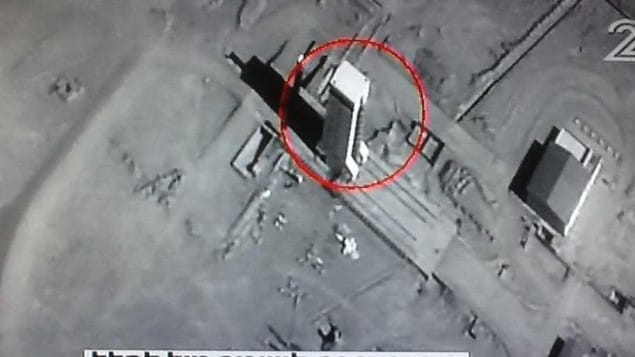
Treaties, I suspect, do not exist to create love between nations, but rather to preserve, in mummified form, the love that once existed between leaders. They are useful for display, and as a guide to the future, their main purpose is to allow a politician to help his friends while casting blame on someone else when problems show up. In the case of the US Iran-deal that seems certain to pass in a day or two with only Democratic-party support, and little popular support, I see no love between the nations. On a depressingly regular basis, Iranian leaders promise Death to America, and Death to America’s sometime-ally Israel. Iran has acted on these statements too, funding Hezbollah missiles and suicide bombers, and hanging its dissidents: practices that lead it to become something of a pariah among its neighbors. They also display the sort of nuclear factories and ICBMs (long-range rockets) that could make them much bigger threats if they choose to become bigger threats. The deal just signed by US Secretary of State and his counterpart in Iran (read in full here) seems to preserve this state. It releases to Iran $100,000,000,000 to $150,000,000,000 that it claims it will use against Israel, and Iran claims to have no interest in developing multi-point compression atom bombs. This is a tiny concession given that our atom bomb at Hiroshima was single-point compression, first generation, and killed 90,000 people.

Iranian intercontinental ballistic missile, several stories high, brought out during negotiations. Should easily deliver nuclear weapons far beyond Israel, and even to the USA.

Iranian intercontinental ballistic missile, new for 2015. Should easily deliver warheads far beyond Israel -even to the US.

The deal itself is about 170 pages long and semi-legalistic, but I found it easy to read. The print is large, Iran has few obligations, and the last 100 pages or so are a list companies that will no longer be sanctioned. The treaty asserts that we will defend Iran against attacks including military and cyber attacks, and sabotage –presumably from Israel, but gives no specifics. Also we are to help them with oil, naval, and fusion technology, while leaving them with 1500 kg of 20% enriched U235. That’s enough for quick conversion to 8 to 10 Hiroshima-size A-bombs (atom bombs) containing 25-30 kg each of 90% U235. The argument in favor of the bill seems to be that, by giving Iran the money and technology, and agreeing with their plans, Iran will come to like us. My sense is that this is wishful-thinking, and unlikely (as Jimmy Carter discovered). The unwritten contract isn’t worth the paper it’s written on.

As currently written, Iran does not recognize Israel’s right to exist. To the contrary, John Kerry has stated that a likely consequence is further attacks on Israel. Given Hezbollah’s current military budget is only about $150,000,000 and Hamas’s only about $15,000,000 (virtually all from Iran), we can expect a very significant increase in attacks once the money is released — unless Iran’s leaders prove to be cheapskates or traitors to their own revolution (unlikely). Given our president’s and Ms Clinton’s comments against Zionist racism, I assume that they hope to cow Israel into being less militant and less racist, i.e. less Jewish. I doubt it, but you never know. I also expect an arms race in the middle east to result. As for Iran’s statements that they seek to kill every Jew and wipe out the great satan, the USA: our leaders may come to regret hat they ignore such statements. I guess they hope that none of their friends or relatives will be among those killed.

Kerry on why we give Iran the ability to self-inspect.

Kerry on why we give Iran the ability to self-inspect.

I’d now like to turn to fusion technology, an area I know better than most. Nowhere does the treaty say what Iran will do with nuclear fusion technology, but it specifies we are to provide it, and there seem to be only two possibilities of what they might do with it: (1) Build a controlled fusion reactor like the TFTR at Princeton — a very complex, expensive option, or (2) develop a hydrogen fusion bomb of the sort that vaporized the island of Bimini: an H-bomb. I suspect Iran means to do the latter, while I imagine that, John Kerry is thinking the former. Controlled fusion is very difficult; uncontrolled fusion is a lot easier. With a little thought, you’ll see how to build a decent H-bomb.

My speculation of why Iran would want to make an H-bomb is this: they may not trust their A-bombs to win a war with Israel. As things stand, their A-bomb scientists are unlikely to coax more than 25 to 100 kilotons of explosive power out of each bomb, perhaps double that of Hiroshima and Nagasaki. But our WWII bombs “only” killed 70,000 to 90,000 people each, even with the radiation deaths. Used against Israel, such bombs could level the core of Jerusalem or Tel Aviv. But most Israelis would survive, and they would strike back, hard.

To beat the Israelis, you’d need a Megaton-size, hydrogen bomb. Just one Megaton bomb would vaporize Jerusalem and it’s suburbs, kill a million inhabitants at a shot, level the hills, vaporize the artifacts in the jewish museum, and destroy anything we now associate with Israel. If Iran did that, while retaining a second bomb for Tel-Aviv, it is quite possible Israel would surrender. As for our aim, perhaps we hope Iran will attack Israel and leave us alone. Very bright people pushed for WWI on hopes like this.

Robert E. Buxbaum. September 9, 2015. Here’s a thought about why peace in the middle east is so hard to achieve,

Racial symbols: OK or racist

Washington Redskins logo and symbol. Shows race or racism?

Washington Redskins lost protection of their logo and indian symbol. Symbol of race or racism?

In law, one generally strives for uniformity, as in Leviticus 24:22: “You shall have one manner of law; the same for the home-born as for the stranger,”  but there are problems with putting this into effect when dealing with racism. The law seems to allow each individual group to denigrate itself with words that outsiders are not permitted. This is seen regularly in rap songs but also in advertising.

Roughly a year ago, the US Patent office revoked the copyright protection for the Washington Redskin logo and for the team name causing large financial loss to the Redskins organization. The patent office cited this symbol as the most racist-offensive in sports. I suspect this is bad law, in part because it appears non-uniform, and in part because I’m fairly sure it isn’t the most racist-offensive name or symbol. To pick to punish this team seems (to me) an arbitrary, capricious use of power. I’ll assume there are some who are bothered by the name Redskin, but suspect there are others who take pride in the name and symbol. The image is of a strong, healthy individual, as befits a sports team. If some are offended, is his (or her) opinion enough to deprive the team of its merchandise copyright, and to deprive those who approve?

More racist, in my opinion, is the fighting Irishman of Notre Dame. He looks thick-headed, unfit, and not particularly bright: more like a Leprechaun than a human being. As for offensive, he seems to fit a racial stereotype that Irishmen get drunk and get into fights. Yet the US Patent office protects him for the organization, but not the Washington Redskin. Doesn’t the 14th amendment guarantee “equal protection of the laws;” why does Notre Dame get unequal protection?

Notre Damme Fighting Irish. Is this an offensive stereotype.

Notre Dame’s Fighting Irishman is still a protected symbol. Is he a less-offensive, racist stereotype?

Perhaps what protects the Notre Dame Irishman is that he’s a white man, and we worry more about insulting brown people than white ones. But this too seems unequal: a sort of reverse discrimination. And I’m not sure the protection of the 14th was meant to extend to feelings this way. In either case, I note there are many other indian-named sports teams, e.g. the Indians, Braves, and Chiefs, and some of their mascots seem worse: the Cleveland Indians’ mascot, “Chief Wahoo,” for example.

Chief Wahoo, symbol of the Cleveland Indians. Still protected logo --looks more racist than the Redskin to me.

Chief Wahoo, Still protected symbol of the Cleveland Indians –looks more racist than the Redskin to me.

And then there’s the problem of figuring out how racist is too racist. I’m told that Canadians find the words Indian and Eskimo offensive, and have banned these words in all official forms. I imagine some Americans find them racist too, but we have not. To me it seems that an insult-based law must include a clear standard of  how insulting the racist comment has to be. If there is no standard, there should be no law. In the US, there is a hockey team called the Escanaba (Michigan) Eskimos; their name is protected. There is also an ice-cream sandwich called Eskimo Pie — with an Eskimo on the label. Are these protected because there are relatively fewer Eskimos or because eskimos are assumed to be less-easily insulted? All this seems like an arbitrary distinction, and thus a violation of the “equal protection” clause.

And is no weight given if some people take pride in the symbol: should their pride be allowed balance the offense taken by others? Yankee, originally an insulting term for a colonial New Englander became a sign of pride in the American Revolution. Similarly, Knickerbocker was once an insulting term for a Dutch New Yorker; I don’t think there are many Dutch who are still insulted, but if a few are, can we allow the non-insulted to balance them. Then there’s “The Canucks”, an offensive term for Canadian, and the Boston Celtic, a stereotypical Irishman, but also a mark of pride of how far the Irish have come in Boston society. Tar-heel and Hoosiers are regional terms for white trash, but now accepted. There must be some standard of insult here, but I see none.

The Frito Bandito, ambassador of Frito Lays corn chips.

The Frito Bandito, ambassador of Frito Lays corn chips; still protected, but looks racist to me.

Somehow, things seem to get more acceptable, not less if the racial slur is over the top. This is the case, I guess with the Frito Bandito — as insulting a Mexican as I can imagine, actually worse than Chief Wahoo. I’d think that the law should not allow for an arbitrary distinction like this. What sort of normal person objects to the handsome Redskin Indian, but not to Wahoo or the Bandito? And where does Uncle Ben fit in? The symbol of uncle Ben’s rice appears to me as a handsome, older black man dressed as a high-end waiter. This seems respectable, but I can imagine someone seeing an “uncle tom,” or being insulted that a black man is a waiter. Is this enough offense  to upend the company? Upending a company over that would seem to offend all other waiters: is their job so disgusting that no black man can ever be depicted doing it? I’m not a lawyer or a preacher, but it seems to me that promoting the higher levels of respect and civil society is the job of preachers not of the law. I imagine it’s the job of the law to protect contracts, life, and property. As such the law should be clear, uniform and simple. I can imagine the law removing a symbol to prevent a riot, or to maintain intellectual property rights (e.g. keeping the Atlanta Brave from looking too much like the Cleveland Indian). But I’d think to give people wide berth to choose their brand expression. Still, what do I know?

Robert Buxbaum, August 26, 2015. I hold 12 patents, mostly in hydrogen, and have at least one more pending. I hope they are not revoked on the basis that someone is offended. I’ve also blogged a racist joke about Canadians, and about an Italian funeral.

Winning at Bunker Hill lost America for Britain.

The greatest single victory of the American Revolution in terms of British soldiers killed or wounded was the battle of Bunker Hill. It was won without global strategy, or any real sense of victory. The British captured the hill but their loss of soldiers and reputation was such that one can echo British General, George Clinton’s comment: “A few more such victories would have shortly put an end to British dominion in America.” How the British came to blunder this way is a lesson in group-think management; it lead to the destruction of an army of the finest soldiers on earth by a band of untrained, leader-less rabble.

A map of metropolitan Boston in May 1775 shows that it was already a major port with far less dry land than it has today. It consisted of a knob-hill peninsula, British-controlled Boston city, cut off from the rest of the colonies except for one narrow road, called “The Neck,” or The Roxbury Neck. The later name was used to distinguish it from a similar neck road that connected the colonies to nearby Charlestown peninsula; Bunker Hill is on Charlestown peninsula. Following the rumpus battles of Lexington and Concord, Boston’s suburbs were over-filled by 15,000, ill-clad, undisciplined colonials who ate, drank, and shot at random stuff in plain view of Boston’s 6000 trained soldiers and four Generals. The Colonials set up barriers and cannon at their end of the Neck road. These were not particularly good barriers, and the British army could leave at any time by the neck to control of the colonies, but only at a cost in men. This potential cost  kept rising as more colonials came to camp around Boston. What would you do?

The British had sea-power that they felt they could use: excellent ships and excellent admirals; the colonies had neither. The British navy could attack anywhere on the American coast, but only at a risk of further alienating the colonials. They thus used their power judicially. E.g., for the attack on Lexington, April ’75, navy ships took the 2000 soldiers from Boston, landing them at Charlestown, at the foot of Breed’s hill. The army then marched out over the Charlestown neck to Lexington and Concord, but not to a smashing success. Many soldiers lost their lives, and not much was captured.

Back in Boston, the four British generals: Gage, Burgoyne, Howe, and Clinton, decided that, to quash the revolt/revolution, they had to break out of Boston and quarter in Massachusetts proper, on some easily defended ground on the mainland, preferably high ground. They needed to establish a base with good connections to the rest of colonies, plus good access to the sea. Looking about, the obvious spot for this base was the heights of Dorchester, a set of hills that overlooked Boston Harbor from the south. Eventually the British would flee Boston because George Washington would capture and hold these heights. The reason the British didn’t capture the heights or at least defend them was the result of group-think ignorance, on the morning of June 17. The British changed their goals, and decided to attack at Charlestown (Breed’s Hill) instead of Dorchester. Capturing Charlestown left Britain with many dead and no good connection to the colonies; it was just another isolated peninsula barely attached to the mainland by an easily defended road.

Why did four, trained Generals attack this worthless spot instead of Dorchester? It was the luck of American disarray and mob-rule. Looking at the Colonials disarray, each of the four generals saw an opportunity for personal glory; the colonials were inept and would never improve. The same British group-think that reawakeneded in the Crimean war with Russia. The American defense of Charleston and Breeds Hill was done so incredibly poorly that the Americans were left as sitting ducks, waiting to be taken. A poor location was chosen for the fort and only 1200 Colonials came to defend it. We’d meant to build a fort on a better location, Bunker Hill, the tall hill overlooking Boston, and we’d meant to build a minor respite foxhole on Breeds hill, but we screwed up.

Our soldiers were digging  at night, fueled with much rum and little or no leadership. When the sun rose on June 17, we found that we’d built next to nothing on Bunker hill, and a vastly too-large, uselessly deep, square hole at Breed’s Hill: a doubtful redoubt. The square was open at back, and too large for the number of soldiers. It was also too deep for people to shoot out of easily. Looking with spyglasses from Boston, the British generals saw that we had no idea what we were doing. Gage and co., thought to show us the consequences of our incompetence. A few thousand British soldiers could easily take this redoubt and its 1200 defenders, and that thought clouded his mind and the minds of his fellows. They forgot that this was not a hill worth taking, and never imagined that we might fix our defenses. Even if Gage could win without a single lost man, he should have realized that a victory would leave him in a worse position than before. His forces would then be divided between two peninsulas both separated from the mainland, and separated from each other by neck-roads. Coordinating an attack from this position would be a logistic nightmare, and any one of the co-Generals should have alerted him to this.

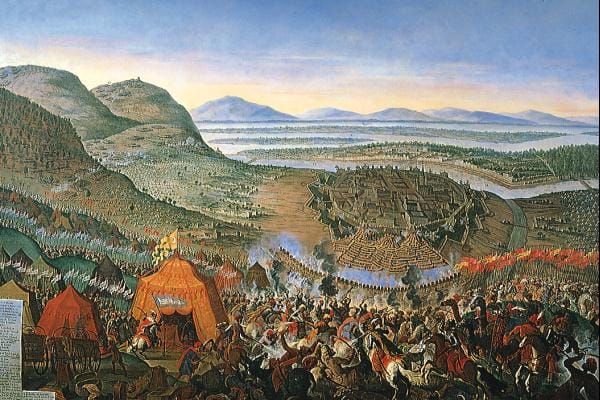
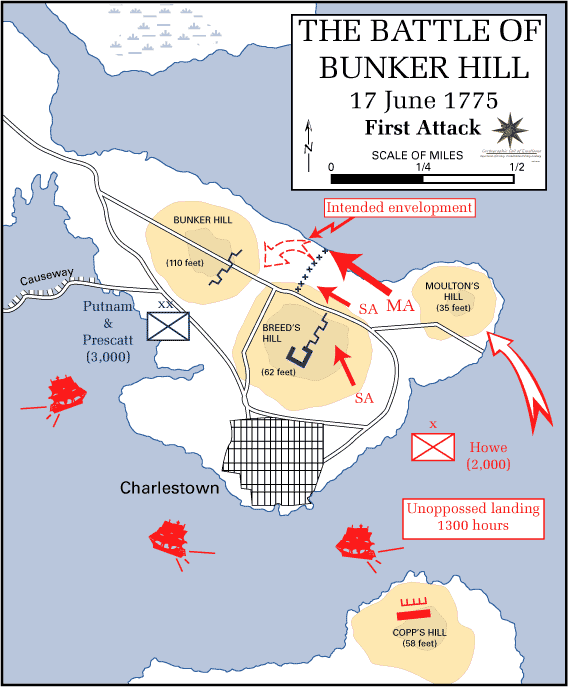
The attack was supposed to work this way: a sea landing at Moulton's hill. two side actions, SA, at the fronts of the Colonial defenses, and a sweeping main attack, MA, at the edge.

The attack was supposed to work this way: a sea landing at Moulton’s hill. two side actions, SA, at the fronts of the Colonial defenses, and a sweeping main attack, MA, at the edge.

But four generals working together were stupider than Gage alone. Their glee at our incompetence made them forget why Dorchester Heights was the right military target. The prospect of personal glory made attacking Charlestown and its hills too tempting to ignore. Their superior force of trained men would land and march forward to an easy victory. They might even do it with bayonets alone, as the Continentals had too few men, no training, and no bayonets. If the Continentals were able to muster together at all (unlikely), they were unlikely to reload fast enough to shoot more than once — that took special guns and training. Under pressure, the colonials would likely miss with most of the only shot they got, and would find themselves over-run before they could reload. The British force could shoot therebels at close range, or they could hold their fire and spear them with bayonets as the rebels tried to reload, or run out of the hole they were in.

It was a perfect plan with only a minor problem, easily addressed: the Americans had a cannon brought to the hill, and a trained cannoneer could kill many with a few follies of grape-shot. Gage and co. thus decided on a complex attack that would avoid the cannon. It included a feint to the front and a side run. This “wheeling motion” was completely unnecessary: the Americans had little powder and no idea what to do with a cannon, the generals didn’t know that.  The plan was to form a single line across from the fort (hole), fake a frontal attack to draw American shots while staying out of range, and then wheel right. That is, on command, every British soldier was to turn right and march, as a column, north to the trench’s right side (the left side if you look as a Colonial). They’d avoid the cannon rifle shots, and take the redoubt from the north side, perhaps without taking a single loss. It should have been a piece of cake, but was not.

Landing the British troops and forming them up took longer than expected, as often happens, and during this time, more Colonials showed up, and some of them took pot-shots at the British officers. What’s more, the rebels began to fix the more-glaring flaws in their defenses. Potshots from Charlestown windows slowed British efforts at mustering into an appropriate line while the Continentals built up the left (north) side of their redoubt — the side the British wished to attack. The colonials added triangular sub forts (Friches) at both sides of their square trench, somewhat in front, and added a wooden fence rail from the hill to the sea somewhat behind. The British naval commander wasted yet more time with a cannon barrage from his ships. He imagined he was softening the defense, but the barrage managed to kill only one colonial, decapitated by a cannon-ball, while providing time for the colonials to build their friches and fence, and allowing for more sniper work. Col. Stark put colonials at the sense with shot markers at 100 feet in front. He then passed the now-famous instruction: don’t shoot till they passed these markers and you see the whites of their eyes.  He needed to preserve ammunition, and assumed that, at 50 to 100 feet, his colonials would not miss, and could fall back. Any British who passed the fence would be taken out by defenders shooting down from Bunker Hill, or up from the hole.

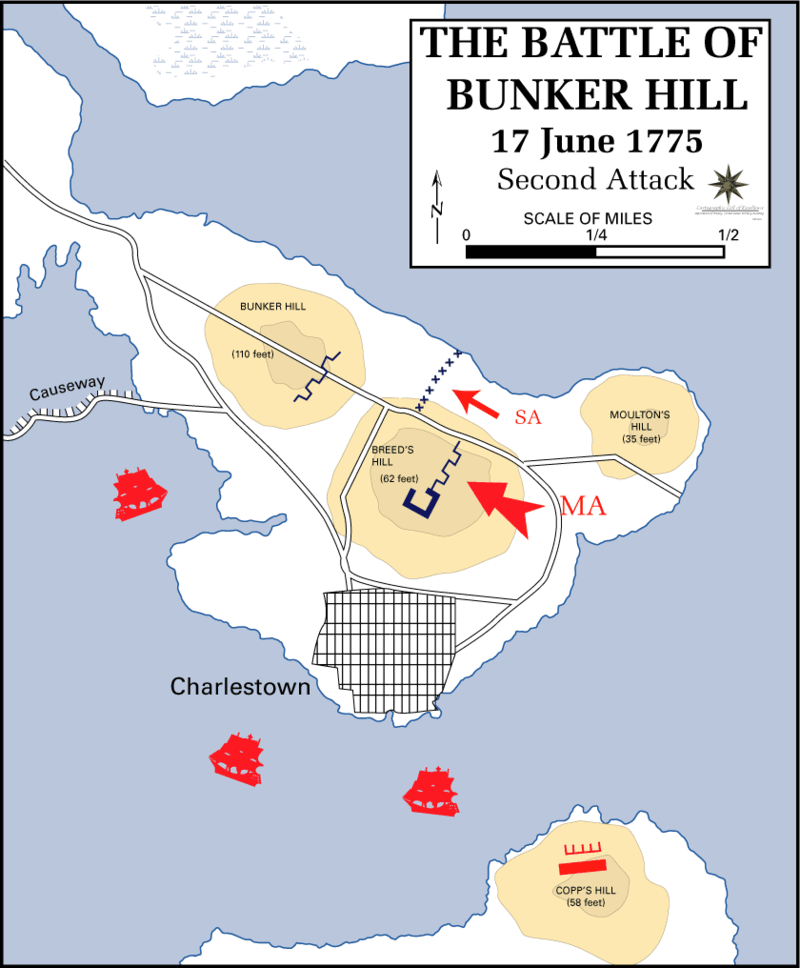
The second attack at Breeds Hill

The second attack at Breeds Hill

At first the British tried the frontal feint attack with a wheel to the north. When this attack failed to heavy losses, they tried again before realizing this attack was ill-suited to the terrain and troops. The British front line was composed of crack Hessians who marched perfectly in step, wearing bright red coats and heavy bear-skin, “Busby hats” to make them look more formidable. It might have worked on even ground, this ground was uneven and mucky, and the hats kept the Hessians from looking down at the brambles and rocks. Their stumbling motion, always aligned, was so slow that the colonials had time to fire and reload. The Hessians who survived the first shots never managed to wheel. Meanwhile, the main British attack, the one at the rail fence, failed because a colonial fired early by mistake. The British force should have ignored it, but instead, stopped and fired back. Hearing the shooting, more Colonials showed up and shot at British soldiers (more or less in range) using the fence to steady their aim. Only a few British got past the fence and these were shot by the retreating Americans and by the garrison on Bunker Hill. The attack was called back, allowing the British to re-muster while the Americans reloaded and repositioned.

Before the second British attack, more colonials wandered onto the peninsula, and built a quick platform in the redoubt so they could shoot better over the top. Some defenders of Bunker Hill — folks who’d seen little action so far — moved forward to get better shots, defending at the fence, and some Colonials wandered off, too. There was still no one in charge. Just everyone doing what seemed right to him.

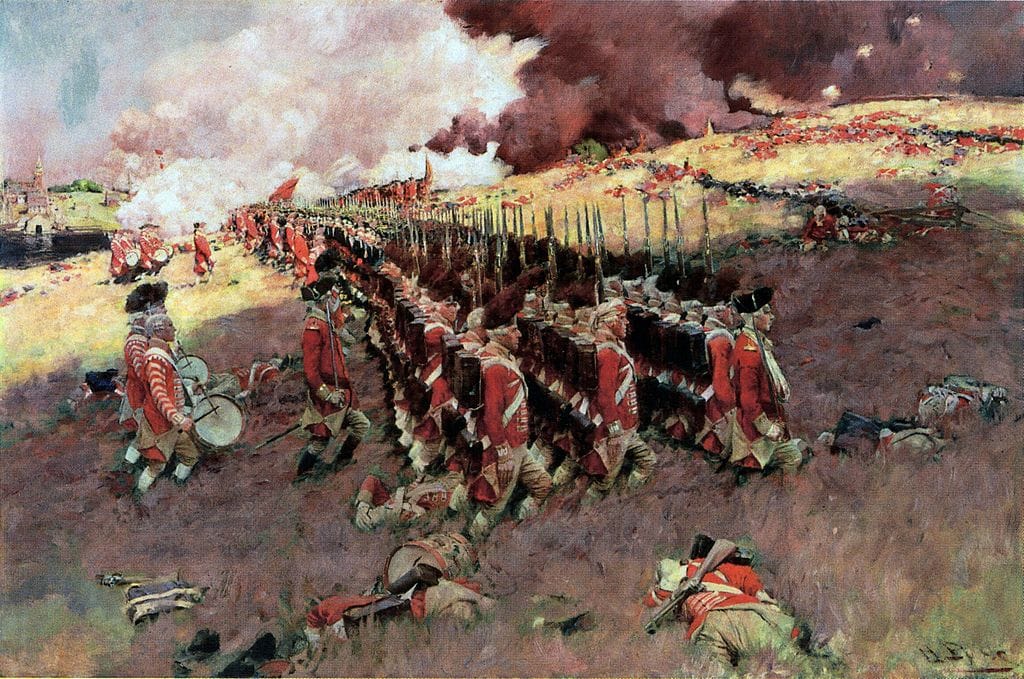
meanwhile, the generals burnt Charlestown as a way of stopping the snipers, and mustered their men for a simpler attack with a simpler troop arrangement, see map above and picture below. Three ranks of soldiers were set to march straight at the fort without trying to wheel. Those with Busby hats were largely dead or wounded, so the attackers could see where they were stepping. Still, without the wheel, the result was many British dead or wounded, and this second attack was called off.

The second attack: Three ranks and no Busby hats this time, with Charlestown burning in the background. Their's not to question why, their's but to do and die.

The second attack: Three ranks and no Busby hats this time, with the dead strewn around and Charlestown burning in the background. Their’s not to question why; their’s but to do and die. Painting by Pyle.

About at this time, the British should have decided to go home and attack elsewhere (Dorchester), but they persisted, not willing to accept defeat. For the third attack, the soldiers were told to attack as two single, long columns. The generals added some 400 marines (ship-board soldiers) plus some 200 wounded who were now ordered to re-muster. The columns waled straight up to the fort. The folks in front pushed by those behind; the soldiers at the front were killed, but the attack worked, sort of. The British took the fort, but most of the defenders avoided capture. They retreated across the neck and rejoined the main mob. The British captured or killed some 400 at the expense of 1,054 men lost; 226 were killed in the immediate battle, including most of the junior officers, with the rest lost as a result of wounds. The soldiers also lost the sense of invincibility; unorganized colonials could fight, inflicting serious damage at minimal cost.

There arose a myth of the backwoods shooter, but it was largely a myth. The Colonials were able to pick off British officers because the officers dressed to be noticed. It was a mistake the British would keep making. At Bunker Hill, the British lost 1 lieutenant colonel (killed), 5 majors (3 killed), 34 captains (7 killed) 41 lieutenants (9 killed), 57 sergeants (15 killed), and 13 drummers (1 killed). A lesson we learned: don’t dress so fancy. Tactically, the British victory at Bunker hill left their forces divided between two peninsulas. The men defending these peninsulas were unavailable for any attack at Dorchester heights. Thus the British forces lost the opportunity to escape Boston and take positions that could hold the colonies. By January, 1776 Washington Controlled Dorchester heights, and the British left Boston and Charlestown by ship. They would try taking Dorchester again in 1776 and 1777, but by then the continental army was more of an army, less of a rabble with rifles. A life lesson: only fight for something that you really want, a pointless win can be a lost opportunity.

After the battle, the back-stabbing and group think continued among the British generals, while the colonials got a single commander, General Washington. Meanwhile,  a new British general arrived, Burgoyne, who blamed Generals Clinton, Howe, and Gage for the loss of men and opportunity. Burgoyne got to lead an attack from Canada, but stung by Burgoyne’s blame-game, Clinton and Howe did not come his aid at Albany in June 1777. Instead, Clinton left Burgoyne to fend for himself (and be captured) while Howe was sent to attack the continental congress at Philadelphia. Burgoyne lost his army and reputation, and Howe captured Philadelphia, restoring his reputation, sort-of.  The Continental Congress fled Philadelphia ahead of the Brits, and Burgoyne’s defeat led to the French joining in on our side. Burgoyne blamed Clinton and Howe for his defeat, but was really done in by over confidence. He could not see that the chaotic leadership of a rabble was better than a fixed command without real communication, even with the best generals and soldiers.

The colonial chaos was horrible, but workable. The fixed-command mistakes on the British side were not as bad, but disastrous, since they required a coordinated effort that could not be produced. Had there been fewer British generals and a simpler plan, the better-trained British army would have won at Charlestown, or they would have left and attacked at Dorchester and won the war. One on one, General Howe’s forces repeatedly beat Washington, meeting in New York and New Jersey in the summer and fall of 1776. These were the same soldiers who lost at Bunker Hill, but with a simple command structure: one general not four. It was only George Washington’s genius that saved some semblance of an army to keep fighting into 1777.

This is not to say that chaos is good, but that it can work, especially with Americans. We tolerate chaos and fractured leadership better than most, I think, because we are, by nature, chaotic. As Bismarck put it: “God protects children, fools, and the United States of America.”

Robert Buxbaum, August 16, 2015 (edited June, 2024). There were several other howler mistakes of the American Revolution discussed here.  British generals took useless victories while losing opportunities that mattered. Don’t fight readily; only to win something of value that can be won.

It’s rocket science

Here are six or so rocket science insights, some simple, some advanced. It’s a fun area of engineering that touches many areas of science and politics. Besides, some people seem to think I’m a rocket scientist.

A basic question I get asked by kids is how a rocket goes up. My answer is it does not go up. That’s mostly an illusion. The majority of the rocket — the fuel — goes down, and only the light shell goes up. People imagine they are seeing the rocket go up. Taken as a whole, fuel and shell, they both go down at 1 G: 9.8 m/s2, 32 ft/sec2.

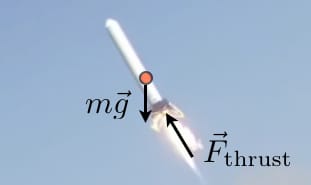
Because 1 G ofupward acceleration is always lost to gravity, you need more thrust from the rocket engine than the weight of rocket and fuel. This can be difficult at the beginning when the rocket is heaviest. If your engine provides less thrust than the weight of your rocket, your rocket sits on the launch pad, burning. If your thrust is merely twice the weight of the rocket, you waste half of your fuel doing nothing useful, just fighting gravity. The upward acceleration you’ll see, a = F/m -1G where F is the force of the engine, and m is the mass of the rocket shell + whatever fuel is in it. 1G = 9.8m/s is the upward acceleration lost to gravity.  For model rocketry, you want to design a rocket engine so that the upward acceleration, a, is in the range 5-10 G. This range avoids wasting lots of fuel without requiring you to build the rocket too sturdy.

For NASA moon rockets, a = 0.2G approximately at liftoff increasing as fuel was used. The Saturn V rose, rather majestically, into the sky with a rocket structure that had to be only strong enough to support 1.2 times the rocket weight. Higher initial accelerations would have required more structure and bigger engines. As it was the Saturn V was the size of a skyscraper. You want the structure to be light so that the majority of weight is fuel. What makes it tricky is that the acceleration weight has to sit on an engine that gimbals (slants) and runs really hot, about 3000°C. Most engineering projects have fewer constraints than this, and are thus “not rocket science.”

Basic force balance on a rocket going up.

Basic force balance on a rocket going up.

A space rocket has to reach very high, orbital speed if the rocket is to stay up indefinitely, or nearly orbital speed for long-range, military uses. You can calculate the orbital speed by balancing the acceleration of gravity, 9.8 m/s2, against the orbital acceleration of going around the earth, a sphere of 40,000 km in circumference (that’s how the meter was defined). Orbital acceleration, a = v2/r, and r = 40,000,000 m/2π = 6,366,000m. Thus, the speed you need to stay up indefinitely is v=√(6,366,000 x 9.8) = 7900 m/s = 17,800 mph. That’s roughly Mach 35, or 35 times the speed of sound at sea level, (343 m/s). You need some altitude too, just to keep air friction from killing you, but for most missions, the main thing you need is velocity, kinetic energy, not potential energy, as I’ll show below. If your speed exceeds 17,800 m/s, you go higher up, but the stable orbital velocity is lower. The gravity force is lower higher up, and the radius to the earth higher too, but you’re balancing this lower gravity force against v2/r, so v2 has to be reduced to stay stable high up, but higher to get there. This all makes docking space-ships tricky, as I’ll explain also. Rockets are the only way practical to reach Mach 35 or anything near it. No current cannon or gun gets close.

Kinetic energy is a lot more important than potential energy for sending an object into orbit. To get a sense of the comparison, consider a one kg mass at orbital speed, 7900 m/s, and 200 km altitude. For these conditions, the kinetic energy, 1/2mv2 is 31,205 kJ, while the potential energy, mgh, is only 1,960 kJ . The potential energy is thus only 1/16 the kinetic energy.

Not that it’s easy to reach 200 miles altitude, but you can do it with a sophisticated cannon. The Germans did it with “simple”, one stage, V2-style rockets. To reach orbit, you generally need multiple stages. As a way to see this, consider that the energy content of gasoline + oxygen is about 10.5 MJ/kg (10,500 kJ/kg); this is only 1/3 of the kinetic energy of the orbital rocket, but it’s 5 times the potential energy. A fairly efficient gasoline + oxygen powered cannon could not provide orbital kinetic energy since the bullet can move no faster than the explosive vapor. In a rocket this is not a constraint since most of the mass is ejected.

A shell fired at a 45° angle that reaches 200 km altitude would go about 800 km — the distance between North Korea and Japan, or between Iran and Israel. That would require twice as much energy as a shell fired straight up, about 4000 kJ/kg. This is still within the range for a (very large) cannon or a single-stage rocket. For Russia or China to hit the US would take much more: orbital, or near orbital rocketry. To reach the moon, you need more total energy, but less kinetic energy. Moon rockets have taken the approach of first going into orbit, and only later going on. While most of the kinetic energy isn’t lost, it’s likely not the best trajectory in terms of energy use.

The force produced by a rocket is equal to the rate of mass shot out times its velocity. F = ∆(mv). To get a lot of force for each bit of fuel, you want the gas exit velocity to be as fast as possible. A typical maximum is about 2,500 m/s. Mach 10, for a gasoline – oxygen engine. The acceleration of the rocket itself is this ∆mv force divided by the total remaining mass in the rocket (rocket shell plus remaining fuel) minus 1 (gravity). Thus, if the exhaust from a rocket leaves at 2,500 m/s, and you want the rocket to accelerate upward at an average of 10 G, you must exhaust fast enough to develop 10 G, 98 m/s2. The rate of mass exhaust is the average mass of the rocket times 98/2500 = .0392/second. That is, about 3.92% of the rocket mass must be ejected each second. Assuming that the fuel for your first stage engine is less than 80% of the total mass, the first stage will flare-out in about 20 seconds. Typically, the acceleration at the end of the 20 burn is much greater than at the beginning since the rocket gets lighter as fuel is burnt. This was the case with the Apollo missions. The Saturn V started up at 0.5G but reached a maximum of 4G by the time most of the fuel was used.

If you have a good math background, you can develop a differential equation for the relation between fuel consumption and altitude or final speed. This is readily done if you know calculous, or reasonably done if you use differential methods. By either method, it turns out that, for no air friction or gravity resistance, you will reach the same speed as the exhaust when 64% of the rocket mass is exhausted. In the real world, your rocket will have to exhaust 75 or 80% of its mass as first stage fuel to reach a final speed of 2,500 m/s. This is less than 1/3 orbital speed, and reaching it requires that the rest of your rocket mass: the engine, 2nd stage, payload, and any spare fuel to handle descent (Elon Musk’s approach) must weigh less than 20-25% of the original weight of the rocket on the launch pad. This gasoline and oxygen is expensive, but not horribly so if you can reuse the rocket; that’s the motivation for NASA’s and SpaceX’s work on reusable rockets. Most orbital rocket designs require three stages to accelerate to the 7900 m/s orbital speed calculated above. The second stage is dropped from high altitude and almost invariably lost. If you can set-up and solve the differential equation above, a career in science may be for you.

Now, you might wonder about the exhaust speed I’ve been using, 2500 m/s. You’ll typically want a speed at lest this high as it’s associated with a high value of thrust-seconds per weight of fuel. Thrust seconds pre weight is called specific impulse, SI, SI = lb-seconds of thrust/lb of fuel. This approximately equals speed of exhaust (m/s) divided by 9.8 m/s2. For a high molecular weight burn it’s not easy to reach gas speed much above 2500, or values of SI much above 250, but you can get high thrust since thrust is related to momentum transfer. High thrust is why US and Russian engines typically use gasoline + oxygen. The heat of combustion of gasoline is 42 MJ/kg, but burning a kg of gasoline requires roughly 2.5 kg of oxygen. Thus, for a rocket fueled by gasoline + oxygen, the heat of combustion per kg is 42/3.5 = 12,000,000 J/kg. A typical rocket engine is 30% efficient (V2 efficiency was lower, Saturn V higher). Per corrected unit of fuel+oxygen mass, 1/2 v2 = .3 x 12,000,000; v =√7,200,000 = 2680 m/s. Adding some mass for the engine and fuel tanks, the specific impulse for this engine will be, about 250 s. This is fairly typical. Higher exhaust speeds have been achieved with hydrogen fuel, it has a higher combustion energy per weight. It is also possible to increase the engine efficiency; the Saturn V, stage 2 efficiency was nearly 50%, but the thrust was low. The sources of inefficiency include inefficiencies in compression, incomplete combustion, friction flows in the engine, and back-pressure of the atmosphere. If you can make a reliable, high efficiency engine with good lift, a career in engineering may be for you. A yet bigger challenge is doing this at a reasonable cost.

At an average acceleration of 5G = 49 m/s2 and a first stage that reaches 2500 m/s, you’ll find that the first stage burns out after 51 seconds. If the rocket were going straight up (bad idea), you’d find you are at an altitude of about 63.7 km. A better idea would be an average trajectory of 30°, leaving you at an altitude of 32 km or so. At that altitude you can expect to have far less air friction, and you can expect the second stage engine to be more efficient. It seems to me, you may want to wait another 10 seconds before firing the second stage: you’ll be 12 km higher up and it seems to me that the benefit of this will be significant. I notice that space launches wait a few seconds before firing their second stage.

As a final bit, I’d mentioned that docking a rocket with a space station is difficult, in part, because docking requires an increase in angular speed, w, but this generally goes along with a decrease in altitude; a counter-intuitive outcome. Setting the acceleration due to gravity equal to the angular acceleration, we find GM/r2 = w2r, where G is the gravitational constant, and M is the mass or the earth. Rearranging, we find that w2  = GM/r3. For high angular speed, you need small r: a low altitude. When we first went to dock a space-ship, in the early 60s, we had not realized this. When the astronauts fired the engines to dock, they found that they’d accelerate in velocity, but not in angular speed: v = wr. The faster they went, the higher up they went, but the lower the angular speed got: the fewer the orbits per day. Eventually they realized that, to dock with another ship or a space-station that is in front of you, you do not accelerate, but decelerate. When you decelerate you lose altitude and gain angular speed: you catch up with the station, but at a lower altitude. Your next step is to angle your ship near-radially to the earth, and accelerate by firing engines to the side till you dock. Like much of orbital rocketry, it’s simple, but not intuitive or easy.

Robert Buxbaum, August 12, 2015. A cannon that could reach from North Korea to Japan, say, would have to be on the order of 10 km long, running along the slope of a mountain. Even at that length, the shell would have to fire at 450 G, or so, and reach a speed about 3000 m/s, or 1/3 orbital.

Major blunders of the American Revolution

As nice as it is to discuss the brilliant men and great battles that allowed the American colonials to win the American Revolution, there is another way to see things –perhaps less enjoyable, but just as legitimate: looking at the great dunderheads and mistakes that allowed the greatest military power on earth to be defeated by a small group of undisciplined rabble. Here follows brief essays on my three top dunderheads: two British, one French. No one realized they were dunces until much later.

Pride of place goes, I think, to King Louis 16th of France. He helped us to win the war, and lost his own empire in the process. King Louis had nothing to gain by funding the American cause. And he had quite a lot to lose in men and money. He lost his ships and men in Rhode Island, lost colonies in India and the Seychelles, and spent millions he’d need when the famine of 1789 came. Worse, by supporting America, Louis put the bug of Liberty in the French ear. Far better (for Louis) would have been if he had waited, non-committally for another 3-5 years as the Dutch and Spanish did. He could have continued to host and honor Franklin, could have continued to sell weapons (to both sides) and could have even encouraged hot-head volunteers like Lafayette to go over and fight. We might still have won (see below) but at a greater cost to us and a fraction of the cost to the French monarchy. Let us thank God for fools. Here are my thoughts on when to get involved in a foreign war.

The basic issue of big-scale blunders is not seeing the disaster that hides behind a small-scale victory. And that tends to be funny.

The basic of every great dunderhead is not seeing the disaster that hides behind a small-scale victory. And that tends to be funny.

British admiral George Rodney is my second, honored dunce. He had many victories, especially after the war was lost, but his major war achievement was not-relieving Cornwallis at Yorktown, and thus losing the war. In early 1781, Rodney was defending Jamaica and other British “Sugar Islands” in the Caribbean while waiting for orders to either fight the French fleet or relieve Cornwallis. As it was, he did neither but instead attacked a Dutch-held, Caribbean island, St. Eustatius. Rodney noticed that British freighters were being hijacked by pirates and that the island was a major trading port to the American colonists. By going after these pirates, he gained booty, but left the rest of the empire under-gunned. This allowed French Admiral, de Grasse Tilly to defeat Admiral Hood in the Caribbean; allowed him to take Tobago for the French. And then, while Rodney was still protecting his St Eustatius booty, de Grasse circled back to Virginia in time to bottle up Cornwallis. British Admiral Graves tried twice to dislodge de Grasse, but without Rodney he hadn’t the firepower. Cornwallis surrounded the day Graves gave up his second, failed attempt.

Rodney’s choice was one of greed, self-interest, and glory-seeking at the expense of British national interest. It isn’t unique in the Revolution or in British military history. Clinton’s move to attack Philadelphia when he was supposed to aid Burgoyne caused the loss of Burgoyne’s army and got the French in on our side, but I judge Rodney’s screw-up bigger if only because Cornwallis’s defeat ended the war and lost America.

Finally, I give the third-place dunce cap to General Banastre Tarleton, otherwise known as “Bloody Ban,” the most hated man in America. Tarleton was the son of a noted slave trader and mayor of Liverpool. He tended to win battles, but as fictionalized in the movie, The Patriot, he rarely differentiated rebel from loyalist, burning farms and churches of both. He also became known for “Tarleton’s quarter”, killing his enemies after they had surrendered. In the long run, this sort of thing turns your friends in to your enemies, and so it did here.

The view, common in Tarlton’s regiment, was that this was at least partially a religious war. If a congregation wasn’t Anglican — a church with the king as its head — it was a “sedition shop” and needed to be eliminated. He wasn’t totally wrong, but it rarely goes down well; for example the Sunni vs Shiite, Hamas vs ISIS wars. He certainly undermined Benedict Arnold’s claims that King George was serious in granting religious freedom.

A religious dissertation on why resistance to the king is obedience to God.

A religious dissertation: resistance to a tyrant is obedience to God.

When Tarleton was given the job of capturing Marion Francis, the Swamp Fox, his approach, with Major James Wemyss and Captain Christian Hock (or Hook), was to burn the farms, churches, and plantations of anyone in the area. In one of Wemyss memoranda, he writes he had “burnt and laid waste about 50 houses and Plantations, mostly belonging to People who have either broke their Paroles or Oaths of Allegiance, and are now in Arms against us.” Note the word, “mostly.” These methods did succeed in drawing out the Swamp Fox, but it also drew out most everyone else in the south, even those who’d given up on the revolution. The now-farmless farmers enlisted and produced enthusiastic counter-attacks at Gibson’s Meeting House, Hill’s Iron Works, Fishdam Ford (Wemyss capture), Williamson’s Plantation (Huck’s Defeat), Blackstock’s farm and Cowpens. By the end, the colonials had even figured out how to use Tarleton’s enthusiasm against him.The right way to deal with your enemy is with focus and mercy, as Grant treated Lee at Appomattox. Tarleton’s methods would have made the Revolution a centuries-long, religious war IMHO, if the French had not gotten involved on our side.

Robert Buxbaum. July 16, 2015. If you have other classics of stupidity, please tell me. I’d like to recommend two books by A. J. O’Shaughnessy: “An Empire Divided,” and “The men who lost America.” As a final note: after the war Tarleton retired to Parliament where he served until 1833 as a fierce advocate for British slavery. Britain ended their use of slave workers in the Caribbean and south Africa in 1833, but didn’t stop their use in Ceylon and areas of East India company until 1843. Most Slaves who came to the new world did so in British ships.

Marriage vs PhD

Marriage vs PhD, from Piled Higher and Deeper (PhD) comics.

Marriage vs PhD, from Piled Higher and Deeper (PhD) comics.

Here’s a PhD comic comparing getting married to getting a PhD. The similarities are striking. It’s funny because …


….one does not expect so many similarities between the two endeavors. On thinking a bit further, one realizes that marriage and graduate school are the main, long-term trust relationship options for young college grads, 21-23 years old who want to move out of home and don’t want to yet enter the grind of being a single, wage slave (grease monkey, computer-code monkey, secretary, etc.)

College grads expect some self-fulfillment and, as they’ve lived away from home, mostly prefer to not move back, Entry level jobs are generally less-than fulfilling, and if you move away from home as a single, living costs can eat up all your income. One could get a same-sex room-mate, but that is a low commitment relationship, and most young grads want more: they’ve an “urge to merge.” Either PhD or marriage provides this more: you continue to live away from home, you get an environment with meals and room semi-provided (sometimes in a very cool environment) and you have some higher purpose and long-term companionship that you don’t get at home, or as a secretary with a room-mate.

I suspect that often, the choice of marriage or grad-school depends on which proffers the better offer. Some PhD programs and some marriages provide you with a stipend of spending-money. In other programs or marriages, you have to get an outside job. Even so, your spouse or advisor will typically help you get that outside job. In most communities, there’s more honor in being a scholar or a wife/ husband than there is in being a single working person. And there’s no guarantee it will be over in 7 years. A good marriage can last 30-50 years, and a good PhD may lead to an equally long stay in academia as a professor or a researcher of high standing. While not all majors are worth it financially, or emotionally, you can generally do more and make more money as a PhD than with a low-pay undergraduate degree. Or you can use your college connections to marry well.

What type of job are you looking for?

Some people are just cut out for the grad-school life-style, and not particularly for normal jobs. Ask yourself: What type of job will make me happy? Could be it’s research or home-making? Then go find a mate or program.

Dr. Robert E. Buxbaum (married with children and a PhD), July 1,, 2015. Growing up is perhaps the most difficult and important thing anyone does; getting married or entering a PhD program is a nice step, though it doesn’t quite mean you’re an adult yet. Some months ago, I wrote an essay about an earlier stage in the process: being a 16-year-old girl. For those interested in research, here’s something on how it is done using induction, and here’s something on statistics.

Sealand, the big Chinese copy, and WWIII

Perhaps the smallest country in the world is the Republic of Sealand, a man-made island in the English Channel. Originally called Roughs Tower, Sealand is only 1/4 acre, 0.0004 mi2 in area, but expands to 1.5 square miles if you include the 0.7 mile sea-claim. The country was built, in international waters, by the British during WWII, and given semi-legitimate nation status through two diplomatic accidents over the next 20 years. This nation status would be a joke except that the precedent it establishes could start WW III.

Greetings from The King and Queen of the Republic of Sealand.

The Republic of Sealand. King Roy and Queen Joan wave their greetings. Note, gun, flag, and helipad.

The British constructed Fort Roughs to serve as a bulwark against German U-Boats that were sinking supply ships. The tower-fort is topped with a deck and a helipad platform. There is one gun still working, see photo, a remnant of WWII service. Hollow concrete tubes extend to the Rough Sands sand bar; these provide storage and housing for as many as 300 troops. After the war, Rough Tower went unused and was officially abandoned in 1956. It was occupied (salvaged, conquered) in December, 1966 by radio-pirates trying to break the BBC monopoly. One of the radio-pirates, a former British Major, Paddy Roy Bates, declared the fort-island a monarchy with Roy as King and his wife Joan as Queen. Sealand, declared itself an independent nation September 2, 1967. Aristocratic titles are for sale at a price.

The first of the diplomatic accidents underlying Sealand’s semi-legitimate claim to nation status is that, when the responsible British officials were asked whether they intended to remove the radio squatters, the official response was that England abandoned ownership and responsibility. If England abandoned ownership, so the argument goes, then anyone who took over would take possession “res derelicta and terra nullius”. From a legal point of view, it constituted extra-national territory and they could declare island-nation status plus (some) sea rights. Needless to say, the British navy didn’t see it that way, and as soon as independence was declared, they attacked the island-tower-nation. Bates returned warning shots and the navy brought a case against him in Crown court, Essex. The result: The Bates’s won effective recognition as the fort sat in international waters. This claim stood until 1978 when Sealand was successfully “invaded” by German pirates. The Bates family managed to “liberate” (take back) Sealand with the help of a Bond-movie helicopter stunt pilot, capturing a German pirate in the process. The king negotiated with the German government for the pirate’s release, and thus claim de-facto German recognition. Sealand participates in some international games (ultimate frisbee, mostly), and issues passports, stamps, and currency that is not accepted anywhere. Still, the British deliver mail as if it were a country, and no nation has formally contested Sealand’s statehood since. island-reclamation-sc-sea spotlight_81412

Man made Chinese Islands in the South Pacific

Man made Chinese Islands in the South Pacific

Sealand was something of a joke until 18 months ago when China began to create a string of much-larger copies in the South China Sea. Like Sealand they are in international waters, in this case among the uninhabited, Spratly and Parasel chains of coral reefs between Vietnam, the Philippines, Indonesia and Brunei. The Chinese built retainer walls around several of the reefs and have been filling the interior with sand and coral from the sea-bed. They’ve since added military housing, desalination plants, docks, and an airstrip.


If these islands are accepted as new nations, or (more likely) as extensions of China, and we accept China’s claim to 200 mile sea rights, this project would give China exclusive control over vast oil, mineral, and fishery wealth, as well as control over the South China sea shipping and air lanes, extending into existing sea rights of Vietnam, Indonesia, Brunei, and the Philippines — about 2,000,000 km2. The governments of Vietnam and The Philippines have complained, but China has ignored them and warned the US to stay out.

The new islands would seem to violate several international laws, but as the incursion doesn’t direct affect us, it seems we should avoid getting involved in a neighbor’s dispute. I’ve written previously on what makes a country, and have argued that it’s a combination of (1) having a defined land and population and (2) having enough of a government and military to maintain and defend itself as a nation. And (3) not doing anything so offensive to attract the complete disdain of other nations. So far there is no civilian population, but there is a military one, and as soon as the Chinese stop building, the islands will meet all of the above criteria, except perhaps #3.

Sealand is a recurring character in the Japanese manga, Hitalia -- dedicated to the more bizarre quirks of history, each country is represented by a character.

Sealand is a recurring character in the Japanese manga, Hitalia. Sealand is the smallest character, but has a dream of ruling the world one day.

Still, it’s in our interest to avoid WW III, and as the islands multiply, so does the chance of the sort of accident that started the Spanish-American War. All it would take is a ship taken or sunk near the islands, or a plane shot down under suspicious circumstances, and the war that started will not be a small or quick. I therefore have a modest suggestion based on Sealand: allow the islands conditional nation status, but as an aristocracy and require the sale of titles of nobility like Sealand does, or the sale of senate seats (like the Illinois Governor tried to do). With enough power in private hands a war could be averted. Peace is possible.

Robert E. Buxbaum, June 21, 2015. Sealand has actually tried selling the whole country in 2007. If you want to buy a title: lord, lady, baron, etc. Go to: sealandgov.org.