Category Archives: politics

bicycle helmets kill

There is rarely a silver lining that does not come with a cloud, and often the cloud is bigger than the lining. A fine example is bicycle helmets. They provide such an obvious good that, at first glance, you’d think everyone would wear one, even without a law mandating it. Why would anyone risk their skull in a bicycle accident if injury were prevented by merely wearing a particular hat? Yet half the people ride without, even when there are laws and fines. There are some down-side to helmets, but they are so small that even mentioning them seems small. Helmets are inconvenient, and this causes people to ride a little less, so what?

hospital admissions for bicycle related head injuries, red, left; and bicycle related, non-head injuries, blue, right. Victoria Australia.

Hospital admissions for bicycle-related, head injuries, red, left scale, and bicycle-related, non-head injuries, blue, right scale. The ratio is 1:2 before and after the helmet law suggesting that helmet law did nothing but reduce ridership.

As to turns out, helmets hardly stop accidental injury, yet cause people to ride a lot less, and this lack of exercise causes all sorts of problems — far more than the benefits. In virtually every city where it was studied, bicycle ridership dropped by 30-40% when helmets were required, and as often as not, those who still rode, rode unhelmeted. There was a 30-40% decrease in head-trauma injuries, but it appears that this was just the result of 30-40% less ridership. You’d expect a larger decrease if the helmet helped, as such.

Take the experience of Victoria, Australia; head and non-head bicycle injury data plotted above. Victoria required bicycle helmets in January 1990. Before then, in the peak summer months, hospital records show some 50 bicycle-related head injuries per month, and 100 bicycle-related, non-head injuries — a 1:2 proportion. Later, after the law went into effect, each summer month saw about 35 bicycle-related, head injuries, and 70 bicycle-related, non head injuries. This proportion, 1:2, remained the same suggesting the only effect of the helmet law was to reduce ridership, with no increase in safety. The same 30% decrease was seen by direct count of riders on major streets, though now a greater proportion of those still riding were flaunting the law, and not wearing helmets.

One reason that helmets don’t help much is that the skull is already a very good helmet. As things stand, the main injury in a bicycle flip does not come from your skull cracking, it comes from your brain hitting the inside of your skull, and a second helmet doesn’t help stop that. There’s no increase in safety, and perhaps a decrease as the helmet appears to decrease vision. In a study of bicycle-injury-related highway deaths, Piet de Jong found that countries with the highest helmet use had the highest highway death rates. The country with the highest helmet use (the USA, 38% helmeted) had the highest cyclist death rate, 44 deaths per 1,000,000,000 km. By comparison, the nation with the least helmet use (Holland, 1% helmeted) had among the lowest death rates, only 10.7 deaths per 1,000,000,000 km. There are many explanations for this finding, one sense is that the helmets hurt vision making all types of injury and death more likely.

An hour or three of exercise per week adds years to your life -- especially among the middle aged.

From the national cancer institute. An hour or three of exercise per week adds years to your life — especially among the middle aged. Note these are healthy weight individuals. 

Worse than the effect on visibility, may be the effect on exercise. Exercise is tremendously beneficial, especially for middle-aged people in a sedentary population like the US. The lack of exercise is a lot more deadly, it turns out, than any likelihood of flying over the handlebars. How do I know? From studies like the National Cancer institute, shown at right. To calculate the cost/benefit of a little riding, less say you ride 3 hours per week at 10 mph (slow roll). The chart at right suggests a middle-aged person will add 3.4 years to your life, or about 10% life extension. Now consider the risks. This person will ride 30 miles per week, or 2400 km per year. Over 35 years the chance of death is only 0.36%. In order to get a 10% chance of death, you’d have to ride, over 2.3 million km, or 1000 years. Clearly the life extension benefit far outweighs the risk from fatal accident.

But life extension isn’t the total benefit of exercise. Exercise is shown to improve metal health, reducing depression and ADD in children, and likely in adults. Exercise also helps with weight loss, and that is another big health benefit (the chart above was for healthy body weight riders). So my first suggestion is get rid of bicycle helmet laws. I would not go so far as to ban helmets, but see clear disadvantages to the current laws.

The other suggestion: invent a better helmet. While most helmets are vented, and reasonably cool while you ride. They become uncomfortably hot when you stop. And they look funny in a store or restaurant. You can’t easily take them off, either: Restaurants no longer have hat racks, and stores never had them. What’s needed is a lighter, cooler helmet. Without that, and with helmet laws in place, people in the US tend to drive rather than ride a bicycle — and the lack of exercise is killing them.

Robert Buxbaum, January 19, 2017. One of my favorite writing subjects is the counter-intuitiveness of health science. See, eg. on radiation, or e-cigarettes, or sunshine, or health food. Here is a general overview of how to do science; I picked all the quotes from Sherlock Holmes.

A thought on what Cornwallis should have done 240 years ago

Build a wall.

As we’ve seen, Cornwallis’s actual plan January 1777 failed badly. Clearly, it was a bad mistake attacking Washington at Trenton. I’d asked what he should have done, and note that the British high command answer was that Cornwallis should have withdrawn from Trenton and hoped that Washington would have entered and allowed Cornwallis to trap him in the city. I don’t like this solution as it depends on Washington doing something very stupid.

After thinking a bit, I think Cornwallis should have left a detail of British soldiers, perhaps 2000-3000 and should have built a berm wall (an earthen wall) about the town. Cornwallis should have distributed guns to the Tory inhabitants, or encouraged the inhabitants to form a militia. Washington could still have shot in, but with far less precision than before. And he would now find he’s killing Americans. A likely result would have been the Trentonians shooting back at Washington’s men from Trenton’s rooftops. The combination of civil war and weather would have defeated Washington, or at least drawn him off. This is how we dealt with hostile Indians in the 1800s, and I suspect it could have worked here too.

Robert Buxbaum, December 27, 2016. Here, by the way is some odd Christmas music, and two odd Chanukkah songs. The strong defeated by the weak, the many by the few. In those days, at this time of year.

Cornwallis attacks. Washington goes to Princeton.

In the previous post, I asked what you would do as a general (Cornwallis), December 27, 1776. You command 30,000 troops, some 12,000 at Princeton of at total 50,000 against Washington’s 3500. Washington is camped 12 miles to the south just outside of Trenton with a majority of his men scheduled to leave in three days when their enlistments expire.

In fact, what Cornwallis did, is what every commenter recommended. He attacked at Trenton, and lost New Jersey. Cornwallis left 2-3000 troops at Princeton and marched south. Despite fallen trees, swollen rivers, destroyed bridges — all courtesy of Washington’s men –Cornwallis reached Trenton and attacked. By the time he got there, 2000 of Washington’s men had left, partially replaced by untrained militia. After a skirmish, Washington set up 400 militia to keep the fires burning, and without telling them where he was going “Fall back if the British attack”, he took the rest of his forces east, across frozen fields and swampland, then north to Princeton along the Quaker-bridge road. He later said the reason was to avoid looking like a retreat.

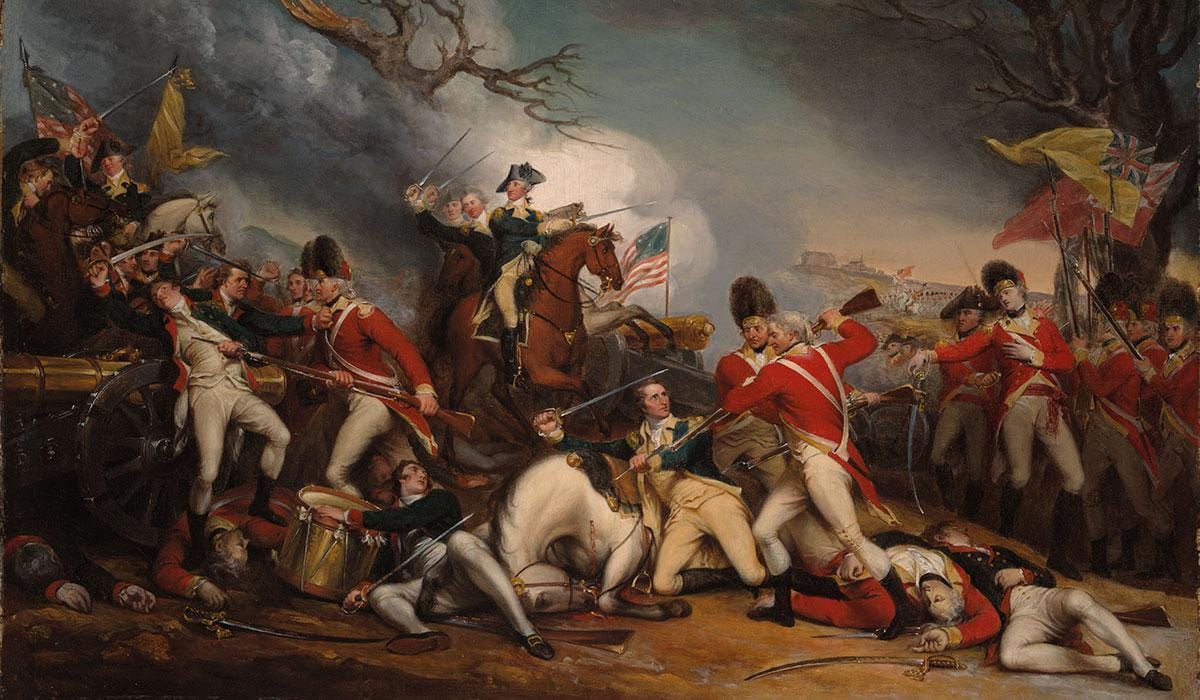
He split his forces just outside of Princeton, and a detachment, led by Hugh Mercer and 350  regulars had the first battle as they ran into the 17th and 55th British regiments as they prepared to escort supplies to Trenton. The British commander, Lt.colonel Mawhood, seeing how few men he faced, sent the 55th and most of the supplies back to Princeton, and led his men to shoot at the Americans from behind a fence. Mercer’s men fired back with rifles and cannon, doing little. Then, the trained British did what their training demanded: they rose up and charged the rebels with fixed bayonets. Mercer, having no bayonets, called “Retreat!” before being stabbed repeatedly, see painting. Mawhood’s men seized the cannon, turned it on the fleeing remnants of Mercer’s men.

General Mercer defeated at Princeton, as Washington shows up.

General Mercer defeated at Princeton, as Washington shows up.

It looked like a British victory, but then General Nathaniel Greene (the fighting Quaker) showed up with several hundred Pennsylvania militiamen. The militiamen had never seen battle, and many fled, after shooting into the British lines with rifles and another cannon and grape-shot. At this point it looked like a draw, but then, Washington himself joined the battle with two brigades of regulars: Hitchcock’s 253 New Englanders and Hand’s 200 Pennsylvania riflemen.

Washington managed to rally the fleeing Pennsylvanians; “Parade with us, my brave fellows! There is but a handful of the enemy and we will have them directly!” And Mawhood, now without most of his officers, ordered a last bayonet charge and fled down the Post Road to Trenton. Washington rode after for a bit “It’s a fine fox chase, my boys!”

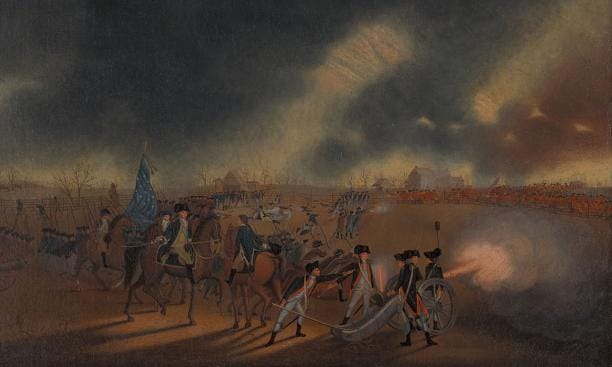
James Peale, 1783. John Sullivan and his forces at Frog Hollow. Battle of Princeton

James Peale, 1783. John Sullivan and his forces at Frog Hollow. Battle of Princeton

The rest of the British along with Mawhood, met the rest of Washington’s men, lead by John Sullivan, at a place called Frog Hollow, near where Princeton Inn College (Forbes College) now stands. The Americans opened with grape-shot and the British put up little resistance. Those who did not surrender were chased into town, taking refuge in Nassau Hall, the central building of the university. Alexander Hamilton’s men (he’d been rejected by Princeton) took special enjoyment in shooting cannon into the building. A hole remains in the college walls and a cannonball supposedly decapitated a portrait of George II. About then the New Jersey militia broke in a door, and the British surrendered.

Washington had captured, killed, or destroyed most of three English regiments, took a wagon train of supplies, and left going north following a bit of looting. “Loyalists” were relieved of coins, liquor, shoes, blankets. They ate the breakfast prepared for the 40th, and were gone by 11 AM, heading north — to where?. Cornwallis returned before noon “in a most infernal sweat — running, puffing, blowing, and swearing.” His men looted the town again, but now what?

Was Washington headed to New Brunswick where a handful of British soldiers guarded Cornwallis’s supplies and a war chest of £70,000? He didn’t go directly, but perhaps by a circuitous route. Cornwallis went straight to New Brunswick and jealously guarded the place, its money and supplies. Washington meanwhile ran to safety in the Watchung Mountains outside Morristown. Cornwallis’s 17th claimed victory, having defeated a larger group, but Cornwallis gave up Princeton, Trenton, and the lives of the New Jersey loyalists. Rebels flocked to Washington. Loyalists were looted and chased. Hessians were shot in “a sort of continual hunting party.” Philip Freneau expressed the change thus:

When first Britannia sent her hostile crew; To these far shores, to ravage and subdue, 

We thought them gods, and almost seemed to say; No ball could pierce them, and no dagger slay.

Heavens! what a blunder—half our fears were vain; These hostile gods at length have quit the plain.


Robert Buxbaum. December 21, 2016. So now that you know what happened, what SHOULD Cornwallis have done? Clearly, it’s possible to do everything right militarily, and still lose. This is an essence of comedy. The British had a similar Pyrrhic victory at Bunker Hill. I suspect Cornwallis should have fortified Trenton with a smaller force; built a stockade wall, and distributed weapons to the loyalists there. That’s a change in British attitude, but it’s this dynamic of trust that works. The British retreat music, “the world turned upside down“, is a Christmas song.

You are Cornwallis, Dec 29, 1776. What should you do?

Here’s a military thought question: what would you do? It is Dec 29, 1776, and you are General Howe and/or Cornwallis. You command 32,000 troops, a big chunk of the largest and finest expeditionary force that England has ever mustered. Washington’s rag-tag army has shrunk from 25,000 at the beginning of the year to 3335 now. They’re arrayed outside of Trenton NJ following their one victory of the year. Their Christmas raid on Trenton killed 100 Hessians and captured 900. In that raid Washington lost only 6 (two to frostbite), but otherwise his year has been nothing but defeats, and you’d like to make sure his string of bad luck continues.

Washington at Trenton with captured regimental flag. December 25, 1776. Peale.

Washington at Trenton with a captured British flag. Dec. 25, 1776. Peale. What should Cornwallis do now?

You’ve retaken the city and have 4000 or so at Trenton and another 10,000 at Princeton, 12 miles to the north. You can march or stay. In favor of staying: the enlistment of 3000 or so of Washington’s army is up Dec. 31, and they’ve not been fed or paid. They will almost certainly quit. You can thus wait and attack Jan. 1, or attack now and give the rabble another reason to quit. Two other options: hole up and let the weather do the job, or bypass Washington, cross the Delaware, and attack Philadelphia, the colonial capital. Philadelphia is completely undefended. What would you do? What should you do? Making the decision somewhat pressing, Washington’s men keep making skirmish raids in and around Trenton. Shooting cannon or rifles in, killing here and there.

Please post your opinion of what Cornwallis should have done, and in a week or so, I’ll post an account of what Cornwallis actually did and how it played out (not well for Cornwallis).

Robert E. Buxbaum, December 8, 2016, roughly 240 years after the events described. I’ve written about other great revolutionary mistakes, and about the battle of Bunker hill.

Everett, the better reviewed Gettysburg speaker

Lincoln’s election was greeted with horror by the educated classes who considered him a western rube. “Honest Ape” he was called in the press. Horace Greeley couldn’t stand him, and blamed the civil war on his reckless speech. Continuing their view that the press is never wrong, Lincoln’s Gettysburg address, November 17, 1863 was given very poor reviews, see my essay on why.

But the press wasn’t all bitterness and gall. A two-hour speech earlier that day by Edward Everett, was a hit with those who’d travelled, some hundreds of miles to hear it. Everett’s showed he was educated and understood the dire situation and causes of the battle. And he presents the conflict in a classical context, as a continuation of Roman and Greek conflicts. Here follows the beginning and end of his two hour address.

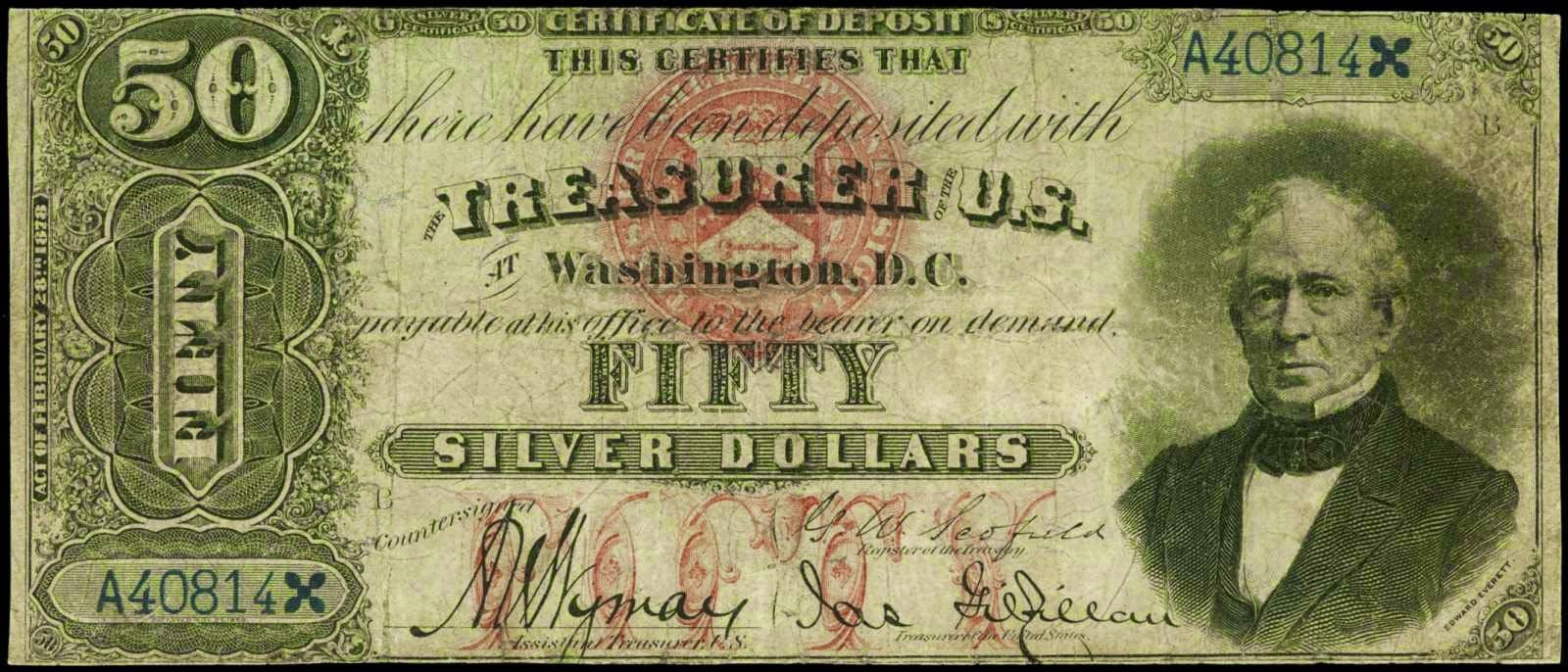
Edward Everett on the Fifty dollar silver certificate.

For nearly fifty years, Edward Everett’s face graced the Fifty dollar silver certificate. Now the world little notes, nor long remembers him. So passes glory.

[1] STANDING beneath this serene sky, overlooking these broad fields now reposing from the labors of the waning year, the mighty Alleghenies dimly towering before us, the graves of our brethren beneath our feet, it is with hesitation that I raise my poor voice to break the eloquent silence of God and Nature. But the duty to which you have called me must be performed;–grant me, I pray you, your indulgence and your sympathy.

[2] It was appointed by law in Athens, that the obsequies of the citizens who fell in battle should be performed at the public expense, and in the most honorable manner. Their bones were carefully gathered up from the funeral pyre where their bodies were consumed, and brought home to the city. There, for three days before the interment, they lay in state, beneath tents of honor, to receive the votive offerings of friends and relatives,–flowers, weapons, precious ornaments, painted vases (wonders of art, which after two thousand years adorn the museums of modern Europe),–the last tributes of surviving affection. Ten coffins of funereal cypress received the honorable deposit, one for each of the tribes of the city, and an eleventh in memory of the unrecognized, but not therefore unhonored, dead, and of those whose remains could not be recovered. On the fourth day the mournful procession was formed: mothers, wives, sisters, daughters, led the way, and to them it was permitted by the simplicity of ancient manners to utter aloud their lamentations for the beloved and the lost; the male relatives and friends of the deceased followed; citizens and strangers closed the train. Thus marshalled, they moved to the place of interment in that famous Ceramicus, the most beautiful suburb of Athens, which had been adorned by Cimon, the son of Miltiades, with walks and fountains and columns,–whose groves were filled with altars, shrines, and temples,–whose gardens were kept forever green by the streams from the neighboring hills, and shaded with the trees sacred to Minerva and coeval with the foundation of the city,–whose circuit enclosed

“the olive grove of Academe,
Plato’s retirement, where the Attic bird
Trilled his thick-warbled note the summer long,”–

whose pathways gleamed with the monuments of the illustrious dead, the work of the most consummate masters that ever gave life to marble. There, beneath the overarching plane-trees, upon a lofty stage erected for the purpose, it was ordained that a funeral oration should be pronounced by some citizen of Athens, in the presence of the assembled multitude.

[3] Such were the tokens of respect required to be paid at Athens to the memory of those who had fallen in the cause of their country. For those alone who fell at Marathon a peculiar honor was reserved. As the battle fought upon that immortal field was distinguished from all others in Grecian history for its influence over the fortunes of Hellas,–as it depended upon the event of that day whether Greece should live, a glory and a light to all coming time, or should expire, like the meteor of a moment; so the honors awarded to its martyr-heroes were such as were bestowed by Athens on no other occasion. They alone of all her sons were entombed upon the spot which they had forever rendered famous. Their names were inscribed upon ten pillars erected upon the monumental tumulus which covered their ashes (where, after six hundred years, they were read by the traveller Pausanias), and although the columns, beneath the hand of time and barbaric violence, have long since disappeared, the venerable mound still marks the spot where they fought and fell,–

“That battle-field where Persia’s victim-horde
First bowed beneath the brunt of Hellas’ sword.”

[4] And shall I, fellow-citizens, who, after an interval of twenty-three centuries, a youthful pilgrim from the world unknown to ancient Greece, have wandered over that illustrious plain, ready to put off the shoes from off my feet, as one that stands on holy ground,–who have gazed with respectful emotion on the mound which still protects the dust of those who rolled back the tide of Persian invasion, and rescued the land of popular liberty, of letters, and of arts, from the ruthless foe,–stand unmoved over the graves of our dear brethren, who so lately, on three of those all-important days which decide a nation’s history,–days on whose issue it depended whether this august republican Union, founded by some of the wisest statesmen that ever lived, cemented with the blood of some of the purest patriots that ever died, should perish or endure,–rolled back the tide of an invasion, not less unprovoked, not less ruthless, than that which came to plant the dark banner of Asiatic despotism and slavery on the free soil of Greece? Heaven forbid! And could I prove so insensible to every prompting of patriotic duty and affection, not only would you, fellow-citizens, gathered many of you from distant States, who have come to take part in these pious offices of gratitude,–you, respected fathers, brethren, matrons, sisters, who surround me,–cry out for shame, but the forms of brave and patriotic men who fill these honored graves would heave with indignation beneath the sod.

[5] We have assembled, friends, fellow-citizens, at the invitation of the Executive of the great central State of Pennsylvania, seconded by the Governors of seventeen other loyal States of the Union, to pay the last tribute of respect to the brave men who, in the hard-fought battles of the first, second, and third days of July last, laid down their lives for the country on these hillsides and the plains before us, and whose remains have been gathered into the cemetery which we consecrate this day. As my eye ranges over the fields whose sods were so lately moistened by the blood of gallant and loyal men, I feel, as never before, how truly it was said of old that it is sweet and becoming to die for one’s country. I feel, as never before, how justly, from the dawn of history to the present time, men have paid the homage of their gratitude and admiration to the memory of those who nobly sacrifice their lives, that their fellow-men may live in safety and in honor. And if this tribute were ever due, to whom could it be more justly paid than to those whose last resting-place we this day commend to the blessing of Heaven and of men?

………………………………….. The speech went on for 58 sections of more-or-less this size and ends by mentioning the achievements of the other union armies and navy saying, “But they, I am sure, will join us in saying, as we bid farewell to the dust of these martyr-heroes, that wheresoever throughout the civilized world the accounts of this great warfare are read, and down to the latest period of recorded time, in the glorious annals of our common country there will be no brighter page than that which relates THE BATTLES OF GETTYSBURG.”

_____________________________________________________________________

I find it long-winded and boring, but the crowd thought this speech wonderful. As grand as Lincoln’s 2 minute coda was plain. Part of the draw of Edward Everett was his cultured demeanor and his wide classical knowledge —  a big contrast to Lincoln. Everett had been president of Harvard, and had been a senator, a congressman, governor of Massachusetts, Secretary of State, and US Ambassador to Great Britain. Lincoln had been a country lawyer and one-term congressman. When states started succeeding, Everett had been the one called on to negotiate a compromise that delayed war until the firing on fort Sumter. All impressive in the day, now mostly forgotten glories. Today, many of his lines ring hollow today, e.g.  ” … that it is sweet and becoming to die for one’s country.” It just sounds weird to my ears. And the classic allusions sound pointless. By the early 20th century, most public pinion had changed; people decided that Lincoln’s was the better presentation, a monument to the spirit of man. The world remembers Lincoln fondly, but little notes, nor long remembers Everett, nor what he said there. The lesson: do not judge hastily. All things exist only in the context of time.

Robert E. Buxbaum, November 14, 2016. A week ago, Tuesday, our nation elected Donald Trump as 45th President of the United States, an individual as disliked and divisive as any since Lincoln. I do not know if he will prove to be honored or hated. There are demonstrations daily to remove him or overthrow the election. There are calls for succession, as when Lincoln took office. At Hampshire college, the flag was lowered in mourning. It’s possible that Trump is as offensive and unqualified as they say– but it is also possible that history will judge him otherwise in time. They did Lincoln.

Lessons of WWI: remove aristocrats and beards

Tzar Nicholas II and King George V.

Tzar Nicholas II and King George V, cousins and allies.

When I was a kid, Veterans day was called Armistice day. It marked the end of WWI. As many people died on all sides (there were many shifting alliances), it’s worthwhile asking what we’ve learned. The main thing, I think, is that aristocrats suck, both hereditary aristocrats, and the aristocrats of thought. Europe entered a world war for no big reason: small gains of land and status gains for a few aristocrats, generals, and thinkers at the top of society. These saw an opportunity to get medals and prove they could lead men in battle. The mass of Europeans cheered for war (see photo below, right) and followed them in battle. Millions were sent running at machine guns and poison gas. Most died, Those who survived returned home feeling less enthused about the ignorant, arrogant hereditary aristocrats, but still honored the generals and thinkers. They executed Tzar Nicolas of Russia and greatly reduce the power of the kings of England, Belgium, Turkey, Holland, and Austria. The thinkers inherited that power, but dropped the monarch’s face hair.

Emperor Franz Joseph

Emperor Franz Joseph II

mehmedv

Calif Mohammet V

Before WWI, virtually all of Europe was ruled by king; generally bearded kings who were believed to rule by divine right, as the will of God. The king generally had aid of a republican congress, a large aristocracy — counts, dukes, marchese, and earls, and the academic élite — professors and generals. All of these avoided association with the masses, except for show, all spent lavishly, and all maneuvered for power. By the end of WWI, no king in Europe retained real power, and the hereditary aristocrats discredited, power went to the intellectual aristocrats, where it resides today: generals, professors, newspapermen, novelists, generally mustached and modern. In 20 years or so, the new aristocrats would bring on WWII, in part because of a fear of war. Their wisdom proved to be little better than the old, but it is hard to say it was worse. The main lessons learned: avoid beards and aristocrats.

Brittains unified and cheering for the start of WWI

Britains unified and cheering for the start of WWI

In his book, “Diplomacy”, Henry Kissinger draws a few more lessons from the Great War. A major one is that balance of power works: it worked for the 100 years until WWI. Another lesson he draws: don’t let mutual defense treaties kick in until an actual invasion has begun: until troops actually cross the border. He blames hair trigger treaties for much of the trouble of WWI. His book is a good read, though, if only as a background his diplomatic approaches.

I write about WWI because of today is Veterans day, and also because two days ago we elected Donald Trump president of the US in a bitterly divisive election. Trump claims he wants “to drain the swamp,” a claim I take to mean that he intends to diminish the power of the intellectual aristocracy, the generals, writers, professors and politicians who think together, vacation together, club together, and control what it means to be educated. The Washington Post calls this removal a threat to western civilization; it removes the intelligentsia, and replaces it with racist boobs, or so they see Trump’s crew. There were anti election demonstrations in Boston, New York, Oakland, Austin, and Detroit. Upon election news a movement was started to impeach Trump, or get him to step down on claims that he stole the election. Officials of Hampshire college lowered the flag to half mast as a sign of mourning for our democracy. These acts of dissent are as heartfelt a reaction as the widespread approval that greeted WWI. I can hope the outcome is better.

For what it’s worth, I do not believe the supporters of Trump are as angry, or as stupid as portrayed: half a basketball of deplorables and irredeemables, the other half needing re-education (to borrow from Ms Clinton). These are the people who fight our wars, and I suspect we’ll be somewhat better off for giving them a voice. As for veterans day, honor the poor blokes who fought for our folly.

Robert E. Buxbaum, November 10, 2016.

The straight flush

I’m not the wildest libertarian, but I’d like to see states rights extended to Michigan’s toilets and showers. Some twenty years ago, the federal government mandated that the maximum toilet flush volume could be only 1.6 gallons, the same as Canada. They also mandated a maximum shower-flow law, memorialized in this Seinfeld episode. Like the characters in those shows, I think this is government over-reach of states rights covered by the 10th amendment. As I understand it, the only powers of the federal government over states are in areas specifically in the constitution, in areas of civil rights (the 13th Amendment), or in areas of restraint of trade (the 14th Amendment). None of that applies here, IMHO. It seems to me that the states should be able to determine their own flush and shower volumes.

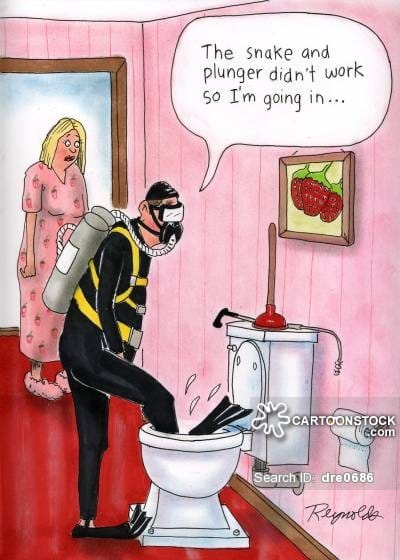
If this happen to you often, you might want to use more water for each flush, or  at least a different brand of toilet paper.

If your toilet clogs often, you might want to use more flush water, or at least a different brand of toilet paper.

There is a good reason for allowing larger flushes, too in a state with lots of water. People whose toilets have long, older pipe runs find that there is insufficient flow to carry their stuff to the city mains. Their older pipes were designed to work with 3.5 gallon flushes. When you flush with only 1.6 gallons, the waste only goes part way down and eventually you get a clog. It’s an issue known to every plumber – one that goes away with more flush volume.

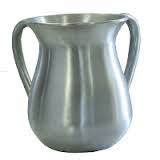
Given my choice, I’d like to change the flush law through the legislature, perhaps following a test case in the Supreme court. Similar legislation is in progress with marijuana decriminalization, but perhaps it’s too much to ask folks to risk imprisonment for a better shower or flush. Unless one of my readers feels like violating the federal law to become the test case, I can suggest some things you can do immediately. When it comes to your shower, you’ll find you can modify the flow by buying a model with a flow restrictor and “ahem” accidentally losing the restrictor. When it comes to your toilet, I don’t recommend buying an older, larger tank. Those old tanks look old. A simpler method is to find a new flush cistern with a larger drain hole and flapper. The drain hole and flapper in most toilet tanks is only 2″ in diameter, but some have a full 3″ hole and valve. Bigger hole, more flush power. Perfectly legal. And then there’s the poor-man solution: keep a bucket or washing cup nearby. If the flush looks problematic, pour the extra water in to help the stuff go down. It works.

A washing cup.

A washing cup. An extra liter for those difficult flushes.

Aside from these suggestions, if you have clog trouble, you should make sure to use only toilet paper, and not facial tissues or flushable wipes. If you do use these alternatives, only use one sheet at a flush, and the rest TP, and make sure your brand of wipe is really flushable. Given my choice, I would like see folks in Michigan have freedom of the flush. Let them install a larger tank if they like: 2 gallons, or 2.5; and I’d like to see them able to use Newman’s Serbian shower heads too, if it suits them. What do you folks think?

Dr. Robert E. Buxbaum, November 3, 2016. I’m running for Oakland county MI water resources commissioner. I’m for protecting our water supply, for better sewage treatment, and small wetlands for flood control. Among my less-normative views, I’ve also suggested changing the state bird to the turkey, and ending daylight savings time.

Most flushable wipes aren’t flushable.

I’m a chemical engineer running for Oakland county water resources commissioner, and as the main job of the office is sewage, and as I’ve already written on the chemistry, I thought I might write about an aspect of the engineering. Specifically about toilet paper. Toilet paper is a remarkable product: it’s paper, compact and low in cost; strong enough to clean you, smooth on your bum, and beyond that, it will disintegrate in turbulent water so it doesn’t clog pipes. The trick to TP’s dry strength and wet-weakness, is that the paper pulp, wood cellulose, is pounded very thin, yet cast fluffy. For extra softness, the paper is typically coated with aloe or similar. Sorry to say, the same recipe does not work for wet-wipes, paper towels or kleenex (facial tissues); all of these products must have wet-strength, and this can cause problems with sewer clogs.

Patent 117355 for perforated toilet paper claimed it as an improved wrapping paper.

Patent 117,355 for perforated toilet paper on a roll. It’s claimed as an improved wrapping paper.

Before there was toilet paper, the world was a much sadder, and smellier place. Much of the world used sticks, stones, leaves, or corn cobs, and none of these did a particularly thorough job. Besides, none of these is particularly smooth, or particularly disposable, nor did it fall apart — not that most folks had indoor plumbing. Some rich Romans had plumbing, and these cleaned themselves with a small sponge on the end of a stick. They dipped the sponge end in water for each use. It was disgusting, but didn’t clog the pipes. I’ve seen this in use on a trip to Turkey 25 years ago — not in actual use, but the stick and sponge was there in a smelly bucket next to the hole in the ground that served as the commode.

The first reasonably modern toilet was invented in 1775 by Alexander Cummings, and by 1852 the first public flush toilets were available. The design looked pretty much like it looks today and the cost was 1¢. You got a towel and a shoe-shine too for that penny, but there was no toilet paper as such. Presumably one used a Roman sponge or some ordinary, standard paper. A popular wipe, back in the day was the Sears-Roebuck catalog. It came free to most homes and included a convenient hole in the corner allowing one to hang it in and outhouse or near the commode. It was rough on the bum, and didn’t fall apart. My guess is that it clogged the pipes too, for those who used it with flush toilets. The first toilet-specific paper wasn’t invented till 1859. Joseph Gayetty, an American, patented a product from pulverized hemp, a relatively soft fiber, softened further with aloe. This paper was softer than standard, and had less tendency to clog pipes.

Toilet paper has to be soft

Toilet paper is either touted to be soft or strong; Modern Charmin touts wet strength, while Cottonelle touts completeness of wipe: ‘go commando.”

The next great innovation was to make toilet paper as a perforated product on a roll. These novelties appear as US Patent #117,355 awarded to Seth Wheeler of Albany, NY 25 July 1871 (Wheeler also invented the classic roll toilet paper dispenser). Much of the sales pitch was that a cleaner bum would prevent the spread of cholera, typhoid, and other plagues and that is a legitimate claim. As the  market expanded, advertising followed. Some early brands touted their softness, others their strength. Facial tissues, e.g. Kleenex, were sold specifically as a soft TP-like product that does not fall apart when wet. Sorry to say, this tends to go along with clogged toilets; do not flush more than one kleenex down at a flush. Kleenex is made with the same short fibers and aloe as toilet paper, but it contains binders (glue) to give it wet-strength. My guess is that Charmin is made the same way and that it isn’t great on your plumbing.

Paper towels and most baby wipes are worse to flush than Kleenex. They are made with lots of binder and they really don’t fall apart in water. Paper towels should never be flushed, and neither should most baby wipes, even brands that claim to be ‘flushable.” When flushed, these items tend to soak up fat and become fat bergs – the bane of sewer workers everywhere. There is a class action law suit against flushable wipe companies, and New York City is pursuing legislation to prevent them from claiming to be flushable. Still, as with everything, there are better and worse moist-wipe options. “Cottonelle” brand by Kleenex, and Scott flushable wipes are the best currently. In a day or less they will dissolve in water. These products are made with binders like kleenex, but the binder glue is a type that dissolves in any significant amount of water. As a result, these brands fall apart eventually. For now, these are the only flushable brands I’d recommend flushing, and even then I suggest you only flush one at a time. In tests by Consumer Reports, other brands, e.g. Charmin and Equate flushable wipes do not dissolve. These manufacturers either have not quite figured out how to make dissolvable binders, or they can’t get around Kleenex’s patents.

Robert Buxbaum. October 10, 2016. If you live in Oakland County, MI, vote for me for water commissioner. Here’s my web-site with other useful essays. I should mention Thomas Crapper, too. He invented the push-button flush and made some innovations in the water cistern, and he manufactured high-end commodes for Parliament and the royal family, but he’s irrelevant to the story here.

1939, when East and West became friends and partners

Forward Marx

The large mustache, Soviet Socialist it seems is very much like his neighbor, the small mustache, National Socialist.

In August, 1939, just about 77 years ago to the day, Germany and the Soviet union signed a non-aggression pact — The Molotov von Ribbentrop agreement. The open text suggested peace, but there was a secret rider that was made widely available. The large mustache soviet socialist and the small mustache national socialist had divided up the land between them. “In case there was war,” Russia would get Lithuania, Finland, Eastern Poland, and Bessarabia (Northern Romania). Germany would get Denmark, Western Poland, and Greece.

Commemoration of the Soviet -German non-aggression pact, August 1939.

Commemoration of the Soviet – German non-aggression pact, August 1939.

Up till then, we in the US assumed that these nations were bitter enemies and that their enmity would protect us. It turned out they were friends, or at least that they had the common goal of conquest and domination. Both were socialists in the sense that they did not respect the property rights of their neighbors. In the cartoon at right, Uncle Sam is standing on the battlements, looking stupid, holding his useless umbrella (The League of Nations? US foreign policy?). The title, “Watchman, What of the Night.” Is from Isaiah. In August, 1939 night was most definitely coming along with a combined storm of aggression from Germany and the USSR.

I’m posting this as a reminder that East and West are more similar than is generally believed. That left and right too are often useless distinctions. That folks will generally seek their own advantage over philosophical purity, and over the advantage of the US. Internationalism, thus, is not a panacea for peace. Generally speaking, I suspect that Flavius’s dictum still applies: “if you wish for peace, prepare for war.” Also, I had these great cartoons, courtesy of my friend, Jim Wald.

Robert Buxbaum, August 25, 2016. People often forget/ ignore that the USSR started its part of WWII by invading Finland and Poland. Finland resisted invasion a lot better than Poland. So well that, when Germany broke the agreement and Russia became our friend, Finland became our enemy– sort-of. They were still fighting Russia. And, in the East, Russia remained an ally of Japan for another year, even briefly after Japan attacked Pearl Harbor. This made sending aid to Russia problematic, though Roosevelt did it. I’ve written about WWII in terms of mustaches because, to me, it makes as much sense as anything, and more sense than east vs west.

More French engineering, the Blitzkrieg motorcycle.

There’s something fascinating that I find in French engineering. I wrote a previous essay about French cars, bridges, and the Eiffel tower. Here’s a picture or two more. Things I wanted to include but didn’t. First here’s a Blitzkrieg Vespa motorcycle; the French built some 800 of these from 1947 to 1962 and used them in Vietnam and Algeria. What’s remarkable is how bizarrely light and unprotected it is. It’s a design aesthetic that follows no one, and that American engineers would not follow.

French Blitzkrieg Vespa used in Vietnam

French Blitzkrieg Vespa used in Vietnam; cannon range is 4.5 miles.

The key engineering insight that allows this vehicle to make sense is that recoil-less rifles are really recoil-less if you design them right. Thus, one can (in theory) mount them on something really light, like a Vespa. Another key (French) insight is that a larger vehicle may make the soldier more vulnerable rather than less by slowing him down and by requiring more gasoline and commissariat services.

Americans do understand the idea of light and mobile, but an American engineers idea of this is a jeep or an armored truck; not a Vespa. From my US engineering perspective, the French went way overboard here. The French copy no one, and no one copies the French, as they say. Still, these things must have worked reasonably well or they would not have made 800 of them over 15 years. A Vespa is certainly cheaper than a Jeep, and easier to transport to the battle zone….

Robert Buxbaum, February 18, 2016. The Italians have a somewhat similar design aesthetic to the French: they like light and cheap, but also like maneuverable and favor new technology. See my blog about a favorite Fiat engine.