Category Archives: politics

Pre-Columbus America, slavery and cannibalism.

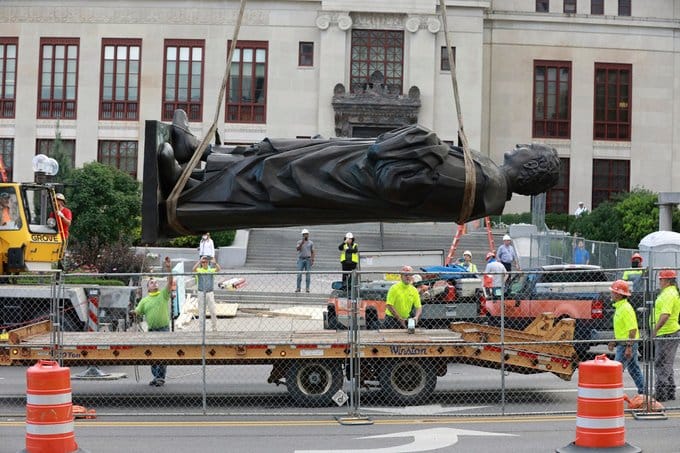
We’re still in the midst of a frenzy of statue removals, and among the most popular to remove is Columbus. The City of Columbus Ohio just removed theirs, and Detroit soon followed. What Columbus is accused of is colonialism, bringing evil western values and western religion to the peaceful Indians. At least that’s the legend being told these days.

The war god, Huitzilopochti, son of the sun, seated at right, required thousands of human sacrifices to keep the sun from going out. Columbus claims that many Indians preferred Christianity to his worship.

According to Columbus and his followers, the Indians of 1492 included some who were peaceful, and others who were murderous cannibals. According to Columbus, the less-violent of the Indians willingly accepted Christianity, or a sort, considering it better than the human sacrifice they were used to.

Mask for Tezcatlipoca, god of the night and sorcery, secondary son of the sun, brother of Huitzilopochtli.

Columbus described people being roasted and eaten with pineapple. Some of Columbus’s crew who were captured, claim they, were fattened for eating, and that others were eaten. That also is the story of Captain Cook, who appears to have been cooked and eaten in 1791, and of Michael Rockefeller, eaten by cannibals in New Guinea in 1961. Some customs die hard.

The natives of Mexico of the time are known to have practiced slavery and human sacrifice, killing thousands of young men and women each year to a wide variety of gods. For Huitzilopochtli, the war-god, son of the sun, Mexican priests cut out the still -beating hearts of adult male slaves, and ate them. This was done to prevent the sun from going out. On flat rocks they same Mexican Indians sacrificed to his brother, Tezcatlipoca, the god of the night and of sorcery. Though Texcatlipoca was slightly less powerful, he was more personally useful. The sacrifice to Tezcatlipoca is reminiscent of the attempted sacrifice of John Smith of the Virginia colony. According to testimony, in 1607, Smith was captured while hunting, kept in captivity for a few days, and was going to be sacrificed on a flat rock until saved by Pocahontas, the chief’s daughter. Later Pocahontas converted to Christianity, travelled to England, and was presented to King James I.

Pocahontas, renamed Rebecca, in 1616.

Related to the story of John Smith of the Virginia colony, is the landing of John Smith of the Massachussetts colony. The reason they settled on that spot in Plymouth bay, was that, when they landed there in 1620, the land was already cleared, but empty. Apparently, there had been a farming Indian tribe who had cleared the land, but had been recently killed off or enslaved by the local Iroquois. The Iroquois practiced slavery against their fellow Indians well before the arrival of the first African slaves in 1619. According to Frederic Douglas in 1870, the Indians treated their slaves better than the white settlers did, but he was writing 150 years later. The peaceful Indian, Squanto who helped the Massachusetts colony had been captured and brought to England in 1609 and brought back to the Americas by the John Smith of the Virginia colony. Squanto lived as a free man among the pilgrims. Squanto helped negotiate a peace treaty for the colony with the Wampanoags against the Narragansett. This treaty was settled at the first Thanksgiving, and lasted for the life of the Wampanoags Chief.

Returning to the Gods of the Mexicans, Tlaloc, the rain god, was responsible for fertility and agriculture. He required the sacrifice of children. There was also a corn god, Centeotl, I think Steven King has a story about his worship, it involved a corn sacrifice, plus spilling your own blood and killing a young woman and using her skin as a mask. There was also the feathered serpent god, Quetzalcoatl, god of love, knowledge, and intoxicating drink. She required the sacrifice of a mix of men, women, and children, plus ingestion of intoxicating substances. Columbus claimed that many Indians willingly changed religion to Christianity and away from the worship of these deities, a claim that modern liberals find ludicrous, but that I find believable. I think modern liberals imagine themselves as the priests of these religions, or perhaps nobles, but they do not see it, as I do, from the perspective of the unwilling sacrifices.

The folks behind the removal of Columbus statues and behind defunding the police would like to use the money for education about the noble pre-Columbian peoples. They would like to focus on the pyramids and on the large, flat sacrificial stones, without spending too much time on what the pyramids and stones were used for.

Chief Tammany signed a peace treaty with William Pitt in 1683. His grandson converted to Moravian (Protestant?) Christianity. He is considered a model of good will and good government.

The fate of the Indians varied. Some converted to Christianity, some did not. Some tribes integrated well into the new society, many did not. Among the most famous who converted and integrated well, we find Chief Tammany of the Turtle clan of the Delaware Indians. He signed a peace treaty with William Penn, 1683, and his tribe seems to have lived in peace with the settlers for 70 years at least and married into the most prominent families of the area. The Turkey of the same tribe did not fare so well, They sided with the French and warred against the English settlers, and suffered with the French defeat. Western involvement was not always good or fair to the Indians, but that is not inherently Columbus’s fault. Columbus did a service, I think, opening up the new world, and providing an alternative religion to natives who were rescued from human sacrifice. I believe western civilization is a boon to the world by the very balance of order and freedom that some find troubling. The Jewish Bible is strongly against tightly ordered religions with human sacrifice. Christianity is a big improvement, IMHO.

Robert Buxbaum. July 27, 2020

Hamilton and his slave-trading father in law.

Philip Schuyler as a Major General in the Revolution. His statue was removed.

What most folks know about Alexander Hamilton’s father in law, Philip Schuyler, is that he was “loaded”, that he had three daughters, and that he quickly took to young Alexander. But an important fact varnished over is that Schuyler made his money in the slave trade, a trade that Hamilton was likely in when he met the young Schuyler daughters. Schuyler was also a slave owner, owning 13 slaves, by his record, and perhaps another 17 indentured servants working at two mansions. So far, only the Philip Schyler statue has been taken down. It seems possible that many monuments to Hamilton may follow.

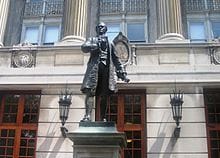
Statue of Alexander Hamilton, proudly stands in front of Columbia University. The ten dollar founding father.

The play “Hamilton” proclaims Hamilton’s genius and exceptional work ethic, mentioning that, at the young age of 14 (more likely 16) he was left in charge of a trading company. This was for 5 months in 1771, while the owner was over seas doing business. Hamilton knew the business well; he’d been hired as a clerk at 11 at Beekman and Cruger, a similar import-export trading firm. What items did these firms trade — cotton, sugar, rum, and most profitable slaves. This likely was the business that kept the owner overseas for 5 months while Alexander ran the shop. There are at least two notifications of slave ships entering the harbor with human good for sale. Among Hamilton’s likely jobs would have been fattening and oiling the goods for sale. Hamilton himself seems to have owned a slave-boy named Ajax who he inherited (briefly) from his mother, Rachel. His mother is listed on the tax records as white. She owned five saves at one time, suggesting she was not entirely impoverished. Hamilton’s father, though a failed businessman, was a Scottish Laird (a Lord). As for the court-mandated transfer of Ajax from Alexander, it was to his half-brother James because James was “Legitimate.”

I base Hamilton’s age on the Nevis-St Kitts record of his birth, January 11, 1755.”[1] The play takes as a fact Hamilton’s claim to have been born two years later, January 11, 1757. I trust the written records here, and imagine Hamilton wanted to present himself as a young genius, rather than as a bright, but older fellow. In 1772, at at age 17, Hamilton wrote a “fire and brimstone” description of a deadly hurricane, describing it as “divine rebuke to human vanity and pomposity.”[2] Between this, and his skill at trading, the community leaders collected money to send him to New York, but unlike the play’s description, it was not only for further education. The deal was that he continue trading for the firm,[3] and this is likely how he met his future father in law. “[4] 

Hercules Mulligan, a revolutionary tailor: He was a spy. According to the CIA, much of the work was through his black slave, Cato.

In New York, Hamilton met Schuyler and his daughters. It seems likely that he met the father first, likely as possible customer for the slave trade from the Caribbean, or perhaps as a customer for rum and sugar. A 1772 letter in Hamilton’s handwriting [4] asks for the purchase of “two or three poor boys” for plantation work, “bound in the most reasonable manner you can.” As in the play, Hamilton was friends with John Laurens, an abolitionist, and among his first lodgings was with Hercules Mulligan, a tailor’s apprentice. Hercules is presented as black in the play, but he was quite white (see picture) with a black slave, Cato. Cato ran most of the messages. According to the play, “I’m joining the rebellion cuz I know it’s my chance
To socially advance, Instead of sewin’ some pants, I’m taking my shot. No, Hercules was socially advanced ,married into the British Admiralty, even. He was a true believer in freedom and a slave-holder. His older brother, Hugh Mulligan, was one of the traders that Hamilton was supposed to work with.[5] As for Laurens and his anti-slavery organization, most of those in the organization owned slaves, and though they opposed slavery, they could never decide on when or how to end it. There is no evidence that Cato was ever set free.

The appointment to Washingtons staff was not likely a coincidence. The elder Schuyler was one of the four top generals appointed in 1775 to serve directly under Washington. Phillip oversaw, at a distance, the disastrous attack on Quebec and the victory at Saratoga– both, Burr served admirably. Phillip’s main role was as a quartermaster/supplier, and this is not a small role. Phillip Schuyler had been a quarter-master in the French and Indian war. It’s likely that it was Schuyler who got Hamilton his appointment to Washington’s staff.

Once on Washington’s staff, Hamilton served admirably. Originally serving as a secretary, Hamilton wrote many of Washington’s dispatches. Then, according to tradition, as a cannon commander, he took particular pleasure in the attack on Princeton University. He then served well as secretary of the Treasury, and as head of the Bank of The United States, the only major US bank until Burr opened the Bank of the Manhattan company. Despite his aversion to slavery, Hamilton also continued to deal in slaves. A 1796 cash book entry records Hamilton’s payment of $250 to his father-in-law for “2 Negro servants purchased by him for me.” This is only 3 years before 1799, when New York began to end slavery in the state with the Act for the Gradual Abolition of Slavery. Children of slaves born after July 4, 1799, were to be legally free, but required indentured servitude: to age 28 for males and 25 for females. Those born before July 4, 1799 became free in 1817. There is no evidence that Hamilton was a leader in any of this, but Burr, another slave-owning abolitionist, was a leader in the NY legislature at the time.

I’m with Burr.He was flawed, a slave-owning abolitionist, but vehimently against the Alien and Sedition Acts, a Hamiltonian horror.

It seems that Robert Morris introduced Hamilton to the importance of tariffs, and to the idea of using debt service as a backing to currency. It’s brilliant idea, but Hamilton understood it and took to it. Hamilton also understood the need for a coast guard to enforce the tariffs. As for Hamilton’s character, or Burr’s. Both, in my understanding, were imperfect people who did great deeds. I’ve already written that Hamilton was likely setting up Burr for murder, perhaps because of Burr’s vehement opposition to the Alien and Sedition Acts — That’s why Hamilton wore his glasses and fiddled with the gun so much. Burr was also gaining power through his Manhattan corporation and Tammany organization. both of which got his support among the immigrants.

My intent here is not to knock the image of Hamilton, Schuyler, Laurens and Mulligan, nor to raise that of Burr, but to correct some current fictions in the play “Hamilton”, and to fight a disease of our age, the cancel culture. The cancel culture elevates their heroes (Hamilton, Mulligan) to god-status. They will lie to cover the flaws of their heroes, and will lie also to claim a drop of black blood in them; neither Hamilton nor Mulligan were black and both owned slaves, as did Burr. The other side of the cancel culture is to cancel — to eliminate the validity — of the reactionaries, the non-revolutionary. In the play, these include Samuel Seebury and Aaron Burr. Great building is almost always the work of contradictory people. They need some talent, and a willingness to act, and because building requires a group, they have to work in a group, tolerating flaws of the others in the group. It is just these flawed, contradictory builders that are being cancelled, and I don’t think that’s right or healthy.

Robert Buxbaum, August 4, 2020.

Sweden v Michigan: different approaches, same outcome.

Sweden has scientists; Michigan has scientists. Sweden’s scientists said to trust people to social distance and let the COVID-19 disease run its course. It was a highly controversial take, but Sweden didn’t close the schools, didn’t enforce masks, and let people social distance as they would. Michigan’s scientists said to wear masks and close everything, and the governor enforced just that. She closed the schools, the restaurants, the golf courses, and even the parks for a while. In Michigan you can not attend a baseball game, and you can be fined for not wearing a mask in public. The net result: Michigan and Sweden had almost the same death totals and rates, as the graphs below show. As of July 28, 2020: Sweden had 5,702 dead of COVID-19, Michigan had 6,402. That’s 13 more dead for a population that’s 20% smaller.

Sweden’s deaths pre day. There are 5,702 COVID dead since the start, out of a population of 10.63 million. There are 79,494 confirmed COVID cases, but likely a lot more infected.

Sweden and Michigan are equally industrial, with populations in a few dense cities and a rural back-country. Both banned large-scale use of hydroxy-chloroquine. Given the large difference in social distance laws, you’d expect a vastly different death rate, with Michigan’s, presumably lower, but there is hardly any difference at all, and it’s worthwhile to consider what we might learn from this.

Michigan’s deaths pre day. There are 6,426 COVID dead since the start, out of a population of 9.99 million. There are 88,025 confirmed COVID cases, but likely a lot more infected.

What I learn from this is not that social distance is unimportant, and not that hand washing and masks don’t work, but rather it seems to me that people are more likely to social distance if they themselves are in control of the rules. This is something I also notice comparing freezer economies to communist or controlled ones: people work harder when they have more of a say in what they do. Some call this self -exploitation, but it seems to be a universal lesson.

Both Sweden and the US began the epidemic with some moderate testing of a drug called hydroxychloroquine (HCQ)and both mostly stopped in April when the drug became a political football. President Trump recommended it based on studies in France and China, but the response was many publications showing the didn’t work and was even deadly. Virtually ever western country cut back use of the drug. Brazil’s scientists objected — see here where they claim that those studies were crooked. It seems that countries that continued to use the drug had fewer COVID deaths, see graph, but it’s hard to say. The Brazilians claim that the anti HCQ studies were politically motivated, but doctors in both Sweden and the US largely stopped prescribing the drug. This seems to have been a mistake.

US hospitals stopped using HCQ in early April almost as soon as Trump recommended it. Sweden did the same.

In July, Henry Ford hospitals published this large-scale study showing a strong benefit: for HCQ: out of 2,541 patients in six hospitals, the death rate for those treated with HCQ was 13%. For those not treated with HCQ, the death rate was more than double: 26.4%. It’s not clear that this is cause and effect. It’s suggestive, but there is room for unconscious bias in who got the drug. Similarly, last week, a Yale researcher this week used epidemiological evidence to say HCQ works. This might be proof, or not. Since epidemiology is not double-blind, there is more than common room for confounding variables. By and large the newspaper experts are unconvinced by epidemiology and say there is no real evidence of HCQ benefit. In Michigan and Sweden the politicians strongly recommend continuing their approaches, by and large avoiding HCQ. In Brazil, India and much of the mideast, HCQ is popular. The countries that use HCQ claim it works. The countries that don’t claim it does not. The countries with strict lock-down say that science shows this is what’s working. The countries without, claim they are right to go without. All claim SCIENCE to support their behaviors, and likely that’s faulty logic.

Hydroxychloroquine and COVID-19 fatality rates in different countries as of early June 2020. This isn’t enough to prove HCQ effectiveness, but it’s promising, and suggests that increased use is warranted, at least among those without heart problems.

Given my choice, I’d like to see more use of HCQ. I’m not sure it works, but I’m ,sure there’s enough evidence to put it into the top tier of testing. I’d also prefer the Sweden method, of nor enforced lockdown, or a very moderate lockdown, but I live I’m Michigan where the governor claims she knows science, and I’m willing to live within the governor’s lockdown.There is good, scientific evidence that, if you don’t you get fined or go to jail.

Robert Buxbaum, July 29, 2020. As I side issue, I think iodine hand wash is a good thing. I may be wrong, but here’s my case.

Package postage from China: 70¢ for 2 oz.

The minimum US postage rate to send a 1 oz to 8 oz package across the street is $8.30. This is the price for any size package going in “zone 1”. That is, to a nearby, instate address. It costs more to send a package to nearby states or across the country, zones 2,3,4,5,6,7, 8 You don’t get shipping updates or delivery confirmation unless you pay more. By comparison the US post office charges no more than $1.50 to Chinese companies to deliver packages of up to 4.4 lbs (2 kg) and they get shipping and delivery confirmation thrown in free. The high US rates are, in part, because the post office is losing money to subsidize postage from China.

On the internet folks are amazed at how cheap things are shipped from China (I copied this post from this Forbes article)

US producers can not compete on the sale of small items, in part, because we subsidize the shipping costs. Go to Amazon or e-Bay and you can buy from China packaged items shipped by air for a total price of $1 or so. That includes the price of the item, the shipping cost, and some profit for Amazon or eBay. A US supplier could not sell this cheap even if it were a box of air. The low shipping costs result from a poorly negotiated postage deal of 2011 between us (Obama’s negotiator) and the Chinese. Until 2021, we are committed to deliver a package of 50g or less, (2 oz) for 5 Chinese Yuan, or 70¢ at the current exchange rate of 14¢/NCY. Additional ounces are billed at 35¢ up to 4.4 lbs; use the following table of prices and apply the dollar to CNY conversion. We threw in tracking services and an e-mail confirmation for free, in part because China was poor, and we were rich. Also, the deal was pushed by e-Bay and Amazon, two big supporters of Obama’s presidency.

US suppliers cannot compete.

Adding insult to injury, Obama raised the de minimis amount for billing tariffs from the normal $100 to $800 making almost all purchases from China duty free. Obama made some complaints about unfair trade, and about the counterfeits and knockoffs but no major enforcement. In 2012 and 2014, the Obama administration signed similar postage deals with Korea, Hong Kong, and the EU. The Germans applauded as it allows them to ship goods to the US for far less than the cost of us shipping to Germany. The US post office loses money on this and makes up for it by charging us more for domestic mail.

The Washington Post praised Obama on these deals claiming that they benefitted US customer and promoted democracy. Of course, the Washington Post is owned by Amazon’s main stock holder, Jeff Bezos– someone who benefits very much by the deal. He is among the relatively few people and organizations that own the media outlets. The Post loses money on newspaper sales but benefits the owners by the propaganda value of the stories, a situation also found with Al Jazeera and the emir of Qatar.

Trump has informed China that these special rates will end when the treaty runs out in January 1, 2021. A per-package ship fee will be $3.00 for a one ounce package, with 11¢ per additional once. This is less than the domestic rate, but far higher than the current 35¢ for 1 oz. I’d probably have raised their postage even more, but this is an election year, and Biden may well reverse any deal Trump signs.

Robert Buxbaum, July 14, 2020. Though I’m appalled by this postage deal, I just bought a 50 lb kayak from China, $99.99 including shipping. The prices are too low to pass up.

Who are the BLM vandals?

There have been a dozen attempts to tear down the statue of Andrew Jackson outside the Whitehouse. Most of these appear to have been done by white people, supporters of “Black Lives Matter,” or BLM. BLM vandals were more successful destroying statues of Columbus, Lee, Washington, Jefferson, Roosevelt, Lincoln, Saint Louis, and Christian Heg, an anti-slavery activist of the 1800s, — he was a white guy. Graves are spray painted BLM, stores have been vandalized and looted, people have been killed, and at least one “cop free autonomous zone” set upin Seattle. No police allowed, no fire fighters allowed. At least one murder. Policing by a BLM warlord. So who are the BLM vandals running these activities, and who are their supporters?

Graves vandalized with Black Lives Matter, and with BLM Floyd. The vandals prepared, bringing spray paint to the cemetery, but there is no sense they were helping black people.

To my observation the BLM activist-vandal is not typically black, nor illiterate, nor disadvantaged; nor do they act in a fit of anger. The tools of destruction, bricks, spray paint, chains torches, and firebombs are brought home, often many miles away. Bricks are left in buckets are key locations for ready use in the demonstration. Many of the activists are white, often women, literate, liberal, socially secure, and self-satisfied. Two lawyers, one a Princeton graduate, were among those throwing firebombs in a Jewish section of Brooklyn, last week. They were acting for social justice in Palestine, they say. Another pair of bomb-throwers were two sisters white, from upstate NY who traveled to Brooklyn to throw a gasoline bomb into a police care with four officers. Her motivation, she says, social injustice — certainly not for the innocent policemen.

There is rarely any connection between the destruction and any positive help to black people nor is there any direct relationship to George Floyd, killed by cruel police. Why behead the statue of Columbus, or burn this statue of an elk? Even the fire-bombing lawyers had trouble explaining the relationship between their bombing of a police car in Brooklyn and the motivating causes, police brutality and ending the zionist presence in Palestine, for these particular two. So why burn a car, topple a statue, or loot a store, or burn an elk? As best I can tell, it’s because these things are big, available, and minimally guarded. If someone steps out to defend their property, the vandals leave, or snuck around to sucker-punch from behind, leaving quickly afterward, before the police get there.

The vandals do not act out of rage either, but with malice and fore-thought. It takes a lot of organization to show up with working fire-bombs, bricks, or with spray paint for that matter. Neither of these items is available at stores near the demonstrations. And taking down a statute requires more. The vandals bring strong ropes, chains, and cutting torches. Check out this video of an attempt on the Andrew Jackson statue, and note the organization of labor and that virtually everyone here is white.

Samantha Shader, traveled to Brooklyn with gasoline bombs and through one into a police car with 4 officers inside. None died. She’s not black, uneducated, or oppressed, Just bored, and angry.

Whether they succeed or not, the vandals are proud of their activities. They brag to the press and often post videos. Publicity is part of the motivation, but it sometimes leads to capture. Samantha Shader, throwing a gasoline bomb, was caught because of her own bragging video.

When caught, the BLM vandal immediately appeals for his or her rights, and is often bailed out by the politicians who claim to deplore violence. They blame the very folks they’d harmed too, and claim it was justice to destroy the statue, or the Jewish or black-owned store. The black store owner is an uncle Tom, the Jewish synagog a symbol of oppression, and they see themselves as white saviors, white knights and revolutionaries, destroying offensive symbols of other folks success. It’s only other people’s stuff that’s offensive to them, by the way. I’ve yet to see any of the BLM vandals destroy their own cars or homes.

As bad as the actual vandals are, in a sense the politicians who support them are worse, spurring them, then sitting judgement on the BLM wrongs. The politicians, liberal, often white women, praise the BLM vandal leaders, and help the raise money for them. They ascend the podium with the worst of the BLM vandal leaders, proclaiming, “We’re with you.” “You are right to be angry, and your cause just.” “We are inspired by you.” They say they are against violence, but they eagerly remove the statues that the BLM vandals spray painted — The statue of Columbus in front of Columbus city hall for example, They defund the police — their salaries, retirements, etc. — and give the money to BLM-run organizations. The Biden campaign does more and provides bail money. All this helps honest black people not at all, nor is it good for the cities, but it does provide good press for the politicians, and so far the support for BLM seems to make up for Biden’s habit of touching and sniffing girls’ hair. As for where the BLM money goes, we have little information, but this is what we know. Some will go back to the Democratic party via a BLM program called #WhatMatters2020. Some will go toward Black Liberation education. None is slated to help victims of BLM vandalism, black or white. And this is what passes for political accountability.

Columbus Ohio; Vandals spray paint the statue of Columbus in front of city hall, then the Mayor cleans the statue, and removes it. Which one is the bigger vandal? Do either help black people?

I imagine that I do more for black lives than what BLM does, by my efforts to provide clean water and better sewage, for example. Another thing we might do, if we thought black lives really mattered would be to change the laws that put black people behind bars for minor crimes, e.g. pot sales. Recreational pot use is legal in much of the US, but black people are emprissoned in large numbers, because the sale is illegal unless you have special licenses. and black people never can get the license to sell legally. I don’t think defunding the police is a road to help black people, certainly not when the money goes to Black Liberation education and statue removal. It seems that black lives don’t matter at all to either the BLM vandals, or the fire-bombers, or to the politicians,, and they never did.

Robert Buxbaum, July 6 2020.

If nothing sticks to teflon, how do you stick teflon to a pan? PFAS.

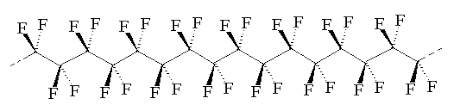
When I was eight or nine year old, I went to the 1963-64 World’s Fair in New York. Among the attractions, in “the kitchen of the future”, I saw the first version of an amazing fry-pan that was coated with plastic. You could cook an egg on that plastic without any oil, and the egg didn’t stick. The plastic was called teflon, a DuPont innovation, whose molecule is shown below.

The molecular structure of Teflon. There is an interior carbon backbone that is completely enclosed with tightly bound fluorine atoms. The net result is a compound that does not bind readily to anything else.

Years later, I came to understand that Teflon’s high-temperature stability and non-stick properties derive from the carbon-fluorine bonds. These bonds are much stronger than the carbon-hydrogen bonds found in food, and most solid, organic things. Because of the strength of the carbon-fluorine bond, Teflon is resistant to oxidation, and to chemical interaction with other molecules, e.g. in food. It does not even interact with water, making it hydrophobic and non-wetting on metals. The carbon-carbon bonds in the middle remained high temperature stable, in part because they were completely shielded by the fluorine atoms.

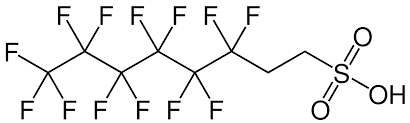
This is a PFAS. The left side is just like teflon, and very hydrophobic. The right side is hydrophilic and highly bonding to pans, and many other things like water or cotton.

But as remarkable as teflon’s non-stick properties are, perhaps the most amazing thing was that it somehow sticks to the pan. For the first generation pans I saw, it didn’t stick very well. Still, the DuPont engineers had found a way to stick non-stick Teflon to a metal for long enough to cook many meals. If they had not found this trick, teflon would not have the majority of its value, but how did they do it? It turns out they used a thin coating of a di-functional compound called PFAS, a a polyfluoro sulphonyl (or polyfluoroalkyl) substance. The molecular structure of a common PFAS, is shown above.

Each molecule of PFAS has one end that’s teflon-like and another end that’s different. The non-Teflon end, in this case a sulfonyl group, is chosen to be both high temperature stable and sticky to metal oxides. The sulphonyl group above is highly polar, and acidic. Acidic will bind to bases, like metal oxides. The surface of the metal pan is prepared by applying a thin layer of oxide or amidine, making it a polar base. The PFAS is then applied, then Teflon. The Teflon-end of the PFAS is bound to teflon by the hydrophobicity of everything else rejecting it.

There are many other uses for PFAS. For example, PFAS is applied to clothing to make it wrinkle free and stain resistant. It can also be used as a super soap, making uncommonly stable foams and bubbles. It is also used in fire-fighting and plane de-icing. Finally, PFAS is the main component of Nafion, the most common membrane for PEM fuel cells. (I can think of yet other applications..) There is just one small problem with PFAS, though. Like teflon, this molecule is uncommonly stable. It doesn’t readily decompose in nature. That would be a small problem if we were sure that PFAS was safe. As it happens it seems safe, but we’re not totally sure.

The safety of PFAS was studied extensively before PFAS-teflon pans was put on the market, but the methodology has been questioned. Large doses of PFAS were fed to test animals, and their health observed. Since the test animals showed no real signs of ill-health though some showed a slight liver enlargement, PFAS was accepted as safe for humans at a lower exposure dose. PFAS was approved for use on pans and allowed to be dumped under conditions where humans would be exposed to 1/1000 of that used on the animals. The assumption was that there would be little or no health hazard at these low exposure levels.

But low risk is not no risk, and today one can sue for even the hint of an effect though use of a class action suit. That is, lawyers sue on behalf of all the people who might have been damaged. My city was sued successfully this way for complicity in sewage over-flows. Of course, since the citizens being paid by the suit are the same ones who have to pay for the damage, only the lawyers benefit. Still, the law is the law, and at least for some judges, putting anyone at risk is enough evidence of willful disregard to hand down a stinging judgement against the evil doer. Judges have begun awarding large claims for PFAS too. While no individual can get the claim more than a tiny amount of money, the lawyers can do very well.

There is no new evidence that PFAS is dangerous, but none is needed if you can get yourself the right judge. In this regard, an industry of judicial tourism has sprung up, where class-action lawyers travel to districts where the judges are favorable. For Teflon suits, the bust hunting grounds are in New York, New Hampshire, and California, and the worst are blood-red states like Wyoming and Utah. Just as different judges promote different precedents, different states allow vastly different PFAS concentrations in the water. A common standard, one used by Michigan, is 70 ppt, 1 billion times stricter than the amounts tested on animals. This is roughly 500 times stricter than the acceptable concentratios for lead, a known poison. The standard in New York is 7 times stricter than Michigan, 10 ppt. The standard in North Carolina is 140,000 ppt, in in several states there is no legal limit to PFAS dumping. There is no scientific logic to all of this, and skeptical view is that the states that rule more strictly for PFAS than lead do so make money for lawyers. Lead is everyone in the natural environment, so you can’t sue as easily for lead. PFAS is a man-made intruder, though, and a strict standard helps lawyers sue. You can find a summary of state by state regulations here.

Any guideline stricter than about 1000 ppt, presents a challenge to the water commissioner who must measure it and enforce the law. There are tricks, though. You can use the surfactant quality of PFAS to concentrate it by a factor of 100 or more. To do this, you take a sample of river water and create bubbles. Any bubbles that form will be highly concentrated in PFAS. Once PFAS can be identified this way, and the concentrators estimated, the polluters can be held liable. Whether we benefit from the strict rulings is another story. If I were making the law for Michigan, I’d probably choose a limit about 1 ppb, but I’m not making the law. The law, as written, may be an idiot, as Bumble said, but the Law is the Law.

In terms of Michigan fishing, while some rivers have PFAS concentrators above the MI-legal limit, they are generally not far over the line. I would trust the fish in the Huron River, even west of Wixom road but I’d suggest you avoid any foam you find floating there. The PFAS content of foam will be much higher than that of the water in general.

Robert E. Buxbaum, June 30, 2020, edited July 8, 2020. There are seven compounds known as PFAS’s: perfluorooctanesulfonic acid (PFOS), perfluorooctanoic acid (PFOA), perfluorononanoic acid (PFNA), perfluorohexanesulfonic acid (PFHxS), perfluoroheptanoic acid (PFHpA), and perfluorobutanesulfonic acid (PFBS).

When prostitution was legal in America, 1863-65.

Readers of this blog know that I am not a fan of very harsh punishments for crime, in particular for crimes that have no direct victim, e.g. drug possession and sales. Prostitution is another crime with no direct victim. One could argue that society as a whole is the victim, but my sense is that punishments should be minimal and targeted, e.g. to prevent involuntary human trafficking and disease. Our current laws, depicted here, are clearly not designed for this, but there was a brief period where prostitution laws did make more sense. During the civil war, civil war, prostitution was legal and regulated to prevent disease.

In 1862, Union forces captured the southern cities of Nashville and Memphis, Tenn. Major Gen. William Rosecrans set up headquarters in Nashville. Before the war, Nashville was home to 198 white prostitutes and nine  “mulatto,” operating in a two-block area known as “Smoky Row.” 

By the end of 1862,  Smokey row had grown and these numbers swelled to 1,500 “public women”. White southern women turned to prostitution out of poverty, largely. Their husbands were dead, or ill paid, and they were joined by recently freed slaves. Benton E. Dubbs, a Union private, reported a saying that “no man culd [sic] be a soldier unless he had gone through Smokey Row,” … “The street was about three-fourths of a mile long and every house or shanty on both sides was a house of ill fame. Women had no thought of dress or decency. They say Smokey Row killed more soldiers than the war.” 

By 1863, venerial disease was becoming a major problem. The Surgeon General would document 183,000 cases of venereal disease in the Union Army alone, “…the Pocks and the Clap. The cases of this complaint is numerous, especially among the officers.”  

Permit for Legal prostitution signed by Col George Spaulding.

At first General Rosecrans directed his assistant, Colonel Spaulding, to remove the women by sending them to other states, first by train, and then by boat commandeering the ship, Idaho for the purpose. The effect was horrible, not only was the ship turned back by every city, but the departure of these ladies just resulted in the appearance of a new cohort of sex-workers. By the time the Idaho had returned, Rosecrans had been relieved of command following embarrassing defeats at Chickamauga and Chattanooga . Col. Spaulding now tried a new technique to stop the plague of VD: legalized prostitution. It worked.

Women’s hospital during the war, Nashville.

For a $5/month fee a “public woman” could become a legal prostitute, or “Public Woman” so long as she submitted to monthly health inspections for a certificate of her soundness. If found infected, she was to report to a hospital dedicated to this treatment, was subject to imprisonment if she operated without the license and certificate. The effect was a major decline in sexually-transmitted disease, and an improvement (so it is claimed) in the quality of the services. The fees collected were sufficient to cover the cost of the operation and hospital, nearly.

At the end of the war, Col Spaulding and the union soldiers left Nashville, and prostitution returned to being illegal, if tolerated. One assumes that the VD rates went up as well.

George Spaulding, Congressman..

Colonel Spaulding and Maj. General Rosecrans are interesting characters beyond the above. Spaulding had entered the war as a private and rose through the ranks by merit. The rise didn’t stop at colonel. After the war, he became postmaster of Monroe Michigan, 1866 to 1870, US Treasury agent, 1871 to 1875, Mayor of Monroe, 1876 to ?, President of the board of education, a lawyer in 1878, and congressman for the MI 2nd district (Republican) 1894 -1898. He also served as board member of the Home for Girls 1885 to 1897, and postmaster of Monroe, 1899 to 1907.

William Rosecrans was a Catholic, engineer-inventor from West Point. Before the war, in 1853, he designed St. Mary’s Roman Catholic Church, one of the largest US churches at the time, site of the wedding of John Kennedy and Jacqueline Bouvier. He also designed and installed one of the first lock systems in Western Virginia. He and two partners built an early oil refinery. He patented a method of soap making and the first kerosene lamp to burn a round wick, and was one of the eleven incorporators of the Southern Pacific Railroad. After the war, he served as Ambassador to Mexico, 1868-69 and was congressman from California, 1st district (Democrat) 1880 – 1884. A true Democrat, Rosecrans could not stand either Grant or Garfield, and fought against Grant getting a retirement package.

Robert Buxbaum, June 5, 2020. There are other ways to stop the spread of sexual diseases. During the AIDS epidemic, condoms were the preferred method, and during the current COVID crisis, face masks are being touted. My preference is iodine hand wash. All methods work if they can reduce the transmission rate, Ro below 1.

Biden’s touching problem.

Ex VP, Joe Biden has a long history of touching people in uncomfortable ways. He does it with men and women, and has a particular problem with children. As bad as it is to grab a sheriff on the leg, or Hillary Clinton when she clearly does not want to be grabbed, it’s quite a lot worse to fondle the hair and face of a child you are not related to (above). An expert reviewing the video of his many grabs, pats, and hair sniffs, came to conclude that Biden behaves like a predator.

Biden grabs a sheriff in a ways that most find inappropriate. He says’s its just his way to make a connection. Others say it’s ‘his power move.’

Adding to Biden’s touching problems, Tara Reade, one of Biden’s staffers has come forward to say that Biden not only made her feel uncomfortable, but pinned her to a wall at the capital building, penetrated her with his hand, and asked for sex. When a panel of experts went over her testimony and Biden’s denial, they came away believing Tara, and not believing Biden. Here is a video with them discussing the various tells that cause them to doubt Biden. Here is another video with the same individuals discussing Reade’s accusation.

Biden applies his power move on Secretary of State Clinton.

What’s to be done? There are still may in the Democratic party who would like to see Biden drop out in favor of someone less tainted, like Bernie. Others, like Illan Omar have concluded that despite Biden being a predator, she supports him as providing the best chance to defeat Donald Trump.

Robert Buxbaum, June 4, 2020

Brazilian scientists speak out for hydroxychloroquine

Brazil has decided to go its own route in response to the Corona virus pandemic. They’re using minimal social distancing with a heavy reliance on hydroxychloroquine (HCQ), a cheap drug that they claim is effective (as has our president). Brazil has been widely criticized for this, despite so far having lower death rate per million than the US, Canada, or most of Europe. In an open letter, copied in part below, 25 Brazilian scientists speak out against the politicalization of science, and in favor of their approach to COVID-19. The full letter (here). The whole letter is very worth reading, IMHO, but especially worthwhile is their section on hydroxychloroquine (HCQ), copied below.

….. Numerous countries such as the USA, Spain, France, Italy, India, Israel, Russia, Costa Rica and Senegal use the drug (HCQ) to fight covid-19, whereas other countries refrain from using HCQ as one of the strategies to contain the pandemic, betting on other controversial tactics.

Who then speaks here in the name of “science”? Which group has a monopoly on reason and its exclusive authorization to be the spokesperson of “science”? Where is such authorization found?One can choose an opinion, and base his strategy on it, this is fine, but no one should commit the sacrilege of protecting his decision risking to tarnish with it the “sacred mantle of science”.

Outraged, every day I hear mayors and governors saying at the top of their lungs that they “have followed science”. Presidents of councils and some of their advisers, and of academies and deans in their offices write letters on behalf of their entire community, as if they reflect everyone’s consensual position. Nothing could be more false.Have they followed science? Not at all! They have followed the science wing which they like, and the scientists who they chose to place around them. They ignore the other wing of science, since there are also hundreds of scientists and articles that oppose their positions and measures.

Worse, scientists are not angels. Scientists are people, and people have likes and dislikes, passions and political party preferences. Or wouldn’t they? There are many scientists, therefore, who do good without looking at whom, I know and admire many of them. But there are also pseudoscientists who use science to defend their opinion, their own pocket, or their passion. Scientists have worked and still work hard and detached to contribute to the good of humanity, many of whom are now in their laboratories, risking their lives to develop new methods of detecting coronavirus, drugs and vaccines, when they could stay “safe at home”. But, to illustrate my point, I know scientists who have published articles, some even in major journals such as “Science” or “Nature”, with data they have manufactured “during the night”; others who have removed points from their curves, or used other similar strategies. Many scientists were at Hitler’s side, weren’t they? Did they act in the name of “science”? Others have developed atom bombs. Others still develop chemical and biological weapons and illicit drugs, by design.

The Manaus’ study with chloroquine (CQ) performed here in Brazil and published in the Journal of the American Medical Association (JAMA) [1], is emblematic to this discussion of “science”. Scientists there used, the manuscript reveals, lethal doses in debilitated patients, many in severe conditions and with comorbidities. The profiles of the groups do not seem to have been “randomized”, since a clear “preference” in the HIGH DOSE group for risk factors is noted. Chloroquine, which is more toxic than HCQ, was used, and it seems that they even made “childish mistakes” in simple stoichiometric calculations, doubling the dosage with the error. I’m incapable of judging intentions, but justice will do it. The former Brazilian Health Minister Luiz Henrique Mandetta quoted this study, supported it, and based on it, categorically stated: “I do not approve HCQ because I am based on ‘science, science, science’!”.

Another study published by Chinese researchers in the British Medical Journal (BMJ) and which is still persistently used against HCQ was also at least revolting [2]. In it, the authors declared: “we administer 1,200 mg for 3 days, followed by 800 mg for 12 to 21 days, in patients with moderate to severe symptoms”. In other words, they gave a huge dosage of the drug that could reach the absurdity of 20 grams in the end, and it given was too late to patients (HCQ should be administered in the first symptoms or even earlier). And even worse, overdosing on HCQ or any other drug for severe cases is poisonous. What do you think, was it good science? The recommended dosage in Brazil, since May 20th, 2020, by the new Ministry of Health, for mild symptoms is 2 times 400 mg in the first day (every 12 hours) and 400 mg for 5 days for a total of 2.8 grams.

In other published studies, also in these internationally renowned journals such as The New England Journal of Medicine, JAMA and BMJ [3-5], once again, “problems” are clearly noted, since or the patients were randomized in irregular ways, placing older, more susceptible or most severe and hypoxemic patients in the higher (lethal) dose groups, or more men (almost 3 times more deadly by covid than women), or more black people (in the USA, black people have displayed higher mortality) and more smokers, and where most of the deaths occurred in the first days of the studies (signs that were deaths of critically ill patients, who at this stage would be more “intoxicated” than “treated” with HCQ), or they administered HCQ isolated, when it is known that it is necessary to associate HCQ at least with azithromycin. One of these studies [5] administered HCQ only on the sixteenth day of symptoms (for really early treatment, HCQ administration should be started up to fifth day), in other words, at the end of the disease, when the drug can do little good or nothing to the patient.

These studies indicate that some scientists either forgot how “science” is done or that there is a huge effort to disprove, whatever it takes, that HCQ works. How can someone or even Councils and Academies of Medicine cite such studies as the “science” of their decisions? How can that be?

On the contrary, the study published – and today with more than 3 thousand patients tested – and carried out by Dr. Didier Raoult in France [6], using the correct dosage and at the right time, with a very low mortality rate (0.4%), and the Prevent Senior’s clinical experience in Brazil – also quite encouraging – are disqualified with very “futile” arguments such as: “Didier Raoult is a controversial and unworthy researcher”, “At Prevent Senior Clinic they were not sure of the diagnosis” (but none of the hospitalized patients with clear COVID symptoms died), “Placebo effect” (what a supernatural power of inducing our mind that reduces mortality from 40% to zero, I want this placebo!), “Study performed by a health plan company” (I do not doubt that this people indeed want to save lives, because the patients were their customers who pay their bills), and similar ephemeral arguments.

The Brazilian scents who signed the letter. Read the whole letter here.

I admire the spunk of these fellows going agains the doctors, WHO. Beyond being a critique of bad research on a particular drug, it is a defense of science. Science is a discussion, a striving for truth. It is not supposed to demand blind allegiance to a few politically appointed experts. They’ve convinced me that the tests sponsored by the world health organization seem designed to show failure, and reminded me that there is rarely a one-size-fits-all for problems and all times.

I also find striking the highly critical response of my local newspapers and TV reporters. While they both like to highlight efforts by South America as they try entering the first world, with help from Bill gates and leftist politicians, they have been uniformly condemned Brazil for its non-left approach and now for use of HCQ. They want Sous Americans to think, but only if their conclusions are no different from those of their favorite, liberal thinkers.

Robert Buxbaum, May 28, 2020. Check out my notes on how to do science right. And by the way, you might want to use iodine hand wash to minimize your chance of getting or spreading COVID and other diseases.

How not to make an atom bomb

There are many books on how the atom bomb was made. They are histories of the great men who succeeded at site Y, Los Alamos, usually with a sidelight of the economics and politics in the US at the time. It’s sometimes noted that there was an equally great German group working too, and one in Japan and in Russia, that they didn’t succeed, but it’s rarely discussed what they did wrong. Nor does anyone make clear why so many US scholars were needed. What did all those great US minds to do? The design seems sort-of obvious; it appears in the note Einstein sent to Roosevelt, so what were all these people thinking about all that time, and why did the Germans fail? By way of answer, let me follow the German approach to this problem, an approach that won’t get you anywhere, or anywhere that I’ve seen.

It seems that everyone knew that making a bomb was possible, that it would be fearsomely powerful, and that it would be made using a chain reaction in uranium or plutonium. Everyone seems to have understood that there must be a critical mass: use less and there is no explosion, use more and there is one. The trick was how to bring enough uranium together make the thing go off, and as a beginning to that, there is the concept of “a barn.” A barn is a very small unit of area = 10−24 cm², and a typical atom has a cross-section of a few barns. Despite this, it is generally thought to be very easy to hit an atom at the nucleus, that is, at the right spot, as easy as hitting the board side of a barn (hence the name). The cross section of a uranium atom is 600 barnes at room temperature, or 6×10⁻²² cm². But each cubic centimeter of uranium holds .5 x 1023 atoms. Based on this, it comes out that a thermal neutron that enters a 1 cm cube of uranium has a virtual certainty of hitting an atom — there are 3 cm² of atoms in a 1 cm² box. You could hardly miss.

Each uranium atom gives off a lot of energy when hit with a neutron, but neutrons are hard to come by, so a practical bomb would have to involve a seed neutron that hits a uranium atom and releases two or more neutrons along with energy. The next neutron has to hit another nucleus, and it has to releases two or more. As it happens uranium atoms, when hit release on average 2.5 neutrons, so building a bomb seems awfully easy.

But things get more difficult as the neutron speeds get greater, and as the atoms of uranium get hotter. The cross-section of the uranium atom goes down as the temperature goes up. What’s more the uranium atoms start to move apart fast. The net result is that the bomb can blow itself apart before most of the uranium atoms are split. At high speed, the cross -section of a uranium atom decreases to about 5 barnes you thus need a fairly large ball of uranium if you expect that each neutron will hit something. So how do you deal with this. For their first bomb, the American scientists made a 5 kg (about) sphere of plutonium, a man-made uranium substitute, and compressed it with explosives. The explosion had to be symmetrical and very fast. Deciding how fast, and if the design would work required a room full of human “computers”. The German scientists, instead made flat plates of uranium and slowed the neutrons down using heavy water. The heavy water slowed the neutrons, and thus, increased the effective size of the uranium atoms. Though this design seems reasonable, I’m happy to say, it can not ever work well; long before the majority of the reaction takes place, the neutrons get hot, and the uranium atoms fly apart, and you get only a small fraction of the promised bang for your bomb.

How fast do you need to go to get things right? Assume you want to fusion 4 kg of uranium, or 1 x 1025 atoms. In that case, hitting atoms has to be repeated some 83 times. In tech terms, that will take 83 shakes (83 shakes of a lamb’s tail, as it were). This requires getting the ball compressed in the time it takes for a high speed neutron to go 83 x 3 cm= 250 cm. That would seem to require 1 x 10⁻⁷ seconds, impossibly fast, but it turns out, you can go somewhat slower. How much slower? It depends, and thus the need for the computers. And how much power do you get? Gram for gram, uranium releases about 10 million times more energy than TNT, but costs hardly more. That’s a lot of bang for the buck.

Robert Buxbaum, Mar 29, 2020.