Category Archives: sewage

Sewage: rain to the river, poop to the fields, nothing to your basement

I’ve written a fair amount about sewage over the years, including the benefits of small dams, and problems of combined sewers, but I thought I’d write here about something really fundamental: sewage has two components, poop and rain, and they should be kept separate. The poop and related liquids are known as sanitary sewage. Ideally it is the treated, saved and used as fertilizer. Rain, known as storm sewage, needs to go to the rivers at a controlled speed, unmixed with sanitary sewage. Sorry to say, in many counties, mine included, the two are mixed following every rain, costing us unnecessary money, and making swimming unsafe, and boating (sometimes) unpleasant.

Our system is not quite mixed, but is semi-separate. It only mixes in a “big” rain, more than 1/2″, something that happens once per month, on average. The Pipes are semi-connected as shown below.

Combined sewer system, like in our county, Oakland MI. We use little dams in the pipe system to semi-separate the flows. Here, showing a rain-induced overflow of combined sewage, a CSO.

The pipes of a sanitary sewage system can be relatively small in diameter as this flow is continuous, but never that large. The cost of treatment is high, per gallon though. Some of this cost can be recovered in fertilizer value.

Stormwater flow, by contrast, requires big pipes because the flow, while episodic and be 10,000 more than the sanitary flow. A city can go for weeks without storm flow as there’re is no rain. A storm will then drop more water in an hour than all the sanitary sewage of the last few weeks. You need large diameter stormwater pipes, and you typically want retention basins so that even these pipes are not overwhelmed, and to provide a little settling. The pipes should direct storm water to the nearest river. In our county we mixed the two for historical reasons. This adds tremendously to the cost of sewage treatment, and we find we regularly overwhelm the treatment facility. When this happens, as shown above, sanitary sewage is flushed into the riveras I described ten years ago in a post focussed on pollution from combined sewers. If the rains are really heavy, they back up “sanitary” sewage into basements as well. More commonly, once or twice a month where I live, we just pollute the river. Several cities with combined sewers have separated them recently. Paris, for example, ahead of the 2024 Summer Olympics.

To get an idea of the relative size of the flows in our county, note that Oakland county is a square 30 miles by 30 miles. That’s 900 square miles, or 25.1 billion square feet. In th4e event of a, not uncommon, 2″ rain on this area, we must deal with 4.2 billion cubic feet of water or 33 billion gallons. Some of this absorbs into the ground, but much of it runs goes to pipes heading to the rivers. Ideally we retain some of it above ground for an hour or more because the pipes can’t handle this flow. Even with retention, our rivers rise some 10 feet typically and begin to flow at many miles per hour after a storm. They can be seen carrying trees along, and massively eroding the soil, even in areas that were prepared appropriately.
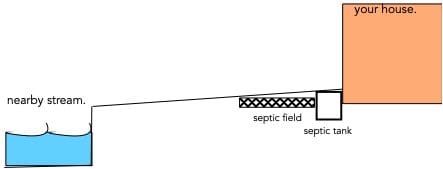
A home based approach to sewage. Many homes near me have this setup — with internal plumbing and a septic field for sewage treatment. Often, these homes are near a stream that flows at least temporarily.

Sanitary sewage flows are far less voluminous. Our county has roughly 1 million people who flush about 100 million gallons per day, generally sending this to our sanitary sewage treatment plants. That averages a mere 4 million gallons per hour, or 500,000 cubic feet. That’s roughly 8000 times less flow than the storm flow. If any significant fraction of the rainwater goes into our sanitary system, it will quickly overwhelm it and back up into our basements.

Many people try to get out of paying the high price for municipal sewage treatment by making their own small system with a septic tank an a septic field. I think this is a great idea, a benefit for them and the county. I will be happy to direct them to appropriate educational materials so that home waste flows to the septic tank where anaerobic bacteria break things down, it should then flow to a septic field that filters the nutrients and allows aerobic bacteria to break things down further. Nutrients in the sewage helps whatever you plant and, as we say, “the grass is always greenest over the septic tank.” As for the county on the whole, I wish we got real value from the fertilizer, as Milwaukee does, and wish we’d separate the sewers.

Robert Buxbaum, February 23, 2025
EDDS chelation for electroless coating, solar cells and soil remediation

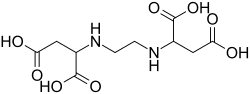
Among the products our company sells is a non-toxic chelating agent, EDDS (ethylenediamine-disuccinic acid), typically sold as a purified salt in ammonia solution, see here. The main use of EDDS is to stabilize heavy metal ions in solution. We use it, for example, as an aide in electroless Palladium coating, to stabilize palladium ions, helping us produce a smaller grain, more continuous coat. The structure, shown below, is similar to that of EDTA (ethylenediaminetetraacetic acid), and the behavior is similar too. EDDS is more stabilizing in the presence of the other ions and we like that it is non-toxic.

Structure of EDDS, it binds metals by way of four OH groups. While each binding is weak, the total is strong.

The popular literature use for chelating agents like this is as a treatment for heavy metal poisoning by lead, arsenic, cadmium, nickel or copper. The TV series “House” featured patients with all these metal-poisoning problems, problems. Chelation treatment was important in Flint Michigan, 2015 when thousands got low-level lead poisoning and legionaries disease after the water department put insufficient phosphate and hypochlorite into the water and lead leached from pipes. Typically, EDTA is used for humans here, while EDDS is used by farmers and ranchers to treat animals. EDDS is less toxic, and removes fewer essential light minerals: magnesium, calcium, and zinc, so I’d think it would be better for humans too.

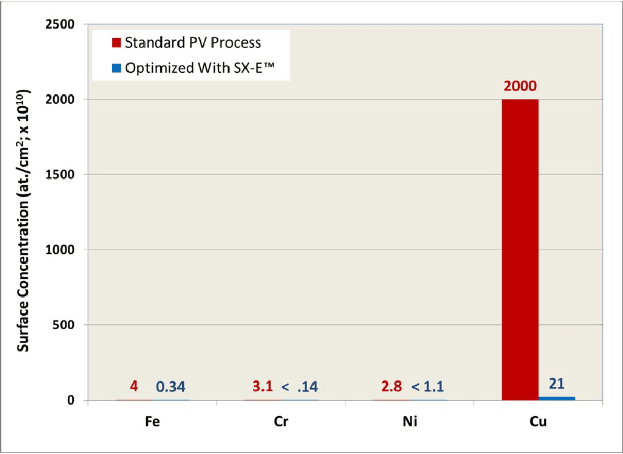
Effect of 300ppm SX-E in DI water, compared to standard DI water and acid wash. The biggest difference is with copper.

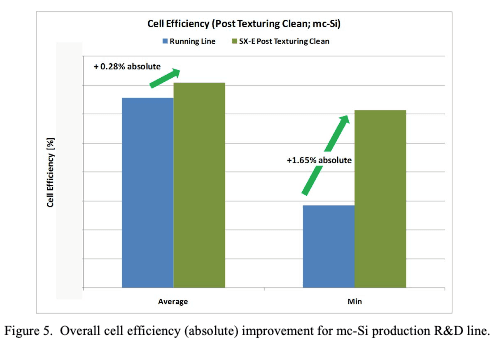
Our EDDS has been used to make cleaning solutions for silicon wafers, Sunsonix SXE, for example. Sunsonix SXE behaves as a soap, removing Fe, Cr, Ni, and Cu from solar cells, see reproduced figures at right. These metals will diffuse into surface of a silicon wafer, forming defects that absorb light and decrease solar cell performance by an average of 0.28%, see below.

Solar cell efficiency improvement with EDDS washing from a baseline of 16%. Occasionally 1.65% improvement was seen, but 0.28% on average

This is, based on a baseline efficiency of 16%. For more details see “Surface Contamination Removal from Si PV Substrates Using a Biodegradable Chelating Agent and Detection of Cleaning Endpoints Using UV/VIS Spectroscopy” ECS Transactions, 41 (5) 295-302 (2011). See also this article in Wikipedia.

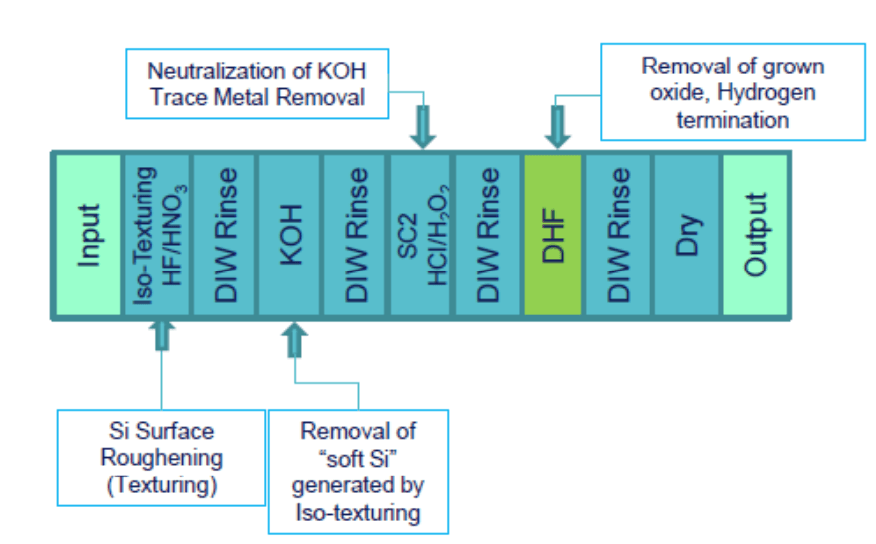
This is the normal treatment regime for solar cells

At a different pH, EDDS and EDTH are used in remediation of metal-contaminated soils, see here. This can be done ex-situ, with the soil taken out to an external site and then washed. Alternately, for less contaminated soils, remediation can be done in-situ with the chelating wash applied to the soil. Plants, like vetiver grass (Chrysopogon zizanioides) then extract the heavy metals, concentrating them in their leaves. EDDS is more suitable for this as it is biodegradable and shows a high extraction efficiency in mineral rich soils, see here for comparison to EDTA.

Moving to another area of extraction. It seems that EDDS or EDTA solutions can be used to profitably extract rare earth metals, perhaps sending them to plants before final concentration. A standard methods of rare earth extraction uses chlorine and high temperatures. Alternate methods use ion-exchange extraction of liquid-liquid extraction. I suspect that chelation treatment might turn out to be more effective and cheaper. The price of rare earths has risen in recent years as China restricts sales so that the need for a new source has become a national priority.

Robert Buxbaum, January 13, 2026

Rain barrels aren’t much good. Wood chips are better, And I’d avoid rain gardens, even as a neighbor.

A lot of cities push rain barrels as a way to save water and reduce flooding. Our water comes from the Detroit and returns to it as sewage, so I’m not sure there is any water saving, but there is a small cash saving (very small) if you buy 30 to 55 gallon barrels from the city and connect them to the end of your drain spout. The rainwater you collect won’t be pure enough to drink, or safe for bathing, but you can use it to water your lawn and garden. This sounds OK, even patriotic, until you do the math, or the plumbing, or until you consider the wood-chip alternative.

The barrels are not cheap, even when subsidized they cost about $100 each. Add to this the cost and difficulty of setting up the collection system and the distribution hose. Water from your rain barrel will not flow through a normal nozzle as there is hardly any pressure. Expect watering to take a lot longer than you are used to.

40 gallon rain barrels. Two of these give about 70 usable gallons every heavy rain fall. That’s about 70¢ worth.

In Michigan you can not leave the water in your barrel over the winter, the water will freeze and the barrel will crack. You have to drain the tank completely every fall, an almost impossible task, and the tank is attached to a rainspout and the last bit of water is hard to get out. Still, you have to do it, or the barrel will crack. And the savings for all this is minimal. During a rainy month, you don’t need this water. During a dry month, there is no water to use. Even at the best, the The marginal cost of water in our town is less than 1¢ per gallon. For all the work and cost to set up, two complete 40 gallon tanks (like those shown) will give you at most about 70 usable gallons. That’s to say, almost 70¢ per full filling.

How much lawn can you water? Assume you like to water your lawn to the equivalent of 1″ of rain per week, your 70 gallons will water about 154 ft2 of lawn or garden, virtually nothing compared to the typical Michigan 2000 ft2 lawn. You’ll still have to get most of your water from the city’s main. All that work, for so little benefit.

Young trees with chip volcanos, 1 ft high x18″. Spread the chips to the diameter of the leaves.You don’t need more than 2″.

A far better option is wood chips. They don’t cover a lawn, but they’re great for shrubs, trees or a garden. Wood chips are easy to spread, and they stop weeds and hold water. The photo at left shows a wood chips around the shrubs, and a particularly poor use of wood chips around the trees. For shrubs, trees, or a garden, I suggest you put down 1 to 2 inches of wood chips. Surround a young tree at that depth to the diameter of the branches. Do not build a “chip volcano,” as this lazy landscaper has done.

Consider that, covering 500 ft2 of area to a depth of 1.5 inches will take about 60 cubic feet of wood chips. That will cost about $35 dollars at the local Home Depot. This is enough to hold about 1.25″ or rainwater, That’s about 100 ft3 or water or 800 gallons. The chips prevent excess evaporation while preventing weeds and slowly releasing the water to your garden. You do no work. The chips take almost no work to spread, and will keep on working for years, with no fear of frost-damage. A as the chips stop working, they biocompost slowly into fertilizer. That’s a win.

There is a worst option too, called a rain garden. This is often pushed by environmental-gooders. You dig a hole near your downspout, perhaps ten feet in diameter, by two feet deep, and plant native grasses (weeds). When it rains, the hole fills with water creating a mini wetland that will soon smell like the swamp that it is. If you are not lucky, the water will find a way to leak into your basement. If that’s your problem look here. If you are luckier, your mini-swamp will become the home of mosquitos, frogs, and snakes. The plants will grow, then die, and rot, and look awful. It is very hard to maintain native grasses. That’s why people drain swamps and grow trees or turf or vegetables. If you want to see a well-maintained rain garden, they have two on the campus of Lawrence Tech. A wetland isn’t bad, but you want drainage, Make a bioswale or muir.

Robert Buxbaum, May 31, 2023. I ran for water commissioner some years back.

Upgrading landfill and digester gas for sale, methanol

We live in a throw-away society, and the majority of it, eventually makes its way to a landfill. Books, food, grass clippings, tree-products, consumer electronics; unless it gets burnt or buried at sea, it goes to a landfill and is left to rot underground. The product of this rot is a gas, landfill gas, and it has a fairly high energy content if it could be tapped. The composition of landfill gas changes, but after the first year or so, the composition settles down to a nearly 50-50 mix of CO2 and methane. There is a fair amount of water vapor too, plus some nitrogen and hydrogen, but the basic process is shown below for wood decomposition, and the products are CO2  and methane.

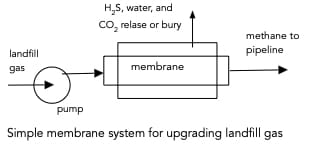
System for sewage gas upgrading, uses REB membranes.

C6 H12 O6  –> 3 CO2  + 3 CH4 

This mix can not be put in the normal pipeline: there is too much CO2  and there are too many other smelly or condensible compounds (water, methanol, H2S…). This gas is sometimes used for heat on site, but there is a limited need for heat near a landfill. For the most part it is just vented or flared off. The waste of a potential energy source is an embarrassment. Besides, we are beginning to notice that methane causes global-warming with about 50 times the effect of CO2, so there is a strong incentive to capture and burn this gas, even if you have no use for the heat. I’d like to suggest a way to use the gas.

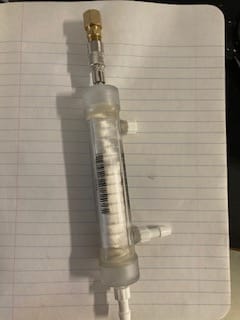
We sell small membrane modules too.

The landfill gas can be upgraded by removing the CO2. This can be done via a membrane, and REB Research sells a membranes that can do this. Other companies have other membranes that can do this too, but ours are smaller, and more suitable to small operations in my opinion. Our membrane are silicone-based. They retain CH4 and CO and hydrogen, while extracting water, CO2 and H2S, see schematic. The remainder is suited for local use in power generation, or in methanol production. It can also be used to run trucks. Also the gas can be upgraded further and added to a pipeline for shipping elsewhere. The useless parts can be separated for burial. Find these membranes on the REB web-site under silicone membranes.

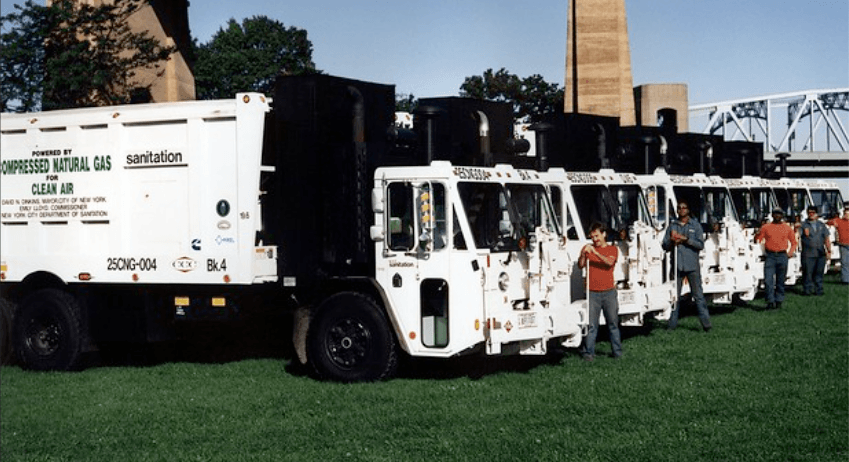
Garbage trucks in New York powered by natural gas. They could use landfill gas.

There is another gas source whose composition is nearly identical to that of landfill gas; it’s digester gas, the output of sewage digesters. I’ve written about sewage treatment mostly in terms of aerobic bio treatment, for example here, but sewage can be treated anaerobically too, and the product is virtually identical to landfill gas. I think it would be great to power garbage trucks and buses with this. Gas. In New York, currently, some garbage trucks are powered by natural gas.

As a bonus, here’s how to make methanol from partially upgraded landfill or digester gas. As a first step 2/3 of the the CO2 removed. The remained will convert to methanol. by the following overall chemistry:

3 CH4 + CO2 + 2 H2O –> 4 CH3OH. 

When you removed the CO2., likely most of the water will leave with it. You add back the water as steam and heat to 800°C over Ni catalyst to make CO and H2. That’s done at about 800°C and 200 psi. Next, at lower temperature, with an appropriate catalyst you recombine the CO and H2 into methanol; with other catalysts you can make gasoline. These are not trivial processes, but they are doable on a smallish scale, and make economic sense where the methane is essentially free and there is no CNG customer. Methanol sells for $1.65/gal when sold by the tanker full, but $5 to $10/gal at the hardware store. That’s far higher than the price of methane, and methanol is far easier to ship and sell in truckload quantities.

Robert Buxbaum, June 8, 2021

Sewage reactor engineering, Stirred tank designs

Over the past few years, I’ve devoted several of these essays to analysis of first-stage sewage treatment reactors. I described and analyzed the rotating disc reactor found at the plant is Holly here, and described the racetrack,“activated sludge” plug reactor found most everywhere else here. I also described a system without a primary clarifier found near Cincinatti. All of these were effective for primary treatment; soluble organics are removed by bio-catalyzed oxidation:

2 H-C-O-H + O2 –> CO2 + H2O.

A typical plant in Oakland county treats 2,000,000 gallons per day of this stuff, with the bio-reactor receiving liquid waste containing about 200 ppm of soluble and colloidal biomass. That’s 400 dry gallons for those interested, or about 3200 dry lbs./day. About half of this will be oxidized to CO2 and water. The rest (cell bodies) are removed with insoluble components, and applied to farmers fields or buried, or burnt in an incinerator.

There is another type of reactor used in Oakland County. It’s mostly used for secondary treatment, converting consolidated sludge to higher-quality sludge that can be sold or used on farms with less restriction, but it is a type of reactor used at the South Lyon treatment plant, for primary treatment. It is a Continually stirred tank reactor, or CSTR, a design that is shown in schematic below.

As of some years ago, the South Lyon system involved a single largish pond lined with plastic with a volume about 2,000,000 gallons total. About 700,000 gallons per day of sewage liquids went into the lagoon, at 200 ppm soluble organics. Air was bubbled through the liquid providing a necessary reactant, and causing near-perfect mixing of the contents. The aim of the plant managers is to keep the soluble output to the, then-acceptable level of 10 ppm; it’s something they only barely managed, and things got worse as the flow increased. Assume as before, a value V and a flow Q.

We will call the concentration of soluble organics C, and call the initial concentration, the concentration that enters,  Ci. It’s about 200 ppm. We’ll call the output concentration Co, and for this type of reactors, Co = C.  The reaction is first order, approximately, so that, if there were no flow into or out of the reactor, the concentration of organics would decrease at the rate of

dC/dt = -kC.

Here k is a reaction constant, dependent on temperature oxygen and cell content. It’s typically about 0.5/hour. For a given volume of tank the rate of organic removal is VkC. We can now do a mass balance on soluble organics. Since the rate of organic entry is QCi and the rate leaving by flow is QC. The difference must be the amount that is reacted away:

QCi – QC = VkC.

We now use algebra, to find that

Co = Ci/(1 + kV/Q).

V/Q is sometimes called a residence time; for the system. At normal flow, the residence time of the South Lyon system is about 2.8 days or 68.6 hours. Plugging these numbers in, we find that the effluent from the reactor leaves at 1/35 of the input concentration, or 5.7 ppm, on average. This would be fine except that sometimes the temperature drops, or the flow increases, and we start violating the standard. A yet bigger problem was that the population increased by 50% while the EPA standard got more stringent to 2 ppm. This was solved by adding another, smaller reactor, volume = V2. Using the same algebraic analysis, as above you can show that, with two reactors,

Co = Ci/ [(1 + kV/Q)(1+kV2/Q)].

It’s a touchy system, but it meets government targets, just barely, most of the time. I think it is time to switch to a plug-flow reactor system, as used in much of Oakland county. In these, the fluid enters a channel and is reacted as it flows along. Each gallon of fluid, in a sense moves by itself as if it were its own reactor. In each gallon, we can say that dC/dt = -kC. We can thus solve for Co in terms of the total residence time, where t again is V/Q. We can rearrange this equation and integrate: ∫dC/C = – ∫kdt. We then find that, 

      ln(Ci/Co) = kt = kV/Q

To convert 200 ppm sewage to 2 ppm we note that Ci/Co = 100 and that V = Q ln(100)/k = Q (4.605/.5) hours. An inflow of 1000,000 gallons per day = 41,667 gal/ hour, and we find the volume of tank is 41,667 x 9.21 = 383,750 gallons. This is quite a lot smaller than the CSTR tanks at South Lyon. If we converted the South Lyon tanks to a plug-flow, race-track design, it would allow it to serve a massively increased population, discharging far cleaner sewage. 

Robert Buxbaum, November 17, 2019

Why does water cost what it does?

Water costs vary greatly about Oakland county, and around the US, and I have struggled in vain to find out why. In part the problem is that each city gets to add as much maintenance and management costs as the city government thinks appropriate. High management and infrastructure fees can increase to the cost of water, but I also not that different cities about Oakland County Michigan get their water at different rates from the multi-county organization that oversees water in South East Michigan: GLWA, The Great Lakes Water Authority.

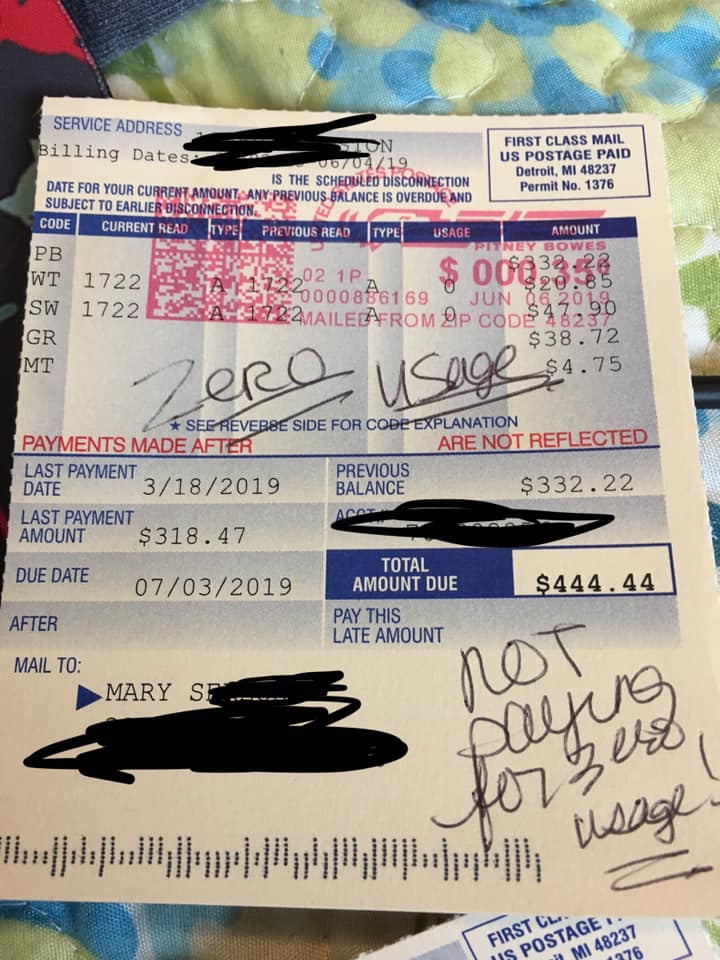
$112 water bill for zero usage. The base charge is so large that prices are essentially independent of useage.

I’ve attended meetings, both local and multi county and have tried to find out why one town gets its water at a far lower rate than another, near by. Towns get lower rates if they have a water tower, but it is not at all clear what the formula is. It also helps to separate the storm sewage from the sanitary sewage — something that I have proposed for all of Oakland county, but if there is fixed formula of how that affects rates, I’ve not seen it. And I wonder how well communities monitor the amount of storm sewage they generate.

The water itself is free. For the most part, in this county, we pump it from the Detroit river. Some of the rest of the water is pumped from wells. None of this costs anything. There is a pump cost, but it is manicure. Pumping 1 gallon of water up 75 feet, costs about 0.002¢ in pumping cost. The rest of the cost is infrastructure: the cost of the pumps, the pipes, the treatment, the billing and sewage. Among the sewage fees is a pollution penalty, and Oakland county pays plenty of pollution penalties. When it rains, we generate more sewage than the system will handle, and we dump the rest into the rivers and lakes. This results in closed beaches and poisoned fish, and fines too. The county pays the EPA when we do this, and the county passes the cost to the cities. I don’t know what the formula for fee distribution is, and don’t even know what it should be. What I do know is that we do this vastly too often. I’d really like us to stop this by moving to separate the sewers so that, as a city, we don’t spend so much on treating rainwater and we don’t pollute so often.

Another oddity is that we do a propaganda campaign to tell folks to use less water. Why? I’d much prefer if people would use more. We could then charge a lower base charge, and then collect the rest on per-gallon fees. As with much that is socialist, the current system is inefficient, but pleasant for the management. Or, for those cheapskates and environmentalists who wish to save water, here are some ideas.

August 21, 2019, Robert Buxbaum

Kindness and Cholera in California

California likely leads the nation in socially activist government kindness. It also leads the nation in homelessness, chronic homelessness, and homeless veterans. The US Council on Homelessnesses estimates that, on any given day, 129,972 Californians are homeless, including 6,702 family households, and 10,836 veterans; 34,332 people are listed among “the chronic homeless”. That is, Californians with a disability who have been continuously homeless for one year or cumulatively homeless for 12 months in the past three years. No other state comes close to these numbers. The vast majority of these homeless are in the richer areas of two rich California cities: Los Angeles and San Francisco (mostly Los Angeles). Along with the homeless in these cities, there’s been a rise in 3rd world diseases: cholera, typhoid, typhus, etc. I’d like to explore the relationship between the policies of these cities and the rise of homelessness and disease. And I’d like to suggest a few cures, mostly involving sanitation. 

A homeless encampment in LosAngeles

Most of the US homeless do not live in camps or on the streets. The better off US homelessness find it is a temporary situation. They survive living in hotels or homeless shelters, or they “couch-serf,” with family or friends. They tend to take part time jobs, or collect unemployment, and they eventually find a permanent residence. For the chronic homeless things are a lot grimmer, especially in California. The chronic unemployed do not get unemployment insurance, and California’s work rules tend to mean there are no part time jobs, and there is not even a viable can and bottle return system in California, so the homeless are denied even this source of income*. There is welfare and SSI, but you have to be somewhat stable to sign up and collect. The result is that California’s chronic homeless tend to live in squalor strewn tent cities, supported by food handouts.

Californians provide generous food handouts, but there is inadequate sewage, or trash collection, and limited access to clean water. Many of the chronic homeless are drug-dependent or mentally ill, and though they might  benefit from religion-based missions, Los Angeles has pushed the missions to the edges of the cities, away from the homeless. The excess food and lack of trash collection tends to breed rats and disease, and as in the middle ages, the rats help spread the diseases. 

Total homelessness by state, 2018; California leads the nation. The better off among these individuals do not live on the streets, but in hotels or homeless shelters. For most, this is a short term situation. The rest, about 20%, are chronically homeless. About half of these live on the streets without adequate sewage and water. Many are drug-dependent.

The first major outbreaks of the homeless camps appeared in Los Angeles in August and September of 2017. They reappeared in 2018, and by late summer, rates were roughly double 2017’s. This year, 2019, looks like it could be a real disaster. The first case of a typhoid infected police officer showed up in May. By June there were six police officers with typhoid, and that suggests record numbers are brewing among the homeless.

To see why sanitation is an important part of the cure, it’s worth noting that typhoid is a disease of unclean hands, and a relative of botulism. It is spread by people who go to the bathroom and then handle food without washing their hands first. The homeless camps do not, by and large, have hand washing stations. and forced hygiene is prohibited. Los Angeles has set up porta-potties, with no easy hand washing. The result is typhoid epidemic that’s even affecting the police (six policemen in June!).

rate od disease spread.
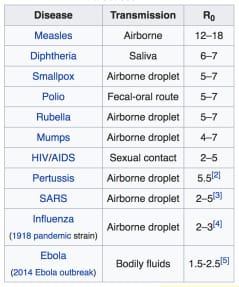
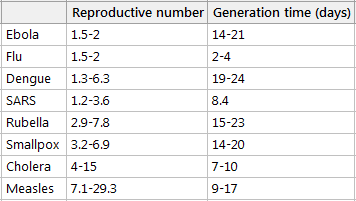
R-naught, reproduction number for some diseases, CDC.

Historically, the worst outbreaks of typhoid were spread by food workers. This was the case with “typhoid Mary of the early 20th century.” My guess is that some of the police who got typhoid, got it while trying to feed the needy. If so, this fellow could become another Typhoid Mary. Ideally, you’d want shelters and washing stations where the homeless are. You’d also want to pickup the dirtier among the homeless for forced washing and an occasional night in a homeless shelter. This is considered inhumane in Los Angeles, but they do things like this in New York, or they did.

Typhus is another major disease of the California homeless camps. It is related to typhoid but spread by rodents and their fleas. Infected rodents are attracted to the homeless camps by the excess food. When the rodents die, their infected fleas jump to the nearest warm body. Sometimes that’s a person, sometimes another animal. In a nastier city, like New York, the police come by and take away old food, dead animals, and dirty clothing; in Los Angeles they don’t. They believe the homeless have significant squatters rights. California’s kindness here results in typhus.

Reproduction number and generation time for some diseases.

The last of the major diseases of the homeless camps is cholera. It’s different from the others in that it is not dependent on squalor, just poor health. Cholera is an airborne disease, spread by coughing and sneezing. In California’s camps, the crazy and sick dwell close to each other and close to healthy tourists. Cholera outbreaks are a predictable result. And they can easily spread beyond the camps to your home town, and if that happens a national plague could spread really fast.

I’d discussed R-naught as a measure of contagiousness some months ago, comparing it to the reproductive number of an atom bomb design, but there is more to understanding a disease outbreak. R-naught refers merely to the number of people that each infected person will infect before getting cured or dying. An R-naught greater than one means the disease will spread, but to understand the rate of spread you also need the generation time. That’s the average time between when the host becomes infected, and when he or she infects others. The chart above shows that, for cholera, r-naught is about 10, and the latency period is short, about 9 days. Without a serious change in California’s treatment of the homeless, each cholera case in June will result in over 100 cases in July, and well over 10,000 in August. Cholera is somewhat contained in the camps, but once an outbreak leaves the camps, we could have a pandemic. Cholera is currently 80% curable by antibiotics, so a pandemic would be deadly.

Hygiene is the normal way to prevent all these outbreaks. To stop typhoid, make bathrooms available, with washing stations, and temporary shelters, ideally these should be run by the religious groups: the Salvation Army, the Catholic Church, “Loaves and Fishes”, etc. To prevent typhus, clean the encampments on a regular basis, removing food, clothing, feces and moving squatters. For cholera, provide healthcare and temporary shelters where people will get clean water, clean food, and a bed. Allow the homeless to work at menial jobs by relaxing worker hiring and pay requirements. A high minimum wage is a killer that nearly destroyed Detroit. Allow a business to hire the homeless to sweep the street for $2/hour or for a sandwich, but make a condition that they wash their hands, and throw out the leftovers. I suspect that a lot of the problems of Puerto Rico are caused by a too-high minimum wage by the way. There will always be poor among you, says the Bible, but there doesn’t have to be typhoid among the poor, says Dr. Robert Buxbaum.

*California has a very strict can and bottle return law where — everything is supposed to be recycled– but there are very few recycling centers, and most stores refuse to take returns. This is a problem in big government states: it’s so much easier to mandate things than to achieve them.

July 30, 2019. I ran for water commissioner in Oakland county, Michigan, 2016. If there is interest, I’ll run again. One of my big issues is clean water. Oakland could use some help in this regard.

How to avoid wet basements

My house is surrounded my mulch — it absorbs enough rainwater that I rarely have to water.

Generally speaking water gets to your basement from rain, and the basic way you avoid wet basements is by providing some more attractive spot for the rainwater to go to. There are two main options here: divert the water to a lake or mulch-filled spot at least 8 feet away from your home, or divert it to a well-operated street or storm drain. My personal preference is a combination of both.

At right I show a picture of my home taken on a particularly nice day in the spring. Out front is a mulch-filled garden and some grass. On the side, not shown is a driveway. Most of the rain that hits our lawn and gardens is retained in 4 inches of mulch, and waters the plants. Four inches of mulch-covered ground will hold at least four inches of rainwater. Most of the rain that hits the house is diverted to downspouts and flows down the driveway to the street. Keeping some rainwater in the mulch means you don’t have to pay so much to water the trees and shrubs. The tree at the center here is an apple tree. I like fruit trees like this, they really suck up water, and I like the apples. We also have blueberries and roses, and a decorative pear (I like pears too, but they are messy).

In my opinion, you want some slope even in the lawn area, so excess rainwater will run to the sewers and not form a yard-lake, but that’s a professional preferences; it’s not always practical and some prefer a brief (vernal ) lake. A vernal lake is one that forms only in the spring. If you’ve got one, you may want to fill it with mulch or add trees that are more water tolerant than the apple, e.g. swamp oak or red cedar. Trees remove excess water via transpiration (enhanced evaporation). Red Cedars grow “knees” allowing them to survive with their roots completely submerged.

For many homes, the trick to avoiding a flooded basement is to get the water away from your home and to the street or a retention area.

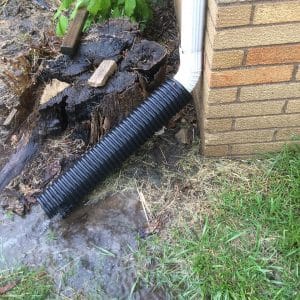
When it comes to rain that falls on your hose, one option is to send it to a vernal lake, the other option is to sent it to the street. If neither is working, and you find water in your basement, your first step is to try to figure out where your rainwater goes and how it got there. Follow the water when it’s raining or right after and see where it goes. Very often, you’ll discover that your downspouts or your driveway drain into unfortunate spots: spots that drain to your basement. To the extent possible, don’t let downspout water congregate in a porous spot near your house. One simple correction is to add extenders on the downspouts so that the water goes further away, and not right next to your wall. At left, I show a simple, cheap extender. It’s for sale in most hardware stores. Plastic or concrete downspout pans work too, and provide a good, first line of defense agains a flood basement. I use several to get water draining down my driveway and away from the house.

Sometimes, despite your best efforts, your driveway or patio slopes to your house. If this is the case, and if you are not quite ready to replace your driveway or patio, you might want to calk around your house where it meets the driveway or patio. If the slope isn’t too great, this will keep rainwater out for a while — perhaps long enough for it to dry off, or for most of the rainwater to go elsewhere. When my driveway was put in, I made sure that it sloped away from the house, but then the ground settled, and now it doesn’t quite. I’ve put in caulk and a dirt-dam at the edge of the house. It keeps the water out long enough that it (mostly) drains to the street or evaporates.

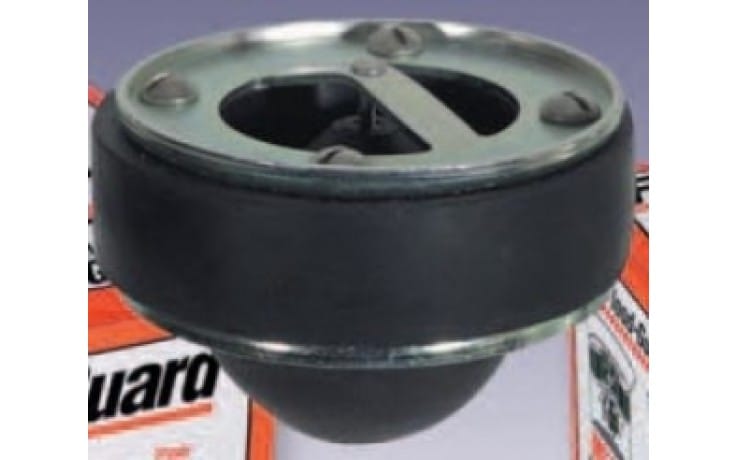
A drain valve. Use this to keep other people’s sewer water out of your basement.

There is one more source of wet basement water, one that hits the houses in my area once a year or so. In our area of Oakland county, Michigan, we have combined storm and sanitary sewers. Every so often, after a big rain, other people’s rainwater and sanitary sewage will come up through the basement drains. This is really a 3rd world sewer system, but we have it this way because when it was put in, in the 1900s, it was first world. One option if you have this is to put in a one-way drain valve. There are various options, and I suggest a relatively cheap one. The one shown at right costs about $15 at Ace hardware. It will keep out enough water, long enough to protect the important things in your home. The other option, cheaper and far more hill-billy, is to stuff rags over your basement drains, and put a brick over the rags. I’ll let you guess what I have in my basement.

Robert Buxbaum, June 13, 2019

Water Conservation for Michigan – Why?

The Michigan Association of Planners joined several environmental groups to pass state legislation requiring water conservation for public, and private users.

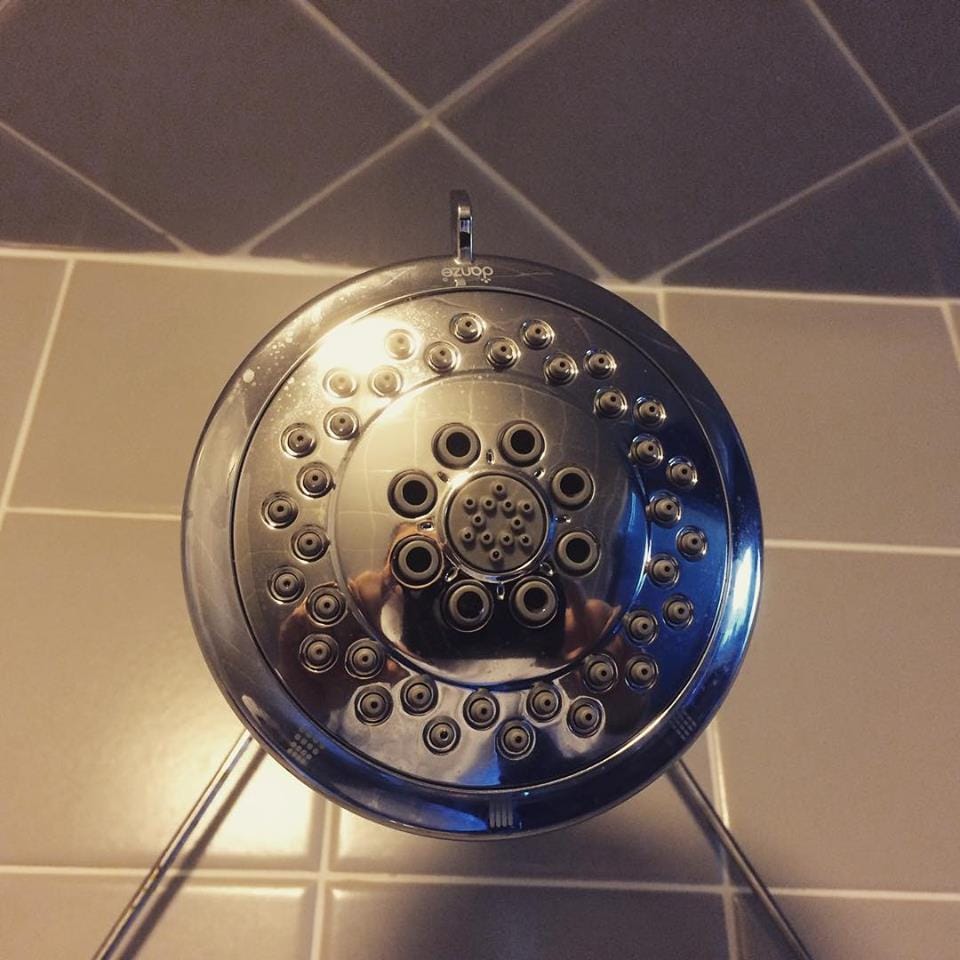
Among the legislation are laws requiring low flush toilets, and prohibiting high-volume shower heads as in this Seinfeld episode. I suppose I should go along: I’m running for water commissioner, and consider myself a conservationist. The problem is, I can’t see a good argument for these laws here in Oakland County, or in neighboring Macomb and Wayne Counties. The water can’t run out because most users take it from the Detroit river and return it there, cleaned after it’s used; it’s all recycled.

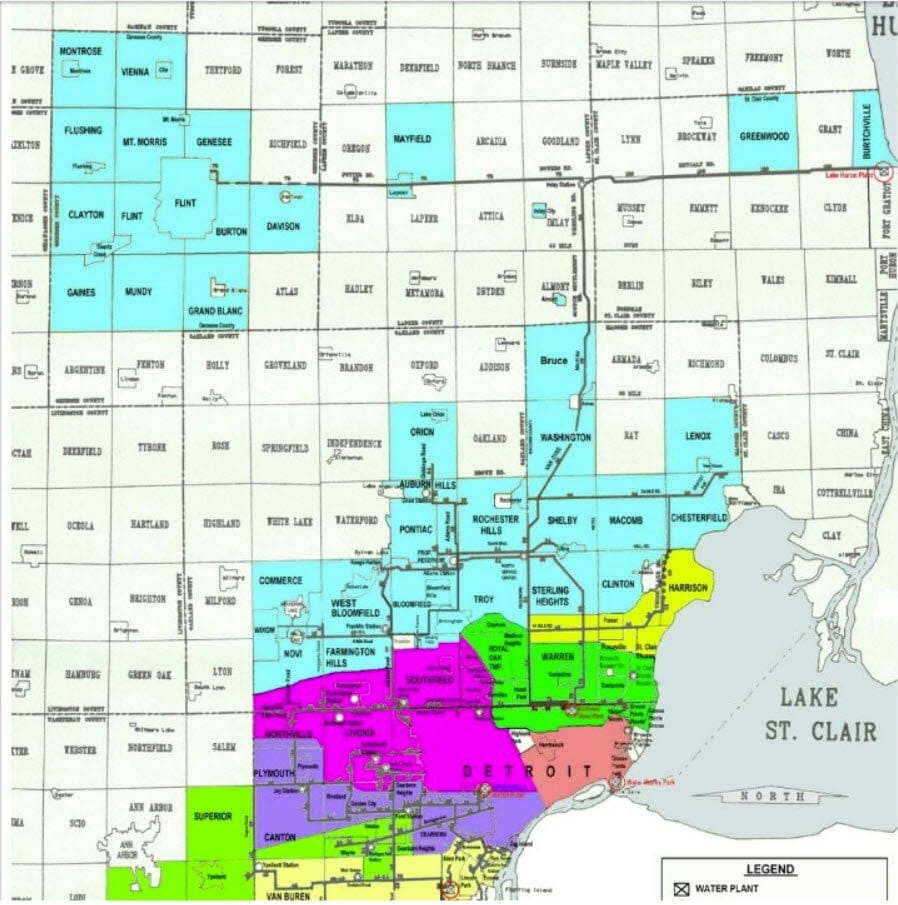
Map of the main drinking-water pipes serving south-east Michigan

Map of the main drinking-water pipes serving south-east Michigan

The map above shows the clean water system for south-east Michigan. The high-population areas, the ones that are colored in the map, get their water from the Detroit River or from Lake Huron. It’s cleaned, pumped, and carried to your home along the pipes shown. Then after you’ve used the water, it travels back along another set of pipes to the water treatment plant and into the Detroit River.

Three-position shower head -- a wonderful home improvement  I got it at universal plumbing.

Three-position shower head — a wonderful home improvement. I got it at universal plumbing.

When the system is working well, the water we return to the Detroit River is cleaner than the water we took in. So why legislate against personal use? If a customer wants to enjoy a good shower, and is willing to pay for the water at 1.5¢ per gallon, who cares how much water that customer uses? I can understand education efforts, sort-of, but find it hard to push legislation like we have against a high-volume shower head. We can not run out, and the more you use, the less everyone pays per gallon. A great shower head is a great gift idea, in my opinion.

The water department does not always work well, by the way, and these problems should be solved by legislation. We give away, for $200/year, high value clean water to Nestle company and then buy it back for $100,000,000. That’s a problem. Non-flushable toilet wipes are marketed as flushable; this causes sewer blockades. Our combined sewers regularly dump contaminated water into our rivers, lakes, and basements. These problems can be solved with legislation and engineering. It’s these problems that I’m running to solve.

Robert Buxbaum, January 6, 2019. If you want to save water, either to save the earth, or because you are cheep, here are some conservation ideas that make sense (to me).

We don’t need no stinking primary clarifier

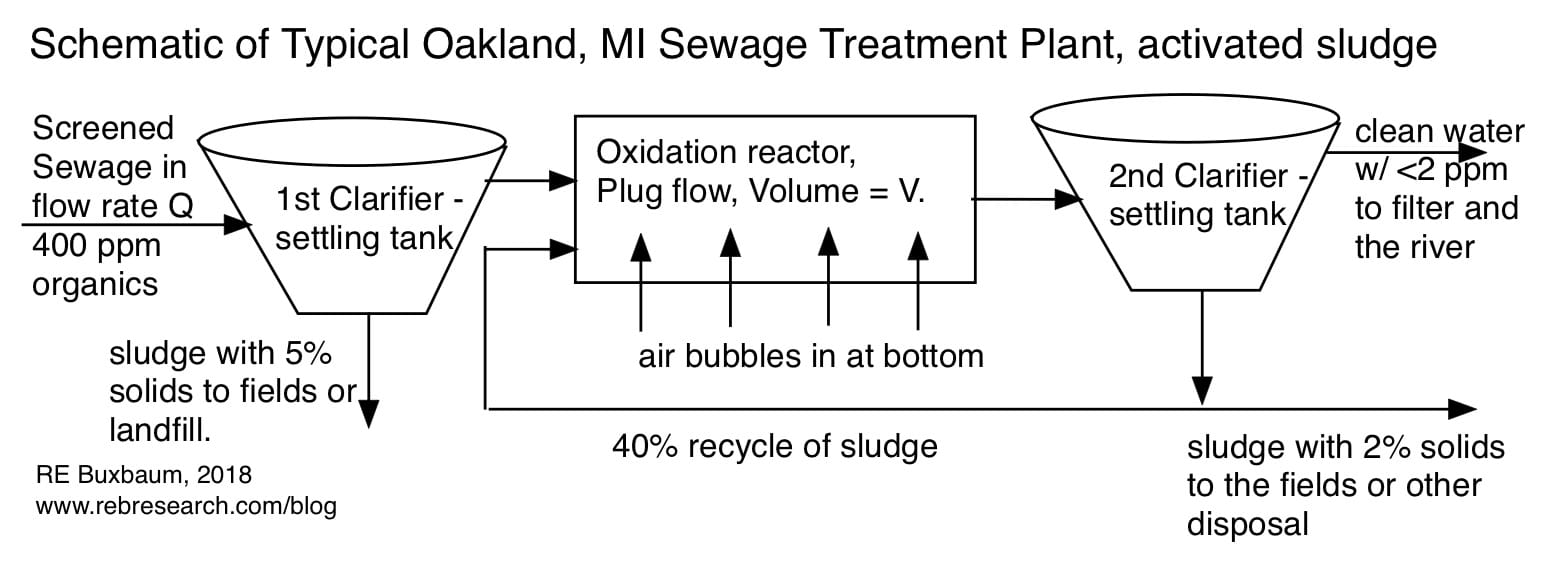
Virtually every sewage plant of Oakland County uses the activated sludge process, shown in the layout below. Raw sewage comes in, and goes through physical separation — screening, grit removal, and a first clarifier – settling tank before moving to the activated sludge oxidation reactor. The 1st clarifier, shown at left below, removes about half of the incoming organics, but it often stinks and sometimes it “pops” bubbles of fart. This is usually during periods of low flow, like at night. When the flow is slow, it arrives at the plant as a rotting smelly mess; it’s often hard to keep the bubbles of smell down.

Typical Oakland Sewage plant, activated sludge process with a primary clarifier.

Typical Oakland County Sewage treatment plant, activated sludge process with a primary clarifier.

The smell is much improved in the oxidation reactor, analyzed here, and in the 2nd clarifier, shown above at right. Following that is a filter, an ultraviolet cleanup stage, and the liquids are discharged to a local river. In Oakland county, the solids from the two clarifiers are hauled off to a farm, or buried in a landfill. Burial in a landfill is a costly waste, as I discuss here. The throughputs for most of these treatment plants is only about 2-3 million gallons of sewage per day. But Oakland county can produce 500 million gallons of sewage per day. The majority of this goes to Detroit for treatment, and sometimes the overflow is dumped rotting and smelly, in the rivers.

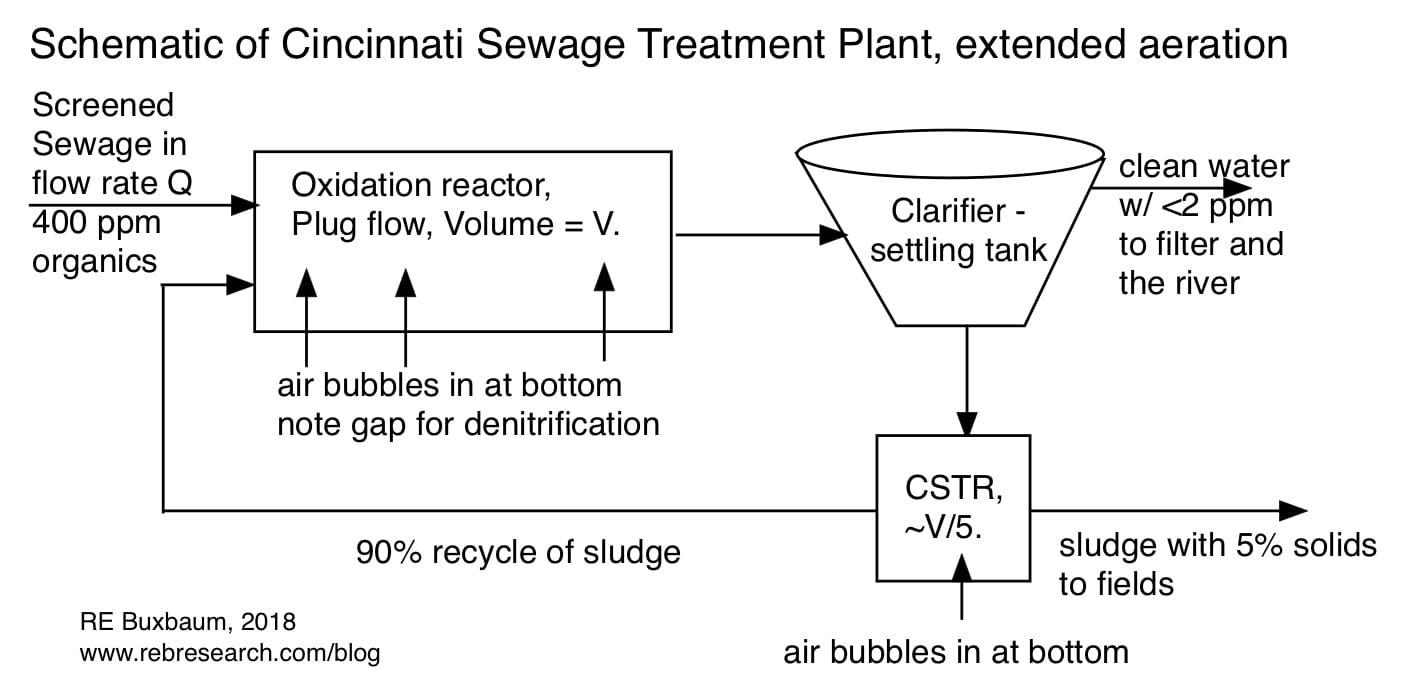
A few months ago, I visited the Sycamore Creek Wastewater facility outside of Cincinnati. This is an 8 million gallon per day plant that uses the “extended aeration process”, shown in the sketch below. I noticed several things I liked: the high throughput (the plant looks no bigger than our 2-3 million gallon plants) and the lack of a bad smell, primarily. The Sycamore Creek plant had an empty hole where the primary clarifier had once been. Lacking this clarifier, the screened sewage could not sit and pop. Instead it goes directly from grit removal to the oxidation reactor, a reactor that looks no bigger than in our plants. This reactor manages a four times higher throughput, I think, because of a higher concentration of cellular catalyst. Consider the following equation derived in a previous post:

ln C°/C = kV/Q.

Here, C° and C are the incoming and exit concentrations of soluble organic; k is the reaction rate, proportional to cellular concentration, V is the volume of the reactor, Q is the flow, and ln is natural log. The higher cellular concentration in the extended aeration plant results in an increased reaction rate, k. The higher the value of k, the higher the allowed flow, Q, per reactor volume, V.

The single clarifier at the end of the Sycamore Creek plant does not look particularly big. My sense is that it deals with a lot more sludge and flow than is seen in our 2nd clarifiers because (I imaging) the sludge is higher density, thus faster settling. I expect that, without the 1 clarifier, there is extra iron and sulfate in the sludge, and more large particles too. In our plants, a lot of these things are removed in the primary clarifier. Sludge density is also increased, I think, because the Cincinnati plant recycle a greater percentage of the sludge (I list it as 90% in the diagram). Extra iron in the reactor also helps to remove phosphates from the water effluent that flows back to the river, an important pollution concern. Iron phosphates are insoluble, and thus leave with the sludge. In Oakland county’s activated sludge plants, it is typical to add iron to the reactor or clarifier. In Cincinnati’s extended aeration plant, I’m told, iron addition is generally not needed.

Typical Oakland Sewage plant, activated sludge process with a primary clarifier.

Cincinnati sewage treatment plant, extended aeration process with no primary clarifier.

The extended aeration part of the above process refers to the secondary sludge oxidizer, the continuously stirred tank reactor, or CSTR shown at lower right above. The “CSTR” is about 1/5 the volume of the main oxidation reactor and about the size of a clarifier. Oxidation in the CSTR compliments that in the main oxidizer removing organics, making bio-polymer, and improving (I think) the quality of the sludge that goes to the farms. Oxidation in the CSTR reduces the amount of sludge that goes to the farms. The sludge that does go, is  less-toxic and more concentrated in organics and minerals. I’m not sure if the CSTR product is as good as the product from an anaerobic digester, or if the CSTR is cheaper to operate, but it looks cheaper since there is no roof, and no (or minimal) heating. This secondary oxidizer is very efficient at removing organics because the cellular catalyst concentration is very high – much higher than in the main oxidizer.

During periods of high load, early morning, the CSTR seems to serve as a holding tank so that sludge does not build up in the clarifier. Too much sludge in the clarifier can start to rot, and ruin the effluent quality. The way you tell if there is too much sludge, by the way, is through a device called the “sludge judge.” I love that name. The Cincinnati plant used a centrifugal drier; none of our plants do. The Cincinnati plant had gap the bubble spots of the main oxidizer. This is good for denitrification, I’m told, an important process that I discuss elsewhere.

The liquid output of their clarifier (or ours) is not pure enough to be sent directly to the river. In this plant, the near-pure water from the clarifier is sent to a trickling filter, a bed of sand and anthracite that removes colloidal remnants. Some of our plants do the same. I suspect that the large surface area in this filter is also home to some catalysis: last stage oxidation of remaining bio-organics. On a regular basis, the filter bed is reverse-flushed to remove cellular buildup, slime, and send it to the beginning of the process. The trickling filter output is then sent to an ultraviolet, bacteria-killing step before being released to the rivers. All in all, I suspect that an extended aeration process like this is worth looking into for Oakland County, especially for our North Pontiac sewage treatment facility. That plant is particularly bad smelling, and clearly too small to treat all its sewage. Perhaps we can increase the throughput and decrease the smell at a minimal cost.

Dr. Robert E. Buxbaum, December 18, 2018. I’m running for water commissioner of Oakland county, MI. If you like, visit my campaign site. Here are some sludge jokes and my campaign song.