Category Archives: materials

How long could you make a suspension bridge?

The above is one of the engineering questions that puzzled me as a student engineer at Brooklyn Technical High School and at Cooper Union in New York. The Brooklyn Bridge stood as a wonder of late 1800s engineering, and it had recently been eclipsed by the Verrazano bridge, a pure suspension bridge. At the time it was the longest and heaviest in the world. How long could a bridge be made, and why did Brooklyn bridge have those catenary cables, when the Verrazano didn’t? (Sometimes I’d imagine a Chinese engineer being asked the top question, and answering “Certainly, but How Long is my cousin.”)

I found the above problem unsolvable with the basic calculus at my disposal. because it was clear that both the angle of the main cable and its tension varied significantly along the length of the cable. Eventually I solved this problem using a big dose of geometry and vectors, as I’ll show.

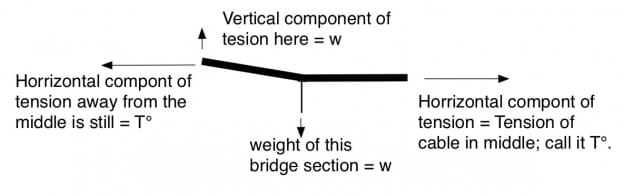
Vector diagram of forces on the cable at the center-left of the bridge.

Vector diagram of forces on the cable at the center-left of the bridge.

Consider the above vector diagram (above) of forces on a section of the main cable near the center of the bridge. At the right, the center of the bridge, the cable is horizontal, and has a significant tension. Let’s call that T°. Away from the center of the bridge, there is a vertical cable supporting a fraction of  roadway. Lets call the force on this point w. It equals the weight of this section of cable and this section of roadway. Because of this weight, the main cable bends upward to the left and carries more tension than T°. The tangent (slope) of the upward curve will equal w/T°, and the new tension will be the vector sum along the new slope. From geometry, T= √(w2 +T°2).

Vector diagram of forces on the cable further from the center of the bridge.

Vector diagram of forces on the cable further from the center of the bridge.

As we continue from the center, there are more and more verticals, each supporting approximately the same weight, w. From geometry, if w weight is added at each vertical, the change in slope is always w/T° as shown. When you reach the towers, the weight of the bridge must equal 2T Sin Θ, where Θ is the angle of the bridge cable at the tower and T is the tension in the cable at the tower.

The limit to the weight of a bridge, and thus its length, is the maximum tension in the main cable, T, and the maximum angle, that at the towers. Θ. I assumed that the maximum bridge would be made of T1 bridge steel, the strongest material I could think of, with a tensile strength of 100,000 psi, and I imagined a maximum angle at the towers of 30°. Since there are two towers and sin 30° = 1/2, it becomes clear that, with this 30° angle cable, the tension at the tower must equal the total weight of the bridge. Interesting.

Now, to find the length of the bridge, note that the weight of the bridge is proportional to its length times the density and cross section of the metal. I imagined a bridge where the half of the weight was in the main cable, and the rest was in the roadway, cars and verticals. If the main cable is made of T1 “bridge steel”, the density of the cable is 0.2833 lb/in3, and the density of the bridge is twice this. If the bridge cable is at its yield strength, 100,000 psi, at the towers, it must be that each square inch of cable supports 50,000 pounds of cable and 50,000 lbs of cars, roadway and verticals. The maximum length (with no allowance for wind or a safety factor) is thus

L(max) = 100,000 psi / 2 x 0.2833 pounds/in3 = 176,500 inches = 14,700 feet = 2.79 miles.

This was more than three times the length of the Verrazano bridge, whose main span is ‎4,260 ft. I attributed the difference to safety factors, wind, price, etc. I then set out to calculate the height of the towers, and the only rational approach I could think of involved calculus. Fortunately, I could integrate for the curve now that I knew the slope changed linearly with distance from the center. That is for every length between verticals, the slope changes by the same amount, w/T°. This was to say that d2y/dx2 = w/T° and the curve this described was a parabola.

Rather than solving with heavy calculus, I noticed that the slope, dy/dx increases in proportion to x, and since the slope at the end, at L/2, was that of a 30° triangle, 1/√3, it was clear to me that

dy/dx = (x/(L/2))/√3

where x is the distance from the center of the bridge, and L is the length of the bridge, 14,700 ft. dy/dx = 2x/L√3.

We find that:
H = ∫dy = ∫ 2x/L√3 dx = L/4√3 = 2122 ft,

where H is the height of the towers. Calculated this way, the towers were quite tall, higher than that of any building then standing, but not impossibly high (the Dubai tower is higher). It was fairly clear that you didn’t want a tower much higher than this, though, suggesting that you didn’t want to go any higher than a 30° angle for the main cable.

I decided that suspension bridges had some advantages over other designs in that they avoid the problem of beam “buckling.’ Further, they readjust their shape somewhat to accommodate heavy point loads. Arch and truss bridges don’t do this, quite. Since the towers were quite a lot taller than any building then in existence, I came to I decide that this length, 2.79 miles, was about as long as you could make the main span of a bridge.

I later came to discover materials with a higher strength per weight (titanium, fiber glass, aramid, carbon fiber…) and came to think you could go longer, but the calculation is the same, and any practical bridge would be shorter, if only because of the need for a safety factor. I also came to recalculate the height of the towers without calculus, and got an answer that was shorter, for some versions, a hundred feet shorter, as shown here. In terms of wind, I note that you could make the bridge so heavy that you don’t have to worry about wind except for resonance effects. Those are the effects are significant, but were not my concern at the moment.

The Brooklyn Bridge showing its main cable suspension structure and its catenaries.

Now to discuss catenaries, the diagonal wires that support many modern bridges and that, on the Brooklyn bridge, provide  support at the ends of the spans only. Since the catenaries support some weight of the Brooklyn bridge, they decrease the need for very thick cables and very high towers. The benefit goes down as the catenary angle goes to the horizontal, though as the lower the angle the longer the catenary, and the lower the fraction of the force goes into lift. I suspect this is why Roebling used catenaries only near the Brooklyn bridge towers, for angles no more than about 45°. I was very proud of all this when I thought it through and explained it to a friend. It still gives me joy to explain it here.

Robert Buxbaum, May 16, 2019.  I’ve wondered about adding vibration dampers to very long bridges to decrease resonance problems. It seems like a good idea. Though I have never gone so far as to do calculations along these lines, I note that several of the world’s tallest buildings were made of concrete, not steel, because concrete provides natural vibration damping.

A hydrogen permeation tester

Over the years I’ve done a fair amount of research on hydrogen permeation in metals — this is the process of the gas dissolving in the metal and diffusing to the other side. I’ve described some of that, but never the devices that measure the permeation rate. Besides, my company, REB Research, sells permeation testing devices, though they are not listed on our site. We recently shipped one designed to test hydrogen permeation through plastics for use in light weight hydrogen tanks, for operation at temperatures from -40°C to 85°C. Shortly thereafter we got another order for a permeation tester. With all the orders, I thought I’d describe the device a bit — this is the device for low permeation materials. We have a similar, but less complex design for high permeation rate material.

Shown below is the central part of the device. It is a small volume that can be connected to a high vacuum, or disconnected by a valve. There is an accurate pressure sensor, accurate to 0.01 Torr, and so configured that you do not get H2 + O2 reactions (something that would severely throw off results). There is also a chamber for holding a membrane so one side is help in vacuum, in connection to the gauge, and the other is exposed to hydrogen, or other gas at pressures up to 100 psig (∆P =115 psia). I’d tested to 200 psig, but currently feel like sticking to 100 psig or less. This device gives amazingly fast readings for plastics with permeabilities as low as 0.01 Barrer.

REB Research hydrogen permeation tester cell with valve and pressure sensor.

REB Research hydrogen permeation tester cell with valve and pressure sensor.

To control the temperature in this range of interest, the core device shown in the picture is put inside an environmental chamber, set up as shown below, with he control box outside the chamber. I include a nitrogen flush device as a safety measure so that any hydrogen that leaks from the high pressure chamber will not build up to reach explosive limits within the environmental chamber. If this device is used to measure permeation of a non-flammable gas, you won’t need to flush the environmental chamber.

I suggest one set up the vacuum pump right next to the entrance of the chamber; in the case of the chamber provided, that’s on the left as shown with the hydrogen tank and a nitrogen tank to the left of the pump. I’ve decided to provide a pressure sensor for the N2 (nitrogen) and a solenoidal shutoff valve for the H2 (hydrogen) line. These work together as a safety feature for long experiments. Their purpose is to automatically turn off the hydrogen if the nitrogen runs out. The nitrogen flush part of this process is a small gauge copper line that goes from the sensor into the environmental chamber with a small, N2 flow bleed valve at the end. I suggest setting the N2 pressure to 25-35 psig. This should give a good inert flow into the environmental chamber. You’ll want a nitrogen flush, even for short experiments, and most experiments will be short. You may not need an automatic N2 sensor, but you’ll be able to do this visually.

Basic setup for REB permeation tester and environmental chamber

Basic setup for REB permeation tester and environmental chamber

I shipped the permeation cell comes with some test, rubbery plastic. I’d recommend the customer leave it in for now, so he/she can use it for some basic testing. For actual experiments, you replace mutest plastic with the sample you want to check. Connect the permeation cell as shown above, using VCR gaskets (included), and connect the far end to the multi-temperature vacuum hose, provided. Do this outside of the chamber first, as a preliminary test to see if everything is working.

For a first test live the connections to the high pressure top section unconnected. The pressure then will be 1 atm, and the chamber will be full of air. eave the top, Connect the power to the vacuum pressure gauge reader and connect the gauge reader to the gauge head. Open the valve and turn on the pump. If there are no leaks the pressure should fall precipitously, and you should see little to no vapor coming out the out port on the vacuum pump. If there is vapor, you’ve got a leak, and you should find it; perhaps you didn’t tighten a VCR connection, or you didn’t do a good job with the vacuum hose. When things are going well, you should see the pressure drop to the single-digit, milliTorr range. If you close the valve, you’ll see the pressure rise in the gauge. This is mostly water and air degassing from the plastic sample. After 30 minutes, the rate of degassing should slow and you should be able to measure the rate of gas permeation in the polymer. With my test plastic, it took a minute or so for the pressure to rise by 10 milliTorr after I closed the valve.

If you like, you can now repeat this preliminary experiment with hydrogen connect the hydrogen line to one of the two ports on the top of the permeation cell and connect the other port to the rest of the copper tubing. Attach the H2 bleed restrictor (provided) at the end of this tubing. Now turn on the H2 pressure to some reasonable value — 45 psig, say. With 45 psi (3 barg upstream) you will have a ∆P of 60 psia or 4 atm across the membrane; vacuum equals -15 psig. Repeat the experiment above; pump everything down, close the valve and note that the pressure rises faster. The restrictor allows you to maintain a H2 pressure with a small, cleansing flow of gas through the cell.

If you like to do these experiments with a computer record, this might be a good time to connect your computer to the vacuum reader/ controller, and to the thermocouple, and to the N2 pressure sensor. 

Here’s how I calculate the permeability of the test polymer from the time it takes for a pressure rise assuming air as the permeating gas. The volume of the vacuumed out area after the valve is 32 cc; there is an open area in the cell of 13.0 cm2 and, as it happens, the  thickness of the test plastic is 2 mm. To calculate the permeation rate, measure the time to rise 10 millitorr. Next calculate the millitorr per hour: that’s 360 divided by the time to rise ten milliTorr. To calculate ncc/day, multiply the millitorr/hour by 24 and by the volume of the chamber, 32 cc, and divide by 760,000, the number of milliTorr in an atmosphere. I found that, for air permeation at ∆P = one atm, I was getting 1 minute per milliTorr, which translates to about 0.5 ncc/day of permeation through my test polymer sheet. To find the specific permeability in cc.mm/m2.day.atm, I multiply this last number by the thickness of the plastic (2 mm in this case), divide by the area, 0.0013 m2, and divide by ∆P, 1 atm, for this first test. Calculated this way, I got an air permeance of 771 cc.mm/m2.day.atm.

The complete setup for permeation testing.

The complete setup for permeation testing.

Now repeat the experiment with hydrogen and your own plastic. Disconnect the cell from both the vacuum line and from the hydrogen in line. Open the cell; take out my test plastic and replace it with your own sample, 1.87” diameter, or so. Replace the gasket, or reuse it. Center the top on the bottom and retighten the bolts. I used 25 Nt-m of torque, but part of that was using a very soft rubbery plastic. You might want to use a little more — perhaps 40-50 Nt-m. Seal everything up. Check that it is leak tight, and you are good to go.

The experimental method is the same as before and the only signficant change when working with hydrogen, besides the need for a nitrogen flush, is that you should multiply the time to reach 10 milliTorr by the square-root of seven, 2.646. Alternatively, you can multiply the calculated permeability by 0.378. The pressure sensor provided measures heat transfer and hydrogen is a better heat transfer material than nitrogen by a factor of √7. The vacuum gauge is thus more sensitive to H2 than to N2. When the gauge says that a pressure change of 10 milliTorr has occurred, in actuality, it’s only 3.78 milliTorr.  The pressure gauge reads 3.78 milliTorr oh hydrogen as 10 milliTorr.

You can speed experiments by a factor of ten, by testing the time to rise 1 millitorr instead of ten. At these low pressures, the gauge I provided reads in hundredths of a milliTorr. Alternately, for higher permeation plastics (or metals) you want to test the time to rise 100 milliTorr or more, otherwise the experiment is over too fast. Even at a ten millTorr change, this device gives good accuracy in under 1 hour with even the most permeation-resistant polymers.

Dr. Robert E. Buxbaum, March 27, 2019; If you’d like one of these, just ask. Here’s a link to our web site, REB Research,

Why concrete cracks and why sealing is worthwhile

The oil tanker Palo Alto is one of several major ships made with concrete hulls.

The oil tanker Palo Alto is one of several major ships made with concrete hulls.

Modern concrete is a wonderful construction material. Major buildings are constructed of it, and major dams, and even some ships. But under the wrong circumstances, concrete has a surprising tendency to crack and fail. I thought I’d explain why that happens and what you can do about it. Concrete does not have to crack easily; ancient concrete didn’t and military or ship concrete doesn’t today. A lot of the fault lies in the use of cheap concrete — concrete with lots of filler — and with the cheap way that concrete is laid. First off, the major components of modern concrete are pretty uniform: sand and rock, Portland cement powder (made from cooked limestone, mostly), water, air, and sometimes ash. The cement component is what holds it all together — cements it together as it were — but it is not the majority of even the strongest concretes. The formula of cement has changed too, but the cement is not generally the problem. It doesn’t necessarily stick well to the rock or sand component of concrete (It sticks far better to itself) but it sticks well enough that spoliation, isn’t usually a problem by itself.

What causes problem is that the strength of concrete is strongly affected (decreased) by having lots of sand, aggregate and water. The concrete used in sidewalks is as cheap as possible, with lots of sand and aggregate. Highway and wall concrete has less sand and aggregate, and is stronger. Military and ship concrete has little sand, and is quite a lot stronger. The lowest grade, used in sidewalks, is M5, a term that refers to its compressive strength: 5 Mega Pascals. Pascals are European (Standard International) units of pressure and of strength. One Pascal is one Newton per square meter (Here’ a joke about Pascal units). In US (English) units, 5 MPa is 50 atm or 750 psi.

Ratios for concrete mixes of different strength.

Ratios for concrete mixes of different strength; the numbers I use are double these because these numbers don’t include water; that’s my “1”.

The ratio of dry ingredients in various concretes is shown at right. For M5, and including water, the ratio is 1 2 10 20. That is to say there is one part water, two parts cement, 10 parts sand, and 20 parts stone-aggregate (all these by weight). Added to this is 2-3% air, by volume, or nearly as much air as water. At least these are the target ratios; it sometimes happens that extra air and water are added to a concrete mix by greedy or rushed contractors. It’s sometimes done to save money, but more often because the job ran late. The more the mixer turns the more air gets added. If it turns too long there is extra air. It the job runs late, workers will have to add extra water too because the concrete starts hardening. I you see workers hosing down wet concrete as it comes from the truck, this is why. As you might expect, extra air and water decrease the strength of the product. M-10 and M-20 concrete have less sand, stone, and water as a proportion to cement. The result is 10 MPa or 20 MPa strength respectively.

A good on-site inspector is needed to keep the crew from adding too much water. Some water is needed for the polymerization (setting) of the concrete. The rest is excess, and when it evaporates, it leaves voids that are similar to the voids created by having air mix in. It is not uncommon to find 6% voids, in commercial concrete. This is to say that, after the water evaporates, the concrete contains about as much void as cement by volume. To get a sense of how much void space is in the normal concrete outside your house, go outside to a piece of old concrete (10 years old at least) on a hot, dry day, and pour out a cup of water. You will hear a hiss as the water absorbs, and you will see bubbles come out as the water goes in. It used to be common for cities to send inspectors to measuring the void content of the wet (and dry) concrete by a technique called “pycnometry” (that’s Greek for density measurement). I’ve not seen a local city do this in years, but don’t know why. An industrial pycnometer is shown below.

Pyncnometer used for concrete. I don't see these in use much any more.

Pycnometer used for concrete. I don’t see these in use much any more.

One of the main reason that concrete fails has to do with differential expansion, thermal stress, a concept I dealt with some years ago when figuring out how cold it had to be to freeze the balls off of a brass monkey. As an example of the temperature change to destroy M5, consider that the thermal expansion of cement is roughly 1 x 10-5/ °F or 1.8 x10-5/°C. This is to say that a 1 meter slab of cement that is heated or cooled by 100°F will expand or shrink by 10-3 m respectively; 100 x 1×10-5 = 10-3. This is a fairly large thermal expansion coefficient, as these things go. It would not cause stress-failure except that sand and rock have a smaller thermal expansion coefficients, about 0.6×10⁻⁵ — barely more than half the value for cement. Consider now what happens to concrete that s poured in the summer when it is 80°F out, and where the concrete heats up 100°F on setting (cement setting releases heat). Now lets come back in winter when it’s 0°F. This is a total of 100°F of temperature change. The differential expansion is 0.4 x 10⁻⁵/°F x 100°F =  4 x10⁻⁴ meter/meter = 4 x10⁻⁴ inch/inch.

The force created by this differential expansion is the elastic modulus of the cement times the relative change in expansion. The elastic modulus for typical cement is 20 GPa or, in English units, 3 million psi. This is to say that, if you had a column of cement (not concrete), one psi of force would compress it by 1/3,000,000. The differential expansion we calculated, cement vs sand and stone is 4×10⁻⁴ ; this much expansion times the elastic modulus, 3,000,000 = 1200 psi. Now look at the strength of the M-5 cement; it’s only 750 psi. When M-5 concrete is exposed to these conditions it will not survive. M-10 will fail on its own, from the temperature change, without any help needed from heavy traffic. You’d really like to see cities check the concrete, but I’ve seen little evidence that they do.

Water makes things worse, and not only because it creates voids when it evaporates. Water also messes up the polymerization reaction of the cement. Basic, fast setting cement is mostly Ca3SiO5

2Ca3SiO5 + 6 H2O –> 3Ca0SiO2•H2O +3Ca(OH)2•H2O.

The former of these, 3Ca0SiO2•H2O, forms something of a polymer. Monomer units of SiO4 are linked directly or by partially hydrated CaO linkages. Add too much water and the polymeric linkages are weakened or do not form at all. Over time the Ca(OH)2 can drain away or react with  CO2 in the air to form chalk.

concrete  strength versus-curing time. Slow curing of damp concrete helps; fast dry hurts. Carbonate formation adds little or no strength. Jehan Elsamni 2011.

Portland limestone cement strength versus curing time. Slow curing and damp helps; fast dry hurts. Carbonate formation adds little or no strength. Jehan Elsamni 2011.

Ca(OH)2 + CO2 → CaCO3 + H2O

Sorry to say, the chalk adds little or no strength, as the graph at right shows. Concrete made with too much water isn’t very strong at all, and it gets no stronger when dried in air. Hardening goes on for some weeks after pouring, and this is the reason you don’t drive on 1 too 2 day old concrete. Driving on weak concrete can cause cracks that would not form if you waited.

You might think to make better concrete by pouring concrete in the cold, but pouring in the cold makes things worse. Cold poured cement will expand the summer and the cement will detach from the sand and stone. Ideally, pouring should be in spring or fall, when the temperature is moderate, 40-60°F. Any crack that develops grows by a mechanism called Rayleigh crack growth, described here. Basically, once a crack starts, it concentrates the fracture forces, and any wiggling of the concrete makes the crack grow faster.

Based on the above, I’ve come to suspect that putting on a surface coat can (could) help strengthen old concrete, even long after it’s hardened. Mostly this would happen by filling in voids and cracks, but also by extending the polymer chains. I imagine it would be especially helpful to apply the surface coat somewhat watery on a dry day in the summer. In that case, I imagine that Ca3SiO5 and Ca(OH)2 from the surface coat will penetrate and fill the pores of the concrete below — the sales pores that hiss when you pour water on them. I imagine this would fill cracks and voids, and extend existing CaOSiO2•H2O chains. The coat should add strength, and should be attractive as well. At least that was my thought.

I should note that, while Portland cement is mostly Ca3SiO5, there is also a fair amount (25%) of Ca2SiO4. This component reacts with water to form the same calcium-silicate polymer as above, but does so at a slower rate using less water per gram. My hope was that this component would be the main one to diffuse into deep pores of the concrete, reacting there to strengthen the concrete long after surface drying had occurred.

Trump tower: 664', concrete and glass. What grade of concrete would you use?

Trump tower: 664′, concrete and glass. What grade of concrete would you use?

As it happened, I had a chance to test my ideas this summer and also about 3 years ago. The city inspector came by to say the concrete flags outside my house were rough, and thus needed replacing, and that I was to pay or do it myself. Not that I understand the need for smooth concrete, quite, but that’s our fair city. I applied for a building permit to apply a surface coat, and applied it watery. I used “Quickrete” brand concrete patch, and so far it’s sticking OK. Pock-holes in the old concrete have been filled in, and so far surface is smooth. We’ll have to see if my patch lasts 10-20 years like fresh cement. Otherwise, no matter how strong the concrete becomes underneath, the city will be upset, and I’ll have to fix it. I’ve noticed that there is already some crumbling at the sides of flags, something I attribute to the extra water. It’s not a problem yet, but hope this is not the beginning of something worse. If I’m wrong here, and the whole seal-coat flakes off, I’ll be stuck replacing the flags, or continuing to re-coat just to preserve my reputation. But that’s the cost of experimentation. I tried something new, and am blogging about it in the hope that you and I benefit. “Education is what you get when you don’t get what you want.” (It’s one of my wise sayings). At the worst, I’ll have spent 90 lb of patching cement to get an education. And, I’m happy to say that some of the relatively new concrete flags that the city put in are already cracked. I attribute this to: too much sand, air, water or air (they don’t look like they have much rock): Poor oversight.

Dr. Robert E. Buxbaum. March 5, 2019. As an aside, the 664 foot Trump Tower, NY is virtually the only skyscraper in the city to be built of concrete and glass. The others are mostly steel and glass. Concrete and glass is supposed to be stiffer and quieter. The engineer overseeing the project was Barbara Res, the first woman to oversee a major, NY building project. Thought question: if you built the Trump Tower, which quality of concrete would you use, and why.