Category Archives: Detroit

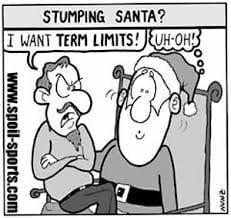
Term limits, in what world are they Republican or conservative?

The desire for term limits is one of the political innovations that leaves me baffled. What is the logic, especially for conservatives or Republicans. In theory, Republicans favor any freedom that does not hurt the individual, and in theory conservatives favor things according to the Bible. Both should oppose term limits. No individual is hurt by term limits, and in the Bible, good kings, judges, and advisors should serve for life. Rehoboam, Solomon’s son, splits Israel by ignoring his father’s advisors (1 Kings 12 ff). term limits

In a more-secular context, if you have a good doctor, one who took years to learn the craft, would you get rid of him just because you’re afraid he’ll become comfortable? It’s insane personally, and worse to make a law forcing other people to do it. It suggests a paranoia of public will, the opposite of what a Democratic Republic stands for. These are laws to keep people from voting for the fellow they like! it’s like we believe ourselves to be addicts with a deadly addiction. It’s also like we believe policy is so simple and so corrupting that a beginner is always better than everyone with experience. As it happened, Rehoboam’s young councilors were more money-hungry than the old.

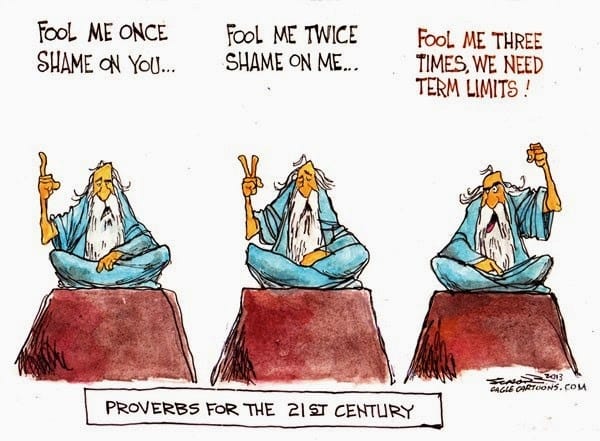
Protect me from making the same mistake thrice.

Protect me from making the same mistake thrice.

Michigan’s term limits are worse than most because ours are uncommonly short: 6 years for the house. 8 for the senate, 8 for governor. While I can accept an eight year  term limit for the governor, in theory he’s just an executor, I can see no basis for the short term limits on those serving in the MI house or senate. If we can’t eliminate these limits, we should at least extend them. Also I would not make the exclusion on any of these individuals life-long. If someone served in the senate say, then left and served as governor, why not let the fellow run again for senate?

For those reading this in future decades, it's funny because XI is president of China for life, something US presidents (Trump) can't be. But they can be  put in prison for life.

behind bars  For those reading this in future decades, it’s funny because XI is president of China for life, something US presidents (Trump) can’t be. But they can be put in prison for life.

For the same reason, I’m not a fan of long, mandatory minimum prison sentences. It’s like we don’t trust our judges to be tough enough. If we don’t trust them, don’t elect them, or remove them. As it is, we have more people per-capita behind bars than any other nation on earth. We assume, I guess that we can’t pick a good judge, but have to make sure he or she isn’t a lenient rascal who’ll serve for life. But is that so bad? Is it better to force the judge to spit on everyone?

There are many problems with fair sentencing, but I’m inclined to say that extenuating circumstances are always relevant, and that the shortest sentence sufficient to prevent further crime is usually the best. If judges are rascals, then the way to deal with it is judicial review or un-election. As Cotton Mather said years after overseeing the Salem witch hunts: “It’s better that a hundred witches go free than that we kill a single innocent person”. With judges, as with voters, restricting choice by law seems proper only when the effect is to protect the individual, not when the effect is to increase his burden, or so it seems to me.

Robert E. Buxbaum, October 11, 2018.

Beavers, some of the best dam builders

I ran for water commissioner in 2016 (Oakland county, Michigan; I’ll be running again in 2020), and one of my big issues was improving our rivers. Many are dirty and “flashy”. Shortly after a rain they rise too high and move dangerously fast. At other times, they become, low, smelly, and almost disappear. There are flash floods in these rivers, few fish or frogs, and a major problem with erosion. A big part of a solution, I thought, would be to add few small dams, and to refurbish a few others by adding over-flow or underflow weirs. We had a small dam in the middle of campus at Michigan State University where I’d taught, and I’d seen that it did wonders for river control, fishing, and erosion. The fellow I was running against had been removing small dams in the belief that this made the rivers “more natural”. The Sierra Club thought he was right doing this; the fishing community and some homeowners and MSU alumni thought I was. My problem was that I was a Republican running in a Democratic district. Besides, the county executive, L. Brooks Patterson (also a Republican) was a tightwad. Among my the first stops on my campaign trail was to his office, and while he liked many of my ideas, and promised to support me, he didn’t like the idea of spending money on dams. I suggested, somewhat facetiously, using beavers, and idea that’s grown on me since. I’m still not totally convinced it’s a good idea, but bear with me as I walk you through it.

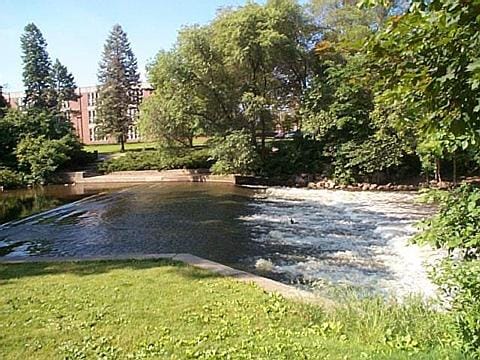
Red Cedar River dam as seen from behind the Michigan State University Administration Building.

Small dam on the Red Cedar River at Michigan State University behind the Administration Building. The dam provided good fishing and canoeing, and cleaned the water somewhat.

The picture at right shows the dam on the Red Cedar River right behind the Administration building at Michigan State University, looking south. During normal times the dam slows the river flow and raises the water level high enough to proved a good canoe trail, 2 1/2 miles to Okemos. Kids would fish behind the dam, and found it a very good fishing spot. The slow flow meant less erosion, and some pollution control. The speed of flow and the height of the river are related; see calculation here. After a big rain, a standing wave (a “jump”) would set up at the dam, raising its effective height by three or four feet. Students would surf the standing wave. More importantly, the three or four feet of river rise provided retention so that the Red Cedar did little damage. Some picnic area got flooded, but that was a lot better than having a destructive torrent. Here’s some more on the benefits of dams.

Between July 31 and Aug 1 the Clinton River rose nine feet in 3 hours, sending 130,000,000 cubic feet of water and sewage to lake St Clair.

Between July 31 and Aug 1 the Clinton River rose nine feet in 3 hours, sending 130,000,000 cubic feet of water to lake St Clair.

The Sierra club supported (supports) my opponent, in part because he supports natural rivers, without dams. I think they are wrong about this, and about their political support in general. Last night, following a 1 1/2 inch rain, the Clinton River flash flooded, going from 5.2 feet depth to 14 feet depth in just two hours. My sense is that the natural state of our rivers had included beavers and beaver dams until at least the mid 1700s. I figured that a few well-designed dams, similar to those at Michigan State would do wonders to stop this. Among the key locations were Birmingham, on the Rouge, Rochester, near Oakland University, Auburn Hills, and the Clinton River gorge, and near Lawrence Technical University. If we could not afford to build man-made dams, I figured we could seed some beaver into nearby nature areas, and let the beavers dam the rivers for free. It would bring back the natural look of these areas, as in the picture below. And engineers at Lawrence Tech and Oakland University might benefit from seeing the original dam engineers at work.

Beaver dam on a branch of the Huron River. Beavers are some of the best dam builders.

Beaver dam on a branch of the Huron River. A rather professional and attractive job at a bargain price.

Beavers are remarkably diligent. Once they set about a task, they build the basics of a dam in a few days, then slowly improve it like any good craftsman. As with modern dams, beaver dams begin with vertical piles set into the river bottom. Beavers then fill in the dam with cross-pieces, moving as much as 1000 lbs of wood in a night to add to the structure and slow the flow. They then add mud. They use their hearing to detect leaks, and slowly plug the leaks till the dam is suitably tight. Most of the streams I identified are narrow and pass through wooded areas. I think a beaver might dam them in a few days. Based on the amount of wood beavers move, and the fact that beavers are shaped like big woodchucks, I was able to answer the age-old question: how much wood would a woodchuck chuck if a woodchuck could chuck wood — see my calculation here.

Me, visiting the DNR to talk beavers

Me, visiting the DNR to talk beavers

There are a few things to check out before I start hiring beavers to take care of Oakland county flooding, and I have not checked them all out yet. Beavers don’t necessarily build where you want or as solidly, and sometimes they don’t build at all. If there are no predators, beavers can get lazy and just build a low-water lodge and a high water lodge, moving from one to the other as the river rises and falls. Hiring a beaver is like hiring an artistic contractor, it seems: you don’t necessarily get what you ask for, and sometimes you get more. Given the flash flooding we have, it’s hard to picture they’d make things worse, but what do I know? In some cases, e.g. the Red Run near the 12 towns drain, the need is for more than a beaver can deliver. Still, without beavers, the need would be for a billion gallons of retention on the Clinton alone, a 10 billion dollar project if carried out as my opponent likes to build. So, with no budget to work with, my next stop was at the Department of Natural Resources Customer Service Center (Lansing). I had some nice chats with beaver experts, and I’m happy to say they liked the idea, or at least they were not opposed. I’ve yet to talk to the Michigan director of dams, and will have to see what he has to say, but so far it seems like, if I get elected in 2020, I’ll be looking for some hard-working beavers, willing to relocate. I’d like to leave it to Beaver.

Robert E. Buxbaum, August 2, 2018. I still don’t get the Sierra Club’s idea of what a natural river would look like, or their commitment to Democrats. In my opinion, a river should include beavers, fish, and fishermen, and drainage should be done by whoever can do it best. Sierra club folks are welcomed to comment below.

The Great, New York to Paris, Automobile race of 1908.

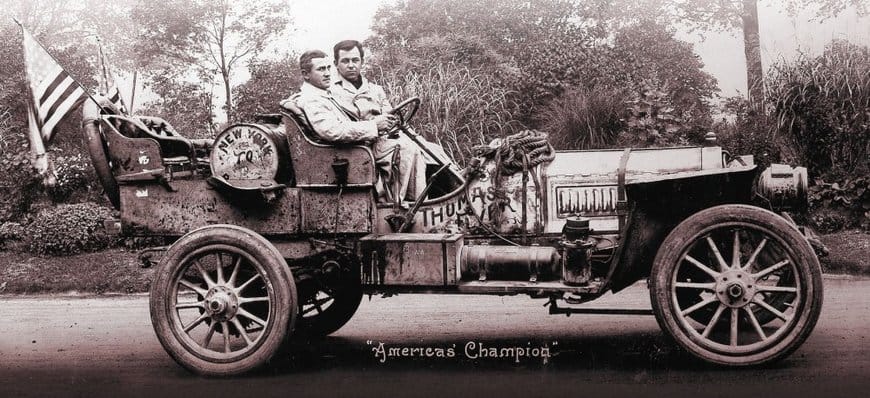
As impressive as Lindberg’s transatlantic fight was in 1926, more impressive was George Schuster driving and winning the New York to Paris Automobile race beginning in the dead of winter, 1908, going the long way, through Russia. As of 1908, only nine cars had ever made the trip from Chicago to California, and none had done it in winter, but this race was to go beyond California, to Alaska and then over the ice through Russia and to Paris. Theodore Roosevelt was president, and Americans were up to any challenge. So, on February 12, 1908 there congregated in Times Square, New York, a single, US-made production car, along with five, specially made super-cars from Europe; one each from Italy and Germany; and three from France. The US car, a Thomas Flyer (white), is shown in the picture below. The ER Thomas company sent along George Schuster, as an afterthought: he was a mechanic and test-driver for the company, and was an ex bicycle racer. The main driver was supposed to be Montague Roberts, a dashing sportsmen, but the fellow dropped out in Cheyenne, Wyoming. Schuster reached the Eiffel tower on July 30, 1908, 169 days after leaving New York. The Germans and Italians followed. None of the French super-cars got further than Vladivostok, and one dropped out after less than 100 miles.

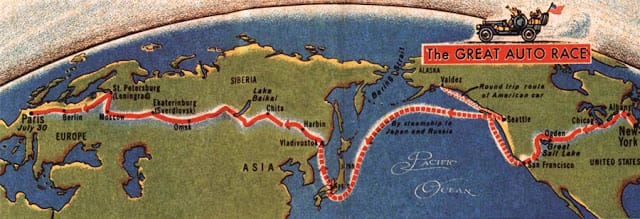
The race was sponsored by The New York Times and Le Matin, a Paris newspaper. They offered a large trophy, a cash prize of $1000, not enough to pay for the race, and the prospect of fame. The original plan was for drivers to go from New York to San Francisco, then to Seattle by ship, and Northern Alaska, driving to Russia across the Arctic ice. That plan was abandoned when Schuster, the first driver to reach Alaska, discovered ten foot snows outside of Valdez. The race was modified so that travel to Russia would be by ship. Schuster took his Thomas to Russia from Alaska, the other two drivers reached Russia from Seattle by way of Japan. Schuster was given a bonus of days to account for having taken the longer route. Because of his detour, he was the last to arrive in Russia. From Japan, the route was Vladivostok, Omsk, Moscow, St. Petersburg, Berlin, and Paris, 21,900 miles total; 13,341 miles driven. Schuster drove most of those 13,341 miles, protected by his own .32-caliber pistol, and mostly guided by the stars and a sextant. He’d taught himself celestial navigation as there were no roadmaps, and hardly any roads.

George Schuster driving the Thomas Flyer, the only American entry, and the only production motorcar in the race.

George Schuster driving the Thomas Flyer with another mechanic, George Miller, the Flyer was only American entry, and the only production motorcar in the race. Note that the flag has only 45 stars.

The ship crossing of the Pacific was a good idea given that, even in the dead of winter, global warming meant that the arctic could not be relied upon to be solid ice. As it was, Schuster had to content with crossing the Rockies in deep snow, and crossing Russia in the season of deepest mud. He reached the Eiffel tower at 6 p.m. on July 30, 1908. The German car had arrived in Paris three days ahead of Schuster, but was penalized to second place because the German team had avoided the trip to Alaska, and had traveled some 150 km of the Western US by railroad while Schuster had driven. The Italian team reached Paris months later, in September, 1908. That the win went to the only production car to compete is indicative, perhaps of the reliability that comes with mass production. That Mr. Schuster was not given the fame that Lindberg got may have to do with the small size of the prize, or with him being a mechanic while Lindberg was a “flyer”. Flyers were sexy; even the car was called a flyer. The Times saw fit to hardly mention Schuster at all, and when it did, it spelled his name wrong. Instead the Times headline read, “Thomas Flyer wins New York to Paris Race.” You’d think the car did it on its own, or that the driver was named Thomas Flyer.

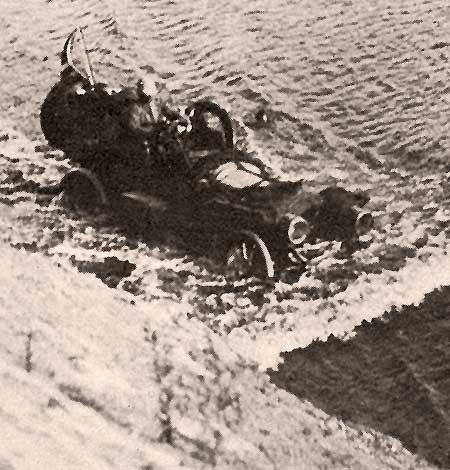
The Flyer crossing a swollen  river in Manchuria.

Schuster in his Flyer crossing a swollen river in Manchuria.

The Times could not get enough of Montague Roberts; the driver of the first leg was famous and photographic. They tried to get Roberts to drive the last few miles into Paris, “once the roads were good”. And Roberts was the one chosen to drive in the hero-parade in New York, Schuster rode too, but didn’t drive. Schuster was feted by Theodore Roosevelt, though, who said he liked people “who did things.” Schuster said he’d never do a race like that again, and he never did race again.

The race did wonders for the reputation of American automobiles, and greatly spurred the desire for roads, but it did little or nothing for the E.R.Thomas company. Thomas cars were high cost, high power models, and they lost out in the marketplace to Henry Ford’s, low-cost Model T’s. You’d think that, in the years leading up to WWI, the US Army might buy a high cost, high reliability car, but they were not interested, and the Thomas company did little to capitalize on their success. The Flyer design that won the race was discontinued. It was a 60 hp, straight 4 cylinder engine version, replaced by lower cost Flyers with 3 cylinders and 24 hp. Shortly after that, Edwin R. Thomas, decided to drop the Flyer altogether. His company went bankrupt in 1912, and was bought by Empire Smelting. The original Flyer was sold in 1913 at a bankruptcy action, lot #1829, “Famous New York to Paris Racer.”

ER Thomas went on to found another car company, as was the style in those days. Thomas-Detroit went on make similar cars to the Flyer, but cheaper. The largest, the K-30, was only 30 hp. The original Thomas Flyer is now in the National Automobile Museum, Reno Nevada. after being identified by Schuster and restored. Here is a video showing the original Flyer being driven by a grandson of George Schuster. There is a lower-power Thomas Flyer (black) in a back space of the Henry Ford museum (Detroit). Protos vehicles, similar to the one that came in second, were produced for the German military through WWI. Their manufacturer, Siemens, benefited, as did the German driver.

Advertisement for the Protos Automobile, a product of Siemens motor company. The race did not include a production Protos but one made specially for the race.

Advertisement for the Protos Automobile, a product of Siemens motor company. The race did not include a production Protos but one made specially for the race.

The Thomas engine (and the Protos) engine) live on in a host of cars with water-cooled, four-cylinder, straight engines. In 1922, Chalmers-Detroit merged with Maxwell and continued to produce versions of the old Flyer design, now with an internal drive-shaft. The original Flyer was powered via a gear-chain, like a bicycle. In 1928, Maxwell was sold to Chrysler. Chrysler persists in calling their high-power, four-cylinder engines by the name Chalmers. As for Schuster, when ER Thomas closed its doors, he had still not been paid for his time as a race driver. He went to work for Pierce-Arrow, another maker of large, heavy vehicles. The “cheaper by the dozen” family (two parents, 12 kids) drove a Pierce-Arrow.

The Great race appears in two documentaries and two general audience movies, both comedies. The first of these was Mishaps of the New York–Paris Race, released by Georges Méliès, July 1908, just about as the Flyer was entering Paris. The second movie version  “The Great Race” was released in 1965. It’s one of my favorite movies, with Jack Lemon as the Protos driver (called Dr. Fate in the movie), Tony Curtis as “The Great Leslie”, the Flyer driver. For the movie, the Flyer is called “The Leslie”, and with Natalie Wood as a female reporter who rides along and provides the love interest. In the actual race reporters from the New York Times, male, traveled in the Flyer’s rear seat sending stories back by carrier pigeon.

Path of the Great Race

Path of the Great Race

As a bit of fame, here’s George Schuster in 1958 on “What’s my secret.” He was 85, and no one knew of him or the race. Ten years later, in 1968, Schuster finally received his $1000 prize, but still no fame. A blow-by-blow of the race can be found here, in Smithsonian magazine. There is also an article about the race in The New York Times, February 10, 2008. This article includes only two pictures, a lead picture showing one of the French cars, and another showing Jeff  Mahl, the grandson of George Schuster, and a tiny bit of the flyer. Why did the New York Times choose these pictures? My guess is it’s the same reason that they reported as they did in 1908: The French car looked better than the Flyer, and Jeff Mahl looked better than George Schuster.

Robert Buxbaum, July 20, 2018. What does all this mean, I’ve wondered as I wrote this essay. There were so many threads, and so many details. After thinking a bit, my take is that the movie versions were right. It was all a comedy. Life becomes a comedy when the wrong person wins, or the wrong vehicle does. A simple mechanic working for a failing auto company beat great drivers and super cars, surpassing all sorts of obstacles that seem impossible to surpass. That’s comedy, It’s for this reason that Dante’s Divine Comedy is a comedy. When we see things like this we half-choose to disbelieve, and we half-choose to laugh, and because we don’t quite believe, very often we don’t reward the winner as happened to Schuster for the 60 years after the race. Roberts should have won, so we’ll half-pretend he did.

Sex differences in addiction.

Men become addicted and so do women, but the view in popular movies and songs present some clear differences. Addicted men are presented as drunks or stoners. By contrast, the popular picture of an addicted woman is a middle-aged housewife who takes “mother’s little helper“: anti-depressant and pain pills, “mother’s little helper of the classic Rolling Stones song. Male addicts are presented to take their drugs in the company of friends while female addicts are pictured taking their pills in private. A question I have: is there any evidence to back these popular perceptions.

All addiction may not be bad. Though Churchill was addicted to drink, he imagined it as a virtue not a vice.

Not all who are addicted consider their addiction a liability. Though Churchill was addicted to drink, starting the day with a tumbler of whiskey, he imagined it as a virtue. One would be hard-pressed to prove otherwise.

As it happens, if you look at the statistics in a certain way, they do bear out the popular perceptions. About three times as many men as women are in treatment for alcohol or pot, voluntary or court-mandated. Meanwhile, as a percentage of the addicted, women are nearly twice as likely as men to claim pills as their primary addiction. Percentage data is plotted below. The problem with the percentage graph is that it ignores the fact that twice as many men as women are in treatment: 1,233,000 men vs 609,000 women, as of 2011. Multiply the total numbers by the percentages and you find that there are more men than women with primary addiction to pills, or to cocaine, heroin, or meth-amphetamines. For any drug you mention, the real sex-difference is that more men are addicts.

It could be argues that rehab attendance is a bad measure of addiction, but I would argue that this is the best measure, not only are the numbers are more accurate, rehab is an indication that the addict feels that his or her addiction is a problem. It is a mistake, I think, to include people who feel their addiction is not ruining their lives with people who do not, e.g. Churchill. Any person who believes he or she is benefiting, and who has managed to avoid running afoul of the police, it could be argued, does not have a serious problem. Friends and employers may disagree in terms of diagnosis, but in terms of statistics, other measures like self-reporting come to the same conclusion: if it’s a stupid addiction, more men do it than women. Men self-report that they smoke more, binge-drink more, and use drugs more. Men also commit suicide more and end up in jail more.

Main addiction of men and women. percent based on rehab records, 2011. From the TEDS Report 4/3/14. Twice as many men as women go to rehab.

Main addiction of men and women. percent based on rehab records, 2011. From the TEDS Report on substance abuse. 4/3/14. The most significant sex difference, as I see it: twice as many men as women go to rehab.

In terms of age of prescription drug use, the graph below shows a difference between men and women. There is a slight tendency for women to persist with prescription drugs, but that may reflect the tendency for men to move on to some other stupid behavior.

While more female than male addicts consider opioids their main addiction, since there are twice as many male addicts as female, it comes out that the number using opioids is about the same. Interestingly, a greater fraction of men seem capable of switching out from opioids -- likely to some other addiction.

While more female than male addicts consider opioids their main addiction, since there are twice as many male addicts as female, it comes out that the number using opioids is about the same. A greater fraction of men switch out from opioids, perhaps to another addiction. Source: ibid.

A few cheerful bits of news are in order. One is that smoking, the most deadly of the addictions, is on the decline. It seems like vaping is a contributor to this, and much safer. Similarly, with illicit drug addictions, while use is on the upswing, and while an amazingly large share of Americans have used such drugs — see graph below from Statista — only a small fraction remain users into middle age. Most seem to quit on their own — they even seem to quit heroin when it ceases to serve a purpose. At present, only 60,000/year total die of overdose out of some 120,000,000 who’ve used illicit drugs. Ringo Starr’s song, “I don’t smoke it no more“may be cited, especially when paired with his “Oh my my” song about quitting through dance. If you want to quit and dance doesn’t work for you, I’d suggest AA or NA. To quote Ringo: “You can do it if you try.”

Number of people in the US using different drugs as of 2016. The vast majority have not used in the last year.

Number of people in the US who have used different illegal drugs as of 2016. It’s about 1/3 of America. The vast majority from every category have quit, and are not using. 89% of heroin uses have quit. You can too. Statista.

As for why men more than women do drugs, all I can say is that they do all sorts of stupid things. They fight in wars more often, they go over Niagara Falls in barrels more often, and they start new businesses more often. Sometimes it works for them; usually not. Here is a more detailed article with the same semi-conclusion: men are stupid, risk takers. I suspect that’s their language of love.

Robert Buxbaum, June 11, 2018

School violence and the prepositional subjective

There is a new specialty in the law, both in prosecution and defense: dealing with possible school shooters and other possible purveyors of violence. Making threats of violence has always been a felony — it’s a form of assault. But we’ve recently extended this assault charge to those student who make statements to the effect that they might like to commit violence, a conditional subjunctive statement of assault. This finer net manages to catch, in Michigan alone, about 100 per month. That’s a large number. Mostly they are male high-school age students who shot off their mouth, kids caught for saying “I’ll kill you” often in an argument, or following one. They are arrested for protection of others, but the numbers are so high and the charge so major, 15 – 20 year felonies, it’s possible that the cure is worse than the disease.

Eight students of the 100 charged in the last month in crimes of potential violence.

Putting some faces to the crime. Eight of the 100 charged in Michigan in the last month for potential violence. All or most are boys. 

Several of the cases are described in this recent Free-Press article, along with the picture at right. According to the article, many of those charged, are sentenced to lower crimes than the 15 -20 maximum, things like reckless endangerment. Many, the majority, I hope — they are not mentioned in the article — are let go with a warning. But even there, one wonder if these are the richer, white ones. In any case, it’s clear that many are not let go and have their lives ruined because they might come to commit a crime.

Let’s consider one case in-depth, outcome unknown: A top high school student, skinny, but without many friends, who gets picked on regularly. One day, one of the more popular kids in school calls him out and says, “You look like you’re one of those school shooters.” The loner responds, “If I were a school shooter, you’d be the first I’d shoot.” And that’s enough to ruin the kid’s life. Straight to the principal, and then to the police. The ACLU has not seen to get involved as there are competing rights at play: the right of the loner to have a normal education, and the rights of the other students. One thing that bothers me is that this crime hangs on the conditional subjunctive:  “If I were…., then you would be…”

What makes the threat subjective is that “I’ll kill you” or “I’d shoot you first” is something you’d like to be true at some time in the indefinite future. There is no clear time line or weapon, just a vague desire that the person should be shot. It’s a desire that more-likely than not, is a fleeting hyperbole, and not an actual threat. What makes the threat conditional on the person has yet to decide to show up with a weapon or show any sign of doing violence: “If I were to become a school shooter.”

The person who drew this faces 15 years in prison. The only evidence is this picture.

The person who drew this faces 15 years in prison. The only evidence of a threat is this picture.

It did not used to be that either the conditional or the subjunctive were considered threats. A person was assumed to be blowing off steam if he (or she) said “I’d like to see you dead” or even “I’ll kill you.” And we certainly never bothered folks who prefaced it with, “If I were a …” In theory, we had to extend the law to protect the weak from a shooter, but we’ve also put a weapon in the hands of the schoolyard bully. The school bully can now ruin the life of his fellow by accusing him of being a potential school scooter. We’ve weaponized the conditional subjunctive, and I don’t like it. The boy who drew the picture at right was charged with a 15 year felony for drawing something that, in earlier generations, would be called a fantasy picture.

It bothers me is that the majority of those charged — perhaps all those charged — are boys. Generally these boys are doing things that normal boys have often done. The picture of a shooting is considered a written threat of violence, but to me it looks like a normal boy picture. Girls have not been caught, so far, perhaps because their words and pictures are more “girly” so their threats are not considered threats. Sometimes is seems that it is boy-behaviors themselves are being criminalized, or at minimum diagnosed as ADHD (crazy). There is so much we don’t like about boy-behaviors, and we’ve elevated the female to such an extent, that we may have lost the positive idea of what a male should be. We want boys to be “girly” or at least “trans,” and that’s not normal in the sense that it’s not normative. We’ve come to worry about boyness, creating a cure that may be worse than the harm we are trying to prevent.

Robert Buxbaum, May 7, 2018. I’ve also noted how bizarre US sex laws are, and have written about pirates and transgender grammar.

Elvis Presley and the opioid epidemic

For those who suspect that the medical profession may bear some responsibility for the opioid epidemic, I present a prescription written for Elvis Presley, August 1977. Like many middle age folks, he suffered from back pain and stress. And like most folks, he trusted the medical professionals to “do no harm” prescribing nothing with serious side effects. Clearly he was wrong.

Elis prescription, August 1977. Opioid city.

Elis prescription, August 1977. Opioid city.

The above prescription is a disaster, but you may think this is just an aberration. A crank doctor who hooked (literally) a celebrity patient, but not as aberrant as one might think. I worked for a pharmacist in the 1970s, and the vast majority of prescriptions we saw were for these sort of mood altering drugs. The pharmacist I worked for refused to service many of these customers, and even phoned the doctor to yell at him for one particular egregious case: a shivering skinny kid with a prescription for diet pills, but my employer was the aberration. All those prescriptions would be filled by someone, and a great number of people walked about in a haze because of it.

The popular Stones song, Mother’s Little Helper, would not have been so popular if it were not true to life. One might ask why it was true to life, as doctors might have prescribed less addicting drugs. I believe the reason is that doctors listened to advertising then, and now. They might have suggested marijuana for pain or depression — there was good evidence it worked — but there were no colorful brochures with smiling actors. The only positive advertising was for opioids, speed, and Valium and that was what was prescribed then and still today.

One of the most common drugs prescribed to kids these days is speed, marketed as “Ritalin.” It prevents daydreaming and motor-mouth behaviors; see my essay is ADHD a real disease?. I’m not saying that ADD kids aren’t annoying, or that folks don’t have back ached, but the current drugs are worse than marijuana as best I can tell. It would be nice to get non-high-inducing pot extract sold in pharmacies, in my opinion, and not in specialty stores (I trust pharmacists). AS things now stand the users have medical prescription cards, but the black sellers end up in jail..

Robert Buxbaum, January 25, 2018. Please excuse the rant. I ran for sewer commissioner, 2016, And as a side issue, I’d like to reduce the harsh “minimum” penalties for crimes of possession with intent to sell, while opening up sale to normal, druggist channels.

Bitcoin risks, uses, and bubble

Bitcoin prices over the last 3 years

Bitcoin prices over the last 3 years

As I write this, the price of a single bitcoin is approximately $11,100 yesterday, up some 2000% in the last 6 months. The rise rate suggests it is a financial bubble. Or maybe it’s not: just a very risky investment suited for inclusion in a regularly balanced portfolio. These are two competing views of bitcoin, and there are two ways to distinguish between them. One is on the basis of technical analysis — does this fast rise look like a bubble (Yes!), and the other is to accept that bitcoin has a fundamental value, one I’ll calculate that below. In either case, the price rise is so fast that it is very difficult to conclude that the rise is not majorly driven by speculation: the belief that someone else will pay more later. The history of many bubbles suggests that all bubbles burst sooner or later, and that everyone holding the item loses when it does. The only winners are the brokers and the last investors who get out just before the burst. The speculator thinks that’s going to be him, while the investor uses rebalancing to get some of benefit and fun, without having to know exactly when to get out.

That bitcoin is a bubble may be seen by comparing the price three years ago. At that point it was $380 and dropping. A year later, it was $360 and rising. One can compare the price rise of the past 2-3 years with that for some famous bubbles and see that bitcoin has risen 30 times approximately, an increase that is on a path to beat them all except, perhaps, the tulip bubble of 1622.

A comparison between Bitcoin prices, and those of tulips, 1929 stocks, and other speculative bubbles; multiple of original price vs year from peak.

A comparison between Bitcoin prices, and those of tulips, 1929 stocks, and other speculative bubbles; multiple of original price vs year from peak.

That its price looks like a bubble is not to deny that bitcoin has a fundamental value. Bitcoin is nearly un-counterfeit-able, and its ownership is nearly untraceable. These are interesting properties that make bitcoin valuable mostly for illegal activity. To calculate the fundamental value of a bitcoin, it is only necessary to know the total value of bitcoin business transactions and the “speed of money.” As a first guess, lets say that all the transactions are illegal and add up to the equivalent of the GDP of Michigan, $400 billion/year. The value of a single bitcoin would be this number divided by the number of bitcoin in circulation, 15,000,000 currently, and by the “speed of money,” the number of business transactions per year per coin. I’ll take this to be 3 per year. It turns out there are 5 bitcoin transactions total per year per coin, but 2/5 of that, I’ll assume, are investment transactions. Based on this, a single bitcoin should be worth about $8890, slightly below its current valuation. The gross speed number, 5/year, includes bitcoin transactions that are investments and never traded for goods, and those actively being used in smuggling, drug-deals, etc.

If the bitcoin trade will grow to $600 billion year in a year with no other change, the price rise of a single coin would surpass that of Dutch tulip bulbs except that more coins are bing minted, and that the speed is increasing. If you assume that coin use will reach $1,600 billion/year, the GDP of Texas in the semi-near future, before the Feds jump in, the fundamental value of a coin should grow no higher than $44,000 or so. There are several problems for bitcoin investors who are betting on this. One is that the Feds are unlikely to tolerate so large an unregulated, illegal economy. Another is that bitcoin transactions are not likely to go totally legal. It is very hard (near impossible) to connect a bitcoin to its owner. This is a plus for someone trying to deal in drugs or trying hide profits from the IRS (or his spouse), but a legal merchant will want the protection of courts of law. For this, he or she needs to demonstrate ownership of the item being traded, and that is not available with bitcoin. The lack of a solid, legitimate business need suggests to me that the FBI will likely sweep in sooner or later, and that the value of a coin will never reach $44,000.

Yet another problem for those wishing to invest in bitcoin is the existence of more bitcoins (undiscovered, or un-mined so far) and the existence of other cryptocurrencies with the same general qualities: Litecoin (LTC), Ethereum (ETH), and Zcash (ZEC) as examples. The existence of these coins increases the divisor one should use when calculating the value of a bitcoin. The total number of bitcoins is capped at 21,000,000, that is 6,000,000 coins more than known today. Assuming more use and more acceptance, the speed (turnovers per year) is likely to increase to four or five, similar to that of other currencies. Let’s assume that the bitcoin will control 1 trillion dollars per year of a $1.6 trillion/year illegal market. One can now calculate the maximum long term target price of a bitcoin by dividing $1 trillion/year by the number of bitcoins, 21,000,000, and by the speed of commercial use, 4.5/year. This suggests a maximum fundamental value of $10,582 per coin. This is just about the current price. Let the investment buyer beware.

For an amusing, though not helpful read into the price: here are Bill Gates, Warren Buffet, Charlie Munger, and Noam Chomsky discussing Bitcoin.

Robert Buxbaum, December 3, 2017.

How to tell a genius from a nut.

In my time in college, as a student, grad student, and professor, I ran into quite a few geniuses and quite a few weirdos. Most of the geniuses were weird, but most of the weirdos were not geniuses. Many geniuses drank or smoked pot, most drunks and stoners were stupid, paranoids. My problem was finding a reasonably quick way to tell the geniuses from the nuts; tell Einsteins from I’m-stoned.kennedy thought

Only quick way I found is by their friends. If someone’s friends are dullards, chances are they are too. Related to this is humility. Most real geniuses have a body of humility that can extent to extreme self-doubt. They are aware of what they don’t know, and are generally used to skepticism and having to defend their ideas. A genius will do so enthusiastically, happy to have someone listen; a non genius will bristle at tough questions, responding by bluster, bragging, name dropping, and insult. A science genius will do math, and will show you interesting math stuff just for fun, a nut will not. Nuts will use big words will have few friends you’d want to hang with. A real genius uses simple words.

Another tell, those with real knowledge are knowledgeable on what others think (there’s actually a study on this). That is, they are able to speak in the mind-set of others, pointing out the logic of the other side, and practical differences where the other side would be right. There should be a clear reason to come on one side or the other, and not just a scream of frustration that you don’t agree. The ability to see the world through others’ eyes is not a proof they are right — some visionary geniuses have been boors, but it is a tell. Besides boors are no fun to be with; they are worth avoiding if possible.

education test treeAnd what of folks who are good to talk to; decent, loyal, humble, and fun, but turn out to be not-geniuses. I’d suggest looking a little closer. At the worst, these are good friends, boon companions, and decent citizens — far more enjoyable to deal with than the boors. But if you look closer, you may find a genius in a different area — a plumbing genius, or a police genius, or a short-order cook genius. One of my some-time employees is a bouncer-genius. He works as a bouncer and has the remarkable ability to quite people down, or throw them out, without causing a fight — it’s not an easy skill. In my political work trying to become drain commissioner, I ran into a sewage genius, perhaps two. These are hard-working people that I learn from.

People make the mistake of equating genius with academia, but that’s just a very narrow slice of genius. They then compound the mistake by looking at grades. It pays to look at results and to pay respects accordingly. To quote an old joke/ story: what do you call the fellow who graduated at the bottom of his medical school class? “Doctor” He or she is a doctor. And what do you call the fellow who graduated at the bottom of his law school class? “your honor.”

Robert Buxbaum, November 27, 2017.

Penicillin, cheese allergy, and stomach cancer

penecillin molecule

The penicillin molecule is a product of the penicillin mold

Many people believe they are allergic to penicillin — it’s the most common perceived drug allergy — but several studies have shown that most folks who think they are allergic are not. Perhaps they once were, but when people who thought they were allergic were tested, virtually none showed allergic reaction. In a test of 146, presumably allergic patients at McMaster University, only two had their penicillin allergy confirmed; 98.6% of the patients tested negative. A similar study at the Mayo Clinic tested 384 pre-surgical patients with a history of penicillin allergy; 94% tested negative. They were given clearance to receive penicillin antibiotics before, during, and after surgery. Read a summary here.

08

Orange showing three different strains of the penicillin mold; some of these are toxic.

This is very good news. Penicillin is a low-cost, low side-effect antibiotic, effective against many diseases including salmonella, botulism, gonorrhea, and scarlet fever. The penicillin molecule is a common product of nature, produced by a variety of molds, e.g. on the orange at right, and in cheese. It is thus something people have been exposed to, whether they realize it or not.

Penicillin allergy is a deadly danger for the few who really are allergic, and it’s worthwhile to find out if that means you. The good news: that penicillin is found in common cheeses suggests, to me, a simple test for penicillin allergy. Anyone who suspects penicillin allergy and does not have a general dairy allergy can try eating appropriate cheese: brie, blue, camembert, or Stilton. That is any of the cheeses made with penicillin molds. If you don’t break out in a rash or suffer stomach cramps, you’re very likely not allergic to penicillin.

There is some difference between cheeses, so if you have problems with Roquefort, but not brie or camembert, there’s still a good chance you’re not allergic to penicillin. Brie and camembert have a white fuzzy mold coat of Penicillium camemberti. This mold exudes penicillin — not in enough quantity to cure gonorrhea, but enough to give taste and avoid spoilage, and enough to test for allergy. Danish blue and Roquefort, shown below, have a different look and a sharper flavor . They’re made with blue-green, Penicillium roqueforti. This mold produces penicillin, but also a small amount of neurotoxin, roquefortine C. It’s not enough to harm most people, but it could cause an allergic reaction to folks who are not allergic to penicillin. Don’t eat a moldy orange, by the way; some forms of the mold produce a lot of neurotoxin.

For people who are not allergic, a thought I had is that one could, perhaps treat heartburn or ulcers with cheese; perhaps even cancer? H-Pylori, the bacteria associated with heartburn, is effectively treated by amoxicillin, a penicillin variant. If a penicillin variant kills the bacteria, it seems plausible that penicillin cheese might too. And since amoxicillin, is found to reduce the risk of gastric cancer, it’s reasonable to expect that penicillin or penicillin cheese might be cancer-protective. To my knowledge, this has never been studied, but it seems worth considering. The other, standard treatment for heartburn, pantoprazole / Protonix, is known to cause osteoporosis, and increase the risk of cancer, and it doesn’t taste as good as cheese.

A culture of Penicillium roqueforti. Most people are not allergic to it.

The blue in blue cheese is Penicillium roqueforti. Most people are not allergic.

Penicillin was discovered by Alexander Fleming, who noticed that a single spore of the mold killed the bacteria near it on a Petrie dish. He tried to produce significant quantities of the drug from the mold with limited success, but was able to halt disease in patients, and was able to interest others who had more skill in large-scale fungus growing. Kids looking for a good science fair project, might consider penicillin growing, penicillin allergy, treatment of stomach ailments using cheese, or anything else related to the drug. Three Swedish journals declared that penicillin was the most important discovery of the last 1000 years. It would be cool if the dilute form, the one available in your supermarket, could be shown to treat heartburn and/or cancer. Another drug you could study is Lysozyme, a chemical found in tears, in saliva, and in human milk (but not in cow milk). Alexander Fleming found that tears killed bacteria, as did penicillin. Lysozyme, the active ingredient, is currently used to treat animals, but not humans.

Robert Buxbaum, November 9, 2017. Since starting work on this essay I’ve been eating blue cheese. It tastes good and seems to cure heartburn. As a personal note: my first science fair project (4th grade) involved growing molds on moistened bread. For an incubator, I used the underside of our home radiator. The location kept my mom from finding the experiment and throwing it out.

The energy cost of airplanes, trains, and buses

I’ve come to conclude that airplane travel makes a lot more sense than high-speed trains. Consider the marginal energy cost of a 90kg (200 lb) person getting on a 737-800, the most commonly flown commercial jet in US service. For this plane, the ratio of lift/drag at cruise speed is 19, suggesting an average value of 15 or so for a 1 hr trip when you include take-off and landing. The energy cost of his trip is related to the cost of jet fuel, about $3.20/gallon, or about $1/kg. The heat energy content of jet fuel is 44 MJ/kg. Assuming an average engine efficiency of 21%, we calculate a motive-energy cost of 1.1 x 10-7 $/J. The amount of energy per mile is just force times distance. Force is the person’s weight in (in Newtons) divided by 15, the lift/drag ratio. The energy use per mile (1609 m) is 90*9.8*1609/15 = 94,600 J. Multiplying by the $-per-Joule we find the marginal cost is 1¢ per mile: virtually nothing compared to driving.

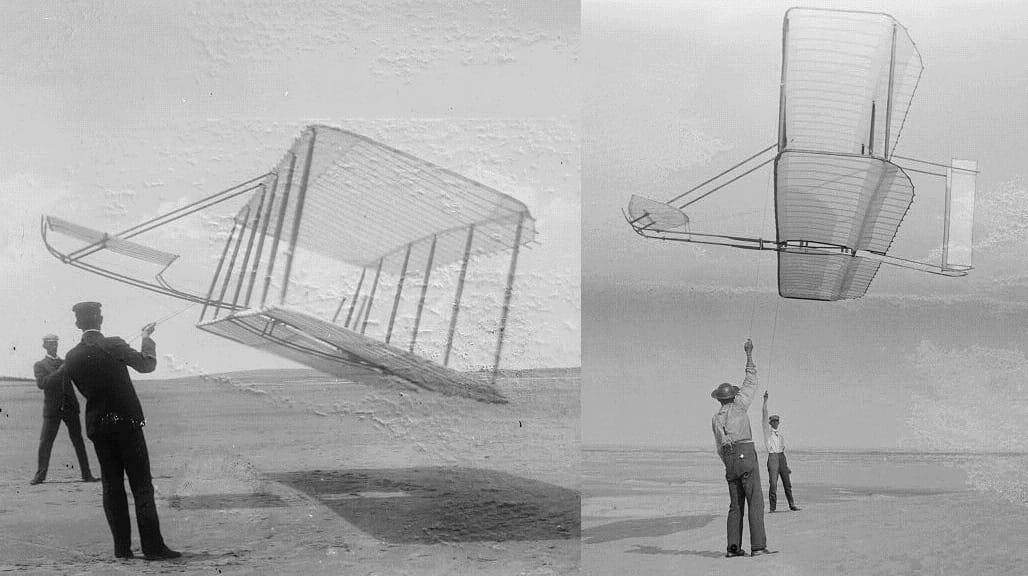
The Wright brothers testing their gliders in 1901 (left) and 1902 (right). The angle of the tether reflects the dramatic improvement in the lift-to-drag ratio.

The Wright brothers testing their gliders in 1901 (left) and 1902 (right). The angle of the tether reflects a dramatic improvement in lift-to-drag ratio; the marginal cost per mile is inversely proportional to the lift-to-drag ratio.

The marginal cost of 1¢/passenger mile explains why airplanes offer crazy-low, fares to fill seats. But this is just the marginal cost. The average energy cost is higher since it includes the weight of the plane. On a reasonably full 737 flight, the passengers and luggage  weigh about 1/4 as much as the plane and its fuel. Effectively, each passenger weighs 800 lbs, suggesting a 4¢/mile energy cost, or $20 of energy per passenger for the 500 mile flight from Detroit to NY. Though the fuel rate of burn is high, about 5000 lbs/hr, the mpg is high because of the high speed and the high number of passengers. The 737 gets somewhat more than 80 passenger miles per gallon, far less than the typical person driving — and the 747 does better yet.

The average passengers must pay more than $20 for a flight to cover wages, capital, interest, profit, taxes, and landing fees. Still, one can see how discount airlines could make money if they have a good deal with a hub airport, one that allows them low landing fees and allows them to buy fuel at near cost.

Compare this to any proposed super-fast or Mag-lev train. Over any significant distance, the plane will be cheaper, faster, and as energy-efficient. Current US passenger trains, when fairly full, boast a fuel economy of 200 passenger miles per gallon, but they are rarely full. Currently, they take some 15 hours to go Detroit to NY, in part because they go slow, and in part because they go via longer routes, visiting Toronto and Montreal in this case, with many stops along the way. With this long route, even if the train got 150 passenger mpg, the 750 mile trip would use 5 gallons per passenger, compared to 6.25 for the flight above. This is a savings of $5, at a cost of 20 hours of a passenger’s life. Even train speeds were doubled, the trip would still take 10 hours including stops, and the energy cost would be higher. As for price, beyond the costs of wages, capital, interest, profit, taxes, and depot fees, trains have to add the cost of new track and track upkeep. Wages too will be higher because the trip takes longer. While I’d be happy to see better train signaling to allow passenger trains to go 100 mph on current, freight-compatible lines, I can’t see the benefit of government-funded super-track for 150+ mph trains that will still take 10 hours and will still be half-full.

Something else removing my enthusiasm for super trains is the appearance of new short take-off and landing jets. Some years ago, I noted that Detroit’s Coleman Young airport no longer has commercial traffic because its runway was too short, 1550 m. I’m happy to report that Bombardier’s new CS100s should make small airports like this usable. A CS100 will hold 120 passengers, requires only 1509m of runway, and is quiet enough for city use. Similarly, the venerable Q-400 carries 72 passengers and requires 1425m. The economics of these planes is such that it’s hard to imagine mag-lev beating them for the proposed US high-speed train routes: Dallas to Houston; LA to San José to San Francisco; or Chicago-Detroit-Toledo-Cleveland-Pittsburgh. So far US has kept out these planes because Boeing claims unfair competition, but I trust that this is just a delay. For shorter trips, I note that modern busses are as fast and energy-efficient as trains, and far cheaper because they share the road costs with cars and trucks.

If the US does want to spend money, I’d suggest improving inner-city airports, and to improve roads for higher speed car and bus traffic. If you want low pollution transport at high efficiency, how about hydrogen hybrid buses? The range is high and the cost per passenger mile remains low because busses use very little energy per passenger mile.

Robert Buxbaum, October 30, 2017. I taught engineering for 10 years at Michigan State, and my company, REB Research, makes hydrogen generators and hydrogen purifiers.