Category Archives: Detroit

Is cannibal tourism good for Michigan?

Governor Snyder has no appetite for it, but ex-governor Jennifer Granholm did, and some of her Democratic colleagues still do. Not cannibal tourism, as such, but movie subsidies paid for by a tax on business property independent of profits. Some seven years ago, in 2008, then-governor Granholm and a majority of our legislature instituted a $132 million/year subsidy program that provided up to 42% of movie production costs. The hope was that films would bring Hollywood-type wealth and glamor, and that they would spark tourism. As it happened, the jobs went to Hollywood transients to such an extent that the total number of MI film employees was reduced. It is now 100 lower than at the start, and virtually all of the money spent went to out-of state employees (quite often the high-priced star) who left as soon as the filming was done. The report concluded that the program returned 11¢ for every tax dollar spent. One of Governor Snyder’s first acts was to diminish the subsidies, and the legislature has just put an end to them: revenge of the nerd.

Offspring, filmed in Michigan. It does not seem to have promoted Michigan tourism.

Offspring: no jobs created, and perhaps no tourism … but think of the cool factor.

The amount spent in the early years, $132 million/year, was about 1/3 of the state’s deficit, a major misuse of funds. Reason magazine claimed it was “stone-crazy” to support movies when the state had, at the time, 14% unemployment, the highest rate in the nation. They argued that the money could be better spent on roads, or schools, or left in folks’ pockets (I agree).

The effect on tourism isn’t quite what was hoped. Movie makers tend to see Michigan as a setting for dystopian films, for example, “Offspring,” a film about cannibal tourism. This film got one of the largest state subsidies. A plot summary is:  “Survivors of a feral flesh-eating clan are chowing their way through the locals.” If this encouraged tourism, it’s not necessarily the tourists you wanted. You can tell it’s Michigan by the Michigan symbol on the police cars. Michigan funds also brought two Batman movies to Detroit, along with Michael Moor’s “Capitalism, a love story“, a  movie billed as showing how capitalism makes life in America a nightmare. The current head of the film board has noted that “realistic cannibalism; the gruesome and graphically violent depiction …. is unlikely to promote tourism in Michigan or to present or reflect Michigan in a positive light.” I can agree.

Batman and Superman in Detroit.

“Batman vs Superman.” They battle in Downtown Detroit, as do “Red Dawn” and “Transformers.”

Opposition to dropping the program came mostly from the Democratic side of the aisle. Rep. Jeremy Moss, D-Southfield, said the film incentives were creating good jobs. Rep. Kristy Pagan, D-Canton, pointed to “… the cool factor. Who doesn’t want to see Ben Affleck or Amy Adams walk down our streets?” (I don’t). In the end, three Democrats and virtually every Republican voted to end the program. Among the Republicans for keeping the program were Kathy Crawford R-Novi, and Mike McCready, R-Birmingham.

You should not feel too bad for the makers of gore films. Subsides are still available in Massachusetts, Oregon, Washington, California, Minnesota, Nevada, and several other states. Massachusetts welcomed Part 2 of The Offspring, a Massachusetts headline proclaimed the victory: “Come to Massachusetts, We Love Cannibals!” Massachusetts folks have been full of themselves for years. As for the money we saved, our Michigan legislature has finally begun balancing the budget and decreasing the destructive personal property tax that helped fund these schemes.

Robert E. Buxbaum, November 5, 2015. I should also commend the legislature for making “talk like a pirate day” a state holiday, and for passing, on November 3, a necessary roads bill. It was signed by most Republicans and two Democrats. Bipartisan-ish. With good management, Michigan might be coming back – lets hope it continues.

Michigan’s road bill — why not?

Stagnating before the Michigan Senate is a road improvement bill that passed the Michigan house 10 days ago. Though it’s not great, I hope they sign the bill. The bill would raise raise $600 million to $1.2 billion/year, an increase of $60 to $120 per person per year ratcheting up over the next six years. The first stage of the bill would take effect in October 2016, and would raise $400 million by increasing our car/ truck registration fees by about 40%. People with normal sedans would pay about $60 more per car per year. Those with more expensive, heavier vehicles would pay more. Though our registration fee is already among the highest in the nation, raising it further has the potential (It seems to me) to be the most fair and reasonable source of additional revenue. People with fancy cars, I imagine, are wealthy and those with heavy cars (I imagine) do the most road damage. This is the part of the bill that has proven the most contentious.

The next stage would begin in early 2018. It would raise $200 million by increasing Michigan diesel and gasoline taxes. The larger part would be on diesel fuel, an increase of 7.3 cents/gal presumably to soak out-of-state truckers who come through Michigan. These individuals deserve extra taxation, I imagine, because they don’t pay registration fees and probably damage our roads even more than those with fancy cars. Besides, they don’t vote in Michigan. The gas tax increase is smaller, 3.3 cents/ gal on regular gas, but Democrats are correct to point out that it is regressive. It takes a greater fraction from the poorer than from the rich. The hope is that, by the time the tax increase takes effect, we’ll have some inflation and also some more fuel-efficient cars so the bite won’t be as bad. Sorry to say, we already pay the 10th highest gas tax in the country.

The final phase of the road funding bill would not take full effect until 2021. The idea is to transfer $600 million from the general fund to pay for the roads with money left over to reduce home-owner taxes. Underlying the ability to do this is an assumption that Michigan industry and home prices will recover enough between now and then that we’ll be able to stop using the gasoline taxes to fund our schools, ideally with money left over from the regular income and sales tax. While I’d like to see this happen, and while this is possible given that the last few years have seen the state’s GDP recover at a 15.5+% growth rate (third highest in the nation) there is also a basis to say the assumptions are over- optimistic. On the other hand, the Democratic plan, based on 1.6% growth next year is likely over-pessimistic. As The Yogi says, “Predictions are always difficult, especially about the future.”

Whatever your views of the future, our roads are crumbling now, and new money is needed to fix them now before they get worse. If taxes must be raised, I’m inclined to do it with use -taxes, that is by charging those who use the services most. This is a philosophical preference of mine. Not all Republicans agree with this, and only one House Democrat has signed on so far. It was the view of the old-time, labor Democrats I grew up with, but not of today’s Democrats who prefer to tax “the rich” for any and all goods and services. Their point: that there are struggling, poor people who drive heavy, expensive cars. They’ve something of a point on the heavy cars, but I have less sympathy for the rest. I wrote a comic story about a poor guy trying to dispose of an expensive car, a Viper. My guess is that struggling rappers and poser politicians would not find it funny.

Dollars per capita spent on roads, 2013. From MDoT's road funding proposal.

Dollars per capita spent on roads, 2013. From MDoT’s road funding proposal.

Part of the way that MDoT (the Michigan Department of Transportation) justified its target of $600 million to $1.2 billion was by comparison with surrounding states — not my favorite way of analysis. The MDoT graphic shows that Michiganians spend about $57 less per capita on roads than folks in Illinois, Wisconsin, or Ohio, and about $100 less than folks in Indiana or Pennsylvania. Multiply $57 by our state’s population, 10 million, and they conclude we should spend some $570 million more per year. Multiply by $100, and you get $1.0 billion.

While the need for at least $600 million/year sounds about right, I note that the per-capita spending justification seems dubious. If you calculate instead on the basis of dollars per lane-mile, as below, you find that Michiganians are already paying more per mile than Minnesota, Wisconsin, or Indiana. You’ll also note that Ohio and Illinois pays about 1 1/2 times as much their roads aren’t much better. A major part of the variation, I suspect, is corruption, and the rest, I guess is incompetence. Illinois, perhaps the most corrupt state in the mid-west, has seen 4 of its past 5 governors go to jail, along with innumerable Chicago Aldermen and lesser officials. Citizens of Illinois pay for this corruption in over-size construction projects, and over-size construction fees. After the $600 million increase, we’ll pay $8,950 per lane mile suggesting we are still not quite as costly per lan-mile as Illinois or Ohio. If it turns out we need the full $1.2 billion extra, it will suggest we are even more incompetent or corrupt than Illinois.

Road funding state by state comparison.

Road funding state by state comparison, from the same MDoT report, 2013.

An ideal way I’d like to reduce the costs of Michigan’s roads would be to reduce corruption, a trend that’s already helped to revitalize Detroit since the Justice department jailed the mayor and his father plus some associates for “pay for play”. I’m sure it also helped to remove the chief of police (millions in his ceiling) and Bobby Ferguson of the useless, expensive Jail project and Guardian building scandal.

Conviceted IL

It’s somewhat hard to judge the level of general incompetence in a state, and even harder to find a fix. Minnesota had a bridge collapse in 2007, and we had the Zilwaukee in 1982 (and 2008), the 9 mile bridge collapse of 2009, and the Southfield overpass collapse of 2014. It’s been proposed that we should be able to fix both our corruption and our incompetence problems by holding the contractors responsible for any failures. If only it were that easy. Holding contractors responsible might get some contractors to allow the concrete cure for longer periods under water before opening a road, but I’m not sure the public would stand for it. A more-likely outcome is that crooked contractors would charge more for the same bad work, and then go bankrupt as soon as the road fails. If their company were appropriately structured, they could re-appear the next day: the same people and equipment, operating under a new corporate name.

The biggest single incompetence issue that I can see appears to be poor under-road drainage. In Oakland county, where I am, the drain department looks responsible for the major flood of last summer. We’ve had rains this big in previous years without this massive flooding. I suspect a lack of dry-wells, but don’t know. From what I see, the drainage is bad beneath many Oakland roads, too. It seems like the concrete slabs are not deteriorating as much as they are coming apart. That’s a sign of bad drainage. I also see sink-holes, new lakes, and places where the sidewalks sink. Again, that’s a sign of bad drainage; a sign there is a swamp near or beneath the road. If the ground below a major road is a swamp, there is no practical way a contractor can build a long-lasting road over it. Until the drains get better, or the corruption subsides, we’re going to have to replace the roads often at a cost of another $600 million/year. We might as well acknowledge our problems and sign the bill.

Robert Buxbaum, November 2-3, 2015. If you feel like getting involved, contact your state senator and tell him/her to vote yes (or no). Our senator is Vince Gregory. And if anyone would like to put me on a drainage board, I’d be happy to serve for free.

What happened to Jack Kelly of Newsies

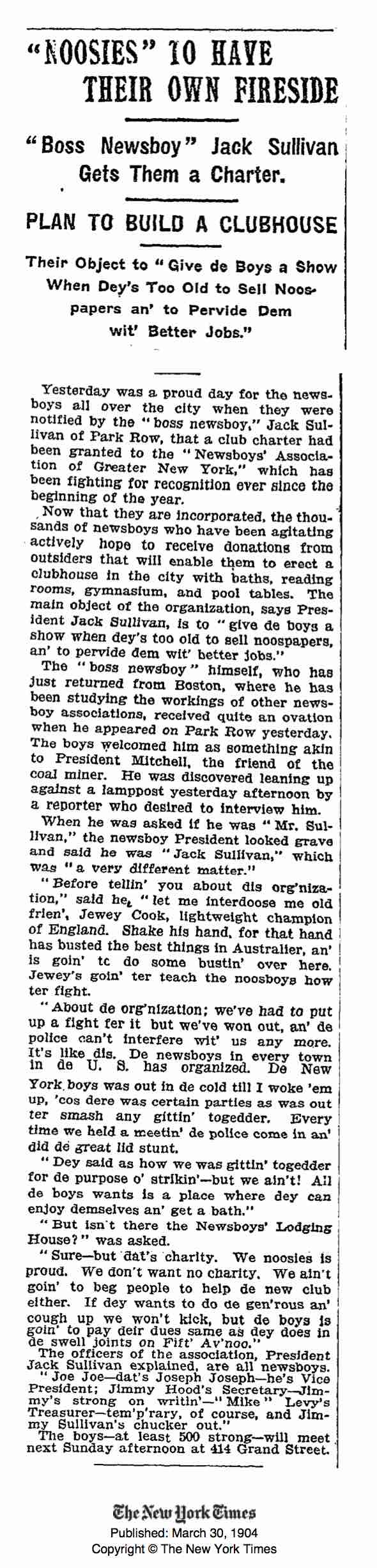
As my daughters are fans of the Disney play and movie, “Newsies,” and as I’ve taken interest in the early 20th century, they’ve asked me to find out what happened to Jack Kelly, the main character of the play/movie. If you’ve never seen it, Newsies is a musical about the New York newsboy strike of 1899. According to the play/ movie, as soon as the strike ends (the newsboys win), the strike leader, “cowboy” Jack Kelly goes off with Theodore Roosevelt, presumably headed to Santa Fé, New Mexico to become a real cowboy. But a simple search did not reveal what actually happened to the real Jack Kelly; here’s what I found. Noosies NYT

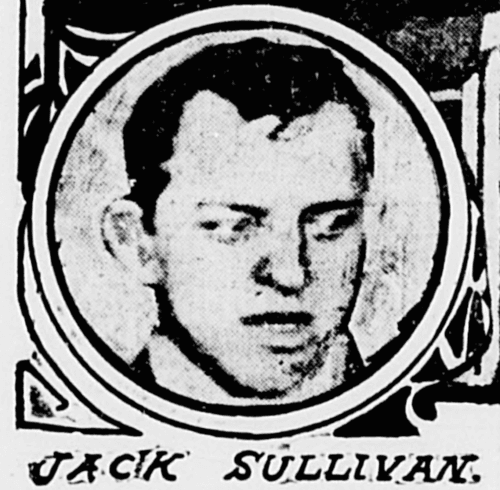
Without looking, I told my daughters that, if Jack Kelly had gone to Santa Fé in 1899, he would have found something very interesting: a cowboy school for young men. As it happened one of Roosevelt’s rough riders from the battle of San Juan Hill, retired to Santa Fé and set up a cowboy school for boys in the mountains above the town. He built a very outdoorsy operation in an area called “Los Alamos”. It ran until 1942 when the location was taken over to become “Site Y” of the Manhattan Project. This is where J. Robert Oppenheimer and co designed and built the first Atom Bombs. That Jack would have gone there would make for a nice, tidy story, but the truth appears to have been more messy, and more interesting. Jack got involved with William Hearst and George M. Cohan, the Titanic, a famous murder, and eventually with the fall of Tammany Hall. Here’s a picture.

Jack Sullivan

Jack Sullivan, head Newsie. He isn’t ugly, but isn’t Christian Bale either.

First, there was an actual newsboy strike in 1899; it was about raising the price the newsboys paid per paper, but the problem was that the price had been raised earlier, for the Spanish-American War, and not decreased after the war ended. The newsboys did win, and there was a leader named Jack, but according to the papers, the name of the leader was “Jack Sullivan”, not Jack Kelly or Francis Sullivan. The New York Tribune, July 22, 1899, lists Jack Sullivan as the leader of the strike Arbitration Committee and a leader of “the first group of newsboys to declare and demand their rights.” There are other leaders too: Louis “Kid Blink” Baletti, and David “Dave/ Yaller” Simmons. “Kid Blink” (he wore an eye patch and appears in the movie) got an award from the newsboys for making the best speech. I’ll guess that the Dave “the mouth” character is based on David “Yaller” Simmons, but it is not clear that he had any close relationship with Sullivan.

As for the movie showing Jack leaving with T. Roosevelt. it might have suited Roosevelt, but the real Jack appears to have stayed in New York, and appears to have taken a job as a bodyguard for William Randolph Hearst, one of the newspaper moguls who’d raised his rates and precipitated the strike. But it doesn’t end there. In 1904, Jack Sullivan, “the Boss Noosie” has gotten a charter for a Newsies Club to be set-up on 4th street in lower New York (the Bowery). A New York Times article (at left) includes an interview with Jack that fans should find pleasing, if only for his grammar. He uses the word, “papes” instead of papers or newspapers. I suspect this is a put-on affect for benefit of Times-readers, but who knows? It is sometimes the height of wisdom to appear stupid.

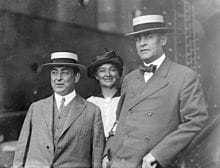
By 1909, Jack has lost control of his newsboy’s club. He appears to have used the club to teach boxing (how crude) and on at least one occasion used club assets to post bail for women accused of “loitering,” a jail-able offense in corrupt, Tammany-era New York. The club closed 2 years later. And then Jack gets married (November 27, 1910), and it appears that Jack’s real name was not Sullivan at all, but Reich. He marries Sarah Siegel at the Ohav Tzedek synagogue as “Jacob Reich”. The name Jacob Reich appears on his marriage license, on his death certificate, and on various court records, though he still appears as Jack Sullivan in other activities. Jack/ Jacob appears to have chosen the Irish-sounding name “Sullivan” as an homage to the leader of the Tammany (Democratic) machine, “Big Tim” Sullivan, shown in the photo below.

Turn of the century Tammany boss, "Big Tim" Sullivan, shown at right.

Turn of the century Tammany boss, “Big Tim” Sullivan, shown at right.

By March, 1912, Jack appears again in the news, this time suing two film companies for use of his story and likeness without payment to him. It’s a film called “the Gangsters.” It would be interesting to see if a copy still exists.

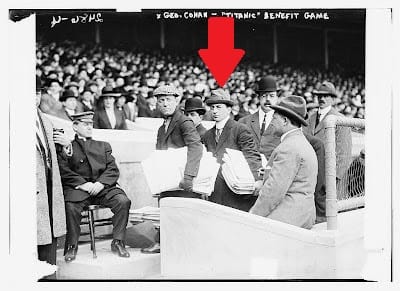
A month later, April 15, 1912, The unsinkable Titanic goes down, and six days after that, April 21, 1912, Jack is selling papers at a charity baseball game to benefit the survivors. The game takes place on a Sunday, normally prohibited by New York blue laws, between The New York Giants and The New York Yankees (the Yankees are still called the Highlanders in those days, but are already wearing pinstripes). In the picture below, Jack is under the red arrow with lots of “papes” under his arm, just behind famous song-writer, playwright, George M. Cohan. Both are dressed as newsies. George M. Cohan, known for the WWI song “Over there”, had four plays on Broadway at the time. He is one of the very few successful New Yorkers to have avoided major attachment to the crooked, New York political machine.

Jack Sullivan with George M Cohan, April 1912 selling a special newspaper to help survivors of the Titanic.

Jack Sullivan (arrow) with George M Cohan, April 1912 selling a special newspaper to help survivors of the Titanic.

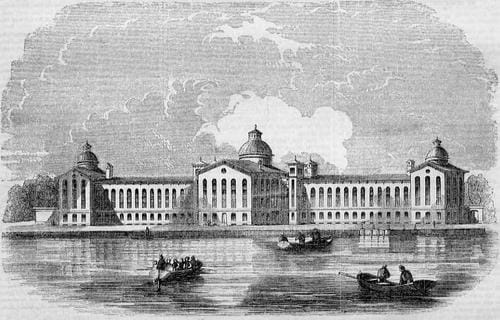
New York Refuge

The New York house of refuge

And now Jack Kelly / Sullivan/ Reich enters history as a tragic bystander. When he got married, Jack borrowed $1000, from a Jewish gambler and gambling hall owner, Herman (Beansy) Rosenthal. Rosenthal was a good friend of his, and of “Big Tim” Sullivan, but he (and Sullivan) had enemies. Among them, the crooked police Lieutenant, Charles Becker, who headed the city vice squad and delighted in shaking down the gamblers, pimps, etc for protection money. Becker wanted Rosenthal dead, in part to keep him from going to the newspapers with stories of police corruption.

By 1912, “Big Tim” lost control of the Tammany organization and was put in seclusion under Tammany guard. Within a year he’d be dead. Someone (Becker?) then hired four hit men to kill Rosenthal (1:30 AM, July 16, 1912 in front of The Metropole Hotel). It’s an event recounted in “The Great Gatsby.” Several beat-policemen were there to see the shooting, but every one looked away. Not one shot back or took the license of the car. In fact, the police did nothing to catch the murderers except to lock up the only honest witness to keep him from testifying. Before the shooting, Becker took Jack Sullivan out for an evening at Madison Square Garden; he then dropped Jack at the Metropole just before the 1:30 shooting. Becker and the police then blamed Jack and four others for the murder based on testimony that they had concocted. In the end, Jack was acquitted, but not the other four, or Becker. All five went to the electric chair; all five protested their innocence.

Becker was the first US police lieutenant to be put to death for murder. It seems unlikely that he was innocent, but was he a murderer, or just an accomplice. As for the other four, perhaps they were guilty, perhaps not; it’s hard to tell from Tammany-era records. The judge was crooked; Police chief Devery was at least as crooked as Becker in terms of shaking down hoodlums. And Devery had as much motive as Becker to want Rosenthal dead. The witnesses were lying from a script they’d been given — that’s what justice was like in those days. Within a year of the murder, Big Tim was dead and Charles Francis Murphy had gained firm control of Tammany Hall. The police spent the next decade in criminal activities while trying to pin something on Jack, now a cigar store owner. He was busted for gambling and related offenses, but nothing much came of it. Jack cleared his name from the charge of murder only in 1936, two years before his death — three years after Fiorello La Guardia was elected mayor. Republican/ Fusion candidate, La Guardia ran against Tammany and did much to end their police corruption.

As for The Refuge, The New York House of Refuge is a real place. It sat on Randal’s Island between Manhattan, The Bronx, and Queens. The Island is now famous as the center of The Triborough Bridge. There is now a park where The Refuge was. Was The Refuge run honestly? If it was, it would have been virtually the only public institutions to run that way. Tammany was corrupt to the core.

Robert E. Buxbaum, October 25, 2015. Much of the information here comes from a tumbler exchange called, “newsies historical research.” I organized it and added some background about Baseball, Tammany, etc. If you like Newsies, or the era, I can recommend the novel (and movie), The Great Gatsby, or Fiorello!, a musical version of La Guardia’s unlikely rise to power. Hearst is treated somewhat positively in Newsies, but less-so as “Citizen Kane.” If someone’s seen, or has a link to “The Gangsters” please tell me.

A prison tale (fiction) by R. E. Buxbaum

I’m writing from the Michigan Department of Corrections; Mail-stop 5678 E, Jackson, MI, awaiting trial on auto-related charges. So, legally speaking, I’m still innocent, if not quite free. So, here’s my  story, and my bargain. The whole situation, it seems, is more comical than criminal. At its source, at bottom, all I was trying to do was take care of some left over issues from unofficial jobs I was doing for the city. For his honor, the mayor. That’s K.K., Kwamie Kilpatrick, the ex-mayor to you, but always his honor to me; great guy. Anyway, cars that fall in the river aren’t that unusual in this town, and it’s not like I planned to smuggle anything to Canada. You’ll notice my case doesn’t involve theft, or injuring anyone but myself. Just trespass, though I wouldn’t mind a short prison stay if it can be arranged. Sort of like Shawshank redemption.

Anyway, my minor crime was committed a week ago, Thursday, and involved a Dodge Viper. One that I own, straight-up, with a partner and the bank: a yellow, convertible viper costing some $220,000 when new. Beautiful machine; tinted glass, and capable of doing 180 mph without breaking a sweat. I use it, or did, to take care of errands for his honor. He tips nice, and helps out when I’m in a jam, so I did get paid for the work, but for the most part, it’s like I’m like a patriot-servant to the city. I’m using my own car for city business. In better days, those errands included taking judges for the occasional joy ride, to the airport or lunch, plus other deliveries. Not generally on the water, like last Thursday, and yes that’s me, waving in the photo. Shame about the car.

As to how I got the viper, I got it at the dealer on Woodward, just over the 8 mile bridge, and paid for it mostly myself, with a loan from First Federal. At the time I had a good job running errands for his honor, as I mentioned. Now I’m so of unemployed. What sort of errands? The sort of ones you’d want to run in a viper, Duh. Aside from driving judges to meetings, there were girl errands; some boy errands; some money errands. Occasionally a disposal — nothing illegal, but embarrassing maybe. When you’re disposing of city property, you don’t look too carefully at the item. When you’re carrying something big, or someone’s wife or girlfriend, or a lot of money, it’s nice to be able to move quickly. Judges and senators like to move fast too, behind tinted windows. They still do.

Anyway, after his honor goes to prison (real shame, that), and my job becomes near-ended. There’s still some errands to to, but not so many, and I’ll grant that the viper has become more of a liability than an asset. Not that there’s insurance fraud behind me ending up in the river, just good-ole fun, and maybe a little reckless driving. I’m owing like 165k still on the machine, and my brother and I came up with this great plan for a movie — no fraud intended. There’s this great spot that we know by Zug Island, where the Rouge meets the Detroit river. It’s pretty well deserted, with a pier and a boat ramp. We used it all the time, back in the day for meetings and such. No-one goes there because of the smells. There’s always an oil slick and the water there will dissolve most anything metal. The Zug Island folks make sure of there are no cameras or loiterers either — just so no-one steals their secrets. Anyway, my brother and I figured that, if I got the viper up to about 30- 40 mph on the pier we could sail it out over the rocks and garbage into the river, land softly in the water, and make for a great movie. We never planned to file an insurance claim like we’d lost the car or it was stolen. Anyway, the water’s only about 8′ below the end of the pier, so it’s sort of like a high-dive. I figured I’d get out of the sinking car swim up to the boat ramp, and walk to my brother’s car on the street. The car would dissolve to rust in a week; the water’s pretty nasty there. He’d film the whole thing. I’d dry off; we’d drive home, have a beer or two, then sell the film. Probably pull the rust out of the river in a week, just to keep everything in it’s pure, pristine state. Though, now that I think of it, insurance might still cover most of the value of the car. You never know.

So the first part goes OK. We drive to the pier about 9:00 PM, Thursday, just as the sun’s setting. There’s that good, reddish light over the Windsor skyline, and the pier is empty. There are two winos off far from my intended route. My brother and I take down the top and line up the vehicle so I avoid unwanted bumps and garbage as I sail out on my way to glory. And, with a shot of Jack, and a wave to my brother (It’s on the film), I go shooting out down the pier and over the water. Fine. No bumps, no rocks. Nice flight. No soft landing, though. The car hits water like a pumpkin on concrete. Ouch! The thing bends in the middle sealing the door shut and me inside. There’s hardly any spring to the seats anyway, and what little there once was is lost. My back gets twisted into the steering wheel. I can barely turn and I can’t quite get out. Then, about 5 minutes later, the air bag goes off. Guess they didn’t design for this accident. My back, is now twisted into the sat-back, and I’m in pain.

I think it’s some sort of Sprite Healey fracture like Kevin Everett got last year. I can walk, thanks, but it needs medical attention that I’m not likely to get on Medicaid. Anyway, like I said, I’m trapped inside the vehicle, and suppose I’d be dead if the car sank like we planned, bit it don’t sink. The thing floats. Like, forever. The car weighs like two tons and it floats! Who knew. I’m carried by my momentum and by some random Rouge current out past Zug Island into the main channel between Detroit and Windsor where I’m almost run down by an ore boat. Anyway, the yellow metal Viper-dingy I’m in gets noticed by the boat lookout and by some fishermen, but no one helps. Everyone’s seems to think it’s really funny. They’re all taking pictures, and texting, and calling their friends. And everyone is laughing but me. It’s funny, like a fart in a space suit. Meanwhile my brother’s been driving along by the river, filming everything and hoping I get out and can somehow swim to safety, and I keep floating off to Canada. Finally, someone calls the coast guard, but when the come, it turns out I’m in Canadian waters. So the Canadians come, and they’re all think it’s a boot. I’m a celebrity with pictures of me in my car floating all over the internet. And well, here I am, a relatively innocent man, with a junked car and a bad back. And I’m ready to make a deal. I’ll admit it looks like I was planning to defraud someone, but there’s no evidence. I’ll admit to trespass if you like, but not fraud or endangerment. There was no one there to endange, and no one endangered, except of me. And I won’t press charges (little joke).

What with all the publicity, I figure you want to press more than just trespass, and what I was thinking of is reckless driving. I’ll admit to that with no contest. Looked at the right way, that’s like a 60 day sentence, maybe 90 days, and that’s just fine with me. I don’t have the cleanest record, but it’s not like I’ve done this before. I think it would be fair if I got 60 to 90-days of incarceration with medical benefits and job rehabilitation. I’d like to learn a new trade, like auto repair. That’s a win-win for everyone. You close the case, and I get cured and put my job skills to work just as soon as I get out. But I really need the medical though. My health insurance doesn’t cover injury-in-performance-of-a-crime — it’s right there on page 28. And Medicare is garbage. Next time you get insurance, your honor, make sure to read the contract.

Anyway, you have the tape and the pictures, and can check with my brother. We have plenty of people who will testify for us, even folks in congress and in the police department. They’ll all tell you, we’re just a couple of good fellows, somewhat down on our luck, waiting to get out and go straight. Thanks for your help, and God-bless.

R. E. Buxbaum. Sept 30, 2015. Some weeks ago, I wrote an essay, “What is comedy.” So I thought I’d try writing one. Tell me how you think I did. No one in the story is meant to be anyone real, except for “his honor,’ who’s meant to be a fictional version of His Honor.

Hamas head deposed, no peace in the middle east

Just about one month ago, the head of the head of Hamas in Syria was removed from his position atop Sheikh Abu Salah Taha’s shoulders. ISIS gave the Sheikh the metaphorical 72 virgins of severance, and his head was given a new post, a wooden pole. Though the fighting has died down since, as it were, we seem no closer to peace. As head of Hamas, Sheik Taha killed many, and ISIS has killed many more. And now, Hamas has pledged Jihad against ISIS, It’s likely ISIS heads will roll, as surviving Hamas members have joined Assad, their murderous enemy of just a few months previous.

Hamas head removed, Sheik Sala, presumed dead.

Hamas head deposed by ISIS. Sheik Salah presumed dead. Prediction: those who killed him will be killed. 

My sense is that bringing peace to the region will require 4 things: (1) one side must have a decisive military victory; (2) They must get the defeated leader to sign a surrender with some clear terms (3) They have to treat the defeated well enough that others will surrender too, and (4) They had to demonstrate the ability to govern. The surrender at Appomattox included all these things, as did Texas independence and the US revolution. By contrast, the history Mexican civil wars suggests that peace becomes near-impossible when you kill the losers, as ISIS has done in Syria. When Santa Ana killed the Texans who surrendered to him at the Alamo and at Goliad, he guaranteed that the Texans would fight on forever, no matter how desperate the odds.

When Santa Anna ordered the execution of all the Texans who surrendered he guaranteed that Texans would not surrender. That's not a road to peace.

When Santa Anna executed the Texans who surrendered at the Alamo and Goliad he guaranteed that Texans would not surrender. That’s not the road to peace.

Governance of any kind is a key distinction between countries and non-countries. In the Middle East, there is a tradition of governance by tyranny and partial genocide, but the rule cemented this way is tenuous at best. About 100 years ago, the Turks cemented their rule over Armenia by killing off many Armenians, and Russia did the same toward to Cossacks, but 70 years later Kasackstan seceded. Sadam Hussain, Bashar Assad, Col’nl Khadaffi, and Ayatollah Khomeini all ruled for reasonable times as murderous tyrants, but two of those ruler’s were killed and three of the kingdoms have descended into chaos. People who’ve seen war will often accept tyranny as a better alternative to chaos in the streets, but eventually they revolt. By contrast, Israel and Jordan have stayed reasonably stable by providing a degree of tolerance and justice.

In the Mid-East peace, we’ve chosen to support tyrants: Hamas and the Iranian Khomeini, even though they are murderously anti-democracy, and even though the Ayatollah has vowed to wipe us out, and even though ISIS seems to be winning. This strategy may work for us temporarily, but I suspect these leaders will fall in a few years, and leave us to deal with anger in the wake. Faced with the options available, I’d prefer to let the war take its course, and only step in when things wind down. This is what Theodore Roosevelt did with the Russo-Japanese war: he waited for it to die down, and then stepped in to make peace when asked to do so. Syria doesn’t seem ready for peace right now, but when it is, I suspect it will be better for us if we take the role of peacemaker later than if we support a losing murder now.

Robert E. Buxbaum, May 7, 2015, edited May 11. I’ve shown previously that there is no peace with zombies until there is a cure. Until then, it’s best to run. For those who don’t know it, Roosevelt was an odd dude: here he is riding a moose.

Detroit emerges from bankruptcy. Not quite.

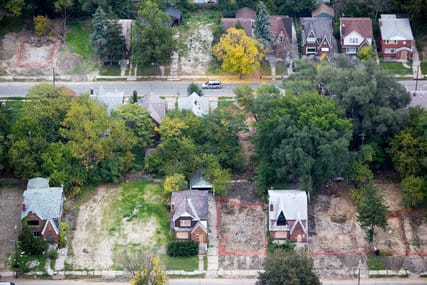
missing homes Detroit

While Detroit’s central core comes back, surrounding, homes burn at 220+/month, leave Detroit streets looking like the teeth of an aging hillbilly.

Detroit went bankrupt last year, the largest US city to do so since New York in 1970. As with New York’s bankruptcy, Detroit’s was used to cancel old debts and rewrite ill-thought contracts. Detroit also got to jail some crooked politicians including mayor Kilpatrick, described as “a walking crime wave.” But the city and county have no easy path out of bankruptcy as both city and county are likely insolvent. That is, they spend more than they take in despite massive out-state funding, and high taxes, 10% above the state level. To make matters worse, they are losing population at the rate of 1% or so per year. It’s hard to fund a city built for 2 million on the tax revenue of 1/3 as many, especially when they are mostly unemployed. Unless a lot changes soon, another bankruptcy is almost inevitable — likely this time at the county level.

We got in this predicament, largely as a result of a 50 year war between the black political establishment of the city, solidly Democrat, crooked, somewhat anarchist, and the white, stayed, mostly Republican out-state. The white population fled following Detroits riots of the 60s, and the richer black population soon followed. The remainder, poor, old and black, stayed, trapped in slowly decaying neighborhoods, relying on flashy, crooked politicians as the city went broke. White flight allowed the black community to develop its own, Motown culture, but except for the music industry, Detroit has not benefitted from this culture.

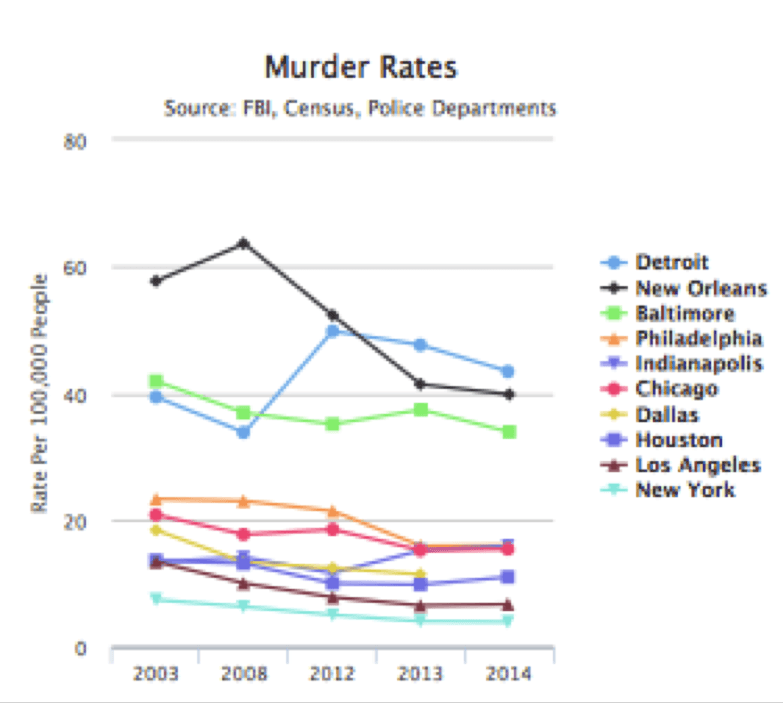
Detroit's murder rate, 45/100,000, is the highest in the US. It's coming down but not that fast.

Detroit’s murder rate is the highest in the US. It’s come down 10% in the last 2 years, but has far to go.

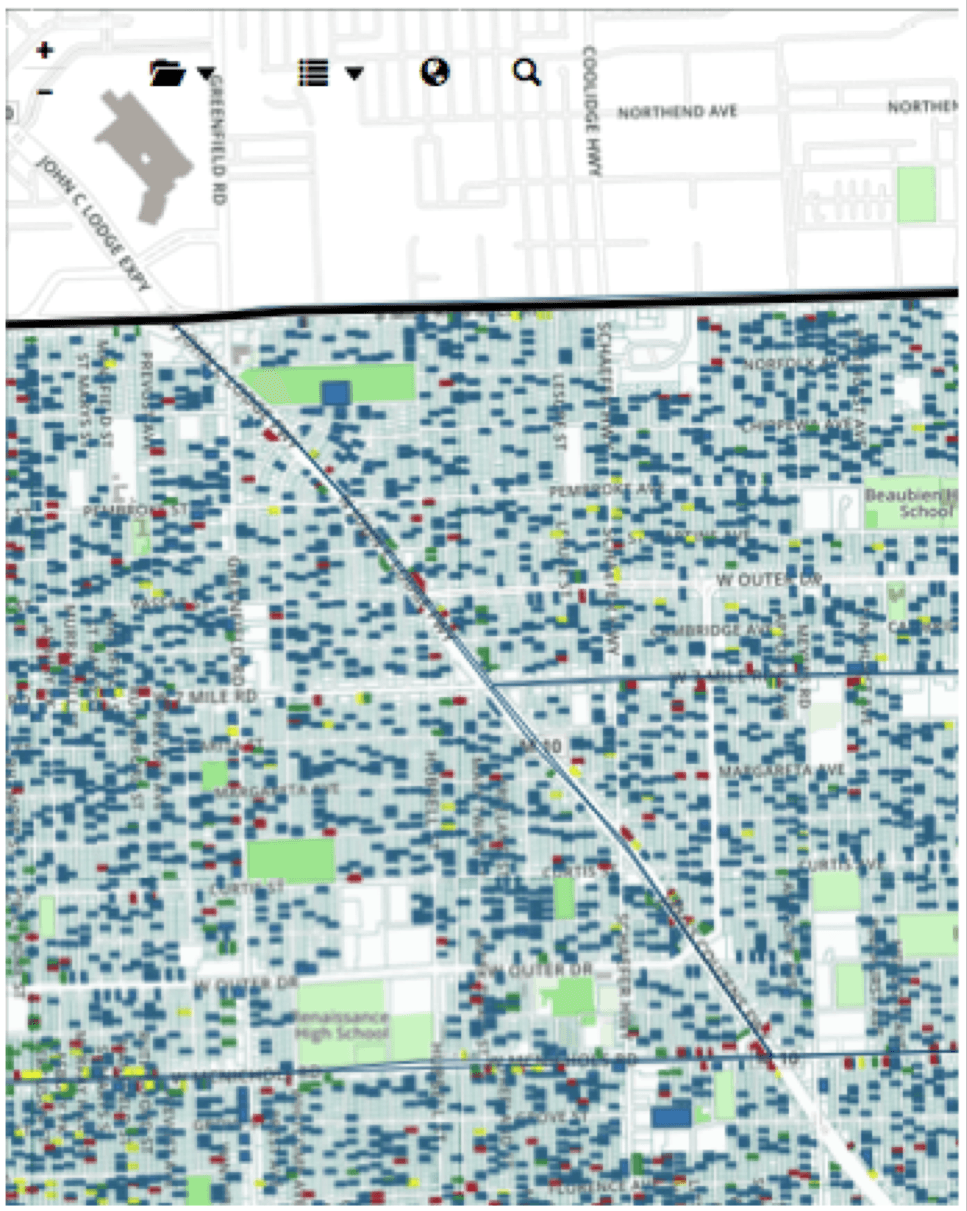
Detroiters have poor health, poor savings rates, high murder rates. The fire rate is about .22% per month, 2.6% per year. The city lacks reliable fire fighting and street plowing. Police, at one point, erected signs at the border that said, “Enter at your own risk.” There is a lack of small businesses and the services they would provide too: laundromats, grocery stores, and taxis (though no lack of bars and marijuana maintenance clinics). Employment in the auto-industry is down. And it’s not being replaced by home-grown small business – perhaps hampered by the low savings rate. A surprisingly large fraction of Detroit homes are in foreclosure, see map, and with it there’s a high abandonment rate. The high fire rate is at least half arson to collect on insurance. As pheasant and dear return, non-core Detroit is beginning to look like farm country.

Detroit foreclosures near me. Blue is occupied homes, red is unoccupied, yellow unknown, and green is destroyed homes or vacant, foreclosed land.

Detroit foreclosures near me. Homes in dark blue are occupied foreclosed, red is unoccupied, and green plots are destroyed homes or vacant, foreclosed land.

It’s not clear what political leaders should do now. The city council would like to return to their pre-bankruptcy ways where they could borrow as much as they felt they needed and spend on whatever they saw fit — often on fast friends, fast cars, gambling, and vacation homes outside of the city. But the out-state population has been reluctant to give them the credit card. Is this racist or prudent — probably both, but this war can not continue. The city and county pension funds were ransacked for ill-advised investments and consulting fees to cronies and their power-lawyers. Either the money is replaced from out-state or there will be some unhappy retirees in the not-too-distant future. My guess is that the state will have to pick up the tab for this mismanagement, but only if they don’t have to hand over management control afterwards.

Rand Paul, a potential GOP presidential candidate, has proposed rebuilding business and property values by a method that the city will almost certainly reject. His solution: cut services to low-population density areas and cut taxes on business and earned income. While this would likely bring in new people and new businesses, the people would likely be white, and the businesses white-owned/ white-serving. Black-Detroiters have too little savings, organization and income to directly benefit from this plan, and black politicians are likely to feel threatened. They are likely to claim, not without merit, that this is welfare for rich whites: a way for them to become yet-richer while doing nothing for the poor blacks of the burning neighborhoods. They are likely to demand control as the elected officials of the town: regulating business and raising the minimum wage to create “equality.” I suspect this is a bad idea.

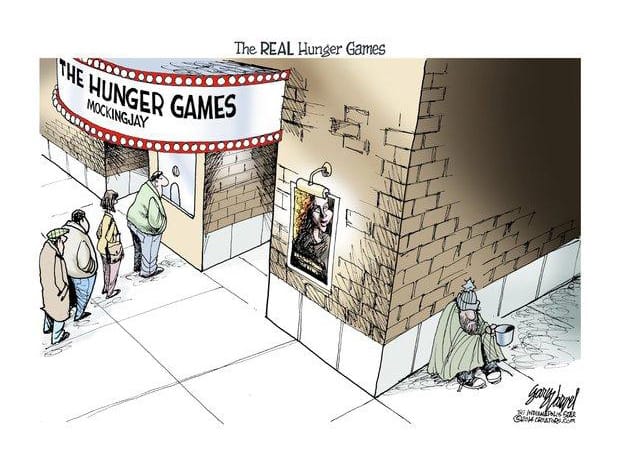
Detroit hunger games

Detroit suffers from two populations and a divide.

To some extent we’re already seeing the return of white-owned, white-serving businesses. Classic buildings in the core of the city have been purchased by white developers – notably Dan Gilbert of Quicken Loans leading to gentrification and an influx of single, white hipsters. The newcomers are viewed as half-saviors, half-carpetbaggers. They dwell in a whiter city core with hipster bars and expensive restaurants. Does a poor city with massive debt, crime, and unemployment benefit from a core filled with high-priced, gourmet coffee and fern bars?

The author, Robert Buxbaum, enjoys a day at an artificial beach in central Detroit.

The author, Robert Buxbaum, enjoys a beer at an artificial beach-cafe in central Detroit with some, few black folks, none poor. Is this good for Detroit?

The new hipsters put a squeeze on city services too — one that’s hard to deal with fairly. Detroit can not afford to plow all the streets after a snow. Should the new high-tax white folks get plowed streets, or should they suffer equally with everyone else? Detroit education is abysmal, but the high tax-bracket folks want better. Should they get it, or suffer equally? They want extra street lights and police protection. Should they get it, or suffer equally? Is this the way up?  A solution I’d proposed some while ago was to divide the core city from the now-rural outskirts so that each could be managed more sanely. It’s not a grand a solution like Rand’s plan, but less likely to be rejected. One way or another, we seem destined to have a Detroit with a rich core and abandoned neighborhoods. I suspect it might as well be managed that way.

Robert E. Buxbaum, February 10, 2015. I don’t have solutions, but write about the city’s problems, and the partial solutions I’ve heard of as a way to clarify my thinking — and perhaps yours too.

What is learning?

It is common to spend the most of one’s youth in school — presumably learning something. The financial cost for primary education is a few hundred thousand dollars, borne by the state, plus 13 years or so of the student’s life. College learning costs another $50,000 to $200,000, borne by the student, plus another 4-6 years of life. The indication that you’ve learned something appears, in many majors by the ability to get a job that pays more than the school financial cost. But there is also a sense that you’ve learned something, and this is perhaps the only reward for students of film, religion, or archeology. My question is based mostly on this part: what is this learning. Is it the same as knowledge, a set of facts, or satisfaction — perhaps you could be as satisfied by ignorance or drugs. How do you evaluate the spiritual payback from 4-6 years of college? I don’t have all the answers, but ask to exercise my ignorance.

It would seem to me that an important standard of learning is that it should develop the mind and not corrupt it. But how do you recognize the difference? it seems to me one should leave with a set of mental skills should be new to you, recognizable to a normal outsider, and somewhat useful, as in the poem “Botany” even if you don’t use it. I’m not sure if the skills have to be true, by the way, or how useful they have to be. Perhaps developing a new confusion is better than having false notions — knowing that you doubt something.

sometimes education is the removal of false notions.

Sometimes learning can be the development of doubt.

If you’ve been educated in music, it seems to me you should be able to make sounds that appear pleasant to a normal listener; if you’ve been educated in mechanics, you should be able to make machines that work, and if you’ve been educated to think… perhaps then you should be able to walk into a discussion about something you once thought was true, and show that it is really false to an extent that others would accept it (and act upon it?). That is, my suspicion is that learning should involve an identifiable change –not only internal satisfaction, and I also suspect learning the new must involve unlearning the old.

Liberal Education may not be useful, or elevating

Education that isn’t useful isn’t particularly elevating

And that leads us to facts and methods: knowledge. Facts are good, they are the fuel and  substance of learning. Without facts there is nothing for the learning to attach to. But facts are often wrong — the ignorance of others, and even when right, they can be  deceptive. If you’ve learned the moon is made of rock, or out of green cheese, it’s pretty much the same unless there is a reason to think the fact you’ve learned is true, and unless you’ve a good understanding of what the fact ‘means.’ I can imagine a rock that is organic (a gall stone) and less solid than some (old) green cheese. The word rock or cheese must mean something to you to be a fact. Similarly in all subjects; if you learn that Shakespeare is a better writer than Poe, you should have a reason to believe it, and a clear understanding of the word ‘better’ in this context.

Turning to the knowledge of methods. It seems to me that learning a new method of thought, action, or argument is a necessary component of learning– one might even call it virtue, but this too seems to have limitations if it is not directed to use. A person is half-educated if he leaves school knowing how to do geometric proofs, but never doing any, or knowing how to run a great business, but never running one. A science graduate should at least be able to use the techniques learned to demonstrate that the world is made of atoms, and that the sun does not circle the earth and perhaps more. An argument can be made for traditional education areas of logic, rhetoric, mathematics, and dialectic. But these seem useless unless they are applied to a worthy end. One should do more with the new methods than to win drawing-room arguments.

There should be some satisfaction to accomplishments, but I'm not sure how it's learned.

Learning should provide satisfaction –in particular religious learning — but it’s nicer if it goes with doing good for someone (not only the poor) and the ability to earn an honest income.

There should be a moral component of learning too, but here I feel less certain in describing it, or describing how it should be taught. Theodore Roosevelt said that “An uneducated man can steal from a rail car, “but an educated one can steal the whole railroad.” but perhaps stealing the railroad isn’t such a bad thing if it’s done legally. And as I don’t quite know when the honest stock deal is moral, I’m even more in the dark as to how to teach one to recognize the moral from the immoral in these situations. Two thoughts here: a student deserves some satisfaction from his or her learning and (from Aristotle’s Nicomachean Ethics) to be moral, the student has to earn an honest income. One who can not earn a living is bound to steal from someone sooner or later.

A final sign of learning, and perhaps it’s crown, is creativity, the ability to come to new understandings and develop new things. To do this productively requires some knowledge of the past plus an indescribable view of the future. A spark? A divine madness? Schools do not seem to be able to teach that, but it can help or hinder by either encouraging it, or beating it down. If you did not possess this ability when you entered school, you are unlikely to leave with it, even if you just did drugs, but school can teach one to direct the spark productively.

I’ve noticed that our high schools focus little on the above areas, perhaps because they are hard to test. Rather classes aim to the exams, and the exams test (as best I can tell), memorization, aptitude, and exposure. A surprisingly large fraction of our students leave diagnosed as ADHD. Still, strangely, our graduates do better than the Europeans.

Dr. Robert E. Buxbaum, December 29, 2014 (I taught in college). Here’s some advice I wrote for my 16 year old daughter in high school.

von NotHaus, the terrorist who uttered money.

Bernard von NotHaus was sentenced two days ago, December 3, 2014 in Federal court, North Carolina on charges of terrorism for the crime of making token coinage. This crime is called uttering money in English common law, but it is not generally considered terrorism, or generally prosecuted at all in modern times. The sentencing was covered by only one newspaper, The New York Sun. The New York Times and others, I guess, found it wasn’t news fit to print. But I find it newsworthy enough to blog about.

The current price of silver (as I write) is $16.60 per ounce. Had Bernard von NotHaus limited himself to selling ordinary, one ounce, silver medallions for $20 each, he could have made money on each, and perhaps been awarded a medal for his artistry. Instead, von NotHaus stands convicted as a terrorist against the US economy. The problem: his $20 medallions include the symbol “$20” and the word “dollar” on the coins. The government’s claim is that people might come to use his silver medallions to buy $20 worth of products, and this, it was argued, could bring down the government. Also incendiary was the phrase “Trust in God.” The federal prosecutor argued this was too close to our government’s, “In God we Trust.”

A liberty dollar. The crime is terrorism by uttering money -- saying that this coin should be used as $20 currency.

A liberty $20 piece The crime is terrorism, undermining the US by suggesting people use this coin as currency.

Von NotHaus was arrested on June 6, 2009, and had his coins and metal confiscated. He was convicted of terrorism March, 2011. Among the evidence are gold coins with the image of Ron Paul and certificates with von NotHaus’s image marked as 1 Dollar negotiable currency. Making these items isn’t quite counterfeiting, as the coins and certificates don’t look like US currency, but the US government decided it’s worse: economic terrorism. Anne Tompkins, the federal prosecutor successfully argued that von NotHaus is suggesting that the currency of the US is somehow deficient, and perhaps that the president and his crowd are doing something wrong in their efforts to drive inflation by printing excess currency. Ms. Tompkins successfully argued that such “attempts to undermine the legitimate currency of this country are simply a unique form of domestic terrorism” and that they “represent a clear and present danger to the economic stability of this country.” I’d say that’s over-reacting.

The Liberty Dollar. It's not counterfeiting, but the crime of terrorism by uttering money. Printing certificates with the intent of having them used as currency.

The Liberty Dollar. It’s not counterfeiting, but terrorism. 20 of these can be exchanged for a silver coin. US currency is non-negotiable; you have no right to change

The mechanism whereby these items are supposed to undermine the economic stability is the reverse of Gresham’s law. Gresham’s law is that the worse currency will stay in circulation and the better will be driven out. Applied here, Gresham would predict that people will hoard these liberty dollars and will spend only the paper. That’s what happens with ordinary art, or gold bars. But our government’s terrorism argument assumes Gresham’s theories are wrong, and that people will hoard Obama’s paper while spending von NotHaus’s coins. On that chance, Mr. von NotHaus stands convicted of terrorism. Mr. von NotHaus’s defense is that he never claimed his medallions should be used as currency. The judge rejected this defense. For all I know, Ms Tompkins could now pursue Von NotHaus for sedition: suggesting there is something wrong with the way we pursue minters.

The Ron Paul $1000, weapon of mass destruction.

The Ron Paul, $1000 weapon of national destruction.

At sentencing yesterday, Judge Voorhees ignored rules that should have condemned von NotHause to life in prison. Instead, he ruled for 6 month’s house arrest and 3 years probation saying he didn’t believe von NotHaus was motivated by evil intent, but rather by philosophical speech (something partially protected by the first amendment). I’m always glad for lenient sentencing, especially when the argument involves freedom of speech. I’m also glad for philosophy, but that does not mean I’m happy about the outcome. To me, von NotHaus deserves a medal; he is the Rosa Parks of hard currency. And I think that’s fit to print.

Part of the reason this conviction bugs me is that I got a free education courtesy of Peter Cooper, the citizen industrialist of the 19th century who founded the greenback party. He published (uttered) $3 bread notes to advertise his cause. Robert Buxbaum is a good US citizen, who uses only non-negotiable, fiat currency; none of this negotiable stuff for me. December 5, 2014.

Change your underwear, bomber; of mites and men

The underware bomber mites make it right.

Umar, the underwear bomber.

For those who don’t know it, the underwear bomber, Umar Farook Abdulmutallab, wore his pair of explosive underwear for 3 weeks straight before trying to detonate them while flying over Detroit in 2009. They didn’t go off, leaving him scarred for life. It’s quite possible that the nasty little mites that live in underwear stopped the underwear bomber. They are a main source of US allergens too.

Dust mite, skin, and pollen seen with a light  microscope. Gimmie some skin.

Dust mite, skin, and pollen seen with a light microscope. Gimmie some skin.

If you’ve ever used an electron microscope to look at household objects, you’ll find them covered with brick-like flakes of dried out skin-cells: yours and your friends’. Each person sheds his or her skin every month, on average. The outer layer dries out and flakes off as new skin grows in behind it. Skin flakes are the single largest source of household dust, and if not for the fact that these flakes are the main food for mites, your house would be chock full of your left over skin. When sunlight shines in your window, you see the shimmer of skin-flakes hanging in the air. Under the electron microscope, the fresh skin flakes look like bricks, but mite-eaten skin flakes look irregular. Less common, but more busy are the mites.

The facial mite movie. They live on in us, about 1 per hair follicle, particularly favoring eyelashes. Whenever you shower, your shower with a friend.

The facial mite movie. They live on in us, about 1 per hair follicle, particularly favoring eyelashes. Whenever you shower, you shower with a friend.

Dry skin is mostly protein (keratin), plus cholesterol and squalene. This provides great nutrition for dust mites and their associated bacteria. In warm, damp environments, as in your underwear or mattress, these beasties multiply and eat the old skin. The average density of dust mites on a mattress is greater than 2500/gram of dust.[1]  The mites leave behind excrement and broken off mite-limbs: nasty bits that are the most common allergens in the US today.

An allergy to dust shows up as sneezing, coughing, clogged lungs, and eczema. The most effective cure is a high level of in-home hygiene; mites don’t like soap or dry air. You’ve go to mop and vacuum regularly. Clean and change your clothing, particularly your undergarments; rotate your mattresses, and shake the dust out of your bedding. Vacuuming is less-effective as a significant fraction of the nasties go through the filter and get spread around by the vacuum blower.

As it turns out, dust mites and their bacteria eat more than skin. They also eat dried body fluids, poop residue, and the particular explosive used by Umar Farook, pentaerythritol tetra nitrate, PETN (humans can eat and metabolize this stuff too — it’s an angina treatment). The mites turn PETN into less-explosive versions, plus more mites.

Mighty mites as seen with electron microscopy. They eat more than skin.

Mighty mites as seen with electron microscopy. They eat more than skin.

There are many varieties of mite living on and among us. Belly button mites, for example, and face mites as shown above (click on the image to see it move). On average, people have one facial mite per hair follicle. It’s also possible that the bomber was stopped by poor quality control engineering and not mites at all. Religion tends to be at odds with a science like quality control, and followers tend to put their faith in miracles.

Chigger turning on a dime

Chigger turning on a dime

larger than the dust mite is the chigger, shown at left. Chiggers leave visible bites, particularly along the underwear waste-band. There are larger-yet critters in the family: lice, bed bugs, crabs. Bathing regularly, and cleaning your stuff will rid yourself of all these beasties, at least temporarily. Keeping your hair short and your windows open helps too. Mites multiply in humid, warm environments. Opening the windows dries and cools the air, and blows out mite-bits that could cause wheezing. Benjamin Franklin and took air-baths too: walking around naked with the windows open, even in winter. It helped that he lived on the second floor. Other ways to minimize mite growth include sunlight, DOT (a modern version of DDT), and eucalyptus oil. At the very minimum, change your underwear regularly. It goes a long way to reduce dust embarrassing moments at the jihadist convention.

Dr. Robert E. Buxbaum, Sept 21, 2014. Not all science or life is this weird and wonderful, but a lot is, and I prefer to write about the weird and wonderful bits. See e.g. the hazards of health food, the value of sunshine, or the cancer hazard of living near a river. Or the grammar of pirates.

Marijuana, paranoia, and creativity

Many studies have shown that marijuana use and paranoid schizophrenia go together, the effect getting stronger with longer-term and heavy use. There also seems to be a relation between marijuana (pot) and creativity. The Beetles and Stones; Dylan, DuChaps, and Obama: creative musicians painters, poets and politicians, smoked pot. Thus, we can ask what causes what: do crazy, creative folks smoke pot, or does pot-smoking cause normal folks to become crazy and creative, or is there some other relationship. Dope dealers would like you to believe that pot-smoking will make you a creative, sane genius, but this is clearly false advertising. If you were not a great artist, poet, or musician before, you are unlikely to be one after a few puffs of weed.

The Freak Brothers, by Gilbert Shelton. While these boys were not improved by dope, It would be a shame to put the artist in prison for any length of time.

The Freak Brothers, by Gilbert Shelton. What’s the relationship?

When things go together, we apply inductive reasoning. There are four possibilities: A causes B (pot makes you crazy and/or creative), B causes A (crazy folks smoke pot, perhaps as self medication), A and B are caused by a third thing C (in this case, poverty culture, or some genetic mutation). Finally, it’s possible there’s no real relationship but a failure to use statistics right. If we looked at how many golf tournaments were won by people with W last names (Woods, Wilson, Watson) we might be fooled to think it’s a causal relationship. Key science tidbit: correlation does not imply causation.

The most likely option, I suspect is that some of all of the above is going on here: There is an Oxford University study that THC, the main active ingredient in pot, causes some, temporary paranoia, and another study suggests that pot smoking and paranoid insanity may be caused by the same genetics. To this mix I’d like to add another semi-random causative: that heavy metals and other toxins that are sometimes found in marijuana are the main cause of the paranoia — while being harmful to creativity.

marijuana -paranoia

Pot cultivation is easy — that’s why it’s called weed– and cultivation is often illegal, even in countries with large pot use, like Jamaica. As a result, I suspect pot is grown preferentially in places contaminated with heavy metal toxins like vanadium, cadmium, mercury, and lead. No one wants to grow something illegal on their own, good crop-land. Instead it will be grown on toxic brownfields where no one goes. Heavy metals are known to absorb in plants, and are known to have negative psychoactive properties. Inhalation of mercury is known to make you paranoid: mad as a hatter. Thus, while the pot itself may not drive you nuts, it’s possible that heavy metals and other toxins in the pot-soil may. The creativity would have to come from some other source, and would be diminished by smoking bad weed.

I suspect that creativity is largely an in-born, genetic trait that can be improved marginally by education, but I also find that creative people are necessarily people who try new things, go off the beaten path. This, I suspect, is what leads them to pot and other “drug experiments.” You can’t be creative and walk the same, standard path as everyone else. I’d expect, therefore, that in high use countries, like Jamaica, creative success is preferentially found in the few, anti-establishment folks who eschew it.

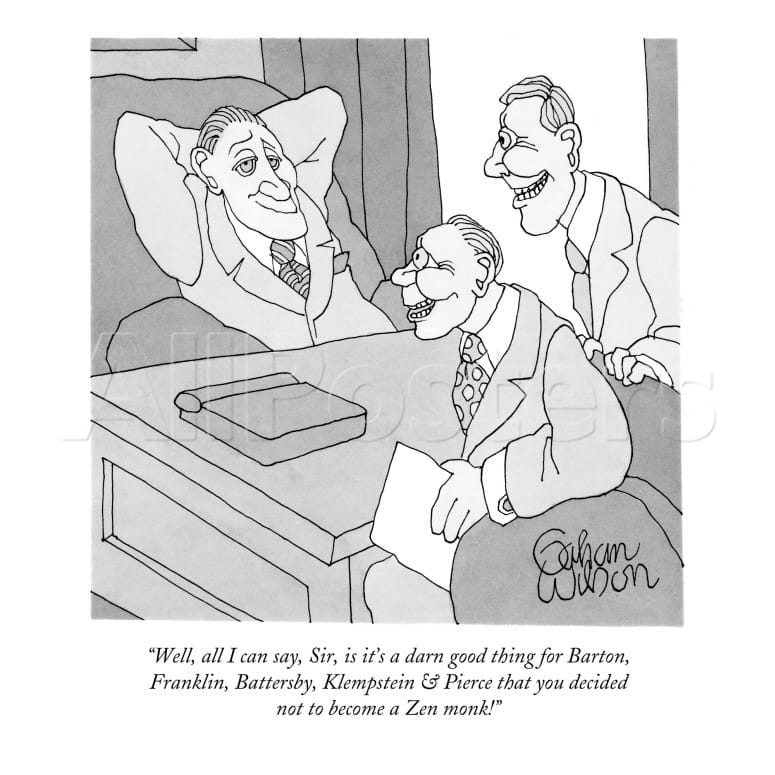
Robert E. (landslide) Buxbaum, September 4, 2014. The words pot, marijuana, dope, and weed all mean the same but appear in different cultural contexts. To add to the confusion, Jamaicans refer to pot as ganja or skiff, and their version of paranoid schizophrenia is called “ganja psychosis”. I’m not anti-pot, but favor government regulation— perhaps along the lines of beer regulation, or perhaps the stricter regulation of Valium. My most recent essay was on the tension-balance between personal freedom and government control. I was recently elected in Oak Park’s 3rd voting district. My slogan: “A Chicken in every pot, not pot in every chicken”. I won by one vote. For those who are convinced they’ve become really deep, creative types without having to create anything, let me suggest the following cartoon about talent. Also, if pot made you smart, Jamaica would be floating in Einsteins.