Category Archives: Detroit

How do you drain a swamp, literally

The Trump campaign has been claiming it wants to “drain the swamp,” that is to dispossess Washington’s inbred army of academic consultants, lobbyists, and reporter-spin doctors, but the motto got me to think, how would you drain a swamp literally? First some technical definitions. Technically speaking, a swamp is a type of wetland distinct from a marsh in that it has no significant flow. The water just, sort-of sits there. A swamp is also unlike a fen or a bog in that swamp water contains enough oxygen to support life: frogs, mosquitos, alligators,., while a fen or bog does not. Common speech ignores these distinctions, and so will I.report__jaguars_running_back_denard_robi_0_5329357_ver1-0_640_360

If you want to drain a large swamp, such as The Great Dismal Swamp that covered the south-east US, or the smaller, but still large, Hubbard Swamp that covered south-eastern Oakland county, MI, the classic way is to dig a system of open channel ditches that serve as artificial rivers. These ditches are called drains, and I suppose the phrase, “drain the swamp comes” from them. As late as the 1956 drain code, the width of these ditch-drains was specified in units of rods. A rod is 16.5 feet, or 1/4 of a chain, that is 1/4 the length of the 66′ surveyor’s chains used in the 1700’s to 1800’s. Go here for the why these odd engineering units exist and persist. Typically, 1/4 rod wide ditches are still used for roadside drainage, but to drain a swamp, the still-used, 1956 code calls for a minimum of a 1 rod width at the top and a minimum of 1/4 rod, 4 feet, at the bottom. The sides are to slope no more than 1:1. This geometry is needed. experience shows, to slow the flow, avoid soil erosion and help keep the sides from caving in. It is not unusual to add one or more weirs to control and slow the flow. These weirs also help you measure the flow.

The main drain for Royal Oak and Warren townships, about 50 square miles, is the Red Run drain. For its underground length, it is 66 foot wide, a full chain, and 25 feet deep (1.5 rods). When it emerges from under ground at Dequindre rd, it expands to a 2 chain wide, open ditch. The Red Run ditch has no weirs resulting in regular erosion and a regular need for dredging; I suspect the walls are too steep too. Our county needs more and more drainage as more and more housing and asphalt is put in. Asphalt reduces rain absorption and makes for flash floods following any rain of more than 1″. The red run should be improved, and more drains are needed, or Oakland county will become a flood-prone, asphalt swamp.
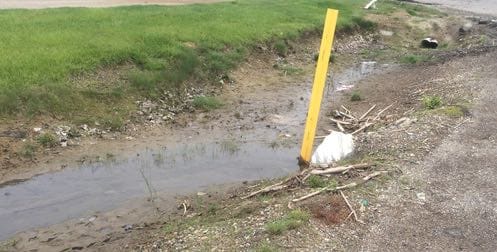
Classic ditch drain, Bloomfiled MI. Notice the culverts used to convey water from the ditch under the road.

Small ditch drain, Bloomfield, MI. The ditches connect to others and to the rivers via the culvert pipes in the left and center of the picture. A cheap solution to flooding.

Ditch drains are among the cheapest ways to drain a swamp. Standard sizes cost only about $10/lineal foot, but they are pretty ugly in my opinion, they fill up with garbage, and they tend to be unsafe. Jaguars running back Denard Robinson was lucky to have survived running into one in his car (above) earlier this year. Ditches can become mosquito breeding grounds, too and many communities have opted for a more expensive option: buried, concrete or metal culverts. These are safer for the motorist, but reduce ground absorption and flow. In many places, we’ve buried whole rivers. We’ve no obvious swamps but instead we get regular basement and road flooding, as the culverts still have combined storm and sanitary (toilet) sewage, and as more and more storm water is sent through the same old culverts.

Given my choice I would separate the sewers, add weirs to some of our ditch drains, weirs, daylight some of the hidden rivers, and put in French drains and bioswales, where appropriate. These are safer and better looking than ditches but they tend to cost about $100 per lineal foot, about 10x more than ditch drains. This is still 70x cheaper than the $7000/ft, combined sewage tunnel cisterns that our current Oakland water commissioner has been putting in. His tunnel cisterns cost about $13/gallon of water retention, and continue to cause traffic blockage.
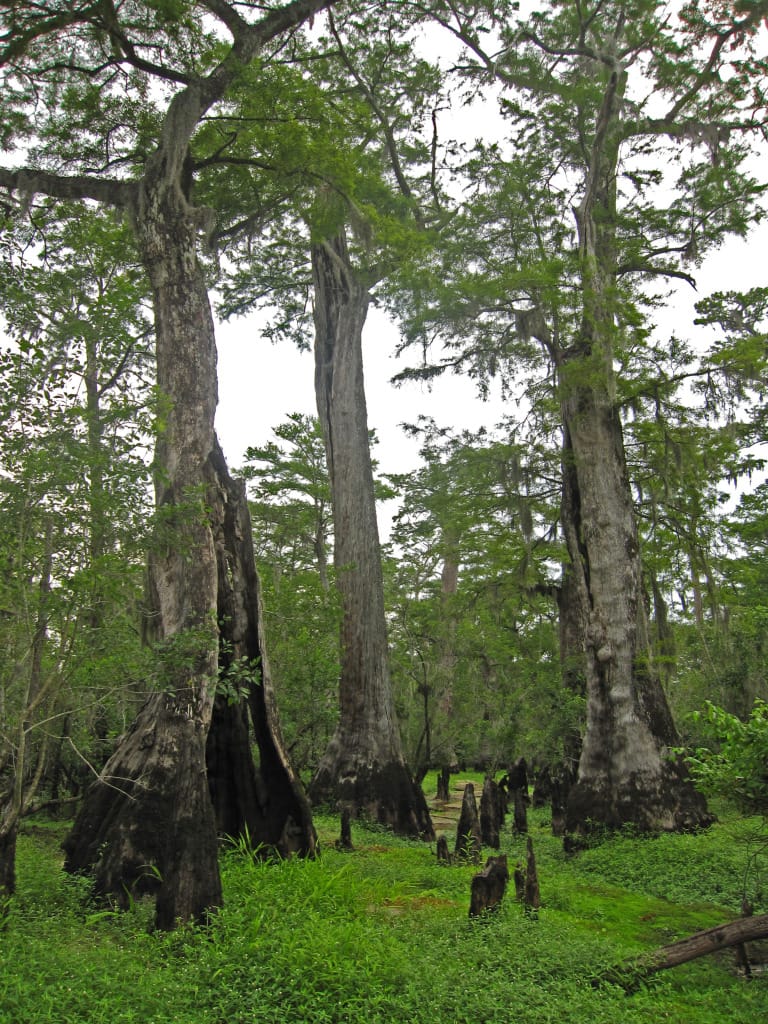
Bald cypress swamp

Bald cypress in a bog-swamp with tree knees in foreground.

Another solution is trees, perhaps the cheapest solution to drain a small swamp or retention pond, A full-grown tree will transpire hundreds of gallons per day into the air, and they require no conduit connecting the groundwater to a river. Trees look nice and can complement French drains and bioswales where there is drainage to river. You want a species that is water tolerant, low maintenance, and has exceptional transpiration. Options include the river birch, the red maple, and my favorite, the bald cypress (picture). Bald cypress trees can live over 1000 years and can grow over 150 feet tall — generally straight up. When grown in low-oxygen, bog water, they develop knees — bits of root-wood that extend above the water. These aid oxygen absorption and improve tree-stability. Cypress trees were used extensively to drain the swamps of Israel, and hollowed-out cypress logs were the first pipes used to carry Detroit drinking water. Some of these pipes remain; they are remarkably rot-resistant.

Robert E Buxbaum, December 2, 2016. I ran for water commissioner of Oakland county, MI 2016, and lost. I’m an engineer. While teaching at Michigan State, I got an appreciation for what you could do with trees, grasses, and drains.

The straight flush and strong shower

I’m not the wildest libertarian, but I’d like to see states rights extended to Michigan’s toilets and showers. Some twenty years ago, the federal government mandated that the maximum toilet flush volume could be only 1.6 gallons, the same as Canada. They also mandated a maximum shower-flow law, memorialized in this Seinfeld episode. Like the characters in those shows, I think this is government over-reach of states rights covered by the 10th amendment. As I understand it, the only powers of the federal government over states are in areas specifically in the constitution, in areas of civil rights (the 13th Amendment), or in areas of restraint of trade (the 14th Amendment). None of that applies here, IMHO. It seems to me that the states should be able to determine their own flush and shower volumes.

If this happen to you often, you might want to use more water for each flush, or  at least a different brand of toilet paper.

If your toilet clogs often, you might want to use more flush water, or at least a different brand of toilet paper.

There is a good reason for allowing larger flushes, too in a state with lots of water. People whose toilets have long, older pipe runs find that there is insufficient flow to carry their stuff to the city mains. Their older pipes were designed to work with 3.5 gallon flushes. When you flush with only 1.6 gallons, the waste only goes part way down and eventually you get a clog. It’s an issue known to every plumber – one that goes away with more flush volume.

Given my choice, I’d like to change the flush law through the legislature, perhaps following a test case in the Supreme court. Similar legislation is in progress with marijuana decriminalization, but perhaps it’s too much to ask folks to risk imprisonment for a better shower or flush. Unless one of my readers feels like violating the federal law to become the test case, I can suggest some things you can do immediately. When it comes to your shower, you’ll find you can modify the flow by buying a model with a flow restrictor and “ahem” accidentally losing the restrictor. When it comes to your toilet, I don’t recommend buying an older, larger tank. Those old tanks look old. A simpler method is to find a new flush cistern with a larger drain hole and flapper. The drain hole and flapper in most toilet tanks is only 2″ in diameter, but some have a full 3″ hole and valve. Bigger hole, more flush power. Perfectly legal. And then there’s the poor-man solution: keep a bucket or washing cup nearby. If the flush looks problematic, pour the extra water in to help the stuff go down. It works.

A washing cup.

A washing cup. An extra liter for those difficult flushes.

Aside from these suggestions, if you have clog trouble, you should make sure to use only toilet paper, and not facial tissues or flushable wipes. If you do use these alternatives, only use one sheet at a flush, and the rest TP, and make sure your brand of wipe is really flushable. Given my choice, I would like see folks in Michigan have freedom of the flush. Let them install a larger tank if they like: 2 gallons, or 2.5; and I’d like to see them able to use Newman’s Serbian shower heads too, if it suits them. What do you folks think?

Dr. Robert E. Buxbaum, November 3, 2016. I’m running for Oakland county MI water resources commissioner. I’m for protecting our water supply, for better sewage treatment, and small wetlands for flood control. Among my less-normative views, I’ve also suggested changing the state bird to the turkey, and ending daylight savings time.

Weir dams to slow the flow and save our lakes

As part of explaining why I want to add weir dams to the Red Run drain, and some other of our Oakland county drains, I posed the following math/ engineering problem: if a weir dam is used to double the depth of water in a drain, show that this increases the residence time by a factor of 2.8 and reduces the flow speed by 1/2.8. Here is my solution.

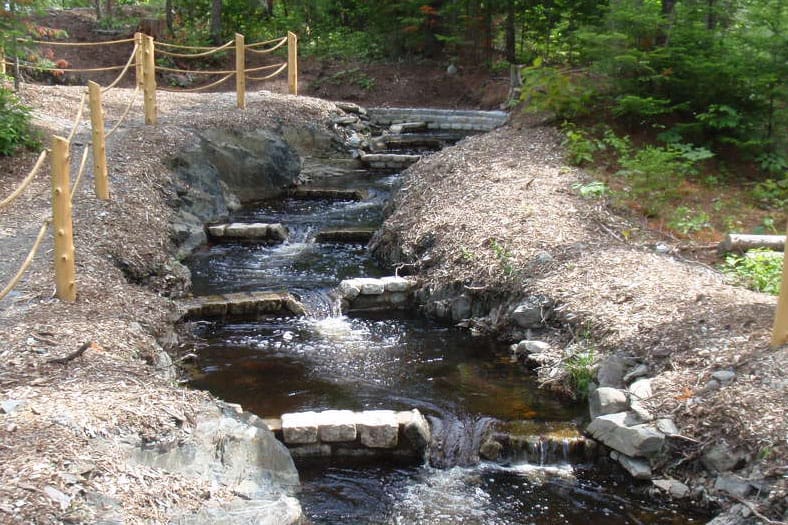
A series of weir dams on Blackman Stream, Maine. Mine would be about as tall, but somewhat further apart.

A series of weir dams on Blackman Stream, Maine. Mine would be about as tall, but wider and further apart. The dams provide oxygenation and hold back sludge.

Let’s assume the shape of the bottom of the drain is a parabola, e.g. y = x, and that the dams are spaced far enough apart that their volume is small compared to the volume of water. We now use integral calculus to calculate how the volume of water per mile, V is affected by water height:  V =2XY- ∫ y dx = 2XY- 2/3 X3 =  4/3 Y√Y. Here, capital Y is the height of water in the drain, and capital X is the horizontal distance of the water edge from the drain centerline. For a parabolic-bottomed drain, if you double the height Y, you increase the volume of water per mile by 2√2. That’s 2.83, or about 2.8 once you assume some volume to the dams.

To find how this affects residence time and velocity, note that the dam does not affect the volumetric flow rate, Q (gallons per hour). If we measure V in gallons per mile of drain, we find that the residence time per mile of drain (hours) is V/Q and that the speed (miles per hour) is Q/V. Increasing V by 2.8 increases the residence time by 2.8 and decreases the speed to 1/2.8 of its former value.

Why is this important? Decreasing the flow speed by even a little decreases the soil erosion by a lot. The hydrodynamic lift pressure on rocks or soil is proportional to flow speed-squared. Also, the more residence time and the more oxygen in the water, the more bio-remediation takes place in the drain. The dams slow the flow and promote oxygenation by the splashing over the weirs. Cells, bugs and fish do the rest; e.g. -HCOH- + O2 –> CO2 + H2O. Without oxygen, the fish die of suffocation, and this is a problem we’re already seeing in Lake St. Clair. Adding a dam saves the fish and turns the run into a living waterway instead of a smelly sewer. Of course, more is needed to take care of really major flood-rains. If all we provide is a weir, the water will rise far over the top, and the run will erode no better (or worse) than it did before. To reduce the speed during those major flood events, I would like to add a low bicycle path and some flood-zone picnic areas: just what you’d see on Michigan State’s campus, by the river.

Dr. Robert E. Buxbaum, May 12, 2016. I’d also like to daylight some rivers, and separate our storm and toilet sewage, but those are longer-term projects. Elect me water commissioner.

A run runs through it

The word ‘run’ appears to be a Michigan dialect for small river. Perhaps Michigan’s most famous run is the Willow run, where the airport is. Currently, almost all of our runs are unrecognizable, they are either trapped in pipes underground, or so dredged out and poisoned that they are more properly called sewers. If I’m elected Oakland county water resources commissioner (drain commissioner) I’d like to free some of these runs, and detoxify them.

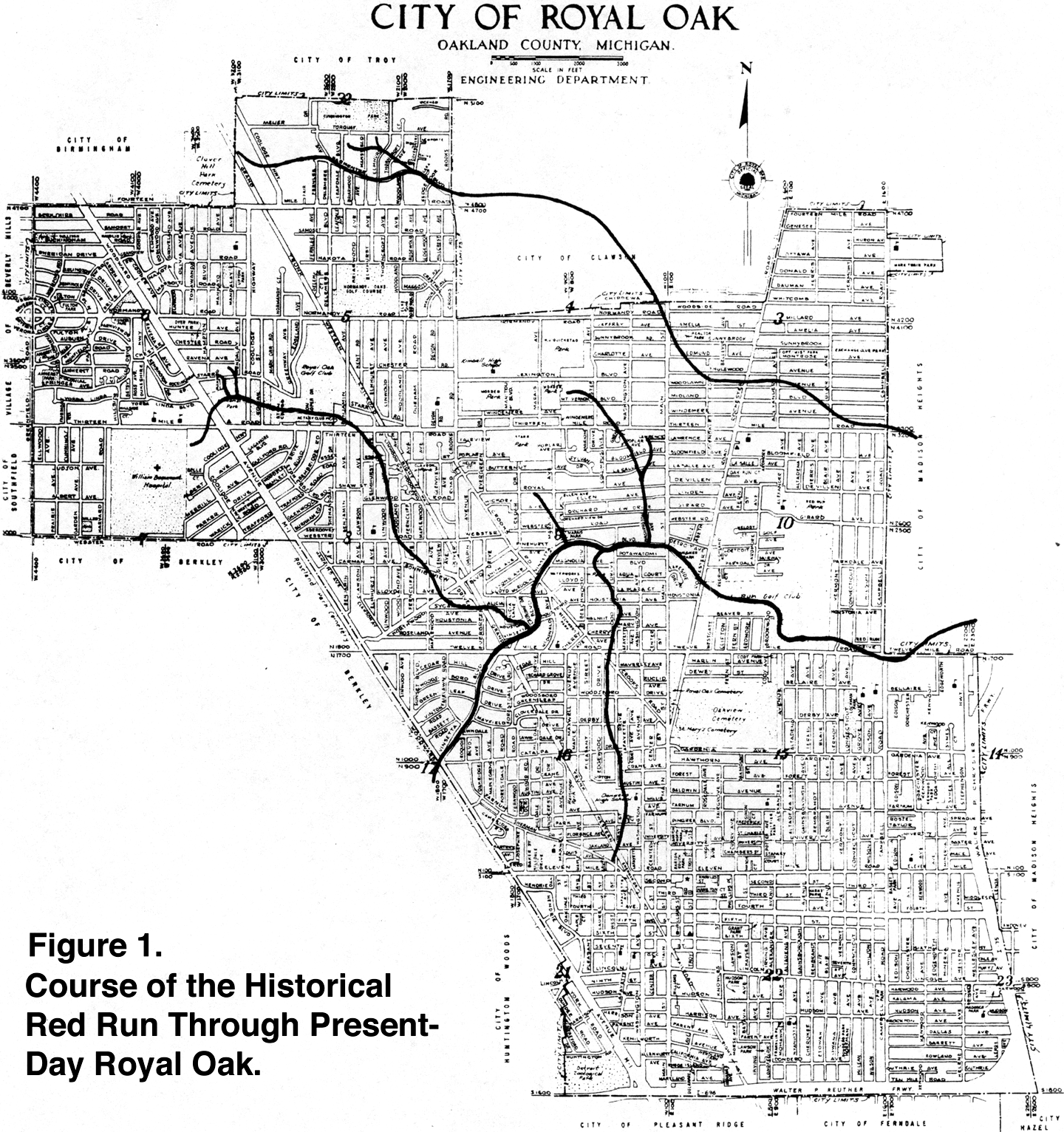
These branches of the red run flow beneath the surface of Royal Oak with the main section beneath Vinsetta Blvd.

These branches of the red run flow beneath the surface of Royal Oak with the main section beneath Vinsetta Blvd.

Consider this historical map of Royal Oak. It shows two  river branches, currently under ground. Back in the day, these were known as the north and south branch of the Red run. The south branch is fed by the Washington creek and the small run, now under ground, with the main branch of the run crossing Woodward ave at Catalpa st. These runs only appear above ground in Warren, MI, miles away, as a polluted sewer. But in Royal Oak they should still be clean. If they were partially freed. That is if the channel were exposed to air again to provide small wetlands along the original path — along Vinsetta Blvd, for example. Vinsetta Blvd. already has concrete bridges to show where the run originally ran. The small wetlands would provide habitat for birds and butterflies, and would provide storm relief and some bioremediation as well. After a heavy rain, most of the water would be absorbed into the ground, while the existing pipes carry away the rest.

Robert E. Buxbaum, March 21, 2016

Follow the feces; how to stop the poisoning

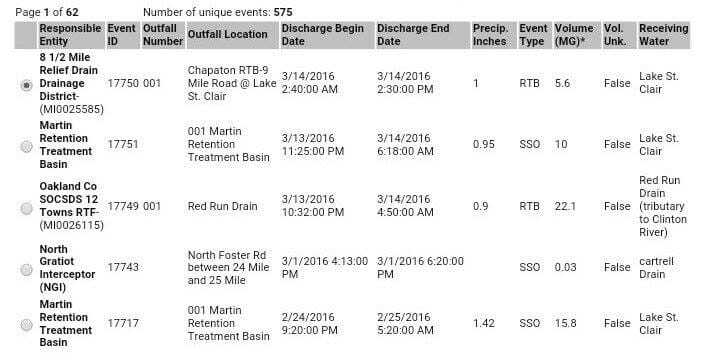
In Oakland county, we regularly poison our basements and our lake St Clair beaches with feces — and potentially our water supply too. We have a combined storm and sanitary sewer system that mixes feces-laden sanitary sewage with rainwater, and our pipes are too old and small to handle the amount of storm water from our larger rains. A group called “Save Lake St. Clair” is up in arms but the current commissioner claims the fault is not his. It’s global warming, he says, and the rains are bigger now. Maybe, or maybe the fault is wealth: more and more of the county is covered by asphalt, so less rain water can soak in the ground. Whatever the cause, the Commissioner should deal with it (I’m running for water commissioner, BTW). As the chart of toxic outfalls shows, we’ve had regular toxic sewage discharges into the Red Run basically every other week, with no exceptional rainfalls: only 0.9″ to 1.42″.

Toxic outfalls into lake St Clair, Feb 20 to Mar 20, 2016. There were also two outfalls into the Rouge in this period. These are too many to claim they are once in hundred-year events.

Toxic outfalls into lake St Clair, Feb 20 to Mar 20, 2016. There were also two outfalls into the Rouge in this period. These are too many to claim they are once in hundred-year events.

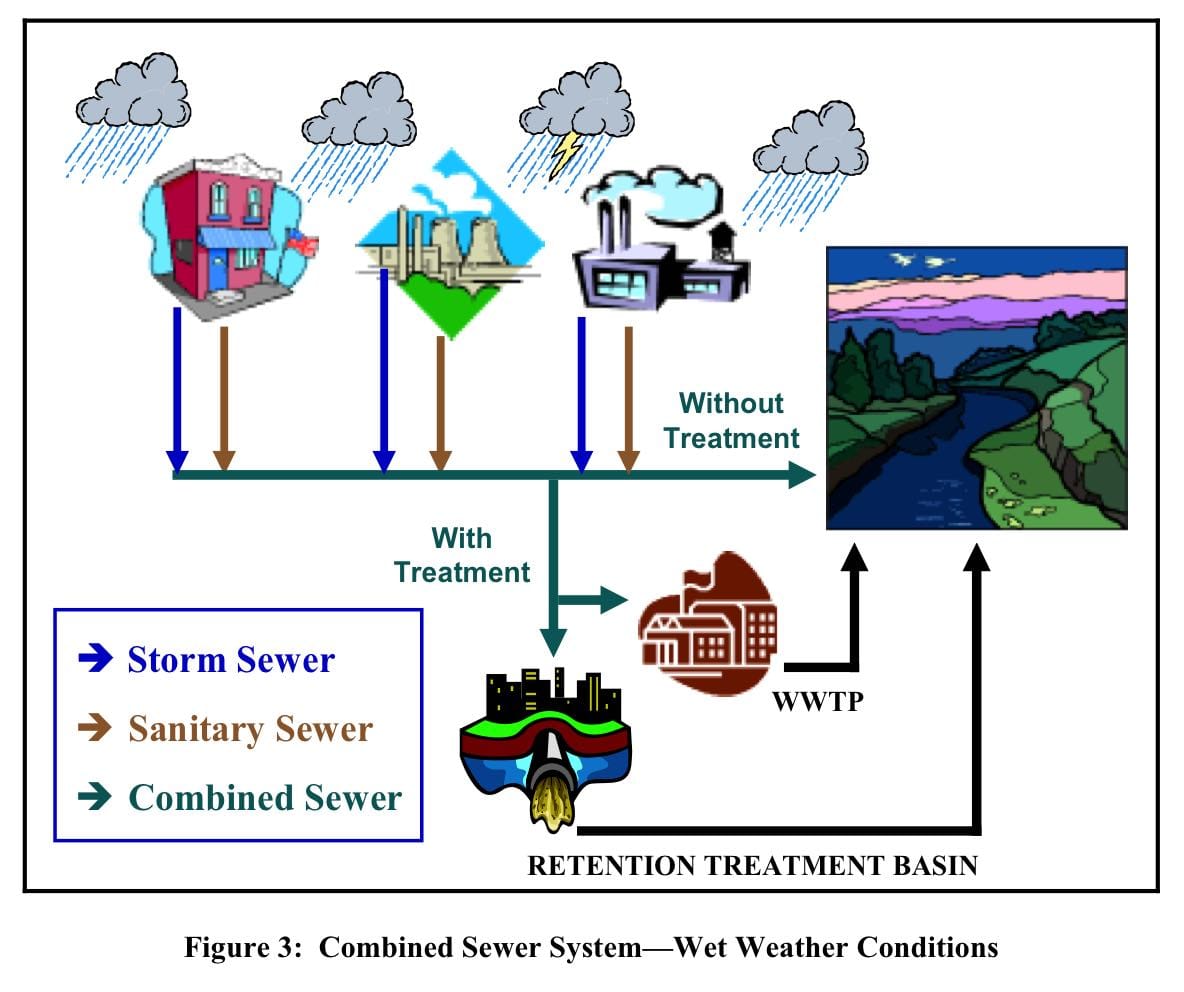
Because we have a combined system, the liquid level rises in our sewers whenever it rains. When the level is above the level of a basement floor drain, mixed sewage comes up into the basement. A mix of storm water comes up mixed with poop and anything else you and your neighbors flush down. Mixed sewage can come up even if the sewers were separate, but far less often. Currently most of the dry outfall from our old, combined sewers is sent to Detroit’s Waste Water Treatment plant near Zug Island. When there is a heavy rain, the pipe to Zug is overwhelmed. We avoid flooding your basement every other week by diverting as much as we can of the mixed storm water and septic sewage to lake St. Clair. This is poop, barely treated, and the fishermen and environmentalists hate it.

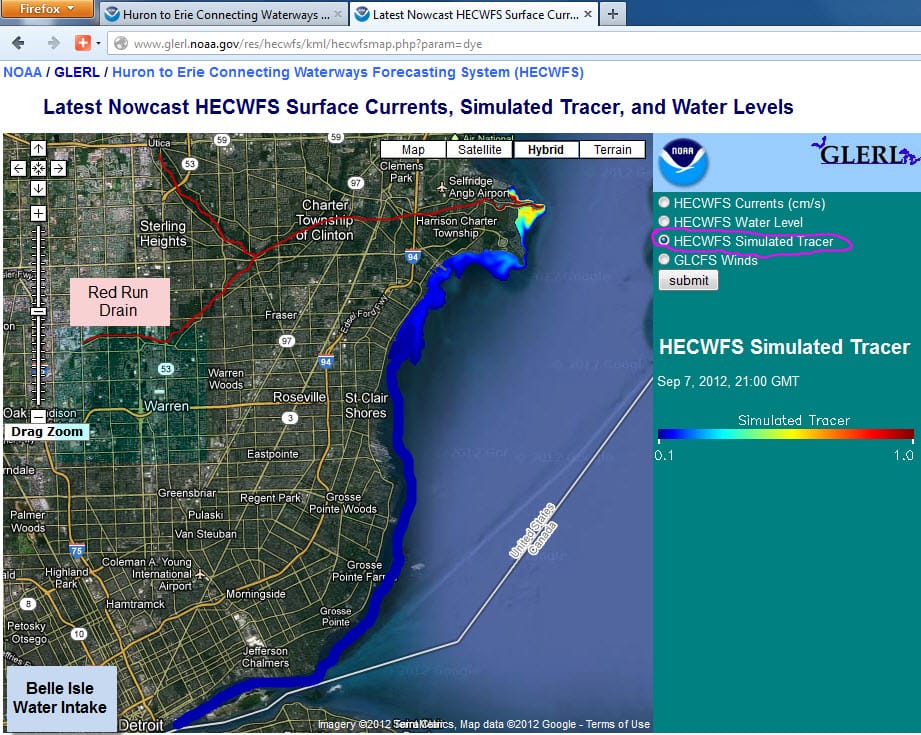
The beaches along Lake St Clair are closed every other week: whenever the pipes to Detroit start getting overwhelmed, whenever there is about 1″ or rain. Worse yet, the sewage is enters the lake just upstream of the water intake on Belle Isle, see map below. Overflow sewage follows the red lines entering the Clinton River through the GW Kuhn — Red Run Drain or through the North Branch off the River. From there it flows out into Lake St. Clair near Selfridge ANG, generally hugging the Michigan shore of the lake, following the light blue line to poison the metro beaches. it enters the water intake for the majority of Oakland County at the Belle Island water intakes, lower left.

Follow the feces to see why our beeches are polluted. It's just plain incompetence.

The storm water plus septic sewage mix is not dumped raw into lake St. Clair, but it’s nearly raw. The only treatment is to be spritzed with bleach in the Red Run Drain. The result is mats of black gunk with floating turds, toilet paper and tampons. This water is filtered before we drink it, and it’s sprayed with more chlorine, but that’s not OK. We can do much better than this. We don’t have to regularly dump poop into the river just upstream of our water intake. I favor a two-prong solution.

The first, quick solution is to have better pumps to send the sewage to Detroit. This is surprisingly expensive since we still have to treat the rain water. Also it doesn’t take care of the biggest rains; there is a limit to what our pipes will handle, but it stops some basement flooding, and it avoids some poisoning of our beaches and drinking water.

This is our combined sewer system showing a tunnel cistern (yuk) and the outflow into the Red Run. We can do better

A combined sewer system showing a tunnel cistern. Outflow goes into the Red Run. We can do better.

A second, longer term solution is to disentangle the septic from the storm sewers. My approach would be to do this in small steps, beginning by diverting some storm runoff into small wetlands or French drain retention. Separating the sewers this way is cheaper and more environmentally sound than trying to treat the mixed flow in Detroit, and the wetlands and drains would provide pleasant park spaces, but the project will take decades to complete. If done right, this would save quite a lot over sending so much liquid to Detroit, and it’s the real solution to worries about your floor drains back-flowing toxic sludge into your basement.

The incumbent, I fear, has little clue about drainage or bio-treatment. His solution is to build a $40MM tunnel cistern along Middlebelt road. This cistern only holds 3 MM gallons, less than 1/100 of the volume needed for even a moderate rain. Besides, at $13/gallon of storage, it is very costly solution compared to my preference — a French drain (costs about 25¢/gallon of storage). The incumbents cistern has closed off traffic for months between 12 and 13 mile, and is expected to continue for a year, until January, 2017. It doesn’t provide any bio-cleaning, unlike a French drain, and the cistern leaks. Currently groundwater is leaking in. This has caused the lowering of the water table and the closure of private wells. If the leak isn’t fixed , the cistern will leak septic sewage into the groundwater, potentially infecting people for miles around with typhus, cholera, and all sorts of 3rd world plagues.

There is also an explosion hazard to the incumbent’s approach. A tunnel cistern like this blew up near my undergraduate college sending manhole covers flying. This version has much bigger manhole covers: 15′ cement, not 2′ steel. If someone pours gasoline down the drain during a rainstorm and if a match went in later, the result could be deadly. The people building these projects are the same ones who fund the incumbent’s campaign, and I suspect they influenced him for this mis-chosen approach. They are the folks I fear he goes to for engineering advice. If you’d like to see a change for the better. Elect me, Elect an engineer.

Dr. Robert E. Buxbaum, March 26, 2016. Go here to volunteer or contribute.

if everyone agrees, something is wrong

I thought I’d try to semi-derive, and explain a remarkable mathematical paper that was published last month in The Proceedings of the Royal Society A (see full paper here). The paper demonstrates that too much agreement about a thing is counter-indicative of the thing being true. Unless an observation is blindingly obvious, near 100% agreement suggests there is a hidden flaw or conspiracy, perhaps unknown to the observers. This paper has broad application, but I thought the presentation was too confusing for most people to make use of, even those with a background in mathematics, science, or engineering. And the popular versions press versions didn’t even try to be useful. So here’s my shot:

Figure 2 from the original paper. For a method that is 80% accurate, you get your maximum reliability at the third to fifth witness. Beyond that, more agreement suggest a flaw in the people or procedure.

Figure 2 from the original paper. For a method that is 80% accurate, you get your maximum reliability at 3-5 witnesses. More agreement suggests a flaw in the people or procedure.

I will discuss only on specific application, the second one mentioned in the paper, crime (read the paper for others). Lets say there’s been a crime with several witnesses. The police line up a half-dozen, equal (?) suspects, and show them to the first witness. Lets say the first witness points to one of the suspects, the police will not arrest on this because they know that people correctly identify suspects only about 40% of the time, and incorrectly identify perhaps 10% (the say they don’t know or can’t remember the remaining 50% of time). The original paper includes the actual factions here; they’re similar. Since the witness pointed to someone, you already know he/she isn’t among the 50% who don’t know. But you don’t know if this witness is among the 40% who identify right or the 10% who identify wrong. Our confidence that this is the criminal is thus .4/(.4 +.1) = .8, or 80%.

Now you bring in the second witness. If this person identifies the same suspect, your confidence increases; to roughly (.4)2/(.42+.12) = .941,  or 94.1%. This is enough to make an arrest, but let’s say you have ten more witnesses, and all identify this same person. You might first think that this must be the guy with a confidence of (.4)10/(.410+.110) = 99.99999%, but then you wonder how unlikely it is to find ten people who identify correctly when, as we mentioned, each person has only a 40% chance. The chance of all ten witnesses identifying a suspect right is small: (.4)10 = .000104 or 0.01%. This fraction is smaller than the likelihood of having a crooked cop or a screw up the line-up (only one suspect had the right jacket, say). If crooked cops and systemic errors show up 1% of the time, and point to the correct fellow only 15% of these, we find that the chance of being right if ten out of ten agree is (0.0015 +(.4)10)/( .01+ .410+.110) = .16%. Total agreement on guilt suggests the fellow is innocent!

The graph above, the second in the paper, presents a generalization of the math I just presented: n identical tests of 80% accuracy and three different likelihoods of systemic failure. If this systemic failure rate is 1% and the chance of the error pointing right or wrong is 50/50, the chance of being right is P = (.005+ .4n)/(.01 +.4n+.1n), and is the red curve in the graph above. The authors find you get your maximum reliability when there are two to four agreeing witness.

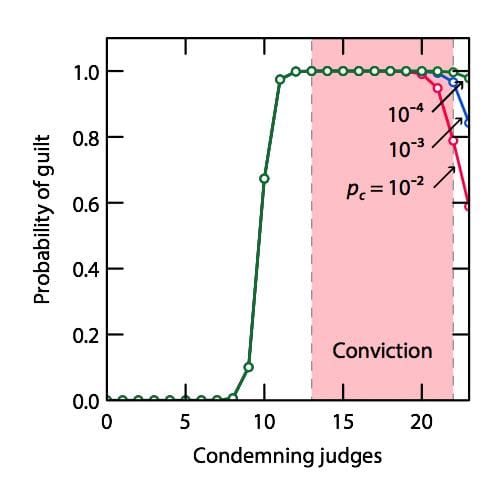
Confidence of guilt as related to the number of judges that agree and your confidence in the integrity of the judges.

Confidence of guilt as related to the number of judges that agree and the integrity of the judges.

The Royal Society article went on to a approve of a feature of Jewish capital-punishment law. In Jewish law, capital cases are tried by 23 judges. To convict a super majority (13) must find guilty, but if all 23 judges agree on guilt the court pronounces innocent (see chart, or an anecdote about Justice Antonin Scalia). My suspicion, by the way, is that more than 1% of judges and police are crooked or inept, and that the same applies to scientific analysis of mental diseases like diagnosing ADHD or autism, and predictions about stocks or climate change. (Do 98% of scientists really agree independently?). Perhaps there are so many people in US prisons, because of excessive agreement and inaccurate witnesses, e.g Ruben Carter. I suspect the agreement on climate experts is a similar sham.

Robert Buxbaum, March 11, 2016. Here are some thoughts on how to do science right. Here is some climate data: can you spot a clear pattern of man-made change?

The Parker house waitstaff hates you

There are many offensive Americans, but perhaps the most offensive must be those who eat at the famous Parker House restaurant, Boston; see photo taken by a friend of mine, historian Jim Wald. Parker House is the home of Parker House rolls and Boston Cream Pie. It’s also famous for its customers: e.g. the Saturday club of Emerson, Longfellow, Holmes, Agassiz, Dana, and Charles Dickens (Dickens lived in the Parker Hotel for two years). But more remarkable still is that a good number of the staff have so hated their customers that they went off and became revolutionary enemies of all things capitalist and American. And it only took a few months working at the Parker House.

The Parker House restaurant, Dec. 2015, photo by jim Wald, perhaps showing the next world leader.

Among Parker House employees we find Malcolm X, he worked as a busboy under his original, given name: Malcolm Little. We also find Ho Chi Minh, a pseudonym taken — it means, the enlightened one or the one who will enlighten (strangely enough, Genghis Kahn also means the enlightened one — in Mongol) was a pastry chef. he arrived in Boston as a ships cook, and worked in the hotel as Nguyen Cung. After Boston, he moved to Paris where he again made cakes and pies but changed his name to Nguyen O Phap (Nguyen who hates the French). Eventually, he and Malcolm X revolted against America and managed to turn the tables, as it were, on their customers.

Why do Parker House workers go off this way. Perhaps it’s because the hotel tries to hire hard-working, intelligent workers. You’ll notice, in the photo above that the waiters look at least as sharp as the customers and more physically fit. Beyond this, I suspect that the waitstaff are constantly exposed to socialist discussions from the customers. They are then sent off for coffee, or ignored, or perhaps insulted or groped, or not tipped. The Hotel seems to attract liberal libertarians — it was a favorite spot for John F. Kennedy.

My guess is that Malcolm X and Ho Chi Minh became socialist revolutionaries because of what they experienced from the customers at Parker House. So what can you do if you eat at Parker House, or any fancy restaurant? I think it pays to tip. Don’t do it in a way that makes your server feel like a beggar. It would help to chat too, I think. It’s important if your waiter is homicidal — or if your waiter becomes famous some day, or writes a book, or becomes a world dictator. You’d like to get a positive mention in that book, or have a positive story to tell — “I gave Genghis his first $10 bill…” And tipping is important so he/she doesn’t hate you. I’m given to understand that one main reasons people hate Satan so much is you can serve him, but he never tips.

Robert Buxbaum, February 29, 2016, updated August 24, 2017. I run REB Research, and I’m running for drain commissioner. Vote for me.

Michigan, an emerging economy

Between 2009 and 2014, Michigan’s per-capita GDP grew at 14% per year, an amazing growth rate similar to that of an emerging, tiger economies. According tot the Bureau of Economic analysis, the only US states that grew faster were Texas and North Dakota, and these oil states were hit badly in the current year 2015-16.
GDPGROWTH


Unfortunately, Michigan remains relatively poor despite it’s growth. Its per-capita GDP, $20,263 (2016), lags behind even perennial backwaters like Vermont, Oklahoma, and Missouri. The wealth gap in Michigan is growing, as in an emerging economy, and the cities, e.g. Detroit and Flint, are known for high murder rates, and a large-scale bankruptcy.

Michigan population change, Detroit Free Press

Michigan population change, Detroit Free Press

Then there’s pollution and flooding. Our beaches close for e-coli after every major rain, and we recently found that the drinking water in Flint was contaminated with lead; it seems other MI cities have lead problems too. Add to this, that we’ve  had major floods, a result of mismanagement, cronyism, and rampant growth, and Michigan keeps looking more and more like Vietnam, China, and India.

Everything here isn’t third world, though. We replaced our hapless, ex-governor Granholm with a relatively competent (in my opinion) nerd, Rick Snyder. We’ve jailed the of worst crooks, e.g. Detroit’s walking-crime-wave mayor, Kwame Kilpatrick, and his father, “Pay-for-play”, and the corrupt city manager, Bobby Ferguson. Under the previous administration, the state population shrank. It is now growing slowly.

Flood of 2014; the view at 696 and Mound rd. It's just incompetence.

Flood of 2014; the view at 696 and Mound rd. It’s part incompetence and part growth.


We passed a needed roads bill. Taxes are high, but not as bad as Illinois, and even Detroit is beginning to look good, at least in the center city. Industry is coming back, and so is Michigan real-estate. Here are some of my ideas going forward: pay our teachers well, and don’t imprison for so long. Some ideas to keep us on the upswing.

Robert Buxbaum, February 23, 2016. I’m running to be the Oakland county water commissioner, by the way.

How to help Flint and avoid lead here.

As most folks know, Flint has a lead-poisoning problem that seems to have begun in April, 2014 when the city switched its water supply from Detroit-supplied, Lake Huron water to their own source, water from the Flint River. Here are some thoughts on how to help the affected population, and how to avoid a repeat in Oakland county, where I’m running for water commissioner. First observation, it is not enough to make sure that the source water does not contain lead. The people who decided on the switch had found that the Flint river water had no significant content of lead or other obvious toxins. A key problem, it seems: the river water did not contain anticorrosion phosphates, and none, it seems, were added by the Flint water folks. It also seems that insufficient levels of chlorine (hypochlorite) were added. After the switch, citizens started seeing disgusting, brown water come from their taps, and citizens with lead pipes or solder were poisoned with ppb-levels of lead. There was also an outbreak of legionaries disease that killed 12 people. It was the legionaries that alerted the CDC to the possibility of lead, since it seems the water folks were fudging the numbers there, and hiding that part of the problem.

Flint water, Sept 2015, before switching back to Lake Huron.

Flint water after 5 hours of flushing, Sept 2015, before switching back to Lake Huron.

The city began solving its problem by switching back to Detroit-supplied, Lake Huron water in October, 2015. Beginning in December, 2015, they started adding triple doses of phosphate to the wate. As a result, Flint tap-water is now back within EPA standards, but it’s still fairly unsafe, see here for more details.

There has been a fair amount of finger-pointing. At Detroit for raising the price of water so Flint had to switch, at water officials ignoring the early signs of lead and fudging their reports, at other employees for not adding phosphate or enough chlorine, and at “the system” for not providing Flint’s government with better oversight. My take is that a lot of the problem came from the ignorance of the water commission, and it’s commissioner. We elect our water commissioners to be competent overseers of complex infrastructure, but in may counties folks seem to pick them the same way they pick aldermen: for a nice smile, a great handshake, and an ability to remember names. That, anyway, seems to be the way that Oakland got its current water commissioner. When you pick your commissioner that way, it’s no surprise that he (or she) isn’t particularly up on corrosion chemistry, something that few people understand, and fewer care about until it bites them.

Flint river water contains corrosive chloride that probably helped dissolve the lead from pipes and solder. Contributing to the corrosion problem, I’m going to guess that Flint River water also contains, relatively little carbonate, but significant amounts of chelating chemicals, like EDTA, in 10s of ppb concentration. EDTA isn’t poisonous at these concentrations, but it’s common in industry and is the most commonly used antidote for lead poisoning. EDTA extracts lead and other metals from people and would tend to contribute to the process of extracting lead and iron oxide from the pipes surface into the drinking water. With EDTA in the water, a lot of phosphate or hypochlorite would be needed to avoid the lead poisoning problem and the deadly multiplication of disease.

Detroit ex-mayor Kwame Kilpatrick has claimed that both Flint water and Detroit water were known to be poisoned even a decade before the switch. I find these claims believable given the high levels of lead in kids blood even before the switch. Also, I note that there are areas of Detroit where the blood-lead levels are higher than Flint. Flint tested at the taps in a way that fudged the data during the first days of the poisoning, and I suspect many of our MI cities do this today — just to make the numbers look better. My first suggestion therefore is to test correctly, both at the pipes and at the taps; lead pipes are most-often found in the last few feet before the tap. In particular, we should test at all schools and other places where the state has direct authorization to fix the problem. A MI senate bill has been proposed to this effect, but I’m not sure where it stands in the MI house. It seems there are movements to add lots of ‘riders’ and that’s usually a bad sign.

Another thought is that citizens should be encouraged to test their private taps and helped to fix them. The state can’t come in and test or rip out your private pipes, even if they suspect lead, but the private owner has that authorization. The state could condemn a private property where they believe the water is bad, but I doubt they could evict the residents. It’s a democratic republic, as I understand; you have the right to be deadly stupid. But I’ll take my own suggestion to encourage you: If you think your water has lead, take a sample and call (517) 335-8184. Do it.

Another suggestion, perhaps the easiest and most important, is drink bottled water for now, and if you feel you’ve been poisoned, take an antidote.  As I understand things, the state is already providing bottles of imported water. The most common antidote is, as I’d mentioned, EDTA. Assuming that Flint River water had enough EDTA to significantly worsen the problem, the cheapest antidote might be Flint River water, assuming you drew it in lead-free pipes and chlorinated sufficiently to rid it of bugs. If there is EDTA it will help the poisoned. Another antidote is Succinic acid, something sold by REB Research, my company. As with EDTA it is non-toxic, even in fairly large doses, but its use would have to be doctor- approved.

Robert E. Buxbaum, January 19-31, 2016. I hope this helps. We’d have to check Flint River water for levels of EDTA, but I suspect we’d find biologically significant concentrations. If you think Oakland should have an engineer in charge of the water, elect Buxbaum for water commissioner.

State bird suggestion: the turkey

state bird stamps; robin cardinal

three US states use the (american) robin as their state bird, and 7 more use the (northern) cardinal. None use the turkey

As things now stand, three states of the union, including Michigan have the robin as their state bird. Another seven have the cardinal. Not that they have different species of robin or cardinal, they use the same species: the American robin, and the Northern cardinal respectively.

A thought I’ve had is that Michigan should change to have a unique bird symbol, and I propose the turkey, in particular the eastern wild turkey shown below. The robin is found in every state of the union except for Hawaii, and is found in several countries, it’s associated with Robin Hood, and with Batman’s side-kick. By contrast, the eastern wild turkey could be a unique state symbol. It’s basically found in no other country besides the US, and found in only a few US states including Michigan.

Eastern Wild Turkey. A majestic bird, and brave Maximum height: 4 foot.

Eastern Wild Turkey. A majestic bird, and brave. Maximum height: 4 foot.

The eastern wild turkey is a far more impressive bird than the cardinal or robin. Full grown, it stands 4 foot tall. Benjamin Franklin claimed to have preferred the turkey (likely the eastern wild turkey) to the eagle as the national bird of the US. In this wonderful letter to his daughter, Sarah, he says that it is a noble bird, useful and the source of sustenance. He also claims it is unafraid to attack a British regimen, claims that also appears in this song, “the egg” in the play/movie 1776. The turkey most definitely provided food for the Indians, for the early European settlers, and still provides for Michigan hunters to this day. Further, turkey feathers are the preferred choice for quill pens. They are used for scribes writing holy works, like copies of the Torah, and it is likely they were used for the declaration of Independence. The same history and associations can not be claimed for the robins or the cardinal. Those birds are basically attractive, and nothing else.

Not that attractive is bad, nor is it bd to have a state bird associated with Batman’s side-kick, or with a Saint Louis baseball team, but I don’t think either is particularly appropriate for Michigan. Not that there are no disadvantages to the name turkey: (1) it might suggest a slow individual or project, and (2) Wild Turkey is the name of a Tennessee bourbon whiskey. Neither of these are quite a bad as being a sidekick to the bat, or to the batman, and I think both are addressed by specifying that the state bird is the eastern wild turkey, and not just some random variety. What say ye, citizens of Michigan? Let’s do it before someone else takes the turkey.

Robert Buxbaum, December 16, 2015.