Category Archives: crime

Detroit emerges from bankruptcy. Not quite.

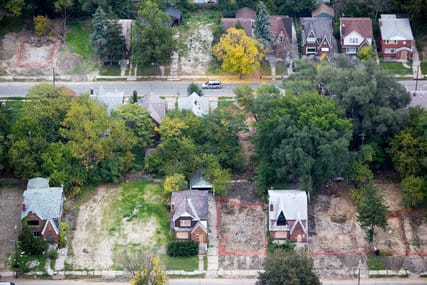
missing homes Detroit

While Detroit’s central core comes back, surrounding, homes burn at 220+/month, leave Detroit streets looking like the teeth of an aging hillbilly.

Detroit went bankrupt last year, the largest US city to do so since New York in 1970. As with New York’s bankruptcy, Detroit’s was used to cancel old debts and rewrite ill-thought contracts. Detroit also got to jail some crooked politicians including mayor Kilpatrick, described as “a walking crime wave.” But the city and county have no easy path out of bankruptcy as both city and county are likely insolvent. That is, they spend more than they take in despite massive out-state funding, and high taxes, 10% above the state level. To make matters worse, they are losing population at the rate of 1% or so per year. It’s hard to fund a city built for 2 million on the tax revenue of 1/3 as many, especially when they are mostly unemployed. Unless a lot changes soon, another bankruptcy is almost inevitable — likely this time at the county level.

We got in this state, largely as a result of a 50 year war between the black, solidly Democrat, somewhat anarchist, political establishment of Detroit, and the white, stayed, mostly Republican out state. The white population fled following the riots of the 60s and the richer black population soon followed. The remainder stayed, trapped in slowly decaying neighborhoods as the city went broke. White flight allowed the black community to develop its own, Motown culture, but except for the music industry, it has not benefitted from this culture.

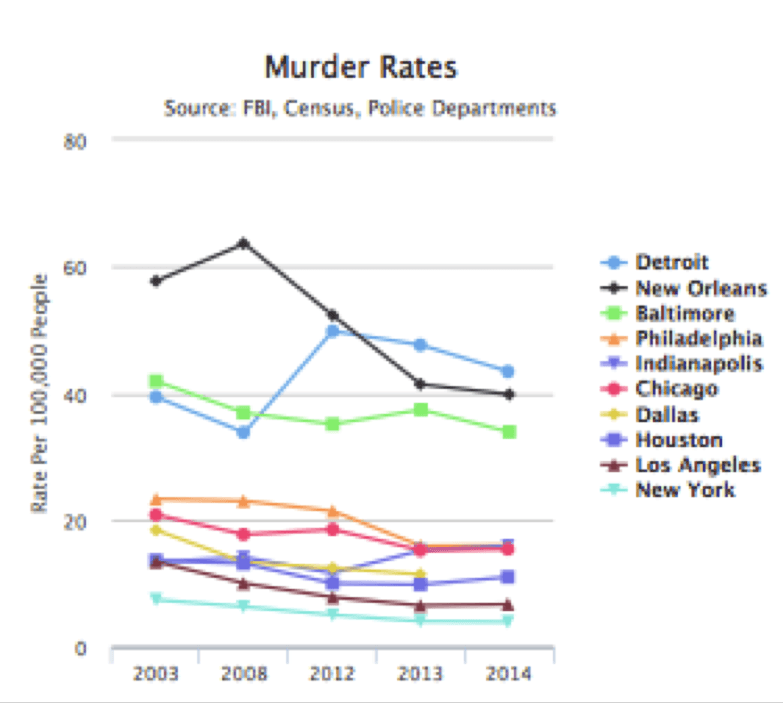
Detroit's murder rate, 45/100,000, is the highest in the US. It's coming down but not that fast.

Detroit’s murder rate is the highest in the US. It’s come down 10% in the last 2 years, but has far to go.

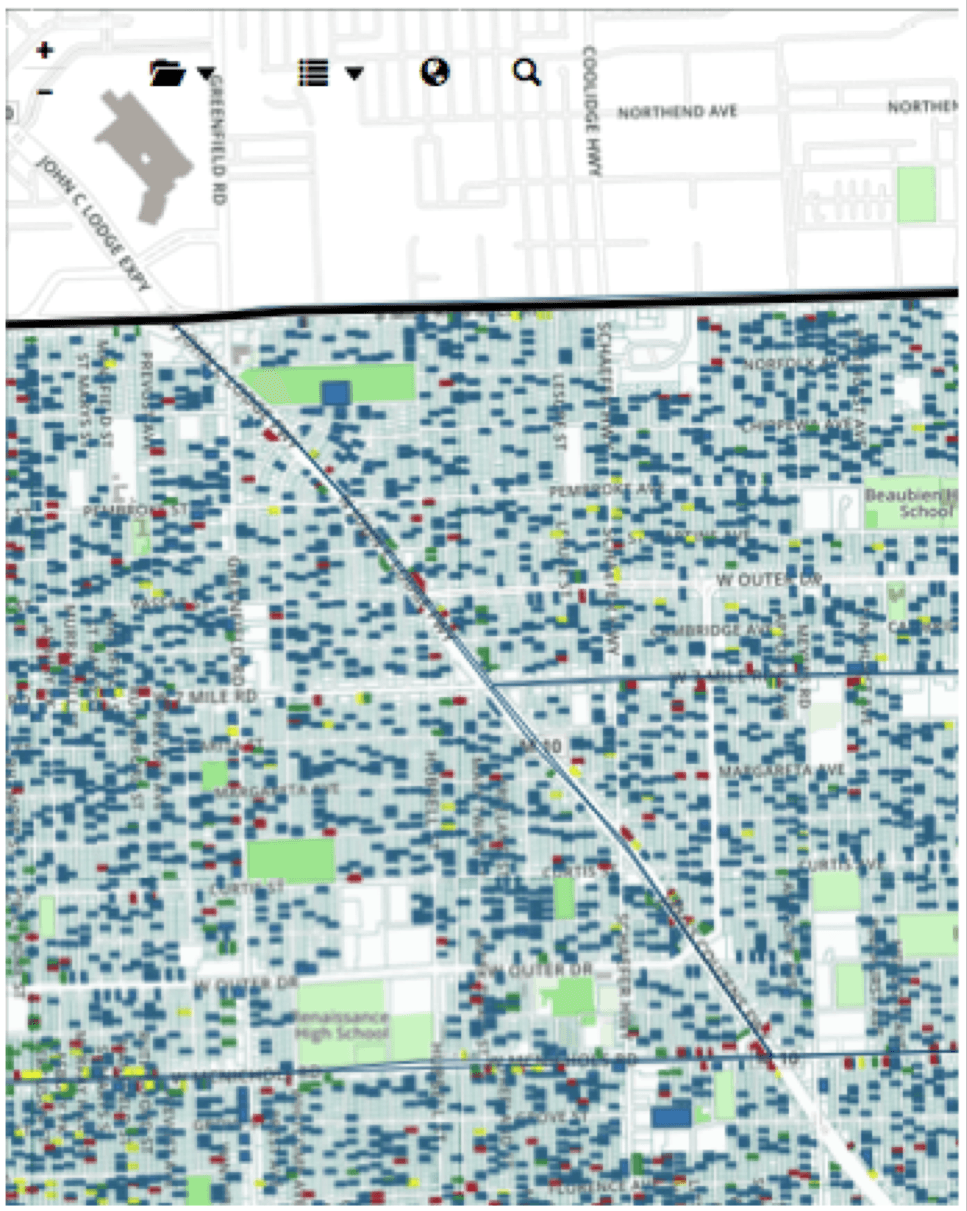
Detroiters have poor health, poor savings rates, high murder rates, and a fire rate of about .22% per month, 2.6% per year. The city lacks basic city services like reliable fire fighting and street plowing. Police at one point erected signs that said, “enter at your own risk.” There is a lack of small businesses and the services they would provide too: laundromats, grocery stores, and taxis (though no lack of bars and marijuana maintenance clinics). Employment in the auto-industry is down. And it’s not being replaced by home-grown small business – perhaps hampered by the low savings rate. A surprisingly large fraction of the Detroit homes are in foreclosure, see map, and with it a high abandonment rate and a high fire rate. As pheasant and dear return, non-core Detroit is beginning to look like farm country.

Detroit foreclosures near me. Blue is occupied homes, red is unoccupied, yellow unknown, and green is destroyed homes or vacant, foreclosed land.

Detroit foreclosures near me. Homes in dark blue are occupied foreclosed, red is unoccupied, and green plots are destroyed homes or vacant, foreclosed land.

It’s not clear what political leaders should do. The city council would like to return to their pre-bankruptcy ways where they could borrow as much as they felt they needed and spend on whatever they saw fit — often on fast friends, fast cars, gambling, and vacation homes outside of the city. But the out-state population has been reluctant to give them the credit card. Is this racist or is it prudent — probably both, but this can not continue. The city and county pension funds were ransacked for ill-advised investments and consulting fees to cronies and their power-lawyers. Either the money is replaced from out-state or there will be some unhappy retirees in the not-too-distant future. My guess is that the state will have to pick up the tab for this mismanagement, but that they won’t want to hand over management control afterwards.

Rand Paul, a potential GOP presidential candidate, has proposed rebuilding business and property values by a method that the city will almost certainly reject. His solution: cut services to low-population density areas and cut taxes on business and earned income. While this would likely bring in new people and new businesses, the people would likely be white, and the businesses white-owned/ white-serving. Black-Detroiters have too little savings, organization and income to directly benefit from this plan. Detroit’s Democrat politicians will claim, not without merit, that this is welfare for rich whites: a way for them to become yet-richer while doing nothing for the poor blacks of the burning neighborhoods. They are likely to demand control as the elected officials of the town: regulating business and raising the minimum wage to create “equality.” I suspect this is a bad idea.

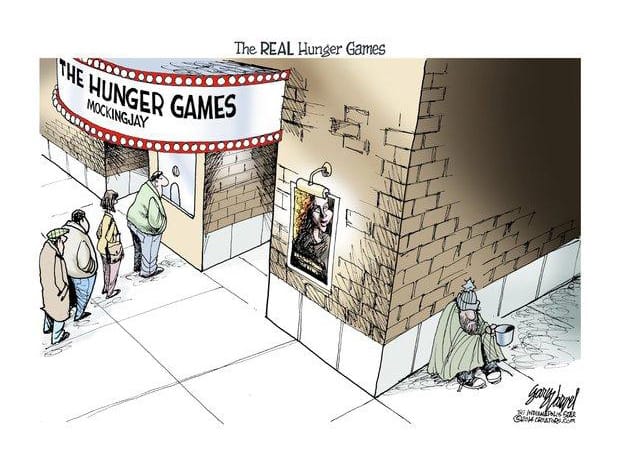
Detroit hunger games

Detroit suffers from two populations and a divide.

To some extent we’re already seeing the return of white-owned, white-serving businesses. Classic buildings in the core of the city have been purchased by white developers – notably Dan Gilbert of Quicken Loans leading to gentrification and an influx of single, white hipsters. The newcomers are viewed as half-saviors, half-carpetbaggers. They dwell in a whiter city core with hipster bars and expensive restaurants. Does a poor city with massive debt, crime, and unemployment benefit from a core filled with high-priced, gourmet coffee and fern bars?

The author, Robert Buxbaum, enjoys a day at an artificial beach in central Detroit.

The author, Robert Buxbaum, enjoys a beer at an artificial beach-cafe in central Detroit with some, few black folks, none poor. Is this good for Detroit?

The new hipsters put a squeeze on city services too — one that’s hard to deal with fairly. Detroit can not afford to plow all the streets after a snow. Should the new high-tax white folks get plowed streets, or should they suffer equally with everyone else? Detroit education is abysmal, but the high tax-bracket folks want better. Should they get it, or suffer equally? They want extra street lights and police protection. Should they get it, or suffer equally? Is this the way up?  A solution I’d proposed some while ago was to divide the core city from the now-rural outskirts so that each could be managed more sanely. It’s not a grand a solution like Rand’s plan, but less likely to be rejected. One way or another, we seem destined to have a Detroit with a rich core and abandoned neighborhoods. I suspect it might as well be managed that way.

Robert E. Buxbaum, February 10, 2015. I don’t have solutions, but write about the city’s problems, and the partial solutions I’ve heard as a way to clarify my thinking — and perhaps yours too.

What is learning?

It is common to spend the most of one’s youth in school — presumably learning something. The financial cost for primary education is a few hundred thousand dollars, borne by the state, plus 13 years or so of the student’s life. College learning costs another $50,000 to $200,000, borne by the student, plus another 4-6 years of life. The indication that you’ve learned something appears, in many majors by the ability to get a job that pays more than the school financial cost. But there is also a sense that you’ve learned something, and this is perhaps the only reward for students of film, religion, or archeology. My question is based mostly on this part: what is this learning. Is it the same as knowledge, a set of facts, or satisfaction — perhaps you could be as satisfied by ignorance or drugs. How do you evaluate the spiritual payback from 4-6 years of college? I don’t have all the answers, but ask to exercise my ignorance.

It would seem to me that an important standard of learning is that it should develop the mind and not corrupt it. But how do you recognize the difference? it seems to me one should leave with a set of mental skills should be new to you, recognizable to a normal outsider, and somewhat useful, as in the poem “Botany” even if you don’t use it. I’m not sure if the skills have to be true, by the way, or how useful they have to be. Perhaps developing a new confusion is better than having false notions — knowing that you doubt something.

sometimes education is the removal of false notions.

Sometimes learning can be the development of doubt.

If you’ve been educated in music, it seems to me you should be able to make sounds that appear pleasant to a normal listener; if you’ve been educated in mechanics, you should be able to make machines that work, and if you’ve been educated to think… perhaps then you should be able to walk into a discussion about something you once thought was true, and show that it is really false to an extent that others would accept it (and act upon it?). That is, my suspicion is that learning should involve an identifiable change –not only internal satisfaction, and I also suspect learning the new must involve unlearning the old.

Liberal Education may not be useful, or elevating

Education that isn’t useful isn’t particularly elevating

And that leads us to facts and methods: knowledge. Facts are good, they are the fuel and  substance of learning. Without facts there is nothing for the learning to attach to. But facts are often wrong — the ignorance of others, and even when right, they can be  deceptive. If you’ve learned the moon is made of rock, or out of green cheese, it’s pretty much the same unless there is a reason to think the fact you’ve learned is true, and unless you’ve a good understanding of what the fact ‘means.’ I can imagine a rock that is organic (a gall stone) and less solid than some (old) green cheese. The word rock or cheese must mean something to you to be a fact. Similarly in all subjects; if you learn that Shakespeare is a better writer than Poe, you should have a reason to believe it, and a clear understanding of the word ‘better’ in this context.

Turning to the knowledge of methods. It seems to me that learning a new method of thought, action, or argument is a necessary component of learning– one might even call it virtue, but this too seems to have limitations if it is not directed to use. A person is half-educated if he leaves school knowing how to do geometric proofs, but never doing any, or knowing how to run a great business, but never running one. A science graduate should at least be able to use the techniques learned to demonstrate that the world is made of atoms, and that the sun does not circle the earth and perhaps more. An argument can be made for traditional education areas of logic, rhetoric, mathematics, and dialectic. But these seem useless unless they are applied to a worthy end. One should do more with the new methods than to win drawing-room arguments.

There should be some satisfaction to accomplishments, but I'm not sure how it's learned.

Learning should provide satisfaction –in particular religious learning — but it’s nicer if it goes with doing good for someone (not only the poor) and the ability to earn an honest income. 

There should be a moral component of learning too, but here I feel less certain in describing it, or describing how it should be taught. Theodore Roosevelt said that “An uneducated man can steal from a rail car, “but an educated one can steal the whole railroad.” but perhaps stealing the railroad isn’t such a bad thing if it’s done legally. And as I don’t quite know when the honest stock deal is moral, I’m even more in the dark as to how to teach one to recognize the moral from the immoral in these situations. Two thoughts here: a student deserves some satisfaction from his or her learning and (from Aristotle’s Nicomachean Ethics) to be moral, the student has to earn an honest income. One who can not earn a living is bound to steal from someone sooner or later.

A final sign of learning, and perhaps it’s crown, is creativity, the ability to come to new understandings and develop new things. To do this productively requires some knowledge of the past plus an indescribable view of the future. A spark? A divine madness? Schools do not seem to be able to teach that, but it can help or hinder by either encouraging it, or beating it down. If you did not possess this ability when you entered school, you are unlikely to leave with it, even if you just did drugs, but school can teach one to direct the spark productively.

I’ve noticed that our high schools focus little on the above areas, perhaps because they are hard to test. Rather classes aim to the exams, and the exams test (as best I can tell), memorization, aptitude, and exposure. A surprisingly large fraction of our students leave diagnosed as ADHD. Still, strangely, our graduates do better than the Europeans.

Dr. Robert E. Buxbaum, December 29, 2014 (I taught in college). Here’s some advice I wrote for my 16 year old daughter in high school.

von NotHaus, the terrorist who uttered money.

Bernard von NotHaus was sentenced two days ago, December 3, 2014 in Federal court, North Carolina on charges of terrorism for the crime of making token coinage. This crime is called uttering money in English common law, but it is not generally considered terrorism, or generally prosecuted at all in modern times. The sentencing was covered by only one newspaper, The New York Sun. The New York Times and others, I guess, found it wasn’t news fit to print. But I find it newsworthy enough to blog about.

The current price of silver (as I write) is $16.60 per ounce. Had Bernard von NotHaus limited himself to selling ordinary, one ounce, silver medallions for $20 each, he could have made money on each, and perhaps been awarded a medal for his artistry. Instead, von NotHaus stands convicted as a terrorist against the US economy. The problem: his $20 medallions include the symbol “$20” and the word “dollar” on the coins. The government’s claim is that people might come to use his silver medallions to buy $20 worth of products, and this, it was argued, could bring down the government. Also incendiary was the phrase “Trust in God.” The federal prosecutor argued this was too close to our government’s, “In God we Trust.”

A liberty dollar. The crime is terrorism by uttering money -- saying that this coin should be used as $20 currency.

A liberty $20 piece The crime is terrorism, undermining the US by suggesting people use this coin as currency.

Von NotHaus was arrested on June 6, 2009, and had his coins and metal confiscated. He was convicted of terrorism March, 2011. Among the evidence are gold coins with the image of Ron Paul and certificates with von NotHaus’s image marked as 1 Dollar negotiable currency. Making these items isn’t quite counterfeiting, as the coins and certificates don’t look like US currency, but the US government decided it’s worse: economic terrorism. Anne Tompkins, the federal prosecutor successfully argued that von NotHaus is suggesting that the currency of the US is somehow deficient, and perhaps that the president and his crowd are doing something wrong in their efforts to drive inflation by printing excess currency. Ms. Tompkins successfully argued that such “attempts to undermine the legitimate currency of this country are simply a unique form of domestic terrorism” and that they “represent a clear and present danger to the economic stability of this country.” I’d say that’s over-reacting.

The Liberty Dollar. It's not counterfeiting, but the crime of terrorism by uttering money. Printing certificates with the intent of having them used as currency.

The Liberty Dollar. It’s not counterfeiting, but terrorism. 20 of these can be exchanged for a silver coin. US currency is non-negotiable; you have no right to change

The mechanism whereby these items are supposed to undermine the economic stability is the reverse of Gresham’s law. Gresham’s law is that the worse currency will stay in circulation and the better will be driven out. Applied here, Gresham would predict that people will hoard these liberty dollars and will spend only the paper. That’s what happens with ordinary art, or gold bars. But our government’s terrorism argument assumes Gresham’s theories are wrong, and that people will hoard Obama’s paper while spending von NotHaus’s coins. On that chance, Mr. von NotHaus stands convicted of terrorism. Mr. von NotHaus’s defense is that he never claimed his medallions should be used as currency. The judge rejected this defense. For all I know, Ms Tompkins could now pursue Von NotHaus for sedition: suggesting there is something wrong with the way we pursue minters.

The Ron Paul $1000, weapon of mass destruction.

The Ron Paul, $1000 weapon of national destruction.

At sentencing yesterday, Judge Voorhees ignored rules that should have condemned von NotHause to life in prison. Instead, he ruled for 6 month’s house arrest and 3 years probation saying he didn’t believe von NotHaus was motivated by evil intent, but rather by philosophical speech (something partially protected by the first amendment). I’m always glad for lenient sentencing, especially when the argument involves freedom of speech. I’m also glad for philosophy, but that does not mean I’m happy about the outcome. To me, von NotHaus deserves a medal; he is the Rosa Parks of hard currency. And I think that’s fit to print.

Part of the reason this conviction bugs me is that I got a free education courtesy of Peter Cooper, the citizen industrialist of the 19th century who founded the greenback party. He published (uttered) $3 bread notes to advertise his cause. Robert Buxbaum is a good US citizen, who uses only non-negotiable, fiat currency; none of this negotiable stuff for me. December 5, 2014.

Change your underwear; of mites and men

The underware bomber mites make it right.

Umar, the underwear bomber.

For those who don’t know it, the underwear bomber, Umar Farook Abdulmutallab, wore his pair of explosive underwear for 3 weeks straight before trying to detonate them while flying over Detroit in 2009. They didn’t go off, leaving him scarred for life. It’s quite possible that the nasty little mites that live in underwear stopped the underwear bomber. They are a main source of US allergens too.

Dust mite, skin, and pollen seen with a light  microscope. Gimmie some skin.

Dust mite, skin, and pollen seen with a light microscope. Gimmie some skin.

If you’ve ever used an electron microscope to look at household objects, you’ll find them covered with brick-like flakes of dried out skin-cells: yours and your friends’. Each person sheds his or her skin every month, on average. The outer layer dries out and flakes off as new skin grows in behind it. Skin flakes are the single largest source of household dust, and if not for the fact that these flakes are the main food for mites, your house would be chock full of your left over skin. When sunlight shines in your window, you see the shimmer of skin-flakes hanging in the air. Under the electron microscope, the fresh skin flakes look like bricks, but mite-eaten skin flakes look irregular. Less common, but more busy are the mites.

The facial mite movie. They live on in us, about 1 per hair follicle, particularly favoring eyelashes. Whenever you shower, your shower with a friend.

The facial mite movie. They live on in us, about 1 per hair follicle, particularly favoring eyelashes. Whenever you shower, you shower with a friend.

Dry skin is mostly protein (keratin), plus cholesterol and squalene. This provides great nutrition for dust mites and their associated bacteria. In warm, damp environments, as in your underwear or mattress, these beasties multiply and eat the old skin. The average density of dust mites on a mattress is greater than 2500/gram of dust.[1]  The mites leave behind excrement and broken off mite-limbs: nasty bits that are the most common allergens in the US today.

An allergy to dust shows up as sneezing, coughing, clogged lungs, and eczema. The most effective cure is a high level of in-home hygiene; mites don’t like soap or dry air. You’ve go to mop and vacuum regularly. Clean and change your clothing, particularly your undergarments; rotate your mattresses, and shake the dust out of your bedding. Vacuuming is less-effective as a significant fraction of the nasties go through the filter and get spread around by the vacuum blower.

As it turns out, dust mites and their bacteria eat more than skin. They also eat dried body fluids, poop residue, and the particular explosive used by Umar Farook, pentaerythritol tetra nitrate, PETN (humans can eat and metabolize this stuff too — it’s an angina treatment). The mites turn PETN into less-explosive versions, plus more mites.

Mighty mites as seen with electron microscopy. They eat more than skin.

Mighty mites as seen with electron microscopy. They eat more than skin.

There are many varieties of mite living on and among us. Belly button mites, for example, and face mites as shown above (click on the image to see it move). On average, people have one facial mite per hair follicle. It’s also possible that the bomber was stopped by poor quality control engineering and not mites at all. Religion tends to be at odds with a science like quality control, and followers tend to put their faith in miracles.

Chigger turning on a dime

Chigger turning on a dime

larger than the dust mite is the chigger, shown at left. Chiggers leave visible bites, particularly along the underwear waste-band. There are larger-yet critters in the family: lice, bed bugs, crabs. Bathing regularly, and cleaning your stuff will rid yourself of all these beasties, at least temporarily. Keeping your hair short and your windows open helps too. Mites multiply in humid, warm environments. Opening the windows dries and cools the air, and blows out mite-bits that could cause wheezing. Benjamin Franklin and took air-baths too: walking around naked with the windows open, even in winter. It helped that he lived on the second floor. Other ways to minimize mite growth include sunlight, DOT (a modern version of DDT), and eucalyptus oil. At the very minimum, change your underwear regularly. It goes a long way to reduce dust embarrassing moments at the jihadist convention.

Dr. Robert E. Buxbaum, Sept 21, 2014. Not all science or life is this weird and wonderful, but a lot is, and I prefer to write about the weird and wonderful bits. See e.g. the hazards of health food, the value of sunshine, or the cancer hazard of living near a river. Or the grammar of pirates.

Marijuana, paranoia, and creativity

Many studies have shown that marijuana use and paranoid schizophrenia go together, the effect getting stronger with longer-term and heavy use. There also seems to be a relation between marijuana (pot) and creativity. The Beetles and Stones; Dylan, DuChaps, and Obama: creative musicians painters, poets and politicians, smoked pot. Thus, we can ask what causes what: do crazy, creative folks smoke pot, or does pot-smoking cause normal folks to become crazy and creative, or is there some other relationship. Dope dealers would like you to believe that pot-smoking will make you a creative, sane genius, but this is clearly false advertising. If you were not a great artist, poet, or musician before, you are unlikely to be one after a few puffs of weed.

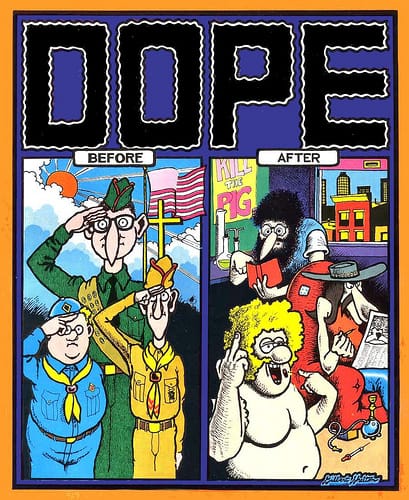
The Freak Brothers, by Gilbert Shelton. While these boys were not improved by dope, It would be a shame to put the artist in prison for any length of time.

The Freak Brothers, by Gilbert Shelton. What’s the relationship?

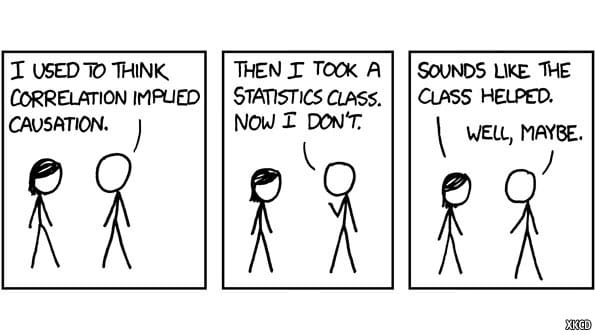
When things go together, we apply inductive reasoning. There are four possibilities: A causes B (pot makes you crazy and/or creative), B causes A (crazy folks smoke pot, perhaps as self medication), A and B are caused by a third thing C (in this case, poverty culture, or some genetic mutation). Finally, it’s possible there’s no real relationship but a failure to use statistics right. If we looked at how many golf tournaments were won by people with W last names (Woods, Wilson, Watson) we might be fooled to think it’s a causal relationship. Key science tidbit: correlation does not imply causation.

The most likely option, I suspect is that some of all of the above is going on here: There is an Oxford University study that THC, the main active ingredient in pot, causes some, temporary paranoia, and another study suggests that pot smoking and paranoid insanity may be caused by the same genetics. To this mix I’d like to add another semi-random causative: that heavy metals and other toxins that are sometimes found in marijuana are the main cause of the paranoia — while being harmful to creativity.

marijuana -paranoia

Pot cultivation is easy — that’s why it’s called weed– and cultivation is often illegal, even in countries with large pot use, like Jamaica. As a result, I suspect pot is grown preferentially in places contaminated with heavy metal toxins like vanadium, cadmium, mercury, and lead. No one wants to grow something illegal on their own, good crop-land. Instead it will be grown on toxic brownfields where no one goes. Heavy metals are known to absorb in plants, and are known to have negative psychoactive properties. Inhalation of mercury is known to make you paranoid: mad as a hatter. Thus, while the pot itself may not drive you nuts, it’s possible that heavy metals and other toxins in the pot-soil may. The creativity would have to come from some other source, and would be diminished by smoking bad weed.

I suspect that creativity is largely an in-born, genetic trait that can be improved marginally by education, but I also find that creative people are necessarily people who try new things, go off the beaten path. This, I suspect, is what leads them to pot and other “drug experiments.” You can’t be creative and walk the same, standard path as everyone else. I’d expect, therefore, that in high use countries, like Jamaica, creative success is preferentially found in the few, anti-establishment folks who eschew it.

Robert E. (landslide) Buxbaum, September 4, 2014. The words pot, marijuana, dope, and weed all mean the same but appear in different cultural contexts. To add to the confusion, Jamaicans refer to pot as ganja or skiff, and their version of paranoid schizophrenia is called “ganja psychosis”. I’m not anti-pot, but favor government regulation— perhaps along the lines of beer regulation, or perhaps the stricter regulation of Valium. My most recent essay was on the tension-balance between personal freedom and government control. I was recently elected in Oak Park’s 3rd voting district. My slogan: “A Chicken in every pot, not pot in every chicken”. I won by one vote. For those who are convinced they’ve become really deep, creative types without having to create anything, let me suggest the following cartoon about talent. Also, if pot made you smart, Jamaica would be floating in Einsteins.

Criminal Punishment Theory

I’ve often wondered about the theory of criminal punishment. How long should sentences be? For which crimes and external circumstances should people be let off, for which should there be alternative punishments, like civic work, or a fine instead of jail time. I’ve a few ideas, but here are some thought cases:

Someone steals an expensive handbag from a clothing store. What should the punishment be for (a) a ghetto black with no job, (b) a middle-class, college sophomore (c) a famous actress? Should it be the same for all? Is jail the best punishment — it costs money, and doesn’t help the criminal or the store. If jail, how long is appropriate? Should the length of stay correspond to the cost of the bag? If the punishment is money or civic service, how should the fine vary with the wealth of the thief, or if the person is a repeat offender? Many countries have corporal punishment — why or why not?

My sense is that sentences should be shorter for less-expensive items, and longer for more expensive. My sense is that a fine or civic service is appropriate for most first offenses, and while jail seems necessary for serious crimes, if only to keep criminals off the streets, the sentences should be reasonably short and include rehabilitation. I suspect that long sentences don’t help the criminal or society. I suspect that victimless crimes, e.g. prostitution or drug sales should have very short sentences or non-jail punishments, and I’m not quite sure what to do if the thief reforms in prison or appears to.

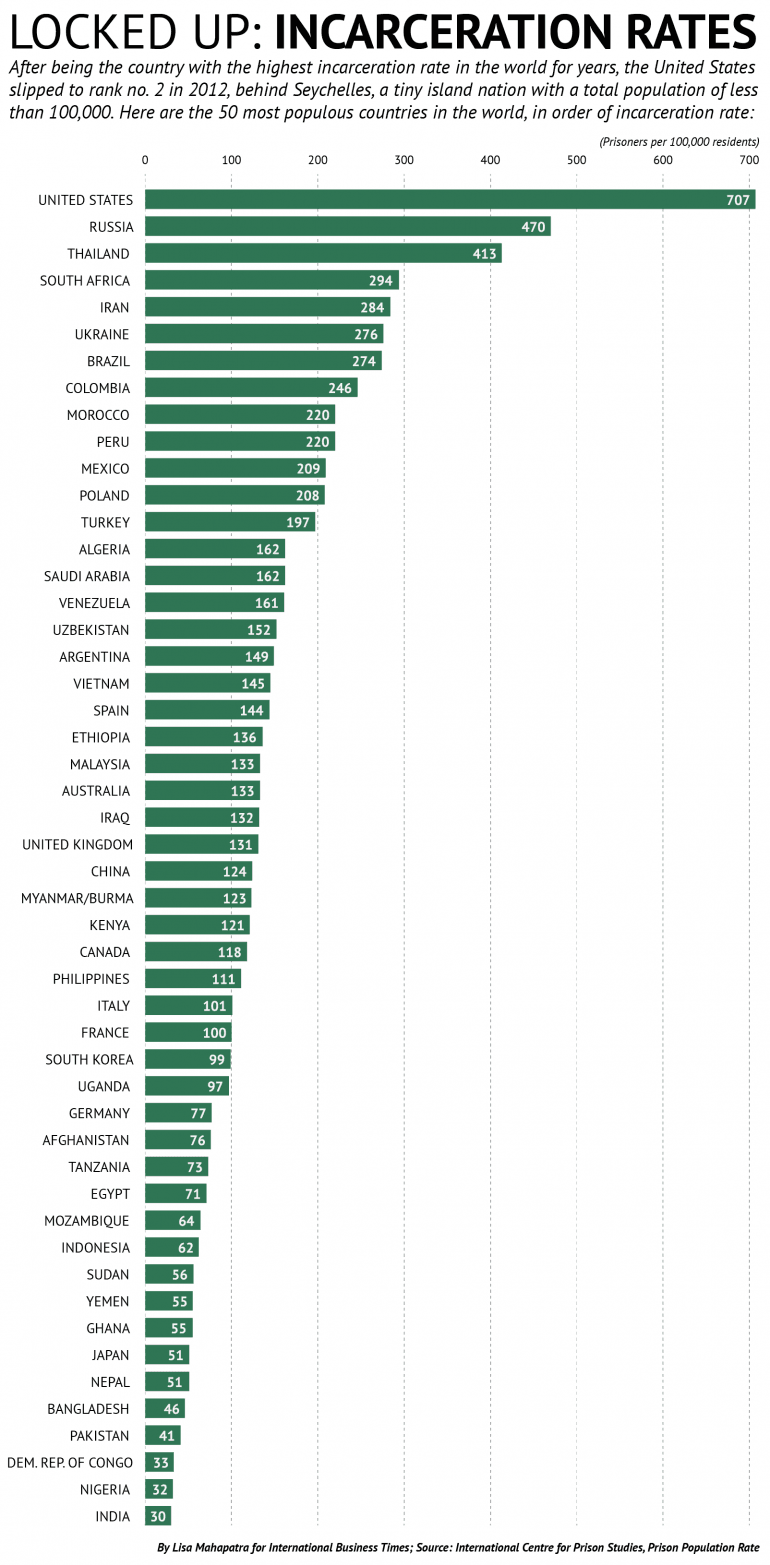
The US leads Russia, China, South Africa, and all of Europe in terms of percent of population is prison.

The US leads Russia, China, Cuba, India, and all of Europe in terms of percent of population in prison. It’s caused byvery long sentences, a product of fixed minimums. Strangely, our crime rate is low. Chart from the international business times.

Regarding prostitution perhaps it should be policed by the clergy, that’s why they get tax breaks. And why is sex between consenting adults punished as prostitution if money changes hands but not otherwise, or if the only pay is dinner? Why should the professional offender (the prostitute) pay more than the casual (the john). Why is drug use punished more than alcohol. Many drug and alcohol users live happy productive lives. To the extent that these crimes should be punished, it seems to me that fines, community service, or corporal punishment might be appropriate — I can not see prison healing a moral failing or reforming a victimless criminal.

And then there is rape. As a crime, the definition of rape has a long slippery slope, but the punishment does not. It isn’t quite clear where consensual become criminal, but the punishment is strict and undivided. We treat some cases as extreme crimes and others are let completely free. We have cases where the sex-criminal man or woman marries his or her underage partner, but is still guilty of statutory rape, and is then listed forever as a sex-criminal.

Children under 21 can not drink alcohol in the US, but they can in many other countries, and in some countries even older people can not drink at all. Is Saudi Arabia a very productive country; is Germany falling apart because of young drinkers? It seems not, so why is 21 the drinking age when you can choose to marry or join the army at 18. Soldiers are allowed to drink earlier than non-soldiers, but young marrieds are not afforded the same benefit. I don’t see why. The punishment for underage drinking varies too, as does the punishment for underage driving.

The Bible has some enlightened ideas on punishment, prescribing the use of fines of double or four or five times the value going to the victim (the thief pays 4 times for a stolen sheep, 5 times for a stolen cow, for example), but in other cases, it’s positively draconian prescribing death for homosexuality, violating the sabbath or for taking God’s name in vain. A seducer has to marry his seducee, but can not divorce her (assuming she agrees) but what if it’s an unhappy marriage? There is no room for judicial leniency in the bible, but there is in traditional applications; I’m not sure that’s not an improvement.

Robert E. Buxbaum, May 30, 2014. I’ve been wondering about the theory of appropriate punishment for at least 35 years. Are we protecting society, extracting vengeance, helping the criminal or doing some vague combination. My sense is we’re just bumbling blindly, and sorry to say, I have no answers.

Stoner’s prison and the crack mayor

With the release of a video of Rob Ford, the Mayor of Toronto, smoking crack while in office, and the admission that at least two US presidents smoked pot, as did the Beatles, Stones, and most of Hollywood, it seems worthwhile to consider the costs and benefits of our war on drugs, especially pot. Drugs are typically bad for productivity and usually bad for health. Thus, it seems worthwhile to regulate it, but most countries do not punish drug sale or use nearly as harshly as we do in the US.

The Freak Brothers by Gilbert Shelton. Clearly these boys were not improved by drugs, but perhaps we could do better than incarcerating them, and their fans, for years, or life.

The Freak Brothers by Gilbert Shelton. Clearly these boys were not improved by drugs, but perhaps we could do better than incarcerating them, and their fans, for years, or life.

While US penalties vary state by state, most states have high minimum penalties that a judge can not go below. In Michigan, where I live, medical marijuana is legalized, but all supply is still illegal. Marijuana cultivation, even for personal medical use, is a felony carrying a minimum punishment of 4 years in state prison and a $20,000 fine. For cultivation of more than 20 plants the minimum sentence is 7 years in prison and $500,000; and cultivating 200 or more plants results in 15 years plus a $10,000,000 fine. These are first-time, minimum sentences where the judge can not consider mitigating circumstances, like a prescription, for a drug that was accepted for use in the US in the 70s, is legal in Holland, legalized in Colorado, and is near-legal in Belgium. While many pot smokers were not served by the herb, many went on to be productive, e.g. our current president and the Beatles.

In Michigan, the mandatory minimums get worse if you are a repeat offender, especially a 3 time offender. Possession of hard drugs; and sales or cultivation of marijuana makes you a felon; a gun found on a felon adds 2 years and another felony. With three felonies you go to prison for life, effectively, so there is little difference between the sentence of a repeat violent mugger and a kid selling $10 rocks of crack in Detroit. America has more people in prison than Russia, China, or almost every industrialized nation, per capita, and the main cause is long minimum sentences.

In 2011, Michigan spent an average of $2,343 per month per prisoner, or $28,116/year: somewhat over 1.3 billion dollars per year in total. To this add the destruction of the criminal’s family, and the loss of whatever value he/she might have added to society. Reducing sentences by 10 or 20% would go a long way towards paying off Detroit’s bankruptcy, and would put a lot of useful people back into the work-force where they might do some good for themselves and the state. 60.8% of drug arrestees were employed before they were arrested for drugs, with an average income of $1050/month. That’s a lot of roofers, electricians, carpenters, and musicians — useful people. As best we can tell, the long sentences don’t help, but lead to higher rates of recidivism and increased violent behavior. If you spend years in jail, you are likely to become more violent, rather than less. Some 75% of drug convicts have no prior record of violent crime, so why does a first-time offense have to be a felony. If we need minimums, couldn’t it be 6 months and a $1000 fine, or only apply if there is violence.

Couldn’t we allow judges more leeway in sentencing, especially for drugs? Recall that Michiganders thought they’d legalized marijuana for medical use, and that even hard-drugs were legal not that long ago. There was a time when Coca-Cola contained cocaine and when Pope Leo was a regular drinker of cocaine laced wine. If the two presidents smoked pot, and the Mayor of Toronto could do a decent job after cocaine, why should we incarcerate them for life? Let’s balance strict justice with mercy; so the fabric of society is not strained to breaking.

Robert Buxbaum, Jan 16, 2014. Here are some other thoughts on Detroit and crime.

Near-Poisson statistics: how many police – firemen for a small city?

In a previous post, I dealt with the nearly-normal statistics of common things, like river crests, and explained why 100 year floods come more often than once every hundred years. As is not uncommon, the data was sort-of like a normal distribution, but deviated at the tail (the fantastic tail of the abnormal distribution). But now I’d like to present my take on a sort of statistics that (I think) should be used for the common problem of uncommon events: car crashes, fires, epidemics, wars…

Normally the mathematics used for these processes is Poisson statistics, and occasionally exponential statistics. I think these approaches lead to incorrect conclusions when applied to real-world cases of interest, e.g. choosing the size of a police force or fire department of a small town that rarely sees any crime or fire. This is relevant to Oak Park Michigan (where I live). I’ll show you how it’s treated by Poisson, and will then suggest a simpler way that’s more relevant.

First, consider an idealized version of Oak Park, Michigan (a semi-true version until the 1980s): the town had a small police department and a small fire department that saw only occasional crimes or fires, all of which required only 2 or 4 people respectively. Lets imagine that the likelihood of having one small fire at a given time is x = 5%, and that of having a violent crime is y =5% (it was 6% in 2011). A police department will need to have to have 2 policemen on call at all times, but will want 4 on the 0.25% chance that there are two simultaneous crimes (.05 x .05 = .0025); the fire department will want 8 souls on call at all times for the same reason. Either department will use the other 95% of their officers dealing with training, paperwork, investigations of less-immediate cases, care of equipment, and visiting schools, but this number on call is needed for immediate response. As there are 8760 hours per year and the police and fire workers only work 2000 hours, you’ll need at least 4.4 times this many officers. We’ll add some more for administration and sick-day relief, and predict a total staff of 20 police and 40 firemen. This is, more or less, what it was in the 1980s.

If each fire or violent crime took 3 hours (1/8 of a day), you’ll find that the entire on-call staff was busy 7.3 times per year (8x365x.0025 = 7.3), or a bit more since there is likely a seasonal effect, and since fires and violent crimes don’t fall into neat time slots. Having 3 fires or violent crimes simultaneously was very rare — and for those rare times, you could call on nearby communities, or do triage.

In response to austerity (towns always overspend in the good times, and come up short later), Oak Park realized it could use fewer employees if they combined the police and fire departments into an entity renamed “Public safety.” With 45-55 employees assigned to combined police / fire duty they’d still be able to handle the few violent crimes and fires. The sum of these events occurs 10% of the time, and we can apply the sort of statistics above to suggest that about 91% of the time there will be neither a fire nor violent crime; about 9% of the time there will be one or more fires or violent crimes (there is a 5% chance for each, but also a chance that 2 happen simultaneously). At least two events will occur 0.9% of the time (2 fires, 2 crimes or one of each), and they will have 3 or more events .09% of the time, or twice per year. The combined force allowed fewer responders since it was only rarely that 4 events happened simultaneously, and some of those were 4 crimes or 3 crimes and a fire — events that needed fewer responders. Your only real worry was when you have 3 fires, something that should happen every 3 years, or so, an acceptable risk at the time.

Before going to what caused this model of police and fire service to break down as Oak Park got bigger, I should explain Poisson statistics, exponential Statistics, and Power Law/ Fractal Statistics. The only type of statistics taught for dealing with crime like this is Poisson statistics, a type that works well when the events happen so suddenly and pass so briefly that we can claim to be interested in only how often we will see multiples of them in a period of time. The Poisson distribution formula is, P = rke/r! where P is the Probability of having some number of events, r is the total number of events divided by the total number of periods, and k is the number of events we are interested in.

Using the data above for a period-time of 3 hours, we can say that r= .1, and the likelihood of zero, one, or two events begin in the 3 hour period is 90.4%, 9.04% and 0.45%. These numbers are reasonable in terms of when events happen, but they are irrelevant to the problem anyone is really interested in: what resources are needed to come to the aid of the victims. That’s the problem with Poisson statistics: it treats something that no one cares about (when the thing start), and under-predicts the important things, like how often you’ll have multiple events in-progress. For 4 events, Poisson statistics predicts it happens only .00037% of the time — true enough, but irrelevant in terms of how often multiple teams are needed out on the job. We need four teams no matter if the 4 events began in a single 3 hour period or in close succession in two adjoining periods. The events take time to deal with, and the time overlaps.

The way I’d dealt with these events, above, suggests a power law approach. In this case, each likelihood was 1/10 the previous, and the probability P = .9 x10-k . This is called power law statistics. I’ve never seen it taught, though it appears very briefly in Wikipedia. Those who like math can re-write the above relation as log10P = log10 .9 -k.

One can generalize the above so that, for example, the decay rate can be 1/8 and not 1/10 (that is the chance of having k+1 events is 1/8 that of having k events). In this case, we could say that P = 7/8 x 8-k , or more generally that log10P = log10 A –kβ. Here k is the number of teams required at any time, β is a free variable, and Α = 1-10 because the sum of all probabilities has to equal 100%.

In college math, when behaviors like this appear, they are incorrectly translated into differential form to create “exponential statistics.” One begins by saying ∂P/∂k = -βP, where β = .9 as before, or remains some free-floating term. Everything looks fine until we integrate and set the total to 100%. We find that P = 1/λ e-kλ for k ≥ 0. This looks the same as before except that the pre-exponential always comes out wrong. In the above, the chance of having 0 events turns out to be 111%. Exponential statistics has the advantage (or disadvantage) that we find a non-zero possibility of having 1/100 of a fire, or 3.14159 crimes at a given time. We assign excessive likelihoods for fractional events and end up predicting artificially low likelihoods for the discrete events we are interested in except going away from a calculus that assumes continuity in a world where there is none. Discrete math is better than calculus here.

I now wish to generalize the power law statistics, to something similar but more robust. I’ll call my development fractal statistics (there’s already a section called fractal statistics on Wikipedia, but it’s really power-law statistics; mine will be different). Fractals were championed by Benoit B. Mandelbrot (who’s middle initial, according to the old joke, stood for Benoit B. Mandelbrot). Many random processes look fractal, e.g. the stock market. Before going here, I’d like to recall that the motivation for all this is figuring out how many people to hire for a police /fire force; we are not interested in any other irrelevant factoid, like how many calls of a certain type come in during a period of time.

To choose the size of the force, lets estimate how many times per year some number of people are needed simultaneously now that the city has bigger buildings and is seeing a few larger fires, and crimes. Lets assume that the larger fires and crimes occur only .05% of the time but might require 15 officers or more. Being prepared for even one event of this size will require expanding the force to about 80 men; 50% more than we have today, but we find that this expansion isn’t enough to cover the 0.0025% of the time when we will have two such major events simultaneously. That would require a 160 man fire-squad, and we still could not deal with two major fires and a simultaneous assault, or with a strike, or a lot of people who take sick at the same time. 

To treat this situation mathematically, we’ll say that the number times per year where a certain number of people are need, relates to the number of people based on a simple modification of the power law statistics. Thus:  log10N = A – βθ  where A and β are constants, N is the number of times per year that some number of officers are needed, and θ is the number of officers needed. To solve for the constants, plot the experimental values on a semi-log scale, and find the best straight line: -β is the slope and A  is the intercept. If the line is really straight, you are now done, and I would say that the fractal order is 1. But from the above discussion, I don’t expect this line to be straight. Rather I expect it to curve upward at high θ: there will be a tail where you require a higher number of officers. One might be tempted to modify the above by adding a term like but this will cause problems at very high θ. Thus, I’d suggest a fractal fix.

My fractal modification of the equation above is the following: log10N = A-βθ-w where A and β are similar to the power law coefficients and w is the fractal order of the decay, a coefficient that I expect to be slightly less than 1. To solve for the coefficients, pick a value of w, and find the best fits for A and β as before. The right value of w is the one that results in the straightest line fit. The equation above does not look like anything I’ve seen quite, or anything like the one shown in Wikipedia under the heading of fractal statistics, but I believe it to be correct — or at least useful.

To treat this politically is more difficult than treating it mathematically. I suspect we will have to combine our police and fire department with those of surrounding towns, and this will likely require our city to revert to a pure police department and a pure fire department. We can’t expect other cities specialists to work with our generalists particularly well. It may also mean payments to other cities, plus (perhaps) standardizing salaries and staffing. This should save money for Oak Park and should provide better service as specialists tend to do their jobs better than generalists (they also tend to be safer). But the change goes against the desire (need) of our local politicians to hand out favors of money and jobs to their friends. Keeping a non-specialized force costs lives as well as money but that doesn’t mean we’re likely to change soon.

Robert E. Buxbaum  December 6, 2013. My two previous posts are on how to climb a ladder safely, and on the relationship between mustaches in WWII: mustache men do things, and those with similar mustache styles get along best.

Improving Bankrupt Detroit

Detroit is Bankrupt in more ways than one. Besides having too few assets to cover their $18 Billion in debts, and besides running operational deficits for years, Detroit is bankrupt in the sense that most everyone who can afford to leaves. The population has shrunk from 2,000,000 in 1950 to about 680,000 today, an exodus that shows no sign of slowing.

The murder rate in Detroit is 25 times the state average; 400/year in 2012 (58/100,00) as compared to 250 in the rest of the state (2.3/100,000). The school system in 2009 scored the lowest math scores that had ever been recorded for any major city in the 21 year history of the tests. And mayor Kwame Kilpatrick, currently in prison, was called “a walking crime wave” by the mayor of Washington DC. The situation is not pretty. Here are a few simple thoughts though.

(1) Reorganize the city to make it smaller. The population density of Detroit is small, generally about 7000/ square mile, and some of the outlying districts might be carved off and made into townships. Most of Michigan started as townships. When they return to that status, each could contract their children’s education as they saw fit, perhaps agreeing to let the outlying cities use their school buildings and teachers, or perhaps closing failed schools as the local area sees fit.

This could work work well for outlying areas like the southern peninsula of Detroit, Mexicantown and south, a narrow strip of land lying along Route 75 that’s further from the center of Detroit than it is from the centers of 5 surrounding cities: River Rouge, Ecorse, Dearborn, Melvindale, and Lincoln Park. This area was Stillwell township before being added to Detroit in 1922. If removed from Detroit control the property values would likely rise. The people could easily contract education or police with any of the 5 surrounding cities that were previously parts of Stillwell township. Alternately, this newly created township might easily elect to join one of the surrounding communities entirely. All the surrounding communities offer lower crime and better services than Detroit. Most manage to do it with lower tax rates too.

Another community worth removing from Detroit is the western suburb previously known as Greenfield, This community was absorbed into Detroit in 1925. Like the Mexicantown area, this part of Detroit still has a majority of the houses occupied, and the majority of the businesses are viable enough that the area could reasonably stand on its own. Operating as a township, they could bring back whatever services they consider more suitable to their population. They would be in control of their own destiny.


Murder rate in Finland, Japan higher than in US

The murder rate in Finland and Japan is higher than in the US if suicide is considered as a type of murder. In the figure below, I’ve plotted total murder rates (homicide plus suicide) for several developed-world countries. The homicide component is in blue, with the suicide rate above it, in green. In terms of this total, the US is seen to be about average among the developed counties. Mexico has the highest homicide rate for those shown, Japan has the highest suicide rate, and Russia has this highest total murder rate shown (homicide + suicide): nearly double that of the US and Canada. In Russia and Japan, some .02% of the population commit suicide every year. The Scandinavian countries are quite similar to the US, and Japan, and Mexico are far worse. Italy, Greece and the UK are better than the US, both in terms of low suicide rate and low homicide rate.

  Combined homicide and suicide rates for selected countries, 2005.


Homicide and suicide rates for selected countries, 2005 Source: Wikipedia.

In the US, pundants like Piers Morgan like to use our high murder rate as an indicator of the ills of American society: loose gun laws are to blame, they say, along with the lack of social welfare safety net, a lack of support for the arts, and a lack of education and civility in general. Japan, Canada, and Scandinavia are presented as near idyls, in these regards. When murder is considered to include suicide though, the murder-rate difference disappears. Add to this, that violent crime rates are higher in Europe, Canada, and the UK, suggesting that clean streets and education do not deter crime.

The interesting thing though is suicide, and what it suggests about happiness. According to my graphic, the happiest, safest countries appear to be Italy and Greece. Part of this is likely weather , people commit suicide more in cold countries, but another part may be that some people (malcontents?) are better served by dirty, noisy cafés and pubs where people meet and complain, and are not so well served by clean streets and civility. It’s bad enough to be a depressed outsider, but it’s really miserable if everything around you is clean, and everyone is polite but busy.

Yet another thought about the lower suicide rates in the US and Mexico, is that some of the homicide in these countries is really suicide by proxy. In the US and Mexico depressed people (particularly men) can go off to war or join gangs. They still die, but they die more heroically (they think) by homicide. They volunteer for dangerous army missions or to attack a rival drug-lord outside a bar. Either they succeed in killing someone else, or they’re shot dead. If you’re really suicidal and can’t join the army, you could move to Detroit; the average house sold for $7100 last year (it’s higher now, I think), and the homicide rate was over 56 per 100,000. As bad as that sounds, it’s half the murder rate of Greenland, assuming you take suicide to be murder.

R.E. Buxbaum, Sept 14, 2013