Category Archives: Art

An Aesthetic of Mechanical Strength

Back when I taught materials science to chemical engineers, I used the following except of a poem to teach an aesthetic for good design, at least as concerns mechanical strength:

“…The secret to design, as the parson explained, is that the weakest part must withstand the strain. And if that part is to withstand the test, then it must be made as strong as all the rest….” (by R.E. Buxbaum, based on “The Wonderful, One-hoss Shay, by Oliver Wendell Holmes, 1858).

I figured that students needed an idea they could remember of what good design looked like. I wanted them to realize that there is always a weakest part in any device or process, and that this is the likely point of failure. Good design accepts this truth and designs everything around it. You make sure that the device will fail at a part or time of your choosing, and that, when it fails (not if), it’s preferably at at time and place where you can repair it easily and cheaply (a fuse, or a door hinge), and that doesn’t cause too much mayhem when it fails. Once this failure part is chosen and in place, I taught that the rest should be stronger, but there is no point in making any other part vastly stronger than your weakest link. Thus for example, once you’ve decided to use a fuse that fails at a certain amperage, there is no point in choosing wiring to take more than 2-3 times the amperage of the fuse.

This is an aesthetic argument, of course, but it’s important for a person to know what good work looks like (to me, and perhaps to the student). An engineer needs a positive view of craftwork beyond compliments from the boss or grades from me. Some day, I’ll be gone, and the boss won’t be looking. Only self-esteem keeps you going.

Many engineering aspects relate to failure points. If you don’t know what the failure point is, make a prototype and test it to failure. Then, if you don’t like what you see, remodel accordingly. If you like the point of failure but decide you really want to make the device stronger or more robust, be aware that this may involve more than strengthening that part only. You may need to re-engineer the entire chain of parts so they are as failure resistant as this part.

I also wanted to teach that there are many failure chains to look out for: many ways that things can wrong beyond breaking. Check for failure by fire, melting, explosion, smell, shock, rust, and even color change. Color change should not be ignored, BTW; there are many products that people won’t use as soon as they look bad (cars, for example). Make sure that each failure chain has it’s own, known weak links. In a car, the paint should fade, chip, or peel before the metal underneath starts rusting or sagging (at least that’s my aesthetic). And in the DuPont gun-powder mill below, one wall should be weaker so that the walls blow outward the right way (away from traffic). Be aware that human error is the most common failure mode: design should be acceptably idiot-proof.

Dupont powder mills had a thinner wall and a stronger wall so that, if there were an explosion it would blow out towards the river. This mill has a second wall to protect workers. The thinner wall should be barely strong enough to stand up to wind and rain; the stronger walls should stand up to explosions that blow out the other wall.

Dupont powder mills had a thinner wall and a stronger wall so that, if there were an explosion, it would blow out ‘safely.’ This mill has a second wall to protect workers. The thinner wall must be strong enough to stand up to wind and rain; the stronger walls should stand up to all likely explosions.

Related to my aesthetic of mechanical strength, I tried to teach an aesthetic of cost, weight, appearance, and green-soundness: Choose materials that are cheaper, rather than more expensive and that weigh less rather than more. Use materials that look better if you’ve the choice, and use recyclable materials. These all derive from the well-known axiom, omit needless stuff. Or, as William of Occam put it, “Entia non sunt multiplicanda sine necessitate.” As an aside, I’ve found that, when engineers use Latin, we sound smarter: “lingua bona lingua motua est.” (a good language is a dead language) — it’s the same with quoting dead 19th century poets. Dead 19th century poets are far better than undead ones, but I digress.

Use of recyclable materials gets you out of lots of problems relative to materials that must be disposed of. E.g. if you use aluminum insulation (recyclable) instead of ceramic fiber, you will have an easier time getting rid of the scrap. As a result, you are not as likely to expose your workers (or you) to mesothelioma, or similar disease. You should not have to pay someone to haul away excess or damaged product; a scraper will oblige, and he may even pay you for it if you have enough. Recycling helps cash flow with decommissioning too, when money is tight. It’s better to find your $1 worth of scrap is now worth $2 instead of discovering that your $1 worth of garbage now costs $2 to haul away. By the way, most heat loss is from black body radiation, so aluminum foil may actually work better than ceramics of the same thermal conductivity.

Buildings can be recycled too. Buy them and sell them as needed. Shipping containers make for great lab buildings because they are cheap, strong, and movable. You can sell them off-site when you’re done. We have a shipping container lab building, and a shipping container storage building — both worth more now than when I bought them. They are also rather attractive with our advertising on them — attractive according to my design aesthetic. Here’s an insight into why chemical engineers earn more than chemists; and insight into the difference between mechanical engineering and civil engineering. Here’s an architecture aesthetic. Here’s one about the scientific method.

Robert E. Buxbaum, October 31, 2013
Surrealists art joke

How many surrealists does it take to screw in a lightbulb.

The fish.

Surrealism aims to show the reality that exceeds realism; the dream-like absurd that is beyond the rational, common-sensical and practical. Beyond control engineering.

And you know “How many engineers would it take to screw in a lightbulb?” —- “Minimally two, and it would have to be a very large lightbulb.”

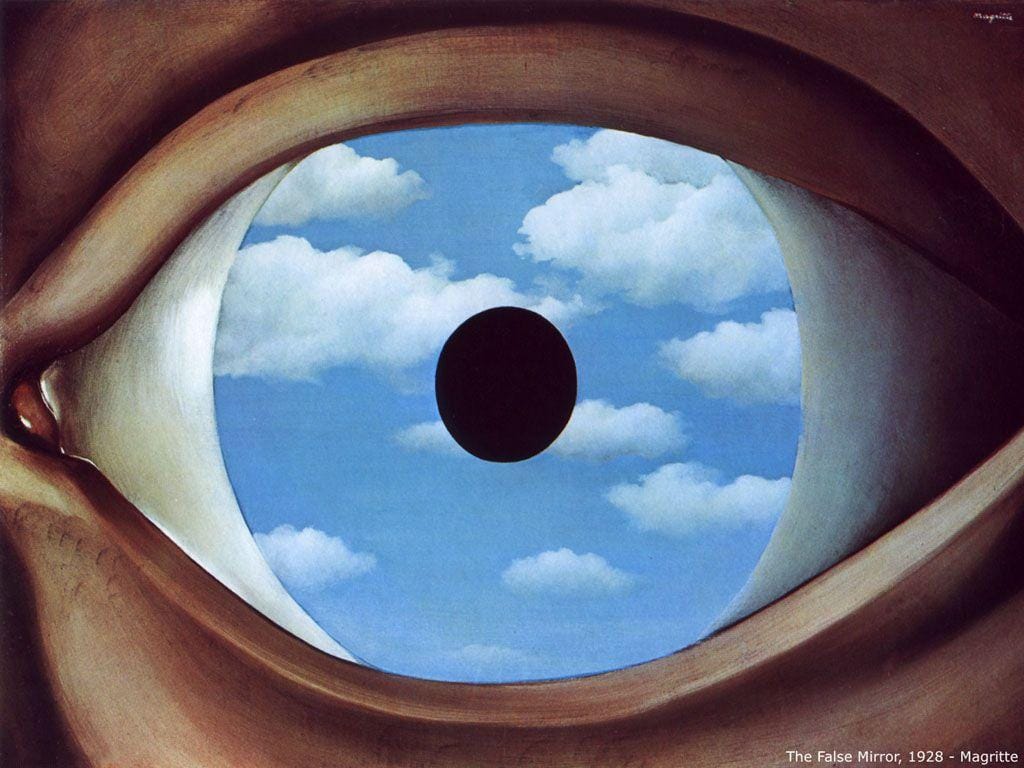
Even if the insights of surrealism are common-place, for example, that the eye is a false mirror of the world, I like is that they become real (if the surrealist is talented.)

False Mirror by Magritte; The idea, I suppose is that the eye is a false mirror of the world, seeing what's already within it.

False Mirror by Magritte; the idea, I suppose is that we see what’s already within us.

“The greatest obstacle to discovering the shape of the earth, the continents, and the oceans was not ignorance but the illusion of knowledge.” What I particularly like is the falseness of the mirror is shown as both false and true. The world is rarely this or that. Another insight / joke.

We all have masks, especially with those we love.

We all have masks, especially with those we love.

I imagine most I could make second-rate surrealistic works. The way to know your work is second rate it’s beautiful and insightful, but not funny.

Creation of Man-the-militant in the style of Michelangelo

Creation of Man-the-militant. Kuksi. It’s well done, and interesting (a retake on Michelangelo), but it’s not funny. See my cartoon in mechanical v civil engineers joke.

And then there is bad modern art. You could argue that this isn’t surreal, but some sort of other modern art, or post modern art. But that’s all false: it’s just bad art.

Bad modern art: little skill, little meaning, no humor. If you have to ask: "is it art?" It usually isn't.

Bad modern art: little skill, little meaning, no humor. If you have to ask: “is it art?” It usually isn’t.

If you buy something like this, and put it in your corporate headquarters lobby, the joke’s on you, and the artist is laughing his or her way to the bank.  Here is a link to why surrealism should be funny, And why architecture should not be (someone’s got to live in that joke).

R. E. Buxbaum, August 5, 2013

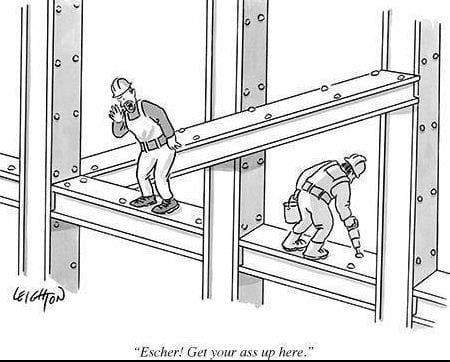
Escher Architecture – joke?

Caption will say where this is from.

Robert  Leighton, from the New Yorker,

Is funny because …. there’s an Escher-like impossible structure and a dirty word (ass, tee hee). Besides that, this joke highlights a fundamental conflict between the architect and the client (customer): what is good architecture?

Typically the customer whats a home or office that “looks nice”, “doesn’t cost too much”, and “works,” perhaps as an advertisement for the company. Often the architect wants to make a statement for him/herself, or wants to produce a work of art. Left to their own, architects can produce expensive monuments that no one can live in.

A wonderful (horrible) case concerns The Cooper Union, my alma mater, and more-or-less the only free college in America. The Cooper Union was founded by an inventive mechanic, Peter Cooper, see my biography, who invented jello, and rolled steel, laid the transatlantic cable, founded AT&T, and managed to give free education to a century and a half of students. The trustees of the school tore down the old, serviceable building, sold the land, and built a $270,000,000 dollar monstrosity. Hailed by the New York Times as great architecture, it bankrupted the school, and is unusable for the sort of hands-on education that Peter Cooper devised.

In hopes of attracting a rich donor, Cooper Union borrowed $175 million to erect this grotesque building for its engineering department. No donor materialized, and, as a result, the school’s 155-year-old policy of free tuition has vaporized.

In hopes of attracting a rich donor, Cooper Union sold its engineering building and borrowed $175 million to erect this replacement. No donor materialized, and, with it, a 155-year-old policy of free tuition.

Here’s a surrealist jokean engineer joke, and a thought on control engineering. Here too is a  sculpture I put on top of my building; the eyes follow you.

R.E. Buxbaum, July 8, 2013; I do consulting on hydrogen, and my company makes hydrogen products.

What’s Holding Gilroy on the Roof

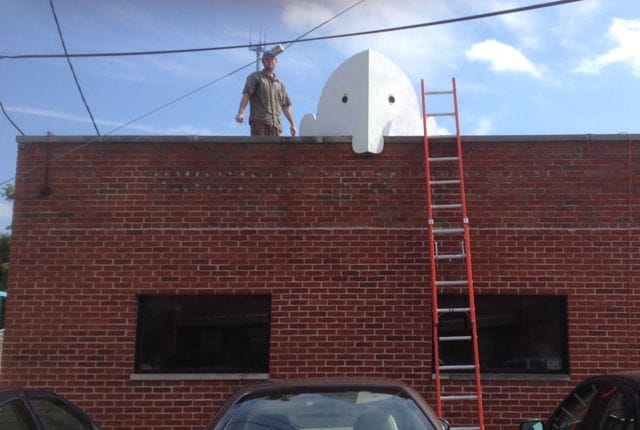
We recently put a sculpture on our roof: Gilroy, or “Mr Hydrogen.” It’s a larger version of a creepy face sculpture I’d made some moths ago. Like it, and my saber-toothed tiger, the eyes follow you. A worry about this version: is there enough keeping it from blowing down on the cars? Anyone who puts up a large structure must address this worry, but I’m a professional engineer with a PhD from Princeton, so my answer is a bit different from most.

Gilroy (Mr Hydrogen) sculpture on roof of REB Research & Consulting. The eyes follow you.

Gilroy (Mr Hydrogen) sculpture on roof of REB Research & Consulting. The eyes follow you. Aim is that it should withstand 50 mph winds.

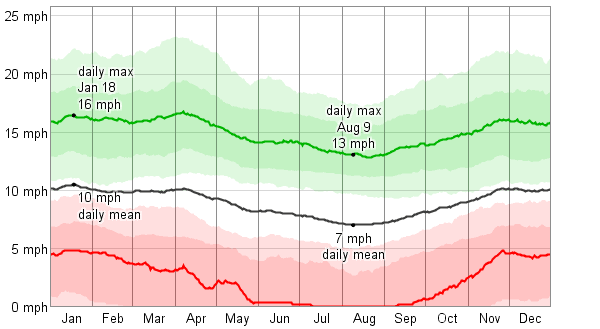
The main force on most any structure is the wind (the pyramids are classic exceptions). Wind force is generally proportional to the exposed area and to the wind-speed squared: something called form-drag or quadratic drag. Since force is related to wind-speed, I start with some good statistics for wind speed, shown in the figure below for Detroit where we are.

The highest Detroit wind speeds are typically only 16 mph, but every few years the winds are seen to reach 23 mph. These are low relative to many locations: Detroit has does not get hurricanes and rarely gets tornadoes. Despite this, I’ve decided to brace the sculpture to withstand winds of 50 mph, or 22.3 m/s. On the unlikely chance there is a tornado, I figure there would be so much other flotsam that I would not have to answer about losing my head. (For why Detroit does not get hurricanes or tornadoes, see here. If you want to know why tornadoes lift things, see here).

The maximum area Gilroy presents is 1.5 m2. The wind force is calculated by multiplying this area by the kinetic energy loss per second 1/2ρv2, times a form factor.  F= (Area)*ƒ* 1/2ρv2, where ρ is the density of air, 1.29Kg/m3, and v is velocity, 22.3 m/s. The form factor, ƒ, is about 1.25 for this shape: ƒ is found to be 1.15 for a flat plane, and 1.1 to 1.3 a rough sphere or ski-jumper. F = 1.5*1.25* (1/2 *1.29*22.32) = 603 Nt = 134 lb.; pressure is this divided by area. Since the weight is only about 40 lbs, I find I have to tie down the sculpture. I’ve done that with a 150 lb rope, tying it to a steel vent pipe.

Wind speed for Detroit month by month. Used to calculate the force. From http://weatherspark.com/averages/30042/Detroit-Michigan-United-States

Wind speed for Detroit month by month. Used to calculate the force. From http://weatherspark.com/averages/30042/Detroit-Michigan-United-States

It is possible that there’s a viscous lift force too, but it is likely to be small given the blunt shape and the flow Reynolds number: 3190. There is also the worry that Gilroy might fall apart from vibration. Gilroy is made of 3/4″ plywood, treated for outdoor use and then painted, but the plywood is held together with 25 steel screws 4″ long x 1/4″ OD. Screws like this will easily hold 134 lbs of steady wind force, but a vibrating wind will cause fatigue in the metal (bend a wire often enough and it falls apart). I figure I can leave Gilroy up for a year or so without worry, but will then go up to replace the screws and check if I have to bring him/ it down.

In the meantime, I’ll want to add a sign under the sculpture: “REB Research, home of Mr Hydrogen” I want to keep things surreal, but want to be safe and make sales.

by Robert E. Buxbaum, June 21, 2013

Surrealism Jokes

What is it that is red and white, polka-dotted, filled with moisture, and hangs from trees in the winter?

Unity

Is funny because …… it’s more true than truth. Whatever claims to be unity must include the red and white, polka-dotted, moist items that hang from trees. Otherwise it wouldn’t be unity. Surrealism jokes should not be confused with Zen Jokes. Eg this. and that.  As a practical matter, you can tell surrealists from Buddhists because surrealists are drunks and have hair. And you know why Dali wore a mustache?

To pass unobserved

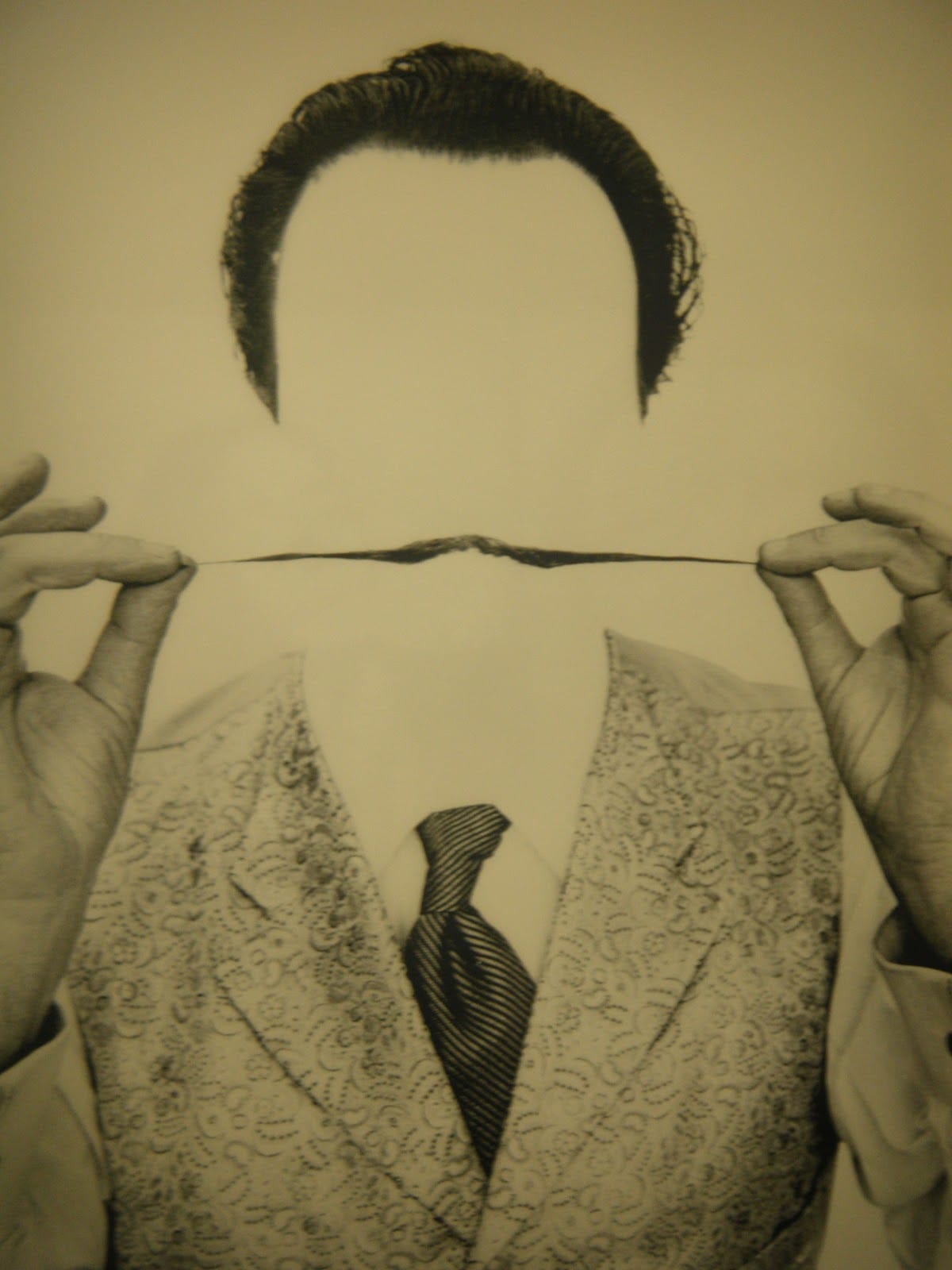
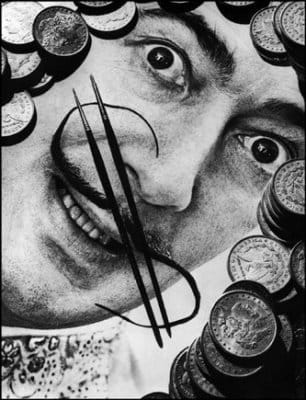
Dali's mustache without dali; notice how the mustache obscures the man.

Dali’s mustache without Dali, from Dali’s Mustache, the only book (to my knowledge) about a part of an artist. There are many books about Picasso, for example, but none about his left foot.

See how it’s true. The mustache takes the place of the man, standing in for him, or here the lack of him. Surrealism sees the absurd dream realism that is beyond the surd. “If you act the genius you will be one.” See? It even speaks for him, when needed.

Dali and his mustache agree, they love art for art's sake.

Dali and his mustache agree, they love art for art’s sake.

So how many surrealists does it take to screw in a lightbulb?  The fish.

by R. E. Buxbaum, June 14, 2013

Musical Color and the Well Tempered Scale

by R. E. Buxbaum, (the author of all these posts)

I first heard J. S. Bach’s Well Tempered Clavier some 35 years ago and was struck by the different colors of the different scales. Some were dark and scary, others were light and enjoyable. All of them worked, but each was distinct, though I could not figure out why. That Bach was able to write in all the keys without retuning was a key innovation of his. In his day, people tuned in fifths, a process that created gaps (called wolf) that prevented useful composition in affected keys.

We don’t know exactly how Bach tuned his instruments as he had no scientific way to describe it; we can guess that it was more uniform than the temper produced by tuning in fifths, but it probably was not quite equally spaced. Nowadays electronic keyboards are tuned to 12 equally spaced frequencies per octave through the use of frequency counters.  Starting with the A below “middle C”, A4, tuned at 440 cycles/second (the note symphonies tune to), each note is programmed to vibrate at a wavelength that is lower or higher than one next to it by a factor of the twelfth root of two, 12√2= 1.05946. After 12 multiples of this size, the wavelength has doubled or halved and there is an octave. This is called equal tempering.

Currently, many non-electric instruments are also tuned this way.  Equally tempering avoids all wolf, but makes each note equally ill-tempered. Any key can be transposed to another, but there are no pure harmonies because 12√2 is an irrational number (see joke). There is also no color or feel to any given key except that which has carried over historically in the listeners’ memory. It’s sad.

I’m going to speculate that J.S. Bach found/ favored a way to tune instruments where all of the keys were usable, and OK sounding, but where some harmonies are more perfect than others. Necessarily this means that some harmonies will be less-perfect. There should be no wolf gaps that would sound so bad that Bach could not compose and transpose in every key, but since there is a difference, each key will retain a distinct color that JS Bach explored in his work — or so I’ll assume.

Pythagoras found that notes sound best together when the vibrating lengths are kept in a ratio of small numbers. Consider the tuning note, A4, the A below middle C; this note vibrates a column of air .784 meters long, about 2.5 feet or half the length of an oboe. The octave notes for Aare called A3 and A5. They vibrate columns of air 2x as long and 1/2 as long as the original. They’re called octaves because they’re eight white keys away from A4. Keyboards add 4 black notes per octave so octaves are always 12 notes away. Keyboards are generally tuned so octaves are always 12 keys away. Based on Pythagoras, a reasonable presumption is that J.S Bach tuned every non-octave note so that it vibrates an air column similar to the equal tuning ratio, 12√2 = 1.05946, but whose wavelength was adjusted, in some cases to make ratios of small, whole numbers with the wavelength for A4.

Aside from octaves, the most pleasant harmonies are with notes whose wavelength is 3/2 as long as the original, or 2/3 as long. The best harmonies with A4 (0.784 m) will be with notes with wavelengths (3/2)*0.784 m long, or (2/3)*0.784m long. The first of these is called D3 and the other is E4. A4 combines with D3 to make a chord called D-major, the so-called “the key of glory.” The Hallelujah chorus, Beethoven’s 9th (Ode to Joy), and Mahler’s Titan are in this key. Scriabin believed that D-major had a unique color, gold, suggesting that the pure ratios were retained.

A combines with E (plus a black note C#) to make a chord called A major. Songs in this key sound (to my ear) robust, cheerful and somewhat pompous; Here, in A-major is: Dancing Queen by ABBA, Lady Madonna by the BeatlesPrelude and Fugue in A major by JS Bach. Scriabin believed that A-major was green.

A4 also combines with E and a new white note, C3, to make a chord called A minor. Since E4 and E3 vibrate at 2/3 and 4/3 the wavelength of A4 respectively, I’ll speculate that Bach tuned C3 to 5/3 the length of A4; 5/3*.0784m =1.307m long. Tuned his way, the ratio of wavelengths in the A minor chord are 3:4:5. Songs in A minor tend to be edgy and sort-of sad: Stairway to heaven, Für Elise“Songs in A Minor sung by Alicia Keys, and PDQ Bach’s Fugue in A minor. I’m going to speculate the Bach tuned this to 1.312 m (or thereabouts), roughly half-way between the wavelength for a pure ratio and that of equal temper.

The notes D3 and Ewill not sound particularly good together. In both pure ratios and equal tempers their wavelengths are in a ratio of 3/2 to 4/3, that is a ratio of 9 to 8. This can be a tensional transition, but it does not provide a satisfying resolution to my, western ears.

Now for the other white notes. The next white key over from A4 is G3, two half-tones longer that for A4. For equal tuning, we’d expect this note to vibrate a column of air 1.05946= 1.1225 times longer than A4. The most similar ratio of small whole numbers is 9/8 = 1.1250, and we’d already generated one before between D and E. As a result, we may expect that Bach tuned G3 to a wavelength 9/8*0.784m = .88 meters.

For equal tuning, the next white note, F3, will vibrate an air column 1.059464 = 1.259 times as long as the A4 column. Tuned this way, the wavelength for F3 is 1.259*.784 = .988m. Alternately, since 1.259 is similar to 5/4 = 1.25, it is reasonable to tune F3 as (5/4)*.784 = .980m. I’ll speculate that he split the difference: .984m. F, A, and C combine to make a good harmony called the F major chord. The most popular pieces in F major sound woozy and not-quite settled in my opinion, perhaps because of the oddness of the F tuning. See, e.g. the Jeopardy theme song, “My Sweet Lord,Come together (Beetles)Beethoven’s Pastoral symphony (Movement 1, “Awakening of cheerful feelings upon arrival in the country”). Scriabin saw F-major as bright blue.

We’ve only one more white note to go in this octave: B4, the other tension note to A4. Since the wavelengths for G3 was 9/8 as long as for A4, we can expect the wavelength for B4 will be 8/9 as long. This will be dissonant to A4, but it will go well with E3 and E4 as these were 2/3 and 4/3 of A4 respectively. Tuned this way, B4 vibrates a column 1.40 m. When B, in any octave, is combined with E it’s called an E chord (E major or E minor); it’s typically combined with a black key, G-sharp (G#). The notes B, E vibrate at a ratio of 4 to 3. J.S. Bach called the G#, “H” allowing him to spell out his name in his music. When he played the sequence BACH, he found B to A created tension; moving to C created harmony with A, but not B, while the final note, G# (H) provided harmony for C and the original B. Here’s how it works on cello; it’s not bad, but there is no grand resolution. The Promenade from “Pictures at an Exhibition” is in E.

The black notes go somewhere between the larger gaps of the white notes, and there is a traditional confusion in how to tune them. One can tune the black notes by equal temper  (multiples of 21/12), or set them exactly in the spaces between the white notes, or tune them to any alternate set of ratios. A popular set of ratios is found in “Just temper.” The black note 6 from A4 (D#) will have wavelength of 0.784*26/12= √2 *0.784 m =1.109m. Since √2 =1.414, and that this is about 1.4= 7/5, the “Just temper” method is to tune D# to 1.4*.784m =1.098m. If one takes this route, other black notes (F#3 and C#3) will be tuned to ratios of 6/5, and 8/5 times 0.784m respectively. It’s possible that J.S. Bach tuned his notes by Just temper, but I suspect not. I suspect that Bach tuned these notes to fall in-between Just Temper and Equal temper, as I’ve shown below. I suspect that his D#3 might vibrated at about 1.104 m, half way between Just and Equal temper. I would not be surprised if Jazz musicians tuned their black notes more closely to the fifths of Just temper: 5/5 6/5, 7/5, 8/5 (and 9/5?) because jazz uses the black notes more, and you generally want your main chords to sound in tune. Then again, maybe not. Jimmy Hendrix picked the harmony D#3 with A (“Diabolus”, the devil harmony) for his Purple Haze; it’s also used for European police sirens.

To my ear, the modified equal temper is more beautiful and interesting than the equal temperament of todays electronic keyboards. In either temper music plays in all keys, but with an un-equal temper each key is distinct and beautiful in its own way. Tuning is engineering, I think, rather than math or art. In math things have to be perfect; in art they have to be interesting, and in engineering they have to work. Engineering tends to be beautiful its way. Generally, though, engineering is not perfect.

Summary of air column wave-lengths, measured in meters, and as a ratio to that for A4. Just Tempering, Equal Tempering, and my best guess of J.S. Bach's Well Tempered scale.

Summary of air column wave-lengths, measured in meters, and as a ratio to that for A4. Just Tempering, Equal Tempering, and my best guess of J.S. Bach’s Well Tempered scale.

R.E. Buxbaum, May 20 2013 (edited Sept 23, 2013) — I’m not very musical, but my children are.

Tiger Sculpture at REB Research

Here’s the latest REB Research sculpture: a saber-toothed tiger:

Saber-toothed Tiger sculpture at REB Research; the face follows you (sort of). Another sculpture, a bit of our 3 foot geodesic is shown in the foreground.

Saber-toothed Tiger sculpture at REB Research; the face follows you. A bit of our 3 foot geodesic dome is shown in the foreground.

It’s face follows you (somewhat); It was inspired by my recent visit to Princeton Univ — they had lots of tiger statues, but none that looked eerie enough as you walked by. Click here for: YouTube movie.

Normally, by the way, REB Research makes hydrogen generators and other hydrogen stuff. May 1, 2013

Some people have noticed that I’m wearing a rather dapper suit during the recent visit of the press to my lab. It’s important to dress sharp and fashionable, I think. What that is varies from situation to situation, but fashion is an obligation, not a privilege or a right: you’ve got to be willing to suffer for it, for the greater good of all.

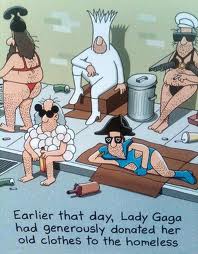
Do you think Lady Gaga finds her stuff comfortable?

Do you think Lady Gaga finds her stuff comfortable? She does it for the greater good.

R.E. Buxbaum. You are your own sculpture; Be art.

Helium leak detector repaired and refurbished in Frankenmuth

To those who know Frankenmuth, MI, it is generally as “Little Bavaria,” the German-themed vacation town of quaint houses and shops; of cheese, wurst, beer, Christmas ornaments, and Oom Pa Pa bands. I know it in a slightly different way as the only town to get your helium leak detector repaired. There are at least three shops in Frankenmuth that repair helium leak detectors (or make new specialty versions), and this is the source of the reference leaks that most qualified shops use. So I was here yesterday and today, both for the World-class snow sculpture contest, and to get my helium leak detector looked at. It was acting funny; it turns out there was a leak in the leak detector plus a bad potentiometer on a switchover circuit. The leak is already fixed, and I should have it back in my shop next week (Wednesday).

Snow-sculpting in Frankenmuth 2013; I was there to have my helium leak detector fixed.

Snow-sculpting in Frankenmuth 2013; I was there to have my helium leak detector fixed.

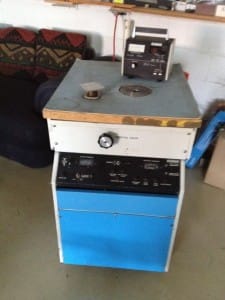
veeco He-leak detector at REB Research.

The joy of curtains

By Dr. Robert E. Buxbaum January 18, 2013

In our northern climates most homes have double-paned windows; they cost a fortune, and are a lot better than plain glass, but they still lose a lot of heat: far more than the equivalent area of wall. The insulation value is poor mostly because the thickness is low: a typical double pane window is only ½” thick. The glass panes have hardly any insulation value, so the majority of the insulation is the 0.3″ air space between them. Our outer walls, by contrast, are typically 6” thick filled with glass –wool. The wall is 12 times as thick as the window, and it turns out that the R value is about 12 times as great. Since window area is about 1/10 the wall area, we can expect that about half your homes heat goes out through the windows (about half the air-conditioner cooling in the summer too). A good trick to improve your home’s insulation, then, is to add curtains as this provides a fairly thick layer of stagnant air inside the room, right next to your windows.

To see how much you can save by adding curtains, it’s nice (for me, and my mind-set mostly) to talk in terms of R values. In the northern USA, the “R” value of a typical, well-insulated outer wall is about 24. What that means is that it takes 24°F and one square foot of wall to remove 1 BTU per hour. That is, the resistance to heat loss is 24 °F.hr.ft2/BTU. The R value for a typical double pane window is about 2 in the same units, and is only 1 if you have single panes. The insulating quality of our windows is so poor that, for many homes, more heat is lost through the windows than through the rest of the wall space.

To figure out how much heat is lost through your windows take the area in square feet multiply by a typical temperature differential (50°F might be typical in Michigan), and divide by the R value of your paned windows (1 or 2) depending on whether it’s single or double paned. Since heat costs about $10/MMBTU ($10 per million BTU) for a gas heated house, you can figure out what a small, 10 ft2 window costs a typical Michigan householder as follows, assuming a single pane (R=1):

Q = Area* ∆T/R = 10 ft2 * 50°F/1 = 500 BTU/hr. Here Q is the heat lost per unit time, ∆T is the temperature difference between the window surface and the room, and A is the ara of the window surface.

Since there are 24 hours in a day, and 30.5 days in a month the dollar cost of that window is 500*24*31.5*10/1,000,000 = $3.78/month. After a few years, you’ll have paid $200 for that small window in lost heat and another $200 in air conditioning.

A cheap solution is to add curtains, shades, or plastic of some sort. These should not be placed too close to the window, or you won’t have a decent air gap, nor so far that the air will not be static in the gap. For small gaps between the window glass and your plastic or curtain, the heat transfer rate is proportional to the thermal conductivity of air, k, and inversely proportional to the air gap distance, ∂.

Q = ∆T A k /∂.

R  = ∂/k.

The thermal conductivity of air, k, is about .024 BTU/ft. hr°F. We thus confirm that the the R-value for an air gap of 9/16” or 1/20 foot is about 2 in these units. Though the typical air gap between the glass is less, about .3″ there is some more stagnant air outside the glass an that counts towards the 9/16″ of stagnant air. The k value of glass or plastic is much higher than of air, so the layers of glass or plastic add almost nothing to the total heat transfer resistance.

Because the R value of glass and plastic is so low, if you cover your window with a layer of plastic sheet that touches the window, the insulation effect is basically zero. To get insulation value you want to use a gap between about ½” and 1” in thickness. If you already have a 2 paned window of R value 2, you can expect to be able to raise your insulation value to 4 by adding a plastic sheet or single curtain at 9/16” from the glass.

Sorry to say, you can’t raise this insulation value much higher than 4 by use of a single air gap that’s more than 1″ thick. When a single gap exceeds this size, the insulating value drops dramatically as gas circulation in the gap (free convection) drives heat transfer. That’s why wall insulation has fiber-glass fill. For your home, you will want something more attractive than fiberglass between you and the window pane, and typical approaches  include cellular blinds or double layer drapes. These work on the same principle as the single sheet, but have extra layers that stop convection.

My favorite version of the double drapes is the federalist version, where the inner drape is near transparent, shim cloth hangs close to the window, with a heavier drape beyond that. The heavier curtain is closed at night and opened in daytime; where insulation is needed, the lighter cloth hangs day and night. This looks a lot better than a roll-type window shade, or bamboo screen. Besides, with a roll-shade or bamboo, you must put it close to the window where it will interfere with the convection flow, that is cold shedding from the shut window.

Another nice alternative is a “cell shade” These are folded lengths of two or more stiff cloths that are formed into honeycombs ½” to 2” apart. This empty thickness provides the insulating power of the shade. Placed at the right distance from the window, the cell shade will add 3 or more to the overall R value of the window (1/12 ft / .024 BTU/ft. hr°F = 3.5 ft2hr°F/BTU). As with a bamboo screen, all this R value goes away if the shade is set at more than about 1” from the window or an interior shade. At a greater thickness that this, the free convection flow of cold air between the window and the shade dominates, and you get a puddle of cold air on the floor. 

I would suggest a cellular shade that opens from the bottom only and is translucent. This provides light and privacy; a shade that is too dark will be left open. Behind this, my home has double-pane windows (when I was single the window was covered by a layer of plastic too). The see-through shade provides insulation while allowing one to see out the window (or let light in) when the shade is drawn. You want to be able to see out; that’s the reason you had a window in the first place. Very thick, insulating curtains and blinds seem like a waste to me – they are enough thicker to add any significant R-value, they block the light, and if they end up far from the window, the shedding heat loss will more than offset any small advantage from the thick cloth.

One last window insulation option that’s worth mentioning is a reflective coating on the glass (an e-coating). This is not as bad an idea as you might think, even in a cold climate as in Detroit. A surprising amount of heat tends to escape your windows in the form of radiation. That is, the heat leaves by way of invisible (infra –red) light that passes unimpeded through the double pane glass. In hot climates even more heat comes in this way, and a coating is even more useful to preserve air conditioning power. Reflective plastic coats are cheap enough and readily available, though they can be hard to apply, and are not always attractive.

You can expect to reduce the window heat loss by a factor of 3 or more using these treatments, reducing the heat loss through the small window to $1.00 or so per month, far enough that the main heat loss is through the walls. At that point, it may be worth putting your efforts elsewhere. Window treatments can save you money, make a previously uninhabitable room pleasant, and can help preserve this fair planet of ours. Enjoy.

Updated, Feb 9, 2022, REB.