Author Archives: R.E. Buxbaum

About R.E. Buxbaum

Robert Buxbaum is a life-long engineer, a product of New York's Brooklyn Technical High School, New York's Cooper Union to Science and Art, and Princeton University where he got a PhD in Chemical Engineering. From 1981 to 1991 he was a professor of Chemical Engineering at Michigan State, and now runs an engineering shop in Oak Park, outside of Detroit, Michigan. REB Research manufactures and sells hydrogen generation and purification equipment. He's married with 3 wonderful children who, he's told, would prefer to not be mentioned except by way of complete, unadulterated compliments. As of 2016, he's running to be the drain commissioner/ water resources commissioner of Oakland county.

Heisenberg joke and why water is wet

I love hydrogen in large part because it is a quantum fluid. To explain what that means and how that leads to water being wet, let me begin with an old quantum physics joke.

Werner Heisenberg is speeding down a highway in his car when he’s stopped by a police officer. “Do you know how fast you were going?” asks the officer. “No idea” answers Heisenberg, “but I know exactly where I am.”

The joke relates to a phenomenon of quantum physics that states that the more precisely you can know the location of something, the less precisely you can infer the speed. Thus, the fact that Heisenberg knew precisely where he was implied that he could have no idea of the car’s speed. Of course, this uncertainty is mostly seen with small things like light and electrons –and a bit with hydrogen, but hardly at all with a car or with Dr. Heisenberg himself (and that’s why it’s funny).

This funky property is related to something you may have wondered about: why is water wet? That is, why does water cling to your hands or clothes while liquid teflon repels. Even further, you may have wondered why water is a liquid at normal conditions when H2S is a gas; H2S is a heavier analog, so if one of the two were a liquid, you’d think it was H2S.

Both phenomena are understood through hydrogen behaving as the quantum car above. Oxygen atoms are pretty small, and hydrogen atoms are light enough to start behaving in a quantum way. When a hydrogen atom attaches to an oxygen atom to form part of a water molecule, its location becomes fixed rather precisely. As a result, the hydrogen atom gains velocity (the hydrogen isn’t going anywhere with this velocity, and it’s sometimes called zero-point energy), but because of this velocity or energy, its bond to the oxygen becomes looser than it would be if you had heavier hydrogen. When the oxygen of another water molecule or of a cotton cellulose molecule comes close, the hydrogen starts to hop back and forth between the two oxygen atoms. This reduces the velocity of the hydrogen atom, and stabilizes the assemblage. There is now less kinetic energy (or zero-point energy) in the system, and this stability is seen as a bond that is caused not by electron sharing but by hydrogen sharing. We call the reasonably stable bond between molecules that share a hydrogen atom this way a “hydrogen bond.” (now you know).

The hydrogen bond is why water is a liquid and is the reason water is wet. The hydrogen atom jumping between water molecules stabilizes the liquid water more than it would stabilize liquid H2S. Since sulfur atoms are bigger than oxygen atoms, the advantage of hydrogen jumping is smaller. As a result, the heat of vaporization of water is higher than that of H2S, and water is a liquid at normal conditions while H2S is a gas.

Water sticks to cotton or your skin the same way, hydrogen atoms skip between the oxygen of water molecules and of these surfaces creating a bond. It is said to whet these surfaces, and the result is that water is found to be wet. Liquid teflon does not have hydrogen atoms that can jump so there is no band that could be made from that direction (there are some hydrogen atoms on the cotton that can jump to the teflon, but there is no advantage to bonding of this sort as there are only a few hydrogen atoms, and these already jump to other oxygens in the cotton. Thus, to jump to the teflon would mean breaking a bond with other oxygen atoms in the cotton — there would be no energy advantage. This then is just one of the reasons I love hydrogen: it’s a quantum-y material.

A visit to the Buxbaum laboratory from Metromedia

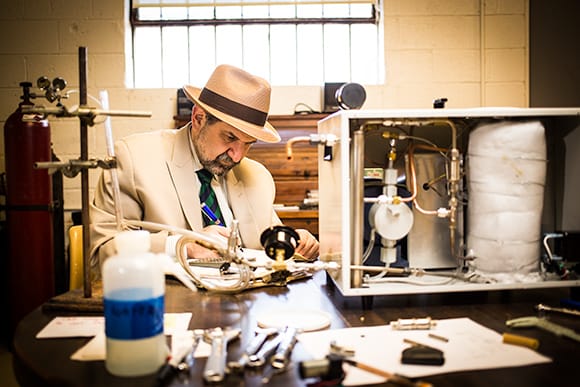
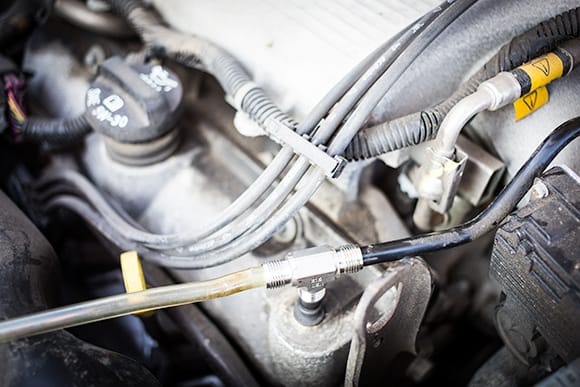
It’s a slow news day in Detroit, so the folks from Metromedia came to visit my laboratory at REB Research. You can visit too. We’re doing cool stuff most of the time, we’re working on a hydrogen-fueled plane that stays aloft for weeks (not that cool, actually, the Hindenberg did it in the 30s). On this particular day I’ve got a cool hat on, and a beige suit. I’m putting hydrogen in my car. Hydrogen increases the speed of combustion, and so it adds to milage — or it has when we’ve added it from electrolysis sources.buxbaum-003

The fun thing about science is that there are always surprises.

Adding hydrogen to a Malibu at REB Research

Adding hydrogen to a Malibu at REB Research

Small hydrogen generators for cooling dynamo generators

A majority of the electricity used in the US comes from rotating dynamos. Power is provided to the dynamos by a turbine or IC engine and the dynamo turns this power into electricity by moving a rotating coil (a rotor) through a non-rotating magnetic field provided by magnets or a non-rotating coil (a stator). While it is easy to cool the magnets or stator, cooling the rotor is challenging as there is no possibility to connect it cooling water or heat transfer paste. One of the more common options is hydrogen gas.

It is common to fill the space between the rotor and the stator with hydrogen gas. Heat transfers from the rotor to the stator or to the walls of the dynamo through the circulating hydrogen. Hydrogen has the lowest density of any gas, and the highest thermal conductivity of any gas. The low density is important because it reduces the power drag (wind drag) on the rotor. The high heat transfer coefficient helps cool the rotor so that it does not burn out at high power draw.

Hydrogen is typically provided to the dynamo by a small hydrogen generator or hydrogen bottle. While we have never sold a hydrogen generator to this market, I strongly believe that our membrane reactor hydrogen generators would be competitive; the cost of hydrogen is lower than that of bottled gas; it is far more convenient and safe; and the hydrogen is purer than from electrolysis.

Why isn’t the sky green?

Yesterday I blogged with a simple version of why the sky was blue and not green. Now I’d like to add mathematics to the treatment. The simple version said that the sky was blue because the sun color was a spectrum centered on yellow. I said that molecules of air scattered mostly the short wavelength, high frequency light colors, indigo and blue. This made the sky blue. I said that, the rest of the sunlight was not scattered, so that the sun looked yellow. I then said that the only way for the sky to be green would be if the sun were cooler, orange say, then the sky would be green. The answer is sort-of true, but only in a hand-waving way; so here’s the better treatment.

Light scatters off of dispersed small particles in proportion to wavelength to the inverse 4th power of the wavelength. That is to say, we expect air molecules will scatter more short wavelength, cool colors (purple and indigo) than warm colors (red and orange) but a real analysis must use the actual spectrum of sunlight, the light power (mW/m2.nm) at each wavelength.

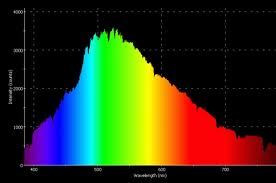
intensity of sunlight as a function of wavelength (frequency)

intensity of sunlight as a function of wavelength

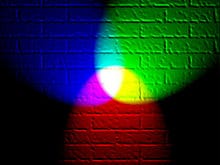
The first thing you’ll notice is that the light from our sun isn’t quite yellow, but is mostly green. Clearly plants understand this, otherwise chlorophyl would be yellow. There are fairly large components of blue and red too, but my first correction to the previous treatment is that the yellow color we see as the sun is a trick of the eye called additive color. Our eyes combine the green and red of the sun’s light, and sees it as yellow. There are some nice classroom experiment you can do to show this, the simplest being to make a Maxwell top with green and red sections, spin the top, and notice that you see the color as yellow.

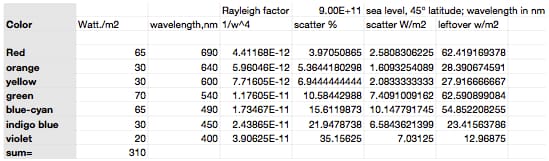
In order to add some math to the analysis of sky color, I show a table below where I divided the solar spectrum into the 7 representative colors with their effective power. There is some subjectivity to this, but I took red as the wavelengths from 620 to 750nm so I claim on the table was 680 nm. The average power of the red was 500 mW/m2nm, so I calculate the power as .5 W/m2nm x 130 nm = 65W/m2. Similarly, I took orange to be the 30W/m2 centered on 640nm, etc. This division is presented in the first 3 columns of the following table. The first line of the table is an approximate of the Rayleigh-scatter factor for our atmosphere, with scatter presented as the percent of the incident light. That is % scattered = 9E11/wavelength^4.skyblue scatter

To use the Rayleigh factor, I calculate the 1/wavelength of each color to the 4th power; this is shown in the 4th column. The scatter % is now calculated and I apply this percent to the light intensities to calculate the amount of each color that I’d expect in the scattered and un-scattered light (the last two columns). Based on this, I find that the predominant wavelength in the color of the sky should be blue-cyan with significant components of green, indigo, and violet. When viewed through a spectroscope, I find that these are the colors I see (I have a pocket spectroscope and used it an hour ago to check). Viewed through the same spectroscope (with eye protection), I expect the sun should look like a combination of green and red, something our eyes see as yellow (I have not done this personally). At any rate, it appears that the sky looks blue because our eyes see the green+ cyan+ indigo + purple in the scattered light as sky blue.220px-RGB_illumination

At sunrise and sunset when the sun is on the horizon the scatter percents will be higher, so that all of the sun’s colors will be scattered except red and orange. The sun looks orange then, as expected, but the sky should look blue-green, as that’s the combination of all the other colors of sunlight when orange and red are removed. I’ve not checked this last yet. I’ll have to take my spectroscope to a fine sunset and see what I see when I look at the sky.

Why isn’t the sky green and the sun orange?

Part of the reason the sky isn’t green has to do with the color of the sun. The sun’s color, and to a lesser extent, the sky color both are determined by the sun’s surface color, yellow. This surface color results from black body radiation: if you heat up a black object it will first glow red, then orange, yellow, green etc. Red is a relatively cool color because it’s a low frequency (long wavelength) and low frequencies are the lowest energy photons, and thus are the easiest for a black body to produce. As one increases the temperature of a black object, the total number of photons increases for all wavelengths, but the short wavelength (high frequency) colors increase faster than the of long wavelength colors. As a result, the object is seen to change color to orange, then yellow, or to any other color representative of objects at that particular temperature.

Our star is called a yellow sun because the center color of its radiation is yellow. The sun provides radiation in all colors and wavelengths, even colors invisible to the eye, infra red and ultra violet, but because of its temperature, most of the radiated energy appears as yellow. This being said, you may wonder why the sky isn’t yellow (the sky of Mars mostly is).

The reason the sky is blue, is that some small fraction of the light of the sun (about 10%) scatters off of the molecules of the air. This is called Rayleigh scatter — the scatter of large wavelegth waves off of small objects.  The math for this will be discussed in another post, but the most relevant aspect here is that the fraction that is scattered is proportional to the 4th power of the frequency. This is to say, that the high frequencies (blue, indigo, and violet) scatter a lot, about 20%, while the red hardly scatters at all. As a result the sky has a higher frequency color than the sun does. In our case, the sky looks blue, while the sun looks slightly redder from earth than it does from space — at least that’s the case for most of the day.

The sun looks orange-red at sundown because the sunlight has to go through more air. Because of this, a lot more of the yellow, green, and blue scatter away before we see it. Much more of the scatter goes off into space, with the result that the sky to looks dark, and somewhat more greenish at sundown. If the molecules were somewhat bigger, we’d still see a blue sky, maybe somewhat greener, with a lot more intensity. That’s the effect that carbon dioxide has — it causes more sunlight to scatter, making the sky brighter. If the sun were cooler (orange say), the sky would appear green. That’s because there would be less violet and blue in the sunlight, and the sky color would be shifted to the longer wavelengths. On planets where the sun is cooler than ours, the sky is likely green, but could be yellow or red.

Rayleigh scatter requires objects that are much smaller than the light wavelength. A typical molecule of air is about 1 nm in size (1E-9 of a meter), while the wavelength of yellow light is 580 nm. That’s much larger than the size of air molecules. Snow appears white because the size of the crystals are the size of the sun wavelengths, tor bigger, 500-2000 nm. Thus, the snow looks like all the colors of the sun together, and that’s white. White = the sum of all the colors: red + orange + blue + green + yellow + violet + indigo.

Robert Buxbaum  Jan. 27, 2013 (revised)

Newfie joke (Newfie’s are Canadians from Newfinland)

Here’s a Newfie joke; it was originally another joke, but I tweaked it because I was in Frankenmuth today watching folks snow sculpt and ice-fish. As for Newfinland, it’s basically the Appalachia of Canada. The folks there aren’t considered to be particularly bright. Anyway.

So this Newfie decides it’s time he took up ice fishing. It’s winter and all his other Newfie friends ice fish. So he gets a setup with an ice drill, a few short fishing poles, a plastic pail to sit on, and a little tent, and he goes to set it up on the ice early one morning.

He finds a nice, empty spot, but as soon as he’s set up the pail and tent but he hears a voice from somewhere around him, “Go home, there are no fish under the ice.” He looks all around but he can’t see anyone. Who said that? Was that comment for him? He goes back to start drilling, and he hears the voice again. “Go home; there are no fish under the ice.” Well, he still can’t see anyone, but figures that maybe he should go to a different spot. He picks up his stuff, moves about 50 feet away and starts to set up again, when he hears the voice again, just as loud. “Go home, there are no fish under the ice.” “Who are you?” yells the Newfie to no-one in particular, “God?” “I’m the rink manager. There are no fish under the ice.”

Helium leak detector repaired and refurbished in Frankenmuth

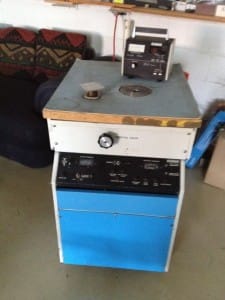
To those who know Frankenmuth, MI, it is generally as “Little Bavaria,” the German-themed vacation town of quaint houses and shops; of cheese, wurst, beer, Christmas ornaments, and Oom Pa Pa bands. I know it in a slightly different way as the only town to get your helium leak detector repaired. There are at least three shops in Frankenmuth that repair helium leak detectors (or make new specialty versions), and this is the source of the reference leaks that most qualified shops use. So I was here yesterday and today, both for the World-class snow sculpture contest, and to get my helium leak detector looked at. It was acting funny; it turns out there was a leak in the leak detector plus a bad potentiometer on a switchover circuit. The leak is already fixed, and I should have it back in my shop next week (Wednesday).

Snow-sculpting in Frankenmuth 2013; I was there to have my helium leak detector fixed.

Snow-sculpting in Frankenmuth 2013; I was there to have my helium leak detector fixed.

veeco He-leak detector at REB Research.

Purifying the Hydrogen from Browns gas, HHO, etc.

Perhaps the simplest way to make hydrogen is to stick two electrodes into water and to apply electricity. The gas that is produced is mostly hydrogen, and is sometimes suitable for welding or for addition to an automobile engine to increase the mileage. Depending on the electrodes and whether salt is added to the water, the gas that is produced can be Browns gas, HHO,  town gas, or some relative of the three. We are sometimes asked if we can purify the product of this electrolysis, and my answer is typically: “maybe,” or “it depends.”

If the electrode was made of stainless steel and the water contained only KOH or baking soda, the gas that results will be mostly hydrogen and you will be able to purify it somewhat with a polymer membrane if you wish. The gas isn’t very explosive generally, since most of the oxygen that results from the electrolysis will go into rusting out the electrodes. The reaction is thus, H2O + Fe –> H2 + FeO. To see if this is what you’ve got, you can use determine the ratio of gas production with a simple version of the Hoffman apparatus made from (for example) two overturned glass jars, or by separating the electrodes with a paper towel. You can also determine the H2 to O2 ratio (if you know a bit more physics) from a measure of the amperage and the rate of gas production. The hydrogen you form with steel plates will always contain some oxygen though, as well as some nitrogen and water vapor. While a polymer membrane will remove most of the oxygen and nitrogen in this gas, it won’t remove all, and it will not generally remove any of the water. With this gas, I suspect that you would be better off just using it as it is. This is particularly so if the fraction of oxygen is more than a few percent: hydrogen with more oxygen than this becomes quite explosive.

Since this gas will contain water, you probably don’t want to store it, and you probably don’t want to purify it over a metal, either, There are two reasons for this: the water can condense out during storage, and will tend to rust whatever metal it contacts (it’s often alkaline). What’s more, the small amount of oxygen in the hydrogen is likely to react over a hydrogen storage metal to form water and heat. This may give rise to the explosion you were trying to avoid. This is clearly the quick a dirty approach to making hydrogen.

Another version of electrolysis gas, one that’s even quicker and dirtier than the above involves the use of table salt instead of KOH or baking soda. The hydrogen that results will contain chlorine as an impurity, and will be quite toxic, but it will be somewhat less explosive.The hydrogen will smell like bleach and the water you use will turn slightly greenish and quite alkaline. Both the liquid and gas are definitely bad news unless your aim was to make chlorine and alkali; this is called the chlor-alkali process for a reason. On a personal note, as a 12 year old I tried this and was confused about why I got equal volumes of gas on the cathode and anode. The reason was that I was making Cl2, and not O2: the chemistry is 2 H2O + 2 NaCl –> H2 + Cl2 + 2 NaOH. I then I used the bromide version reaction to make a nice sample of bromine liquid. That is, I used KBr instead of table salt. Bromine is brown, oily, and only sparingly soluble in water.

Another version of this electrolysis process involves the use of graphite electrodes. If you are lucky, this will give you a mix of CO and hydrogen and not H2 and O2. This mix is a called “town gas.” It’s a very good welding gas since it is not explosive. It is, however, quite toxic. If you begin to get a headache using this gas stop immediately: you’re experiencing CO poisoning. The reaction here is H2O + C –> H2 + CO. CO headaches just get worse and worse until you die. If you are not lucky here you can get HHO instead of town gas, and this is quite explosive: H2O –> H2 + 1/2 O2. The volume ratio will be a key clue as to which you are making; another clue is to put a small volume in a paper bag and light it. If the bag explodes with a terrific bang, you’ve made the wrong gas. Stop!

With all of these gases I would recommend that you add a polymer of paper membrane in the water between the electrodes. Filter paper will work fine for this as will ceramic paper; the classic membrane for this was asbestos. If you keep the two product gas streams separate as soon as they are formed, you’ll avoid most of your explosion-safety issues. Few people take this advice, I’ve found; they think there must be some simpler way. Trust me: this is the classic, safe way to make electrolysis hydrogen.

A balloon filled with pure hydrogen will not ignite. To show you, here is a 2.5 min long video where I poke a lit cigar into a mylar balloon filled with hydrogen from my membrane reactor generators. Note that this hydrogen does not even burn in the balloon because it is oxygen free. As a safety check try this with your hydrogen, but only on a much-smaller scale. Pure hydrogen will not go boom, impure hydrogen will. My advice: keep safe and healthy. You’ll feel better that way, and your heirs will be less inclined to sue me.

In case you are wondering how electrolysis hydrogen can add to the gas mileage, the simple answer is that it increases the combustion speed and the water vapor decreases the parasitic loss due to vacuum. I’ve got some more information on this here. I hope this advice helps with your car project or any other electrolysis option. In my opinion, one should use a membrane in the water to separate the components at formation in all but the smallest experiments and with the smallest amperage sources. Even these should be done only in a well-ventilated room or on a car that is parked outside of the house. Many of the great chemists of the 1800s died doing experiments like these; learn from their mistakes and stay among the living.

What causes the swirl of tornadoes and hurricanes

Some weeks ago, I presented an explanation of why tornadoes and hurricanes pick up stuff based on an essay by A. Einstein that explained the phenomenon in terms of swirling fluids and Coriolis flows. I put in my own description that I thought was clearer since it avoided the word “Coriolis”, and attached a video so you could see how it all worked — or rather that is was as simple as all that. (Science teachers: I’ve found kids love it when I do this, and similar experiments with centrifugal force in the class-room as part of a weather demonstration).

I’d like to now answer a related question that I sometimes get: where does the swirl come from? hurricanes that answer follows, though I think you’ll find my it is worded differently from that in Wikipedia and kids’ science books since (as before) I don’t use the word Coriolis, nor any other concept beyond conservation of angular momentum plus that air flows from high pressure to low.

In Wikipedia and all the other web-sits I visited, it was claimed that the swirl came from “Coriolis force.” While this isn’t quite wrong, I find this explanation incomprehensible and useless. Virtually no-one has a good feel for Coriolis force as such, and those who do recognize that it doesn’t exist independently like gravity. So here is my explanation based on low and high pressure and on conservation of angular momentum.  I hope it will be clearer.

All hurricanes are associated with low pressure zones. This is not a coincidence as I understand it, but a cause-and-effect relationship. The low pressure center is what causes the hurricane to form and grow. It may also cause tornadoes but the relationship seems less clear. In the northern hemisphere, the lowest low pressure zones are found to form over the mid Atlantic or Pacific in the fall because the water there is warm and that makes the air wet and hot. Static air pressure is merely the weight of the air over a certain space, and as hot air has more volume and less density, it weighs less. Less weight = less pressure, all else being equal. Adding water (humidity) to air also reduces the air pressure as the density of water vapor is less than that of dry air in proportion to their molecular weights. The average molecular weight of dry air is 29 and the molecular weight of water is 18. As a result, every 9% increase in water content decreases the air pressure by 1% (7.6 mm or 0.3″ of mercury).

Air tends to flow from high pressure zones to low pressure zones. In the northern hemisphere, some of the highest high pressure zones form over northern Canada and Russia in the winter. High pressure zones form there by the late fall because these regions are cold and dry. Cold air is less voluminous than hot, and as a result additional hot air flows into these zones at high altitude. At sea level the air flows out from the high pressure zones to the low pressure zones and begins to swirl because of conservation of angular momentum.

All the air in the world is spinning with the earth. At the north pole the spin rate is 360 degrees every 24 hours, or 15 degrees per hour. The spin rate is slower further south, proportionally to the sine of the latitude, and it is zero at the equator. The spin of the earth at your location is observable with a Foucault pendulum (there is likely to be one found in your science museum). We normally don’t notice the spin of the air around us because the earth is spinning at the same rate, normally. However the air has angular momentum, and when air moves into into a central location the angular speed increases because the angular momentum must be conserved. As the gas moves in, the spin rate must increase in proportion; it eventually becomes noticeable relative to the earth’s spin. Thus, if the air starts out moving at 10 degrees per hour (that’s the spin rate in Detroit, MI 41.8° N), and moves from 800 miles away from a low pressure center to only 200 miles from the center, the angular momentum must increase four times, or to 40 degrees per hour. We would only see 30 degrees/hr of this because the earth is spinning, but the velocity this involves is significant: V= 200 miles * 2* pi *30/360 = 104 mph.

To give students a sense of angular momentum conservation, most science centers (and colleges) use an experiment involving bicycle wheels and a swivel chair. In the science centers there is usually no explanation of why, but in college they tend to explain it in terms of vectors and (perhaps) gauge theories of space-time (a gauge is basically a symmetry; angular momentum is conserved because space is symmetric in rotation). In a hurricane, the air at sea level always spins in the same direction of the earth: counter clockwise in the northern hemisphere, clockwise in the southern, but it does not spin this way forever.

The air that’s sucked into the hurricane become heated and saturated with water. As a result, it becomes less dense, expands, and rises, sucking fresh air in behind it. As the hot wet air rises it cools and much of the water rains down as rain. When the, now dry air reaches a high enough altitude its air pressure is higher than that above the cold regions of the north; the air now flows away north. Because this hot wet air travels north we typically get rain in Michigan when the Carolinas are just being hit by hurricanes. As the air flows away from the centers at high altitudes it begins to spin the opposite direction, by the way, so called counter-cyclonally because angular momentum has to be consevered. At high altitudes over high pressure centers I would expect to find cyclones too (spinning cyclonally) I have not found a reference for them, but suspect that airline pilots are aware of the effect. There is some of this spin at low altitudes, but less so most of the time.

Hurricanes tend to move to the US and north through the hurricane season because, as I understand it, the cold air that keeps coming to feed the hurricane comes mostly from the coastal US. As I understand it the hurricane is not moving as such, the air stays relatively stationary and the swirl that we call a hurricane moves to the US in the effective direction of the sea-level air flow.

For tornadoes, I’m sorry to say, this explanation does not work quite as well, and Wikipedia didn’t help clear things up for me either. The force of tornadoes is much stronger than of hurricanes (the swirl is more concentrated) and the spin direction is not always cyclonic. Also tornadoes form in some surprising areas like Kansas and Michigan where hurricanes never form. My suspicion is that most, but not all tornadoes form from the same low pressure as hurricanes, but by dry heat, not wet. Tornadoes form in Michigan, Texas, and Alabama in the early summer when the ground is dry and warmer than the surrounding lakes and seas. It is not difficult to imagine the air rising from the hot ground and that a cool wind would come in from the water and beginning to swirl. The cold, damp sea air would be more dense than the hot, dry land air, and the dry air would rise. I can imagine that some of these tornadoes would occur with rain, but that many the more intense?) would have little or none; perhaps rain-fall tends to dampen the intensity of the swirl (?)

Now we get to things that I don’t have good explanation for at all: why Kansas? Kansas isn’t particularly hot or cold; it isn’t located near lakes or seas, so why do they have so many tornadoes? I don’t know. Another issue that I don’t understand: why is it that some tornadoes rotate counter cyclonicly? Wikipedia says these tornadoes shed from other tornadoes, but this doesn’t quite seem like an explanation. My guess is that these tornadoes are caused by a relative high pressure source at ground level (a region of cold ground for example) coupled with a nearby low pressure zone (a warm lake?). My guess is that this produces an intense counter-cyclonic flow to the low pressure zone. As for why the pressure is very low in tornadoes, even these that I think are caused by high pressure, I suspect the intense low pressure is an epee-phenomenon caused by the concentration of spin — one I show in my video. That is, I suspect that the low pressure in the center of counter-cyclonic tornadoes is not the cause of the tornado but an artifact of the concentrated spin. Perhaps I’m wrong here, but that’s the explanation that seems to fit best with the info I’ve got. If you’ve got better explanations for these two issues, I’d love to hear them.