Monthly Archives: December 2025

Is China really a smaller economy than the US, but twice as efficient

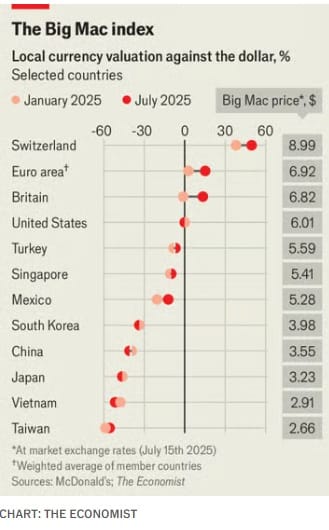
The Economist has run this burger-metric of currency valuation for 40 years or so. I find it instructive.

One can buy a new electric car in China for US $20,000, roughly half of what it would cost in the US. Similarly, a good phone is cheaper in China, or clothes, or a Big Mac. A McDonald’s Big Mac in China costs, effectively $3.55, 59% of what it costs in the US, slightly less than 3/5 the US price. The Chinese explanation is that China is nearly twice as efficient as the US at most every type of manufacturing. I don’t believe this explanation, though there is some truth to it: Their electricity is cheaper, in part because they burn mostly coal for electric power. Meanwhile we have shut-down our coal plants, and have hardly built nuclear since the 1970s.

Another source of efficiency is that China arranges its manufacturing into dedicated cities for different products, one city for toys, another for luggage, others for cars, planes, hair driers… This helps efficiency but I’m not sure how much, and I don’t see these advantages applying to McDonald’s. There is no way I believe their workers are 5/3 as efficient as US workers when it comes to making burgers. It’s not like they ship the burgers from a central factory, and they buy gain and meat from us. My sense, then, is that it’s not efficiency that keeps prices low, but that the Chinese currency, the yuan is undervalued.

It’s hard to estimate how much their currency is undervalued, but I will use the burger-metric, above and say the yuan selling for about 3/5 its true value, and that this explains most of why Chinese shoes, cars, and clothes are so cheap. The rest of the price difference is efficiency, I’d guess. China isn’t the only country with an under-valued currency; Japan’s currency seems even more undervalued. Similarly India, Taiwan… The China is a bigger economy, though, and correcting the Chinese GDP by 5/3, I find their economy is yet bigger, about 111% as big as ours. By a similar correction, European economies appear smaller than they are given credit for.
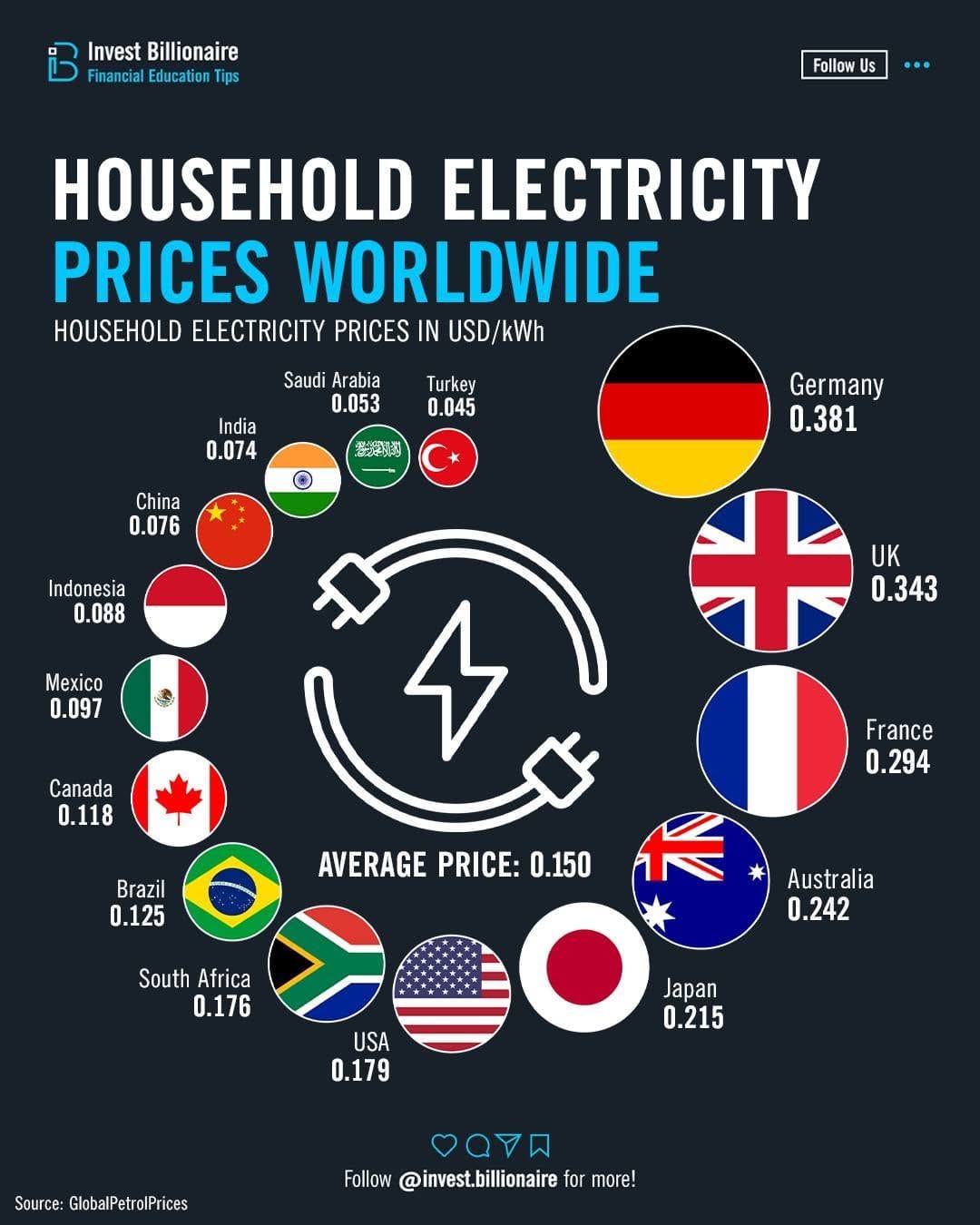
Chinese electricity is cheap, in part because they burn coal. Also, their currency is undervalued; ditto for India, Indonesia, Turkey.

China’s undervalued currency helps propel its growth, I think, and provides us with cheap goods, but our industry suffers. Also troubling, China will likely surpass us militarily in 3-5 years. One way of slowing this is through tariffs. Trump’s tariff formula, as I understand it, was designed to preserve some China trade, allowing US consumers to benefit, but also taxing the exchange. I think this is a good idea.

Another proposal is to lower the US interest rates. Currently our prime interest rate is 6.5% while China’s is 3%. This provides an incentive for the Chinese industry to invest in the US, maintaining its undervalued currency. The benefit isn’t quite as large as it might seem since we have a 2.7% inflation rate and China has a 0.7% inflation rate. Correcting for this, our bonds return an effective 3.8% and Chinese bonds return 2.3%. The difference is about 3/5 similar to the mismatch in our currencies. Trump has been pushing the Federal Reserve to lower our interest rates, and The Fed has grudgingly agreed, slowly. A lower interest rate would also spike US industry and inflation, and help reduce the government deficit. Trump has also proposed new ships for the navy. Too little, too late, I think. Things should get dicy in the next decade between the US and China.

Robert Buxbaum, December 30, 2025. I started this post not knowing where it would lead. As I research and write, I learn. Perhaps you will too,
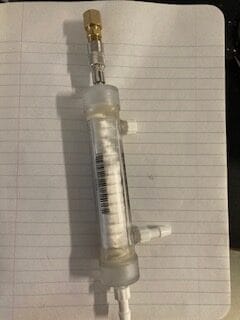
Drying hydrogen with polymeric membranes

Generally, when you make hydrogen, you make wet hydrogen, hydrogen contaminated with water. Usually you want to dry the hydrogen before you use it or compress it. if you compress the hydrogen for transport or storage without drying it, the water will condense and perhaps freeze, clogging valves and fittings.

Water contamination of hydrogen is also a problem for brazing. Hydrogen is a good, cover gas for brazing because of its high heat transfer properties and its reducing chemistry. When the hydrogen is contaminated with water vapor it is unstable for use with stainless steel and similar metals as it will cause oxidation of the surface, resulting in a grey-green surface, and preventing good brazing. Some other contaminates can be problems, e.g. CO2 but water is the main problem in brazing environments.

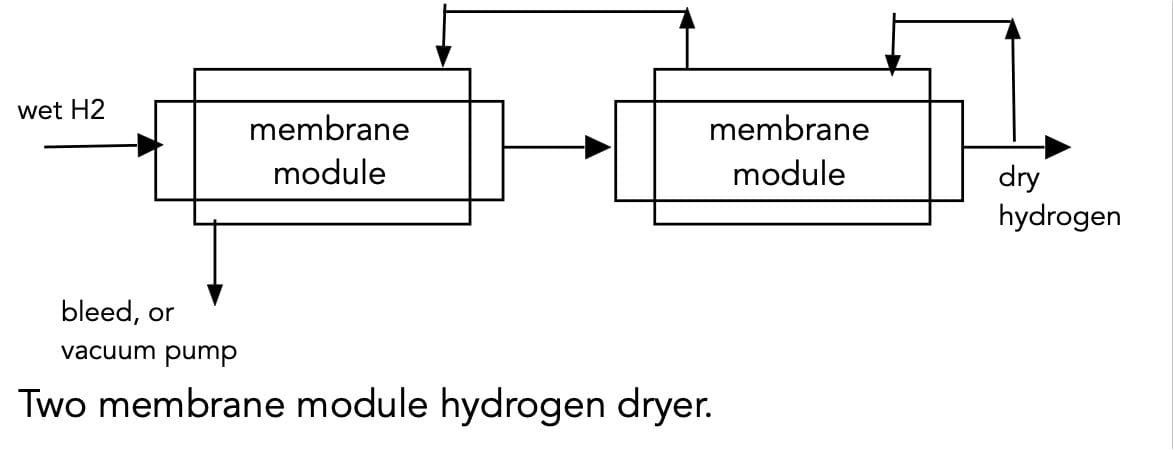
One more example where drying hydrogen is important, is for its use in high altitude balloons. At high altitudes, water can condense, changing the lift characteristics, and perhaps freezing and puncturing the balloon. For all these applications, I suggest use of a silicone polymeric membrane operated as dryers, using a counter current flow as shown below. We sell these at REB Research, see here. These membranes also remove CO2, silanes, and H2S.

The dryer shown in the figure above has two extraction modules in series. for small flows, one module will suffice. As shown, wet hydrogen enters at left, typically at a slightly elevated pressure, 2-4 atm. The bleed stream must be at lower pressure. One atm will work for the bleed stream, but for efficient removal of the water and CO2, you will want mild vacuum, perhaps 1/3 atm. A small amount of dry hydrogen should be directed into the sweep stream as shown for efficient impurity removal. The amount directed to the bleed flow is large determined by the ratio of pressures and by the selectivity of the membrane. At a pressure ratio of ten, for example, you can show that you need at least a leaving bleed flow of 10% of the H2 to remove all the water in the hydrogen, leaving it perfectly dry. In practice, you’ll want a larger exit bleed flow, perhaps 15%, suggesting that you want a recycle stream of ~5% of the dry hydrogen. This will be joined by 10% more hydrogen that comes through the membrane modules. The membranes are 30x more selective to water than to hydrogen.

A silicone module of 0.1m2

Our silicone membranes remove CO2 too, but not with as high a selectivity. For mobile use, you might want to power the vacuum pump by a fuel cell that runs on the waste, wet hydrogen of the bleed stream.

For many applications you need to remove all the impurities, including all the nitrogen and CO2. This is true for diamond making, semiconductors, and nuclear fusion. For this, you want a metallic membrane, e.g. palladium-silver. We sell hydrogen purifiers based on palladium-silver membranes for these applications. Palladium-silver membranes remove all impurities, see why here. You still need a bleed flow, but it can be much lower than the pressure ratio because, with metallic membranes, the hydrogen goes through the membrane, and the impurities stay behind. Of course, palladium costs more than plastics. See our products at www.rebresearch.com.

Robert Buxbaum, December 19, 2025

Banned books, promoted books, basically no oversight

For better or worse, the folks who run for library board and school board are a bizarre lot of political weirdos. It takes a lot of work and time and money to run for these boards, and you have to endure endless insults. For what? If you win, there’s no pay, and you get to sit through long, boring meetings. Because of this, almost everyone, who choses to run for these positions is a weirdo with a bering desire to either ban some book or idea, or to promote them. The rest are little better: developers who want to expand buildings and grounds. I don’t think this problem is unique to the US, or new. That’s just the way it is, and has always been. Noah Webster complained about this in the early 1800s. The net result is large schools – larger than they have to be – and many banned books, plus a preponderance of really perverted books.

In terms of teaching, I find myself on the side of classic books that are fairly non-sexual. That’s because I read them. Many people find them dull. I suspect that the students would prefer more modern and racier fare, or no books at all, but what do I know. In terms of library purchase, I like variety, but virtually no library works that way, either the board are a band of perverts pushing weird sex on under-age kids, or they are blue-noses who want to keep Shakespeare from the shelves. I also claim to prefer a diversity of opinions both in the classroom and in the library, but I suspect that, I’m likely to favor my own opinions over others. Below is the selection of banned books that the “don’t censor” organization wants on all shelves, all gay or transgender, as best I can tell. .

These books are banned in some counties K-12 public schools all are gay or transgender. While I’m not a fan of banning, I’m doubt these are the books to push. Pecksniffs on every side.

Sometimes very good books get banned, for no reason, or modified. This was done with Bowdlerized Shakespeare, for example. Once banned, it’s a lot harder to un-ban a book than it is to ban it. You’d have to get an unbanning committee together, almost impossible, and get them to read all the books. They’d have to make a coherent argument for their merits, and then have some vote. It would help to have balanced boards, but I fear that’s not likely/ possible. If nothing else, I’d like a time limit to banning: any banned book stays banned for only 12 years, or so.

I ran for school-board one year, by the way, and lost. I campaigned on math and science education, and less money for ever larger buildings and grounds. Against AI teaching of math and reading, claiming that math education suffers,. I also like cursive handwriting, something I consider an art form. I lost. You can find my Ballotopedia page if you’re interested.

Robert E. Buxbaum, November 28, 2025