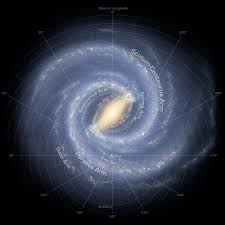
Our planet, Earth, is located in a spiral galaxy, with two arms. We’re about 30,000 light years out from the galactic center (1.8E17 miles), and based on red-shift data, our spot moves around the center at about 1,000,000,000 miles/year or 100,000 mph. This is a normal, average speed for other galaxies too. Our whole of the galaxy thus goes round every 200,000,000 years, maintaining its spiral shape as it does. Based on the age of the sun. We’ve gone around the center about 50 times so far. Based on this, there are a few obvious questions that were unknown when I was in grad school in 1976-81 and still unknown now.
First question, why are we moving round so fast, and why are the other galaxies doing the same. Large rotation speeds should not naturally come out of random variation of the gas molecule speeds. And if it comes from different galaxies moving past one another, that just pushes the rotation source problem further out. Maxwell averaging of gas molecules should produce 2000 mph at most, given the temperatures in space.
Another question, even more interesting: If the galaxy’s gone around about 50 times since it condensed, why are there still spiral arms? That’s an awful lot of turns for our galactic arms to retain stable; you’d expect that the outer parts of the arms would have rotated far fewer times, perhaps only once, while the inner parts would have rotated perhaps 1000 times. After a billion years, you’d expect the arms to be gone. The going explanation is that there is dark matter, matter we can’t see, but there should be a lot of dark matter, more than normal matter in fact. Where does it come from? Why don’t we see it?
After bugging astrophysicists for a few years, I’ve come to believe that many of their models (MACHOs, WIMPs) don’t make much sense. I’ve come to be able to model the distribution of dark matter on my own. Based on the stability of things, it seems clear that it is a particular distribution of light, non-interacting particles, with just the right mass to keep it as a non-rotating cloud. This is fine, as far as it goes, a version of the “WIMP theory” where WIMP stands for Weakly Interacting, Massive Particles. It turns out there is only a narrow range of size-mass for these WIMP particles that fits our rotation stability and does not mess up other galaxies. We want our galaxy rotating as a unit — can you figure out what the WIMP particle distribution is? If interested think, or ask: buxbaum@rebresearch.com

A spiral galaxy, much like our own.
But this doesn’t mean that I now know what dark matter WIMPs are. I think I know where they are, but now we need to find the missing matter and understand it. It directly interacts with itself, but not with other matter except by gravity, and yet it came to be, so it should interact at some energy. Also, how did it avoid becoming a spinning disc. All you need is gravity to get other things spinning in the galaxy, why not the dark matter? All the other matter ended up in a spinning disc, because of…. a galactic collision, but this stuff isn’t. The properties of this dark matter are very weird indeed.
A current theory, and it barely justifies being called a theory, is that gravity diminishes at intra-galactic distances. That is, it works like Newton and Einstein say at planetary distances, and does so exactly to fine, fine detail. Then it works the same at inter-galactic distances, moving on galaxy relative to another using the exact same behavior, but somehow, within the galaxy, it becomes weaker. This would be a nonsense theory except that no-one has found the WIMPy particles, or massive MACHOs for that matter.
As a challenge, see if you can calculate the distribution of dark matter that would result in our galaxy rotating as a unit.
— Robert Buxbaum, Dec. 10, 2012. Perhaps an easier question, why doesn’t the heat of all the stars cook us?
Like this:
Like Loading...