Tag Archives: ships

A new, higher efficiency propeller

Elytron biplane, perhaps an inspiration.

Sharrow Marine introduced a new ship propeller design two years ago, at the Miami International Boat show. Unlike traditional propellers, there are no ends on the blades. Instead, each blade is a connecting ribbon with the outer edge behaving like a connecting winglet. The blade pairs provide low-speed lift-efficiency gains, as seen on a biplane, while the winglets provide high speed gains. The efficiency gain is 9-30% over a wide range of speeds, as shown below, a tremendous improvement. I suspect that this design will become standard over the next 10-20 years, as winglets have become standard on airplanes today.
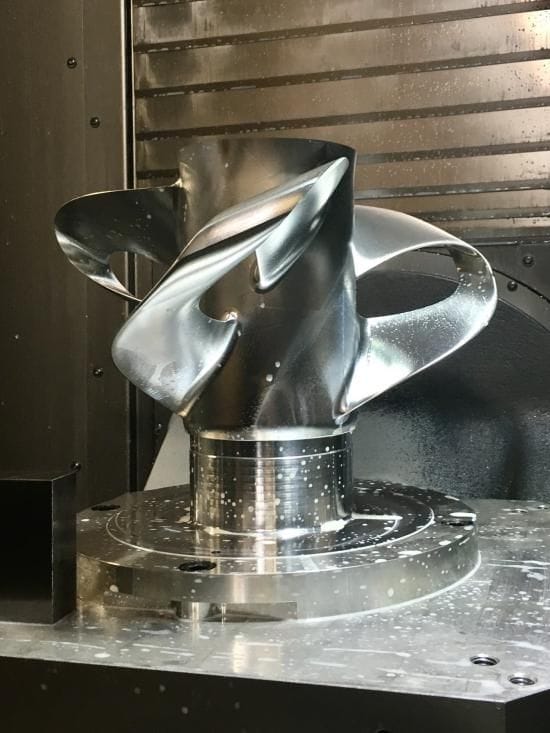
A Sharrow propeller, MX-1

The high speed efficiency advantage of the closed ends of the blades, and of the curved up winglets on modern airplanes is based on avoiding losses from air (or water) going around the end from the high pressure bottom to the low-pressure top. Between the biplane advantage and the wingtip advantage, Sharrow propellers provide improved miles per gallon at every speed except the highest, 32+ mph, plus a drastic decrease in vibration and noise, see photo.

The propeller design was developed with paid research at the University of Michigan. It was clearly innovative and granted design patent protection in most of the developed world. To the extent that the patents are respected and protected by law, Sharrow should be able to recoup the cost of their research and development. They should make a profit too. As an inventor myself, I believe they deserve to recoup their costs and make a profit. Not all inventions lead to a great product. Besides, I don’t think they charge too much. The current price is $2000-$5000 per propeller for standard sizes, a price that seems reasonable, based on the price of a boat and the advantage of more speed, more range, plus less fuel use and less vibration. This year Sharrow formed an agreement with Yamaha to manufacture the propellers under license, so supply should not be an issue.

Vastly less turbulence follows the Sharrow propeller.

China tends to copy our best products, and often steals the technology to make them, employing engineers and academics as spys. Obama/Biden have typically allowed China to benefit for the sales of copies and the theft of intellectual property, allowing the import of fakes to the US with little or no interference. Would you like a fake Rolex or Fendi, you can buy on-line from China. Would you like fake Disney, ditto. So far, I have not seen Chinese copies of the Sharrow in the US, but I expect to see them soon. Perhaps Biden’s Justice Department will do something this time, but I doubt it. By our justice department turning a blind eye to copies, they rob our innovators, and rob American workers. His protectionism is one thing I liked about Donald Trump.
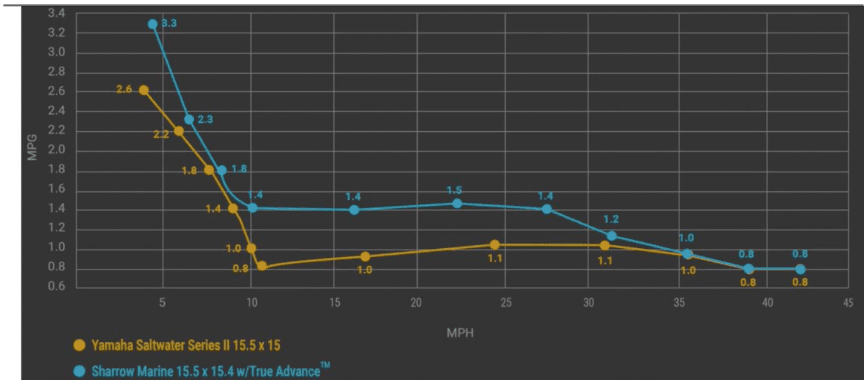
The Sharrow Propeller gives improved mpg values at every speed except the very highest.

Robert Buxbaum, September 30, 2022
Global warming and the president’s Resolute desk

In the summer of 2016, the Crystal Serenity, a cruse ship passed through the Northwest passage, going from the Pacific to the Atlantic above the Canadian arctic circle. It was a first for a cruise ship, but the first time any modern ship made the passage, it was 162 years ago, and the ship was wooden and unmanned. It was the British Resolute; wood from that ship was used to make the President’s main desk — one used by the last four presidents. And thereby hangs a tale of good global warming, IMHO.

President Trump meets with college presidents at the Resolute desk. Originally the front had portraits of Queen Victoria and President Hayes. Those are gone; the eagle on the front is an addition, as is the bottom stand.

President Trump meets with college presidents at the Resolute desk. Originally the front had portraits of Queen Victoria and President Hayes. Those are gone; the eagle on the front is an addition, as is the bottom stand. The desk is now 2″ taller than originally. 

The world today is warmer than it was in 1900. But, what is not generally appreciated is that, in 1900 the world was warmer than In 1800; that in 1800 it was warmer than in 1700; and that, in 1640, it was so cold there were regular fairs on the frozen river Themes. By the 1840s there were enough reports of global warming that folks in England thought the northwest passage might have opened at last. In 1845 the British sent two ships, the Erebus and the Terror into the Canadian Arctic looking for the passage. They didn’t make it. They and their crews were lost and not seen again until 2014. In hopes of finding them though, the US and Britain sent other ships, including the Resolute under the command of captain Edward Belcher.

The Resolute was specially made to withstand the pressure of ice. Like the previous ships, and the modern cruise ship, it entered the passage from the Pacific during the peak summer thaw. Like the ships before, the Resolute and a partner ship got stuck in the ice — ice that was not quite stationary, but nearly so, The ships continued to move with the ice, but at an unbearably slow pace. After a year and a half captain Belcher had moved a few hundred miles, but had had enough. He abandoned his ships and walked out of Canada to face courts martial in England (English captains were supposed to “go down with the ship”). Belcher was acquitted; the ice continued to move, and the ships moved with it. One ship sank, but the Resolute, apparently unscathed, passed through to the Atlantic. Without captain or crew, she was the first ship in recorded history to make the passage, something that would not happen again till the Nautilus nuclear submarine did it under the ice, 100 years later.


The ghost ship Resolute was found in September 1855, five years after she set sail, by captain Buddington of the American whaler, George Henry. She was floating, unmanned, 1200 miles from where captain Belcher had left her. And according to the law of the sea, she belonged to Buddington and his crew to use as they saw fit. But the US was inching to war with Britain, an outgrowth of the Crimean war and seized Russo-American property. Franklin Pierce thought it would help to return the ship as a sign of friendship — to break the ice, as it were. A proposal for funds was presented to congress and passed; the ship was bought, towed to the Brooklyn Navy yard for refitting, and returned to Britain as a gift. The gift may have worked: war with Britain was averted, and the seized property was returned. Then again, Britain went on to supply the confederacy early in the Civil War. None-the-less, it was a notable ship, and a notable gift, and when it was broken up, Parliament decided to have two “friendship desks” made of its timbers. One desk was presented to President Hayes, the other to Queen Victoria. One of these desks sits the British Naval museum at Portsmouth; its American cousin serves Donald Trump in the Oval office as it has served many president before him. It has been used by Coolidge, Kennedy, Carter, Reagan, Clinton, Bush II, and Obama before him — a reminder that global warming can be good, in both senses. If you are interested in the other presidents’ desks, I wrote a review of them here.

As for the reason for the global warming of the mid 1800s, It seems that climate is chaotic. ON a related note, I have proposed that we make a more-permanent northwest passage by cutting thorough one of the islands in northern Canada. If you want to travel the Northwest passage in 2017, there is another cruise scheduled, but passage is sold out.

Robert Buxbaum, March 16, 2017.

Thinking the unthinkable

Do you know how you go about thinking the unthinkable?


With an ithberg, of course.


Robert Buxbaum. April 12, 2016. I thought it was time for another “dad joke.” Besides, the Titanic sank on April 14th. I spend a fair about of time thinking the unthinkable. On a vaguely similar note:

After Boris died, everyone gathered at his funeral.

The minister started to speak: “He was a model husband, a decent man, a terrific father..”

The widow then makes a motion for her son to come to her.

“What is it mother?” he whispers.

“Dear, go check the casket, I think we’re at the wrong funeral…”

The future of steamships: steam

Most large ships and virtually all locomotives currently run on diesel power. But the diesel  engine does not drive the wheels or propeller directly; the transmission would be too big and complex. Instead, the diesel engine is used to generate electric power, and the electric power drives the ship or train via an electric motor, generally with a battery bank to provide a buffer. Current diesel generators operate at 75-300 rpm and about 40-50% efficiency (not bad), but diesel fuel is expensive. It strikes me, therefore that the next step is to switch to a cheaper fuel like coal or compressed natural gas, and convert these fuels to electricity by a partial or full steam cycle as used in land-based electric power plants

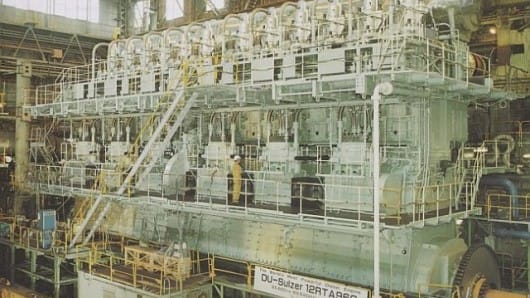
Ship-board diesel engine, 100 MW for a large container ship

Diesel engine, 100 MW for a large container ship

Steam powers all nuclear ships, and conventionally boiled steam provided the power for thousands of Liberty ships and hundreds of aircraft carriers during World War 2. Advanced steam turbine cycles are somewhat more efficient, pushing 60% efficiency for high pressure, condensed-turbine cycles that consume vaporized fuel in a gas turbine and recover the waste heat with a steam boiler exhausting to vacuum. The higher efficiency of these gas/steam turbine engines means that, even for ships that burn ship-diesel fuel (so-called bunker oil) or natural gas, there can be a cost advantage to having a degree of steam power. There are a dozen or so steam-powered ships operating on the great lakes currently. These are mostly 700-800 feet long, and operate with 1950s era steam turbines, burning bunker oil or asphalt. US Steel runs the “Arthur M Anderson”, Carson J Callaway” , “John G Munson” and “Philip R Clarke”, all built-in 1951/2. The “Upper Lakes Group” runs the “Canadian Leader”, “Canadian Provider”, “Quebecois”, and “Montrealais.” And then there is the coal-fired “Badger”. Built in 1952, the Badger is powered by two, “Skinner UniFlow” double-acting, piston engines operating at 450 psi. The Badger is cost-effective, with the low-cost of the fuel making up for the low efficiency of the 50’s technology. With larger ships, more modern boilers and turbines, and with higher pressure boilers and turbines, the economics of steam power would be far better, even for ships with modern pollution abatement.

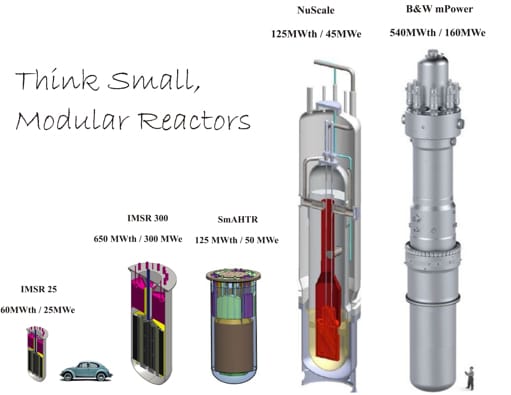
Nuclear steam boilers can be very compact

Nuclear steam boilers can be very compact

Steam powered ships can burn fuels that diesel engines can’t: coal, asphalts, or even dry wood because fuel combustion can be external to the high pressure region. Steam engines can cost more than diesel engines do, but lower fuel cost can make up for that, and the cost differences get smaller as the outputs get larger. Currently, coal costs 1/10 as much as bunker oil on a per-energy basis, and natural gas costs about 1/5 as much as bunker oil. One can burn coal cleanly and safely if the coal is dried before being loaded on the ship. Before burning, the coal would be powdered and gassified to town-gas (CO + H2O) before being burnt. The drying process removes much of the toxic impact of the coal by removing much of the mercury and toxic oxides. Gasification before combustion further reduces these problems, and reduces the tendency to form adhesions on boiler pipes — a bane of old-fashioned steam power. Natural gas requires no pretreatment, but costs twice as much as coal and requires a gas-turbine, boiler system for efficient energy use.

Todays ships and locomotives are far bigger than in the 1950s. The current standard is an engine output about 50 MW, or 170 MM Btu/hr of motive energy. Assuming a 50% efficient engine, the fuel use for a 50 MW ship or locomotive is 340 MM Btu/hr; locomotives only use this much when going up hill with a heavy load. Illinois coal costs, currently, about $60/ton, or $2.31/MM Btu. A 50 MW engine would consume about 13 tons of dry coal per hour costing $785/hr. By comparison, bunker oil costs about $3 /gallon, or $21/MM Btu. This is nearly ten times more than coal, or $ 7,140/hr for the same 50 MW output. Over 30 years of operation, the difference in fuel cost adds up to 1.5 billion dollars — about the cost of a modern container ship.

Robert E. Buxbaum, May 16, 2014. I possess a long-term interest in economics, thermodynamics, history, and the technology of the 1800s. See my steam-pump, and this page dedicated to Peter Cooper: Engineer, citizen of New York. Wood power isn’t all that bad, by the way, but as with coal, you must dry the wood, or (ideally) convert it to charcoal. You can improve the power and efficiency of diesel and automobile engines and reduce the pollution by adding hydrogen. Normal cars do not use steam because there is more start-stop, and because it takes too long to fire up the engine before one can drive. For cars, and drone airplanes, I suggest hydrogen/ fuel cells.

Lets make a Northwest Passage

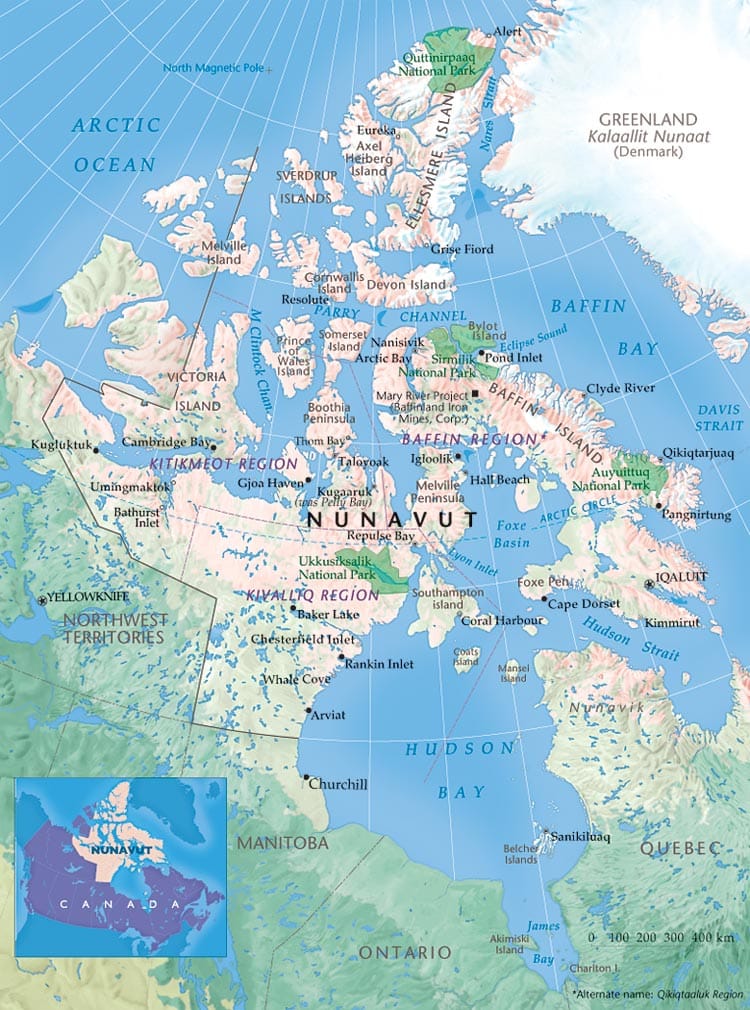
The Northwest passage opened briefly last year, and the two years before allowing some minimal shipping between the Atlantic and the Pacific by way of the Arctic ocean, but was closed in 2013 because there was too much ice. I’ve a business / commercial thought though: we could make a semi-permanent northwest passage if we dredged a canal across the Bootha peninsula at Taloyoak, Nunavut (Canada).Map of Northern Canada showing cities and the Perry Channel, the current Northwest passage. A canal north of the Bootha Peninsula would seem worthwhile.

Map of Northern Canada showing cities and the Perry Channel, the current Northwest passage. A canal north or south of the Bootha Peninsula would seem worthwhile.

As things currently stand, ships must sail 500 miles north of Taloyoak, and traverse the Parry Channel. Shown below is a picture of ice levels in August 2012 and 2013. The proposed channels could have been kept open even in 2013 providing a route for valuable shipping commerce. As a cheaper alternative, one could maintain the Hudson Bay trading channel at Fort Ross, between the Bootha Peninsula and Somerset Island. This is about 250 miles north of Taloyoak, but still 250 miles south of the current route.

Arctic Ice August 2012-2013; both Taloyoak and Igloolik appear open this year.

The NW passage was open by way of the Perry Channel north of Somerset Island and Baffin Island in 2012, but not 2013. The proposed channels could have been kept open even this year.

Dr. Robert E. Buxbaum, October 2013. Here are some random thoughts on Canadian crime, the true north, and the Canadian pastime (Ice fishing).