Tag Archives: psychology

James K. Polk, a great president who did what he said and made America great

One of my favorite presidents is James K. Polk. While running for president he claimed we would do four major things –and do them as a one-term president. He then did them, and left office — and died 103 days later at the age of 53. Mr Polk’s four stated objectives were: a reduction in the tariff, an independent treasury, settlement of the Oregon boundary dispute, and acquisition of California. Acquisition of California required admission of Texas, plus a war with Mexico and a cash payment, but he was ready. Settling the Oregon border required a compromise and a cash payment. But he did it and more. Modern professors are not happy with Polk, ranking him far below Obama, Kennedy, or Adams, but his aims were good, and he got hem done. Few presidents do that, and even fewer left office if they had the power to stay. No professor I know has ever willingly left if he had the power to stay, and didn’t have a better job to go to.
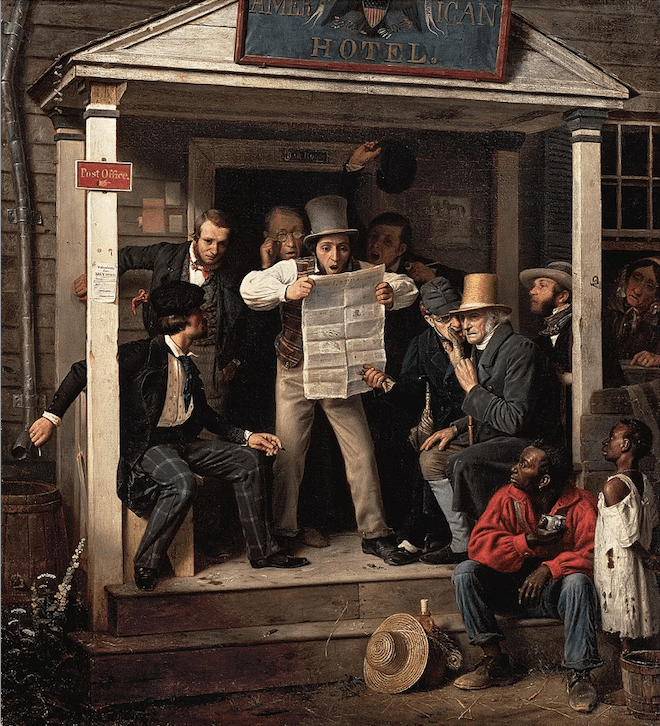
News from Mexico, oil on canvas painting by Richard Caton Woodville Sr., Düsseldorf, 1848. Polk was a god-send for newspaper sales.

I believe that the clarity of Polk’s four objectives was the reason he was a candidate at all, and the reason he won the election, and also the reason he achieved the objectives. There is a magic in clear objectives, repeated often, I find. It’s a formula that got Trump elected that few seem to understand: “Make America Great Again.” “Build the Wall”, “Drill baby Drill” “Deport illegals” “Tariffs. ” Like these ideas or not, you know Trump’s aims. Also, you know that, if. you oppose them, you oppose him. Trump’s pastor, Norman Vincent Peale promoted this approach, one I’ve thought of trying myself. I suspect that Polk died so shortly after leaving office because he had no further goal beyond relaxing; bad water hurt him too.. I suspect that Trump will die shortly after leaving office too- from lack of purpose.

Polk wasn’t expected to be a candidate, but was a “dark horse”, ex-governor of Tennessee, who had lost his past two elections. Martin Van Burin was expected to be the Democrats’ candidate, but he opposed slavery, and most Democrats were for it. What’s more, he was opposing annexation of Texas, at least south of the Nueces River, and many Democrats were for, as were some Whigs.
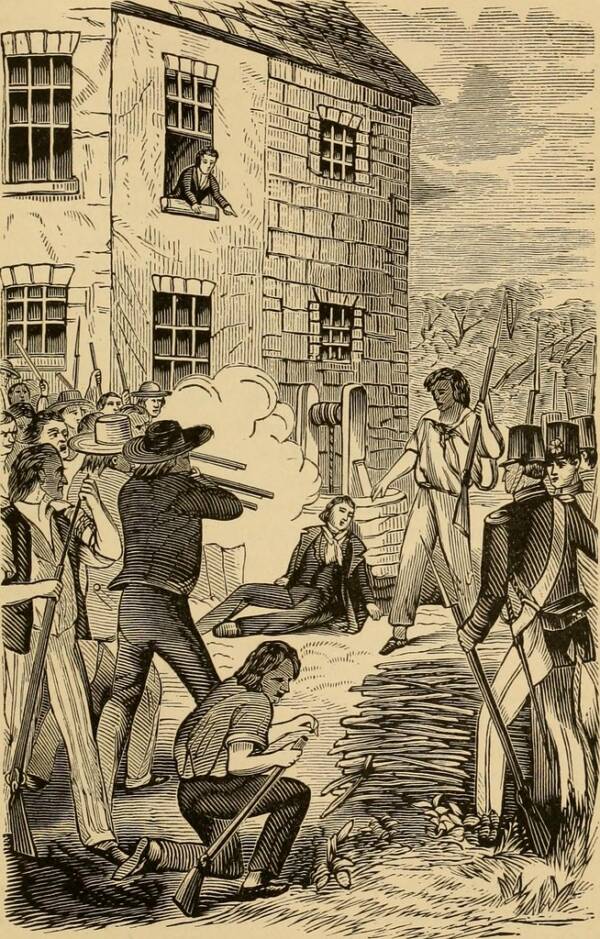
Joseph Smith was shot multiple times while campaigning for president.

Polk was pro-slavery, as was the Whig candidate, Henry Clay. But Polk said repeatedly that he would annex Texas — all the way to the Rio Grande, “no matter what any Mexican said.” He also said he’d fight for California and all of Oregon too: “Fifty four forty or fight”. You might not agree with this, Grant did not, but you knew where he stood. And Polk said he’d serve only one term. Thus, if you didn’t like him, he’d be gone in four years. After a few ballots, Polk became the Democratic Party candidate, with George Dallas as his VP. Like Polk, Dallas was pro Texas – they eventually named a city after him. Clay was Polk’s main opposition, anti Texas, and more vague about everything else.

At first John Tyler, the incumbent, also ran against Polk, but when he saw he was losing, he dropped out to help Polk. Also running for president, 1844 was Joseph Smith, the Mormon founder-profit. he ran as an independent because God told him to. He was shot multiple times, and died while campaigning. Finally there was James G. Birney, the Liberty party candidate. He gained few votes running on an abolitionist ticket. It’s been speculated that Polk won because Birney split the Whig vote. My take is that’s unlikely: Clay was pro-slavery. Polk’s win, I think, was in the power of his clarity.
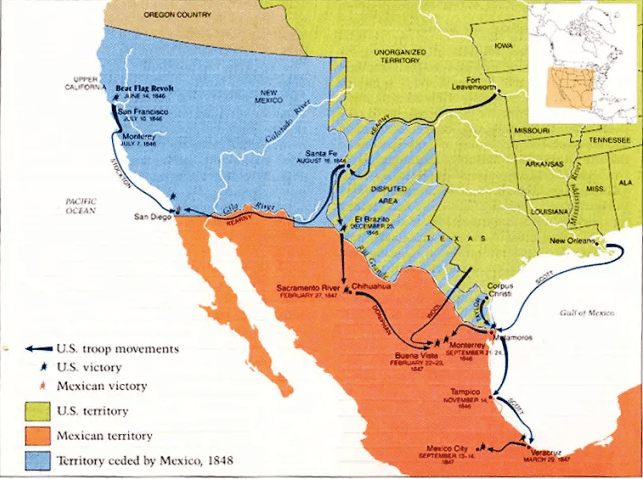
Map of the territory and war.

Once elected, Polk first moved to annex Texas, something he achieved with the help of expresident John Tyler. Tyler sent his Secretary of State, Abel Upsher to negotiat an annexation treaty with Sam Houston, but the Whig-controlled congress rejected it. After the election, Tyler resubmitted the treaty to the new, Democrat-controlled congress, and got two versions passed. The house passed a pro-slavery version, while the senate, pushed by Thomas Hart Benton (a favorite of mine) produced an annexation treaty that divided Texas in half, with a pro-slave and an anti-slave half. Polk liked the pro-slave, House version, returning it to Texas in his first week in office. He instructed the Texas legislature to accept it unconditionally, with no change so he could submit it directly to the Senate. The Texans did so, and congress approved this version later that year. Texas entered the union as one, large, slaveholder state.

With annexation not yet ratified by congress, Polk sent a diplomatic mission to buy California from Mexico along with all of the disputed Texas territory and everything in between for $25 million. Mexico refused, so Polk invited war. He sent 4000 soldiers into disputed Texas territory south of the Nueces River, under command of General Zachary Taylor. Mexican forces attacked them in April 1846, and Polk declared war. The war lasted to 1848, winning all the desired lands including California, and achieving a release of any rights Mexico might have on Oregon.
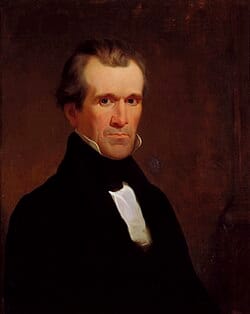
Polk, as governor of Tennessee

The next Polk goal was resolution of the Oregon dispute, ideally with us getting all of it: land that included the current states of Washington, Oregon, and Idaho, plus the Canadian Provence of British Columbia. Britain and Russia also claimed this land, so Polk’s first step was to buy off Russia. The British said they’d fight, noting that they had a larger army and navy and that the US was already at war with Mexico. Polk’s response was to back settlers going to Oregon. Americans had started migrating to Oregon in 1843. In his inaugural address, 1845, Polk said he would defend them “against the British and Indians.” By 1846 Britain recognized the difficulty of fighting US settlers so far from home. On June 15, they agreed to a deal that split the territory along the 49th parallel, giving the US the lower half, except for Vancouver Island, thus allowing Britain an opening to the sea. This deal had been proposed by Edward Everett, Tyler’s minister in London. Polk gave up nothing, beyond an informal agreement to lower tariffs on British goods, something he aimed to do anyway. It’s generally thought that Polk’s willingness for war allowed him to achieve so much without fighting. Polk said, in his inaugural, March 1845: “The world has nothing to fear from military ambition in our government,” a statement that clearly means the opposite of what it claims to say.

Polk’s third goal was lowering the “Black Tariffs”. High and uneven, they were 32% on average, with cut-outs to help specific, northern businesses. Polk’s secretary of the treasury, Robert Walker negotiated a flat advalorum tariff of 25%, with luxury goods, tobacco and alcohol tariffed higher. The “Walker tariff” bill was passed July, 1846, one month after the Oregon agreement. The British, reduced their “corn tariffs” against US grain, benefitting both countries. Our tariffs average 17%, currently, with many cut-outs. I think our tariffs should be more like the Walker tariff, perhaps 20% and simpler.

Polk’s 4th campaign promise was establishing an independent treasury. This was done to weaken “pet” banks, and stabilize the economy. The treasury would now hold all US assets; they would issue most currency, and would pay people directly, either in specie (gold or silver) or notes of debt. Independent banks could still issue notes, but only in amounts over $20. Polk passed this bill August 6, 1846, one week after the Walker Tariff bill. With this, Polk had already achieved all of his goals except California by the mid-term elections, 1846.

Having achieved so much, Polk set out to buy Cuba, but Spain said no. Some other accomplishments: opening the U.S. Naval Academy and the Smithsonian Institution, overseeing the groundbreaking for the Washington Monument, and the issuance of the first United States postage stamp. By the summer of 1848 Polk confirmed that he was satisfied and would not run for re-election. In his address to congress, December 1848, he said, “Peace, plenty, and contentment reign throughout our borders, and our beloved country presents a sublime moral spectacle to the world.” …. “I am heartily rejoiced that my term is so near its close. I will soon cease to be a servant and will become a sovereign.” I trust that was met with applause.

Robert Buxbaum. February 6, 2026. Edward Everett would go on to make the better received speech at Gettysburg. The officer who commanded the 4000 man Texas force, Zachary Taylor, became president in 1849. Like Polk, he died of bad water with too little alcohol added.


Banned books, promoted books, basically no oversight

For better or worse, the folks who run for library board and school board are a bizarre lot of political weirdos. It takes a lot of work and time and money to run for these boards, and you have to endure endless insults. For what? If you win, there’s no pay, and you get to sit through long, boring meetings. Because of this, almost everyone, who choses to run for these positions is a weirdo with a bering desire to either ban some book or idea, or to promote them. The rest are little better: developers who want to expand buildings and grounds. I don’t think this problem is unique to the US, or new. That’s just the way it is, and has always been. Noah Webster complained about this in the early 1800s. The net result is large schools – larger than they have to be – and many banned books, plus a preponderance of really perverted books.

In terms of teaching, I find myself on the side of classic books that are fairly non-sexual. That’s because I read them. Many people find them dull. I suspect that the students would prefer more modern and racier fare, or no books at all, but what do I know. In terms of library purchase, I like variety, but virtually no library works that way, either the board are a band of perverts pushing weird sex on under-age kids, or they are blue-noses who want to keep Shakespeare from the shelves. I also claim to prefer a diversity of opinions both in the classroom and in the library, but I suspect that, I’m likely to favor my own opinions over others. Below is the selection of banned books that the “don’t censor” organization wants on all shelves, all gay or transgender, as best I can tell. .

These books are banned in some counties K-12 public schools all are gay or transgender. While I’m not a fan of banning, I’m doubt these are the books to push. Pecksniffs on every side.

Sometimes very good books get banned, for no reason, or modified. This was done with Bowdlerized Shakespeare, for example. Once banned, it’s a lot harder to un-ban a book than it is to ban it. You’d have to get an unbanning committee together, almost impossible, and get them to read all the books. They’d have to make a coherent argument for their merits, and then have some vote. It would help to have balanced boards, but I fear that’s not likely/ possible. If nothing else, I’d like a time limit to banning: any banned book stays banned for only 12 years, or so.

I ran for school-board one year, by the way, and lost. I campaigned on math and science education, and less money for ever larger buildings and grounds. Against AI teaching of math and reading, claiming that math education suffers,. I also like cursive handwriting, something I consider an art form. I lost. You can find my Ballotopedia page if you’re interested.

Robert E. Buxbaum, November 28, 2025

Shrunken clothes and keffiyehs: anti Trump fashion

Donald Trump has a lot of signature behaviors, including his “America first” politics, his hair, his ‘tan,’ his way of speech, and his way of wearing suits. Half of America finds them attractive or at least OK, while the other half finds them super-unattractive. Trump seems to have a super-power, that there is no middle. Those who dislike him dislike everything about him to his policies to his clothes. Let Trump propose immigration control, and the opposition demands open borders. Let Trump propose tariffs, an ole Republican approach to diplomacy that is thought to bring in Jobs, and the opposition (even unions!) goes crazy for free trade.

Trump likes dark colors, long ties, long jackets, and long sleeves on his suits.

In the book “Fear”, by Bob Woodward’s first story is about folks on Whitehouse staff stealing Trump’s first tariff proposal from his desk in an effort to prevent it being signed. Whatever they thought of the tariff (it was not that weird, and didn’t do much) the fact that they stole it showed the dramatic reaction people have. In this case, folks who otherwise understood that they are there to serve the president, not to overturn his policies.

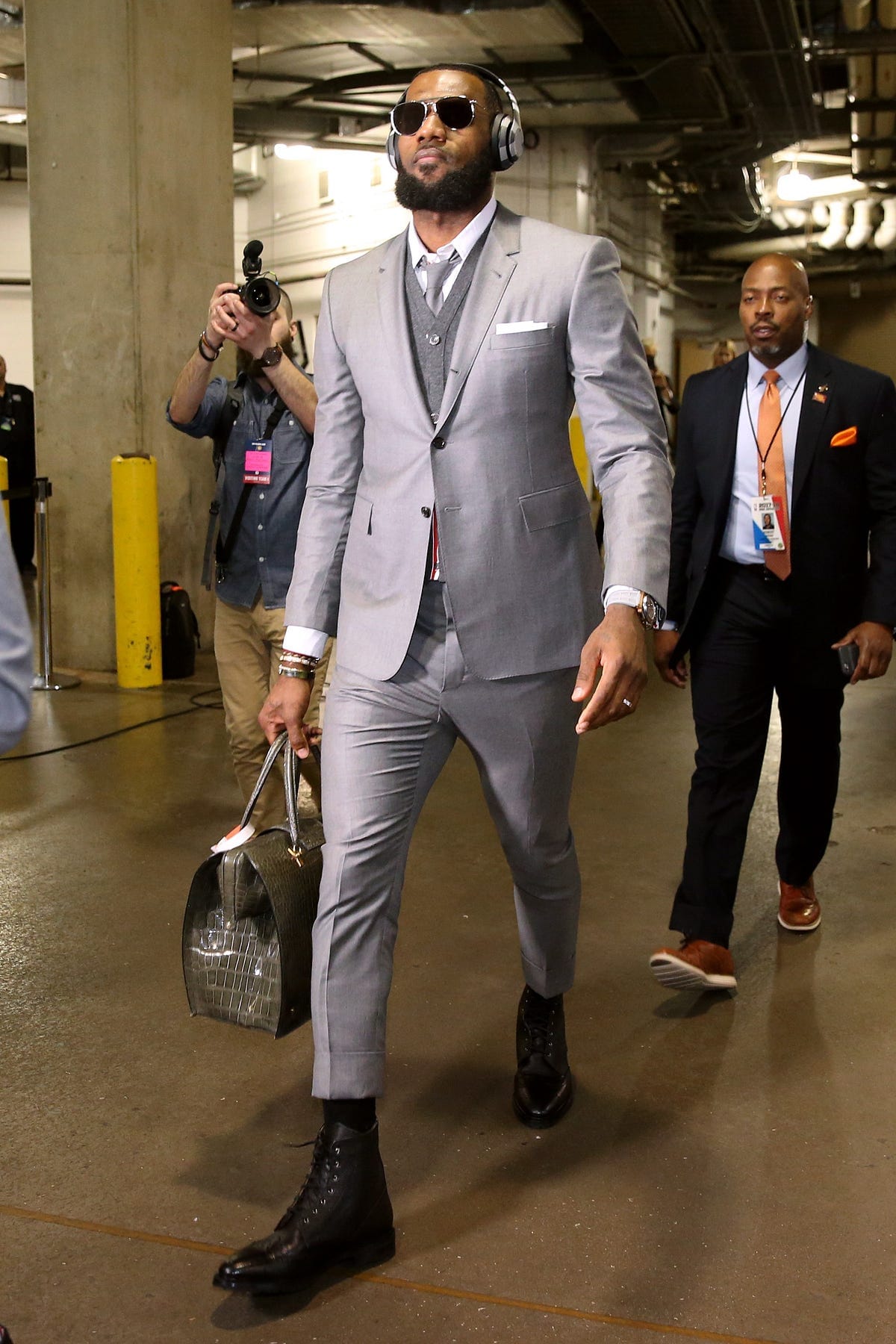
LeBron James in the Thom Browne, Anti Trump look. The pants are too short, as are the sleeves and jacket. Note the dull grey color and the short, dull-grey tie. The fellow behind him is dressed normal or Trumpish: dark clothes, long sleeves, bright, long tie.

In terms of fashion, the anti-Trump fever is to react against Trump’s choice of suits in dark colors, paired with bright ties that hang below the waist. The anti men’s fashion has moved to dull grey suits and short, grey ties. Trumps’s suits’s typically have extra-long long sleeves and long pant legs that hit the shoe-top. He likes long jackets too, that to me look vaguely like Lincoln’s. The fashion back-lash is men are wearing ridiculously short pants and jackets, with socks showing.

LeBron James, at right, is wearing a complete mens, anti-Trump look, likely a Thom Browne suit, a very expensive ill fit. This suit doesn’t look comfortable, but it’s fashion, and as I’ve said before, you’ve got to suffer for fashion.

There is also a woman’s version of anti Trump fashion. The Trump women wore feminine, closely fitting clothing and wore their hair long. The anti-Trump women’s look is the opposite; it includes short hair and masculine, often covered. This is paired with loose fitting male clothes: cargo pants or combat fatigues. Topping it off, ideally ideally is a checkered, keffiyeh scarf, either over the head or around the neck. The style of scarf was made popular by former PLO head, Yassar Arafat. This look is particularly popular on college campuses and at demonstrations. It implies that the wearer supports Palestine (Trump supported Israel), and shows you are part of the cool set. The wearer, herself, is typically is not in favor of kidnapping or rape or putting babies in oven, but they are so strongly anti Israel and Trump that they are OK with it, especially if it is Jews being kidnapped, rabed, or cooked alive. They will call for Jews to be gassed or tortured. It’s part of being in the in-crowd, and antisemitism is what’s in these days — it’s been popular for many centuries.

The women’s anti-Trump look includes short hair and a keffiyeh scarf. Photo from WRLN Florida.

It is a misconception to think that those wearing the keffiye don’t understand that they would not live long if they had to dwell among the Arabs they support. These feminists do understand, as do the ‘Queers for Palestine’. They’d never want to live in even the most moderate Arab country, the same way that those supporting Mao would never want to live in China under Mao. It is fashion, and like all fashion, it’s a mob behavior that exists only for fashion’s sake. In this case there is the added advantage that you get to hit Jews and break their windows — something that is particularly attractive for feminist women, I notice; the majority of people at the Palestine protests are women.

Robert Buxbaum November 7, 2023.

Disney was a narcissist, like Trump, Putin, Musk, and Martin Luther King. It’s not a disease.

Among TV psychiatrists, the universal opinion of Trump, Putin, and Musk, that these individuals are narcissists, a psychological disease related to “toxic masculinity.” Musk, for his part claims the excuse of Asperger’s disease, high-functioning Autism. I half agree with the Narcissist diagnosis, and I’m confused by the Asperger’s claim because I don’t believe these folks are diseased. My sense is they have a leadership personality trait, common in all visionary leaders including Disney, Martin Luther King, and Genghis Khan. I’ve argued that it is important for a president to be a narcissist, and have explained Trump’s vision, “Make America great again” as independence.

Psychological narcissism, short for Narcissistic Personality Disorder, is a disease when it hurts the narcissists life. It is defined as a pattern of exaggerated feelings of self-importance, along with an excessive need for admiration. If it just annoys people it/s a disease, but it’s found among leaders, suggesting it’s not all bad. To get you to follow them, leaders present themselves as mini-messiahs, and try to get you to see them that way. They have a plan, a vision. If it’s successful, they’re visionaries. They fight to bring the vision into reality, which is very annoying to anyone who doesn’t see it or want it. But that’s leadership. Without it nothing big gets done.

Disney’s vision. Not everyone was pleased; quite a few considered him a tyrant.

For the narcissist to succeed, he or she must sell the vision, and his ability to get it done. The plan to get there is often vague and unattractive. These details are shared with only a few. You must see the leader there and yourself too, if you’re to fight for it. Disney was particularly visual, see photo. He got folks to buy into a building a magical kingdom with a private police force, where everyone is happy and cartoon characters glide among the paying visitors.

The majority of those who run into a narcissist reject both the vision and the narcissist. They fear any change, and fear that the success of the visionary will diminish them. For that reason, they run to no-bodies. But some see it, and follow, others throw stones. Disney got state officials to exempt him from state laws, and extend normal copyrights. Others smirked, and worked to stop him, but with less energy: it’s hard to be enthusiastic about no Disneyland. The conflict between doers and the smirkers is the subject of several Ayn Rand books, including The Fountainhead and Atlas Shrugged. She calls the opposing smirkers, “parasites”, “looters”, “moochers,” and my favorite: “do gooders.” It’s for the common good that the narcissist should fail, they claim.

Often these opponents have good reasons to oppose. The Ayatollah Khomeini had a vision similar to Disney: an Islamic Republic in Iran where everyone is happy being a devout Muslim of his stripe. The opponents feared, correctly, that everyone who was not happy would be flogged, hanged, or beheaded. I think it’s legitimate to not want to be forced to be devout. Similarly, with Genghis Khan, or Vladimir Putin. Putin compares himself to Peter the Great who expanded Russia and conquered Crimea. The opponents have legitimate fears of WWII and claim that Ukrainian independence is semi legit. Regarding Musk’s plans to colonize Mars, I note that Neil Armstrong and Gene Cernan have come out against it. There is no right or wrong here, but I have a soft spot for the visionaries, and a suspicion of the “smirkers” and “do gooders.”

Genghis Khan. He saw himself as a world changer. Some followed, some didn’t. Those who followed didn’t think he was crazy.

The smirkers and do-gooders include the most respectable people of today. They are thought leaders, who lose status if someone else exceeds them. They are surprised and offended by Martin Luther King’s dream, and Musk’s, Khomeini’s, Trump’s, and Lenin’s. Trump became president against formidable odds, and the smirkers said it was a fluke, he then lost, and they claimed it showed they were right. He may get a second term, though, and Musk may yet build a community on Mars. To the extent that the visionary succeeds, the smirkers claim it was easy; that they could have done the same, but faster and better. They then laud some fellow smirker, and point out aspects of the vision that failed. In any case, while the narcissist is definitely abnormal, it’s not a disease, IMHO. It’s what makes the world go round.

Robert Buxbaum, June 7, 2023

Social science is irreproducible, drug tests nonreplicable, and stoves studies ignore confounders.

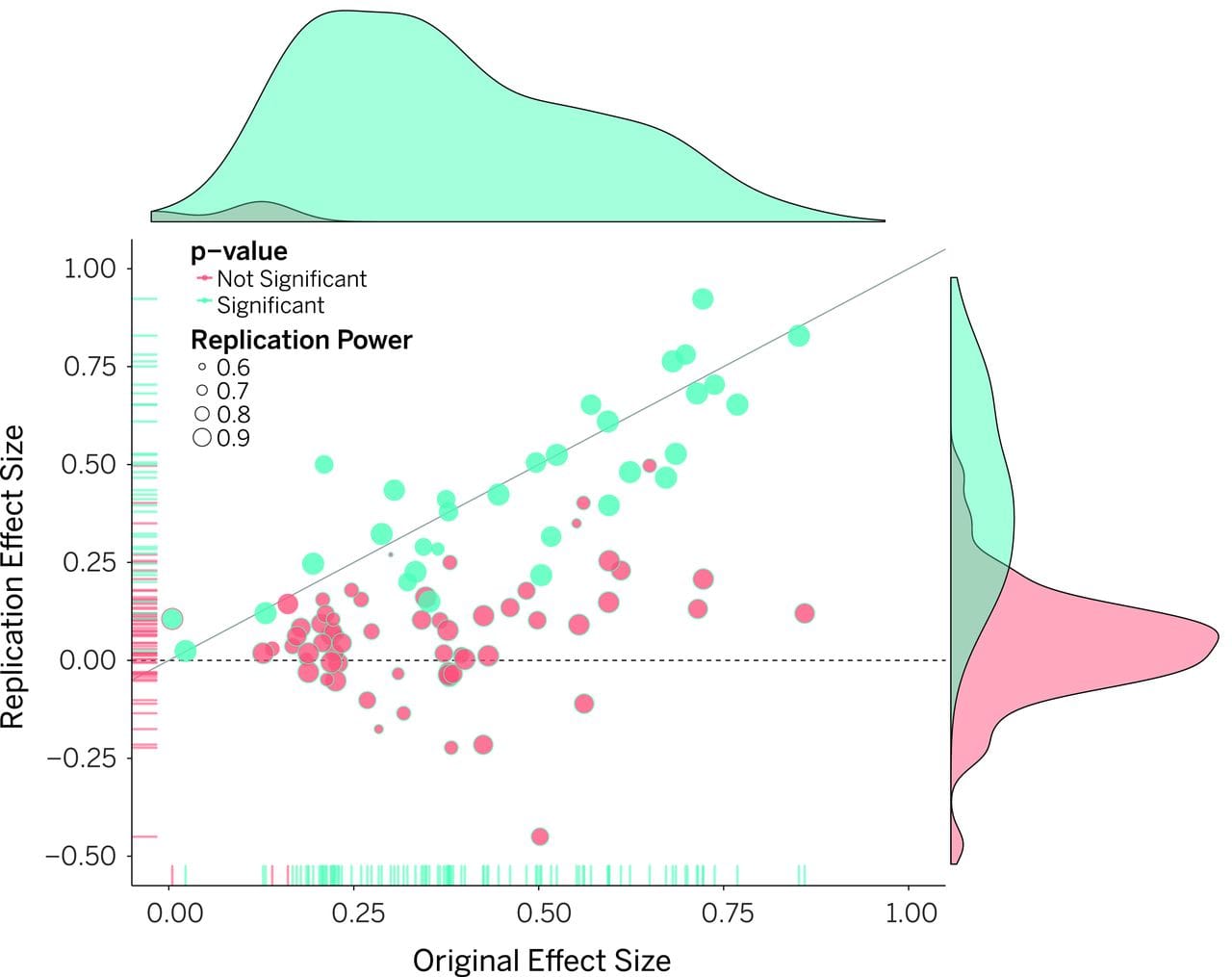
Efforts to replicate the results of the most prominent studies in health and social science have found them largely irreproducible with the worst replicability appearing in cancer drug research. The figure below, from “The Reproducibility Project in Cancer Biology, Errington et al. 2021, compares the reported effects in 50 cancer drug experiments from 23 papers with the results from repeated versions of the same experiments, looking at a total of 158 effects.

Graph comparing the original, published effect of a cancer drug with the replication effect. The units are whatever units were used in the original study, percent, or risk ratio, etc. From “Investigating the replicability of preclinical cancer biology,” Timothy M Errington et al. Center for Open Science, United States; Stanford University, Dec 7, 2021, https://doi.org/10.7554/eLife.71601.

It’s seen that virtually none of the drugs are found to work the same as originally reported. Those below the dotted, horizontal line behaved the opposite in the replication studies. About half, those shown in pink, showed no significant effect. Of those that showed positive behavior as originally published, mostly they show about half the activity with two drugs that now appear to be far more active. A favorite web-site of mine, retraction watch, is filled with retractions of articles on these drugs.

The general lack of replicability has been called a crisis. It was first seen in the social sciences, e.g. the figure below from this article in Science, 2015. Psychology research is bad enough such that Nobel Laureate, Daniel Kahneman, came to disown most of the conclusions in his book, “Thinking, Fast and Slow“. The experiments that underly his major sections don’t replicate. Take, for example, social printing. Classic studies had claimed that, if you take a group of students and have them fill out surveys with words about the aged or the flag, they will then walk slower from the survey room or stand longer near a flag. All efforts to reproduce these studies have failed. We now think they are not true. The problem here is that much of education and social engineering is based on such studies. Public policy too. The lack of replicability throws doubt on much of what modern society thinks and does. We like to have experts we can trust; we now have experts we can’t.

From “Estimating the reproducibility of psychological science” Science, 2015. Social science replication is better than cancer drug replication, about 35% of the classic social science studies replicate to some, reasonable extent.

Are gas stoves dangerous? This 2022 environmental study said they are, claiming with 95% confidence that they are responsible for 12.7% of childhood asthma. I doubt the study will be reproducible for reasons I’ll detail below, but for now it’s science, and it may soon be law.

Part of the replication problem is that researchers have been found to lie. They fudge data or eliminate undesirable results, some more some less, and a few are honest, but the journals don’t bother checking. Some researchers convince themselves that they are doing the world a favor, but many seem money-motivated. A foundational study on Alzheimers was faked outright. The authors doctored photos using photoshop, and used the fake results to justify approval of non-working, expensive drugs. The researchers got $1B in NIH funding too. I’d want to see the researchers jailed, long term: it’s grand larceny and a serious violation of trust.

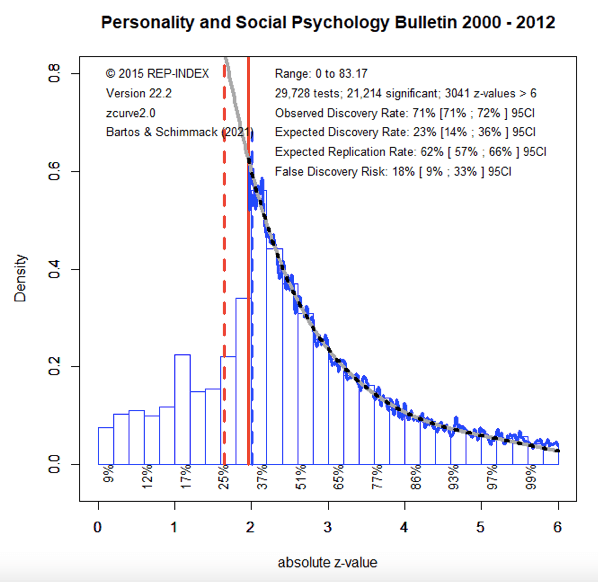
Another cause of this replication crisis — one that particularly hurt Daniel Kahneman’s book — is that many social science researchers do statistically illegitimate studies on populations that are vastly too small to give reliable results. Then, they only publish the results they like. The graph of z-values shown below suggest this is common, at least in some journals, including “Personality and social psychology Bulletin”. The vast fraction of results at ≥95% confidence suggest that researchers don’t publish the 90-95% of their work that doesn’t fit the desired hypothesis. While there has been no detailed analysis of all the social science research, it’s clear that this method was used to show that GMO grains caused cancer. The researcher did many small studies, and only published the one study where GMOs appeared to cause cancer. I review the GMO study here.

From Ulrich Schimmack, ReplicationIndex.com, January, 2023, https://replicationindex.com/2023/01/08/which-social-psychologists-can-you-trust/. If you really want to get into this he is a great resource.

The chart at left shows Z-scores, were Z = ∆X √n/σ. A Z score above 1.93 generally indicates significance, p < .05. Notice that almost all the studies have Z scores just over 1.93 that is almost all the studies proved their hypothesis at 95% confidence. That makes it seem that the researchers were very lucky, near prescient. But it’s clear from the distribution that there were a lot of studies that done but never shown to the public. That is a lot of data that was thrown out, either by the researchers or by the publishers. If all data was published, you’d expect to see a bell curve. Instead the Z values are of a tiny bit of a bell curve, just the tail end. The implication is that these studies with Z= >1.93 suggest far less than 95% confidence. This then shows up in the results being only 25% reproducible. It’s been suggested that you should not throw out all the results in the journal, just look for Z-scores of 3.6 or more. That leaves you with the top 23%, and these should have a good chance of being reproducible. The top graph somewhat supports this, but it’s not that simple.

Another classic way to cook the books, as it were, and make irreproducible studies provide the results you seek is to ignore “confounders.” This leads to association – causation errors. As an example, it’s observed that people taking aspirin have more heart attacks than those who do not, but the confounder is that aspirin is prescribed to those with heart problems; the aspirin actually helps, but appears to hurt. In the case of stoves, it seems likely that poorer, sicker people own gas, and that they live in older, moldy homes, and cook more at home, frying onions, etc. These are confounders that the study to my reading ignores. They could easily be the reason that gas stove owners get more asthma toxins than the rich folks who own electric, induction stoves. If you confuse association, you seem to find that owning the wrong stove causes you to be poor and sick with a moldy home. I suspect that the stove study will not replicate if they correct for the confounders.

I’d like to recommend a book, hardly mathematical, “How to Lie with Statistics” by Darrell Huff ($8.99 on Amazon). I read it in high school. It gives you a sense of what to look out for. I should also mention Dr. Anthony Fauci. He has been going around to campuses saying we should have zero tolerance for those who deny science, particularly health science. Given that so much of health science research is nonreplicable, I’d recommend questioning all of it. Here is a classic clip from the 1973 movie, ‘Sleeper’, where a health food expert wakes up in 2173 to discover that health science has changed.

Robert Buxbaum , February 7, 2023.

Three identical strangers, and the genetics of personality

Inheritability of traits is one of the greatest of insights; it’s so significant and apparent, that one who does not accept it may safely be called a dullard. Personal variation exists, but most everyone accepts that if your parents are tall, you are likely to be tall; If they are dark, you too will likely be dark, etc., but when it comes to intelligence, or proclivities, or psychological leanings, it is more than a little impolite to acknowledge that genetics holds sway. This unwillingness is glaringly apparent in the voice-over narration of a popular movie about three identical triplets who were raised separately without knowing of one another and who turned out virtually identical. The movie is “Three identical strangers”, and it recounts their separate upbringing, their meeting, and their lives afterwards.

Triplets, raised separately, came out near identical.

Although raised separately, one in a rich family, one in a poor family, and one middling, the three showed near identical intelligence, and near identical proclivities. Two of them picked the same out-of-the way college. All of them liked the same sort of clothes and had the same taste in women. There were differences too, showing that genetics isn’t everything: one was more outgoing, one less, and depressed, but in many ways, they were identical. Meanwhile, the voice-over kept saying things like, “isn’t it a shame that we never saw any results on nature/nurture from this study.” The movie looked at some twins, raised separately, saw the same commonalities, and restated that they saw nothing remarkable. My clear takeaway was genetics applies to psychology too. That it’s not all genetics, but it is at least as influential as upbringing/ nurture.

This movie also included pairs of identical twins, raised separately, they also showed strong personality similarities. It’s a finding that is well replicated in broader studies involving siblings raised separately, and unrelated adoptees raised together. Blood, it seems, is stronger than nurture. See for example the research survey paper, “Genetic Influence on Human Psychological Traits” Journal of the American Psychological Society 13-4, pp 148-151 (2004). A table from that paper appears below. Genetics plays a fairly strong role in all personal traits including intelligence, personality, self-control, mental illness, criminality, political views (even mobile phone use). The role is age-dependent, though so that intelligence (test determined) is strongly environment-dependent in 5 year olds, almost entirely genetic in 25-50 year olds. One area that is not strongly genetic, it seems, is religion.

In a sense, the only thing surprising about this result is that anyone is surprised. Genetics is accepted as crucial for all things physical, so why not mental and social. As an example of the genetic influence on sports, consider Jewish chess genius, Lazlo Polgar: he decided to prove that anyone could be great at chess, and decided to train his three daughters: he got two grand masters and an international master. By comparison, there are only 2 chess grand masters in all of Finland. Then consider that there are five all-star, baseball players named Alou, all from the same household, including the three brothers below. The household has seven pro baseball players in all.

Most people are uncomfortable with such evidence of genetic proclivity. The movie has been called “deeply disturbing” as any evidence of proclivity contradicts the promise of education: that all men are equal, blank slates at birth that can be fashioned into whatever you want through education. What we claim we want is leaders — lots of them, and we expect that education will produce equal ratios of woman and men, black and white and Hispanic, etc. and we expect to be able to get there without testing for skills, — especially without blind testing. I notice that the great universities have moved to have testing optional, instead relying on interviews and related measures of leadership. I think this is nonsense, but then I don’t run Harvard. As a professor, I’ve found that some kids have an aptitude and a burning interest, and others do not. You can tell a lot by testing, but the folks who run the universities disagree.

The All star Alou brothers share an outfield.

University heads claim that blind testing is racist. They find that some races score poorly on spacial sense, for example, or vocabulary suggesting that the tests are to blame. There is some truth to these concerns, but I find that the lack of blind testing is more racist. Once the test is eliminated, academia finds a way to elevate their friends, and the progeny of the powerful.

The variety of proclivities plays into an observation that you can be super intelligent in one area, and super stupid in others. That was the humor of some TV shows: “Big Bang Theory” and “Fraser”. That was also the tragedy of Bobby Fischer. He was brilliant in chess (and the child of brilliant parents), but was a blithering idiot in all other areas of life. Finland should not feel bad about their lack of great chess players. The country has produced two phone companies, two strong operating systems, and the all time top sniper.

Robert Buxbaum, May 15, 2022

Hypochondriacs anonymous: the first step is admitting you don’t have a disease.

I’m writing a book about reverse psychology; please don’t buy it.

This one’s not by Rappaport

The judge said I had to keep 6 feet away from my ex-wife. So I buried her under the patio.

Robert Buxbaum: the above 3 jokes are from Jack Rappaport — He sometimes sells jokes. April 13, 2022. The ones below are from Gahan Wilson, and the one at right, I don’t know.

These last two are from Gahan Wilson

People would rather get electric shocks than think for 15 minutes.

A review of some studies on the difficulty of sitting in one’s own thoughts.

There is a joke: what is the opposite of speaking?

It’s waiting to speak.

Most people find it uncomfortable to sit still and be quiet. Even listening is a pain. People sit brewing in their thoughts of what they are going to say. Silence is uncomfortable enough that solitary confinement for a few days is torture.

But what about a few minutes. Almost everyone can sit still and listen for 15 minutes as their friend drones on, especially if they are paid for it. Still, it’s uncomfortable, and a study set out to understand how uncomfortable. It turns out that a majority of men, 67% would rather give themselves electric shocks than sit and think or listen. Women, too find it unpleasant; some 25% of women preferred to give themselves electric shocks rather than sit and think. You’ll find a brief review of this and similar work copied above, or you can read the full study: Wilson et al 2014, “The challenge of the disengaged mind“.

The effect of the COVID-19 lockdowns was to remove virtually every bit of agreeableness, extroversion, conscientiousness, and openness, while fueling neuroticism. Data for 2020.

The effect of the COVID-19 lockdowns has been massive. Those involved in government discussions don’t seem to realize how massive, perhaps because they’re in constant contact with people, speaking and being spoken too. Most of us were not so lucky. We experienced partial isolation. A recent study suggests that almost every measure of happiness disappeared during the summer months of 2020: US agreeableness, extroversion, conscientiousness, and openness all declined dramatically, see data above. Decisiveness too; a lingering effect is an inability to make decisions. My hope is that government officials can resist the temptation for more lockdowns and mandates; mental health is health too.

If lockdowns do come, or if you are depressed for any other reason, you might consider exercise, or lithium, or counseling. At least decide to wake up at a fixed time every morning. Under COVID watch conditions, depression is the new normal. Here’s a joke on marriage counseling.

Robert Buxbaum, October 27, 2021

Exercise helps fight depression, lithium helps too.

With the sun setting earlier, and the threat of new COVID lockdowns, there is a real threat of a depression, seasonal and isolation. A partial remedy is exercise; it helps fight depression whether you take other measures not. An article published last month in the Journal of Affective Disorders reviewed 22 studies of the efficacy of exercise, particularly as an add-on to drugs and therapy. Almost every study showed that exercise helped, and in some studies it helped a lot. See table below. All of the authors are from the University of British Columbia. You can read the article here.

From “Efficacy of exercise combined with standard treatment for depression compared to standard treatment alone: A systematic review and meta-analysis of randomized controlled trials.” by JacquelineLee1 et al.In virtually every study, exercise helps fight depression.

For those who are willing to exercise, there are benefits aside from mental health. Even a daily walk around the block helps with bone strength, weight control, heart disease, plus the above mentioned improvement in mood. More exercise does more. If you bicycle without a helmet, you’re likely to live longer than if you drive.

For those who can’t stand exercise, or if exercise isn’t quite enough to send away the blues, you can try therapy, medication, and/or diet. There is some evidence that food that are high in lithium help fight depression. These food include nuts, beans, tomatoes, some mineral waters, e.g. from Lithia springs, GA. The does is about 1/100 the dose given as a bipolar treatment, but there is evidence that even such small doses help. Lithium was one of the seven ingredients in seven up — it was the one that was supposed to cheer you up. See some research here.

Robert Buxbaum, October 7, 2021.

A pacifist’s personal protection, a 22 revolver.

Before a pacifist buys a gun, there are two critical questions to ask: One is ‘how would I feel if I killed a criminal?” The other is ‘how would I feel if I missed and killed someone else? In my case, I’d feel awful either way. My thinking, even with the criminal, is that I tried my best to do more good than bad, and part of that is to minimize the chance of killing needlessly. Statistics suggest that gun carrying, in general, does good by deterring violent criminals. To be able to stop a deadly attack, while minimizing the chance of killing– particularly an innocent bystander — I’m inclined to a low power gun that’s easy to conceal and easy to aim well. This leads me to suggest a 22 revolver with a barrel that’s not too long to conceal, nor too short for good aiming, 2.5-4″ seems ideal.

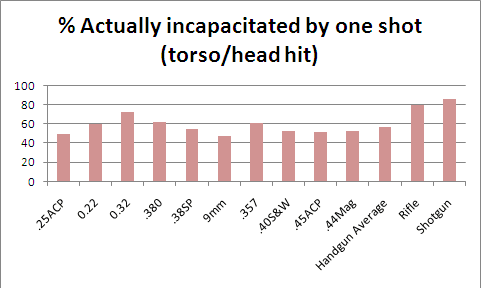
An analysis of what percent of people stop attacking when hit by one bullet of different calibers. The 32 and shotgun are the best, in part because the shooter tends to stop shooting at one shot. With a 9 mm, the shooter keeps on shooting, likely doing more damage than necessary.

At this point I’d like to say that I am not a gun expert. I’ve fired perhaps 15 guns in my life including 5 revolvers. The easiest of these to shoot was a Glock 9mm, heavy, large and powerful, but it think it would be too large to carry or draw in a deadly situation, and the Glock was not cheap. The 22s were all smaller guns, and the 22 cartridges, especially the 22lr, are dirt cheap, costing 8 to10¢ each, or $40-$50 for a box of 500. It’s not the 9mm are super expensive, but they cost 25-30¢ each or $25 to $30 for a box of 100. The price is higher today, over $1 each, because of an ammo shortage, but it’s coming down.

Another advantage of the 22 is that the kill power is lower. A 9mm round will go through the person you are shooting at, and kill the person behind, and can kill on a riccoshet. I like that the 22 won’t do this. I also like that the 22, more effective than almost any other round at stropping a criminal, and getting him to go away. As the chart above shows, there is a 60% stop after the perpetrator is hit once, and that’s my goal — getting him to go away. A shotgun is far more effective as a deterrence, over 80%, but it is much more likely to kill, and much harder to conceal carry. The chart above is from a wonderful analysis of the effect of different calibers used in crimes, read it here. The author, Greg Ellifritz, suggests that the reason the 22 is so effective at stopping a criminal is psychological: criminals stop if shot even once, especially from a civilian, and only civilians use 22s. Larger calibers are better appear to be less effective, though they will be better at stopping a really determined attacker, e.g. someone on PCP. But that’s not the environment I work in, and I suspect it’s not the majority of crime. Overall, one shot from a 9mm does not do a good job stopping an attacker. Another good option is a 32. It was the choice of Theodore Roosevelt and J. Edgar Hoover. It tends to be used by detectives and other professionals, but the bullets are expensive.

I’ve done a meta-analysis of Greg Ellifritz’s death data, and confirm that the 22 is the second least deadly of all bullet types, after the .25. Of 154 people hit with 22 bullets, there 28% fatalities, 43 deaths. The 9mm is more deadly: of those hit with a 9 mm bullet, 44% died, in part because people shooting 9mm tend to shoot more bullets, nearly twice as many as 22 shooters in danger situations.

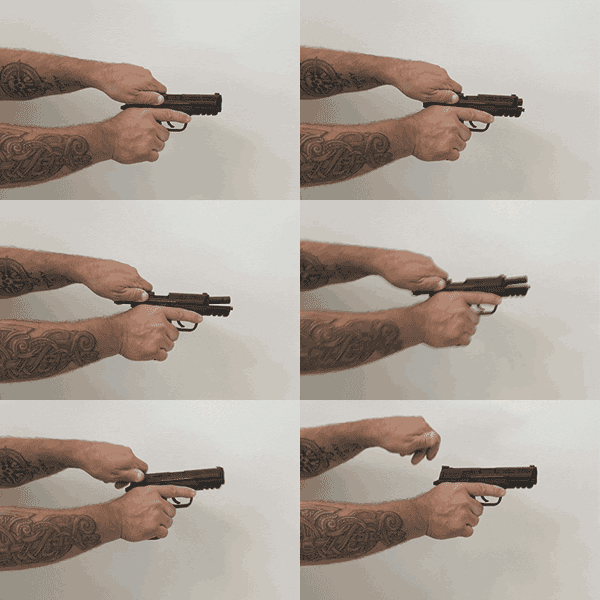
It takes two hands to cock a semi-automatic, that is to draw the first round into the chamber. Gif from ammuniotndepot.com

Handguns for 9mm rounds tend to be semi-automatic with light triggers and large magazines. Guns for 22 tend to be revolvers with heavier triggers and small loads, 5 to 7 rounds. I suspect that a light trigger leads to more missed shots and misfires, and I notice that many folks with semiautomatics, find they jam in danger situations. In the famous duel between Hamilton and Burr, Hamilton hit the branch above Burr’s head, likely because he’d set his trigger very light. Burr’s trigger was set heavy, and he shot straight. When you are nervous, gun with a light trigger can go off early and miss or kill the wrong person. A lot of the people killed with guns in Detroit, I notice, were killed by mistake, because the shooter missed, or because of a ricochet (I did an analysis of Detroit crime early on in this blog). A ricocheting 22 has very little kill power left.

A single action revolver requires cocking by that can be done with one hand; a double action doesn’t need any cocking. Gif from ammuniotndepot.com

Every semi-automatic I’ve tried required a two handed, “racking” step, see above. Thus, unless you leave a cartridge in the chamber while walking around, you need two free hands and an extra second or two to rack the first bullet before you can shoot. That’s OK on a range, but in a danger situation racking is a problem. Even trained policemen with semi-automatics have been killed by knife-wilding criminals because the criminal didn’t need the extra second or two while the policeman racked the first round.

Racking takes strength and coordination, plus an awareness of legal isuess. If you rack too soon and the situation de-escalates, you could be charged with “brandishing.” In most states it’s illegal to brandish a weapon in a non-deadly situation. You have to wait with your gun in your pocket or holster until you are in mortal danger. With a revolver, you don’t need to rack. Even a single action revolver can be cocked with one hand while the weapon is in your pocket. See the process in the figure above. Double-action revolvers don’t require cocking, and that can be a plus. On the other hand, I figure that the sound of a gun cocking might be useful to signal to a criminal that you are serious without getting you into the problems of brandishing.

De-cocking a single action revolver.

Revolvers have another interesting plus in that it’s easy to un-cock revolver, even using one hand, see gif. With semi-automatic pistols, there rarely a graceful way to remove the bullet from the chamber, certainly not with one hand. In theory, you can shoot from your pocket too; it’s something I’ve seen in the movies, but a semi-automatic will almost certainly jam if you try. If the assailant grabs your arm, or otherwise attacks you, you have every right to fire, but you don’t want a jam, or to hit yourself. Most defensive shootings are from close range.

Speaking of jamming, even experts get jams on a fairly regular basis, and beginners have this problem a lot. They forget to hold the gun tightly enough, or they buy rounds that don’t quite match the gun. Rounds that are too weak or powerful cause problems for semi-automatics. I’ve never seen a revolver jam, and if the round doesn’t fire, you can click again, and another round will appear. With a semi-automatic, clearing a jam is a lot of work: more than I can expect in a danger situation.

I should mention that the folks from ammunition depot, the place I got the gifs, recommends 9mm semi-automatics for personal protection because of the extra “stopping power”. Read their opinion here. I disagree, and here is one last reason: Like many other suppliers, they are out of 9mm cartridges, and have been for months. Perhaps it’s panic buying like with toilet paper, or a manufacturing disruption; 22 lr cartridges are still in stock. Supply problems will likely go away, but it’s another reason to look at the 22.

Robert Buxbaum, December 11, 2020. Some vocabulary words: a bullet is the projectile that comes out the barrel. A round = a cartridge. It’s the thing that you put in the gun before shooting. There are several 22s, all with the same size (diameter) bullet, 0.223″ OD, but with different lengths and power, from short to wmr. Different guns can use different cartridges. Meir Kahane was killed by a 22, as was Bobby Kennedy.