Tag Archives: poem

Of cigars and marriage, Kipling, Freud and Shaw.

My last post included a rather gruesome bit of poetry by Rudyard Kipling where he describes the Afghani women coming to kill the wounded British soldiers in the first Afghan war. It’s sexist, or anti-sexist, if you like. Since it reverses a stereotype of the non-violent, female home-body. Then again the Afghanis had wiped out an entire British army, killing virtually everyone including civilians.

What follows is The Betrothed, one of Kipling’s first published poems, appearing in “the civil and military gazette”, Lahor, India (near Afghanistan), November, 1888. Kipling was an assistant editor). It has a more traditional view of women, or of British women who do not go out murdering, but who do wish to control/ stop a British man’s cigar smoking. In a sense, such stoppage is murder. The inspiration was a breach of ‘Promise of Marriage’ case in Glasgow, August 1888, where a young woman, Maggie Watson, sued her fiancee because he continued to smoke cigars after she insisted he stop. Kipling explores the psychology of the choice between smoking and marriage. I think Freud would approve.

The Betrothed.

OPEN the old cigar-box, get me a Cuba stout, For things are running crossways, and Maggie and I are out. 

We quarrelled about Havanas—we fought o’er a good cheroot, And I knew she is exacting, and she says I am a brute. 

Open the old cigar-box—let me consider a space; In the soft blue veil of the vapour musing on Maggie’s face. 

Maggie is pretty to look at—Maggie’s a loving lass, But the prettiest cheeks must wrinkle, the truest of loves must pass. 

There’s peace in a Larranaga, there’s calm in a Henry Clay; But the best cigar in an hour is finished and thrown away— 

Thrown away for another as perfect and ripe and brown— But I could not throw away Maggie for fear o’ the talk o’ the town! 

Maggie, my wife at fifty—grey and dour and old— With never another Maggie to purchase for love or gold! 

And the light of Days that have Been. The dark of the Days that Are,
And Love’s torch stinking and stale, like the butt of a dead cigar— 

The butt of a dead cigar you are bound to keep in your pocket— With never a new one to light tho’ it’s charred and black to the socket! 

Open the old cigar-box—let me consider a while. Here is a mild Manila—there is a wifely smile. 

Which is the better portion—bondage bought with a ring, Or a harem of dusky beauties, fifty tied in a string? 

Counsellors cunning and silent—comforters true and tried, And never a one of the fifty to sneer at a rival bride? 

Thought in the early morning, solace in time of woes, Peace in the hush of the twilight, balm ere my eyelids close, 

This will the fifty give me, asking nought in return, With only a Suttee’s passion—to do their duty and burn. 

This will the fifty give me. When they are spent and dead, Five times other fifties shall be my servants instead. 

The furrows of far-off Java, the isles of the Spanish Main, When they hear my harem is empty will send me my brides again. 

I will take no heed to their raiment, nor food for their mouths withal, So long as the gulls are nesting, so long as the showers fall. 

I will scent ’em with best vanilla, with tea will I temper their hides, And the Moor and the Mormon shall envy who read of the tale of my brides. 

For Maggie has written a letter to give me my choice between. The wee little whimpering Love and the great god Nick o’ Teen. 

And I have been servant of Love for barely a twelvemonth clear, But I have been Priest of Cabanas a matter of seven year; 

And the gloom of my bachelor days is flecked with the cheery light Of stumps that I burned to Friendship and Pleasure and Work and Fight. 

And I turn my eyes to the future that Maggie and I must prove, But the only light on the marshes is the Will-o’-the-Wisp of Love. 

Will it see me safe through my journey or leave me bogged in the mire? Since a puff of tobacco can cloud it, shall I follow the fitful fire? 

Open the old cigar-box—let me consider anew— Old friends, and who is Maggie that I should abandon you? 

A million surplus Maggies are willing to bear the yoke; And a woman is only a woman, but a good Cigar is a Smoke. 

Light me another Cuba—I hold to my first-sworn vows. If Maggie will have no rival, I’ll have no Maggie for Spouse! 
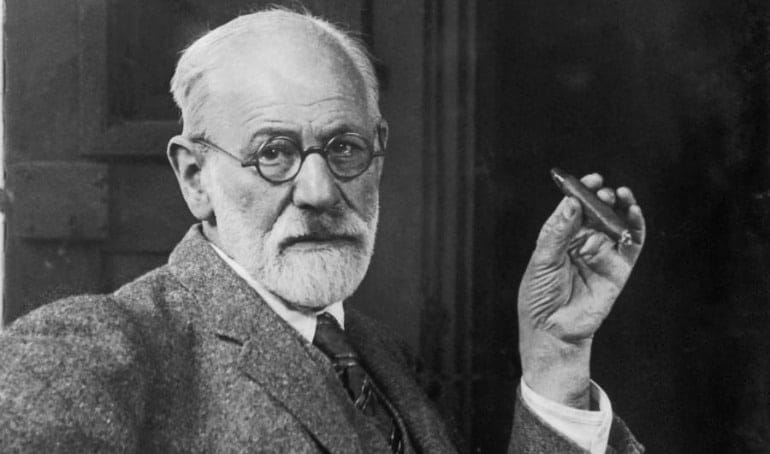
Sigmund Freud with his cigar. The attraction of cigars, is a strange one, as Freud knew better than most. Part Thanatos, Cigars are deadly, but casual, often with a good flavor, and they provide sucking comfort. The death-risk of one is small and distant. Cigars thus represent risky fun they are thus life-affirming, in a temporary, risky way. Marriage is permanence and safe, and binding. The binding permanence of marriage is thus a sort of death, but children are good, and that’s life. Freud’s choice was to smoke himself to death. Kipling got married and eventually gave up smoking. C’est la vie.

Robert E. Buxbaum, September 17, 2021. Kipling has a great sense of words, and an attractive sense of the subjects, great and small. For years he was the voice of his generation in Britain, but by the end of his life, his views were unacceptable. sexist. On the other hand, he remained staunchly anti-Nazi, anti eugenics, and anti Soviet. By comparison, George Bernard Shaw was a vocal fan of Stalin, of Hitler, and of the eugenic removal of Jews and other undesirables. Shaw’s words remain fashionable, while Kipling’s do not. Such is the nature of fame.
Seize the day

It is forbidden knowledge what our term of years, mine and yours.
Don’t scan the tables of your Babylonian seers.
Better far to bear the future, my Leuconoe, like the past.
Whether Jupiter has many years yet to give,
Or this one is our last:

This, that makes the Tyrrhene waves spent against the shore.
Strain your wine and strain your wisdom.
Life is short; should we hope for long?
In the moment of our talking, precious time has slipped away.
Seize the day. Trust tomorrow little as you may.

by Horace (23 BC Roman poet) Odes, 1.11

This poem by Horace, 23 BC, is the first appearance of the phrase “carpe diem,” translated as seize the day. I’d decided to look over the poem in translation from Wikipedia, and to correct and update the translation as I saw fit, aiming to extract the meanings better and make the grammar less-clunky. Also, to some extent, to make it rhyme. Seen in context, the whole poem looks romantic, and the intent of the famous phrase reads more like ‘seize the moment’, or ‘enjoy the present’. Either translation is acceptable from the Latin, I’m told, but the phrase has taken of a different meaning in current movies.

Robin Williams quotes the phrase to a class of literature students in the sense of ‘seize the moment’ in this scene of “The Dead Poets Society,” He’s trying to get the boys to appreciate poetry, and the preciousness of their years in prep-school. A very well-done movie, IMHO. The newspaper sellers sing the phrase for different intent in this song in “Newsies.” For them, it’s a call to arms, more like seize the opportunity, or maybe even seize power. This was not Horace’s intent, but by coincidence, it’s sung in front of the statue of Horace Greeley, and it works.

In either context, there is a certain young masculinity. In both movies, the peron expressing the idea is male and young. I don’t think either movie would work as well with women preaching, dancing or singing to this idea.

Robert E. Buxbaum, March 9, 2019. In case you should wonder what happens to Frank Kelly (Sullivan) after the movie ends, I’ve written about that.  Also, a friend of mine notes that the grammar used in these movies is wrong:  “Carpe diem” is singular, for this 3rd declension noun. The equivalent Latin plural is “Carpite diem:” That’s the equivalent of you-all, should seize the moment, so the classics teacher is saying it wrong (who cares?). Unlike in the movies, much of classic education is spent on pedantic, uninspiring, minutia, as in Latin grammar. As it happens, that’s what’s necessary to permit distinction of meaning, but the day is lost. Thank you, David Hoenig for grammar help. Here are some of my thoughts on education.

Cornwallis attacks. Washington goes to Princeton.

In the previous post, I asked what you would do as a general (Cornwallis), December 27, 1776. You command 30,000 troops, some 12,000 at Princeton of at total 50,000 against Washington’s 3500. Washington is camped 12 miles to the south just outside of Trenton with a majority of his men scheduled to leave in three days when their enlistments expire.

In fact, what Cornwallis did, is what every commenter recommended. He attacked at Trenton, and lost New Jersey. Cornwallis left 2-3000 troops at Princeton and marched south. Despite fallen trees, swollen rivers, destroyed bridges — all courtesy of Washington’s men –Cornwallis reached Trenton and attacked. By the time he got there, 2000 of Washington’s men had left, partially replaced by untrained militia. After a skirmish, Washington set up 400 militia to keep the fires burning, and without telling them where he was going “Fall back if the British attack”, he took the rest of his forces east, across frozen fields and swampland, then north to Princeton along the Quaker-bridge road. He later said the reason was to avoid looking like a retreat.

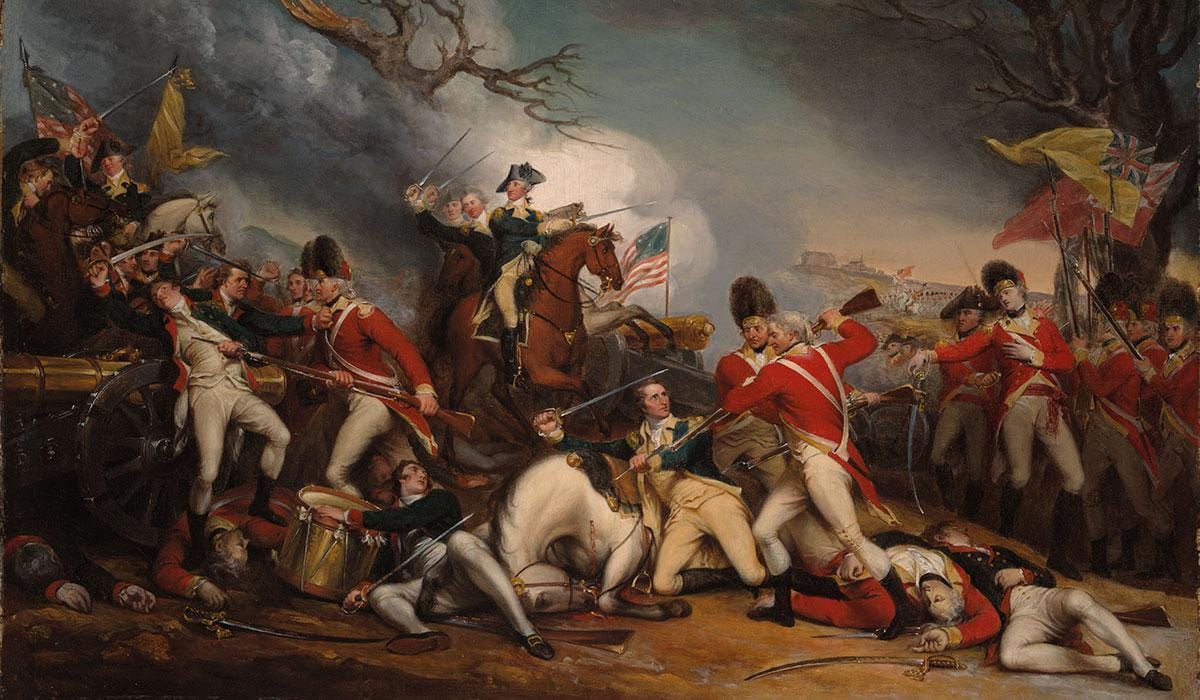
He split his forces just outside of Princeton, and a detachment, led by Hugh Mercer and 350  regulars had the first battle as they ran into the 17th and 55th British regiments as they prepared to escort supplies to Trenton. The British commander, Lt.colonel Mawhood, seeing how few men he faced, sent the 55th and most of the supplies back to Princeton, and led his men to shoot at the Americans from behind a fence. Mercer’s men fired back with rifles and cannon, doing little. Then, the trained British did what their training demanded: they rose up and charged the rebels with fixed bayonets. Mercer, having no bayonets, called “Retreat!” before being stabbed repeatedly, see painting. Mawhood’s men seized the cannon, turned it on the fleeing remnants of Mercer’s men.

General Mercer defeated at Princeton, as Washington shows up.

General Mercer defeated at Princeton, as Washington shows up.

It looked like a British victory, but then General Nathaniel Greene (the fighting Quaker) showed up with several hundred Pennsylvania militiamen. The militiamen had never seen battle, and many fled, after shooting into the British lines with rifles and another cannon and grape-shot. At this point it looked like a draw, but then, Washington himself joined the battle with two brigades of regulars: Hitchcock’s 253 New Englanders and Hand’s 200 Pennsylvania riflemen.

Washington managed to rally the fleeing Pennsylvanians; “Parade with us, my brave fellows! There is but a handful of the enemy and we will have them directly!” And Mawhood, now without most of his officers, ordered a last bayonet charge and fled down the Post Road to Trenton. Washington rode after for a bit “It’s a fine fox chase, my boys!”

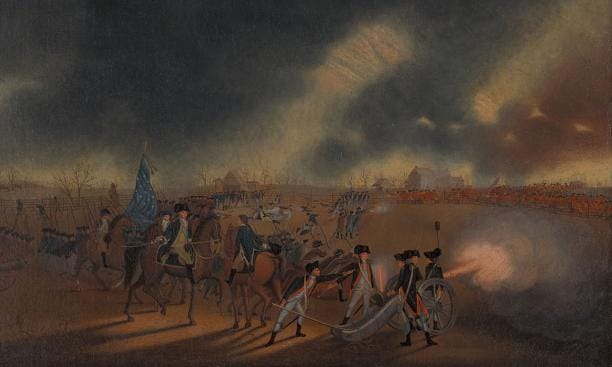
James Peale, 1783. John Sullivan and his forces at Frog Hollow. Battle of Princeton

James Peale, 1783. John Sullivan and his forces at Frog Hollow. Battle of Princeton

The rest of the British along with Mawhood, met the rest of Washington’s men, lead by John Sullivan, at a place called Frog Hollow, near where Princeton Inn College (Forbes College) now stands. The Americans opened with grape-shot and the British put up little resistance. Those who did not surrender were chased into town, taking refuge in Nassau Hall, the central building of the university. Alexander Hamilton’s men (he’d been rejected by Princeton) took special enjoyment in shooting cannon into the building. A hole remains in the college walls and a cannonball supposedly decapitated a portrait of George II. About then the New Jersey militia broke in a door, and the British surrendered.

Washington had captured, killed, or destroyed most of three English regiments, took a wagon train of supplies, and left going north following a bit of looting. “Loyalists” were relieved of coins, liquor, shoes, blankets. They ate the breakfast prepared for the 40th, and were gone by 11 AM, heading north — to where?. Cornwallis returned before noon “in a most infernal sweat — running, puffing, blowing, and swearing.” His men looted the town again, but now what?

Was Washington headed to New Brunswick where a handful of British soldiers guarded Cornwallis’s supplies and a war chest of £70,000? He didn’t go directly, but perhaps by a circuitous route. Cornwallis went straight to New Brunswick and jealously guarded the place, its money and supplies. Washington meanwhile ran to safety in the Watchung Mountains outside Morristown. Cornwallis’s 17th claimed victory, having defeated a larger group, but Cornwallis gave up Princeton, Trenton, and the lives of the New Jersey loyalists. Rebels flocked to Washington. Loyalists were looted and chased. Hessians were shot in “a sort of continual hunting party.” Philip Freneau expressed the change thus:

When first Britannia sent her hostile crew; To these far shores, to ravage and subdue, We thought them gods, and almost seemed to say; No ball could pierce them, and no dagger slay. Heavens! what a blunder—half our fears were vain; These hostile gods at length have quit the plain.

Robert Buxbaum. December 21, 2016. So now that you know what happened, what SHOULD Cornwallis have done? Clearly, it’s possible to do everything right militarily, and still lose. This is an essence of comedy. The British had a similar Pyrrhic victory at Bunker Hill. I suspect Cornwallis should have fortified Trenton with a smaller force; built a stockade wall, and distributed weapons to the loyalists there. That’s a change in British attitude, but it’s this dynamic of trust that works. The British retreat music, “the world turned upside down“, is a Christmas song.

Ginsberg poem about Bernie Sanders

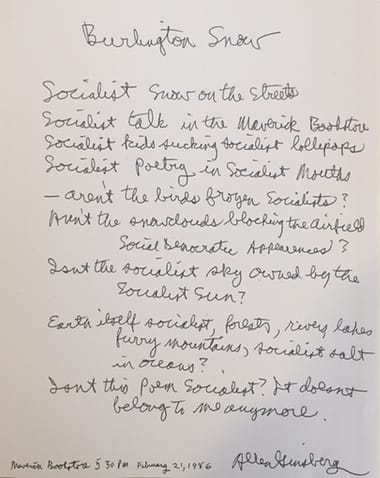
It’s 30 years to the day since Alan Ginsberg wrote “Burlington Snow” a poem inspired by Bernie Sanders, the socialist mayor of Burlington Vermont. It’s a snapshot of the wonder and contradiction of socialist government. And now Bernie is running for president.

Birlington Snows, April 24, 1996

Burlington Snow, February 21, 1996 by Alan Ginsburg.

“Socialist snow on the streets. Socialist talk in the Maverick Bookstore. Socialist kids sucking socialist lollipops. Socialist poetry in socialist mouths — aren’t the birds frozen socialists? Aren’t the snow clouds blocking the airfield social bureaucratic apprentices? Isn’t the socialist sky owned by the socialist sun? Earth itself socialist, forests rivers, lakes, furry mountains, socialist salt in oceans? Isn’t this Poem socialist? It doesn’t belong to me anymore.”

Dr. Robert Buxbaum, February 21, 2016. If anyone would write a poem about me, or water commissioner (I’m running) or pollution or drinking water, or anything like that, I’d be awfully honored. It doesn’t have to be complimentary, or even particularly good.

American education sucks, how do we succeed?

Despite my PhD from a top American college, Princeton University, I find I lag ordinary Europeans in languages and history. I can claim to know some math, and a little Latin and a little Greek, but in my case it’s two short friends, Manuel Ramos and Stanos Platsis. It was recently reported that one fourth of college-educated Americans did not know that the earth spun on an axis. With an education system of this sort, how is it that the US has the largest GDP, and nearly the largest per-capita GDP. We have a grosser national product than any European country despite a degree of science ignorance that would be inconceivable there.

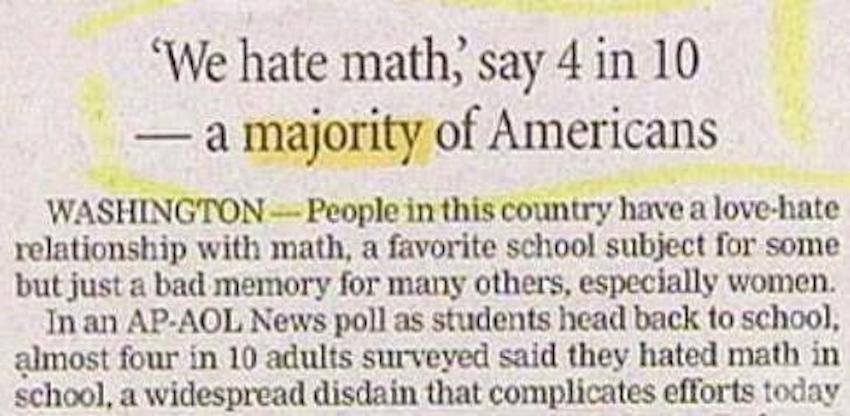
Americans hate math.

Americans hate math.

One part of US success is imported talent, of course. We import Nobel lauriate chemists, Russian dancers, German rocket scientists…, but we don’t import that many. The majority of our immigrants are more in the wretched refuse category, and even these appear to do better here in the US than their colleagues that they left behind. Otto von Bismark once joked that, “God protects children, drunks, and the United States of America.” But I’d like to suggest that our success is based on optimism, pronia: a can-do belief in ourselves that our education provides, at least to our more creative citizens.

Most of the great successful businesses of the USA are not started by the A students, it is clear, but by the C students who develop the greatness of the little they know. Consider Colonel Harlen Sanders, founder of Kentucky Fried Chicken. He believed in the greatness of his chicken recipe, and developed to skills to sell it fast. He did not have to know astronomy, whether the earth goes round the sun. It’s an important fact, but only relevant if you can use it, as Sherlock Holmes points out. I suspect that few Europeans could use the knowledge that the earth spins productively, and suspect that the majority of those that might, lack the confidence to do so (I provide some at the end of this essay).

Benjamin Jowett. His students included the heads of 6 colleges and the head of Eaton

Benjamin Jowett, Master of Balliol College, Oxford.

A classic poem about European education describes Benjamin Jowett, shown at right. It goes: “The first come I, my name is Jowett. There is no knowledge, but that I know it. I am master of this college. What I don’t know isn’t knowledge.” Benjamin Jowett was Master of Balliol College, Oxford. By the time he died in 1893, his ex-student pallbearers included the heads of 6 colleges, and the head of Eaton. Most English heads of state and industry were his students directly or second-hand. All left university with a passing knowledge of Greek, Latin, Plato, law, science, theology, classics, math, rhetoric, logic, and grammar. Only people so educated were deemed suited to run banks or manage backward nations like India or Rhodesia. It worked for a while but showed its limitations, e.g. in the Boer Wars.

In France and continental Europe, the education system is similar, to this day ,to England’s under Jowett. There is a fixed set of knowledge and a fixed rate to learn it. Government and industry jobs go largely to those who’ve demonstrated their ability to give the fixed, correct answers to tests on this knowledge. In schools across France, the same page is turned virtually simultaneously in the every school– no student is left behind, but none jump ahead either or deviate. As new knowledge is integrated, the approved text books are updated and the correct answers are adjusted. Until then, the answers in the book are God’s truth, and those who master it can comfort themselves to have mastered the truth. The European system appears to benefit the many, providing useful skills (and useless tidbits) but it is oppressive to others with forward-thinking, imaginative minds, or who see a new truth a year before the test acknowledges it. College, it is said, “..is a place where pebbles are polished but diamonds are dimmed.” The system work well in areas that barely change like French grammar, geometry, law, and the map of Europe. It does not work so well in music, computers, or the art of war. For creative students, bright or otherwise, schooling is “another brick in the wall.” These students need learning in ‘how to get along without a teacher.’

The American approach leans, or perhaps leaned, towards independence of thought, for good or bad. American graduates can live without the teacher, but leave school knowing no language but English, knowing hardly and maths or science, and hardly any grammar. We can hardly find another country on a map, and often can’t find our own. Teachers will take incorrect answers as correct as a way to build self-esteem, so students leave with the view that there is no such thing as truth. Strangely, this model works, at least in music, engineering, and science where change is fast, creativity is king, and nature itself is a teacher. American graduate-schools are preeminent in these areas. In reading, history and math our graduates might well be described as galumphing ignorants.

Every now and again the US tries to Europeanize education. The “no child left behind” movement was a Republican-led effort to teach on the French model, at least in reading and math. It never caught on. Drugs are a popular approach to making American students less obstreperous, but they work only temporarily. Americans leave school ignorant, but not stupid; respectful of those who can do things, and suspicious of those with lengthy degrees. Without Latin, we do OK as managers of the most complex operations, relying on bumptious optimism and distain for hierarchy.

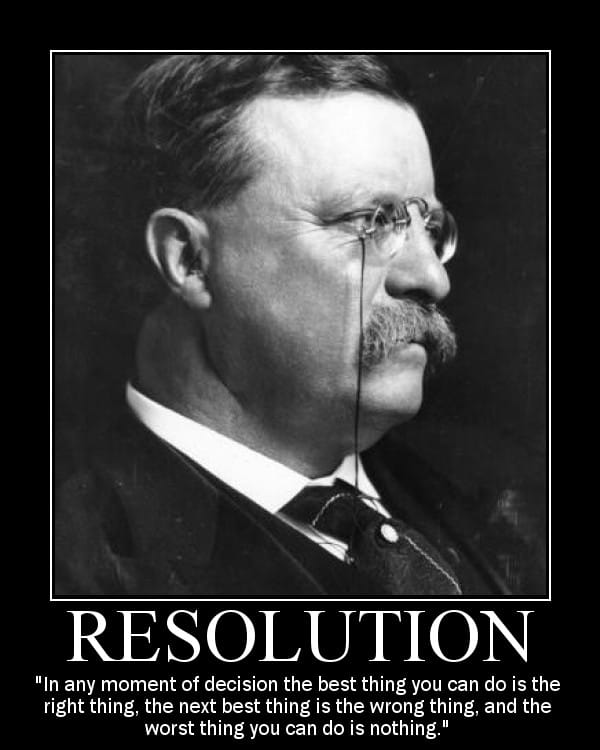
In any moment of decision, the best thing you can do is the right thing, the next bet thing is the wrong thing, and the worst thing you can do is nothing. An American attitude that sometimes blows up, but works surprisingly well at times.

Often the inability to act is worse than acting wrong.

The American-educated boss will do some damage by his ignorance but it is no more than  comes from group-think: non-truths passed as truths. America stopped burning witches far sooner than Europe, and never burned Jews. America dropped nobles quicker, and transitioned to electric lights and motor cars quicker, perhaps because we put less weight on what nobles and universities did. When dealing Europeans, we greet them in a loud, cheerful voice, appoint a subordinate to “get things done,” and get in the way until lunchtime. The Europeans are suitably appalled, both by the crassness and by the random energy.

European scholars accepted that nobility gives one a handle on leadership. This belief held back the talented, non-noble. Since religion was part of education, they accepted that state should have an established religion, Anglican, in England, Catholicism in France; scientific atheism now. They learned from the state, and accepted, that divorce was unnecessary, that homosexuality should be punished by prison or worse, In the early 60s, Turing, a brilliant mathematician and computer scientist, was chemically castrated as a way to cure his homosexuality. In America our “Yankee ingenuity,” as we call it, screwed up too, but in ways like prohibition, McCarthyism, and disco. Such screwups resolved themselves relatively fast. “Ready, fire, aim” is a European description of the American method to any problem. It’s not great, but works better than “steady as she goes.”

The best option, it seems, is when we work together with those “across the pond.” It worked well for us in WWI, WWII, and the American Revolution, benefitting from Lafayette, Baron Von Steuben, Kosciusko, etc. Heading into the world cup of football (fifa soccer) this week, we’re expected to lose badly due to our lack of talent and our general inability to pass, dribble, or strategize. Still, we’ve got enthusiasm, and we’ve got a German coach. The world’s bookies give us 0.05% odds, but our chances are 10 times that, I’d say: 5%. God protects our galumphing corn-fed ignorants when, as in the Revolution, it’s attached to European coaching.

Some businesses where it helps to know the earth spins: rocketry (military and exploratory), communication via geosynchronous satellites (they only work because the earth spins), weather prediction (the spin of hurricanes is because the earth spins), cyclone lifting. It amazes me that people ever thought everything went around the earth, by the way; Mercury and Venus never appear overhead. If authorities could have been so wrong about this for so long, what might they be wrong about today?

Dr. Robert Buxbaum, June 10, 2014 I’ve also written about ADHD on Lincoln’s Gettysburg Address, on Theodore Roosevelt, and how he survived a gun shot.

Lincoln’s Gettysburg address, not as bad as first thought.

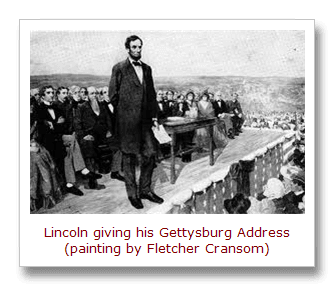
Three score days ago, The Harrisburg Patriot & Union retracted its unflattering 1863 review of Lincoln’s Gettysburg address. But this retraction deserves more attention, I think, than that the editors reconsidered. The Patriot & Union was a Republican journal; it carried an accurate account of the speech, and so it’s worthwhile to ask why its editors labeled this great speech, “silly remarks”, deserving “a veil of oblivion”; “without sense.” Clearly the editors saw a serious lack that we do not see today. It’s worth asking then, what made them think it was silly and lacking in sense?

The Union & Patriot has retracted their review of this 1863 speech.

Lincoln in 1863; The Union & Patriot has retracted their review of this Gettysburg speech — in the fullness of time, they’ve come to reconsider their original review.

Lincoln spoke a few words in honor of the dead, but Edward Everett spoke on this topic for two hours before Lincoln rose. This lack does not appear to be what bothered the editors: “To say of Mr. Everett’s oration that it rose to the height which the occasion demanded, or to say of the President’s remarks that they fell below our expectations, would be alike false. Neither the orator nor the jester surprised or deceived us. Whatever may be Mr. Everett’s failings he does not lack sense – whatever may be the President’s virtues, he does not possess sense. Mr. Everett failed as an orator, because the occasion was a mockery, and he knew it, and the President succeeded, because he acted naturally, without sense and without constraint, in a panorama which was gotten up more for his benefit and the benefit of his party than for the glory of the nation and the honor of the dead.” The editors came to Gettysburg (I think) to hear Lincoln to hear things that only LIncoln could provide — his real thoughts on slavery and an update on his efforts at peace. As best I can tell, it was in these areas that they saw “a veil of oblivion.” Even so, for them to call this address, “silly remarks” there must be more going on. Here are my thoughts.

Lincoln had freed southern slaves a few months earlier by the emancipation proclamation, but no one knew their status; there had been a riot over this a few days previous. Did Lincoln claim equality for these ex-slaves, and if not, what were his thoughts on the extent of their in-equality. They were confiscated as war booty; would Lincoln return them to their owners after the war was over? If so, they were not free at all. Along with this, what was Lincoln doing to end the war? It was far from clear that the North could win in 1863. Lee had many victories, and now England had entered in support of the Confederacy. In my opinion, it was Ericsson’s Monitors that allowed the North to stop the British and win, but it appears that, in 1863, only the British navy realized that their power had been neutralized, and the south was lost.

By 1863 Ericsson was turning out two of these Monitor-type sips per month, enough to keep the British from any major port in America

The North’s Monitor, right, fights the Confederate Merrimac, left, to a draw over control of Norfolk harbor. Ericsson turned out two Monitor ships per month. In my opinion is was these ships that stopped the British and won the war.

Lincoln was cryptically brief when it came to slavery or peace: 271 words. About half the speech is devoted to the brave men who struggled here; the other half speaks of “the Nation,” or the “government.” Not the United States, the Union, the North, the South, but an undefined entity that Lincoln claims came into existence 70 years earlier, in 1776. Most educated people would have said that 1776 created no nation or government, only a confederation of independent states as described by the articles of confederation. Under these articles, these 13 states could only act by consensus and had the right to leave at will. To the extent that anyone held the South was bound now, it was because of the Constitution, signed ten years later, but Lincoln does not mention the Constitution at all– perhaps because most Democrats, understood the Constitution to allow departure. Also, to the extent the Constitution mentions slavery, it’s not to promote equality, but to give each slave 3/5 the vote-power of a free man. If “created equal” is to come from anywhere, it’s the Declaration, but most people understood the intent of the Declaration differently from the vision Lincoln now presented.

As far as most people understood it, The Declaration claimed the God-given right to separate from England and gain us a measure of self-rule — something that the South now claimed for itself, but Lincoln opposed. Further, we claimed in The Declaration, that British mis-management made the separation necessary, and listed the abhorrent offenses including suspension of habeas corpus, and the confiscation of property without process of law — things Lincoln was doing even now. Even the introductory phrase, created equal, was not understood to imply that everyone was equal. Rather, as Stephen Douglass pointed out in their 1858 Chicago debate, we’d created a nation “by the white man, for the benefit of the white man, to be administered by white men, in such a manner as they should determine.”

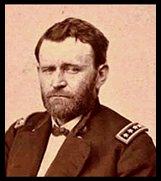
Ulysses Grant had a slave who he freed in 1859, and had control of his wife's slaves, who became free only in 1865. Lee's slaves were freed in 1862.

Ulysses Grant had a slave he freed in 1859; his wife held slaves till 1865. Lee freed his in 1862.

Where was Lincoln coming from? What was he saying that November day? It’s been speculated that Lincoln was proposing a secular religion of administered freedom. There appears to be some legitimacy here, but more I suspect Lincoln was referring to the UNANIMITY requirement behind the Declaration — by agreement all the states had to agree to independence, or we would all stay bound to Britain. If we had to unanimously bind ourselves, we must have unanimously bound ourselves to some shared vision of the union or democracy, -presumably that all were created equal. Five years earlier, William Herndon, Lincoln’s law partner, had given Lincoln a book of the sermons of Theodore Parker, a Boston Unitarian. That volume includes the following section marked by Lincoln in reference to what the unanimous binding entailed: “‘Democracy is direct self-government, over all the people, for all the people, by all the people.” Whether Lincoln was now speaking in direct reference to this line, or more-likely, as I suspect, to a more general refutation of the claims of Southern separation and Douglas’s 1858 white man claim, Lincoln’s sense of the import of the Declaration was one that few understood or agreed with. The North still had slaves — Grant’s wife for example, and there was no obvious desire for a new birth of freedom, just an end to the war. Lincoln’s words thus must have sounded like gobbledygook to the majority of learned ears.

Based on the events and issues of the time, and the un-obvious point of the speech, I’d say the editors were justified in their ill review. Further, the issues that bothered them then, abuse of power, citizen and states’ rights, remain as relevant today as ever. Do the current editors see any import of the 9th and 10th amendment limiting the power of federal government? If so, what. Thus, I’m a bit disappointed that the Union & Patriot retracted its review of Lincoln’s short speech with nothing more than claiming to see things differently today. We stand on LIncoln’s shoulders now, and though we see the nation, and the Declaration, through his eyes, their issues remain, and the original review gives perspective on the nation as it looked at a very different time. Thus, while I understand the editors desire to look correct in retrospect, I’d prefer if the current editors would have left the review, or at least addressed the points that bothered their earlier colleagues. It’s a needed discussion. When every person thinks alike, nobody thinks very much.

January 6, 2014 by Robert E. Buxbaum, a doctor of Philosophy (in Chemical Engineering). Here is a translation of the Address into Jive. And into yeshivish. I’ve also written an essay on a previous retraction (regarding GM food). If Lincoln had a such a long address, how did he ever get mail?

An Aesthetic of Mechanical Strength

Back when I taught materials science to chemical engineers, I used the following except of a poem to teach an aesthetic for good design, at least as concerns mechanical strength:

“…The secret to design, as the parson explained, is that the weakest part must withstand the strain. And if that part is to withstand the test, then it must be made as strong as all the rest….” (by R.E. Buxbaum, based on “The Wonderful, One-hoss Shay, by Oliver Wendell Holmes, 1858).

I figured that students needed an idea they could remember of what good design looked like. I wanted them to realize that there is always a weakest part in any device or process, and that this is the likely point of failure. Good design accepts this truth and designs everything around it. You make sure that the device will fail at a part or time of your choosing, and that, when it fails (not if), it’s preferably at at time and place where you can repair it easily and cheaply (a fuse, or a door hinge), and that doesn’t cause too much mayhem when it fails. Once this failure part is chosen and in place, I taught that the rest should be stronger, but there is no point in making any other part vastly stronger than your weakest link. Thus for example, once you’ve decided to use a fuse that fails at a certain amperage, there is no point in choosing wiring to take more than 2-3 times the amperage of the fuse.

This is an aesthetic argument, of course, but it’s important for a person to know what good work looks like (to me, and perhaps to the student). An engineer needs a positive view of craftwork beyond compliments from the boss or grades from me. Some day, I’ll be gone, and the boss won’t be looking. Only self-esteem keeps you going.

Many engineering aspects relate to failure points. If you don’t know what the failure point is, make a prototype and test it to failure. Then, if you don’t like what you see, remodel accordingly. If you like the point of failure but decide you really want to make the device stronger or more robust, be aware that this may involve more than strengthening that part only. You may need to re-engineer the entire chain of parts so they are as failure resistant as this part.

I also wanted to teach that there are many failure chains to look out for: many ways that things can wrong beyond breaking. Check for failure by fire, melting, explosion, smell, shock, rust, and even color change. Color change should not be ignored, BTW; there are many products that people won’t use as soon as they look bad (cars, for example). Make sure that each failure chain has it’s own, known weak links. In a car, the paint should fade, chip, or peel before the metal underneath starts rusting or sagging (at least that’s my aesthetic). And in the DuPont gun-powder mill below, one wall should be weaker so that the walls blow outward the right way (away from traffic). Be aware that human error is the most common failure mode: design should be acceptably idiot-proof.

Dupont powder mills had a thinner wall and a stronger wall so that, if there were an explosion it would blow out towards the river. This mill has a second wall to protect workers. The thinner wall should be barely strong enough to stand up to wind and rain; the stronger walls should stand up to explosions that blow out the other wall.

Dupont powder mills had a thinner wall and a stronger wall so that, if there were an explosion, it would blow out ‘safely.’ This mill has a second wall to protect workers. The thinner wall must be strong enough to stand up to wind and rain; the stronger walls should stand up to all likely explosions.

Related to my aesthetic of mechanical strength, I tried to teach an aesthetic of cost, weight, appearance, and green-soundness: Choose materials that are cheaper, rather than more expensive and that weigh less rather than more. Use materials that look better if you’ve the choice, and use recyclable materials. These all derive from the well-known axiom, omit needless stuff. Or, as William of Occam put it, “Entia non sunt multiplicanda sine necessitate.” As an aside, I’ve found that, when engineers use Latin, we sound smarter: “lingua bona lingua motua est.” (a good language is a dead language) — it’s the same with quoting dead 19th century poets. Dead 19th century poets are far better than undead ones, but I digress.

Use of recyclable materials gets you out of lots of problems relative to materials that must be disposed of. E.g. if you use aluminum insulation (recyclable) instead of ceramic fiber, you will have an easier time getting rid of the scrap. As a result, you are not as likely to expose your workers (or you) to mesothelioma, or similar disease. You should not have to pay someone to haul away excess or damaged product; a scraper will oblige, and he may even pay you for it if you have enough. Recycling helps cash flow with decommissioning too, when money is tight. It’s better to find your $1 worth of scrap is now worth $2 instead of discovering that your $1 worth of garbage now costs $2 to haul away. By the way, most heat loss is from black body radiation, so aluminum foil may actually work better than ceramics of the same thermal conductivity.

Buildings can be recycled too. Buy them and sell them as needed. Shipping containers make for great lab buildings because they are cheap, strong, and movable. You can sell them off-site when you’re done. We have a shipping container lab building, and a shipping container storage building — both worth more now than when I bought them. They are also rather attractive with our advertising on them — attractive according to my design aesthetic. Here’s an insight into why chemical engineers earn more than chemists; and insight into the difference between mechanical engineering and civil engineering. Here’s an architecture aesthetic. Here’s one about the scientific method.

Robert E. Buxbaum, October 31, 2013