Tag Archives: chemistry

Metals and nonmetals

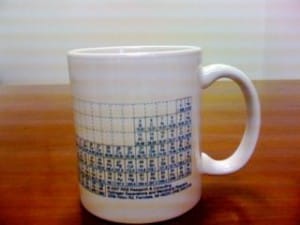
Hydrogen is both a metal an a non-metal. It says so on the specially produced coffee cups produced by my company (and sold by my company) but not on any other periodic table i’ve seen. That’s a shame for at least two reason. First, on a physiochemical level, while hydrogen is a metal in the sense that it combines with non-metals like chlorine and oxygen to form HCl and H2O, it’s not a metal in how it looks (not very shiny, malleable, etc.). Hydrogen acts like a chemical non-metal in the sense that it reacts with most metals to form metal hydrides like NaH CaH2 and YH3 (my company sells metal hydride getters, and metal membranes that use this property), and it also looks like a non-metal; it’s a gas like non-metallic chlorine, fluorine, and oxygen.

REB Research, Periodic table coffee cup

REB Research, Periodic table coffee cup

Most middle schoolers and high schoolers learn to differentiate metals and nonmetals by where they sit on the periodic tables they are given, and by general appearance and feel, that is by entirely non-scientific methods. Most of the elements on the left side of their periodic tables are shiny and conduct electricity reasonably well, so students come to believe that these are fundamental properties of metals without noting that boron and iodine (on the right side) are both shiny and conduct electricity, while hydrogen (presumably the first metal) does not. Students note that many metals are ductile without being told that calcium and chromium are brittle, while boron and tin (non-metals) are ductile. And what’s with the jagged dividing line: some borderline cases, like aluminum, look awfully metallic by normal standards.

The actual distinction, and the basis for the line, has nothing to do with the descriptions taught in middle school, but everything to do with water. When an element is oxidized to its most common oxide and dissolved in water the solution will be either acidic or basic. This is the basis of the key distinction: we call something a metal if the metal oxide solution is basic. We call something a non-metal if the oxide solution is an acid. To make sulfuric acid or nitric acid: you dissolve the oxides of sulfur or nitrogen respectively, in water. That’s why nitrogen and sulfur are nonmetals. Similarly, since you make boric acid by dissolving boron oxide in water boron is a non-metal. Calcium is a metal because calcium oxide is lime, a strong base. Aluminum and antimony are near borderline cases, because their oxides are nearly neutral.

And now we return to hydrogen and my cup. hydrogen is the only element listed as both a metal and a non-metal because hydrogen oxide is water. It is entirely neutral. When water dissolves in water the pH is 7; by definition, hydrogen is the only real borderline case. It is not generally shown that way, but it is shown as a metal and a non metal is on a cup produced by my company.
How is Chemical Engineering?

I’m sometimes asked about chemical engineering by high-schoolers with some science aptitude. Typically they are trying to decide between a major in chemistry or chemical engineering. They’ve typically figured out that chemical engineering must be some practical version of chemistry, but can’t quite figure out how that could be engineering. My key answer here is: unit operations.

If I were a chemist trying to make an interesting product, beer or whisky say, I might start with sugar, barley, water and yeast, plus perhaps some hops and tablets of nutrients and antimicrobial. After a few hours of work, I’d have 5 gallons of beer fermenting, and after a month I’d have beer that I could either drink or batch-distill into whisky. If I ran the cost numbers, I’d find that my supplies cost as much to make as buying the product in a store; the value of my time was thus zero and would not be any higher if I were to scale up production: I’m a chemist.

The key to making my time more valuable is unit operations. I need to scale up production and use less costly materials. Corn costs less than sugar but has to be enzyme processed into a form that can be fermented. Essentially, I have to cook a large batch of corn at the right temperatures (near boiling) and then add enzymes from the beer or from sprouted corn and then hold the temperature for an hour or more. Sounds simple, but requires good heat control, good heating, and good mixing, otherwise the enzymes will die or won’t work or the corn will burn and stick to the bottom of the pot. These are all unit operations; you’ll learn more about them in chemical engineering.

Reactor design is a classical unit operation. Do I react in large batches, or in a continuous fermentor. How do I hold on to the catalyst (enzymes); what is the contact time; these are the issues of reactor engineering, and while different catalysts and reactions have different properties and rates, the analysis is more-or-less the same.

Another issue is solid-liquid separation, in this case filtration of the dregs. When made in small batches, the bottoms of the beer barrel, the dregs, were let to settle and then washed down the sink. At larger scales, settling will take too long and will still leave a beer that is cloudy. Further, the dregs are too valuable to waste. At larger scales, you’ll want to filter the beer and will want to do something to the residue. Centrifugal filtration is typically used and the residue is typically dried and sold as animal feed. Centrifugal filtration is another unit operation.

Distillation is another classical unit operation. An important part here is avoiding hangover-producing higher alcohols and nasty tasting, “fusel oils.” There are tricks here that are more-or-less worth doing depending on the product you want. Typically, you start with a simple processes and equipment and keep tweaking them until the product and costs are want you want. At the end, typically, the process equipment looks more like a refinery than like a kitchen: chemical engineering equipment is fairly different from the small batch equipment that was used as the chemist.

The same approach to making things and scaling them up also applied in management situations, by the way, and many of my chemical engineering friends have become managers.

For parents of a young scientist: math

It is not uncommon for parents to ask my advice or help with their child; someone they consider to be a young scientist, or at least a potential young scientist. My main advice is math.

Most often the tyke is 5 to 8 years old and has an interest in weather, chemistry, or how things work. That’s a good age, about the age that the science bug struck me, and it’s a good age to begin to introduce the power of math. Math isn’t the total answer, by the way; if your child is interested in weather, for example, you’ll need to get books on weather, and you’ll want to buy a weather-science kit at your local smart-toy store (look for one with a small wet-bulb and dry bulb thermometer setup so that you’ll be able to discuss humidity  in some modest way: wet bulb temperatures are lower than dry bulb with a difference that is higher the lower the humidity; it’s zero at 100%). But math makes the key difference between the interest blooming into science or having it wilt or worse. Math is the language of science, and without it there is no way that your child will understand the better books, no way that he or she will be able to talk to others who are interested, and the interest can bloom into a phobia (that’s what happens when your child has something to express, but can’t speak about it in any real way).

Math takes science out of the range of religion and mythology, too. If you’re stuck to the use of words, you think that the explanations in science books resemble the stories of the Greek gods. You either accept them or you don’t. With math you see that they are testable, and that the  versions in the book are generally simplified approximations to some more complex description. You also get to see that there the descriptions are testable, and that are many, different looking descriptions that will fit the same phenomena. Some will be mathematically identical, and others will be quite different, but all are testable as the Greek myths are not.

What math to teach depends on your child’s level and interests. If the child is young, have him or her count in twos or fives, or tens, etc. Have him or her learn to spot patterns, like that the every other number that is divisible by 5 ends in zero, or that the sum of digits for every number that’s divisible by three is itself divisible by three. If the child is a little older, show him or her geometry, or prime numbers, or squares and cubes. Ask your child to figure out the sum of all the numbers from 1 to 100, or to estimate the square-root of some numbers. Ask why the area of a circle is πr2 while the circumference is 2πr: why do both contain the same, odd factor, π = 3.1415926535… All these games and ideas will give your child a language to use discussing science.

If your child is old enough to read, I’d definitely suggest you buy a few books with nice pictures and practical examples. I’d grown up with the Giant Golden book of Mathematics by Irving Adler, but I’ve seen and been impressed with several other nice books, and with the entire Golden Book series. Make regular trips to the library, and point your child to an appropriate section, but don’t force the child to take science books. Forcing your child will kill any natural interest he or she has. Besides, having other interests is a sign of normality; even the biggest scientist will sometimes want to read something else (sports, music, art, etc.) Many scientists drew (da Vinci, Feynman) or played the violin (Einstein). Let your child grow at his or her own pace and direction. (I liked the theater, including opera, and liked philosophy).

Now, back to the science kits and toys. Get a few basic ones, and let your child play: these are toys, not work. I liked chemistry, and a chemistry set was perhaps the best toy I ever got. Another set I liked was an Erector set (Gilbert). Get good sets that they pick out, but don’t be disappointed if they don’t do all the experiments, or any of them. They may not be interested in this group; just move on. I was not interested in microscopy, fish, or animals, for example. And don’t be bothered if interests change. It’s common to start out interested in dinosaurs and then to change to an interest in other things. Don’t push an old interest, or even an active new interest: enough parental pushing will kill any interest, and that’s sad. As Solomon the wise said, the fire is more often extinguished by too much fuel than by too little. But you do need to help with math, though; without that, no real progress will be possible.

Oh, one more thing, don’t be disappointed if your child isn’t interested in science; most kids aren’t interested in science as such, but rather in something science-like, like the internet, or economics, or games, or how things work. These areas are all great too, and there is a lot more room for your child to find a good job or a scholarship based on their expertise in theses areas. Any math he or she learns is certain to help with all of these pursuits, and with whatever other science-like direction he or she takes.   — Good luck. Robert Buxbaum (Economics isn’t science, not because of the lack of math, but because it’s not reproducible: you can’t re-run the great depression without FDR’s stimulus, or without WWII)

REB Research periodic table cup

Some 20 years ago I designed this periodic table cup, but with only the 103 named elements that existed then. In part this was done because I wanted a good, large, white coffee cup, in part because I often found I needed a periodic table, and didn’t like to have to look one up, and in part to people how much more area you get on a cylinder than on a flat sheet (roughly 3.14 times more area). To show that, I put all the side elements (rare earth lanthanides, and actinides) where they belonged, and not off on the side. I also put hydrogen in twice, once as a metal (HCl) and once as a non metal (NaH). The color I chose was Tryian Blue, a key color of Biblical Tyre, what you get from male purpura mollusks (the females give a shade of red that I also try to associate with REB Research).

I’ve updated the cup to add more elements: I think it’s great. You can buy it for $45 through our web-site, or for $40 by e-mailing me (reb@rebresearch.com). Or if you do something really cool, I may send you one for free.

REB Research, Periodic table coffee cup

REB Research, Periodic table coffee cup

By the way, I only use 4 digits for the atomic weight; I can think of no application where a normal person needs more.