With the sun setting earlier, and the threat of new COVID lockdowns, there is a real threat of a depression, seasonal and isolation. A partial remedy is exercise; it helps fight depression whether you take other measures not. An article published last month in the Journal of Affective Disorders reviewed 22 studies of the efficacy of exercise, particularly as an add-on to drugs and therapy. Almost every study showed that exercise helped, and in some studies it helped a lot. See table below. All of the authors are from the University of British Columbia. You can read the article here.
From “Efficacy of exercise combined with standard treatment for depression compared to standard treatment alone: A systematic review and meta-analysis of randomized controlled trials.” by JacquelineLee1 et al.In virtually every study, exercise helps fight depression.
For those who are willing to exercise, there are benefits aside from mental health. Even a daily walk around the block helps with bone strength, weight control, heart disease, plus the above mentioned improvement in mood. More exercise does more. If you bicycle without a helmet, you’re likely to live longer than if you drive.
For those who can’t stand exercise, or if exercise isn’t quite enough to send away the blues, you can try therapy, medication, and/or diet. There is some evidence that food that are high in lithium help fight depression. These food include nuts, beans, tomatoes, some mineral waters, e.g. from Lithia springs, GA. The does is about 1/100 the dose given as a bipolar treatment, but there is evidence that even such small doses help. Lithium was one of the seven ingredients in seven up — it was the one that was supposed to cheer you up. See some research here.
It is a fundamental of science that that the properties of every pure one-phase material is totally fixed properties at any given temperature and pressure. Thus for example, water at 0°C is accepted to always have a density of 0.998 gm/cc, a vapor pressure of 17.5 Torr, a viscosity of 1.002 centipoise (milliPascal seconds) and a speed of sound of 1481 m/s. Set the temperature and pressure of any other material and every other quality is set. But things go screwy near surfaces, and this is particularly true for water where the hydrogen bond — a quantum bond — predominates.
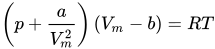
its vapor pressure rises and it becomes less inclined to condense or freeze. I use this odd aspect of thermodynamics to keep my platinum-based hydrogen getter catalysis active at low temperatures where they would normally clog. Normal platinum catalysts are not suitable for hydrogen removal at normal temperatures, eg room temperature, because the water that forms from hydrogen oxidation chokes off the catalytic surface. Hydrophobic additions prevent this, and I’d like to show you why this works, and why other odd things happen, based on an approximation called the Van der Waals equation of state:
(1)
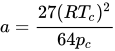
This equation described the molar volume of a pure material, , of any pure material based not the pressure, the absolute temperature (Kelvin) and two, substance-specific constants, and . These constants can be understood as an attraction force term, and a molecular volume respectively. It is common to calculate a and b from the critical temperature and pressure as follows, where Tc is absolute temperature:
, (2 a,b)
For water Tc = 647 K (374°C) and 220.5 bar. Plugging in these numbers, the Van der Waals gives reasonable values for the density of water both as a liquid and a gas, and thus gives a reasonable value for the boiling point.
Now consider the effect that an inert surface would have on the effective values of a and b near that surface. The volume of the molecules will not change, and thus b will not change, but the value of a will change, likely by about half. This is because, the number of molecules surrounding any other molecule is reduced by about half while the inert surface adds nothing to the attraction. Near a surface, surrounding molecules still attract each other the same as before, but there are about half as many molecules at any temperature and pressure.
To get a physical sense of what the surface does, consider using the new values of a and b to determine a new value for Tc and Pc, for materials near the surface. Since b does not change, we see that the presence of a surface does not affect the ratio of Tc and Pc, but it decreases the effective value of Tc — by about half. For water, that is a change from 647 K to 323.5K, 50.5°C, very close to room temperature. Pc changes to 110 bar, about 1600 psi. Since the new value of Tc is close to room temperature, the the density of water will be much lower near the surface, and the viscosity can be expected to drop. The net result is that water flows more readily through a teflon pipe than through an ordinary pipe, a difference that is particularly apparent at small diameters.
This decrease in effective Tc is useful for fire hoses, and for making sailing ships go faster (use teflon paint) and for making my hydrogen removal catalysts more active at low temperatures. Condensed water can block the pores to the catalyst; teflon can forestall this condensation. It’s a general trick of thermodynamics, reasonably useful. Now you know it, and now you know why it works.
The toll of COVID-19 has been terrible: 660,000 dead by my count, based on excess deaths, graph below, or 620,000 according to the CDC based on hospital records. Death rates appear to have returned to pre-pandemic levels, more or less*, but folks are still getting very sick and going to the hospital, mostly for “the delta variant.”
Weekly US death rates since October 2015.
As the following chart shows, severe symptoms of COVID are now almost entirely in the old, and unvaccinated. The risk to the young and middle aged is low, but even there, vaccination helps. According to the CDC, 72.2% of the adult US population is vaccinated with at least one shot. The vaccination, doesn’t prevent you from getting the delta variant nor from spreading it; it just protects from the most serious consequences of the disease. It seems a previous infection has the same effect, though less so.
Vaccination helps prevent hospitalization – at all ages (Israeli data)
If you’re over 60 and unvaccinated, I recommend getting vaccinated with at least one shot; the inconvenience and side-effects are few, and the benefit is large. The second shot seemswothshile too, and for all I know a third will too. Sooner or later there is a diminishing return. The benefit of masks seems is smaller, as I judge things. I notice that the disease is spreading at about the same rate in masked and unmasked states, and that the death numbers are as high, or higher in heavily masked, blue states as in red. New York and NJ are the top COVID death states, with Michigan not far behind. Masks seem to help, just not very much.
If you wish to check my analysis, go here to get the raw data: https://gis.cdc.gov/grasp/fluview/mortality.html. Then, to calculate the COVID effect, I subtracted the weekly death rates in 2020 and 2021 from the corresponding week rates in 2019, correcting the deaths by 1%/year for population growth and aging. *I find that there are about 500 excess deaths per week, and I assume those are among the unvaccinated. If you are vaccinated, I’d worry about something else besides COVID-delta: heart attack, cancer, suicide, or Afghanistan.
We live in a throw-away society, and the majority of it, eventually makes its way to a landfill. Books, food, grass clippings, tree-products, consumer electronics; unless it gets burnt or buried at sea, it goes to a landfill and is left to rot underground. The product of this rot is a gas, landfill gas, and it has a fairly high energy content if it could be tapped. The composition of landfill gas changes, but after the first year or so, the composition settles down to a nearly 50-50 mix of CO2 and methane. There is a fair amount of water vapor too, plus some nitrogen and hydrogen, but the basic process is shown below for wood decomposition, and the products are CO2 and methane.
System for sewage gas upgrading, uses REB membranes.
C6 H12 O6 –> 3 CO2 + 3 CH4
This mix can not be put in the normal pipeline: there is too much CO2 and there are too many other smelly or condensible compounds (water, methanol, H2S…). This gas is sometimes used for heat on site, but there is a limited need for heat near a landfill. For the most part it is just vented or flared off. The waste of a potential energy source is an embarrassment. Besides, we are beginning to notice that methane causes global-warming with about 50 times the effect of CO2, so there is a strong incentive to capture and burn this gas, even if you have no use for the heat. I’d like to suggest a way to use the gas.
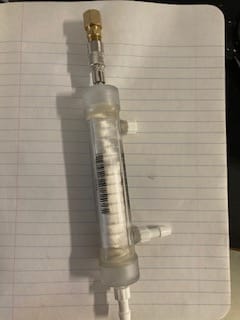
We sell small membrane modules too.
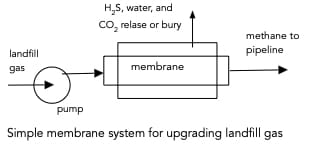
The landfill gas can be upgraded by removing the CO2. This can be done via a membrane, and REB Research sells a membranes that can do this. Other companies have other membranes that can do this too, but ours are smaller, and more suitable to small operations in my opinion. Our membrane are silicone-based. They retain CH4 and CO and hydrogen, while extracting water, CO2 and H2S, see schematic. The remainder is suited for local use in power generation, or in methanol production. It can also be used to run trucks. Also the gas can be upgraded further and added to a pipeline for shipping elsewhere. The useless parts can be separated for burial. Find these membranes on the REB web-site under silicone membranes.
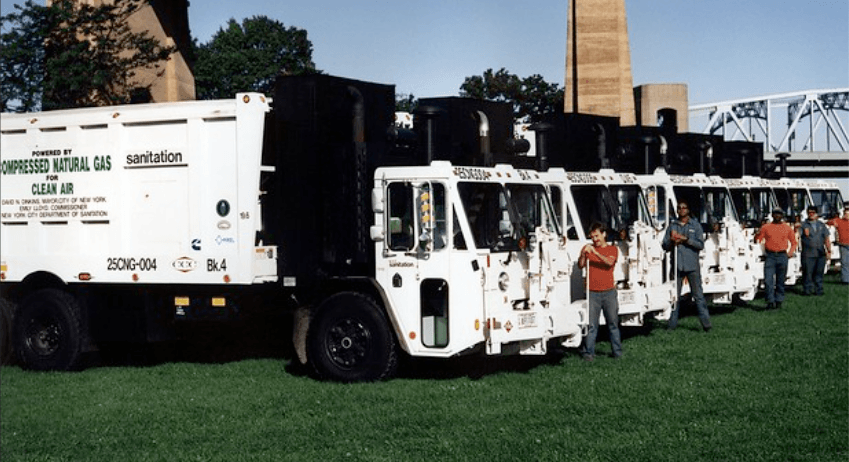
Garbage trucks in New York powered by natural gas. They could use landfill gas.
There is another gas source whose composition is nearly identical to that of landfill gas; it’s digester gas, the output of sewage digesters. I’ve written about sewage treatment mostly in terms of aerobic bio treatment, for example here, but sewage can be treated anaerobically too, and the product is virtually identical to landfill gas. I think it would be great to power garbage trucks and buses with this. Gas. In New York, currently, some garbage trucks are powered by natural gas.
As a bonus, here’s how to make methanol from partially upgraded landfill or digester gas. As a first step 2/3 of the the CO2 removed. The remained will convert to methanol. by the following overall chemistry:
3 CH4 + CO2 + 2 H2O –> 4 CH3OH.
When you removed the CO2., likely most of the water will leave with it. You add back the water as steam and heat to 800°C over Ni catalyst to make CO and H2. That’s done at about 800°C and 200 psi. Next, at lower temperature, with an appropriate catalyst you recombine the CO and H2 into methanol; with other catalysts you can make gasoline. These are not trivial processes, but they are doable on a smallish scale, and make economic sense where the methane is essentially free and there is no CNG customer. Methanol sells for $1.65/gal when sold by the tanker full, but $5 to $10/gal at the hardware store. That’s far higher than the price of methane, and methanol is far easier to ship and sell in truckload quantities.
Some years ago I wrote a largely negative review of Brown’s gas, but the COVID crisis in India makes me want to reconsider. Browns gas can provide a simple source of oxygen for those who are in need. First, an explanation, Browns gas is a two-to-one mix of hydrogen and oxygen; it’s what you get when you do electrolysis of water without any internal separator. Any source of DC electricity will do, e.g. the alternator of a car or a trickle charger of the sort folks buy for their car batteries, and almost any electrode will do too (I’d suggest stainless steel). You can generate pressure just by restricting flow from the electrolysis vessel, and it can be a reasonable source of small-scale oxygen or hydrogen. The reaction is:
H2O –> H2 + 1/2 O2.
The problem with Brown’s gas is that it is explosive, more explosive than hydrogen itself, so you have to handle it with care; avoid sparks until you separate the H2 from the O2. Even the unseparated mix has found some uses, e.g. as a welding gas, or for putting in cars to avoid misfires, increase milage, and decrease pollution. I think that methanol reforming is a better source of automotive hydrogen: hydrogen is a lot safer than this hydrogen-oxygen mix.
Browns gas to oxygen for those who need it.
The mix is a lot less dangerous if you separate the oxygen from the hydrogen with a membrane, as I show in the figure. at right. If you do this it’s a reasonable wy to make oxygen for patients who need oxygen. The electrolysis cell can be a sealed bottle with water and the electrodes; add a flow restriction as shown to create the hydrogen pressure that drives the separation. The power can be an automotive trickle charger. You can get this sort of membranes from REB Research, here and many other suppliers. REB provide consulting services if you like.
In a pinch, you don’t even need the membrane, by the way. You can rely on your lungs to make the separation. A warning, though, the mix is dangerous. Avoid all sparks. Also, don’t put salt into the water. You can can put in some baking soda or lye to speed the electrolysis, but If you put salt in, you’ll find you don’t make oxygen, but will instead make chlorine. And chlorine is deadly. If you’re not sure, smell the gas. If it smells acrid, don’t use it. This is the chlorine-forming reaction.
2NaCl + 2 H2O –> H2 + Cl2 + 2NaOH
Ideally you should vent the hydrogen stream out the window, but for short term, emergency use, the hydrogen can be vented into your home. Don’t do this if anyone smokes (not that anyone should smoke about someone on oxygen). This is a semi-patentable design, but I’m giving it away; not everything that can be patented should be.
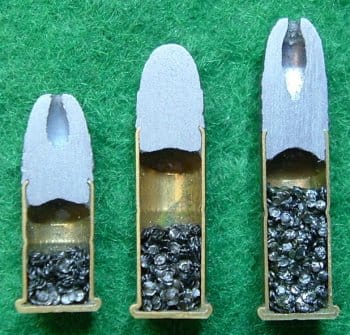
22 long rifle shells contain hardly any propellant.
The most rifle cartridge in the US today is the 22lr a round that first appeared in 1887. It is suitable to small game hunting and while it is less–deadly than larger calibers, data suggests it is effective for personal protection. It is also remarkably low cost. This is because the cartridge in almost entirely empty as shown in the figure at right. It is also incredibly energy efficient, that is to say, it’s incredibly good at transforming heat energy of the powder into mechanical energy in the bullet.
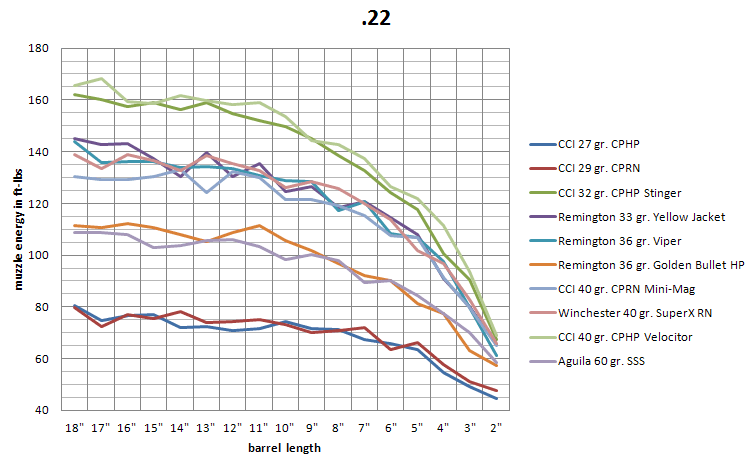
The normal weight of a 22lr is 40 grains, or 2.6 grams; a grain is the weight of a barley grain 1/15.4 gram. Virtually every brand of 22lr will send its bullet at about the speed of sound, 1200 ft/second, with a kinetic energy of about 120 foot pounds, or 162 Joules. This is about twice the energy of a hunting bow, and it will go through a deer. Think of a spike driven by a 120 lb hammer dropped from one foot. That’s the bullet from a typical 22lr.
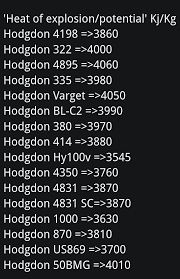
The explosive combustion heat of several Hodgdon propellants.
The Hodgdon power company is the largest reseller of smokeless powder in the US with products from all major manufacturers, with products selling for an average of $30/lb or .43¢ per grain. The CCI Mini-Mag, shown above, uses 0.8 grains of some powder 0.052 grams, or about 1/3¢ worth, assuming that CCI bought from Hodgdon rather than directly from the manufacturer. You will notice that the energies of the powders hardly varies from type to type, from a low of 3545 J/gram to a high of 4060 J/gram. While I don’t know which powder is used, I will assume CCI uses a high-energy propellant, 4000 J/gram. I now calculate that the heat energy available as 0.052*4000 = 208 Joules. To calculate the efficiency, divide the kinetic energy of the bullet by the 208 Joules. The 40 grain CCI MiniMag bullet has been clocked at 1224 feet per second indicating 130 foot pounds of kinetic energy, or 176 J. Divide by the thermal energy and you find a 85% efficiency: 176J/ 208 J = 85%. That’s far better than your car engine. If the powder were weaker, the efficiency would have to be higher.
The energy content of various 22lr bullets shot from different length barrels.
I will now calculate the pressure of the gas behind a 22lr. I note that the force on the bullet is equal to the pressure times the cross-sectional area of the barrel. Since energy equals force times distance, we can expect that the kinetic energy gained per inch of barrel equals this force times this distance (1 inch). Because of friction this is an under-estimate of the pressure, but based on the high efficiency, 85%, it’s clear that the pressure can be no more than 15% higher than I will calculate. As it happens, the maximum allowable pressure for 22lr cartridges is set by law at 24,000 psi. When I calculate the actual pressure (below) I find it is about half this maximum.
The change in kinetic energy per inch of barrel is calculated as the change in 1/2 mv2, where m is the mass of the bullet and v is the velocity. There is a web-site with bullet velocity information for many brands of ammunition, “ballistics by the inch”. Data is available for many brands of bullet shot from gun barrels that they cut shorter inch by inch; data for several 22lr are shown here. For the 40 grain CCI MiniMag, they find a velocity of 862 ft/second for 2″ barrel, 965 ft/second for a 3″ barrel, 1043 ft/second for a 4″ barrel, etc. The cross-section area of the barrel is 0.0038 square inches.
Every 22 cartridge has space to spare.
Based on change in kinetic energy, the average pressure in the first two inches of barrel must be 10,845 psi, 5,485 psi in the next inch, and 4,565 psi in the next inch, etc. If I add a 15% correction for friction, I find that the highest pressure is still only half the maximum pressure allowable. Strain gauge deformation data (here) gives a slightly lower value. It appears to me that, by adding more propellant, one could make a legal, higher-performance version of the 22lr — one with perhaps twice the kinetic energy. Given the 1/3¢ cost of powder relative to the 5 to 20¢ price of ammo, I suspect that making a higher power 22lr would be a success.
Robert Buxbaum, March 18, 2021. About 10% of Michigan hunts dear every year during hunting season. Another 20%, as best I can tell own guns for target shooting or personal protection. Just about every lawyer I know carries a gun. They’re afraid people don’t like them. I’m afraid they’re right.
I used to follow an Australian science blog, called “I Fucking Love Science.” Elise Andrew and her crew scanned the literature with a keen eye for the interesting. They regularly posted to Facebook and alerted science nerds like me to all sorts of new science bits with minimal commentary, minimal advertisements, and no politics. On average they found 6 or 8 really interesting posts, per week, generally one or two on fundamental physics, one or two on materials, one or two on biology or medicine, one or two astronomy, perhaps a chemistry post. My post about the color of the sky on Mars was ignited by a picture of the Mars sky that I saw on IFL Science — the sky was yellow, and I had just written about why the sky on earth was blue, and not green.
But, as with all quirky things, this one matured. The name changed to “IFL Science” — a change that I suspect was designed to promote sharing. There were more advertisements, and click bait — “this starlet lost a ton of weight,” “you won’t believe what this famous person’s partner looks like now,” etc. And there was politics, vaguely presented as science. Ms Andrew wrote more and more of herself, making herself into a personality whose travels and speaking tours would interest us. And there were non-science, guest bloggers too: People telling you who to vote for and more importantly who to vote against. All for the good of the world, she said, but it was her opinion, and not what I’d gone to IFL for.
The science got less technical, too and more popular. More pretty pictures and misleading headlines. Currently there is no math, no equations, no chemical diagrams. A top story of this week told of a semi-interesting approach for women with constipation — something that “would change everything.” When you click on the story, you find that women put their finger in their vagina and work out the poop that way, something called “splinting.” It’s sort of science, but not the sort that made me love science. Another top story — the top one from today is as follows:
Top story from IFL science today, Feb 28, 2021. Is there really no fuel use? No. The fuel is a battery, and the speed in 4m/s (9mph), and the plane looks nothing like this.
If you follow the links to here, it turns out that the plane (unmanned) looks nothing like this. It uses electric energy from a battery to move ionized air rearward at an efficiency far lower than with a propeller. The forward speed is 4 m/s (9 mph) and the maximum distance covered was 55m, half a Canadian football field. As presented in IFL science, it’s a misleading, non-math clickbait for something that’s interesting engineering — sort of. As for being Star Trek like, no. To move this plane, you need air.
I’m sorry, you can not make any real version of a book that teaches quantum mechanics to dummies. No dummy will understand it. You can make a book that’s not quantum mechanics, and OK for dummies, or a quantum book that’s not for dummies. Just saying.
In the treatment of the work of the recent Noble laureates, IFL Science didn’t talk about the work so much as the biographies of the people, and their struggles, and that two of the people who won Nobels for their work in biology were women — for an advance related to CRISPERS– but that wasn’t science. I’d prefer to know what the advance was, and how it works. I’d prefer to figure out that these were women from their names or from the pronouns like, “she” or “her”. There was also no information about other two researchers (males, I assume, or perhaps females who had less-interesting biographies?). It was the same with the Physics Nobel except that I already knew there was a black hole at the center of the galaxy, and that those who found it are long dead. Instead the Note Prize was being awarded for a photograph of the black hole. Interesting (sure doesn’t look like a black hole to me). Is there something they learn from the photo. I’ve noted that we are likely within a black hole, and I show why this is using some, not too difficult math.
Having griped along this way, I have to say that that IFL isn’t that bad, it’s just non-mathy, popular, and a little grown up. That’s sad, but it’s not toxic. Grownups make money, and please customers, and that’s how it goes. To quote a wonderful book, The outsiders, “Nothing gold can stay.” In my own blog, I try to be more math-y, and more science-y. My model is Isaac Asimov, a writer who excited me to love science from when I was 8 to when I entered college, nine years later (1972). He would die of AIDS from a transfusion, 20 years after that.
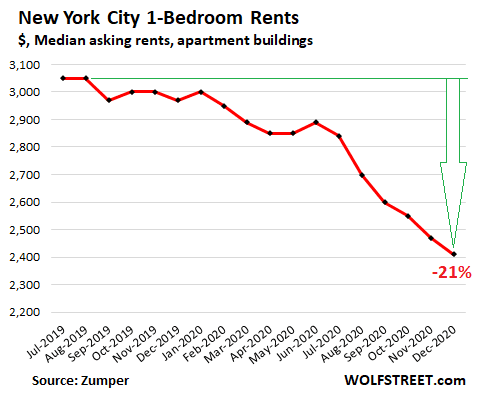
Rents in New York and San Francisco are far less expensive than before the pandemic. It’s been a boon for the suburbs, the south and the midwest, one that’s likely to continue unless Biden steps in. Before the pandemic, rent in San Francisco for a one bedroom apartment averaged over $3700 per month. New York rent was similar. People paid it because these cities offered robust business and entertainment, the best restaurants and bars, the best salons and clubs, the best music, museums, universities, and theater. New York was Wall Street, Madison Avenue and Broadway; San Francisco was Silicon valley and Hollywood. These cities were the place to be, and then the pandemic hit.
Post COVID-19, the benefits of big city life are gone, and replaced by negatives. The great restaurants are mostly gone; the museums, theaters, and salons, shut along with Hollywood. Wall Street and Madison Ave have gone on-line, as have the universities. If you can work and study from anywhere, why do it from an expensive hotbed of Corona.
People of means left the big cities with the first lockdowns. Wall Street moved on line, with offices in New Jersey, and many followed, along with college students, and hotel and restaurant workers. New York’s unemployment rate increased from 4-5% to over 9.5% today, among the highest rates in the nation, 9.5%. It would be higher if not for the departures. Crime spiked; the murder rate doubled. To keep people from leaving, landlords have lowered rents and many will now forgive a month or two of rent to keep apartments full with some rent coming in and an illusion of exclusivity. This is good for tenants, but tough on landlords.
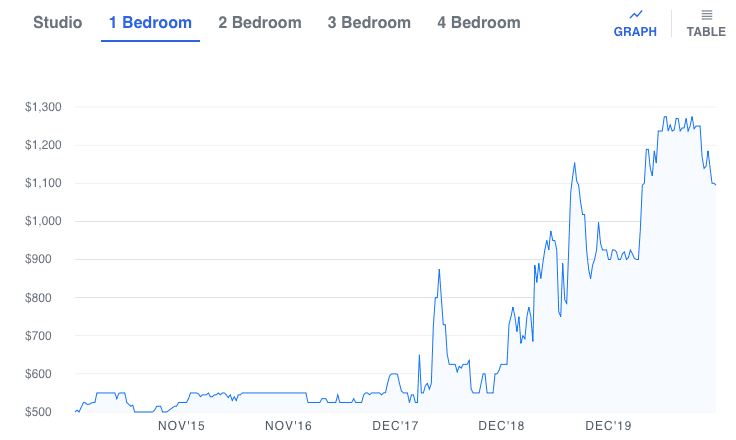
Detroit rent history, 2014 to January 2021. Rents fell a lot on election day, maybe because of Biden, or because we think the pandemic is over.
As things stand, the suburbs and smaller cities are the beneficiaries of the exodus. Among the cities benefiting the most are cities in the south and mid-west: states that are more open and are relatively low cost: Phoenix, Oakland, Cleveland, St. Petersburg, and even Detroit. Detroit’s rents were already moving up as auto manufacturing returned from Mexico, see chart. Between early 2017 and October 2020, they went from $500/month to $1250/month for a 1 bedroom apartment, according to Zumper. Detroit rents fell after election day, but are still up 20% on the year. The influx of wealthier working folk to Detroit is welcome to some, unwelcome to tenants who find their rents are raised. I think it’s is a sign of a healthy economy that people follow life-quality, and that rents follow people. Our landlords are happy, but there are a lot of Detroit renters who are not
Joe Biden has promised to step in to make things right for everyone. He promised to have the government pay people’s rent so they don’t get evicted. I presume that means paying about double to people in NY and SF as to those in Detroit. He claims he will shutter smokestack industries too, and create the good jobs of the future in computers and high tech. It’s a nice claim. I suspect it’s a bailout of big city landlords, but what would I know. I suspect that the US would be better off if Joe just sat back and let New York rents fall, while allowing Detroit to gentrify. Detroiters need not worry about rents getting too pricy here. We’ve1500 shootings per year, that 15 times more than NYC, per capita. Unless that ratio changes, Detroit will continue to be the lower rent city.
Part of the mandate to the 2020 election was to join with Europe and the rest of the western world in agreeing to stop the use of coal. It’s a low cost way to generate energy. Of course we still like to buy things, and we’ve largely turned to China, a country that still burns coal, and thus makes things cheap. The net result of this shift to Chinese goods is that China keeps building coal-fired plants while we shut ours. As it happens, China is worse than the US in terms of CO2 per output, but at least when China pollutes, we don’t see the smoke directly, and we don’t see their new coal plants at all. So we feel better buying things from China than from the US. Besides, slave labor is cheap.
From th eEconomist, December 2020.
Buying Chinese goods is good for the importers, and for the non-manufacturing consumer, at least in the short term. It has the effect of exporting jobs though, and eventually we have to support the displaced workers. It also means we don’t keep up our manufacturing technology. Long term, that affects innovation, and that starts to displace other industries. Antibiotic production has already left the US and along with it semiconductors. Still, we feel good about it since the Chinese don’t let us see the slave labor camps. We do get to see the haze of the pollution.
The Chinese expect this pattern to continue. China is building new coal-fired plants at a furious rate. Presently China has most of the world’s coal-fired power plants. Mostly these are only 4 to 12 years old, far younger than our forty year old plants China plans to build more, and keeps encouraging us to shut down ours. Even 10 years ago, China lead the world in CO2 output. And their fraction of the CO2 keeps climbing.
China is popular with the press. In part, I expect, that’s because they pay the international experts. lAlso, writers and editors are consumers industrial products, but not manufacturers. Consumers benefit from slave labor, or maybe not, but displaced American workers certainly suffer. Also, of course, the news requires pictures and personal stories to keep viewer interest. If you can’t get pictures of young protesters, like Grey Thunberg, you can get an interesting story. Our Chinese pollution is out of sight, and not in the press.
Most people know that aspirin can reduce blood clots and thus the risk heart attack, as shown famously in the 1989 “Physicians’ Health Study” where 22,000 male physicians were randomly assigned to either a regular aspirin (325 mg) every other day or an identical looking placebo. The results are shown in the table below, where “Myocardial Infarction” or “MI” is doctor-speak for heart attack.
Treatment
Myocardial Infarctions
No Infarction
Total
fraction with MI
Aspirin
139
10,898
11,037
139/11,037 = 0.0126
Placebo
239
10,795
11,034
239/11,034 = 0.0217
Over the 5 years of the study, the physicians had 378 MI events, but mostly in the group that didn’t take aspirin: 1.28% of the doctors who took aspirin had a heart attack as opposed to 2.17% for those with the placebo. The ratio 1.28/2.17 = 0.58 is called the risk ratio. Apparently, aspirin in this dose reduces your MI risk to 58% of what it was otherwise — at least in white males of a certain age.
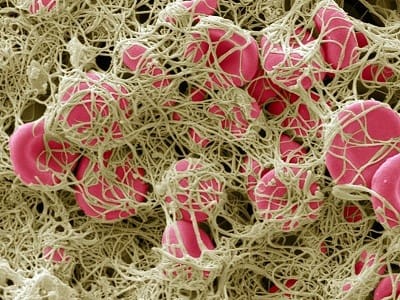
A blood clot showing red cells held together by fibrin fibers. Clots can cause heart attack, stroke, and breathing problems. photo: Steve Gschmeissner.
Further study showed aspirin benefits with women and other ethnicities, and benefits beyond hear attack, in any disease that induces disseminated intravascular coagulopathy. That’s doctor speak for excessive blood clots. Aspirin produced a reduction in stroke and in some cancers (Leukemia among them) and now it now seems likely that aspirin reduces the deadliness of COVID-19. Data from Wuhan showed that excessive blood clots were present in 71% of deaths vs. 0.4% of survivors. In the US, some 30% of those with serious COVID symptoms and death show excessive blood clots, particularly in the lungs. Aspirin and Vitamin D seem to help.
.The down-side of aspirin use is a reduction in wound healing and some intestinal bleeding. The intestinal bleeding is known as aspirin burn. Because of these side-effects it is common to give a lower dose today, just one baby aspirin per day, 81 mg. While this does does some good, It is not clear that it is ideal for all people. This recent study in the Lanset (2018) shows a strong relationship between body weight and aspirin response. Based on 117,279 patients, male and female, the Lanset study found that the low dose, baby aspirin provides MI benefits only in thin people, those who weigh less than about 60 kg (130 lb). If you weigh more than that, you need a higher dose, perhaps two baby aspirin per day, or a single adult aspirin every other day, the dose of the original doctors study.
In this study of COVID patients, published in July, those who had been taking aspirin fared far better than those who did not A followup study will examine the benefits of one baby aspirin (81 mg) with and without Vitamin D, read about it here. I should note that other pain medications do not have this blood-thinning effect, and would not be expected to have the same benefit.
While it seems likely that 2 baby aspirins might be better in fat people, or one full aspirin every other day, taking a lot more than this is deadly. During the Spanish flu some patients were given as much as 80 adult aspirins per day. It likely killed them. As Paracelsus noted, the difference between a cure and a poison is the dose.

 (1)
(1) , of any pure material based not the pressure, the absolute temperature (Kelvin) and two, substance-specific constants,
  and
and  . These constants can be understood as an attraction force term, and a molecular volume respectively. It is common to calculate a and b from the
  ,
,  (2 a,b)