Category Archives: Science: Physics, Astronomy, etc.

The Scientific Method isn’t the method of scientists

A linchpin of middle school and high-school education is teaching ‘the scientific method.’ This is the method, students are led to believe, that scientists use to determine Truths, facts, and laws of nature. Scientists, students are told, start with a hypothesis of how things work or should work, they then devise a set of predictions based on deductive reasoning from these hypotheses, and perform some critical experiments to test the hypothesis and determine if it is true (experimentum crucis in Latin). Sorry to say, this is a path to error, and not the method that scientists use. The real method involves a few more steps, and follows a different order and path. It instead follows the path that Sherlock Holmes uses to crack a case.

The actual method of Holmes, and of science, is to avoid beginning with a hypothesis. Isaac Newton claimed: “I never make hypotheses” Instead as best we can tell, Newton, like most scientists, first gathered as much experimental evidence on a subject as possible before trying to concoct any explanation. As Holmes says (Study in Scarlet): “It is a capital mistake to theorize before you have all the evidence. It biases the judgment.”

It is a capital mistake to theorize before one has data. Insensibly one begins to twist facts to suit theories, instead of theories to suit facts (Holmes, Scandal in Bohemia).

Holmes barely tolerates those who hypothesize before they have all the data: “It is a capital mistake to theorize before one has data. Insensibly one begins to twist facts to suit theories, instead of theories to suit facts.” (Scandal in Bohemia).

Then there is the goal of science. It is not the goal of science to confirm some theory, model, or hypothesis; every theory probably has some limited area where it’s true. The goal for any real-life scientific investigation is the desire to explain something specific and out of the ordinary, or do something cool. Similarly, with Sherlock Holmes, the start of the investigation is the arrival of a client with a specific, unusual need – one that seems a bit outside of the normal routine. Similarly, the scientist wants to do something: build a bigger bridge, understand global warming, or how DNA directs genetics; make better gunpowder, cure a disease, or Rule the World (mad scientists favor this). Once there is a fixed goal, it is the goal that should direct the next steps: it directs the collection of data, and focuses the mind on the wide variety of types of solution. As Holmes says: , “it’s wise to make one’s self aware of the potential existence of multiple hypotheses, so that one eventually may choose one that fits most or all of the facts as they become known.” It’s only when there is no goal, that any path will do

In gathering experimental data (evidence), most scientists spend months in the less-fashionable sections of the library, looking at the experimental methods and observations of others, generally from many countries, collecting any scrap that seems reasonably related to the goal at hand. I used 3 x5″ cards to catalog this data and the references. From many books and articles, one extracts enough diversity of data to be able to look for patterns and to begin to apply inductive logic. “The little things are infinitely the most important” (Case of Identity). You have to look for patterns in the data you collect. Holmes does not explain how he looks for patterns, but this skill is innate in most people to a greater or lesser extent. A nice set approach to inductive logic is called the Baconian Method, it would be nice to see schools teach it. If the author is still alive, a scientist will try to contact him or her to clarify things. In every SH mystery, Holmes does the same and is always rewarded. There is always some key fact or observation that this turns up: key information unknown to the original client.

Based on the facts collected one begins to create the framework for a variety of mathematical models: mathematics is always involved, but these models should be pretty flexible. Often the result is a tree of related, mathematical models, each highlighting some different issue, process, or problem. One then may begin to prune the tree, trying to fit the known data (facts and numbers collected), into a mathematical picture of relevant parts of this tree. There usually won’t be quite enough for a full picture, but a fair amount of progress can usually be had with the application of statistics, calculus, physics, and chemistry. These are the key skills one learns in college, but usually the high-schooler and middle schooler has not learned them very well at all. If they’ve learned math and physics, they’ve not learned it in a way to apply it to something new, quite yet (it helps to read the accounts of real scientists here — e.g. The Double Helix by J. Watson).

Usually one tries to do some experiments at this stage. Homes might visit a ship or test a poison, and a scientist might go off to his, equally-smelly laboratory. The experiments done there are rarely experimenti crucae where one can say they’ve determined the truth of a single hypothesis. Rather one wants to eliminated some hypotheses and collect data to be used to evaluate others. An answer generally requires that you have both a numerical expectation and that you’ve eliminated all reasonable explanations but one. As Holmes says often, e.g. Sign of the four, “when you have excluded the impossible, whatever remains, however improbable, must be the truth”. The middle part of a scientific investigation generally involves these practical experiments to prune the tree of possibilities and determine the coefficients of relevant terms in the mathematical model: the weight or capacity of a bridge of a certain design, the likely effect of CO2 on global temperature, the dose response of a drug, or the temperature and burn rate of different gunpowder mixes. Though not mentioned by Holmes, it is critically important in science to aim for observations that have numbers attached.

The destruction of false aspects and models is a very important part of any study. Francis Bacon calls this act destruction of idols of the mind, and it includes many parts: destroying commonly held presuppositions, avoiding personal preferences, avoiding the tendency to see a closer relationship than can be justified, etc.

In science, one eliminates the impossible through the use of numbers and math, generally based on your laboratory observations. When you attempt to the numbers associated with our observations to the various possible models some will take the data well, some poorly; and some twill not fit the data at all. Apply the deductive reasoning that is taught in schools: logical, Boolean, step by step; if some aspect of a model does not fit, it is likely the model is wrong. If we have shown that all men are mortal, and we are comfortable that Socrates is a man, then it is far better to conclude that Socrates is mortal than to conclude that all men but Socrates is mortal (Occam’s razor). This is the sort of reasoning that computers are really good at (better than humans, actually). It all rests on the inductive pattern searches similarities and differences — that we started with, and very often we find we are missing a piece, e.g. we still need to determine that all men are indeed mortal, or that Socrates is a man. It’s back to the lab; this is why PhDs often take 5-6 years, and not the 3-4 that one hopes for at the start.

More often than not we find we have a theory or two (or three), but not quite all the pieces in place to get to our goal (whatever that was), but at least there’s a clearer path, and often more than one. Since science is goal oriented, we’re likely to find a more efficient than we fist thought. E.g. instead of proving that all men are mortal, show it to be true of Greek men, that is for all two-legged, fairly hairless beings who speak Greek. All we must show is that few Greeks live beyond 130 years, and that Socrates is one of them.

Putting numerical values on the mathematical relationship is a critical step in all science, as is the use of models — mathematical and otherwise. The path to measure the life expectancy of Greeks will generally involve looking at a sample population. A scientist calls this a model. He will analyze this model using statistical model of average and standard deviation and will derive his or her conclusions from there. It is only now that you have a hypothesis, but it’s still based on a model. In health experiments the model is typically a sample of animals (experiments on people are often illegal and take too long). For bridge experiments one uses small wood or metal models; and for chemical experiments, one uses small samples. Numbers and ratios are the key to making these models relevant in the real world. A hypothesis of this sort, backed by numbers is publishable, and is as far as you can go when dealing with the past (e.g. why Germany lost WW2, or why the dinosaurs died off) but the gold-standard of science is predictability.  Thus, while we a confident that Socrates is definitely mortal, we’re not 100% certain that global warming is real — in fact, it seems to have stopped though CO2 levels are rising. To be 100% sure you’re right about global warming we have to make predictions, e.g. that the temperature will have risen 7 degrees in the last 14 years (it has not), or Al Gore’s prediction that the sea will rise 8 meters by 2106 (this seems unlikely at the current time). This is not to blame the scientists whose predictions don’t pan out, “We balance probabilities and choose the most likely. It is the scientific use of the imagination” (Hound of the Baskervilles)The hope is that everything matches; but sometimes we must look for an alternative; that’s happened rarely in my research, but it’s happened.

You are now at the conclusion of the scientific process. In fiction, this is where the criminal is led away in chains (or not, as with “The Woman,” “The Adventure of the Yellow Face,” or of “The Blue Carbuncle” where Holmes lets the criminal free — “It’s Christmas”). For most research the conclusion includes writing a good research paper “Nothing clears up a case so much as stating it to another person”(Memoirs). For a PhD, this is followed by the search for a good job. For a commercial researcher, it’s a new product or product improvement. For the mad scientist, that conclusion is the goal: taking over the world and enslaving the population (or not; typically the scientist is thwarted by some detail!). But for the professor or professional research scientist, the goal is never quite reached; it’s a stepping stone to a grant application to do further work, and from there to tenure. In the case of the Socrates mortality work, the scientist might ask for money to go from country to country, measuring life-spans to demonstrate that all philosophers are mortal. This isn’t as pointless and self-serving as it seems, Follow-up work is easier than the first work since you’ve already got half of it done, and you sometimes find something interesting, e.g. about diet and life-span, or diseases, etc. I did some 70 papers when I was a professor, some on diet and lifespan.

One should avoid making some horrible bad logical conclusion at the end, by the way. It always seems to happen that the mad scientist is thwarted at the end; the greatest criminal masterminds are tripped by some last-minute flaw. Similarly the scientist must not make that last-mistep. “One should always look for a possible alternative, and provide against it” (Adventure of Black Peter). Just because you’ve demonstrated that  iodine kills germs, and you know that germs cause disease, please don’t conclude that drinking iodine will cure your disease. That’s the sort of science mistakes that were common in the middle ages, and show up far too often today. In the last steps, as in the first, follow the inductive and quantitative methods of Paracelsus to the end: look for numbers, (not a Holmes quote) check how quantity and location affects things. In the case of antiseptics, Paracelsus noticed that only external cleaning helped and that the help was dose sensitive.

As an example in the 20th century, don’t just conclude that, because bullets kill, removing the bullets is a good idea. It is likely that the trauma and infection of removing the bullet is what killed Lincoln, Garfield, and McKinley. Theodore Roosevelt was shot too, but decided to leave his bullet where it was, noticing that many shot animals and soldiers lived for years with bullets in them; and Roosevelt lived for 8 more years. Don’t make these last-minute missteps: though it’s logical to think that removing guns will reduce crime, the evidence does not support that. Don’t let a leap of bad deduction at the end ruin a line of good science. “A few flies make the ointment rancid,” said Solomon. Here’s how to do statistics on data that’s taken randomly.

Dr. Robert E. Buxbaum, scientist and Holmes fan wrote this, Sept 2, 2013. My thanks to Lou Manzione, a friend from college and grad school, who suggested I reread all of Holmes early in my PhD work, and to Wikiquote, a wonderful site where I found the Holmes quotes; the Solomon quote I knew, and the others I made up.

Ozone hole shrinks to near minimum recorded size

The hole in the ozone layer, prominently displayed in Al Gore’s 2006 movie, an inconvenient truth has been oscillating in size and generally shrinking since 1996. It’s currently reached its second lowest size on record.

South pole ozone hole shrinks to 2nd smallest size on record. Credit: BIRA/IASB

South pole ozone hole (blue circle in photo), shrinks to its 2nd smallest size on record. Note outline of antarctica plus end of south america and africa. Photo Credit: BIRA/IASB

The reason for the oscillation is unknown. The ozone hole is small this year, was large for the last few years, and was slightly smaller in 2002. My guess is that it will be big again in 2013. Ozone is an alternate form of oxygen containing three oxygen atoms instead of the usual two. It is an unstable compound formed by ions in the upper atmosphere acting on regular oxygen. Though the ozone concentration in the atmosphere is low, ozone is important because it helps shield people from UV radiation — radiation that could otherwise cause cancer (it also has some positive effects on bones, etc.).

An atmospheric model of ozone chemistry implicated chlorofluorocarbons (freons) as a cause of observed ozone depletion. In the 1980s, this led to countries restricting the use of freon refrigerants. Perhaps these laws are related to the shrinkage of the ozone hole, perhaps not. There has been no net decrease in the amount of chlorofluorocarbons in the atmosphere, and the models that led to banning them did not predicted the ozone oscillations we now see are common — a fault also found with models of global warming and of stock market behavior. Our best computer models do not do well with oscillatory behaviors. As Alan Greenspan quipped, our best models successfully predicted eight of the last five recessions. Whatever the cause, the good news is that the ozone hole has closed, at least temporarily. Here’s why the sky is blue, and some thoughts on sunlight, radiation and health.

by Dr. Robert E. Buxbaum, dedicated to bringing good news to the perpetually glum.

Slowing Cancer with Fish and Unhealth Food

Some 25 years ago, while still a chemical engineering professor at Michigan State University, I did some statistical work for a group in the Physiology department on the relationship between diet and cancer. The research involved giving cancer to groups of rats and feeding them different diets of the same calorie intake to see which promoted or slowed the disease. It had been determined that low-calorie diets slowed cancer growth, and were good for longevity in general, while overweight rats died young (true in humans too, by the way, though there’s a limit and starvation will kill you).

The group found that fish oil was generally good for you, but they found that there were several unhealthy foods that slowed cancer growth in rats. The statistics were clouded by the fact that cancer growth rates are not normally distributed, and I was brought in to help untangle the observations.

With help from probability paper (a favorite trick of mine), I confirmed that healthy rats fared better on healthily diets, but cancerous rats did better with some unhealth food. Sick or well, all rats did best with fish oil, and all rats did pretty well with olive oil, but the cancerous rats did better with lard or palm oil (normally an unhealthy diet) and very poorly with corn oil or canola, oils that are normally healthful. The results are published in several articles in the journals “Cancer” and “Cancer Research.”

Among vitamins, they found something similar (it was before I joined the group). Several anti-oxidizing vitamins, A, D and E made things worse for carcinogenic rats while being good for healthy rats (and for people in moderation). Moderation is key; too much of a good thing isn’t good, and a diet with too much fish oil promotes cancer.

What seems to be happening is that the cancer cells grow at the same rate with all of the equi-caloric diets, but that there was a difference the rate of natural cancer cell death. More cancer cells died when the rat was fed junk food oils than those fed a diet of corn oil and canola. Similarly, the reason anti-oxidizing vitamins hurt cancerous rats was that fewer cancer cells died when the rats were fed these vitamins. A working hypothesis is that the junk oils (and the fish oil) produced free radicals that did more damage to the cancer than to the rats. In healthy rats (and people), these free radicals are bad, promoting cell mutation, cell degradation, and sometimes cancer. But perhaps our body use these same free radicals to fight disease.

Larger amounts of vitamins A, D, and E hurt cancerous-rats by removing the free radicals they normally use fight the disease, or so our model went. Bad oils and fish-oil in moderation, with calorie intake held constant, helped slow the cancer, by a presumed mechanism of adding a few more free radicals. Fish oil, it can be assumed, killed some healthy cells in the healthy rats too, but not enough to cause problems when taken in moderation. Even healthy people are often benefitted by poisons like sunlight, coffee, alcohol and radiation.

At this point, a warning is in-order: Don’t rely on fish oil and lard as home remedies if you’ve got cancer. Rats are not people, and your calorie intake is not held artificially constant with no other treatments given. Get treated by a real doctor — he or she will use radiation and/ or real drugs, and those will form the right amount of free radicals, targeted to the right places. Our rats were given massive amounts of cancer and had no other treatment besides diet. Excess vitamin A has been shown to be bad for humans under treatment for lung cancer, and that’s perhaps because of the mechanism we imagine, or perhaps everything works by some other mechanism. However it works, a little fish in your diet is probably a good idea whether you are sick or well.

A simpler health trick is that it couldn’t hurt most Americans is a lower calorie diet, especially if combined with exercise. Dr. Mites, a colleague of mine in the department (now deceased at 90+) liked to say that, if exercise could be put into a pill, it would be the most prescribed drug in America. There are few things that would benefit most Americans more than (moderate) exercise. There was a sign in the physiology office, perhaps his doing, “If it’s physical, it’s therapy.”

Anyway these are some useful things I learned as an associate professor in the physiology department at Michigan State. I ended up writing 30-35 physiology papers, e.g. on how cells crawl and cell regulation through architecture; and I met a lot of cool people. Perhaps I’ll blog more about health, biology, the body, or about non-normal statistics and probability paper. Please tell me what you’re interested in, or give me some keen insights of your own.

Dr. Robert Buxbaum is a Chemical Engineer who mostly works in hydrogen I’ve published some 75 technical papers, including two each in Science and Nature: fancy magazines that you’d normally have to pay for, but this blog is free. August 14, 2013

Global warming takes a 15 year rest

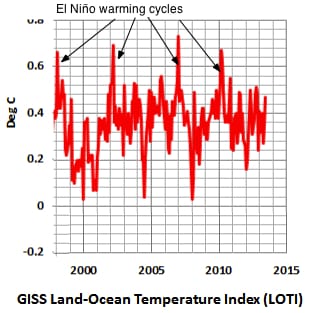
I have long thought that global climate change was chaotic, rather than steadily warming. Global temperatures show self-similar (fractal) variation with time and long-term cycles; they also show strange attractors generally states including ice ages and El Niño events. These are sudden rests of the global temperature pattern, classic symptoms of chaos. The standard models of global warming is does not predict El Niño and other chaotic events, and thus are fundamentally wrong. The models assume that a steady amount of sun heat reaches the earth, while a decreasing amount leaves, held in by increasing amounts of man-produced CO2 (carbon dioxide) in the atmosphere. These models are “tweaked” to match the observed temperature to the CO2 content of the atmosphere from 1930 to about 2004. In the movie “An Inconvenient Truth” Al Gore uses these models to predict massive arctic melting leading to a 20 foot rise in sea levels by 2100. To the embarrassment of Al Gore, and the relief of everyone else, though COconcentrations continue to rise, global warming took a 15 year break starting shortly before the movie came out, and the sea level is, more-or-less where it was except for temporary changes during periodic El Niño cycles.

Global temperature variation Fifteen years and four El Niño cycles, with little obvious change. Most models predict .25°C/decade.

Fifteen years of global temperature variation to June 2013; 4 El Niños but no sign of a long-term change.

Hans von Storch, a German expert on global warming, told the German newspaper, der Spiegel: “We’re facing a puzzle. Recent CO2 emissions have actually risen even more steeply than we feared. As a result, according to most climate models, we should have seen temperatures rise by around 0.25 degrees Celsius (0.45 degrees Fahrenheit) over the past 10 years. That hasn’t happened. [Further], according to the models, the Mediterranean region will grow drier all year round. At the moment, however, there is actually more rain there in the fall months than there used to be. We will need to observe further developments closely in the coming years.”

Aside from the lack of warming for the last 15 years, von Storch mentions that there has been no increase in severe weather. You might find that surprising given the news reports; still it’s so. Storms are caused by temperature and humidity differences, and these have not changed. (Click here to see why tornadoes lift stuff up).

At this point, I should mention that the majority of global warming experts do not see a problem with the 15 year pause. Global temperatures have been rising unsteadily since 1900, and even von Storch expects this trend to continue — sooner or later. I do see a problem, though, highlighted by the various chaotic changes that are left out of the models. A source of the chaos, and a fundamental problem with the models could be with how they treat the effects of water vapor. When uncondensed, water vapor acts as a very strong thermal blanket; it allows the sun’s light in, but prevents the heat energy from radiating out. CObehaves the same way, but weaker (there’s less of it).

More water vapor enters the air as the planet warms, and this should amplify the CO2 -caused run-away heating except for one thing. Every now and again, the water vapor condenses into clouds, and then (sometimes) falls as rain or show. Clouds and snow reflect the incoming sunlight, and this leads to global cooling. Rain and snow drive water vapor from the air, and this leads to accelerated global cooling. To the extent that clouds are chaotic, and out of man’s control, the global climate should be chaotic too. So far, no one has a very good global model for cloud formation, or for rain and snowfall, but it’s well accepted that these phenomena are chaotic and self-similar (each part of a cloud looks like the whole). Clouds may also admit “the butterfly effect” where a butterfly in China can cause a hurricane in New Jersey if it flaps at the right time.

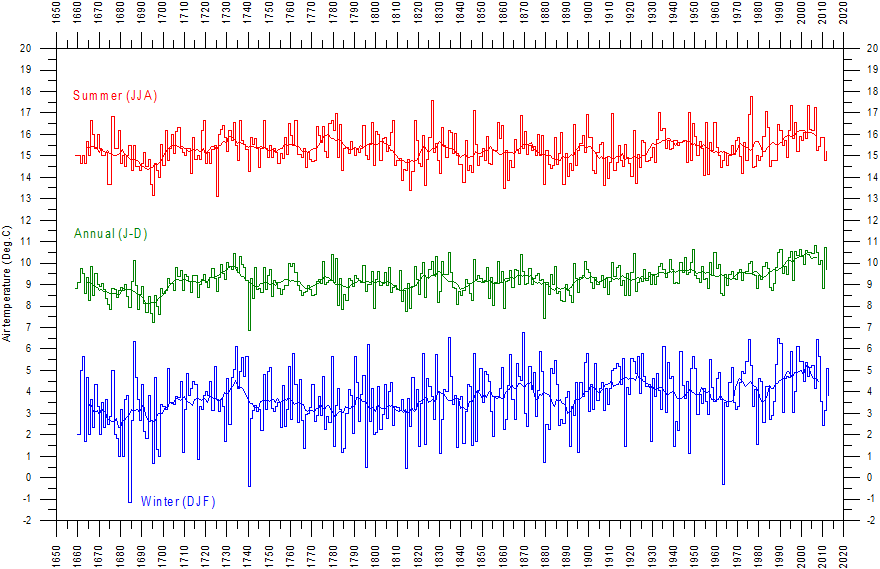
For those wishing to examine the longer-range view, here’s a thermal history of central England since 1659, Oliver Cromwell’s time. At this scale, each peak is an El Niño. There is a lot of chaotic noise, but you can also notice either a 280 year periodicity (lat peak around 1720), or a 100 year temperature rise beginning about 1900.

Global warming; Central England Since 1659; From http://www.climate4you.com

It is not clear that the cycle is human-caused,but my hope is that it is. My sense is that the last 100 years of global warming has been a good thing; for agriculture and trade it’s far better than an ice age. If we caused it with our  CO2, we could continue to use CO2 to just balance the natural tendency toward another ice age. If it’s chaotic, as I suspect, such optimism is probably misplaced. It is very hard to get a chaotic system out of its behavior. The evidence that we’ve never moved an El Niño out of its normal period of every 3 to 7 years (expect another this year or next). If so, we should expect another ice age within the next few centuries.

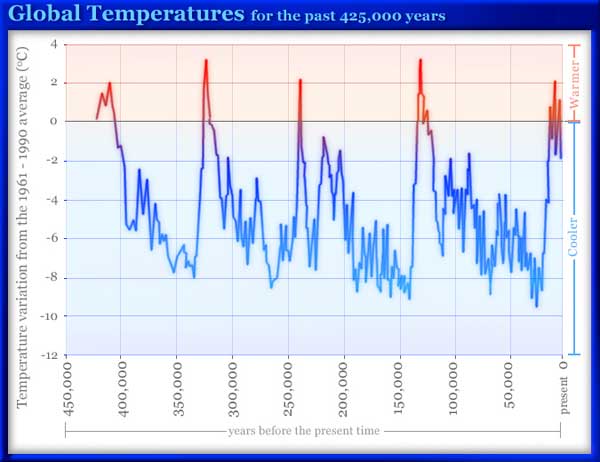
Global temperatures measured from the antarctic ice showing stable, cyclic chaos and self-similarity.

Global temperatures measured from the antarctic ice showing 4 Ice ages.

Just as clouds cool the earth, you can cool your building too by painting the roof white. If you are interested in more weather-related posts, here’s why the sky is blue on earth, and why the sky on Mars is yellow.

Robert E. Buxbaum July 27, 2013 (mostly my business makes hydrogen generators and I consult on hydrogen).

chemistry and dentistry joke

What do you get when you dissolve all your rear teeth in water.


An eight molar solution.


Is funny because ….. most adults have eight molars (four on the bottom, four on the top); and there is a measure of solution concentration called molarity; an eight molar solution is one that contains 8 formula weights of solute per liter of solution.

For a chemistry joke about dissolving bears, go here; for a chemist v chemical engineer joke, here; for my latest quantum joke, here; and for an architecture joke, here. On a more serious note, if you’d like to see how we do simple electroplating, see the previous post.


R.E.Buxbaum, July 24, 2013

Simple electroplating of noble metals

Electro-coating gold onto a Pd tube by dissolving an iron wire.

Electro-coating gold onto at Pd-coated tube by dissolving an iron wire at REB Research.

Here’s a simple trick for electroplating noble metals: gold, silver, copper, platinum. I learned this trick at Brooklyn Technical High School some years ago, and I still use it at REB Research as part of our process to make hydrogen permeation barriers, and sulfur tolerant permeation membranes.  It’s best used to coat reasonably inactive, small objects,  e.g. to coat copper on a nickel or silver on a penny for a science fair.

As a first step, you make a dilute acidic solution of the desired noble metal. Dissolve a gram or so of copper sulphate, silver nitrate, or gold chloride per 250 ml of water. Make sure the solution is acidic using pH paper, add acid if needed aiming for a pH of 3 to 4. Place some solution into a test tube or beaker of a size that will hold the object you want to coat. As a next step, attach an iron or steel wire to the object, I typically use bailing wire from the hardware store wrapped several times about the top of the object, and run the length of the object; see figure. Place the object into your solution and wait for 5 to 30 minutes. Coating works without the need for any other electric source or any current control.

The iron wire creates the electricity used in electroplating the noble metal. Iron has a higher electro-motive potential than hydrogen and hydrogen has a higher potential than the noble metals. In acid solution, the iron wire dissolves but (it’s hoped) the substrate does not. Each iron atom gives up two electrons, becoming Fe++. Some of these electrons go on to reduce hydrogen ions making H2 (2H+ 2e –> H2), but most should go to reduce the noble metal ions in the solution to form a coat of metallic gold, silver, or copper on both the wire and the object. See an example of how I do calculations regarding voltage, electron number, and Gibbs free energy.

Transferring electrons requires you have good electrical contact between the wire and the object. Most of the noble metal coats the object, not the wire since the object is bigger, typically. Thanks to my teachers at Brooklyn Technical High School for teaching me. For a uniform coat, it helps to run the wire down parallel to the entire length of tube; I think this is a capacitance, field effect. For a larger object, you may want several wires if you are plating a larger object. For a thicker coat, I found you are best off making many thin coats and heating them. This reduces tension forces in the coat, I think.

The picture shows a step in the process we use making our sulfur-resistant hydrogen permeation membranes (buy them here), used, e.g. to concentrate impurities in a hydrogen stream for improved gas chromatography. The next step is to dissolve the gold or copper into the palladium.

Go here for a great periodic table cup from REB Research, or for the rest of our REB Research products. I occasionally make silver-coated pennies for schoolchildren, but otherwise use this technology only for in-house production.

R.E. Buxbaum, July 20, 2013.

yet another quantum joke

Why do you get more energy from a steak than from the same amount of hamburger?


Hamburger is steak in the ground state.


Is funny because….. it’s a pun on the word ground. Hamburger is ground-up meat, of course, but the reference to a ground state also relates to a basic discovery of quantum mechanics (QM): that all things exist in quantized energy states. The lowest of these is called the ground state, and you get less energy out of a process if you start with things at this ground state. Lasers, as an example, get their energy by electrons being made to drop to their ground state at the same time; you can’t get any energy from a laser if the electrons start in the ground state.

The total energy of a thing can be thought of as having a kinetic and a potential energy part. The potential energy is usually higher the more an item moves from its ideal (lowest potential point). The kinetic energies of though tends to get lower when more space is available because, from Heisenberg uncertainty, ∆l•∆v=h. That is, the more space there is, the less uncertainty of speed, and thus the less kinetic energy other things being equal. The ground energy state is the lowest sum of potential and kinetic energy, and thus all things occupy a cloud of some size, even at the ground state. Without this size, the world would cease to exist. Atoms would radiate energy, and shrink until they vanished.

In grad school, I got into understanding thermodynamics, transport phenomena, and quantum mechanics, particularly involving hydrogen. This lead to my hydrogen production and purification inventions, what my company sells.

Click here for a quantum cartoon on waves and particles, an old Heisenberg joke, or a joke about how many quantum mechanicians it takes to change a lightbulb.

R. E. Buxbaum, July 16, 2013. I once claimed that the unseen process that maintains existence could be called God; this did not go well with the religious.


Thermodynamics of hydrogen generation

Perhaps the simplest way to make hydrogen is by electrolysis: you run some current through water with a little sulfuric acid or KOH added, and for every two electrons transferred, you get a molecule of hydrogen from one electrode and half a molecule of oxygen from the other.

2 OH- –> 2e- + 1/2 O2 +H2O

2H2O + 2e- –>  H2 + 2OH-

The ratio between amps, seconds and mols of electrons (or hydrogen) is called the Faraday constant, F = 96500; 96500 amp-seconds transfers a mol of electrons. For hydrogen production, you need 2 mols of electrons for each mol of hydrogen, n= 2, so

it = 2F where and i is the current in amps, and t is the time in seconds and n is the number electrons per molecule of desired product. For hydrogen, t = 96500*2/i; in general, t = Fn/i.

96500 is a large number, and it takes a fair amount of time to make any substantial amount of hydrogen by electrolysis. At 1 amp, it takes 96500*2 = 193000 seconds, 2 days, to generate one mol of hydrogen (that’s 2 grams Hor 22.4 liters, enough to fill a garment bag). We can reduce the time by using a higher current, but there are limits. At 25 amps, the maximum current of you can carry with house wiring it takes 2.14 hours to generate 2 grams. (You’ll have to rectify your electricity to DC or you’ll get a nasty H2 /O2 mix called Brown’s gas, While normal H2 isn’t that dangerous, Browns gas is a mix of H2 and O2 and is quite explosive. Here’s an essay I wrote on separating Browns gas).

Electrolysis takes a fair amount of electric energy too; the minimum energy needed to make hydrogen at a given temperature and pressure is called the reversible energy, or the Gibbs free energy ∆G of the reaction. ∆G = ∆H -T∆S, that is, ∆G equals the heat of hydrogen production ∆H – minus an entropy effect, T∆S. Since energy is the product of voltage current and time, Vit = ∆G, where ∆G is the Gibbs free energy measured in Joules and V,i, and t are measured Volts, Amps, and seconds respectively.

Since it = nF, we can rewrite the relationship as: V =∆G/nF for a process that has no energy losses, a reversible process. This is the form found in most thermodynamics textbooks; the value of V calculated this way is the minimum voltage to generate hydrogen, and the maximum voltage you could get in a fuel cell putting water back together.

To calculate this voltage, and the power requirements to make hydrogen, we use the Gibbs free energy for water formation found in Wikipedia, copied below (in my day, we used the CRC Handbook of Chemistry and Physics or a table in out P-chem book). You’ll notice that there are two different values for ∆G depending on whether the water is a gas or a liquid, and you’ll notice a small zero at the upper right (∆G°). This shows that the values are for an imaginary standard state: 20°C and 1 atm pressure. You can’t get 1 atm steam at 20°C, it’s an extrapolation; behavior at typical temperatures, 40°C and above is similar but not identical. I’ll leave it to a reader to send this voltage as a comment.

Liquid H2O formation∆G° =-237.14
Gaseous H2O formation∆G° =-228.61

The reversible voltage for creating liquid water in a reversible fuel cell is found to be -237,140/(2 x 96,500) = -1.23V. We find that 1.23 Volts is about the minimum voltage you need to do electrolysis at 0°C because you need liquid water to carry the current; -1.18 V is about the maximum voltage you can get in a fuel cell because they operate at higher temperature with oxygen pressures significantly below 1 atm. (typically). The minus sign is kept for accounting; it differentiates the power out case (fuel cells) from power in (electrolysis). It is typical to find that fuel cells operate at lower voltages, between about .5V and 1.0V depending on the fuel cell and the power load.

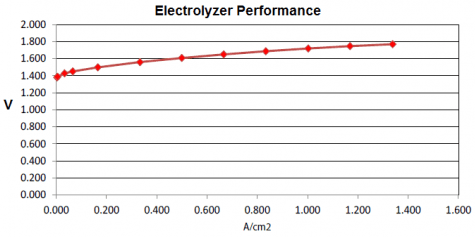
Most electrolysis is done at voltages above about 1.48 V. Just as fuel cells always give off heat (they are exothermic), electrolysis will absorb heat if run reversibly. That is, electrolysis can act as a refrigerator if run reversibly. but electrolysis is not a very good refrigerator (the refrigerator ability is tied up in the entropy term mentioned above). To do electrolysis at reasonably fast rates, people give up on refrigeration (sucking heat from the environment) and provide all the entropy needed for electrolysis in the electricity they supply. This is to say, they operate at V’ were nFV’ ≥ ∆H, the enthalpy of water formation. Since ∆H is greater than ∆G, V’ the voltage for electrolysis is higher than V. Based on the enthalpy of liquid water formation,  −285.8 kJ/mol we find V’ = 1.48 V at zero degrees. The figure below shows that, for any reasonably fast rate of hydrogen production, operation must be at 1.48V or above.

Electrolyzer performance; C-Pt catalyst on a thin, nafion membrane

Electrolyzer performance; C-Pt catalyst on a thin, nafion membrane

If you figure out the energy that this voltage and amperage represents (shown below) you’re likely to come to a conclusion I came to several years ago: that it’s far better to generate large amounts of hydrogen chemically, ideally using a membrane reactor like my company makes.

The electric power to make each 2 grams of hydrogen at 1.5 volts is 1.5 V x 193000 Amp-s = 289,500 J = .080 kWh’s, or 0.9¢ at current rates, but filling a car takes 20 kg, or 10,000 times as much. That’s 800 kW-hr, or $90 at current rates. The electricity is twice as expensive as current gasoline and the infrastructure cost is staggering too: a station that fuels ten cars per hour would require 8 MW, far more power than any normal distributor could provide.

By contrast, methanol costs about 2/3 as much as gasoline, and it’s easy to deliver many giga-joules of methanol energy to a gas station by truck. Our company’s membrane reactor hydrogen generators would convert methanol-water to hydrogen efficiently by the reaction CH3OH + H2O –> 3H2 + CO2. This is not to say that electrolysis isn’t worthwhile for lower demand applications: see, e.g.: gas chromatography, and electric generator cooling. Here’s how membrane reactors work.

R. E. Buxbaum July 1, 2013; Those who want to show off, should post the temperature and pressure corrections to my calculations for the reversible voltage of typical fuel cells and electrolysis.

Chemist v Chemical Engineer joke

What’s the difference between a chemist and a chemical engineer?

How much they make.

I made up this joke up as there were no other chemical engineer jokes I knew. It’s an OK double entente that’s pretty true — both in terms of product produced and the amount of salary (there’s probably a cause-and-effect relation here). Typical of these puns, this joke ignores the internal differences in methodologies and background (see my post, How is Chemical engineering?). If you like, here’s another engineering joke,  a chemistry joke, and a dwarf joke.

R.E. Buxbaum –  June 28, 2013.

Another Quantum Joke, and Schrödinger’s waves derived

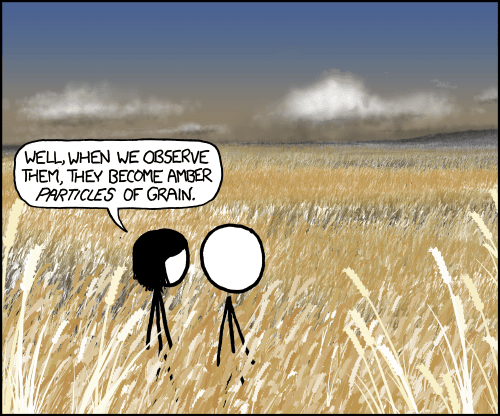
Quantum mechanics joke. from xkcd.

Quantum mechanics joke. from xkcd.

Is funny because … it’s is a double entente on the words grain (as in grainy) and waves, as in Schrödinger waves or “amber waves of grain” in the song America (Oh Beautiful). In Schrödinger’s view of the quantum world everything seems to exist or move as a wave until you observe it, and then it always becomes a particle. The math to solve for the energy of things is simple, and thus the equation is useful, but it’s hard to understand why,  e.g. when you solve for the behavior of a particle (atom) in a double slit experiment you have to imagine that the particle behaves as an insubstantial wave traveling though both slits until it’s observed. And only then behaves as a completely solid particle.

Math equations can always be rewritten, though, and science works in the language of math. The different forms appear to have different meaning but they don’t since they have the same practical predictions. Because of this freedom of meaning (and some other things) science is the opposite of religion. Other mathematical formalisms for quantum mechanics may be more comforting, or less, but most avoid the wave-particle duality.

The first formalism was Heisenberg’s uncertainty. At the end of this post, I show that it is identical mathematically to Schrödinger’s wave view. Heisenberg’s version showed up in two quantum jokes that I explained (beat into the ground), one about a lightbulb  and one about Heisenberg in a car (also explains why water is wet or why hydrogen diffuses through metals so quickly).

Yet another quantum formalism involves Feynman’s little diagrams. One assumes that matter follows every possible path (the multiple universe view) and that time should go backwards. As a result, we expect that antimatter apples should fall up. Experiments are underway at CERN to test if they do fall up, and by next year we should finally know if they do. Even if anti-apples don’t fall up, that won’t mean this formalism is wrong, BTW: all identical math forms are identical, and we don’t understand gravity well in any of them.

Yet another identical formalism (my favorite) involves imagining that matter has a real and an imaginary part. In this formalism, the components move independently by diffusion, and as a result look like waves: exp (-it) = cost t + i sin t. You can’t observe the two parts independently though, only the following product of the real and imaginary part: (the real + imaginary part) x (the real – imaginary part). Slightly different math, same results, different ways of thinking of things.

Because of quantum mechanics, hydrogen diffuses very quickly in metals: in some metals quicker than most anything in water. This is the basis of REB Research metal membrane hydrogen purifiers and also causes hydrogen embrittlement (explained, perhaps in some later post). All other elements go through metals much slower than hydrogen allowing us to make hydrogen purifiers that are effectively 100% selective. Our membranes also separate different hydrogen isotopes from each other by quantum effects (big things tunnel slower). Among the uses for our hydrogen filters is for gas chromatography, dynamo cooling, and to reduce the likelihood of nuclear accidents.

Dr. Robert E. Buxbaum, June 18, 2013.

To see Schrödinger’s wave equation derived from Heisenberg for non-changing (time independent) items, go here and note that, for a standing wave there is a vibration in time, though no net change. Start with a version of Heisenberg uncertainty: h =  λp where the uncertainty in length = wavelength = λ and the uncertainty in momentum = momentum = p. The kinetic energy, KE = 1/2 p2/m, and KE+U(x) =E where E is the total energy of the particle or atom, and U(x) is the potential energy, some function of position only. Thus, p = √2m(E-PE). Assume that the particle can be described by a standing wave with a physical description, ψ, and an imaginary vibration you can’t ever see, exp(-iωt). And assume this time and space are completely separable — an OK assumption if you ignore gravity and if your potential fields move slowly relative to the speed of light. Now read the section, follow the derivation, and go through the worked problems. Most useful applications of QM can be derived using this time-independent version of Schrödinger’s wave equation.