Perhaps the simplest way to make hydrogen is by electrolysis: you run some current through water with a little sulfuric acid or KOH added, and for every two electrons transferred, you get a molecule of hydrogen from one electrode and half a molecule of oxygen from the other.
2 OH- –> 2e- + 1/2 O2 +H2O
2H2O + 2e- –> H2 + 2OH-
The ratio between amps, seconds and mols of electrons (or hydrogen) is called the Faraday constant, F = 96500; 96500 amp-seconds transfers a mol of electrons. For hydrogen production, you need 2 mols of electrons for each mol of hydrogen, n= 2, so
it = 2F where and i is the current in amps, and t is the time in seconds and n is the number electrons per molecule of desired product. For hydrogen, t = 96500*2/i; in general, t = Fn/i.
96500 is a large number, and it takes a fair amount of time to make any substantial amount of hydrogen by electrolysis. At 1 amp, it takes 96500*2 = 193000 seconds, 2 days, to generate one mol of hydrogen (that’s 2 grams H2 or 22.4 liters, enough to fill a garment bag). We can reduce the time by using a higher current, but there are limits. At 25 amps, the maximum current of you can carry with house wiring it takes 2.14 hours to generate 2 grams. (You’ll have to rectify your electricity to DC or you’ll get a nasty H2 /O2 mix called Brown’s gas, While normal H2 isn’t that dangerous, Browns gas is a mix of H2 and O2 and is quite explosive. Here’s an essay I wrote on separating Browns gas).
Electrolysis takes a fair amount of electric energy too; the minimum energy needed to make hydrogen at a given temperature and pressure is called the reversible energy, or the Gibbs free energy ∆G of the reaction. ∆G = ∆H -T∆S, that is, ∆G equals the heat of hydrogen production ∆H – minus an entropy effect, T∆S. Since energy is the product of voltage current and time, Vit = ∆G, where ∆G is the Gibbs free energy measured in Joules and V,i, and t are measured Volts, Amps, and seconds respectively.
Since it = nF, we can rewrite the relationship as: V =∆G/nF for a process that has no energy losses, a reversible process. This is the form found in most thermodynamics textbooks; the value of V calculated this way is the minimum voltage to generate hydrogen, and the maximum voltage you could get in a fuel cell putting water back together.
To calculate this voltage, and the power requirements to make hydrogen, we use the Gibbs free energy for water formation found in Wikipedia, copied below (in my day, we used the CRC Handbook of Chemistry and Physics or a table in out P-chem book). You’ll notice that there are two different values for ∆G depending on whether the water is a gas or a liquid, and you’ll notice a small zero at the upper right (∆G°). This shows that the values are for an imaginary standard state: 20°C and 1 atm pressure. You can’t get 1 atm steam at 20°C, it’s an extrapolation; behavior at typical temperatures, 40°C and above is similar but not identical. I’ll leave it to a reader to send this voltage as a comment.
| Liquid H2O formation | ∆G° = | -237.14 | |
| Gaseous H2O formation | ∆G° = | -228.61 |
The reversible voltage for creating liquid water in a reversible fuel cell is found to be -237,140/(2 x 96,500) = -1.23V. We find that 1.23 Volts is about the minimum voltage you need to do electrolysis at 0°C because you need liquid water to carry the current; -1.18 V is about the maximum voltage you can get in a fuel cell because they operate at higher temperature with oxygen pressures significantly below 1 atm. (typically). The minus sign is kept for accounting; it differentiates the power out case (fuel cells) from power in (electrolysis). It is typical to find that fuel cells operate at lower voltages, between about .5V and 1.0V depending on the fuel cell and the power load.
Most electrolysis is done at voltages above about 1.48 V. Just as fuel cells always give off heat (they are exothermic), electrolysis will absorb heat if run reversibly. That is, electrolysis can act as a refrigerator if run reversibly. but electrolysis is not a very good refrigerator (the refrigerator ability is tied up in the entropy term mentioned above). To do electrolysis at reasonably fast rates, people give up on refrigeration (sucking heat from the environment) and provide all the entropy needed for electrolysis in the electricity they supply. This is to say, they operate at V’ were nFV’ ≥ ∆H, the enthalpy of water formation. Since ∆H is greater than ∆G, V’ the voltage for electrolysis is higher than V. Based on the enthalpy of liquid water formation, −285.8 kJ/mol we find V’ = 1.48 V at zero degrees. The figure below shows that, for any reasonably fast rate of hydrogen production, operation must be at 1.48V or above.
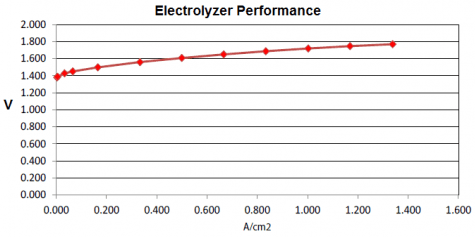
Electrolyzer performance; C-Pt catalyst on a thin, nafion membrane
If you figure out the energy that this voltage and amperage represents (shown below) you’re likely to come to a conclusion I came to several years ago: that it’s far better to generate large amounts of hydrogen chemically, ideally using a membrane reactor like my company makes.
The electric power to make each 2 grams of hydrogen at 1.5 volts is 1.5 V x 193000 Amp-s = 289,500 J = .080 kWh’s, or 0.9¢ at current rates, but filling a car takes 20 kg, or 10,000 times as much. That’s 800 kW-hr, or $90 at current rates. The electricity is twice as expensive as current gasoline and the infrastructure cost is staggering too: a station that fuels ten cars per hour would require 8 MW, far more power than any normal distributor could provide.
By contrast, methanol costs about 2/3 as much as gasoline, and it’s easy to deliver many giga-joules of methanol energy to a gas station by truck. Our company’s membrane reactor hydrogen generators would convert methanol-water to hydrogen efficiently by the reaction CH3OH + H2O –> 3H2 + CO2. This is not to say that electrolysis isn’t worthwhile for lower demand applications: see, e.g.: gas chromatography, and electric generator cooling. Here’s how membrane reactors work.
R. E. Buxbaum July 1, 2013; Those who want to show off, should post the temperature and pressure corrections to my calculations for the reversible voltage of typical fuel cells and electrolysis.
