Gout is a painful disease of the joints, often associated with high-achieving intellectuals, and high fat diets, Benjamin Franklin, Isaac Newton, Charles Darwin, Henry the VIII, and Imanuel Kant had gout, to mention a few. Franklin wrote a dialogue with Madam Gout, at midnight, October 22, 1780, very funny. And six months ago it struck me too – less funny. I developed the classic symptoms: swelling, redness, and pain in my big, left toe.
I followed the classic cure: I drank lots of water, took aspirin (a mistake, apparently) and wrapped my toe using hockey tape. It helped slightly. A neighbor assured me it was gout, suggesting ibuprofen and a change of diet: Water, avoid meat, sugar, and alcohol. For a week, I did this and kept my toe wrapped, but it didn’t get better. So, I went to a foot specialist who removed the bandage, and pronounced it as gout, a disease caused by uric acid crystals in the joints. He took x-rays that showed nothing, prescribed a slightly different diet and a week of colchicine pills. He also suggested cortisone shots mixed with Novocain, I said no to the shots, but took the colchicine and followed the new diet for two weeks. But they did no good.
In general, gout is associated with older, fat people. I wonder if, even in earlier centuries part of the problem was tight shoes.
Then, one day, I wandered into a New Balance store. The lady asked if I wanted my foot measured, something that I’d not done in 35 years. I said “yes,” and discovered that my feet had expanded about a size and a half, from 9 wide to somewhere between 10 1/2 and 11. I bought comfortable jogging shoes in size 10 1/2, and found that the pain started going away almost immediately. Two months later, the pain is still gone, except for a few days after I tried wearing an old pair as an experiment. I’ve come to think that many, or most gout cases are not real gout at all, but inflammation from too-tight shoes. And even if you’ve got real gout, it couldn’t hurt to try bigger shoes, or get your feet remeasured.
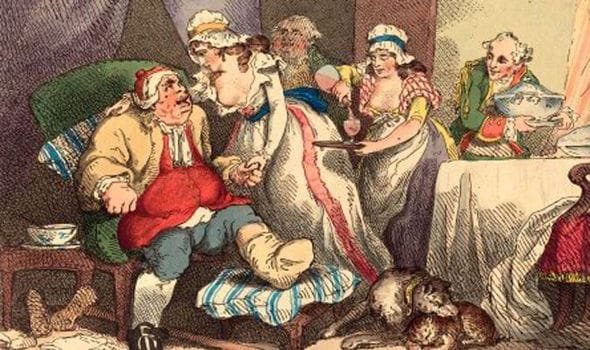
Take a look at gout-related paintings from the 18th century, like in the one above. Generally, they show fat, old men with one foot wrapped, and the other in a small, tight shoe. It seems possible that, even back then, much of the gout was the result of too-tight shoes, or of over-eating without getting a bigger shoe to compensate.
I took a trip to Princeton this weekend and rented the cheapest car I could, a 2026 Chevy Trax, rented from Drivo -Ace for $25.47/day. Taxes and state fees added another $26.50 for a total of $52/day. Still not bad. I’d known that this car had a ridiculously small 3 cylinder engine, 1.2 liter. I thus expected the car to be tiny, and expected no power or acceleration. In reality, it was spacious and attractive, a compact SUV with decent size seats front and back, and a lot of trunk space, 54 cubic feet of storage with the back seat down. And it was peppy, not great, but not sluggish at all. Zero to 60 in ~ 8.7 seconds, respectable, similar to the Chevyt equinox at 2/3 the price; better than the 10 seconds or so for the Nissan Versa. Congratulations to GM’s Changwon, Korea division who makes the car, and to GM who approved the project. The gas milage was great 30 mpg in my combined hwy and city driving — real world driving with me at the wheel. With milage like that, you’d think this is a hybrid, but it isn’t, and it doesn’t need fancy gas, just good old 87 octane.
2026 Chevy Trax in blah – grey. Also available in colors.
I have to credit the turbocharger for the high mpg and zip, along with the light weight, about 3000 lbs depending on the trim — I didn’t think to check the trim or weight because I didn’t expect to write this blog until after I’d returned the car. Most US cars have gotten really heavy for no obvious reason, over 4000 lbs typically. To get similar acceleration, US cars generally go to a bigger engine often non-turbocharged. They often pair it with a variable transmission that tends to feel funky. The trax uses a standard transmission.
The price for this vehicle is $21,000 to $23, 500 depending on trim, slightly higher than the cheapest for new car in America. The 2026 Hyundai Venue, comes a base price of $20,550, before taxes, fees, and dealer incentives, but after these things, the price ends up the same as the Trax. I notice that the Venue is smaller though, with a bigger engine 1.6 liter (not turbocharged), and continuously variable transmission. Because of the continuous transmission, I expect that you can not manually shift – something I like to do; I know if I’m going to accelerate soon, or plan to just cruse while the computer does not. The Hyundai Venue gets similar mpg to the Trax, but does not come with lane following, at least at the lower trim. The basic Trax comes with OK lane following that’s active only when you go over a certain speed. There’s a small screen on the Trax, and real buttons, plus a manual shift adjuster that I was glad to see, but din’t use on my trip. I din’t find the Trax loud either, or rough riding despite the 3 cylinders, my guess is the smooth-ish ride is a result of some power balancing from the turbo, maybe. I’ve never driven a Venue, BTW.
The biggest cost of a car, typically, is depreciation, so it generally pays to buy used. And since I’m looking to buy a car, I looked into buying used Trax a 2026 or early with perhaps 20,000 miles, expecting to find a bargain now that the 2027s are out. As it turns out, a new 2026 is no cheaper than the new 2027. And a used 2025 with a few thousand miles costs just a few thousand less. This low depreciation suggests that a new Trax is a relatively good deal, though I’m still inclined to go used, e.g. a 2024 model for $15,500. My compliments to GM for delivering a fun, affordable, attractive car. Congrats.
Robert Buxbaum, November 4, 2026. My trip to Princeton was great, BTW. It’s a gorgeous town, and I got together with folks I like that I hadn’t seen in 45 years or so. We’re getting older, too.
This is a short post, but useful. We had a moaning toilet. This was “our two-mode commode” described previously, but the same thing happens with one-mode commodes too. I cured it. At issue, the toilet moaned or wailed after it was flushed. Either the toilet was possessed by a tormented soul, as sometimes happens, or the moan was caused by a vibration in the fill diaphragm. That was the case here.
It’s usually toilets in social science university buildings that get inhabited by tormented souls, as these are typically social scientists who are forced to come back this way as punishment for passing themselves off as real scientists. Sometimes they show up making the heating pipes rattle and clang. You can cure this by bringing in a plumber or heating professional to encourage the soul to repent. The heating professional then adjusts some things and the soul moves on. In our case, a toilet in a private home, it required no exorcism, just an adjustment of the flow.
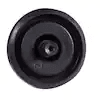
In our case, it became clear that the fill valve had become partially blocked resulting in a high flow against the diaphragm. This diaphragm, shown below, is in the valve that gets closed when the float in the toilet tank rises. At high flows the diaphragm begins to vibrate and moan, sounding just like a possessed toilet.
toilet diaphragm
For most toilets, replacing this diaphragm is an easy repair: buy a new diaphragm for about $4, (and typically, also a new flapper — it’s a good idea to change the flapper every 4-6 years), remove the old diaphragm. It’s behind a thumb-nut, typically, and do the necessary exchange. Remember, thumbnuts are better than others. Sorry to say, our toilet has a new-fangled float mechanism where the diaphragm is hidden inside, not easily replaced. A normal thing to do is to replace the float mechanism, but those cost $30 or more, and take a fair amount of work. Instead, I choose to reduce the flow speed of the water by partially closing the inlet valve sending fill water to the commode. It now fills slightly slower than before, but since there is less flow, there is no longer any audible vibration. A quick fix at zero cost.
If that hadn’t worked, I’d have called in the exorcist, an expensive proposition. You have to pay your the exorcist. If you don’t, you get repossessed.
For better or worse, the folks who run for library board and school board are a bizarre lot of political weirdos. It takes a lot of work and time and money to run for these boards, and you have to endure endless insults. For what? If you win, there’s no pay, and you get to sit through long, boring meetings. Because of this, almost everyone, who choses to run for these positions is a weirdo with a bering desire to either ban some book or idea, or to promote them. The rest are little better: developers who want to expand buildings and grounds. I don’t think this problem is unique to the US, or new. That’s just the way it is, and has always been. Noah Webster complained about this in the early 1800s. The net result is large schools – larger than they have to be – and many banned books, plus a preponderance of really perverted books.
In terms of teaching, I find myself on the side of classic books that are fairly non-sexual. That’s because I read them. Many people find them dull. I suspect that the students would prefer more modern and racier fare, or no books at all, but what do I know. In terms of library purchase, I like variety, but virtually no library works that way, either the board are a band of perverts pushing weird sex on under-age kids, or they are blue-noses who want to keep Shakespeare from the shelves. I also claim to prefer a diversity of opinions both in the classroom and in the library, but I suspect that, I’m likely to favor my own opinions over others. Below is the selection of banned books that the “don’t censor” organization wants on all shelves, all gay or transgender, as best I can tell. .
These books are banned in some counties K-12 public schools all are gay or transgender. While I’m not a fan of banning, I’m doubt these are the books to push. Pecksniffs on every side.
Sometimes very good books get banned, for no reason, or modified. This was done with Bowdlerized Shakespeare, for example. Once banned, it’s a lot harder to un-ban a book than it is to ban it. You’d have to get an unbanning committee together, almost impossible, and get them to read all the books. They’d have to make a coherent argument for their merits, and then have some vote. It would help to have balanced boards, but I fear that’s not likely/ possible. If nothing else, I’d like a time limit to banning: any banned book stays banned for only 12 years, or so.
I ran for school-board one year, by the way, and lost. I campaigned on math and science education, and less money for ever larger buildings and grounds. Against AI teaching of math and reading, claiming that math education suffers,. I also like cursive handwriting, something I consider an art form. I lost. You can find my Ballotopedia page if you’re interested.
I got my PhD in the engineering of nuclear fusion reactors (Princeton 1982). The most common version of these reactors use magnetic confinement. Rare isotopes of hydrogen are held in a magnetic bottle at 300 million °C (30 KeV), reacting to produce helium, useful energy, and a neutron. The magnetic bottle and high temperatures are necessary to overcome the repulsion between the hydrogen atoms at the distances necessary for nuclear fusion.
A customer of ours is building a different type of fusion reactor, without high temperatures or a magnetic bottle. They replace a few electrons of the hydrogen with muons — particles that are like electrons, but weigh about 207 times more. Hydrogen fusion is quickly catalyzed, as described in an earlier post. The muons recirculate to catalyze more until they decay or are trapped by an impurity, often helium.
Our company, REB Research, just shipped a specially made, hydrogen purifier tailored to remove the impurities in this process. Another aspect of the purifier design is that it minimizes radioactive tritium leakage, something that happens when hydrogen (tritium) diffuses through metals. We wish them all success, and wish success to our other fusion customers as well.
All of the following bits of Zen-like wisdom are derived from David M. Bader’s book, “Zen Judaism”. Some of these (in italics) have been modified by me. I’ve posted several other examples of zen-wisdom/ humor, e.g this. Most every piece of real wisdom appears as a joke, IMHO.
I bought a copy, then modified some as I saw fit. He’s holding a bagel.
If you meet the Buddha on the road, show him pictures of the grandchildren.
One may take a vow of fasting, or of celibacy, a vow of silence or to avoid sleep is out of the question.
Wherever you go, there you are. Your luggage is another story.
Be here now, be someplace else later; is that so complicated?
Accept misfortune. Do not wish for perfect health, or a life without problems. What would you talk about?
Drink tea and nourish life; with the first sip, joy; with the second sip, satisfaction; with the third sip, Danish.
Self abnegation is not easy. It takes much effort, and then what have you got? Bupkis.
The words, “there is no self,” can be terrifying. Still they’re not as bad as, “may you grow like an onion with your head in the ground.”
Bring the Buddha to your table, and on Passover, the prophet Elijah. That’s about as many invisible guests as anyone needs.
If there is no self, whose arthritis is this?
The journey of a thousand miles begins with a single Oy.
The world does not speak. It does not blame or take sides. The world has no expectations, and it demands nothing of others. The world is not Jewish.
Be patient and achieve all things. Be impatient and achieve all things faster.
Be aware of your body. Be aware of your perceptions. Keep in mind that not every physical sensation is a symptom of a terminal illness.
To find the Buddha, look within. Deep inside you are ten thousand flowers. Each flower blossoms ten thousand times. Each blossom has ten thousand petals. You might want to see a specialist.
Seek not the outer enticements. Dwell not in the inner strife. Try to find a nice place in the suburbs with good schools.
Practice a livelihood that does not harm yourself or others, choose an occupation furthering love and compassion. Ask about the health plan, too. No freelancing.
Let go of pride, ego, and opinions. Admit your error and forgive those of others. Relinquishment will lead to calm and healing in your relationships. If that doesn’t work, try small claims court.
For the wary Pilgrim, a Zen poem: thousands reach the gateless gate from many paths; once through, they dwell serenely between heaven and earth; enjoying golf, line dancing, Yiddish lessons, and aquacise. Come see our model units at Century Village.
Breathe in. Breathe out. Breathe in. Breathe out. Do this and achieve peace. Forget this and attaining Enlightenment will be the least of your problems.
Go then and wander for the good of the many, for the welfare of the many, out of compassion for the world. Teach what is good in the beginning, good in the middle, and good in the end. Don’t forget to write, and always wear clean underwear. You never know when you could end up in the emergency room.
Robert Buxbaum, March 24, 2025. Other books by David Bader include “Haikus for jews”, “The book of Murray”, and “How to be an extremely Reform Jew”. Bader claims to have achieved complete and perfect emptiness, although two hours later he often feels full again.
Hockey sticks have gotten bendier in recent years, with an extreme example shown below: Alex Ovechkin getting about 3″ of bend using a 100# stiffness stick. Bending the stick allows a player to get more power out of wrist shots by increasing the throw distance of the puck. There is also some speed advantage to the spring energy stored in the stick — quite a lot in Mr Ovechkin’s case.
Alexander Ovechkin takes a wrist shot using a bendy stick.
A 100# stiffness stick takes 100 pounds of force in the middle to get 1″ of bend. That Ovechkin gets 3″ of bend with his 100# stick suggests that he shoots with some 300 lbs of force, an insane amount IMHO. Most players use a lot less force, but even so a bendy stick should help them score goals.
There is something that bothers me about the design of Alex Ovechkin’s stick though, something that I think I could improve. You’ll notice that the upper half of his stick bends as much as the lower half. This upper-bend does not help the shot, and it takes work-energy. The energy in that half of the bend is wasted energy, and its release might even hurt the shooter by putting sudden spring-stress on his wrist. To correct for this, I designed my own stick, shown below, with an aim to have no (or minimal) upper bend. The modification involved starting with a very bendy stick, then covering most of the upper half with fiberglass cloth.
I got ahold of a junior stick, 56″ long with 60# flex, and added a 6″ extension to the top. Doing this made the stick longer, 62″ long (adult length) and even more bendy. One 1″ of flex requires less force on a longer stick. I estimate that, by lengthening the stick, I reduced it to about 44#. Flex is inversely proportional to length cubed. I then sanded the upper part of the stick, and wrapped 6 oz” fiberglass cloth (6 oz) 2-3 wraps around the upper part as shown, holding it tight with tape at top and bottom when I was done. I then applied epoxy squeezing it through the cloth so that the composite was nearly transparent, and so the epoxy filled the holes. This added about 15g, about 1/2 oz to the weight. Transparency suggested that the epoxy had penetrated the cloth and bonded to the stick below, though the lack of total transparency suggests that the bond could have been better with a less viscous epoxy. Once the epoxy had mostly set, I took the tape off, and stripped the excess fiberglass so that the result looked more professional. I left 23″ of fiberglass wrap as shown. The fiberglass looks like hockey tape.
Assuming I did the gluing right, this hockey stick should have almost all of the spring below the shooter’s lower hand. I have not measured the flex, but my target was about 80 lbs, with improved durability and the new lower center of bend. In theory, more energy should get into the puck. It’s a gift for my son, and we’ll see how it works in a month or so.
Original hardware brass screws from my door and locks, plus one of the stainless screw that I used as a replacement.
I just replaced the door knob assembly on my home and found that it was held in place by a faceplate that was attached by two, 5/8″, brass screws. These screws, shown at right with their replacement, would not have been able to withstand a criminal, I think. Our door is metal, foam filled, and reasonably strong. I figure it would have withstood a beating, but the brass screws would not, especially since only 1/4″ of the screw is designed to catch foam. Look closely at the screws, and you will see there are two sizes of pitch, each 1/4 long. Only the last 1/4″ looks like it was ever engaged. The top 1/4″ may have been designed to catch metal, but the holes in the door were not tapped to match. The bottom 1/4″ held everything. Even without a criminal attack, the screw at right was bent and beginning to go.
Instead of reusing these awful screws or buying similar ones, I replaced them with stainless screws, 1 3/4″ long, like the one shown in the picture above. But then I had a thought — what were the other locks on my door attached with? I checked and found my deadbolt lock was held in by two of the same type of sorry, 5/8″ brass screws. So I replaced these too, using two more, 1.75″ stainless steel. Then, in my disgust, I thought to write this post. Perhaps the screws holding your door hardware is as lousy as was holding mine. Take a look.
In 1905 and 1908, Einstein developed two formulations for the diffusion of a small particle in a liquid. As a side-benefit of the first derivation, he demonstrated the visible existence of molecules, a remarkable piece of work. In the second formulation, he derived the same result using non-equilibrium thermodynamics, something he seems to have developed on the spot. I’ll give a brief version of the second derivation, and will then I’ll show off my own extension. It’s one of my proudest intellectual achievements.
But first a little background to the problem. In 1827, a plant biologist, Robert Brown examined pollen under a microscope and noticed that it moved in a jerky manner. He gave this “Brownian motion” the obvious explanation: that the pollen was alive and swimming. Later, it was observed that the pollen moved faster in acetone. The obvious explanation: pollen doesn’t like acetone, and thus swims faster. But the pollen never stopped, and it was noticed that cigar smoke also swam. Was cigar smoke alive too?
Einstein’s first version of an answer, 1905, was to consider that the liquid was composed of atoms whose energy was a Boltzmann distribution with an average of E= kT in every direction where k is the Boltzmann constant, and k = R/N. That is Boltsman’s constant equals the gas constant, R, divided by Avogadro’s number, N. He was able to show that the many interactions with the molecules should cause the pollen to take a random, jerky walk as seen, and that the velocity should be faster the less viscous the solvent, or the smaller the length-scale of observation. Einstein applied the Stokes drag equation to the solute, the drag force per particle was f = -6πrvη where r is the radius of the solute particle, v is the velocity, and η is the solution viscosity. Using some math, he was able to show that the diffusivity of the solute should be D = kT/6πrη. This is called the Stokes-Einstein equation.
In 1908 a French physicist, Jean Baptiste Perrin confirmed Einstein’s predictions, winning the Nobel prize for his work. I will now show the 1908 Einstein derivation and will hope to get to my extension by the end of this post.
Consider the molar Gibbs free energy of a solvent, water say. The molar concentration of water is x and that of a very dilute solute is y. y<<1. For this nearly pure water, you can show that µ = µ° +RT ln x= µ° +RT ln (1-y) = µ° -RTy.
Now, take a derivative with respect to some linear direction, z. Normally this is considered illegal, since thermodynamic is normally understood to apply to equilibrium systems only. Still Einstein took the derivative, and claimed it was legitimate at nearly equilibrium, pseudo-equilibrium. You can calculate the force on the solvent, the force on the water generated by a concentration gradient, Fw = dµ/dz = -RT dy/dz.
Now the force on each atom of water equals -RT/N dy/dz = -kT dy/dz.
Now, let’s call f the force on each atom of solute. For dilute solutions, this force is far higher than the above, f = -kT/y dy/dz. That is, for a given concentration gradient, dy/dz, the force on each solute atom is higher than on each solvent atom in inverse proportion to the molar concentration.
For small spheres, and low velocities, the flow is laminar and the drag force, f = 6πrvη.
Now calculate the speed of each solute atom. It is proportional to the force on the atom by the same relationship as appeared above: f = 6πrvη or v = f/6πrη. Inserting our equation for f= -kT/y dy/dz, we find that the velocity of the average solute molecule,
v = -kT/6πrηy dy/dz.
Let’s say that the molar concentration of solvent is C, so that, for water, C will equal about 1/18 mols/cc. The atomic concentration of dilute solvent will then equal Cy. We find that the molar flux of material, the diffusive flux equals Cyv, or that
where Cy is the molar concentration of solvent per volume.
Classical engineering comes to a similar equation with a property called diffusivity. Sp that
Molar flux of y (mols y/cm2/s) = -D dCy/dz, and D is an experimentally determined constant. We thus now have a prediction for D:
D = kT/6πrη.
This again is the Stokes Einstein Equation, the same as above but derived with far less math. I was fascinated, but felt sure there was something wrong here. Macroscopic viscosity was not the same as microscopic. I just could not think of a great case where there was much difference until I realized that, in polymer solutions there was a big difference.
Polymer solutions, I reasoned had large viscosities, but a diffusing solute probably didn’t feel the liquid as anywhere near as viscous. The viscometer measured at a larger distance, more similar to that of the polymer coil entanglement length, while a small solute might dart between the polymer chains like a rabbit among trees. I applied an equation for heat transfer in a dispersion that JK Maxwell had derived,
where κeff is the modified effective thermal conductivity (or diffusivity in my case), κl and κp are the thermal conductivity of the liquid and the particles respectively, and φ is the volume fraction of particles.
To convert this to diffusion, I replaced κl by Dl, and κp by Dp where
Dl = kT/6πrηl
and Dp = kT/6πrη.
In the above ηl is the viscosity of the pure, liquid solvent.
The chair of the department, Don Anderson didn’t believe my equation, but agreed to help test it. A student named Kit Yam ran experiments on a variety of polymer solutions, and it turned out that the equation worked really well down to high polymer concentrations, and high viscosity.
As a simple, first approximation to the above, you can take Dp = 0, since it’s much smaller than Dl and you can take Dl to equal Dl = kT/6πrηl as above. The new, first order approximation is:
D = kT/6πrηl (1 – 3φ/2).
We published in Science. That is I published along with the two colleagues who tested the idea and proved the theory right, or at least useful. The reference is Yam, K., Anderson, D., Buxbaum, R. E., Science 240 (1988) p. 330 ff. “Diffusion of Small Solutes in Polymer-Containing Solutions”. This result is one of my proudest achievements.
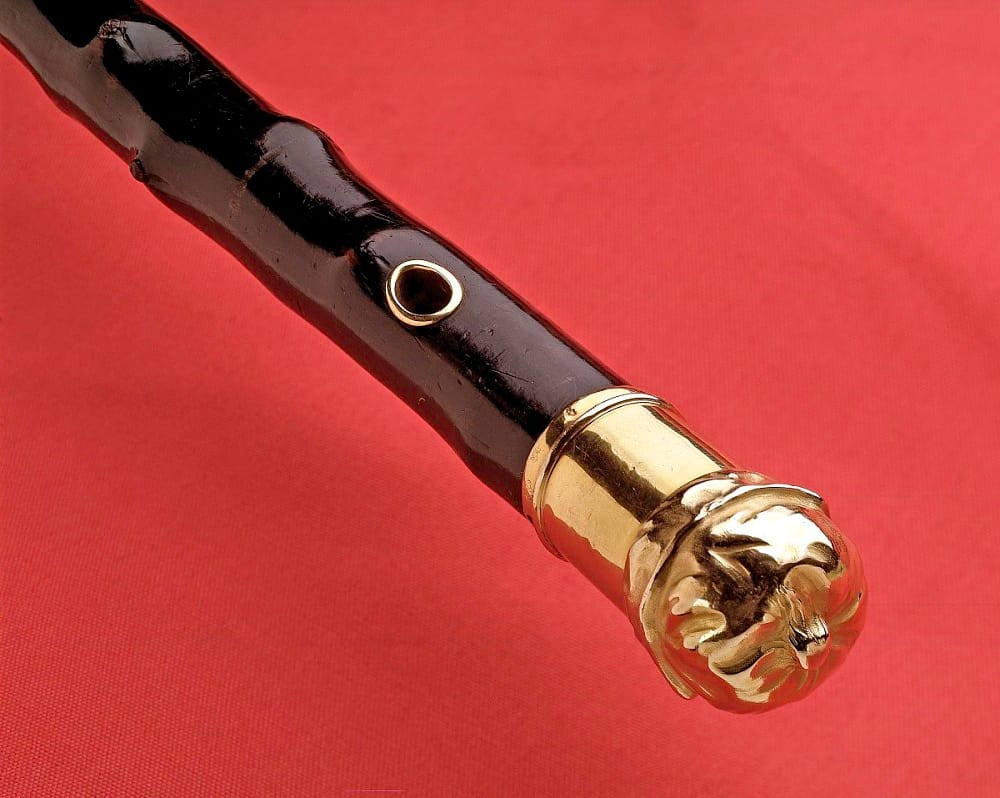
Franklin’s walking stick, willed to General Washington. Now in the Smithsonian.
Many famous people carried walking sticks Washington, Churchill, Moses, Dali. Until quite recently, it was “a thing”. Benjamin Franklin willed one, now in the Smithsonian, to George Washington, to act as a sort of scepter: “My fine crab-tree walking stick, with a gold head curiously wrought in the form of the cap of liberty, I give to my friend, and the friend of mankind, General Washington. If it were a Scepter, he has merited it, and would become it. It was a present to me from that excellent woman, Madame de Forbach, the dowager Duchess of Deux-Ponts”. A peculiarity of this particular stick is that the stick is uncommonly tall, 46 1/2″. This is too tall for casual, walking use, and it’s too fancy to use as a hiking stick. Franklin himself, used a more-normal size walking stick, 36 3/8″ tall, currently in the collection of the NY Historical Society. Washington too seems to have favored a stick of more normal length.
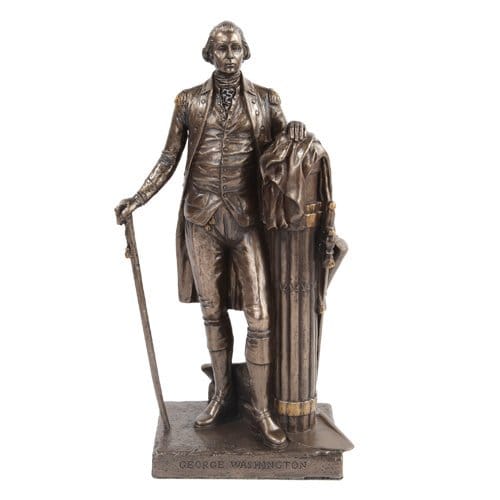
Washington with walking stick
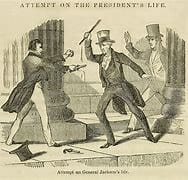
Walking sticks project a sort of elegance, as well as providing personal protection. Shown below is President Andrew Jackson defending himself against an assassin using his walking stick to beat off an assassin. He went on to give souvenir walking sticks to friends and political supporters. Sticks remained a common political gift for 100 years, at least through the election of Calvin Coolidge.
Andrew Jackson defends himself.
I started making walking sticks a few years back, originally for my own use, and then for others when I noticed that many folks who needed canes didn’t carry them. It was vanity, as best I could tell: the normal, “old age” cane is relatively short, about 32″. Walking with it makes you bend over; you look old and decrepit. Some of the folks who needed canes, carried hiking sticks, I noticed, about 48″. These are too tall to provide any significant support, as the only way to grasp one was from the side. Some of my canes are shown below. They are about 36″ tall, typically with a 2″ wooden ball as a head. They look good, you stand straight, and they provides support and balance when going down stairs.
Some of my walking sticks.
I typically make my sticks of American Beech, a wood of light weight, with good strength, and a high elastic modulus of elasticity, about 1.85 x10⁶ psi. Oak, hickory, and ash are good options, but they are denser, and thus more suited to self-defense. Wood is better than metal for many applications, IMHO, as I’ve discussed elsewhere. The mathematician Euler showed the the effective strength of a walking stick does not depend on the compressive strength but rather on elastic constant via “the Euler buckling equation”, one of many tremendously useful equations developed by Leonhard Euler (1707-1783).
For a cylindrical stick, the maximum force supported by a stick is: F = π3Er4/4L2, where F is the force, r is the radius, L is the length, and E is the elastic modulus. I typically pick a diameter of 3/4″ or 7/8″, and fit the length to the customer. For a 36″ beech stick, the buckling strength is calculated to be 221 or 409 pounds respectively. I add a rubber bottom to make it non–scuff and less slip-prone. I sometimes add a rope thong, too. Here is a video of Fred Astaire dancing with this style of stick. It’s called “a pin stick”, in case you are interested because it looks like a giant pin.
Country Irishmen are sometimes depicted with a heavy walking stick called a Shillelagh. It’s used for heavier self-defense than available with a pin-stick, and is generally seen being used as a cudgel. There are Japanese versions of self defense using a lighter, 36″ stick, called a Han-bo, as shown here. There is also the wand, as seen for example in Harry Potter. It focuses magical power. Similar to this is Moses’s staff that he used in front of Pharaoh, a combination wand and hiking stick as it’s typically pictured. It might have been repurposed for the snake-on-a-stick that protects against dark forces. Dancing with a stick, Astaire style, can drive away emotional forces, while the more normal use is elegance, and avoiding slips.