Category Archives: war

It’s rocket science

Here are six or so rocket science insights, some simple, some advanced. It’s a fun area of engineering that touches many areas of science and politics. Besides, some people seem to think I’m a rocket scientist.

A basic question I get asked by kids is how a rocket goes up. My answer is it does not go up. That’s mostly an illusion. The majority of the rocket — the fuel — goes down, and only the light shell goes up. People imagine they are seeing the rocket go up. Taken as a whole, fuel and shell, they both go down at 1 G: 9.8 m/s2, 32 ft/sec2.

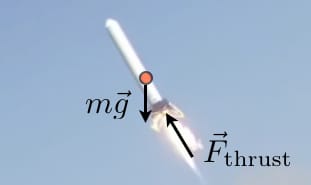
Because 1 G ofupward acceleration is always lost to gravity, you need more thrust from the rocket engine than the weight of rocket and fuel. This can be difficult at the beginning when the rocket is heaviest. If your engine provides less thrust than the weight of your rocket, your rocket sits on the launch pad, burning. If your thrust is merely twice the weight of the rocket, you waste half of your fuel doing nothing useful, just fighting gravity. The upward acceleration you’ll see, a = F/m -1G where F is the force of the engine, and m is the mass of the rocket shell + whatever fuel is in it. 1G = 9.8m/s is the upward acceleration lost to gravity.  For model rocketry, you want to design a rocket engine so that the upward acceleration, a, is in the range 5-10 G. This range avoids wasting lots of fuel without requiring you to build the rocket too sturdy.

For NASA moon rockets, a = 0.2G approximately at liftoff increasing as fuel was used. The Saturn V rose, rather majestically, into the sky with a rocket structure that had to be only strong enough to support 1.2 times the rocket weight. Higher initial accelerations would have required more structure and bigger engines. As it was the Saturn V was the size of a skyscraper. You want the structure to be light so that the majority of weight is fuel. What makes it tricky is that the acceleration weight has to sit on an engine that gimbals (slants) and runs really hot, about 3000°C. Most engineering projects have fewer constraints than this, and are thus “not rocket science.”

Basic force balance on a rocket going up.

Basic force balance on a rocket going up.

A space rocket has to reach very high, orbital speed if the rocket is to stay up indefinitely, or nearly orbital speed for long-range, military uses. You can calculate the orbital speed by balancing the acceleration of gravity, 9.8 m/s2, against the orbital acceleration of going around the earth, a sphere of 40,000 km in circumference (that’s how the meter was defined). Orbital acceleration, a = v2/r, and r = 40,000,000 m/2π = 6,366,000m. Thus, the speed you need to stay up indefinitely is v=√(6,366,000 x 9.8) = 7900 m/s = 17,800 mph. That’s roughly Mach 35, or 35 times the speed of sound at sea level, (343 m/s). You need some altitude too, just to keep air friction from killing you, but for most missions, the main thing you need is velocity, kinetic energy, not potential energy, as I’ll show below. If your speed exceeds 17,800 m/s, you go higher up, but the stable orbital velocity is lower. The gravity force is lower higher up, and the radius to the earth higher too, but you’re balancing this lower gravity force against v2/r, so v2 has to be reduced to stay stable high up, but higher to get there. This all makes docking space-ships tricky, as I’ll explain also. Rockets are the only way practical to reach Mach 35 or anything near it. No current cannon or gun gets close.

Kinetic energy is a lot more important than potential energy for sending an object into orbit. To get a sense of the comparison, consider a one kg mass at orbital speed, 7900 m/s, and 200 km altitude. For these conditions, the kinetic energy, 1/2mv2 is 31,205 kJ, while the potential energy, mgh, is only 1,960 kJ . The potential energy is thus only 1/16 the kinetic energy.

Not that it’s easy to reach 200 miles altitude, but you can do it with a sophisticated cannon. The Germans did it with “simple”, one stage, V2-style rockets. To reach orbit, you generally need multiple stages. As a way to see this, consider that the energy content of gasoline + oxygen is about 10.5 MJ/kg (10,500 kJ/kg); this is only 1/3 of the kinetic energy of the orbital rocket, but it’s 5 times the potential energy. A fairly efficient gasoline + oxygen powered cannon could not provide orbital kinetic energy since the bullet can move no faster than the explosive vapor. In a rocket this is not a constraint since most of the mass is ejected.

A shell fired at a 45° angle that reaches 200 km altitude would go about 800 km — the distance between North Korea and Japan, or between Iran and Israel. That would require twice as much energy as a shell fired straight up, about 4000 kJ/kg. This is still within the range for a (very large) cannon or a single-stage rocket. For Russia or China to hit the US would take much more: orbital, or near orbital rocketry. To reach the moon, you need more total energy, but less kinetic energy. Moon rockets have taken the approach of first going into orbit, and only later going on. While most of the kinetic energy isn’t lost, it’s likely not the best trajectory in terms of energy use.

The force produced by a rocket is equal to the rate of mass shot out times its velocity. F = ∆(mv). To get a lot of force for each bit of fuel, you want the gas exit velocity to be as fast as possible. A typical maximum is about 2,500 m/s. Mach 10, for a gasoline – oxygen engine. The acceleration of the rocket itself is this ∆mv force divided by the total remaining mass in the rocket (rocket shell plus remaining fuel) minus 1 (gravity). Thus, if the exhaust from a rocket leaves at 2,500 m/s, and you want the rocket to accelerate upward at an average of 10 G, you must exhaust fast enough to develop 10 G, 98 m/s2. The rate of mass exhaust is the average mass of the rocket times 98/2500 = .0392/second. That is, about 3.92% of the rocket mass must be ejected each second. Assuming that the fuel for your first stage engine is less than 80% of the total mass, the first stage will flare-out in about 20 seconds. Typically, the acceleration at the end of the 20 burn is much greater than at the beginning since the rocket gets lighter as fuel is burnt. This was the case with the Apollo missions. The Saturn V started up at 0.5G but reached a maximum of 4G by the time most of the fuel was used.

If you have a good math background, you can develop a differential equation for the relation between fuel consumption and altitude or final speed. This is readily done if you know calculus, or reasonably done if you use differential methods. By either method, it turns out that, for no air friction or gravity resistance, you will reach the same speed as the exhaust when 64% of the rocket mass is exhausted. In the real world, your rocket will have to exhaust 75 or 80% of its mass as first stage fuel to reach a final speed of 2,500 m/s. This is less than 1/3 orbital speed, and reaching it requires that the rest of your rocket mass: the engine, 2nd stage, payload, and any spare fuel to handle descent (Elon Musk’s approach) must weigh less than 20-25% of the original weight of the rocket on the launch pad. This gasoline and oxygen is expensive, but not horribly so if you can reuse the rocket; that’s the motivation for NASA’s and SpaceX’s work on reusable rockets. Most orbital rocket designs require three stages to accelerate to the 7900 m/s orbital speed calculated above. The second stage is dropped from high altitude and almost invariably lost. If you can set-up and solve the differential equation above, a career in science may be for you.

Now, you might wonder about the exhaust speed I’ve been using, 2500 m/s. You’ll typically want a speed at lest this high as it’s associated with a high value of thrust-seconds per weight of fuel. Thrust seconds pre weight is called specific impulse, SI, SI = lb-seconds of thrust/lb of fuel. This approximately equals speed of exhaust (m/s) divided by 9.8 m/s2. For a high molecular weight burn it’s not easy to reach gas speed much above 2500, or values of SI much above 250, but you can get high thrust since thrust is related to momentum transfer. High thrust is why US and Russian engines typically use gasoline + oxygen. The heat of combustion of gasoline is 42 MJ/kg, but burning a kg of gasoline requires roughly 2.5 kg of oxygen. Thus, for a rocket fueled by gasoline + oxygen, the heat of combustion per kg is 42/3.5 = 12,000,000 J/kg. A typical rocket engine is 30% efficient (V2 efficiency was lower, Saturn V higher). Per corrected unit of fuel+oxygen mass, 1/2 v2 = .3 x 12,000,000; v =√7,200,000 = 2680 m/s. Adding some mass for the engine and fuel tanks, the specific impulse for this engine will be, about 250 s. This is fairly typical. Higher exhaust speeds have been achieved with hydrogen fuel, it has a higher combustion energy per weight. It is also possible to increase the engine efficiency; the Saturn V, stage 2 efficiency was nearly 50%, but the thrust was low. The sources of inefficiency include inefficiencies in compression, incomplete combustion, friction flows in the engine, and back-pressure of the atmosphere. If you can make a reliable, high efficiency engine with good lift, a career in engineering may be for you. A yet bigger challenge is doing this at a reasonable cost.

At an average acceleration of 5G = 49 m/s2 and a first stage that reaches 2500 m/s, you’ll find that the first stage burns out after 51 seconds. If the rocket were going straight up (bad idea), you’d find you are at an altitude of about 63.7 km. A better idea would be an average trajectory of 30°, leaving you at an altitude of 32 km or so. At that altitude you can expect to have far less air friction, and you can expect the second stage engine to be more efficient. It seems to me, you may want to wait another 10 seconds before firing the second stage: you’ll be 12 km higher up and it seems to me that the benefit of this will be significant. I notice that space launches wait a few seconds before firing their second stage.

As a final bit, I’d mentioned that docking a rocket with a space station is difficult, in part, because docking requires an increase in angular speed, w, but this generally goes along with a decrease in altitude; a counter-intuitive outcome. Setting the acceleration due to gravity equal to the angular acceleration, we find GM/r2 = w2r, where G is the gravitational constant, and M is the mass or the earth. Rearranging, we find that w2  = GM/r3. For high angular speed, you need small r: a low altitude. When we first went to dock a space-ship, in the early 60s, we had not realized this. When the astronauts fired the engines to dock, they found that they’d accelerate in velocity, but not in angular speed: v = wr. The faster they went, the higher up they went, but the lower the angular speed got: the fewer the orbits per day. Eventually they realized that, to dock with another ship or a space-station that is in front of you, you do not accelerate, but decelerate. When you decelerate you lose altitude and gain angular speed: you catch up with the station, but at a lower altitude. Your next step is to angle your ship near-radially to the earth, and accelerate by firing engines to the side till you dock. Like much of orbital rocketry, it’s simple, but not intuitive or easy.

Robert Buxbaum, August 12, 2015. A cannon that could reach from North Korea to Japan, say, would have to be on the order of 10 km long, running along the slope of a mountain. Even at that length, the shell would have to fire at 450 G, or so, and reach a speed about 3000 m/s, or 1/3 orbital.

Major blunders of the American Revolution

As nice as it is to discuss the brilliant men and great battles that allowed the American colonials to win the American Revolution, there is another way to see things –perhaps less enjoyable, but just as legitimate: looking at the great dunderheads and mistakes that allowed the greatest military power on earth to be defeated by a small group of undisciplined rabble. Here follows brief essays on my three top dunderheads: two British, one French. No one realized they were dunces until much later.

Pride of place goes, I think, to King Louis 16th of France. He helped us to win the war, and lost his own empire in the process. King Louis had nothing to gain by funding the American cause. And he had quite a lot to lose in men and money. He lost his ships and men in Rhode Island, lost colonies in India and the Seychelles, and spent millions he’d need when the famine of 1789 came. Worse, by supporting America, Louis put the bug of Liberty in the French ear. Far better (for Louis) would have been if he had waited, non-committally for another 3-5 years as the Dutch and Spanish did. He could have continued to host and honor Franklin, could have continued to sell weapons (to both sides) and could have even encouraged hot-head volunteers like Lafayette to go over and fight. We might still have won (see below) but at a greater cost to us and a fraction of the cost to the French monarchy. Let us thank God for fools. Here are my thoughts on when to get involved in a foreign war.

The basic issue of big-scale blunders is not seeing the disaster that hides behind a small-scale victory. And that tends to be funny.

The basic of every great dunderhead is not seeing the disaster that hides behind a small-scale victory. And that tends to be funny.

British admiral George Rodney is my second, honored dunce. He had many victories, especially after the war was lost, but his major war achievement was not-relieving Cornwallis at Yorktown, and thus losing the war. In early 1781, Rodney was defending Jamaica and other British “Sugar Islands” in the Caribbean while waiting for orders to either fight the French fleet or relieve Cornwallis. As it was, he did neither but instead attacked a Dutch-held, Caribbean island, St. Eustatius. Rodney noticed that British freighters were being hijacked by pirates and that the island was a major trading port to the American colonists. By going after these pirates, he gained booty, but left the rest of the empire under-gunned. This allowed French Admiral, de Grasse Tilly to defeat Admiral Hood in the Caribbean; allowed him to take Tobago for the French. And then, while Rodney was still protecting his St Eustatius booty, de Grasse circled back to Virginia in time to bottle up Cornwallis. British Admiral Graves tried twice to dislodge de Grasse, but without Rodney he hadn’t the firepower. Cornwallis surrounded the day Graves gave up his second, failed attempt.

Rodney’s choice was one of greed, self-interest, and glory-seeking at the expense of British national interest. It isn’t unique in the Revolution or in British military history. Clinton’s move to attack Philadelphia when he was supposed to aid Burgoyne caused the loss of Burgoyne’s army and got the French in on our side, but I judge Rodney’s screw-up bigger if only because Cornwallis’s defeat ended the war and lost America.

Finally, I give the third-place dunce cap to General Banastre Tarleton, otherwise known as “Bloody Ban,” the most hated man in America. Tarleton was the son of a noted slave trader and mayor of Liverpool. He tended to win battles, but as fictionalized in the movie, The Patriot, he rarely differentiated rebel from loyalist, burning farms and churches of both. He also became known for “Tarleton’s quarter”, killing his enemies after they had surrendered. In the long run, this sort of thing turns your friends in to your enemies, and so it did here.

The view, common in Tarlton’s regiment, was that this was at least partially a religious war. If a congregation wasn’t Anglican — a church with the king as its head — it was a “sedition shop” and needed to be eliminated. He wasn’t totally wrong, but it rarely goes down well; for example the Sunni vs Shiite, Hamas vs ISIS wars. He certainly undermined Benedict Arnold’s claims that King George was serious in granting religious freedom.

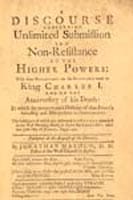
A religious dissertation on why resistance to the king is obedience to God.

A religious dissertation: resistance to a tyrant is obedience to God.

When Tarleton was given the job of capturing Marion Francis, the Swamp Fox, his approach, with Major James Wemyss and Captain Christian Hock (or Hook), was to burn the farms, churches, and plantations of anyone in the area. In one of Wemyss memoranda, he writes he had “burnt and laid waste about 50 houses and Plantations, mostly belonging to People who have either broke their Paroles or Oaths of Allegiance, and are now in Arms against us.” Note the word, “mostly.” These methods did succeed in drawing out the Swamp Fox, but it also drew out most everyone else in the south, even those who’d given up on the revolution. The now-farmless farmers enlisted and produced enthusiastic counter-attacks at Gibson’s Meeting House, Hill’s Iron Works, Fishdam Ford (Wemyss capture), Williamson’s Plantation (Huck’s Defeat), Blackstock’s farm and Cowpens. By the end, the colonials had even figured out how to use Tarleton’s enthusiasm against him.The right way to deal with your enemy is with focus and mercy, as Grant treated Lee at Appomattox. Tarleton’s methods would have made the Revolution a centuries-long, religious war IMHO, if the French had not gotten involved on our side.

Robert Buxbaum. July 16, 2015. If you have other classics of stupidity, please tell me. I’d like to recommend two books by A. J. O’Shaughnessy: “An Empire Divided,” and “The men who lost America.” As a final note: after the war Tarleton retired to Parliament where he served until 1833 as a fierce advocate for British slavery. Britain ended their use of slave workers in the Caribbean and south Africa in 1833, but didn’t stop their use in Ceylon and areas of East India company until 1843. Most Slaves who came to the new world did so in British ships.

Sealand, the big Chinese copy, and WWIII

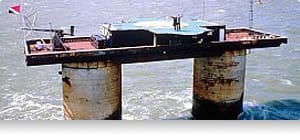
Perhaps the smallest country in the world is the Republic of Sealand, a man-made island in the English Channel. Originally called Roughs Tower, Sealand is only 1/4 acre, 0.0004 mi2 in area, but expands to 1.5 square miles if you include the 0.7 mile sea-claim. The country was built, in international waters, by the British during WWII, and given semi-legitimate nation status through two diplomatic accidents over the next 20 years. This nation status would be a joke except that the precedent it establishes could start WW III.

Greetings from The King and Queen of the Republic of Sealand.

The Republic of Sealand. King Roy and Queen Joan wave their greetings. Note, gun, flag, and helipad.

The British constructed Fort Roughs to serve as a bulwark against German U-Boats that were sinking supply ships. The tower-fort is topped with a deck and a helipad platform. There is one gun still working, see photo, a remnant of WWII service. Hollow concrete tubes extend to the Rough Sands sand bar; these provide storage and housing for as many as 300 troops. After the war, Rough Tower went unused and was officially abandoned in 1956. It was occupied (salvaged, conquered) in December, 1966 by radio-pirates trying to break the BBC monopoly. One of the radio-pirates, a former British Major, Paddy Roy Bates, declared the fort-island a monarchy with Roy as King and his wife Joan as Queen. Sealand, declared itself an independent nation September 2, 1967. Aristocratic titles are for sale at a price.

The first of the diplomatic accidents underlying Sealand’s semi-legitimate claim to nation status is that, when the responsible British officials were asked whether they intended to remove the radio squatters, the official response was that England abandoned ownership and responsibility. If England abandoned ownership, so the argument goes, then anyone who took over would take possession “res derelicta and terra nullius”. From a legal point of view, it constituted extra-national territory and they could declare island-nation status plus (some) sea rights. Needless to say, the British navy didn’t see it that way, and as soon as independence was declared, they attacked the island-tower-nation. Bates returned warning shots and the navy brought a case against him in Crown court, Essex. The result: The Bates’s won effective recognition as the fort sat in international waters. This claim stood until 1978 when Sealand was successfully “invaded” by German pirates. The Bates family managed to “liberate” (take back) Sealand with the help of a Bond-movie helicopter stunt pilot, capturing a German pirate in the process. The king negotiated with the German government for the pirate’s release, and thus claim de-facto German recognition. Sealand participates in some international games (ultimate frisbee, mostly), and issues passports, stamps, and currency that is not accepted anywhere. Still, the British deliver mail as if it were a country, and no nation has formally contested Sealand’s statehood since. island-reclamation-sc-sea spotlight_81412

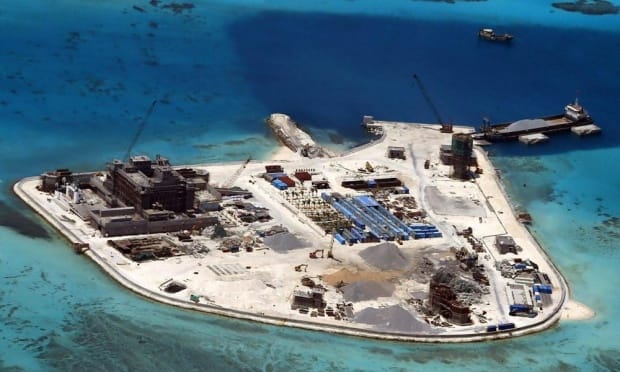
Man made Chinese Islands in the South Pacific

Man made Chinese Islands in the South Pacific

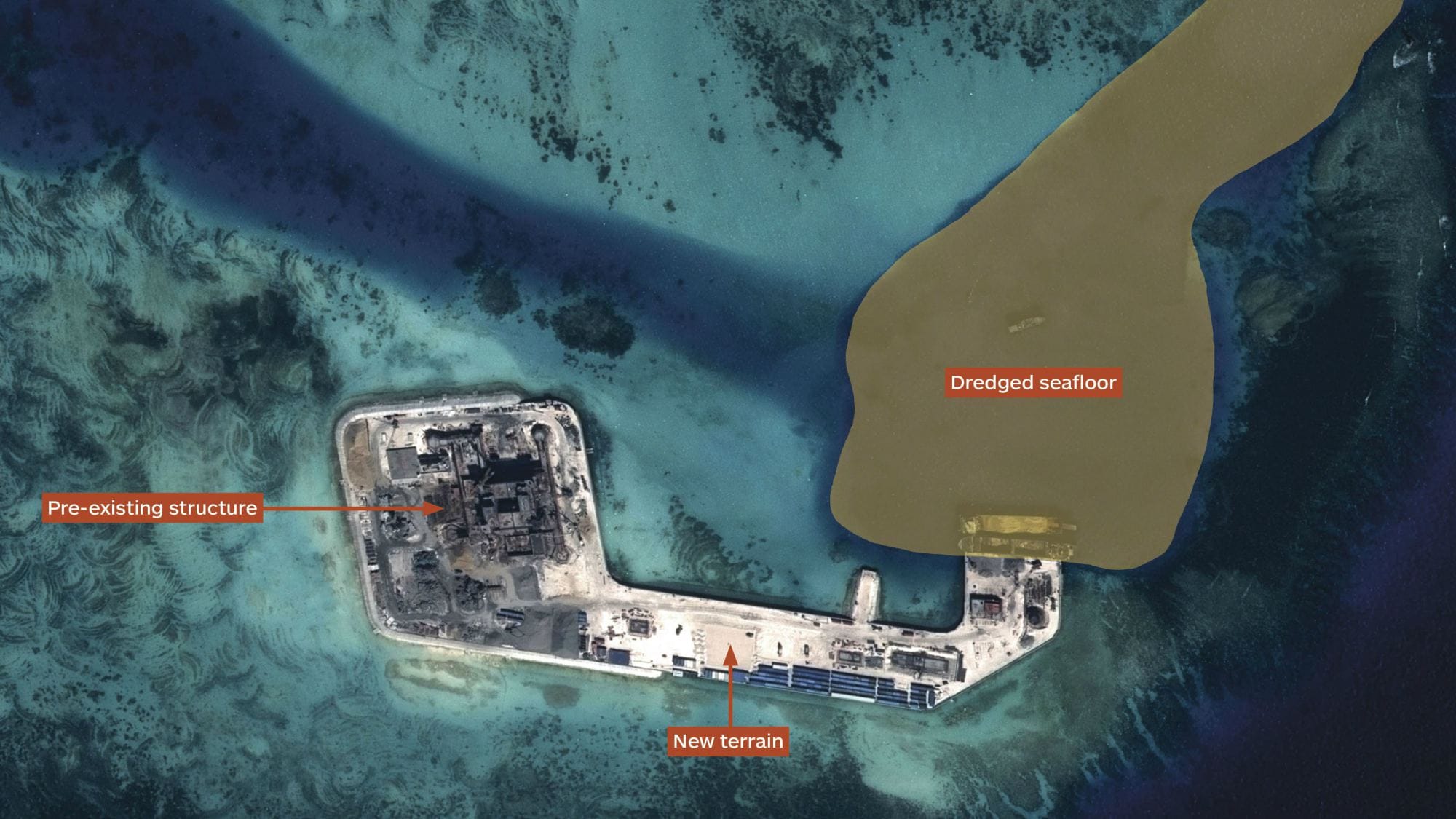
Sealand was something of a joke until 18 months ago when China began to create a string of much-larger copies in the South China Sea. Like Sealand they are in international waters, in this case among the uninhabited, Spratly and Parasel chains of coral reefs between Vietnam, the Philippines, Indonesia and Brunei. The Chinese built retainer walls around several of the reefs and have been filling the interior with sand and coral from the sea-bed. They’ve since added military housing, desalination plants, docks, and an airstrip.

If these islands are accepted as new nations, or (more likely) as extensions of China, and we accept China’s claim to 200 mile sea rights, this project would give China exclusive control over vast oil, mineral, and fishery wealth, as well as control over the South China sea shipping and air lanes, extending into existing sea rights of Vietnam, Indonesia, Brunei, and the Philippines — about 2,000,000 km2. The governments of Vietnam and The Philippines have complained, but China has ignored them and warned the US to stay out.

The new islands would seem to violate several international laws, but as the incursion doesn’t direct affect us, it seems we should avoid getting involved in a neighbor’s dispute. I’ve written previously on what makes a country, and have argued that it’s a combination of (1) having a defined land and population and (2) having enough of a government and military to maintain and defend itself as a nation. And (3) not doing anything so offensive to attract the complete disdain of other nations. So far there is no civilian population, but there is a military one, and as soon as the Chinese stop building, the islands will meet all of the above criteria, except perhaps #3.

Sealand is a recurring character in the Japanese manga, Hitalia -- dedicated to the more bizarre quirks of history, each country is represented by a character.

Sealand is a recurring character in the Japanese manga, Hitalia. Sealand is the smallest character, but has a dream of ruling the world one day.

Still, it’s in our interest to avoid WW III, and as the islands multiply, so does the chance of the sort of accident that started the Spanish-American War. All it would take is a ship taken or sunk near the islands, or a plane shot down under suspicious circumstances, and the war that started will not be a small or quick. I therefore have a modest suggestion based on Sealand: allow the islands conditional nation status, but as an aristocracy and require the sale of titles of nobility like Sealand does, or the sale of senate seats (like the Illinois Governor tried to do). With enough power in private hands a war could be averted. Peace is possible.

Robert E. Buxbaum, June 21, 2015. Sealand has actually tried selling the whole country in 2007. If you want to buy a title: lord, lady, baron, etc. Go to: sealandgov.org.

Gatling guns and the Spanish American War

I rather like inventions and engineering history, and I regularly go to the SME, a fair of 18th to 19th century innovation. I am generally impressed with how these machines work, but what really brings things out is when talented people use the innovation to do something radical. Case in point, the Gatling gun; invented by Richard J. Gatling in 1861 for use in the Civil war, it was never used there, or in any major war until 1898 when Lieut. John H. Parker (Gatling Gun Parker) showed how to deploy them successfully, and helped take over Cuba. Until then, they were considered another species of short-range, grape-shot cannon, and ignored.

1876_Gatling_gun_NPS_Fort_Laramie_WY_by-Matthew_Trump_2004

A Gatling gun of the late 1800s. Similar, but not identical to the ones Parker brought along.

Parker had sent his thoughts on how to deploy a Gatling gun in a letter to West Point, but they were ignored, as most new thoughts are. For the Spanish-American War, Parker got 4 of the guns, trained his small detachment to use them, and registered as a quartermaster corp in order to sneak them aboard ship to Cuba. Here follows Theodore Roosevelt’s account of their use.

“On the morning of July 1st, the dismounted cavalry, including my regiment, stormed Kettle Hill, driving the Spaniards from their trenches. After taking the crest, I made the men under me turn and begin volley-firing at the San Juan Blockhouse and entrenchment’s against which Hawkins’ and Kent’s Infantry were advancing. While thus firing, there suddenly smote on our ears a peculiar drumming sound. One or two of the men cried out, “The Spanish machine guns!” but, after listening a moment, I leaped to my feet and called, “It’s the Gatlings, men! It’s our Gatlings!” Immediately the troopers began to cheer lustily, for the sound was most inspiring. Whenever the drumming stopped, it was only to open again a little nearer the front. Our artillery, using black powder, had not been able to stand within range of the Spanish rifles, but it was perfectly evident that the Gatlings were troubled by no such consideration, for they were advancing all the while.

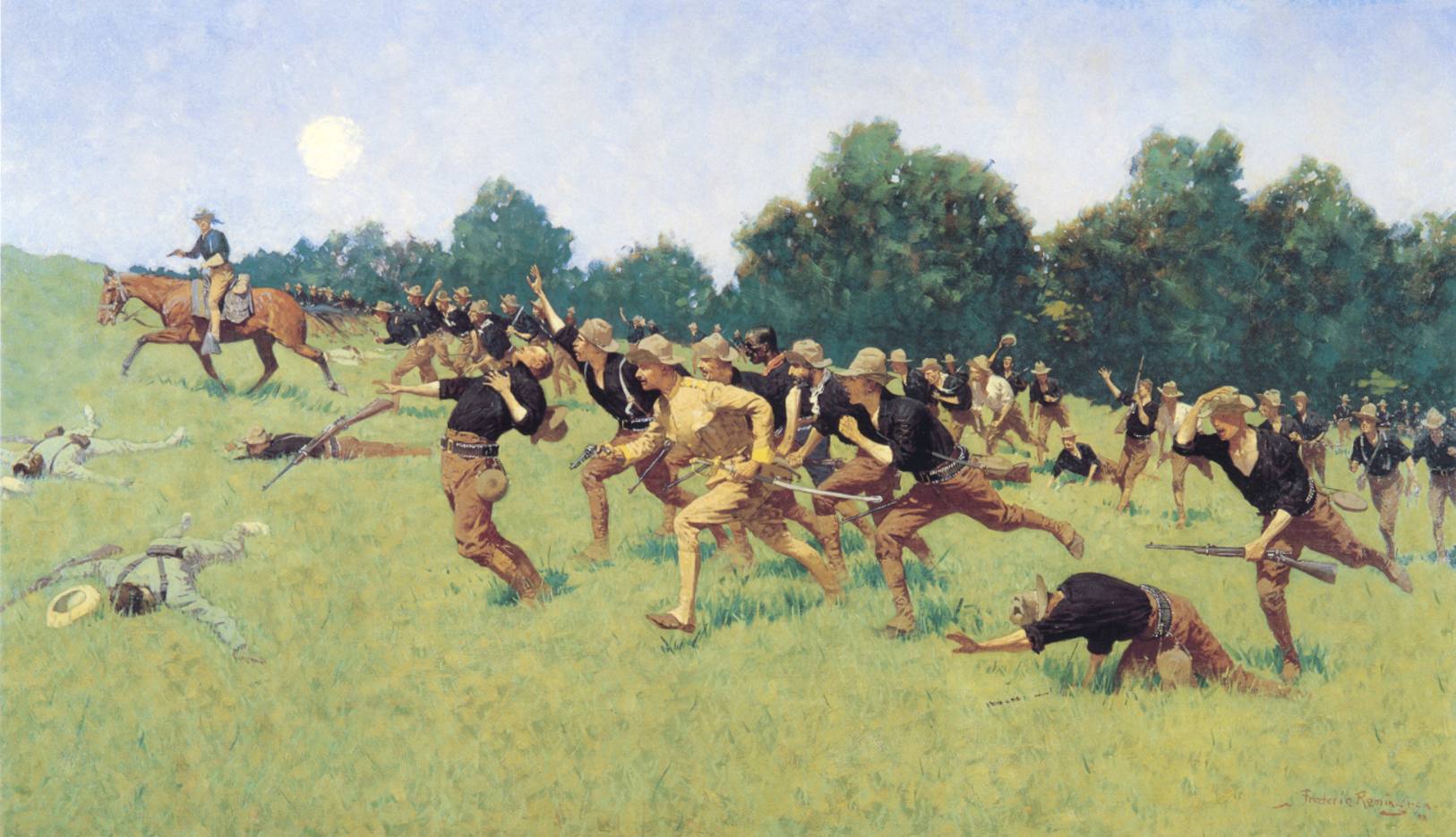
Roosevelt and the charge up Kettle Hill, Frederick Remington

Roosevelt, his volunteers, and the Buffalo soldiers charge up Kettle Hill, Frederick Remington.

Soon the infantry took San Juan Hill, and, after one false start, we in turn rushed the next line of block-houses and intrenchments, and then swung to the left and took the chain of hills immediately fronting Santiago. Here I found myself on the extreme front, in command of the fragments of all six regiments of the cavalry division. I received orders to halt where I was, but to hold the hill at all hazards. The Spaniards were heavily reinforced and they opened a tremendous fire upon us from their batteries and trenches. We laid down just behind the gentle crest of the hill, firing as we got the chance, but, for the most part, taking the fire without responding. As the afternoon wore on, however, the Spaniards became bolder, and made an attack upon the position. They did not push it home, but they did advance, their firing being redoubled. We at once ran forward to the crest and opened on them, and, as we did so, the unmistakable drumming of the Gatlings opened abreast of us, to our right, and the men cheered again. As soon as the attack was definitely repulsed, I strolled over to find out about the Gatlings, and there I found Lieut. Parker with two of his guns right on our left, abreast of our men, who at that time were closer to the Spaniards than any others.

From thence on, Parker’s Gatlings were our inseparable companion throughout the siege. They were right up at the front. When we dug our trenches, he took off the wheels of his guns and put them in the trenches. His men and ours slept in the same bomb-proofs and shared with one another whenever either side got a supply of beans or coffee and sugar. At no hour of the day or night was Parker anywhere but where we wished him to be, in the event of an attack. If a troop of my regiment was sent off to guard some road or some break in the lines, we were almost certain to get Parker to send a Gatling along, and, whether the change was made by day or by night, the Gatling went. Sometimes we took the initiative and started to quell the fire of the Spanish trenches; sometimes they opened upon us; but, at whatever hour of the twenty-four the fighting began, the drumming of the Gatlings was soon heard through the cracking of our own carbines.

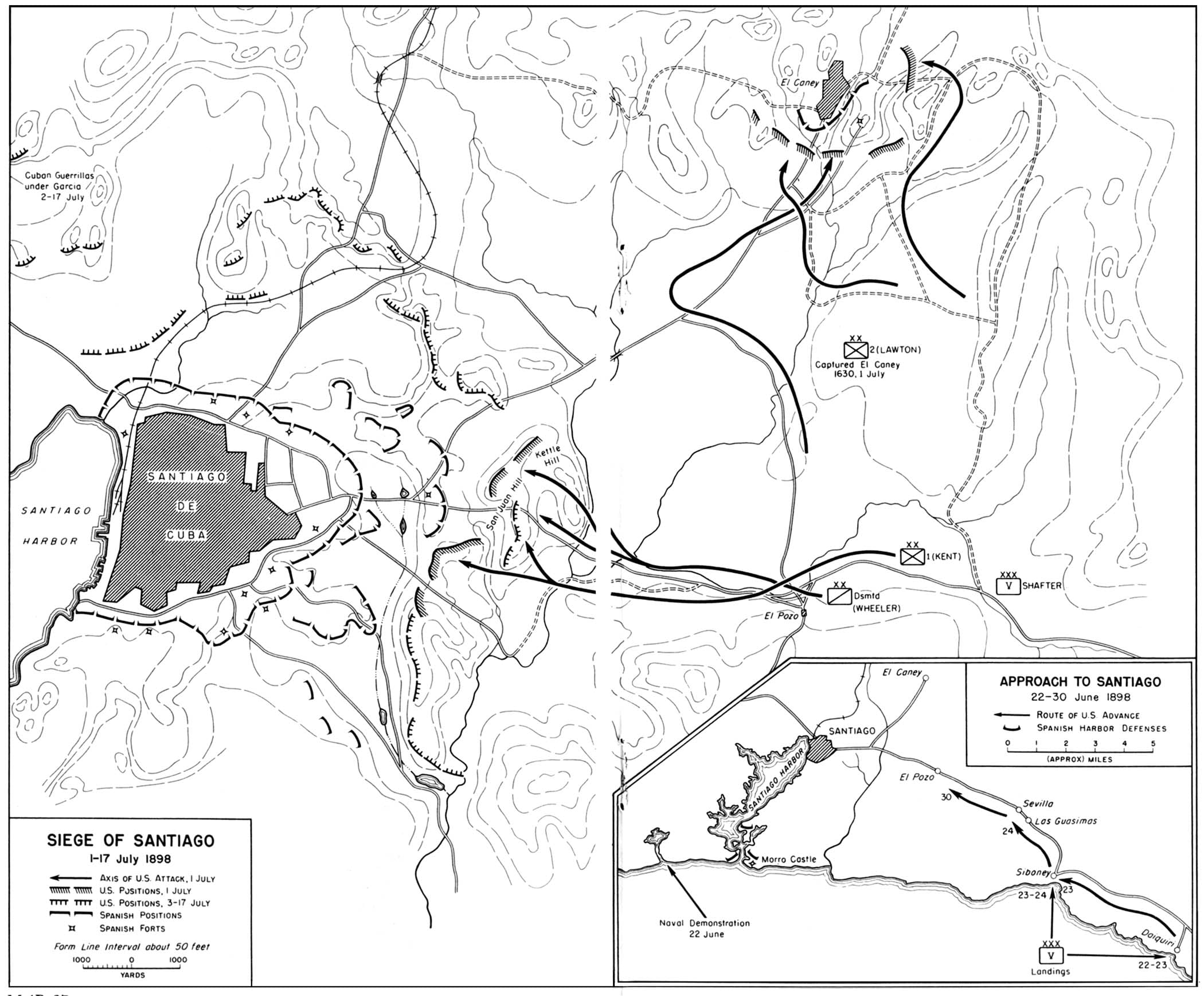
Map of the Attack on Kettle Hill and San Juan Hill in the Spanish American War.

Map of the Attack on Kettle Hill and San Juan Hill in the Spanish-American War, July 1, 1898 The Spanish had 760 troops n the in fortified positions defending the crests of the two hills, and 10,000 more defending Santiago. As Americans were being killed in “hells pocket” near the foot of San Juan Hill, from crossfire, Roosevelt, on the right, charged his men, the “Rough Riders” [1st volunteers] and the “Buffalo Soldiers [10th cavalry], up Kettle Hill in hopes of ending the crossfire and of helping to protect troops that would charge further up San Juan Hill. Parker’s Gatlings were about 600 yards from the Spanish and fired some 700 rounds per minute into the Spanish lines. Theyy were then repositioned on the hill to beat back the counter attack. Without the Parker’s Gatling guns, the chances of success would have been small.

I have had too little experience to make my judgment final; but certainly, if I were to command either a regiment or a brigade, whether of cavalry or infantry, I would try to get a Gatling battery–under a good man–with me. I feel sure that the greatest possible assistance would be rendered, under almost all circumstances, by such a Gatling battery, if well handled; for I believe that it could be pushed fairly to the front of the firing-line. At any rate, this is the way that Lieut. Parker used his battery when he went into action at San Juan, and when he kept it in the trenches beside the Rough Riders before Santiago.”

Here is how the Gatling gun works; it’s rather like 5 or more rotating zip guns; a pall pulls and releases the firing pins. Gravity feeds the bullets at the top and drops the shells out the bottom. Lt’ Parker’s deployment innovation was to have them hand-carried to protected positions, near-enough to the front that they could be aimed. The swivel and rapid fire of the guns allowed the shooter to aim them to correct for the drop in the bullets over fairly great distances. This provided rapid-fire accurate protection from positions that could not be readily hit. Shortly after the victory on San Juan HIll, July 1 1898, the Spanish Caribbean fleet was destroyed July 3, Santiago surrendered July 17, and all of Cuba surrendered 4 days later, July 21 (my birthday) — a remarkably short war. While TR may not have figured out how to use the Gatling guns effectively, he at least recognized that Lt. John Parker had.

A new type of machine gun,  a colt browning repeating rifle, a gift from Con'l Roosevelt to John Parker's Gatling gun detachment.

Roosevelt gave two of these, more modern, Colt-Browning repeating rifles to Parker’s detachment the day after the battle. They were not particularly effective. By WWI, “Gatling Gun” Parker would be a general; by 1901 Roosevelt would be president.

The day after the battle, Col. Roosevelt gifted Parker’s group with two Colt-Browning machine guns that he and his family had bought, but had not used. According to Roosevelt, but these rifles, proved to be “more delicate than the Gatlings, and very readily got out-of-order.” The Brownings are the predecessor of the modern machine gun used in the Boxer Rebellion and for wholesale deaths in WWI and WWII.

Dr. Robert E. Buxbaum, June 9, 2015. The Spanish-American War was a war of misunderstanding and colonialism, but its effects, by and large, were good. The cause, the sinking of the USS Maine, February 15, 1898, was likely a mistake. Spain, a decaying colonial power, was a conservative monarchy under Alfonso XIII; the loss of Cuba seems to have lead to liberalization. The US, a republic, became a colonial power. There is an inherent friction, I think between conservatism and liberal republicanism, Generally, republics have out-gunned and out-produced other countries, perhaps because they reward individual initiative.