Category Archives: war

COVID is 1/50 as deadly in China, Hong Kong, Taiwan, Korea…

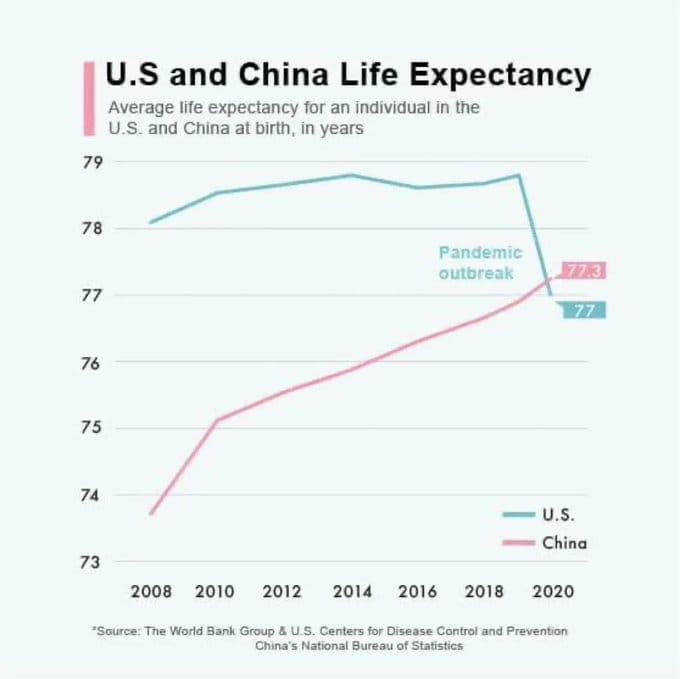
I may be paranoid, but that doesn’t mean I’m crazy. COVID-19 shows a remarkably low death rate in Asia, particularly Eastern Asia, compared to the US or Europe or South America. As of this month, there have been 734,600 US deaths from COVID-19, representing 0.22% of all Americans. Another way of stating this is 2.2 deaths per thousand population. In one year, COVID has lowered the life expectancy of US men by 2.1 years; with the decline worst among hispanic men. The COVID death rate is very similar in Europe, and higher in South America (in Peru 0.62%), but hardly any deaths in East Asia. In China only 4,636 people, 0.003% of the population. That’s 1/700th the rate in the US, and almost all of these deaths are in western China. They no longer bother with social distancing.

The low death rate in East Asia. was noted by the BBC over a year ago. Based on today’s data from Worldometer, here, the low death rates continue throughout East Asia, as graphed at right. In Hong-Kong the death rate is 0.03 per thousand, or 1/70th the US rate. In Taiwan, 0.04 per thousand; in Singapore, 0.01 per thousand; in S. Korea 0.04 per thousand; Cambodia and Japan, 0.1 per thousand. The highest of these countries shows 1/20 the death rate of the US. This disease kills far fewer East Asians than Westerners. This difference shows up, for example in a drop in the lifespan of male Americans by 2.16 years. The lifespan of male Hispanics dropped more, by 4.58 years. In China, Japan, and Korea the lifespans have continued to increase.

Life expectancy for US males has dropped by 2.16 years. It’s dropped more for Hispanic and Black Americans. Data for women is similar but not as dramatic.

My suspicion is that this was a racially targeted bio-weapon. But perhaps the targeting of westerners reflects a cultural lifestyle difference. Mask use has been suggested, but I don’t think so. In many high mask countries the death rate is high, while in low mask Taiwan and Korea it’s low, only 0.04 COVID deaths per thousand. Even Sweden, with no masks reports only 1.4 per thousand deaths; that’s 2/3 the death rate of the US. Masks do not seem to explain the difference.

Another lifestyle difference is obesity; Americans are fat. Then again, Peru was hit far worse than we were, and Peruvians are thin. Meanwhile, in Hong Kong, folks are fat, but the death rate is small. Another cultural difference is medicine, but I don’t believe Sweden, Germany, and France have worse healthcare than Taiwan or Cambodia. Cambodia saw 1/20 the US COVID death rate.

My suspicion is that this disease targets by race because it was designed that way. If it isn’t a bio weapon, it certainly behaves like one. I may be paranoid here, but that’s the way it seems.

As a side issue, perhaps related, I note that China keeps pushing for the to close its manufacturing in the interest of CO2 abatement, while they keep building coal burning power plants to fill the manufacturing need that we abandon. I also notice that they hit us with tariffs while protesting our tariffs, that they steal our intellectual property, and that they are building islands in the sea between China and Japan. There is war-tension between our countries, and Western-targetting virus appears right outside of China’s top-security virus lab — their only level 4 lab — I’m guessing it’s not a total coincidence.

Robert Buxbaum, October 12, 2021

The British Exit from Afghanistan, and ours

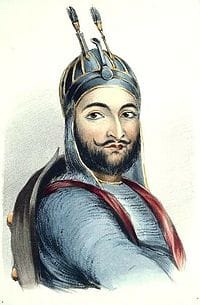
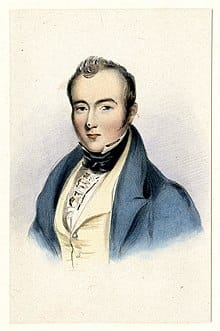
As bad as our exit from Afghanistan has been, the slow British exit in the 1840s to 1920 was worse. While we lost a lot of stuff and left hundreds of Americans and contractors behind, the British, in their first try at leaving, lost a whole army including thousands of civilians. Then they returned and left repeatedly for 80 years, having to fight against their own weapons and people that they had trained. We did many of the same things the Brits did, like trusting our security to folks we’d been trying to kill, but we have not lost anywhere near as many people (yet) and we have not returned (yet). What follows is a look at the British exit, based mostly on Wikipedia articles: “The First Afghan War“, and the retreat from Kabul, 1842, and the biographies of Shah Shujah and Akbar Khan, pictures below.

Akbar Khan. The British tried to kill him, then negotiated with him. Sketch by Vincent Eyre
Britain’s Puppet King, Shah Shujah, Sketch by Vincent Eyre.

The British went into Afghanistan, as we did, to create a more stable and western-friendly government. Their first act was to remove the king, Mohammed Khan, and install a more pliant leader, Sultan Shujah. Mohammed was part of the Khanate, that is the Moguls (Mongols), a deadly violent group who the British were fighting in India. We did the same when we entered Afghanistan. We removed the elected president, Burhanuddin Rabbani, a “radical Moslem” associated with the Taliban leader, Mohammed Omar, an even more radical moslem. Omar was associated Osama bin Laden who’d attacked the US on 9-11. We replaced these, long-bearded Moslems with Hamid Karzai, a moderate Moslem: short beard, reasonably popular, US-friendly, elected in Bonn, Germany. The problem with Shah Shujah and Hamid Karzai is neither one had legitimacy in the eyes of the people, nor respect from the army, either. In part that’s because we put them in power and kept them there, in part that’s because we never let them lead in war or diplomacy. Our follow-on leader, Ashraf Ghani, had no beard, and even less legitimacy and respect. The Afghan army left Ghani as soon as we started leaving; they’d done the same to Shah Shujah when the British left in 1842.

William Macnaughten, the British Envoy, prison sketch by Vincent Eyre, the same fellow who sketched Akbar and Shujah above.

Shah Shujah had a habit of mutilating those who worked for him whenever he got upset. All of Shujah’s servants were missing ears or noses or testicles. Strangely, this seems to have given him more legitimacy than Ghani had. Perhaps if we allowed our leaders to lead, or at least mutilate, the army would have stayed loyal. Then again, maybe nothing would have prevented the puppet from collapsing when the puppet-master left. Both we and the Brits relied on our own troops to keep the peace, along with payoffs and occasional assassinations (we call those airstrikes). It worked for a time, but did not build loyalty or love.

Among those the British paid off and occasionally tried to kill was Akbar Khan, the son of imprisoned Mohammed Khan. Eventually, the British felt they needed Akbar’s help to protect their exit, as he controlled the hills around Kabul including the old Silk Road that the British hoped to travel. Similarly, in the end, we found we needed Taliban help to clear the road to the airport. We didn’t quite get the help, nor did the Brits.

On December 23, 1841, the British envoy, William Macnaughten, visited Akbar Khan and proposed that he would hand over Shah Shujah and make him king in return for safe passage for 16,500 people under General Keith Elphinstone on a journey from Kabul to fort Jalalabad: 93 miles due east. Akbar agreed, but had Macnoughton arrested and later killed. His body was hung in the bazaar. Akbar seems to have figured that anyone willing to betray his old friend would be likely to betray him as well.

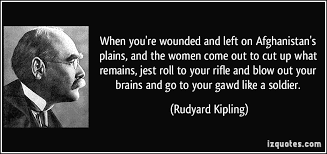
Kipling was stationed in India, near the Afghan border. His view of the locals is rather gruesome.

General Elphinstone left Kabulon January 5, 1842 with 4,500 armed soldiers, several cannon, and 12,000+ unarmed civilians. The going was slow and supplies didn’t arrive. Five days later, January 10, allies of Akbar attacked in the hills and killed or captured most of the group. Akbar invited Elphinstone to tea the next day and announced that the group was now his prisoner. He offered safe passage for the women and children, but demanded payment. The alternative was that they freeze in the hills. Elphinstone, at first refused, then ransomed himself and others, in all nine people. The rest of the group were shot, stabbed, taken by the Afghanis to be wives, or stripped of clothing and left to freeze. Younger children were raised as Afghanis, only identified as British sixty or more years later– the British liked to pretend they had not left them. Of the rest, only two survived. One soldier, William Brydon made it to Jalalabad, January 13, 1842. Elphinstone died in captivity in Kabul, April, 1842. According to Kipling’s poem, the Afghanis mutilated British bodies. More likely it was animals.

Hamid Karzai, American supported President, now under house arrest.

The British re-invaded Kabul several times after that, each time hoping to free captives and show who’s boss. There followed a second Anglo Afghan war (1878-80) and third (1919-20), and arguably a fourth (2001-21). Our exit isn’t as bad, at least not yet. We’ve left behind 200-300 Americans plus hundreds of helicopters, trucks, and high-tech weapons. The Taliban are now in charge, folks we’d tried to kill, all of them were associated with Omar, and several with Osama bin Laden, too. Our security forces have been shot, the embassy translator is scheduled to be beheaded, the new government includes several senior members who had been detained at Guantánamo Bay, released to Qatar in a prisoner swap for Bowe Bergdahl in 2014. Hamid Karzai is in captivity, and we’ve taken 100,000 Afghanis who may not integrate well into US society. But at lest there is no sign we’re going back, not for Karzai, or the Americans, or for anyone else. It’s very bad, but it could be worse. Biden calls it a success. Compared to the British exit, it is so far.

Robert Buxbaum, Sept. 5, 2021. IMHO beards are associated with commitment.

Great mistakes: Sultan Mohammed II steals from a Mongol

There are small errors and great mistakes. I’d previously written about the mistakes that caused Britain to lose America — e.g. General Tarleton burning churches because he thought the sermons were anti monarchist. They were, but if he thought they were anti monarchist before burning the church, they were far more so after… He’d misjudged the American character, something that I think the Democrats are doing today with BLM. Another example was the British attack on Bunker Hill. They spent the lives of 600 soldiers, won a hill they didn’t need, and lost the colony. It’s a mistake we would make reputedly in Vietnam.

Another one of the larger of mistakes of history – and one that changed hsotry massively was made by Mohammad II, ruler of Persia and eastern Islam, from Turkey to Kazakhstan, Uzbekistan, and Afghanistan. He had an army of 100,000 and ruled from the walled city of Samarkand. Mohammed’s uncle, Inalchuq, served as a governor in Kazakhstan. With an army of 40-50,000, he ruled from the walled city of Otrar. A Mongol leader named Temujin contacted them asking to trade. Mohammed II ignored the request, but his uncle accepted it. Temujin ruled a poor, distant community of perhaps 100,000, and boasted a motley horse army of perhaps 10,000. But, what Mohammad II didn’t appreciate, was that these Mongol horsemen were uncommonly warlike, and that Temujin, also known as Genghis Kahn, was an uncommonly talented leader.

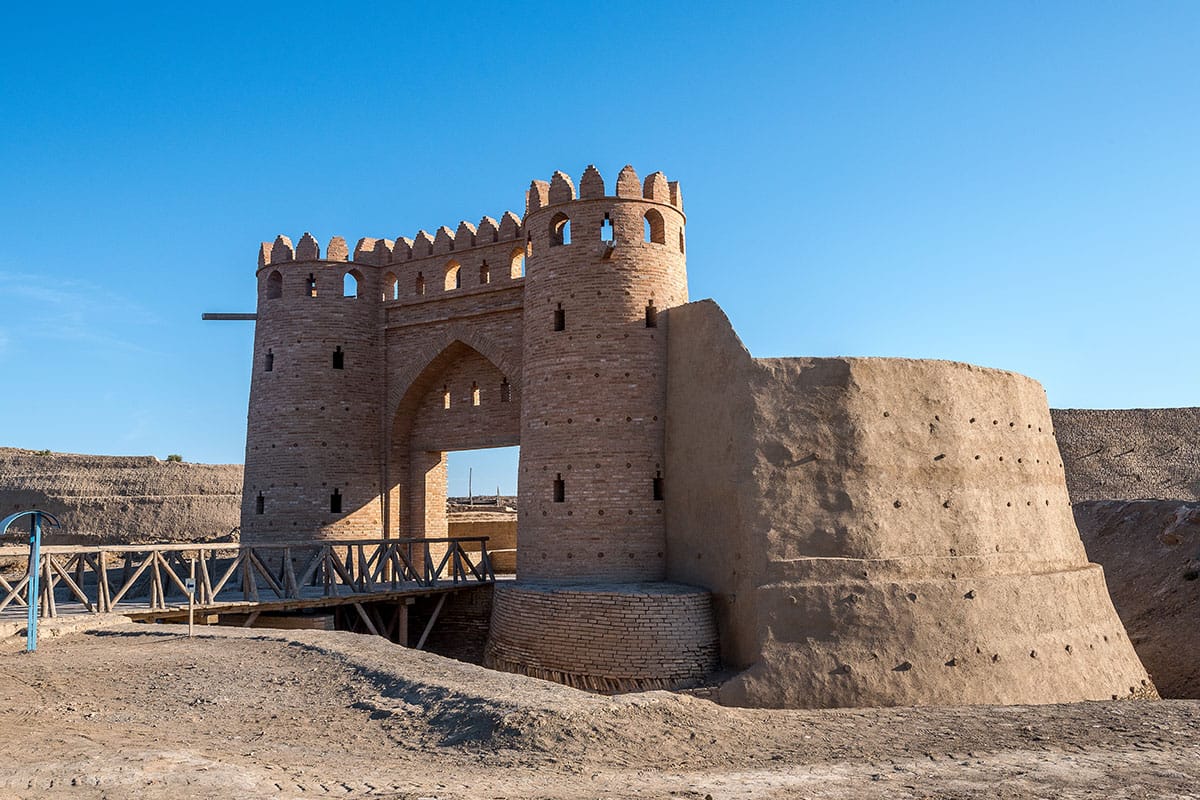
Gate of the mighty, walled city of Otrar. It’s now a ghost town.

Temujin was not someone to insult. He had laid waste to northern China, and defeated an army of over 1 million, because of an insult. The Chinese emperor had demanded Temujin come to Peking with a grift, then bow low and pledge allegiance. That is he wanted Temujin ,to Kowtow, a request that emperors had made to every tribal leader for centuries, but Temujin took it as an insult. He defeated the Chinese army and killed a good fraction of China’s population. Using methods that are discussed in Mongol literature, but are almost unknown in the west, or highly perverted, as in Mulan. I’ve written in speculation of one aspect of Mongol success here. Another aspect was psychological: Genghis Kahn was able to co-opt the Chinese army, and get them to fight for him. It’s a useful skill.

Now Temujin, Genghis Kahn, was writing to the leaders of eastern Islam asking to trade along the silk road. Inalchuq offered safe passage, and in 1218, the first trade caravan arrived with 100 laden camels and 450 men including an ambassador. Inalchuq did what sultans before him had done: He executed most of the men, sold the rest as slaves, and took the goods, selling them in markets of Bukhara. Mohammed II and his uncle were sure that Temujin would do nothing, he was 2000 miles away, but Temujin sent another peace delegation. This time 3 men direct to Mohmmed II asking for his goods back and for the punishment of those responsible. Mohammad II killed the lead ambassador, blinded one of the others, and had the face of the third disfigured. A year later, 1219, Genghis Kahn showed up in Otrar with siege engines.

Otrar held out for 5 months, falling when a traitor opened the gates and defected with part of the army. The Mongols took the city and let most people live, though he killed Inalchq and his army, as well as the defectors.. Genghis Kahn figured he could not trust a soldier who defects this way. Inalchq was killed by having molten silver poured into his eyes and ears.

Death of Sultan Mohammed II, Picture from the History of Rashad Al-Din.

Genghis then went after Mohammed II, but first defeated the Assassin sect. Mohammed had the sense to run. It didn’t save him, but it did buy him some years of life. When caught, Genghis locked him in a prison fed him gold coins. He is supposed to have explained that, had Mohammad II not hoarded gold, but shared it with his soldiers, they would have fought for him as Genghis’s soldiers had. It’s not a message we like to hear today because it’s practical, but not very charitable. Then again, Genghis Kahn was nothing if not practical.

The Mongols brought many innovations: paper, stirrups, the blast furnace, the number zero, “islamic numerals” (they’re really Mongol /Tibetan numerals), the compass, the printing press, the triangular plow, gun powder, and a new way in war (The Germans called it ‘Blitz Kreig’). I find that schools don’t teach much about Genghis Kahn or our debt to the Mongols, nor do they properly contextualize these innovations as means for a small nation to dominate many larger ones. Perhaps that’s because we find the whole idea of management disturbing, or it’s embarrassing. Western scholars used to write like we invented these things. There are several histories of the Mongols, one was written by Rashid Al-Din (Aladin), vizier over all Persia, the person responsible for renaming it Iran. He wrote an illustrated history of the world, particularly of the Mongols, called Jāmiʿ al-Tawārīkh (“Compendium of Chronicles”). I suspect it would be worthwhile reading but like much of Mongol literature, it is not available in any local library, nor is it referred to by most histories. Another Mongol history, also not available in libraries, is called the Secret History of the Mongols. This was likely written for and by Genghis’s third son, Ogedei, to describe for his children and grandchildren the true story of the early years, the conquests, his father’s and his management methods (some fairly brutal) and as a review of what Ogedei thought worked and what did not. It sounds like an honest book, worthwhile book — the sort modern readers would rather forget exists.

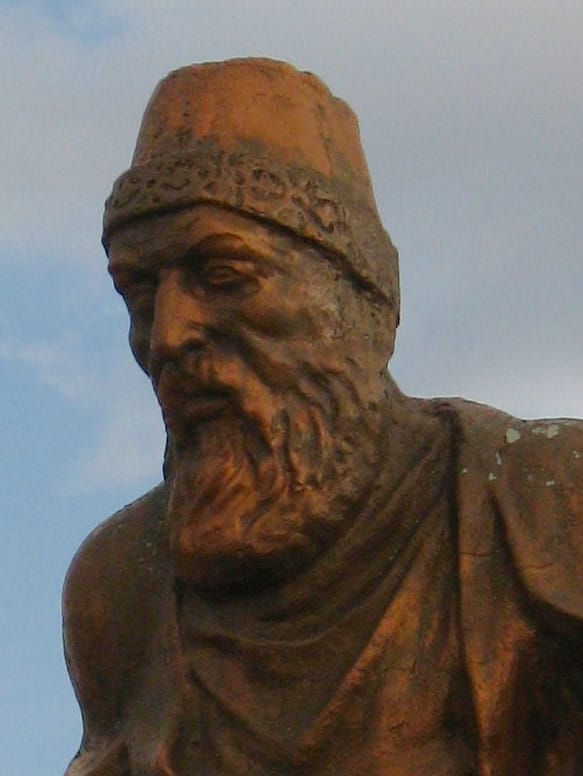
Rashid Al-Din (Aladin), Vizier of Persia. He renamed Persia Iran, and wrote a history of the world from the Mongol perspective. Known as a fictional character, or not at all today.

In general, I find our scholars would like to ignore the more unpleasant lessons of history, including that family matters, and that people like honor over kowtowing, and that they get surly if they’re not rewarded,. Much of our society is built by warriors for the purpose of destruction, as in this engineering joke. We are now in the process of destroying statues of warriors because we find they were often non-nice people who often did not-nice things, or held not-nice views. That’s the way it is with warriors, especially the successful ones. While I’m not a fan of having statues to bums, I think that ignoring successful warriors is worse than honoring them. I discuss the dilemma of military statues here. Without statues to important wars and warriors, modern leaders might repeat the mistake of Mohammed II, or Bunker hill , or of Mohammed IV, or of the Chinese emperor.

Robert Buxbaum, September 20, 2020. I’ve come to wonder if Mohammed II would have fared better if he didn’t steal from the Mongols. He would likely have put off the attack as he learned more about them, and they learned more about him. When the war came, as likely it would, he might have had gun powder, paper, the compass, and the stirrup. Then again, war might have come immediately. The proud Polish officers who collaborated/ surrendered to the Soviet Russians, were quickly murdered in the Katyn forest.

When prostitution was legal in America, 1863-65.

Readers of this blog know that I am not a fan of very harsh punishments for crime, in particular for crimes that have no direct victim, e.g. drug possession and sales. Prostitution is another crime with no direct victim. One could argue that society as a whole is the victim, but my sense is that punishments should be minimal and targeted, e.g. to prevent involuntary human trafficking and disease. Our current laws, depicted here, are clearly not designed for this, but there was a brief period where prostitution laws did make more sense. During the civil war, civil war, prostitution was legal and regulated to prevent disease.

In 1862, Union forces captured the southern cities of Nashville and Memphis, Tenn. Major Gen. William Rosecrans set up headquarters in Nashville. Before the war, Nashville was home to 198 white prostitutes and nine  “mulatto,” operating in a two-block area known as “Smoky Row.” 

By the end of 1862,  Smokey row had grown and these numbers swelled to 1,500 “public women”. White southern women turned to prostitution out of poverty, largely. Their husbands were dead, or ill paid, and they were joined by recently freed slaves. Benton E. Dubbs, a Union private, reported a saying that “no man culd [sic] be a soldier unless he had gone through Smokey Row,” … “The street was about three-fourths of a mile long and every house or shanty on both sides was a house of ill fame. Women had no thought of dress or decency. They say Smokey Row killed more soldiers than the war.” 

By 1863, venerial disease was becoming a major problem. The Surgeon General would document 183,000 cases of venereal disease in the Union Army alone, “…the Pocks and the Clap. The cases of this complaint is numerous, especially among the officers.”  

Permit for Legal prostitution signed by Col George Spaulding.

At first General Rosecrans directed his assistant, Colonel Spaulding, to remove the women by sending them to other states, first by train, and then by boat commandeering the ship, Idaho for the purpose. The effect was horrible, not only was the ship turned back by every city, but the departure of these ladies just resulted in the appearance of a new cohort of sex-workers. By the time the Idaho had returned, Rosecrans had been relieved of command following embarrassing defeats at Chickamauga and Chattanooga . Col. Spaulding now tried a new technique to stop the plague of VD: legalized prostitution. It worked.

Women’s hospital during the war, Nashville.

For a $5/month fee a “public woman” could become a legal prostitute, or “Public Woman” so long as she submitted to monthly health inspections for a certificate of her soundness. If found infected, she was to report to a hospital dedicated to this treatment, was subject to imprisonment if she operated without the license and certificate. The effect was a major decline in sexually-transmitted disease, and an improvement (so it is claimed) in the quality of the services. The fees collected were sufficient to cover the cost of the operation and hospital, nearly.

At the end of the war, Col Spaulding and the union soldiers left Nashville, and prostitution returned to being illegal, if tolerated. One assumes that the VD rates went up as well.

George Spaulding, Congressman..

Colonel Spaulding and Maj. General Rosecrans are interesting characters beyond the above. Spaulding had entered the war as a private and rose through the ranks by merit. The rise didn’t stop at colonel. After the war, he became postmaster of Monroe Michigan, 1866 to 1870, US Treasury agent, 1871 to 1875, Mayor of Monroe, 1876 to ?, President of the board of education, a lawyer in 1878, and congressman for the MI 2nd district (Republican) 1894 -1898. He also served as board member of the Home for Girls 1885 to 1897, and postmaster of Monroe, 1899 to 1907.

William Rosecrans was a Catholic, engineer-inventor from West Point. Before the war, in 1853, he designed St. Mary’s Roman Catholic Church, one of the largest US churches at the time, site of the wedding of John Kennedy and Jacqueline Bouvier. He also designed and installed one of the first lock systems in Western Virginia. He and two partners built an early oil refinery. He patented a method of soap making and the first kerosene lamp to burn a round wick, and was one of the eleven incorporators of the Southern Pacific Railroad. After the war, he served as Ambassador to Mexico, 1868-69 and was congressman from California, 1st district (Democrat) 1880 – 1884. A true Democrat, Rosecrans could not stand either Grant or Garfield, and fought against Grant getting a retirement package.

Robert Buxbaum, June 5, 2020. There are other ways to stop the spread of sexual diseases. During the AIDS epidemic, condoms were the preferred method, and during the current COVID crisis, face masks are being touted. My preference is iodine hand wash. All methods work if they can reduce the transmission rate, Ro below 1.

How not to make an atom bomb

There are many books on how the atom bomb was made. They are histories of the great men who succeeded at site Y, Los Alamos, usually with a sidelight of the economics and politics in the US at the time. It’s sometimes noted that there was an equally great German group working too, and one in Japan and in Russia, that they didn’t succeed, but it’s rarely discussed what they did wrong. Nor does anyone make clear why so many US scholars were needed. What did all those great US minds to do? The design seems sort-of obvious; it appears in the note Einstein sent to Roosevelt, so what were all these people thinking about all that time, and why did the Germans fail? By way of answer, let me follow the German approach to this problem, an approach that won’t get you anywhere, or anywhere that I’ve seen.

It seems that everyone knew that making a bomb was possible, that it would be fearsomely powerful, and that it would be made using a chain reaction in uranium or plutonium. Everyone seems to have understood that there must be a critical mass: use less and there is no explosion, use more and there is one. The trick was how to bring enough uranium together make the thing go off, and as a beginning to that, there is the concept of “a barn.” A barn is a very small unit of area = 10−24 cm², and a typical atom has a cross-section of a few barns. Despite this, it is generally thought to be very easy to hit an atom at the nucleus, that is, at the right spot, as easy as hitting the board side of a barn (hence the name). The cross section of a uranium atom is 600 barnes at room temperature, or 6×10⁻²² cm². But each cubic centimeter of uranium holds .5 x 1023 atoms. Based on this, it comes out that a thermal neutron that enters a 1 cm cube of uranium has a virtual certainty of hitting an atom — there are 3 cm² of atoms in a 1 cm² box. You could hardly miss.

Each uranium atom gives off a lot of energy when hit with a neutron, but neutrons are hard to come by, so a practical bomb would have to involve a seed neutron that hits a uranium atom and releases two or more neutrons along with energy. The next neutron has to hit another nucleus, and it has to releases two or more. As it happens uranium atoms, when hit release on average 2.5 neutrons, so building a bomb seems awfully easy.

But things get more difficult as the neutron speeds get greater, and as the atoms of uranium get hotter. The cross-section of the uranium atom goes down as the temperature goes up. What’s more the uranium atoms start to move apart fast. The net result is that the bomb can blow itself apart before most of the uranium atoms are split. At high speed, the cross -section of a uranium atom decreases to about 5 barnes you thus need a fairly large ball of uranium if you expect that each neutron will hit something. So how do you deal with this. For their first bomb, the American scientists made a 5 kg (about) sphere of plutonium, a man-made uranium substitute, and compressed it with explosives. The explosion had to be symmetrical and very fast. Deciding how fast, and if the design would work required a room full of human “computers”. The German scientists, instead made flat plates of uranium and slowed the neutrons down using heavy water. The heavy water slowed the neutrons, and thus, increased the effective size of the uranium atoms. Though this design seems reasonable, I’m happy to say, it can not ever work well; long before the majority of the reaction takes place, the neutrons get hot, and the uranium atoms fly apart, and you get only a small fraction of the promised bang for your bomb.

How fast do you need to go to get things right? Assume you want to fusion 4 kg of uranium, or 1 x 1025 atoms. In that case, hitting atoms has to be repeated some 83 times. In tech terms, that will take 83 shakes (83 shakes of a lamb’s tail, as it were). This requires getting the ball compressed in the time it takes for a high speed neutron to go 83 x 3 cm= 250 cm. That would seem to require 1 x 10⁻⁷ seconds, impossibly fast, but it turns out, you can go somewhat slower. How much slower? It depends, and thus the need for the computers. And how much power do you get? Gram for gram, uranium releases about 10 million times more energy than TNT, but costs hardly more. That’s a lot of bang for the buck.

Robert Buxbaum, Mar 29, 2020.

Italian Engineering and the Kennedy assassination.

There are several unbelievable assertions surrounding the Kennedy assassination, leading many to conclude that Oswald could not have killed Kennedy alone. I believe that many of these can be answered once you realize that Oswald used an Italian gun, and not a US gun. Italian engineering differs from our in several respects that derive from the aesthetic traditions of the countries. It’s not that our engineers are better or worse, but our engineers have a different idea of what good engineering is and thus we produce designs that, to an Italian engineer, are big, fat, slow, and ugly. In our eyes Italian designs are light, fast, pretty, low-power, and unreliable. In the movie, Ford vs Ferrari, the American designer, Shelby says that, “If races were beauty contests, the Ferrari would win.” It’s an American, can-do, attitude that rings hollow to an Italian engineer. 

Three outstanding questions regarding the Kennedy assassination include: How did Oswald fire three bullets, reasonably accurately in 5 to 8 seconds. How did he miss the limousine completely on the first, closest shot, then hit Kennedy twice on the next two, after previously missing on a close shot at retired general, Edwin Walker. And how could the second shot have gone through Kennedy’s neck, then through his wrist, and through Connolly twice, emerging nearly pristine. I will try to answer by describing something of the uniquenesses of the gun and bullets, and of Italian engineering, in general. 

Oswald cartridge.

The rifle Oswald used was a Modello 91/38, Carcano (1938 model of a design originally used in 1891) with an extra-long, 20.9″ barrel, bought for only $19.95 including a 4x sight. That’s $12.50 for the gun, the equivalent of $100 in 2020). The gun may have been cheep, but it was a fine Italian weapon: it was small, fast, pretty, manual, and unreliable. The small size allowed Oswald to get the gun into the book depository without arousing suspicion. He claimed his package held curtain rods, and the small, narrow shape of the gun made the claim believable.

The first question, the fast shooting, is answered in part by the fact that loading the 91/38 Carcano rifle takes practice. Three American marksmen who tried to duplicate the shots for the Warren commission didn’t succeed, but they didn’t have the practice with this type of gun that Oswald had. The Carcano rifle used a bolt and clip loading system that had gone out of style in the US before WWI. To put in a new shell, you manually unlock and pull back the bolt. The old casing then flies out, and the spring–clip loads a new shell. You then have to slam the bolt forward and lock it before you can fire again. For someone practiced, loading this way is faster than with a semi-automatic. To someone without practice it is impossibly slow, like driving a stick shift car for the first time. Even with practice, Americans avoid stick shift cars, but Italians prefer them. Some time after the Warren report came out, Howard Donahue, an American with experience on this type of rifle, was able to hit three moving targets at the distance in 4.8 seconds. That’s less than the shortest estimate of the time it took Oswald to hit twice. Penn of Penn and Teller recreates this on TV, and shows here that Kennedy’s head would indeed have moved backward.

Oswald’s magic bullet, shot two.

That Oswald was so accurate is explained, to great extent by the way the sight was mounted and by the unusual bullets. The model 38 Carcano that Oswald bought fired light, hollow, 6.5×52mm cartridges. This is a 6.5 mm diameter bullet, with a 52 mm long casing. The cartridge was adopted by the Italians in 1940, and dropped by 1941. These bullets are uncommonly bullet is unusually long and narrow (6.5 mm = .26 caliber), round-nosed and hollow from the back to nearly the front. In theory a cartridge like this gives for greater alignment with the barrel., and provides a degree of rocket power acceleration after it leaves the muzzle. Bullets like this were developed in the US, then dropped by the late 1800s. The Italians dropped this bullet for a 7.5 mm diameter version in 1941. The 6.5 mm version can go through two or three people without too much damage, and they can behave erratically. The small diameter and fast speed likely explains how Oswald’s second shot went through Kennedy and Connolly twice without dong much. An American bullet would have done a lot more damage.

Because of the light weight and the extra powder, the 6.5 mm hollow bullet travels uncommonly fast, about 700 m/s at the muzzle with some acceleration afterwards, ideally. Extra powder packs into the hollow part by the force of firing, providing, in theory, low recoil, rocket power. Unfortunately these bullets are structurally weak. They can break apart or bend and going off-direction. By comparison the main US rifle of WWII, the M1, was semi-automatic, with bullets that are shorter, heavier, and slower, going about 585 m/s. Some of our bullets had steel cores too to provide a better combination of penetration and “stopping power”. Only Oswald second shot stayed pristine. It could be that his third shot — the one that made Kennedy’s head explode — flattened or bent in flight.

Oswald fragment of third bullet. It’s hollow and seems to have come apart in a way a US bullet would not.

The extra speed of Oswald’s bullets and the alignment of his gun would have given Oswald a great advantage in accuracy. At 100 yards (91 m), test shots with the rifle landed 2 12 to 5 inches high, within a 3-to-5-inch circle. Good accuracy with a sight that was set to high for close shot accuracy. The funky sight, in my opinion , explains how Oswald managed to miss Walker, but explains how he hit Kennedy accurately especially on the last, longest shot, 81 m to Kennedy’s head

Given the unusually speed of the bullets (I will assume 750 m/s) Oswald’s third shot would have taken 0.108 s to reach the target. If the sight were aligned string and if Kennedy were not moving, the bullet would have been expected to fall 2.24″ low at this range, but given the sight alignment we’d expect him to shoot 3-6″ high on a stationary target, and dead on, on the president in his moving vehicle. Kennedy was moving at 5 m/sand Oswald had a 17° downward shot. The result was a dead on hit to the moving president assuming Oswald didn’t “lead the shot”. The peculiarities of the gun and bullets made Oswald more accurate here than he’d been in the army, while causing him to miss Walker completely at close range.

comparison of the actual, second shot, “magic bullet,” left, with four test-shot bullets. Note that one of the test bullets collapsed, two bent, and one exploded. This is not a reliable bullet design.

We now get to the missed, first shot: How did he miss the car completely firing at the closest range. The answer, might have to do with deformation of the bullets. A hollow base bullet can explode, or got dented and fly off to the side. More prosaically, it could be that he hit a tree branch or a light pole. The Warren commission blamed a tree that was in the way, and there was also a light pole that was never examined. For all we know the bullet is in a branch today, or deflected. US bullets would have a greater chance to barrel on through to at least hit the car. This is an aspect of Italian engineering — when things are light, fast, and flexible, unusual things happen that do not expect to happen with slow, ugly, US products. It’s a price of excellence, Italian style.

Another question appears: Why wasn’t Oswald stopped when the FBI knew he’d threatened Kennedy, and was suspected of shooting at Walker. The simple answer, I think, is that the FBI was slow, and plodding. Beyond this, neither the FBI nor the CIA seem to have worried much about Kennedy’s safety. Even if Kennedy had used the bubble top, Oswald would likely have killed him. Kennedy didn’t care much for the FBI and didn’t trust Texas. Kennedy had a long-running spat with the FBI involving his involvement with organized crime, and perhaps running back to the days when Kennedy’s father was a bootlegger. His relation with the CIA was similar.

The Mateba, Italian semi-automatic revolver, $3000, available only in 357 Magnum and 44 magnum.

I should mention that the engineering styles and attitudes of a country far outlast the particular engineer.We still make big, fat, slow, ugly cars — that are durable and reasonably priced. Germans still overbuild, and Italian cars and guns are as they ever were: beautiful, fast, expensive, and unreliable. The fastest production car is Italian, a Bugatti with a top speed of 245 mph; the fastest rollercoaster is at Ferrari gardens, 149 mph, and in terms of guns, let me suggest you look at the Mateba, left, a $3000 beautiful super fast semi-automatic revolver (really), produced in Italy, and available in 357 magnum and .44 magnum only . It’s a magnificent piece of Italian engineering beautiful, accurate, powerful, and my guess is it’s unreliable as all get out. Our, US pistols typically cost 1/5 to 1/10 as much. A country’s cars, planes, and guns represent the country’s aesthetics. The aesthetics of a county changes only slowly, and I think the world is better off because of it

Robert Buxbaum, February 14, 2020. One of my favorite courses in engineering school, Cooper Union, was in Engineering Aesthetics and design.

Disease, atom bombs, and R-naught

A key indicator of the speed and likelihood of a major disease outbreak is the number of people that each infected person is likely to infect. This infection number is called R-naught, or Ro; it is shown in the table below for several major plague diseases.

R-naught - communicability for several contagious diseases, CDC.

R-naught – infect-ability for several contagious diseases, CDC.

Of the diseases shown, measles is the most communicable, with an Ro of 12 to 18. In an unvaccinated population, one measles-infected person will infect 12- 18 others: his/her whole family and/ or most of his/her friends. After two weeks or so of incubation, each of the newly infected will infect another 12-18. Traveling this way, measles wiped out swaths of the American Indian population in just a few months. It was one of the major plagues that made America white.

While Measles is virtually gone today, Ebola, SARS, HIV, and Leprosy remain. They are far less communicable, and far less deadly, but there is no vaccine. Because they have a low Ro, outbreaks of these diseases move only slowly through a population with outbreaks that can last for years or decades.

To estimate of the total number of people infected, you can use R-naught and the incubation-transmission time as follows:

Ni = Row/wt

where Ni is the total number of people infected at any time after the initial outbreak, w is the number of weeks since the outbreak began, and wt is the average infection to transmission time in weeks.

For measles, wt is approximately 2 weeks. In the days before vaccine, Ro was about 15, as on the table, and

Ni = 15w/2.

In 2 weeks, there will be 15 measles infected people, in 4 weeks there will be 152, or 225, and in 6 generations, or 12 weeks, you’d expect to have 11.39 million. This is a real plague. The spread of measles would slow somewhat after a few weeks, as the infected more and more run into folks who are already infected or already immune. But even when the measles slowed, it still infected quite a lot faster than HIV, Leprosy, or SARS (SARS is a form of Influenza). Leprosy is particularly slow, having a low R-naught, and an infection-transmission time of about 20 years (10 years without symptoms!).

In America, more or less everyone is vaccinated for measles. Measles vaccine works, even if the benefits are oversold, mainly by reducing the effective value of Ro. The measles vaccine is claimed to be 93% effective, suggesting that only 7% of the people that an infected person meets are not immune. If the original value of Ro is 15, as above, the effect of immunization is to reduce the value Ro in the US today to effectively 15 x 0.07 = 1.05. We can still  have measles outbreaks, but only on a small-scale, with slow-moving outbreaks going through pockets of the less-immunized. The average measles-infected person will infect only one other person, if that. The expectation is that an outbreak will be captured by the CDC before it can do much harm.

Short of a vaccine, the best we can do to stop droplet-spread diseases, like SARS, Leprosy, or Ebola is by way of a face mask. Those are worn in Hong Kong and Singapore, but have yet to become acceptable in the USA. It is a low-tech way to reduce Ro to a value below 1.0, — if R-naught is below 1.0, the disease dies out on its own. With HIV, the main way the spread was stopped was by condoms — the same, low tech solution, applied to sexually transmitted disease.

Image from VCE Physics, https://sites.google.com/site/coyleysvcephysics/home/unit-2/optional-studies/26-how-do-fusion-and-fission-compare-as-viable-nuclear-energy-power-sources/fission-and-fusion---lesson-2/chain-reactions-with-dominoes

Progress of an Atom bomb going off. Image from VCE Physics, visit here

As it happens, the explosion of an atom bomb follows the same path as the spread of disease. One neutron appears out of somewhere, and splits a uranium or plutonium atom. Each atom produces two or three more neutrons, so that we might think that R-naught = 2.5, approximately. For a bomb, Ro is found to be a bit lower because we are only interested in fast-released neutrons, and because some neutrons are lost. For a well-designed bomb, it’s OK to say that Ro is about 2.

The progress of a bomb going off will follow the same math as above:

Nn = Rot/nt

where Nn is the total number of neutrons at any time, t is the average number of nanoseconds since the first neutron hit, and nt is the transmission time — the time it takes between when a neuron is given off and absorbed, in nanoseconds.

Assuming an average neutron speed of 13 million m/s, and an average travel distance for neutrons of about 0.1 m, the time between interactions comes out to about 8 billionths of a second — 8 ns. From this, we find the number of neutrons is:

Nn = 2t/8, where t is time measured in nanoseconds (billionths of a second). Since 1 kg of uranium contains about 2 x 1024 atoms, a well-designed A-bomb that contains 1 kg, should take about 83 generations (283 = 1024). If each generation is 8 ns, as above, the explosion should take about 0.664 milliseconds to consume 100% of the fuel. The fission power of each Uranium atom is about 210 MeV, suggesting that this 1 kg bomb could release 16 billion Kcal, or as much explosive energy as 16 kTons of TNT, about the explosive power of the Nagasaki bomb (There are about 38 x10-24 Kcal/eV).

As with disease, this calculation is a bit misleading about the ease of designing a working atomic bomb. Ro starts to get lower after a significant faction of the atoms are split. The atoms begin to move away from each other, and some of the atoms become immune. Once split, the daughter nuclei continue to absorb neutrons without giving off either neutrons or energy. The net result is that an increased fraction of neutrons that are lost to space, and the explosion dies off long before the full power is released.

Computers are very helpful in the analysis of bombs and plagues, as are smart people. The Manhattan project scientists got it right on the first try. They had only rudimentary computers but lots of smart people. Even so, they seem to have gotten an efficiency of about 15%. The North Koreans, with better computers and fewer smart people took 5 tries to reach this level of competence (analyzed here). They are now in the process of developing germ-warfare — directed plagues. As a warning to them, just as it’s very hard to get things right with A-bombs, it’s very hard to get it right with disease; people might start wearing masks, or drinking bottled water, or the CDC could develop a vaccine. The danger, if you get it wrong is the same as with atom bombs: the US will not take this sort of attack lying down.

Robert Buxbaum, January 18, 2019. One of my favorite authors, Issac Asimov, died of AIDS; a slow-moving plague that he contacted from a transfusion. I benefitted vastly from Isaac Asimov’s science and science fiction, but he wrote on virtually every topic. My aim is essays that are sort-of like his, but more mathematical.

Wilsonian Obama vs the Trump Doctrine

As best I see it, Obama’s approach to world peace was a version of Woodrow Wilson’s: he consistently supported left-leaning, popular groups and governments, even when they were anti-American over pro-American kings, generals, and dictators. Obama heaped money and praise on elected leaders of Iran and the Palestinian Authority, while condemning Israel, and encouraging Democrats to walk out of a speech its PM. He then sent a statement to be read on the floor of congress that the Israeli PM  had nothing to say. Similarly, Obama refused to negotiate with Kim Jung Un of North Korea, a dictator in his eyes, but he had no problem with Raul Castro. Leftists, in his view, were for the masses, and thus democratic. Such democrats were on the side of the angels in his view, though Castro’s Cuba was not exactly free.

The co-head of the Democratic Party wears a shirt that reads "I don't believe in borders." It's a Moslem Brotherhood slogan. They do not believe in borders between Gaza and Israel, but do believe in them between Yemen and Saudi Arabia.

The co-head of the Democratic Party wears a shirt that reads “I don’t believe in borders.” It’s a globalist slogan, a Moslem Brotherhood slogan. The Trump doctrine requires boundaries between ‘turf.”

One of the most popular, if violent groups on the world stage was (is) the Moslem Brotherhood. A few months after becoming president, he gave his first foreign speech at Cairo University,  making the Wilsonian request to include the Brotherhood here and in all further negotiations. The Moslem Brotherhood was anti-American and left leaning, and they favored elections. On the other hand, they had assassinated Egyptian president Anwar el-Sadat and Egyptian prime minister Mohammad Pasha just a few years previous. They had also tried to overthrow the government of Egypt and Jordan by force, and had tried to assassinate Egyptian president Nasser and Jordan’s kings Abdullah and Hussein, unsuccessfully. Including the Brotherhood was symptomatic of a general problem of Wilsonian diplomacy; it provides no good way to tell the good guys from the bad without putting them in power. Some hints: the Brotherhood afforded no rights to women or gays; they had no clear distinctions from Hezbollah, Hamas, or Al Qaeda; and they were anti-American and anti Israel to the extent that they shouted death to both.

Even though the Moslem Brotherhood was Sunni-Moslem, a fair number in the mid-east cane to claim that Obama had included them because he was a Shiite Moslem, and just using them to overthrow more-stable Sunni governments of Egypt, Jordan, Turkey, and Saudi Arabia. Here’s a bit from an Iraqi MP, and from Saudi TV making this claim. Here too is a joke about Sunni and Shia to help you keep the two groups straight. Whatever his motivation, the outcome was the so-called Arab Spring (2011) uprisings that overthrew pro-American regimes in Egypt, Algeria, Tunisia and Turkey. It also brought the end of a free press in Turkey, and trouble for pro-American regimes in Bahrain, UAE, and Saudi Arabia. After the Brotherhood murdered the American ambassador in Libya and his (few) US guards, Obama blamed the death on some Jewish film-makers. My sense is that Obama was unwilling to believe that a fellow leftist of the Brotherhood would lie to him and murder our ambassador just to get at billions of dollars of Libya’s oil.

Trump, his daughter, el Sisi, and the King of Saudi Arabia. No Emir of Qatar.

Trump, Melania, the King of Saudi Arabia, and  el-Sisi of Egypt at a meeting in Riyadh with other friendly leaders; no Emir of Qatar, no Muslim Brotherhood.

Wilson lived to see the Mid-east parts of his 14 points lead to disaster in country after country (those were points V, XI, and XII for the Woody Woo fans). Obama similarly backed Kurdish and Hezbollah “moderates” only to see them turn sides and fight one another, or fight against our ally Turkey, or join together and form ISIS. He backed Palestinians in Gaza too, and saw them murder gays and suspected traitors on TV. He supported “moderate” Turkey, and found his Turkish allies killing his Kurds. Obama fueled a murderous tribal war, like Wilson had done, based on the best of intentions, and an American naiveté about how the world works.

Closer to home, at the very end of Obama’s presidency, he ended the registry of the National Security Entry-Exit System (NSEERS) intended to track terrorists. He closed this border program because it was racist in his view. Most of the illegals caught were Moslems or brown-skinned. Republicans seem to agree that a border-security program like this is problematic, especially where children are involved, but they claim it is better than letting in terrorists, or criminals, or the occasional human trafficker. Lacking anyone with a better answer, they elected Donald Trump, a man who claimed he’d bring peace by building a wall.

Trump made his first mideast speech in Saudi Arabia, but unlike Obama, he invited only pro-American, authoritarian leaders. He left out the Muslim Brotherhood and the rulers of any “republican” government that chanted “Death to America.” Trump announced that the US will not dictate how leaders should run their countries, or how people in these countries should live. Instead, we would be a friend to our friends, and that we would mediate disputes where necessary and helpful. There was also a threat against “bad guys” understood to be the enemies of America.

This “Trump doctrine” seems (to me) to have been borrowed from Charles (Lucky) Luciano, a New York mob boss who kept peace between the various mob families of New York and New Jersey by keeping the territories separate and clear (similar to Trump’s wall). Luciano allowed the various family heads to do what they wanted on their own turf, and offered to mediate disputes (see the similarity?). He also treated to hit those who hit him, and he took no guff. So far, Trump’s version of this seems to be working. The mideast is far calmer than when Obama was president, perhaps because its leaders understand Trump better, and Trump may have negotiated an end to the Korean war. Wilsonian Democrats (Obama) claimed that you can’t negotiate with a murderous thug like Kim Jung Un, but Trump has no problem — they both like walls. Besides, Trump points out that the alternative is nuclear war.

I suspect that Trump is hated by the Europeans is the comparison with Obama. Obama spent our money liberally, on them and on their issues, while Trump does not. A thought: if the Europeans think a president is spending enough, he's spending too much.

Obama spent our money liberally on the Europeans while Trump does not. A thought: if the Europeans think you spend enough, you’re spending too much.

How does Trump hit back? For one, he refuses to serve as free protector for those who can defend themselves. Trump has threatened Germany saying they must pay for their own defense, and has cut funding to the UN Human Rights commission and the Paris climate council, groups he considers pointless or worse. More recently, he ended Obama’s constraints on natural gas exploration and exports. In 2017 US gas exports rose by $4B, a factor of four from 2016, dramatically lowering the price of natural gas on the open market. Several oil nations were hit by this including Qatar the main gas exporter in 2014 (Russia is now) and a main funder of Al Jazeera, and of Al Qaeda, Hezbollah, and Hamas.

Robert Buxbaum, June 26, 2018. I’ve never understood why people expect Marxist leaders to be peaceful. Marx himself claims that the mode of production determines a country’s social, political and intellectual life. A leader hoping to control the latter must control the former with a war-like ferocity if he’s to be a Marxist, and even the most milk-toast Marxists have done so.

The worst president was John Adams

Every now and again a magazine incites a group of historians to pick the best and worst presidents. And there, at the bottom of their scale, I typically find James Buchanan, Franklin Pierce, Andrew Johnson; Warren Harding, and/or Ulysses Grant, none of whom deserve the dishonor, in my opinion. For Pierce and Buchanan, their high crime was to not solve the slavery /succession problem — as if this was a problem that any PhD historian would have been able to solve in a weekend. It was not so simple; the slavery question bedeviled the founding fathers, tormented Daniel Webster and Henry Clay; George Washington and Thomas Jefferson wrestled with it. None could solve it, and we accept that they served the country well, promoting prosperity and relative levels of good feeling. Now, in the 1850s, Pierce and Buchanan inherit this monster, the slave issue, and we blame them for not resolving it when the nation was at the boiling point and Kansas was burning. They did the best they could in impossible circumstance, buying us time. Pierce also bought us southern Arizona and helped open Japan.

Similarly, with Johnson: our historians’ complaint is that he didn’t manage reconstruction well — as if any one of them could have done better. You can’t blame a person for failing in a hopeless situation. Be happy they filled their terms, avoided war with our neighbors, and left the country richer and more populous than they found it.

Moving on to Grant and Harding, their crime was to be president at a time of scandal. But the very essence of this condemnation is that it presents the scandal, a non-issue in the large sweep of America, as if it were the only issue. Both Harding and Grant drank in the white house, and played cards while members of their cabinets stole money. These are major scandals to blue noses, but not so relevant to normal people. Most presidents drank, and many had corrupt associates. Both presidencies were periods of prosperity, employment, and growth. Both presidents paid down the national debt. Harding paid down $2,000,000 of debt, a good chunk of the debt from WWI. Grant paid down a similarly large chunk of the debts of the civil war. Both oversaw times of peace, and both signed peace treaties: Harding from WWI, Grant from the civil war and the Indian wars. Both left office with the nation far more prosperous than when they came in. No, these are not bad presidents except in the eyes of puritans who require purity in everyone but them, and care little for the needs of the average American.

The worst president, in my opinion, was John Adams, and I would say he set a standard for bad that’s not likely to be beat. How bad was Adams? He oversaw the worst single law ever in American history, the Sedition act. This act, a partner to the Alien act (almost as bad), was pushed though by Adams a mere 8 years after passage of the bill of rights. The act made it illegal to criticize the government in any way. In this, it made a mockery of free expression. Adams put someone in jail for calling him “his rotundancy” — that is, for calling him fat. The supreme court had to step in and undo this unbelievably horrible law, but this was only one of several horrible acts of president Adams.

Another horrible act of president Adams is his decision to pick a war with France, our ally from the revolution. Adams himself had signed the treaty of Paris guaranteeing that we would never go to war with France. So why did Adams do it? He was a puritan, literally. He didn’t like French immorality and hated French Catholicism. He was insulted that French officials had overthrown their king (not that we had done otherwise) that they wore fancy clothes, and that they wanted bribes. He leaked their request for bribes to the press (the XYZ affair) and presented this as the reason for war. So Adams, pure Adams, got us to war with our oldest ally, a war we could not win, and didn’t.

But Adams didn’t stop there. Having decided to go to war, he also decided to stop paying on US debt to the French. He was too pure to pay debt to a nation that overthrew its king and set up a more-egalitarian state than we had. One where slavery was abolished.

Adams, of course, did nothing to address slavery, though he berated others about it. And it’s not like Adams didn’t pay out bribes, just not to the despised Catholics. At the beginning of Adams’s single term a group of Moslems, the Barbary pirates, captured some American ships. Adams agreed to pay bribe after bribe to the Barbary Pirates for return of these US ships. But the more we paid, the more ships the Barbary pirates captured. So Adams, the idiot, just bribed them more. By the end of Adams’s term, 1/4 of the US budget went to pay these pirates. When Jefferson became president, he ended the war with France by the simple solution of buying Louisiana and he sent the US Marines to deal with the pirates of North Africa. Adams could have done these things but didn’t; Jefferson did, and is ranked barely above Adams as a result. So why is it that no historian calls out Adams as an awful president? I think it’s because Adams wrote beautifully about all the right sentiments, including to his wife. Historians like writers of high sentiment. According to 170 scholars, the top ten presidents, not counting those on Mount Rushmore are FDR, Truman, Eisenhower, Reagan, Obama, and LBJ, all of them fairly recent.

The bottom ten presidents. And there's Trump at the very bottom, with the usual suspects. Harrison was only president for a month.

The bottom ten presidents. And there’s Trump at the very bottom, with the usual suspects. Harrison was only president for a month.

And that brings us to the new poll. It puts William Henry Harrison among the worst. Harrison took office, became sick almost immediately, and died 31 days later of Typhoid. The white house water supply was just down river from the sewage outlet, something you find in Detroit as well. He did nothing to deserve dishonor except drinking the water. he ran a great presidential campaign, BTW. His campaign song, Tippecanoe and Tyler too is wonderful listening, even today.

And that brings us to the historian’s worst of the worst. The current president, Donald J. Trump. This is remarkable since it’s only a year into Trumps term, and since he’s done a variety of potentially good things: He ended a few trade deals and regulations that most people agree were bad, and made some that most people agree are good. A result is that the stock market is up, employment is up, people are back at work, and historians are unhappy. What they want is another FDR, someone who’ll tell us: “We have nothing to fear, but fear itself.” whatever that means; who overspends liberally and oversees 9 years of the Great Depression. By historian polls, FDR is the second or third best president ever.

Robert Buxbaum. April 25, 2018. Semi-irrelevant: here’s a humorous song about Harrison.  Two other bad presidents: James Madison and Zachary Taylor. Madison started a war against Britain without preparing, and Taylor crafted the horrible compromise of 1850.

Military heroes, Genghis and confederate

genghis-khan-statue-complex

This 13 story statue of Genghis Kahn looks over the plains of Mongolia.

All military statues are offensive, as best I can tell. Among the most offensive, is the 131 foot tall monument to Genghis Kahn in central Mongolia. Genghis Kahn is known for near-perfect military success, and for near-total disregard for non-Mongols; he treated them as cattle, to be herded, slaughtered, raped or pillaged. I imagine this statue is offensive to Chinese, Russians, Koreans, Moslems, Jews, Hindus, Poles, and Germans — people he slaughtered by the millions. For some Mongols too, I imagine this statue is offensive as a sad reminder that Mongolia no longer rules the eastern world. But the monument is not for the maudlin, nor is it intended to offend. Like other military statues, the Genghis monument is a rally point for soldiers, old and new. It’s a way to inspire Mongols to be great leaders of men, military and not. Such will see, in Genghis, a man who made tough choices, and carried through to great achievements. That he killed and oppressed others will be justified by noting he did it to keep his Mongols from being killed or oppressed. The grand size is chosen to encourage Mongols to think big.

Genghis appears in fictional form as the villain, Shan Yu, in Mulan. There, his motivation is he doesn’t like the wall. Mulan and the Chinese army stop his Mongol attack by burying them at a snow-covered mountain pass. Historically, a Chinese army did meet Genghis and his army at a mountain pass, but the Mongols were not defeated. Instead they bypassed the Chinese and captured their supplies. Genghis then offered the starving Chinese a choice: join or die. Those that joined had to fight those who did not. A few months later, Peking fell, and in a few years, the rest of Asia. Few of the turncoats survived. Given the same choice, Genghis’s men never turned on him.

General Lee planted a maple tree on this spot in Fort Hamilton, New York. in 2017 the  plaque is removed as it's considered offensive.

General Lee planted a maple tree on this spot in Fort Hamilton, New York. in 2017 the plaque is removed as offensive.

Genghis’s most famous saying is that one arrow is easily broken, but a bundle will overcome any adversary. Similar to this, he is supposed to have said that, if you treat your soldiers as sons, they will follow you even into death. Such words are nonsense to non-soldiers and professional complainers: those who do not imagine themselves going to war. Those who go to war as generals know this is how to behave; those who go as soldiers hope for a leader who values them as sons, and not as cannon fodder.

In the US we’ve begun removing all monuments to the southern forces of the Civil War. This may be a mistake, but it seems irreversible. We’ve kept our monuments for Northern generals including William Sherman, known for his tactic of total destruction, and for Phillip Sheridan, equally known for total war, and for the saying: “The only good Indian is a dead Indian.” But we no longer tolerate Confederates. Among the reasons is that we claim to ease the pain of black people — a pain I feel looking at the Genghis Kahn monument. Another reason, we’re told, is that the statues are “dog-whistles” to racists and white supremacists — a particular danger now, evidenced in the election of Donald Trump. A danger, I think, that’s been largely trumped up as a way to keep politicians and newscasters politically relevant.

For these reasons, or politicians have removed every last confederate monument in Florida, the last being a large grave-stone in the Woodlawn cemetery. Virginia’s governor has similarly declared his intention to remove them all from his state. The city of Baltimore removed all four civil-war monuments in the middle of one busy night, August 18, 2017, and the University of Texas did similarly, working at night. New York City removed a plaque remembering Robert E. Lee for planting a tree at Ft. Hamilton, And, last week, an honorary window at the Washington cathedral where Lee had been a deacon.

Statues of Robert E. Lee are a particular target. There are quite a few in Virginia where his family was prominent — it was Richard H. Lee’s motion in the Continental Congress that carried as independence; his home now serves as Arlington Cemetery. While Lee opposed slavery and freed his slaves before the war, he fought for the Confederacy, so clearly he didn’t oppose slavery as totally as we would like. And Lee only freed his wife’s inherited slaves in 1862, fairly late, though Grant still had slaves at that time. Besides, in 1852, Lee caused an escaped slave to be whipped. I imagine he did the same to runaway soldiers. Historians used to praise Lee, but now call him a cruel racist. In hindsight, we imagine we would have done much better.

General Lee statue being removed from University of Texas.

General Lee statue being removed from the University of Texas.

As best I can tell, Virginians still remember Lee fondly, particularly soldiers, veterans, and those who imagine themselves leading men in difficult situations. When I try to put myself in Lee’s position, I find I can’t imagine myself doing better or achieving more. His life involved thousands of divisions and hundreds of inspiring actions. In the choice to fight for Virginia and not for the north, I note that Lee was given the same no-win choice as Genghis’s trapped Chinese: join the Union army and kill your brothers, or be killed by that army. The exchange appears in this movie. I admire Lee’s courage to stand by his brothers; it seems the more honorable of two bad choices. Early in his life, Lee committed himself to only honorable behavior  — according to his conception. This is all I expect from myself, and the most I hope for from any other person.

Another thing is Lee’s surrender. I find it a model of how to end a war so that lasting peace is achieved. It’s remembered in Johnny Cash’s song, “God Bless Robert E. Lee.”  Another song, “The night they drove old Dixie down” calls Lee “the very best.” I would be hard pressed to find a better US general: one who won more or was better loved.

Japanese resettlement.

Japanese resettlement in WWII. Our history is full of painful decisions by people we admire. Let’s try to not repeat our mistakes or pretend we don’t make them.

A killer complaint lodged against Lee, and against all the confederates, is that they were traitors. If so, George Washington and Ben Franklin were traitors too. In England, Benedict Arnold is honored as a patriot with a statue on Trafalgar square, but we do not honor him, rightly I think. He turned on his friends and brothers. I think it’s politics that’s motivated the current spate of removal. Most of the confederate statues stand (stood) in Democrat-leaning cities of five Republican-leaning states: Virginia, Texas, Georgia, North Carolina, and Mississippi. The white, non-college country-folk of these states are being pitted against the darker, college-educated city folk in a fight for their hearts and pocket books.

As for my guess at interpretation of the statues themselves. I’m inclined to suggest that the statues and their inscriptions do not appear racists to me, so much as soldierly. The statues were largely erected between the Spanish-American war and WWII with soldierly (to my eyes) comments. Baltimore monument to Jackson and Lee, reads on one side: “STRAIGHT AS THE NEEDLE TO THE POLE JACKSON ADVANCED TO THE EXECUTION/ OF MY PURPOSE” and on the other side: “SO GREAT IS MY CONFIDENCE IN GENERAL LEE THAT I AM WILLING TO FOLLOW HIM BLINDFOLDED.” Another Baltimore inscription: “THEY FOUGHT AS GENTLEMEN.” To me this latter is a swipe at Sherman and Sheridan, who did not. Removing these statues is a swipe at the honor of southern soldiers. The statues now read “BLACK LIVES MATTER,” a slogan I read as anti-police, anti-Trump, and anti-white.

The remnant of Baltimore's Lee- Jackson statue, showing the old inscription and the new.

The remnant of Baltimore’s Lee – Jackson statue with the old inscription and the new..To me, the old inscription is military, mostly, and not as racist as the new.

The pain of black America is real, but the thing that’s missed is that it is similar to the pain of rural white America. Both have been left behind. I’ve noted that urban black Americans and rural whites have virtually no savings, It could be the two poor cultures don’t realize they have much in common. Or it could be (I think) some folks purposefully fermenting dissension. What is needed, at least is better financial sense, and a recognition that race isn’t racism, but to listen to CNN or read the New York Times, such understandings seem unlikely. The Trump election shocked everyone, I think, those who voted for him and those who didn’t — and perhaps even Trump himself. Hillary, it seems had already bought a house in DC to house her staff. The surprise is not a reason to turn on one’s fellow. I can hope that Trump will prove to be a great president. For now, he is the president, and we are faced by nuclear enemies. It hardly helps to see half of our electorate call the other half racists and deplorables. As with a bundle of arrows, we have strength in union, weakness in disunion. May we all be blessed for a good, sweet year of peace and brotherly love

Robert E. Buxbaum. September 24, 2017. Perhaps my fondness for Lee is because I’m named after him. Here’s my theory for why Mongol arrows flew further.