Category Archives: politics

The free press isn’t

Newspapers remain the primary source for verified news. Facts presumed to be sifted to avoid bias, while opinions and context is presumed to be that of the reporter whose name appears as the byline. We may look to other media sources for confirmation and fact-checking: news magazines, Snopes, and Facebook. Since 2016 these sources have been unanimous in their agreement about the dangers of biassed news. Republicans, including the president have claimed that the left-media spreads “fake news”, against him, while Democrats claim that Trump and the Russians have been spreading pro-Trump, fake news, While Trump and the Republicans claim that the left-media spreads fake news. In an environment like this, it’s worthwhile to point out that the left-wing and right-wing press is owned by a very few rich people, and none of it is free of their influence. An example of this is the following compilation of many stations praising their news independence: CBS, ABC, NBC, and FOX, praising their independence in exactly the same words.

It costs quite a lot to buy a newspaper or television station, and a lot more to keep it running. Often these are money-losing ventures, and as a result, the major newspapers tend to be owned by a few mega-rich individuals who have social or political axes to grind. As the video above shows, one main axe they have is convincing you of their own independence and reliability. The Sinclair news service, owned by the Smith news family came up with the text, and all the independent journalists read it in as convincing a voice as they could muster. This is not to say. that all the news is this bad or that the mega rich don’t provide a service by providing us the news, but it’s worth noting that they extract a fee by controlling what is said, and making sure that the news you see fits their agendas – agendas that are often obvious and open to the general view.

Perhaps the most prominent voice on the right is Rupert Murdoch who owns The New York Post, and The Wall Street Journal. He used to own Fox too, and is still the majority controller and guiding voice, but Fox is now owned by Disney who also owns ABC. Murdoch uses his many media outlets to make money and promote conservative and Republican causes. You might expect him to support Trump, but he has a person feud with him that boils up in the Post’s cover pages. Disney’s ABC tends to present news on the left, but as in the compilation above, left and right journalists have no problem parroting the same words. Here is another, older compilation, more journalistl saying the same thing in the same words, e.g. playing up the Conan O’Brian show.

Another media master is Ted Turner. He tends to own media outlets on the left including CNN. Turner manages to make CNN, and his other properties profitable, in part by courting controversy. His wife for a time was Jane Fonda, otherwise known as Hanoi Jane.

Another left-leaning media empire (whatever that means) is MSNBC. It is owned by Time-Warner, also owner of The Huffington Post. Both are anti-israel, and both promote zero-tariff, Pacific-rim trade, but as seen above, MSNBC anchors will read whatever trash they are told to read, and often it’s the same stuff you’d find on Fox.

Rounding out the list of those with a complete US media empires, I include the Emir of Qatar, perhaps the richest man in the world. He operates Al Jazeera, “the most respected news site for Middle east reporting” as an influence-buying vehicle. Al Jazeera is strongly anti-fracking, anti nuclear, and anti oil (Qatar is Asia’s latest supplier of natural gas). It is strongly anti-Israel, and anti Saudi. Qatar propagandist, Jamal Khashoggi worked for AlJazeera, and was likely killed for it. They’re also reliably pro-Shia, with positive stories about Hamas, The Muslim Brotherhood, and Iran, but negative stories about Sunni Egypt and Turkey. They present news, but not unbiassed.

But you don’t have to buy a complete media empire to present your politics as unbiassed news. Jeff Bezos, founder Amazon, bought The Washington Post for $250 million (chump change to hm). For most of the past two years, the paper mostly promoted anti-tariff views, and liberal causes, like high tax rates on the rich. Amazon thrives on cheep Chinese imports, and high tax rates don’t hurt because Amazon manages to not pay any taxes on $11 billion/year profits (by clever accounting they actually get a rebate). Recently Joe Biden made the mistake of calling out Amazon for not paying on $11 billion in profits, and The Washington Post has returned the favor by bashing Biden. As for why Bezos bought the money-losing Post, he said: “It is the newspaper in the Capital City of the most important country in the world… [As such] … “it has an incredibly important role to play in this democracy.”

Moving on to The New Your Times, its editorial slant is controlled by another contestant for world’s richest man: telecom mogul, Carlos “Slim” Helú. Carlos’s views are very similar to Bezos’s, with more of an emphasis on free trade with Mexico. Steve Jobs’s widow runs “The Atlantic” for the same reasons. It’s free on line, well written and money losing. Like with the above, it seems to be a vanity project to promote her views. It’s a hobby, but sh can afford it.

Like her, Chris Hughes, Facebook’s Co-founder and Zuckerberg room-mate, bought and runs the money losing “The New Republic“. He was Facebook’s director of marketing and communications before joining the Obama campaign as it internet marketing head. The New Republic’s had a stellar reputation, back in the day. Zuckerberg himself runs a media empire, but it’s different from the above: it’s social media where people pay for placement, and where those whose views he doesn’t like get censored: put in Facebook jail. He’s gotten into trouble over it, but as a media giant, there seem to have been no consequences.

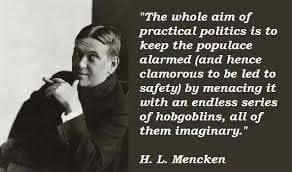
H.L. Menken on the fake news of the early – mid 20th century.

And it’s not only rich individuals who turn trusted news sources into propaganda outlets. The US CIA did this for years, and likely still do. Then there are the Russians, the Chinese, the Israelis, the British (BBC) and our very own NPRt. These sources present news that benefits them in the most positive light and scream about dangers to democracy and the world if their position is touched or their veracity is questioned. As these sources are all government funded, there is a they are unanimous supporters big governments as a cure to all ills. Closer to home, I’d like to mention that Detroit has two major papers, but only one owner. The left leaning Detroit Free Press, and the right-leaning Detroit News are owned by the same people, share a considerable staff, and generally agree on important issues. There are a dozen smaller papers in Metro Detroit; all but one is owned by one media group.

I’d like to end with a positive note. Not every reporter is in this sad grab-bag. In Detroit, Setve Neveling, “the motor-city muckraker” manages to present is independent, active news. Then there is Los Angeles’s Biotech billionaire, Patrick Soon-Shiong. He bought the LA Times in June 2018, claiming he will use it to fight fake news, “the cancer of our time.” I wish him luck. So far, I’d say, he’s made the LA Times is the best Newspaper in the US with The NY Post a close second ( love the snarky headlines).

Robert Buxbaum, July 15, 2019.

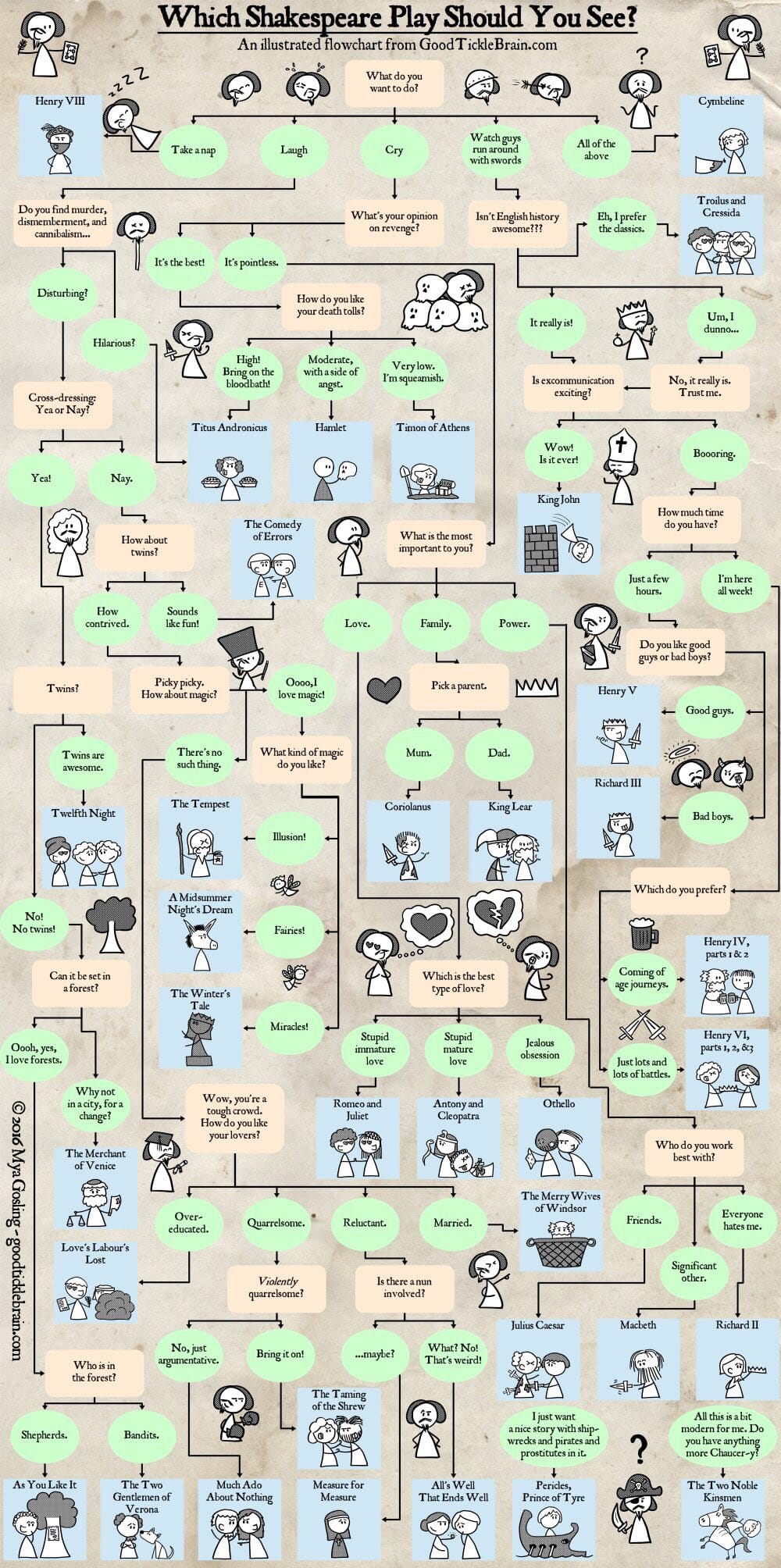
Shakespeare’s plays, organized.

One remarkable thing about Shakespeare’s plays is how varied they are. There are comedies and tragedies; histories of England, and of Rome, musings on religion, and on drink, and lots of cross-dressing. He wrote at least thirty seven plays between 1590 and 1613, alone or as a major collaborator, and the chart below gives a sense of the scope. I have seen less than half of these plays, so I find the chart below both useful and humorous. The humor of the chart is partly that it presents the common man (us) access to the godly (Shakespeare). That access is the root of the best comedy, in my opinion. Shakespeare also has a comic dog, some total idiots, comic violence to women, and a few other cringeworthy laugh-getters, but we’ll not mention those; it’s low comedy. You’ll notice that Merchant of Venice is listed here as a comedy; I think it was seen that way by Shakespeare. The hero of the play in my opinion, is a woman, Portia, who outsmarts all others by her legal genius at the end. Tragedy is when the great individual can not access great things. At least that’s how I see it. As for History; it’s been said, that it starts as tragedy, and ends as comedy. Shakespeare’s histories include some of each. And as for our, US history, Lincoln was tragedy, like LBJ; Truman was comedy, and Andrew Jackson too. And, as for Trump, who knows?

By Myra Gosling, www.goodticklebrain.com
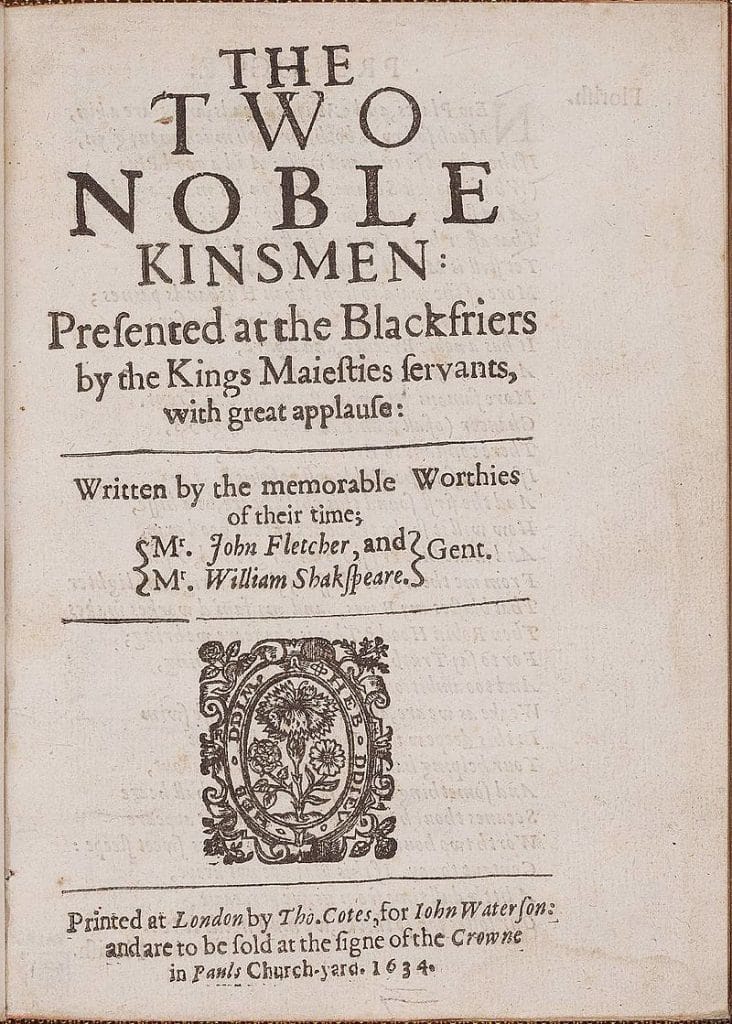
A Shakespeare collaboration. The collaborator, Fletcher, is cited by name.

Ms Gosling’s graphic, wonderful as it is, lists some but not all of Shakespeare’s collaborations. Two listed ones, “Henry VIII,” and “The Two Noble Kinsmen” were with John Fletcher. The cover shown at right, shows Fletcher named as first author. Since Fletcher outlived Shakespeare and took over the company after his death, I’ll assume these are later plays.

“Henry IV, part 1” is thought to be from Shakespeare’s early career, and seems to have been a mass collaboration: something written by a team the way situation comedies are written today. And “Pericles, Prince of Tyre,” listed near the bottom right, seems to have been a mid-career collaboration with George Wilkins. At least four of Shakespeare’s collaborations don’t appear at all in the graphic. “Edward III” and “The Spanish Tragedy”, appear to have been written with Thomas Kyd, likely early in Shakespeare’s career. Perhaps Gosling felt they don’t represent the real Shakespeare, or perhaps she left them off because they are not performed often. Another collaboration, “Sir Thomas More” (an intentional misspelling of Moore?), is well regarded today, and still put on. An existing manuscript includes 300+ lines written in Shakespeare’s hand. Still, Shakespeare’s main contribution seems to have been editing the play to get it past the censors. Finally, “Cardenio,” is a lost play, likely another collaboration with Fletcher. It got good reviews.

The cool thing about Shakespeare’s play writing, in my opinion, is his willingness to let the characters speak for themselves. Even characters who Shakespeare doesn’t like have their say. They speak with passion and clarity; without interruption or mockery. Writing this way is difficult, and most writers can’t avoid putting themselves and their opinions in the forefront. I applaud Ms Gosling for making Shakespeare accessible. Here’s this month’s issue of her blog, GoodTickleBrain.

Robert Buxbaum, June 26, 2019. As a side note, Shakespeare appears to have been born and died on the same date, April 23; in 1564 and 1616, respectively.

How to avoid wet basements

My house is surrounded my mulch — it absorbs enough rainwater that I rarely have to water.

Generally speaking water gets to your basement from rain, and the basic way you avoid wet basements is by providing some more attractive spot for the rainwater to go to. There are two main options here: divert the water to a lake or mulch-filled spot at least 8 feet away from your home, or divert it to a well-operated street or storm drain. My personal preference is a combination of both.

At right I show a picture of my home taken on a particularly nice day in the spring. Out front is a mulch-filled garden and some grass. On the side, not shown is a driveway. Most of the rain that hits our lawn and gardens is retained in 4 inches of mulch, and waters the plants. Four inches of mulch-covered ground will hold at least four inches of rainwater. Most of the rain that hits the house is diverted to downspouts and flows down the driveway to the street. Keeping some rainwater in the mulch means you don’t have to pay so much to water the trees and shrubs. The tree at the center here is an apple tree. I like fruit trees like this, they really suck up water, and I like the apples. We also have blueberries and roses, and a decorative pear (I like pears too, but they are messy).

In my opinion, you want some slope even in the lawn area, so excess rainwater will run to the sewers and not form a yard-lake, but that’s a professional preferences; it’s not always practical and some prefer a brief (vernal ) lake. A vernal lake is one that forms only in the spring. If you’ve got one, you may want to fill it with mulch or add trees that are more water tolerant than the apple, e.g. swamp oak or red cedar. Trees remove excess water via transpiration (enhanced evaporation). Red Cedars grow “knees” allowing them to survive with their roots completely submerged.

For many homes, the trick to avoiding a flooded basement is to get the water away from your home and to the street or a retention area.

When it comes to rain that falls on your hose, one option is to send it to a vernal lake, the other option is to sent it to the street. If neither is working, and you find water in your basement, your first step is to try to figure out where your rainwater goes and how it got there. Follow the water when it’s raining or right after and see where it goes. Very often, you’ll discover that your downspouts or your driveway drain into unfortunate spots: spots that drain to your basement. To the extent possible, don’t let downspout water congregate in a porous spot near your house. One simple correction is to add extenders on the downspouts so that the water goes further away, and not right next to your wall. At left, I show a simple, cheap extender. It’s for sale in most hardware stores. Plastic or concrete downspout pans work too, and provide a good, first line of defense agains a flood basement. I use several to get water draining down my driveway and away from the house.

Sometimes, despite your best efforts, your driveway or patio slopes to your house. If this is the case, and if you are not quite ready to replace your driveway or patio, you might want to calk around your house where it meets the driveway or patio. If the slope isn’t too great, this will keep rainwater out for a while — perhaps long enough for it to dry off, or for most of the rainwater to go elsewhere. When my driveway was put in, I made sure that it sloped away from the house, but then the ground settled, and now it doesn’t quite. I’ve put in caulk and a dirt-dam at the edge of the house. It keeps the water out long enough that it (mostly) drains to the street or evaporates.

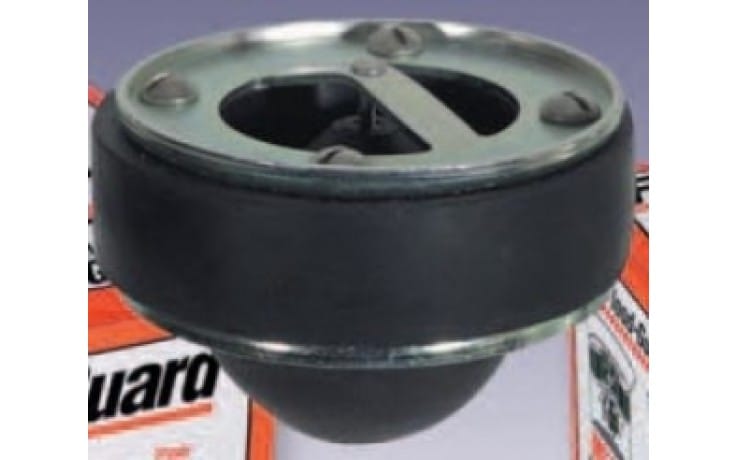
A drain valve. Use this to keep other people’s sewer water out of your basement.

There is one more source of wet basement water, one that hits the houses in my area once a year or so. In our area of Oakland county, Michigan, we have combined storm and sanitary sewers. Every so often, after a big rain, other people’s rainwater and sanitary sewage will come up through the basement drains. This is really a 3rd world sewer system, but we have it this way because when it was put in, in the 1900s, it was first world. One option if you have this is to put in a one-way drain valve. There are various options, and I suggest a relatively cheap one. The one shown at right costs about $15 at Ace hardware. It will keep out enough water, long enough to protect the important things in your home. The other option, cheaper and far more hill-billy, is to stuff rags over your basement drains, and put a brick over the rags. I’ll let you guess what I have in my basement.

Robert Buxbaum, June 13, 2019

Qatar, unbalanced but stable

Doha Airport, Qatar.

Doha Airport, Qatar.

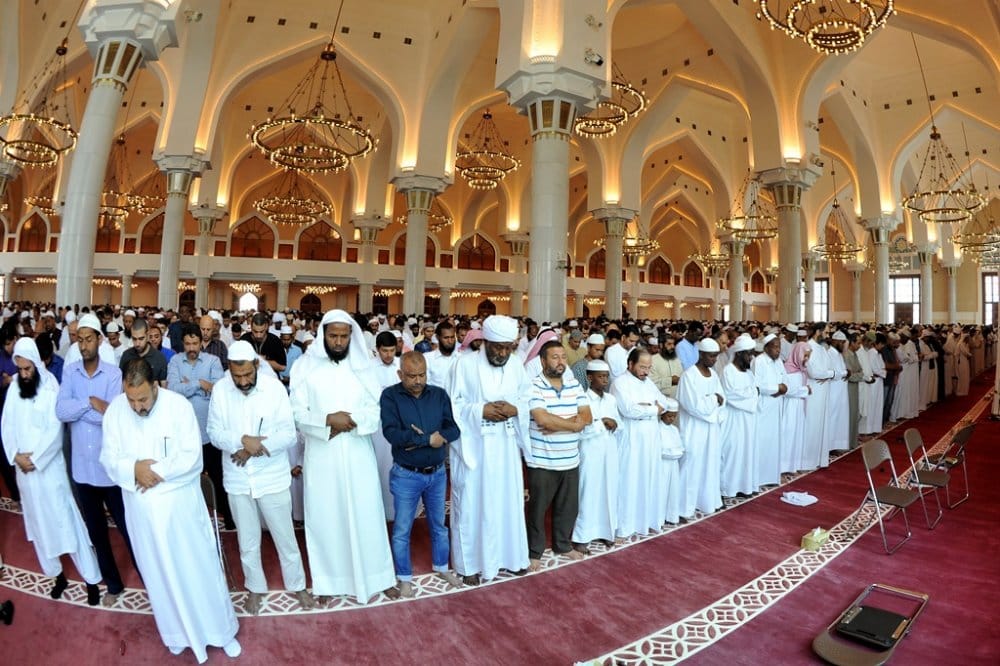
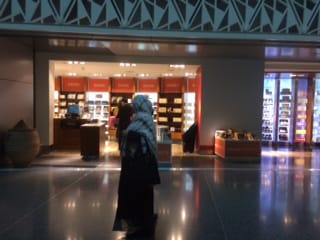
I visited Qatar twice this month, just passing through and only visited in the airport, but there were several things that so impressed me that I had to write. What impressed me most was not so much the size and richness of the airport, but the clothes of the locals. All of the local men wore the same, very sharp robes: blindingly white, long sleeved, and floor-length. They’re called Thobes. While other nations wear something similar. Here, every one was unwrinkled, and unstained. They all looked new, with no signs they’d ever been washed. Some were worn with cuff-links (gold), and most had a pen sticking out of the breast pocket (gold). White pants peak from underneath and a headress usually sits on the head. It’s a really dramatic look, like seeing dozens of Ricardo Montaubans of Fantasy Island in one place. Local women and children were these too, but I found the thobes so dramatic that the women and children disappeared from my mind-space almost immediately. There is a local woman in the picture above, but you hardly notice.

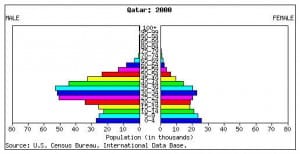
Not everyone wears the thobes. There are lots of stores filled with gold and technology, beer and coffee, and these are maned by non-locals, Moslems mostly, almost all men. The non-locals wear western garb, not particularly sharp; none wear thobes of any sort. Some months ago, I wrote that China had severe imbalance and speculated that it was ripe for revolution. As it happens the large number of foreign worker means that Qatar is far more unbalanced. To some extent this is shown by the male-female population pyramid below.

Qatar demographic pyramid. Vastly more males than females, mostly foreign workers.

Qatar demographic pyramid. The imbalance is caused by the presence of vastly more male than female foreign workers.

Qatar is a country of 2,500,000 residents, of whom 310,000 are locals — citizens and permanent residents. The rest are foreign workers; long term inhabitants without permanent residency or citizenship. They make up 85% of the population. They are  recruited from poor, English-speaking Muslim countries mostly: Egypt, Malaysia, Tunisia. They do all the work, as best I could tell. I saw no one who looked like a local working, male or female.

Foreign workers have very few rights, but don’t seem unhappy. There is no right to unionize, and not even the right to roam around the country. For the most part, they live in employer-owned housing, and are transported back and forth to work in employer vans. They sign up for year-long contracts, and at the end of the year, they have the choice to re-up or leave. Up a year ago, foreign workers could not become permanent residents. As of last year, the Emir’s order 10 authorized permanent residency status for as many as 100 foreign workers who had sufficient means, had been in Qatar for 10 to 20 years (depending on whether they were born there), had stayed out of trouble, and who otherwise were considered desirable. It’s a step.

I suspect that the foreign workers feel lucky to have good pay, decent hours, and a clean bed. Then again, the workers are recruited for positive outlook. And the ones I saw might have had more rights than most. The airport is part of the Umm Al Houl, free enterprise zone. These are areas of Qatar where westerners and their vices like alcohol are tolerated and welcome.

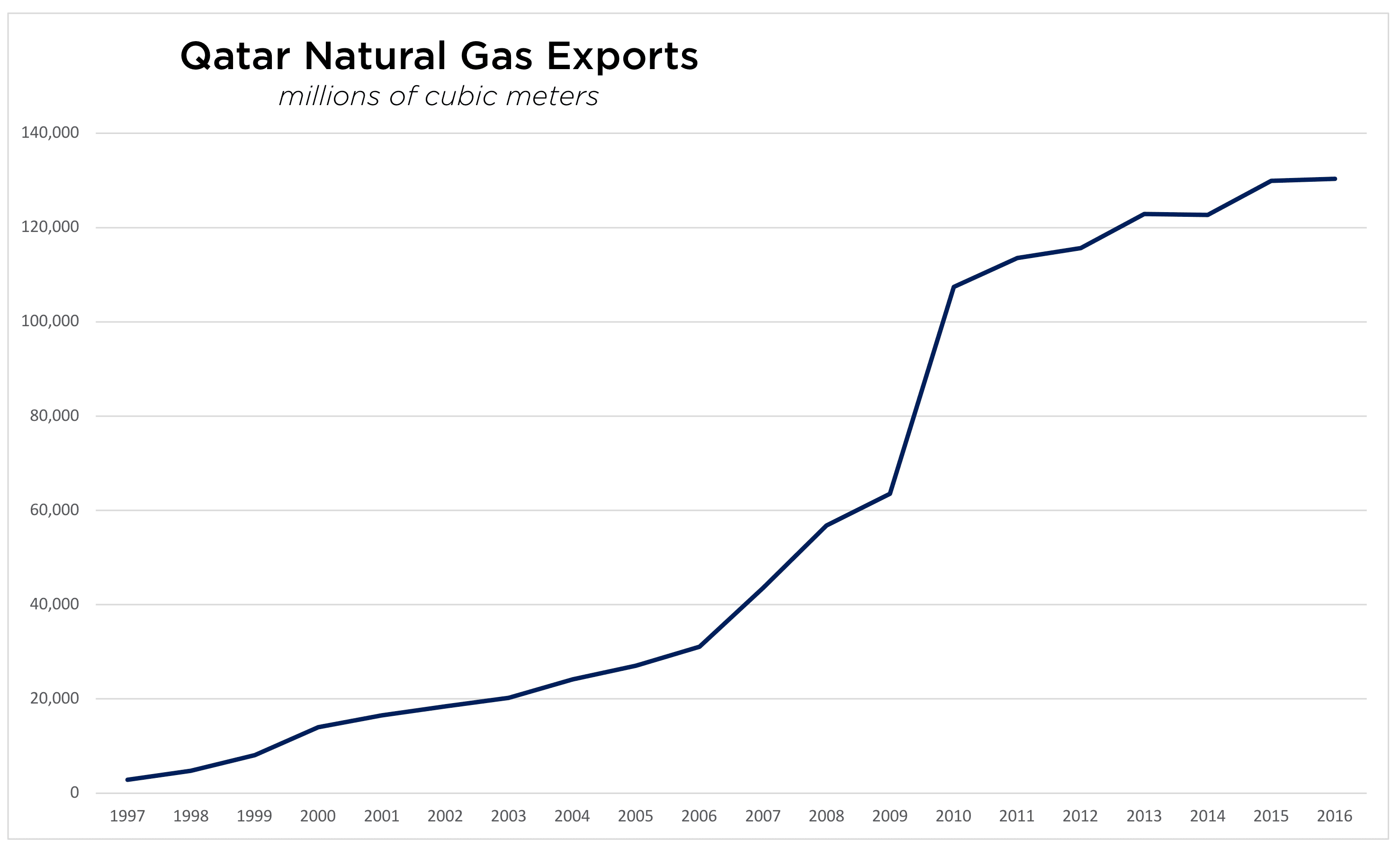
Qatar natural gas production. Natural gas provides 90% of the country's income as best I can tell.

Qatar natural gas production. Natural gas provides 90% of the country’s income as best I can tell. That’s half the GDP almost, the rest of the GDP is Qataris spending the money

There are three “free enterprise zones” in Qatar; the name for the one near the airport, “Al Houl” interestingly enough means “bird trap”. What’s going on with them, as best I can tell, is diversification. Qatar is the worlds second largest exporter of natural gas, with most going to Europe, and a significant portion to India and China. But the gas will run out eventually. They are trying to supplant this income with tourism, industry and transport: running a major airline, a bustling, air hub, and tourist hotels. The airline is only marginally profitable, and though I didn’t see the hotels, I imagine they are luxurious and marginally profitable too. Saudi Arabia, next door, is trying to diversify the same ways, aiming to control west-east, air-traffic via Emirates air.

The GDP of Qatar is $191 B as of last year at the going exchange, and over $450 B at price parity. That suggests a few things. For one that the Qatari currency is undervalued. It also suggests a per-capita GDP of at least $76,400, or perhaps of $616,000 or higher depending on how you count buying power and foreign workers. This money buys a nice lifestyle, if not republican freedoms.  In terms of government, Qatar is a real monarchy, Emir Hamad bin Khalifa al-Thani’s is an absolute ruler who came to power the traditional way: he overthrew his father. Similar to this, his father, Khalifa al-Thani, came to power by overthrowing his cousin. Supporting the Emir’s rule, there is an Advisory Council. The 35 ministers are mostly relatives, and as in North Korea, it has only advisory power. The Prime Minister and Minister of Foreign Affairs is Sheikh Hamad bin Jasim bin Jabir al-Thani; the Deputy Prime Minister is Abdallah Al-Thani. The Economy and Commerce minister is Fahd Al-Thani, and the Communications and Transport minister is Ahmad Al-Thani. Nasir al-Thani heads Cabinet Affairs; Hamad al-Thani is the Secretary of State, and the Governor of the Central Bank is Abdallah bin Saud al-Thani.

Qatar main mosque. Residents stand out from the foreign workers.

Qatar main mosque. Residents stand out from the foreign workers.

My sense was that Qatar was the Disneyland version of Islam. Life in the Qatari free zones resembled normal Islamic life the way that Main Street of Disneyland resembles an actual main street in the US. Every citizen is well dress and rich without having to work. Western visitors are welcome, and not forced to follow the local customs with vices in their own zones. And the state supports all ecological and left-wing causes except for unionization. It’s anti Israel, pro revolution (elsewhere of course) and virulently against petroleum production in all counties outside of Qatar. Al Jazeera, the Emir’s left-leaning news agency, spreads money and influence world-wide. Left-flavored news is presented with high-quality graphics, and different versions of the news story published in different languages. The Emir acknowledges that Al Jazeera is a money-losing propaganda agency, but as with Disneyland, most people seem happy to live the fiction.

Qatari woman and shop. They blend into the scenery compared to the resplendent men

Qatari woman and shop. They blend into the scenery compared to the resplendent men

The local Qataris seem happy with their lot, as best I can tell. The next world soccer tournament will be held in Qatar, 2022, and Qatari’s are excited, as best I can tell. There is a lot of building going on, some for the world cup, the rest for general tourism and the free enterprise zones. The free enterprise zones may catch on, but there is a cold war going on with Saudi Arabia, and the Saudi’s are doing what they can to pour cold water on the programs. So far Qatar seems to be winning the propaganda war at home and abroad. Its people are happy, it shows a beautiful, progressive face to the west, and it seems to have the majority of the middle east travel. Stable but for how long?

Robert Buxbaum April 15, 2019. As I side note, I just bought a Qatari Thobe.

Speed traps penalize the poor

On a street corner about 1/4 mile from my house, at the intersection of the two busiest of the local streets, in the center-median of the street, is parked a police car. He’s there, about 18 hours a day, looking to give out tickets. The cross-street that this officer watches is where drivers get off the highway. In theory, they should instantly go from 65 mph on the highway to 35 mph now. Very few people do. The officer does not ticket every car, by the way, but seems to target those of poor people from outside the city limits. The only time ai was ticketed, I was driving a broken-down car while mine was in the shop. As best I can tell, he choose cars for revenue, not for safety. It’s a speed trap. It’s appalling. And our city isn’t alone in having one.

Speed traps are an annoyance to rich, local folk who sometimes get ticketed, but they’re a disaster for the poor. Poor people are targeted, and these people don’t have any savings. They don’t have the means to pay a suddenly imposed bill of $150 or more. Meanwhile, the speed-trap officer is incentivized to increase revenue and look for other violations: expired registrations or insurance, seat-belt violations, open alcohol, unpaid tickets. Double and triple fines are handed out, and sometimes the car is impounded. A poor driver is often left without any legal way to get to work, to earn money to pay the fines. Police officers behave this way because they are evaluated based on the revenue they generate, based on the number of tickets they write. It’s a horrible situation, especially for the poor

Speed traps to little and cost much.

An article on the effect of speed traps. It appears they do little good and cause much pain, especially to the poor. Here is a link to the whole article.

The article above looks at the impact of speed traps on poor people. The damage is extreme. The folks targeted are often black, barely holding it together financially. They are generally not in a position to pay $150 for “impeding traffic,” and even less in a position to deal with having their car impounded. How are they supposed to pay the bill? And yet they are told they are lucky to have been given this ticket — impeding traffic, a ticket with no “points.” But they are not lucky. They are victims. Tickets with no points is are money generators, and many poor people realize it. If they were to get a speeding ticket, they would have the opportunity to void the penalty by going to traffic school. With a ticket for impeding traffic, there is no school option. Revenue stays local, mostly in that police precinct. Poor people know it, and they don’t like it. I don’t either. After a while, poor people cease to trust the police, or to even speak to them.

In what world should you pay $150 for impeding traffic, by the way? In what world should the police be taken from their main job protecting the people and turned into a revenue arm for the city? I’d like to see this crazy cycle ended. The first steps, I think, are to end speed traps, and to limit the incentive for giving minor tickets, like impeding traffic. As it is we have too many people in jail and too many harsh penalties. 

Robert Buxbaum, April 10, 2019. I ran for water commissioner in 2016, and may run again in 2020.

C-Pap and Apnea

A month of so ago, I went to see a sleep doctor for my snoring. I got a take-home breathing test that gave me the worst night’s sleep in recent memory. A few days later, I got a somber diagnosis: “You are a walking zombie.” Apparently, I hold my breath for ten seconds or more every minute and a half while sleeping. Normal is supposed to be every 4 to 10 minutes. But by this standard, more than half of all middle-aged men are sub-normal (how is this possible?). As a result of my breath-holding, the wrinkled, unsmiling DO claimed I’m brain-dead now and will soon be physically dead unless I change my ways. Without spending 3 minutes with me, the sleep expert told me that I need to lose weight, and that I need a C-Pap (continuous positive airway pressure) device as soon as possible. It’s supposed to help me lose that weight and get back the energy. With that he was gone. The office staff gave me the rest of the dope: I was prescribed  a “ResMed” brand C-Pap, supplied by a distributor right across the hall from the doctor (how convenient).

I picked up the C-Pap three months later. Though I was diagnosed as needing one “as soon as possible,” no one would release the device until they were sure it was covered by my insurance company. The device when I got it, was something of a horror. The first version I tried fit over the whole face and forces air into my mouth and nose simultaneously, supposedly making it easier to inhale, but harder to exhale. I found it more than a bit uncomfortable. The next version was nose only and marginally more comfortable. I found there was a major air-flow restriction when I breath in and a similar pressure penalty when I breathed out. And it’s loud. And, if you open your mouth, there is a wind blowing through. As for what happens if the pump fails or the poor goes out, I notice that there are the tiniest of air-holes to prevent me from suffocating, barely. A far better design would have given me a 0-psi flapper valve for breathing in, and a 1/10 psi flapper for breathing out. That would also reduce the pressure restriction I was feeling every time I took a deep breath. One of my first blog essays was about engineering design aesthetics; you want your designs to improve things under normal conditions and fail safe, not like here. Using this device while awake was anything but pleasant, and I found I still hold my breath, even while awake, about every 5 minutes.

Since I have a lab, and the ability to test these things, I checked the pressure of the delivered air, and found it was 3 cm of water, about 1/20 psi. The prescription was for 5 cm or water (1/14 psi). The machine registers this, but it is wrong. I used a very simple water manometer, a column of water, similar to the one I used to check the pressure drop in furnace air filters. Is 1/20 psi enough?How did he decide on 1/14 psi by the way? I’ve no idea. !/14 psi is about 1/200 atm. Is this enough to do anything? While the C-Pap should get me to breathe more, I guess, about half of all users stop after a few tries, and my guess is that they find it as uncomfortable as I have. There is no research evidence that treatment with it reduces stroke or heart attack, or extends life, or helps with weight loss. The assumption is that, if you force middle-aged men to hold their breath less, they will be healthier, but I’ve no clear logic or evidence to back the assumption. At best, anything you gain on the ease of breathing in, you lose on the difficulty of breathing out. The majority of middle-aged men are prescribed a C-Pap, if they go for a sleep study, and it’s virtually 100% for overweight men with an apple-shaped body.

I’d have asked my doctor about alternatives or for a second opinion but he was out the door too fast. Besides, I was afraid I’d get the same answer that Rodney Dangerfield got: “You want a second opinion? OK. You’re ugly, too.” Mr. Dangerfield was not a skinny comic, by the way, but he was funny, and I assume he’d have been prescribed a C-Pap (maybe he was). He died at 82, considerably older than Jim Fixx, “the running doctor,” Adelle Davis, the “eat right for health” doctor, Euell Gibbons “in search of the wild asparagus,” or Ethan Pritkin, the diet doctor. God seems to prefer fat comedians to diet experts; I expect that most-everyone does.

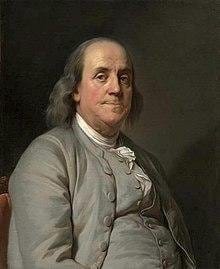
Benjamin Franklin and his apple-shaped body

Benjamin Franklin and his apple-shaped body; I don’t think of him as a zombie.

What really got my goat, besides my dislike of the C-Pap, is that I object to being called a walking zombie. True, I’m not as energetic as I used to be, but I manage to run a company, and to write research papers, and I get patents (this one was approved just today). And I write these blogs — I trust that any of you who’ve read this far find them amusing. Pretty good for a zombie — and I ran for water commissioner. People who use the C-Pap self-report that they have more energy, but self-reporting is poor evidence. A significant fraction of those people who start with the C-Pap, stop, and those people, presumably were not happy. Besides, a review of the internet suggests that a similarly large fraction of those who buy a “MyPillow.com” claim they have more energy. And I’ve seen the same claims from people who take a daily run, or who pray, or smoke medical marijuana (available for sleep apnea, but not from this fellow), or Mirtazapine (study results here), or  for electro-shock therapy, a device called “Inspire.” With so many different products providing the same self-reported results, I wonder if there isn’t something more fundamental going on. I’d wish the doc had spent a minute or two to speak to this, or to the alternatives.

As for weight loss, statistical analysis of lifespan suggests that there is a health advantage to being medium weight: not obese, but not skinny. I present some of this evidence here, along with evidence that extra weight helps ward off Alzheimer’s. For all I know this protection is caused by holding your breath every few minutes. It helps to do light exercise, but not necessary for mental health. In terms of mental health, the evidence suggests that weight loss is worse than nothing.

Jared Gray, author of the Alien movies, was diagnosed with apnea, so he designed his own sleep-mask.

Jared Gray, author of the Alien movies, was diagnosed with apnea, so he designed his own sleep-mask.

Benjamin Franklin was over-weight and apple-shaped, and no zombie, The same is true of John Adams, Otto Von Bismarck, and Alfred Hitchcock. All lived long, productive lives. Hitchcock was sort of morbid, it will be admitted, but I would not want him otherwise. Ed McMahon, Johnny Carson’s side-kick, apologized to America for being overweight and smoking, bu the outlived Johnny Carson by nine years, dying at 89. Henry Kissinger is still alive and writing at 95. He was always fatter than any of the people he served. He almost certainly had sleep apnea, back in the day, and still has more on the ball, in my opinion, than most of the talking-head on TV. The claim that overweight, middle-aged men are all zombies without a breath assisting machine doesn’t make no sense to me. But then, I’m not a sleep doctor. (Do sleep doctors get commissions? Why did he choose, this supplier or this brand device? With so little care about patients, I wonder who runs the doctor’s office.)

I looked up my doctor on this list provided by the American Board of Sleep Medicine. I found my doctor was not certified in sleep medicine. I suppose certified doctors would prescribe something similar  but was disappointed that you don’t need sleep certification to operate as a sleep specialist. In terms of masks, I figure, if you’ve got to wear something, you might as well wear something cool. Author Jared Gray, shown above (not the author of the Alien) was diagnosed with Apnea 6 months ago and made his own C-Pap mask to make it look like the alien was attacking him. Very cool for an ex-zombie, but I’m waiting to see a burst of creative energy.

What do we zombies want? Brains.

When do we want them? Brains.

What do vegetarian zombies want? Grains.

Robert Buxbaum, March 15, 2019. In case real zombies should attack, here’s what to do.  An odd legal/insurance issue: in order to get the device, I had to sign that, if I didn’t use it for 20 days in the first month of 4 hours per night, and thus if the insurance did not pay, I would be stuck with the full fee. I signed. This might cost me $1000 though normally in US law, companies can only charge a reasonable restock fee, but it can’t be unreasonable, like the full  price. I also had to sign that I would go back to the same, quick-take doctor, but again there has to be limits. We’ll see how the machine pans out, but one difference I see already: unlike my pillow.com, there is no money back guarantee with the C-Pap treatment.

Disease, atom bombs, and R-naught

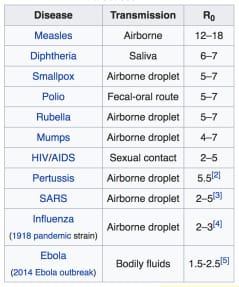
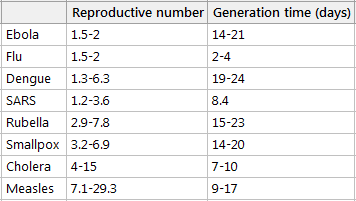
A key indicator of the speed and likelihood of a major disease outbreak is the number of people that each infected person is likely to infect. This infection number is called R-naught, or Ro; it is shown in the table below for several major plague diseases.

R-naught - communicability for several contagious diseases, CDC.

R-naught – infect-ability for several contagious diseases, CDC.

Of the diseases shown, measles is the most communicable, with an Ro of 12 to 18. In an unvaccinated population, one measles-infected person will infect 12- 18 others: his/her whole family and/ or most of his/her friends. After two weeks or so of incubation, each of the newly infected will infect another 12-18. Traveling this way, measles wiped out swaths of the American Indian population in just a few months. It was one of the major plagues that made America white.

While Measles is virtually gone today, Ebola, SARS, HIV, and Leprosy remain. They are far less communicable, and far less deadly, but there is no vaccine. Because they have a low Ro, outbreaks of these diseases move only slowly through a population with outbreaks that can last for years or decades.

To estimate of the total number of people infected, you can use R-naught and the incubation-transmission time as follows:

Ni = Row/wt

where Ni is the total number of people infected at any time after the initial outbreak, w is the number of weeks since the outbreak began, and wt is the average infection to transmission time in weeks.

For measles, wt is approximately 2 weeks. In the days before vaccine, Ro was about 15, as on the table, and

Ni = 15w/2.

In 2 weeks, there will be 15 measles infected people, in 4 weeks there will be 152, or 225, and in 6 generations, or 12 weeks, you’d expect to have 11.39 million. This is a real plague. The spread of measles would slow somewhat after a few weeks, as the infected more and more run into folks who are already infected or already immune. But even when the measles slowed, it still infected quite a lot faster than HIV, Leprosy, or SARS (SARS is a form of Influenza). Leprosy is particularly slow, having a low R-naught, and an infection-transmission time of about 20 years (10 years without symptoms!).

In America, more or less everyone is vaccinated for measles. Measles vaccine works, even if the benefits are oversold, mainly by reducing the effective value of Ro. The measles vaccine is claimed to be 93% effective, suggesting that only 7% of the people that an infected person meets are not immune. If the original value of Ro is 15, as above, the effect of immunization is to reduce the value Ro in the US today to effectively 15 x 0.07 = 1.05. We can still  have measles outbreaks, but only on a small-scale, with slow-moving outbreaks going through pockets of the less-immunized. The average measles-infected person will infect only one other person, if that. The expectation is that an outbreak will be captured by the CDC before it can do much harm.

Short of a vaccine, the best we can do to stop droplet-spread diseases, like SARS, Leprosy, or Ebola is by way of a face mask. Those are worn in Hong Kong and Singapore, but have yet to become acceptable in the USA. It is a low-tech way to reduce Ro to a value below 1.0, — if R-naught is below 1.0, the disease dies out on its own. With HIV, the main way the spread was stopped was by condoms — the same, low tech solution, applied to sexually transmitted disease.

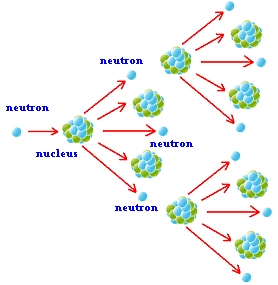
Image from VCE Physics, https://sites.google.com/site/coyleysvcephysics/home/unit-2/optional-studies/26-how-do-fusion-and-fission-compare-as-viable-nuclear-energy-power-sources/fission-and-fusion---lesson-2/chain-reactions-with-dominoes

Progress of an Atom bomb going off. Image from VCE Physics, visit here

As it happens, the explosion of an atom bomb follows the same path as the spread of disease. One neutron appears out of somewhere, and splits a uranium or plutonium atom. Each atom produces two or three more neutrons, so that we might think that R-naught = 2.5, approximately. For a bomb, Ro is found to be a bit lower because we are only interested in fast-released neutrons, and because some neutrons are lost. For a well-designed bomb, it’s OK to say that Ro is about 2.

The progress of a bomb going off will follow the same math as above:

Nn = Rot/nt

where Nn is the total number of neutrons at any time, t is the average number of nanoseconds since the first neutron hit, and nt is the transmission time — the time it takes between when a neuron is given off and absorbed, in nanoseconds.

Assuming an average neutron speed of 13 million m/s, and an average travel distance for neutrons of about 0.1 m, the time between interactions comes out to about 8 billionths of a second — 8 ns. From this, we find the number of neutrons is:

Nn = 2t/8, where t is time measured in nanoseconds (billionths of a second). Since 1 kg of uranium contains about 2 x 1024 atoms, a well-designed A-bomb that contains 1 kg, should take about 83 generations (283 = 1024). If each generation is 8 ns, as above, the explosion should take about 0.664 milliseconds to consume 100% of the fuel. The fission power of each Uranium atom is about 210 MeV, suggesting that this 1 kg bomb could release 16 billion Kcal, or as much explosive energy as 16 kTons of TNT, about the explosive power of the Nagasaki bomb (There are about 38 x10-24 Kcal/eV).

As with disease, this calculation is a bit misleading about the ease of designing a working atomic bomb. Ro starts to get lower after a significant faction of the atoms are split. The atoms begin to move away from each other, and some of the atoms become immune. Once split, the daughter nuclei continue to absorb neutrons without giving off either neutrons or energy. The net result is that an increased fraction of neutrons that are lost to space, and the explosion dies off long before the full power is released.

Computers are very helpful in the analysis of bombs and plagues, as are smart people. The Manhattan project scientists got it right on the first try. They had only rudimentary computers but lots of smart people. Even so, they seem to have gotten an efficiency of about 15%. The North Koreans, with better computers and fewer smart people took 5 tries to reach this level of competence (analyzed here). They are now in the process of developing germ-warfare — directed plagues. As a warning to them, just as it’s very hard to get things right with A-bombs, it’s very hard to get it right with disease; people might start wearing masks, or drinking bottled water, or the CDC could develop a vaccine. The danger, if you get it wrong is the same as with atom bombs: the US will not take this sort of attack lying down.

Robert Buxbaum, January 18, 2019. One of my favorite authors, Issac Asimov, died of AIDS; a slow-moving plague that he contacted from a transfusion. I benefitted vastly from Isaac Asimov’s science and science fiction, but he wrote on virtually every topic. My aim is essays that are sort-of like his, but more mathematical.

James Croll, janitor scientist; man didn’t cause warming or ice age

When politicians say that 98% of published scientists agree that man is the cause of global warming you may wonder who the other scientists are. It’s been known at least since the mid 1800s that the world was getting warmer; that came up talking about the president’s “Resolute” desk, and the assumption was that the cause was coal. The first scientist to present an alternate theory was James Croll, a scientist who learned algebra only at 22, and got to mix with high-level scientists as the janitor at the Anderson College in Glasgow. I think he is probably right, though he got some details wrong, in my opinion.

James Croll was born in 1821 to a poor farming family in Scotland. He had an intense interest in science, but no opportunity for higher schooling. Instead he worked on the farm and at various jobs that allowed him to read, but he lacked a mathematics background and had no one to discuss science with. To learn formal algebra, he sat in the back of a class of younger students. Things would have pretty well ended there but he got a job as janitor for the Anderson College (Scotland), and had access to the library. As janitor, he could read journals, he could talk to scientists, and he came up with a theory of climate change that got a lot of novel things right. His idea was that there were  regular ice ages and warming periods that would follow in cycles. In his view these were a product of the precession of the equinox and the fact that the earth’s orbit was not round, but elliptical, with an eccentricity of 1.7%. We are 3.4% closer to the sun on January 3 than we are on July 4, but the precise dates changes slowly because of precession of the earth’s axis, otherwise known as precession of the equinox.

Currently, at the spring equinox, the sun is in “the house of Pisces“. This is to say, that a person who looks at the stars all the night of the spring equinox will be able to see all of the constellations of the zodiac except for the stars that represent Pisces (two fish). But the earth’s axes turns slowly, about 1 days worth of turn every 70 years, one rotation every 25,770 years. Some 1800 years ago, the sun would have been in the house of Ares, and 300 years from now, we will be “in the age of Aquarius.” In case you wondered what the song, “age of Aquarius” was about, it’s about the precession of the equinox.

Our current spot in the precession, according to Croll is favorable to warmth. Because we are close to the sun on January 3, our northern summers are less-warm than they would be otherwise, but longer; in the southern hemisphere summers are warmer but shorter (southern winters are short because of conservation of angular momentum). The net result, according to Croll should be a loss of ice at both poles, and slow warming of the earth. Cooling occurs, according to Croll, when the earth’s axis tilt is 90° off the major axis of the orbit ellipse, 6300 years before or after today. Similar to this, a decrease in the tilt of the earth would cause an ice age (see here for why). Earth tilt varies over a 42,000 year cycle, and it is now in the middle of a decrease. Croll’s argument is that it takes a real summer to melt the ice at the poles; if you don’t have much of a tilt, or if the tilt is at the wrong time, ice builds making the earth more reflective, and thus a little colder and iceier each year; ice extends south of Paris and Boston. Eventually precession and tilt reverses the cooling, producing alternating warm periods and ice ages. We are currently in a warm period.

Global temperatures measured from the antarctic ice showing stable, cyclic chaos and self-similarity.

Global temperatures measured from the antarctic ice showing stable, cyclic chaos and self-similarity.

At the time Croll was coming up with this, it looked like numerology. Besides, most scientists doubted that ice ages happened in any regular pattern. We now know that ice ages do happen periodically and think that Croll must have been on to something. See figure; the earth’s temperature shows both a 42,000 year cycle and a 23,000 year cycle with ice ages coming every 100,000 years.

In the 1920s a Serbian Mathematician, geologist, astronomer, Milutin Milanković   proposed a new version of Croll’s theory that justified longer space between ice ages based on the beat frequency between a 23,000 year time for axis precession, and the 42,000 year time for axis tilt variation. Milanković used this revised precession time because the ellipse precesses, and thus the weather-related precession of the axis is 23,000 years instead of 25,770 years. The beat frequency is found as follows:

51,000 = 23,000 x 42,000 / (42000-23000).

As it happens neither Croll’s nor Milanković’s was accepted in their own lifetimes. Despite mounting evidence that there were regular ice ages, it was hard to believe that these small causes could produce such large effects. Then, in a 1976 study (Hayes, Imbrie, and Shackleton) demonstrated clear climate variations based on the mud composition from New York and Arizona. The variations followed all four of the Milankocitch cycles.

Southern hemisphere ice is growing, something that confounds CO2-centric experts

Southern hemisphere ice is growing, something that confounds CO2-centric experts

Further confirmation came from studying the antarctic ice, above. You can clearly see the 23,000 year cycle of precession, the 41,000 year cycle of tilt, the 51,000 year beat cycle, and also a 100,000 year cycle that appears to correspond to 100,000 year changes in the degree of elliptic-ness of the orbit. Our orbit goes from near circular to quite elliptic (6.8%) with a cycle time effectively of 100,000 years. It is currently 1.7% elliptic and decreasing fast. This, along with the decrease in earth tilt suggests that we are soon heading to an ice age. According to Croll, a highly eccentric orbit leads to warming because the minor access of the ellipse is reduced when the orbit is lengthened. We are now heading to a less-eccentric orbit; for more details go here; also for why the orbit changes and why there is precession.

We are currently near the end of a 7,000 year warm period. The one major thing that keeps maintaining this period seems to be that our precession is such that we are closest to the sun at nearly the winter solstice. In a few thousand years all the factors should point towards global cooling, and we should begin to see the glaciers advance. Already the antarctic ice is advancing year after year. We may come to appreciate the CO2 produced by cows and Chinese coal-burning as these may be all that hold off the coming ice age.

Robert Buxbaum, November 16, 2018.

Einstein’s theory of happiness

Note for a talk in Tokyo: Einstein's theory of happiness.

Note for a talk in Tokyo: Einstein’s theory of happiness.

In 1922, Einstein was in Tokyo to give a speech, and had just recently been informed that he would win the Nobel prize. He knew that he’d be more famous than he had been, and everyone else did too. The prize money and more had already been contracted out to his wife for his divorce, but most people didn’t know that, and the few who did, didn’t realize that even after receiving the prize, he’d remain as poor as he had been. Anyway, shortly after the announcement a bell boy delivered something to his room, but Einstein had no money available. Instead he gave the bell-boy two scraps of thoughts for the talk, one of them on the Tokyo hotel stationery. The more famous one, “his theory of happiness” says, In German:

“A calm and modest life brings more happiness than the pursuit of success combined with constant restlessness.” The note is signed, Albert Einstein, dated November 1922 Tokyo. It sold at action October, 2018 for $1.56 million, not a bad tip, in both senses of the word. Einstein told the bell-boy that this note would probably be worth more than the usual tip. It was, and is.

In general Einstein told people to avoid academia, and instead go into something productive that you can do well for an income. Do your creative work, he advised, in your spare time, he advised; it ruins the enjoyment of creativity to always have to discover something new for your income, “always have to pull a rabbit out of your hat.” Einstein’s happiest time, and his most productive were his years working at the patent office in Bern, Switzerland, while doing physics in his spare time at home. Einstein produced relatively little of permanent physics value in the years following 1922. The discovery that Einstein’s theories predicted gravitational waves was not Einstein’s, nor was the discovery that his equations suggested an expanding universe. The former was the suggestion of, Howard Robertson, a reviewer of a paper by Einstein, and the latter was made by a Belgian scientist-priest named Georges Lemaitre. it was only after Hubble observed an expanding universe in 1929 that Einstein realized that Lemaitre had been right, and only in 1936 that he came to accept gravitational waves. Gravitational waves were finally observed in 2016. The observation earned Rainer Weiss, Barry Barish, and Kip Thorne the 2017 Nobel Prize in physics.

I’ve written about Einstein a few times. He seems to have been among the few creative people who lived a happy, productive life and died well liked by all. Here are some life lessons, and some thoughts on how you tel a genius from a nut. You can find out more about Einstein’s love letters and his divorce here, including about the divorce settlement.

Robert Buxbaum, November 2, 2018. The essence of a nice gift is in the note.

Presidential drinks, smokes, and other vices

I’d written about presidential desks so now presidential drinking and related vices. The US colonials were hard drinkers, and their leaders lead on this front too. The colonials who fought at Lexington and Concord loaded up at Bradford’s Tavern before greeting the British. Meanwhile, safe in Philadelphia, each of the authors of the declaration of Independence drank, on average, two pint tankards of rum per day, likely mixed with water, a mixture called “grog,” or mixed with apple cider, a mix called “the stone fence.”

Washington's bar bill for 55 men.

Washington’s bar bill for 55 men; food was less than 1/4 of the bill, both for the officers and the servants. Note the “Segars” and broken crockery.

The standard of drinking for officers in the colonial army can be seen from the bill for the farewell dinner (right) held at City Tavern in New York. The average man drank more than two bottles of wine, about a quarter bottle of old stock (whiskey)  bottle of beer, porter or cider, and 1/2 bowl of punch. There is also a cost for “segars” and for broken cookery. The servants drank almost as much but not quite. George Washington was considered a very modest drinker in the crowd, avoiding rum mostly, and sticking to Madera wine or dark, “Philadelphia” porter, typically mixed with molasses. He smoked a pipe too, but didn’t have a mistress nor did he fight in any duels; a model for presidents to come. When Washington retired from the presidency, he become the premier distiller in the USA, making thousands of barrels of rye whiskey per year. A good man and a good president, IMHO.

John Adams considered himself a temperance man, and complained of Washington’s lack of refinement. He didn’t smoke at all, and drank only one tankard of hard cider to start the day, followed by beer, Madera and diluted rum (grog). He was priggish and disliked. He also started the pseudo war with France, spent massively to pay off the Barbary pirates, insulted most everyone, and passed the single worst law ever in US history, Our worst president, IMHO, but at least he didn’t overspend.

According to "The Balance, and Columbian Repository" 1806, "A cock tail is a stimulating liquor composed of spirits of any kind, sugar, water and bitters. It is supposed to be an excellent electioneering potion inasmuch as it renders the heart stout and bold, at the same time that it fuddles the head. It is said also, to be of great use to a democratic candidate: because, a person having swallowed a glass of it, is ready to swallow any thing else."

According to “The Balance, and Columbian Repository” May 15, 1806, “– Cock tail then is a stimulating liquor… an excellent electioneering potion inasmuch as it renders the heart stout and bold, at the same time that it fuddles the head… of great use to a democratic candidate: because, a person having swallowed a glass of it, is ready to swallow any thing else.”

Jefferson was a spendthrift who  spent $16,500 in the money of the day (well over $1 million today) on French wine; $11,000 for his time in the Whitehouse and $5,000 for the ministry in Paris. His wine habits, along with his book and furniture buying, led him to be bankrupt twice. The first time, he was bailed out by congress, the second time (at his death) his slaves and property were sold off to pay debts, including his red-haired, slave children. Not a good man, but a good president. He ended Adam’s the pseudo-war with France, defeated the Barbary pirates, and doubled the size of America through the Louisiana purchase.

James Madison, like Jefferson preferred French wine, mostly Champaign, but he didn’t drink much of it, according to the standard of the day. He said that, if he drank any more than 3 or so glasses or he’d wake up with a headache. He also smoked ‘seegars’ until his death at 85: a good man but a poor president. Who would declare war on the most powerful nation on earth without first preparing his army or navy? Dolly Madison is considered the first of the “First Ladies,” for her hostess prowess.

Monroe liked French Champaign and Burgundy. He was the last of the “gentleman presidents; liked as a man and as a president, doing little that was controversial, except perhaps stating the Monroe Doctrine — US control of the Caribbean. He oversaw an “era of good feelings,” where the US grew and wounds healed.

John Quincy Adams was as obnoxious and disliked like his father, “the bitter branch of the bitter tree.” He was a wine-snob who claimed to have conducted a blind taste test with 14 kinds of Madeira and correctly identified 11 of them. After his one-term as president he returned to congress where his last act was to vote against admitting Texas to the union. At least 17 male-line Adams’s have graduated from Harvard; few are remembered fondly.

Andrew Jackson was not a gentleman. He drank whiskey — home made — and smoked cigars along with his wife. He fought about 20 duels, served whiskey proudly to all his guests, and removed the requirement of land to vote. He was a drinker of coffee too, pairing it with cigars, and is reported to have said, “Doctor, I can do anything you think proper, except give up coffee and tobacco.” One famous duel was with his lawyer, Thomas Hart Benton. Benton shot him twice, and they become friends and allies for life. Jackson added the first running water in the white house. The source was soon contaminated by human waste but I can’t complain. We have similar problems in Oakland county today. He also paid down the national debt, leaving Van Buren with a surplus for the first and only time in America. I consider Jackson an excellent president, but have not decided about him as a man.

Van Buren was a heavy drinker, a pipe smoker, a corrupt Tammany man, and a bit of a spendthrift (“Martin Van Ruin”)  He is the only US president to grow up speaking Dutch, not English, and his favored drink was Schiedam, a blue-colored gin favored by New York’s Dutch. Most people could not stand Schiedam, and it led Van Buren to be called “Blue whiskey Van.” Gin is an acquired taste — one that several later presidents would acquire. My guess is that Schiedam is the reason that some modern gins come in blue bottles. Van Buren accomplished nothing of note as president.

William Henry Harrison smoked a pipe and drank nothing harder than cider. Modest drinking differentiated him from hard-drinking Van Buren. His campaign song — Tippicanoe and Tyler too — includes the line “Van is a used-up man”, but modest drinking may have killed him too. He likely died of infected water in the Whitehouse —  something that could have been cured by a bit of whiskey mixed into the infected water. (I’m running for water commissioner my campaign: clean water at an appropriate pressure for fire-fighting.
Explosion_aboard_USS_Princeton

John Tyler, Harrison’s VP, drank and smoked cigars. He kept two kegs of “Lieutenant Richardson’s whiskey” on hand, and Champaign for state dinners. He was a compromiser, who missed dying in an explosion on the USS Princeton because he’d stopped off for a drink. Most of the rest of his cabinet were not so lucky. He was rejected for re-election in favor of Polk, who promised to admit Texas.

James K. Polk was a modest drinker who favored the occasional wine or brandy. He survived his single term in the Whitehouse to die 105 days after leaving the Whitehouse of gastro-enteritis caused by infected water or fruit. A bit of whiskey might have helped. By admitting Texas, Polk started the Mexican – American War. This expanded the US further, all the way to California. I rather like Polk, but most historians do not.

Zachary Tayler, a Whig, “old rough and ready” had been a whiskey man in the army but never drank as president and rarely smoked in the white house. He died 1 1/2 years after taking office, likely killed by the bad water and lack of alcohol. Tayler was against all forms of secession and against the fugitive slave compromise that Clay. I like Tayler and agree with him.

Millard Fillmore was Tayler’s vice president and another non-smoker, he drank Madera wine as had some early presidents. Always concerned with his health, and is said to have installed the first bathtub, installing with it with copper and brass pipes. I suspect that the copper pipes saved Fillmore from DC’s bad water as copper is a fine anti-microbial. Though opposed to slavery, Fillmore signed the fugitive slave compromise that brought California into the union as a free state. The civil war is sometimes blamed on Fillmore, unfairly I think. It could not have been stopped. He died at the ripe age of 74, long after having left the Whitehouse.

Franklin Pierce, a Democrat and alcoholic, was “the hero of many a well-fought bottle”. Not a bad president, in my opinion. He saw the inevitable civil war coming and could not stop it, His wife lost her mind and his children all died. The last one, Benny, by beheading in front of him when a train Pierce and his wife were about to board broke its axle and slid down a hill. Pierce added the Gadson purchase, made the civil service less corrupt, made treaties with Britain and opened Japan. He too is blamed for the civil war by current historians as if they could have done better. He died of cirrhosis at 65, 13 years after leaving office.

James Buchanan, another Democrat was likely our only homosexual president. Buchanan was a life-long bachelor who drank quite a lot. His favorite was originally “Old Monongahela” but switched to J. Baer “finer than the best Monongahela,” buying ten gallons of J.Baer (rye) per week, direct from the distillery. “The Madeira and sherry that he has consumed would fill more than one old cellar, and the rye whiskey that he has ‘punished’ would make Jacob Baer’s heart glad.” Like Pierce, he is blamed by historians for not saving the union, as if this were an easy job that anyone could have done. Buchanan had no problem with the White House water, but was heart-broken when his housemate, William King left to become minister to France.

Lincoln didn’t drink or chew tobacco, nor did he have mistresses, or apparent trouble with the water. He was depressive though, told wonderful stories, some of them true, smoked a pipe, and once almost fought a duel with swords that broken up by the wives of the duelers. A good man and a great president. His son, Robert was present at his murder, and at two other presidential shootings.

Andrew Johnson drank and smoked occasionally, but had a low tolerance. Johnson added Alaska by purchase (Seward’s folly) but is not liked or respected by historians. I consider this unfair: he compares unfavorably to Lincoln, but don’t we all, and he could not smooth reconstruction, a near impossible task. His main impeachment crime was bombastic speech, by the way, a vice he shares with Andrew Jackson and Donald Trump. Like Buchanan and Pierce, I consider him a good president doing a near-impossible job.

Ulysses S. Grant was a Republican, a heavy cigar smoker, but a light drinker. Grant smoked as many as 20 cigars per day (a Grant cigar is 5″ long by 42 ring), but drank only brandy for his health, and not too much of that. Later in life he drank a mixture of wine and cocaine for throat pain from cancer. This stuff, a favorite of Pope Leo, was the inspiration for Coca-Cola. Grant’s campaign song, “Grant Grant Grant” specifically mentions his opposition to the KKK. He did a good job with reconstruction though the Democrats hated him for it. They mocked him as a drunk and worse: “I smoke my weed and drink my gin, playing with the people’s tin.” Grant wrote a great autobiography with the help of Mark Twain.

Hayes, a Republican, didn’t drink at all and opposed others’ drinking. Elected in 1876, he banned liquor of all sorts in the white house, and his wife was known as “Lemonade Lucy.” Hayes is criticized for corruption and for reducing the burdens of reconstruction. His opponent, Tammany Tilden, was at least as corrupt, and a stronger opponent of reconstruction.

Garfield was a beer man who “drank little else.” He tried to reform the civil service, but died from a gunshot and doctor-caused infection shortly after taking office. If his wound had been disinfected he would have probably lived. That’s what Roosevelt did when he was shot.

Chet Arthur, a cigar smoker and enthusiastic drinker, was Garfield’s vice president. When pressured for a no-liquor policy in the White House, he responded: “Madam, I may be the president of the United States, but what I do with my private life is my own damned business!” Arthur liked late night dining that he would finish with Champagne and a cigar. Though his background was in corrupt civil service, as president he did his best to remove this corruption from the civil service. A good president, IMHO.

Ma ma, Ma ma, where's my pa?

Ma ma, Ma ma, where’s my pa?

Grover Cleveland was a cigar and beer man. Weighing 250 lbs, he was known as ‘Big Steve’ or ‘Uncle Jumbo,” In the white house, he limited himself to a gallon of beer a night. That is he drank four tankards of 1 liter each. He’d drank more before becoming mayor of Baltimore. He fathered a child at that time by seduction, perhaps date rape, of Maria Halpin, a 38-year-old sales clerk. She named the child Oscar Folsom Cleveland, the two last names suggesting she was not sure of the father. Cleveland and Folsom had Maria sent to an insane asylum (she was not crazy) and had Oscar was sent to an orphanage. In the end, Maria was freed and Oscar was adopted by Dr. King a trustee of the orphanage. None of this horrible behavior stopped Cleveland from becoming mayor and president. Cleveland married the 21-year-old daughter of his friend, Folsom. Rutherford Hayes was revolted by it all: “Cleveland … is a brute with women.” Cleveland smoked foot-long, ‘supercoronas’ that he received as gifts, using these cigars to influence people and conversations, similar to Churchill. Not a good man, nor a particularly good president, IMHO. Baby Ruth candy was not named after Cleveland’s daughter Ruth, but after the baseball player. IMHO, the candy company claimed otherwise only to avoid paying royalties. Cleveland is remembered fondly by historians, but not by me. I read two of his books.

Benjamin Harrison didn’t drink, but he did smoke cigars and he allowed liquor in the white house though prohibition was a growing issue. He annexed Hawaii, improved the navy, and replaced the “spoils system” for civil service jobs with a merit system. He also tried unsuccessfully to provide voting rights for African-Americans. The move failed in the senate. Cleveland defeated him in his run for a second term by pointing out that tariffs were too high. A tariff battle would dominate the Democrat / Republican split for a generation, and has recently reappeared. Modern historians don’t much like Harrison as he didn’t succeed in providing civil rights, as if that were an easy battle.

mckinleyMcKinley drank scotch whiskey — Dewar’s, a brand provided by Andrew Carnegie, and he smoked several cigars per day. He would not smoke in public though there is artwork, as at right, and the comment that “one never saw McKinley without a cigar in his mouth except at meals or when asleep.’. The McKinley delight is a variant of the Manhattan made with 3 oz of rye whiskey (at least 100 proof), 1 oz. sweet vermouth, 2 dashes of cherry brandy, and 1 dash absinthe. McKinley was shot and started to recover before dying from doctor-caused infection (he used the same doctor the Garfield had).

Theodore Roosevelt, was McKinley’s VP, and is one of the most beloved and colorful presidents in US history. He smoked cigars starting when he was 8, but swore off them later. He drank modestly, a version of the mint julep and served it to anyone who’d play tennis with him. Roosevelt’s version used rye plus brandy instead of Bourbon: 2-3 oz of rye whiskey, 10 to 12 fresh mint leaves “muddled” with a splash of water, a sugar cube, ¼ oz. of brandy and a sprig or two of mint as a garnish. The fresh mint was grown on the Whitehouse grounds. T. Roosevelt wrote some 30 books (I’ve read four or five) they are all wonderful. Roosevelt did daring things, like ride a moose, and survived being shot by leaving the bullet where is was; here’s a photo and essay. I don’t understand why so many US presidents drank rye and not Bourbon (Bourbon — corn whiskey — had been invented in the late 1700s and is tastier, IMHO). One of TR’s most famous speeches, “the man in the arena”, was given at the Sorbonne 1910. He claimed that being a critic was not much of an achievement.

William H. Taft smoked cigars and like Champaign, but rarely drank; he was on a perpetual diet. He tried to continue Roosevelt’s programs, but got little done. Still the country did well. He’s most remembered for the “7th inning stretch” break near the end of every baseball game.

Woodrow Wilson drank scotch and smoked cigarettes. His campaign slogan, “Wilson that’s all” was a whiskey slogan. Prohibition began during Wilson’s time in office: it was supposed to help women, but did not. It brought corruption and misery. Here’s an anti-alcohol song of the day: “behind those swinging doors.”

Harding's humidor - a massive thing

Harding’s humidor – a massive thing

Despite prohibition, Harding had poker nights twice a week where he smoked cigars, and the whiskey flowed freely. He also had at least 7 mistresses; he got two of them pregnant. Not a good man or a particularly good president. He died in office, perhaps killed by his wife or by his lifestyle.

Calvin Coolidge was Harding’s VP. Coolidge smoked cigars and drank sweet, Tokay wine. As president he cut spending and taxes, paid down the debt, and did not say much. Much of the detail work was done by his secretary of commerce, Herbert Hoover. Here is the Coolidge cooler: 1.5 oz. of Vermont White vodka, ½ oz. of American whiskey, 2 oz. of orange juice, Club soda. A good man and a good president, IMHO.

hoover

hoover

H. Hoover liked good wine and dry gin-martinis, but didn’t drink either in the white house as he respected prohibits as his predecessors did not. Also, his wife poured out his extensive wine collection. He is blamed for the great depression, unfairly I think. The depression hit all other industrial countries at the same time (most economies revered before ours did). Hoover’s dying request, at 80, was for a good, dry martini. He is the first gin man since Van Buren, but not the last.

FDR and Churchill

FDR and Churchill. They drank Champaign and whiskey.

FDR was the first gentleman president since Monroe. He smoked 2 packs of cigarettes per day and drank gin martinis, very dry. Also, “old-fashioneds”, and daiquiris mixed with orange juice (a rum sizzle it’s called). The old-fashioned is made of whiskey, sugar, water, and bitters. FDR spent his last day with one of his mistresses (his wife had a mistress too) and his last words were to recount how much Churchill drank. FDR also took cocaine. It was a fairly normal medication at the time. He took some before giving the famous speech “December 7, 1941….” I question the harsh sentences we now give to users of this drug.

Truman was not a gentleman, but a fine president, IMHO. He swore with abandon, was a bourbon man, and liked to play poker with his buddies late into the night. He liked to include a shot of bourbon with his breakfast before his morning walk, took another shot “for freedom” when he entered the senate, drank bourbon with his poker buddies, and sometimes had bourbon with dinner. Truman’s buddies and colleagues were impressed that he was always up early though, and ready for work. He worked hard, didn’t smoke, and was true to his wife. He lived a long life, dying at 88 in 1972.

Eisenhower typically drank scotch with ice.

Eisenhower drank scotch over ice.

Eisenhower liked scotch, golf, smoking cigarettes and cigars, and entertaining. He had a mistress (his driver) and mostly entertained business men who he would sound out for advice on the issues of the day. He limited himself to only one drink a day or a bit of a second because of his health. It’s a good standard. Eisenhower was one of the first presidents to have a secret-service nickname, “scorecard” because of his love of golf. Before him, only Wilson played more golf.

John F. Kennedy had many mistresses, and was the last to smoke cigars in public while president. He drank classy drinks like Daiquiris, Bloody Marys and Heineken beer, imported from Holland. The Daiquiri is made of rum, lime, sugar, and water. Kennedy lived on amphetamines from “Dr Feelgood,” his personal physician. He is supposed to have tried LSD and marijuana too, His secret service nickname was “Lancer”, a reference to Lancelot, the philandering knight of Camelot fame. A famous story of Kennedy is that, right before signing the embargo of Cuba, he instructed an assistant to buy up every Cuban cigar he could find. He bought over 1000 and then signed the embargo. Not one of my favorite presidents. Jacquline Kennedy smoked like a train, Salems.

Screen Shot 2018-09-13 at 10.58.11 PMLBJ was a cigarette smoker and a heavy drinker who’s responsible for “Bourbon and Branch” becoming the semi-official drink of Texans. Branch water is just another name for water, BTW. He also drank scotch: Cutty Sark or Teachers, and used his ability to hold liquor in negotiations. He’d greet congressional opponent with two bottles, requesting that they finish them before talking. After that, they were pliable, especially since, sometimes he’d have his diluted. A very good president, IMHO: he was able to implement civil right law that had eluded a century of presidents.
nixon-cigars

Nixon is hated, unfairly I think. He liked fine wine and fruity mixed drinks like Mai Tais, but served mediocre wine to guests. He was an ex-smoker of cigarettes – switched to cigars by the time he was president, but smoking them in private, and handing out bubble gum cigars as a campaign prop. Mai Tais are wonderful drinks, the recipe is 60 ml Jamaican and Martinique Rums, 25 ml Fresh Lime Juice, 15 ml Orange Curaçao, 15 ml Orgeat, 3-4 Crushed Ice Cubes. Nixon ended the Vietnam war and began good relations with Russia and China. I also started the EPA, and is the first president to deal well with the Indians, dividing Alaska land nicely. Watergate was his downfall, helped in part by Deep Throat, the second in command of the FBI who was bypassed for a promotion.

Gerald Ford smoked a pipe in public, and liked gin martinis during lunch or with friends, or gin and tonics in the summer. He didn’t drink to excess, and most people liked him. He’s criticized for thinking Russia was an enemy, and for not stopping inflation, as if anyone else could have done it.

Carter didn’t drink or smoke, and was critical of those who did, a possible swipe at Ford. When he had an arms summit with the Soviets, Carter toasted the soviets with a small glass of white wine. He’s the least favorite president of my life-time; he backed tyrants and thought that deficit spending would cure the economy. He got nothing more than foreign policy abuse and stag-flation (inflationary recession). Carter’s secret service name was “Deacon,” because of his church leanings. 114000446

Reagan liked California wine and the Orange Blossom Special: 1 oz. (or slightly less) vodka, 1 oz. of either grenadine or sweet vermouth, 2 oz. fresh orange juice, served over ice. Reagan smoked before becoming president, and ate jelly beans as a way of quitting. They became his signature dish. As president, Reagan was a deficit spender but he got better results than Carter had perhaps because he achieved his deficit by lowering taxes.

George HW Bush drank beer or vodka martinis in moderation, and smoked the occasional cigar. He may have had a mistress, too. A vodka martini is a mix of vodka and dry vermouth mixed in at about 4 to 1. I find it flavorless. He liked (likes) sailing and skydiving. Of the recent presidents, he is the fondest remembered by the white house staff. The soviet union collapsed in his day. A good president and a good man.

Screen Shot 2018-09-13 at 10.58.40 PMBill Clinton smoked pot in college and after, though he claims to have not inhaled. In the white house he smoked cigars, but not in public, and liked an English drink called a snake-bite: 50% beer, 50% hard cider. His secret service name was “eagle,” perhaps because of his eagle eye for women. Several women claimed that he’d pressured them into sex. Clinton denied all charges until one, a 22-year-old intern, turned up with the stained dress. He was a good president but a lousy person. His cigar of choice, the Gurkha Grand Reserve, is slightly longer and wider than the Grant cigar, 6 inches by 50 ring.

George W. Bush had been a heavy drinker in college but completely swore off by the time he was president. When his father had been president, his secret service name had been “Tumbler,” a reference to his drinking and its ill-effects. He requested a different nickname as president, Timberwolf. It sounds vaguely like Tumbler. His main presidential accomplishment was the war on terror, such as it is.

Obama, like Clinton, smoked pot in his youth. He switched to beer and cigarettes in the White house but doesn’t do either in public. The picture at right has him holding the glass. His secret service name is “Renegade,” and his main achievement, seems to have been a close rapport with the countries of Islam. While I can’t say that pot helped either of these men, it does not seem to have hurt them, or society. Thus, I can not favor harsh sentencesusa-whitehouse-beer-1

Trump does not drink or smoke. He has had some affairs before becoming president, but they seem to have been consensual, and he seems to have stopped by the time he entered the Whitehouse. Trump’s church leaning is positivist, and his secret service nickname is “Mogul.” He seems committed to tariffs as a way to restart the economy and as a way to bring down the debt. I wish him success.

It is not clear who is in charge when the president is drunk, nor is the law clear about presidential smoking in the Whitehouse: It is both a public building and a private residence

Robert E. Buxbaum, October 18, 2018. As a side note: The 23rd Prime Minister of Australia, Bob Hawke (1954) held the Guinness Record for fast beer drinking: 2.5 pints in under 11 seconds !