One of the founding ideas of a limited government, as I think our founders intended, is that the power of the state to protect carries with it several dangers. The first of these is cost, all good services and all good protections come at a cost. Generally that is achieved by taxation or by inflation, or by imposing regulations that do more harm than good. Once a tax for a service is accepted the service is really removed, and there is a tendency to over tax or over inflate to maintain it and to mis-distribute the service as well. The people do not become wealthier, or better served, but the people distributing the services win out. There are those who would say we are living through this today.
Another problem with a big, protective government is that the protectors can turn on the people they are supposed to protect. This can be small issues, like firing people who refuse to vaccinate, or large matters like imprisoning enemies. The history of the world is littered with examples of governments taken over by their own police or army. Generally the excuse is that the police is protecting the people from some bigger danger: rioters, disease, subversives. But once the police take over, they are hard to remove. They tend to see anyone who wants to limit their power as another subversive, and they tend to treat treat such people ruthlessly.
In the French Revolution, the group who ran the guillotine was the “committee for public safety”. First they killed to protect the folk from dangerous monarchists, then the clergy, and capitalists, and eventually anyone they considered a threat: That is anyone who considered them a threat. A similar outcome occurred in Russia, the removal of the Tzar lead to a rein of terror by Stalin. Harry Truman wrote saying that the CIA was another Stalinist police force, and wrote that congress was afraid of them. (see his Op-ed here). It seems that FBI director James Comey used made-up evidence of Russian collaboration to try to remove Trump (see NY Post story here).
A final problem with a powerful group of protectors is that it can be bought by outside agents. Rudolf Hess was Truman’s agent for dealing with the UN to promote world peace. It also turns out that he was also a Soviet agent. In Britain in the 50s to 70s, the assistant head of spying, the second in command of MI6, was Kim Philby a Soviet agent. The Soviets helped Philby’s rise by destroying the reputation of anyone who might do the job well. To this day, we regularly find Chinese and Russian agents in our FBI, NSA, and CIA. There is no better place to gather information and spread lies than with the organization that is supposed to protect us.
The title of my essay comes from a satrical poem/ essay written by Juvinal, in first century Rome (read it here). The more famous line is Quis custodiet ipsos custodes? Juvenal points out that not only is group of watchmen/protectors a danger in itself so that, if you hire a watchman to keep your wife chaste, she is likely to stray with the watchman, but he also points out that the watchmen are expensive, and that they are easily bought. Juvenal also points out that cruelty and vanities are common outcomes of a large retinue; if the wife or one of her high eunuchs feels disregarded, everyone lower will be beaten mercilessly. It’s a problem that is best solved, in the home and in politics in general by having a small staff — just what’s really needed. This, I think, was the intent of the founders of our country who limited the number of services provided.
Robert E. Buxbaum, November 27, 2021. As a more-fun way to present watchmen getting excessive, here is a parity song, “Party in the CIA,” by Weird Al. …Better put your hands up and get in the van, Or else you’ll get blown away, Stagin’ a coup like yeah… Party in the CIA.
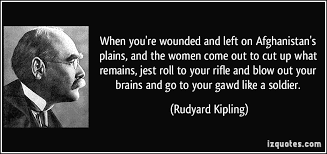
My last post included a rather gruesome bit of poetry by Rudyard Kipling where he describes the Afghani women coming to kill the wounded British soldiers in the first Afghan war. It’s sexist, or anti-sexist, if you like. Since it reverses a stereotype of the non-violent, female home-body. Then again the Afghanis had wiped out an entire British army, killing virtually everyone including civilians.
What follows is The Betrothed, one of Kipling’s first published poems, appearing in “the civil and military gazette”, Lahor, India (near Afghanistan), November, 1888. Kipling was an assistant editor). It has a more traditional view of women, or of British women who do not go out murdering, but who do wish to control/ stop a British man’s cigar smoking. In a sense, such stoppage is murder. The inspiration was a breach of ‘Promise of Marriage’ case in Glasgow, August 1888, where a young woman, Maggie Watson, sued her fiancee because he continued to smoke cigars after she insisted he stop. Kipling explores the psychology of the choice between smoking and marriage. I think Freud would approve.
The Betrothed.
OPEN the old cigar-box, get me a Cuba stout, For things are running crossways, and Maggie and I are out.
We quarrelled about Havanas—we fought o’er a good cheroot, And I knew she is exacting, and she says I am a brute.
Open the old cigar-box—let me consider a space; In the soft blue veil of the vapour musing on Maggie’s face.
Maggie is pretty to look at—Maggie’s a loving lass, But the prettiest cheeks must wrinkle, the truest of loves must pass.
There’s peace in a Larranaga, there’s calm in a Henry Clay; But the best cigar in an hour is finished and thrown away—
Thrown away for another as perfect and ripe and brown— But I could not throw away Maggie for fear o’ the talk o’ the town!
Maggie, my wife at fifty—grey and dour and old— With never another Maggie to purchase for love or gold!
And the light of Days that have Been the dark of the Days that Are, And Love’s torch stinking and stale, like the butt of a dead cigar—
The butt of a dead cigar you are bound to keep in your pocket— With never a new one to light tho’ it’s charred and black to the socket!
Open the old cigar-box—let me consider a while. Here is a mild Manila—there is a wifely smile.
Which is the better portion—bondage bought with a ring, Or a harem of dusky beauties, fifty tied in a string?
Counsellors cunning and silent—comforters true and tried, And never a one of the fifty to sneer at a rival bride?
Thought in the early morning, solace in time of woes, Peace in the hush of the twilight, balm ere my eyelids close,
This will the fifty give me, asking nought in return, With only a Suttee’s passion—to do their duty and burn.
This will the fifty give me. When they are spent and dead, Five times other fifties shall be my servants instead.
The furrows of far-off Java, the isles of the Spanish Main, When they hear my harem is empty will send me my brides again.
I will take no heed to their raiment, nor food for their mouths withal, So long as the gulls are nesting, so long as the showers fall.
I will scent ’em with best vanilla, with tea will I temper their hides, And the Moor and the Mormon shall envy who read of the tale of my brides.
For Maggie has written a letter to give me my choice between. The wee little whimpering Love and the great god Nick o’ Teen.
And I have been servant of Love for barely a twelvemonth clear, But I have been Priest of Cabanas a matter of seven year;
And the gloom of my bachelor days is flecked with the cheery light Of stumps that I burned to Friendship and Pleasure and Work and Fight.
And I turn my eyes to the future that Maggie and I must prove, But the only light on the marshes is the Will-o’-the-Wisp of Love.
Will it see me safe through my journey or leave me bogged in the mire? Since a puff of tobacco can cloud it, shall I follow the fitful fire?
Open the old cigar-box—let me consider anew— Old friends, and who is Maggie that I should abandon you?
A million surplus Maggies are willing to bear the yoke; And a woman is only a woman, but a good Cigar is a Smoke.
Light me another Cuba—I hold to my first-sworn vows. If Maggie will have no rival, I’ll have no Maggie for Spouse!
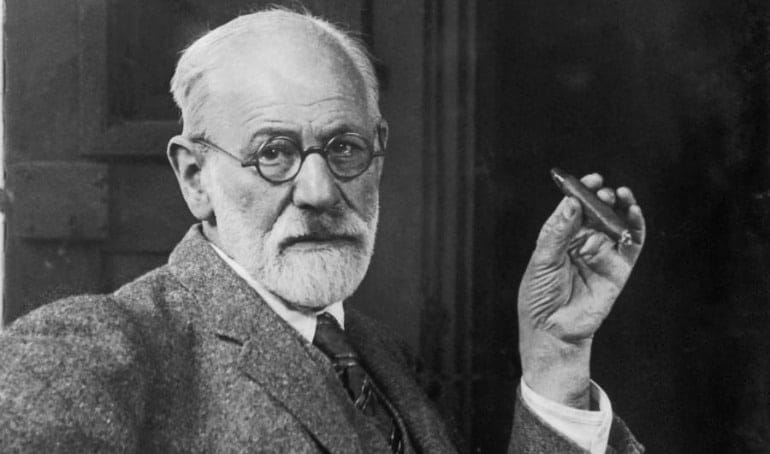
Sigmund Freud with his cigar. The whole attraction of cigars, is a strange one, as Freud knew better than most. Cigars are deadly, but casual, often with a good flavor, and a sucking comfort. The death-risk of one is small and distant. Cigars thus represent risky fun they are thus life, in a temporary, risky way. Marriage is permanence and safe, and binding. The binding permanence is a sort of death, but children are good, and that’s life. Freud’s choice was to smoke himself to death. Kipling got married and eventually gave up smoking.
Robert E. Buxbaum, September 17, 2021. Kipling has a great sense of words, and an attractive sense of the subjects, great and small. For years he was the voice of his generation in Britain, but by the end of his life, his views were unacceptable. sexist. On the other hand, he remained staunchly anti-Nazi, anti eugenics, and anti Soviet. By comparison, George Bernard Shaw was a vocal fan of Stalin, of Hitler, and of the eugenic removal of Jews and other undesirables. Shaw’s words remain fashionable, while Kipling’s do not. Such is the nature of fame.
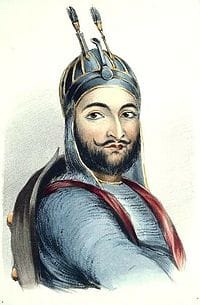
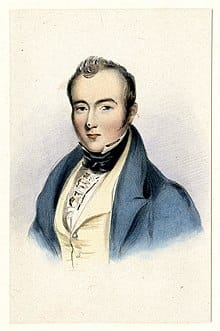
As bad as our exit from Afghanistan has been, the slow British exit in the 1840s to 1920 was worse. While we lost a lot of stuff and left hundreds of Americans and contractors behind, the British, in their first try at leaving, lost a whole army including thousands of civilians. Then they returned and left repeatedly for 80 years, having to fight against their own weapons and people that they had trained. We did many of the same things the Brits did, like trusting our security to folks we’d been trying to kill, but we have not lost anywhere near as many people (yet) and we have not returned (yet). What follows is a look at the British exit, based mostly on Wikipedia articles: “The First Afghan War“, and the retreat from Kabul, 1842, and the biographies of Shah Shujah and Akbar Khan, pictures below.
Akbar Khan. The British tried to kill him, then negotiated with him. Sketch by Vincent Eyre
Britain’s Puppet King, Shah Shujah, Sketch by Vincent Eyre.
The British went into Afghanistan, as we did, to create a more stable and western-friendly government. Their first act was to remove the king, Mohammed Khan, and install a more pliant leader, Sultan Shujah. Mohammed was part of the Khanate, that is the Moguls (Mongols), a deadly violent group who the British were fighting in India. We did the same when we entered Afghanistan. We removed the elected president, Burhanuddin Rabbani, a “radical Moslem” associated with the Taliban leader, Mohammed Omar, an even more radical moslem. Omar was associated Osama bin Laden who’d attacked the US on 9-11. We replaced these, long-bearded Moslems with Hamid Karzai, a moderate Moslem: short beard, reasonably popular, US-friendly, elected in Bonn, Germany. The problem with Shah Shujah and Hamid Karzai is neither one had legitimacy in the eyes of the people, nor respect from the army, either. In part that’s because we put them in power and kept them there, in part that’s because we never let them lead in war or diplomacy. Our follow-on leader, Ashraf Ghani, had no beard, and even less legitimacy and respect. The Afghan army left Ghani as soon as we started leaving; they’d done the same to Shah Shujah when the British left in 1842.
William Macnaughten, the British Envoy, prison sketch by Vincent Eyre, the same fellow who sketched Akbar and Shujah above.
Shah Shujah had a habit of mutilating those who worked for him whenever he got upset. All of Shujah’s servants were missing ears or noses or testicles. Strangely, this seems to have given him more legitimacy than Ghani had. Perhaps if we allowed our leaders to lead, or at least mutilate, the army would have stayed loyal. Then again, maybe nothing would have prevented the puppet from collapsing when the puppet-master left. Both we and the Brits relied on our own troops to keep the peace, along with payoffs and occasional assassinations (we call those airstrikes). It worked for a time, but did not build loyalty or love.
Among those the British paid off and occasionally tried to kill was Akbar Khan, the son of imprisoned Mohammed Khan. Eventually, the British felt they needed Akbar’s help to protect their exit, as he controlled the hills around Kabul including the old Silk Road that the British hoped to travel. Similarly, in the end, we found we needed Taliban help to clear the road to the airport. We didn’t quite get the help, nor did the Brits.
On December 23, 1841, the British envoy, William Macnaughten, visited Akbar Khan and proposed that he would hand over Shah Shujah and make him king in return for safe passage for 16,500 people under General Keith Elphinstone on a journey from Kabul to fort Jalalabad: 93 miles due east. Akbar agreed, but had Macnoughton arrested and later killed. His body was hung in the bazaar. Akbar seems to have figured that anyone willing to betray his old friend would be likely to betray him as well.
Kipling was stationed in India, near the Afghan border. His view of the locals is rather gruesome.
General Elphinstone left Kabulon January 5, 1842 with 4,500 armed soldiers, several cannon, and 12,000+ unarmed civilians. The going was slow and supplies didn’t arrive. Five days later, January 10, allies of Akbar attacked in the hills and killed or captured most of the group. Akbar invited Elphinstone to tea the next day and announced that the group was now his prisoner. He offered safe passage for the women and children, but demanded payment. The alternative was that they freeze in the hills. Elphinstone, at first refused, then ransomed himself and others, in all nine people. The rest of the group were shot, stabbed, taken by the Afghanis to be wives, or stripped of clothing and left to freeze. Younger children were raised as Afghanis, only identified as British sixty or more years later– the British liked to pretend they had not left them. Of the rest, only two survived. One soldier, William Brydon made it to Jalalabad, January 13, 1842. Elphinstone died in captivity in Kabul, April, 1842. According to Kipling’s poem, the Afghanis mutilated British bodies. More likely it was animals.
Hamid Karzai, American supported President, now under house arrest.
The British re-invaded Kabul several times after that, each time hoping to free captives and show who’s boss. There followed a second Anglo Afghan war (1878-80) and third (1919-20), and arguably a fourth (2001-21). Our exit isn’t as bad, at least not yet. We’ve left behind 200-300 Americans plus hundreds of helicopters, trucks, and high-tech weapons. The Taliban are now in charge, folks we’d tried to kill, all of them were associated with Omar, and several with Osama bin Laden, too. Our security forces have been shot, the embassy translator is scheduled to be beheaded, the new government includes several senior members who had been detained at Guantánamo Bay, released to Qatar in a prisoner swap for Bowe Bergdahl in 2014. Hamid Karzai is in captivity, and we’ve taken 100,000 Afghanis who may not integrate well into US society. But at lest there is no sign we’re going back, not for Karzai, or the Americans, or for anyone else. It’s very bad, but it could be worse. Biden calls it a success. Compared to the British exit, it is so far.
Most people know that aspirin can reduce blood clots and thus the risk heart attack, as shown famously in the 1989 “Physicians’ Health Study” where 22,000 male physicians were randomly assigned to either a regular aspirin (325 mg) every other day or an identical looking placebo. The results are shown in the table below, where “Myocardial Infarction” or “MI” is doctor-speak for heart attack.
Treatment
Myocardial Infarctions
No Infarction
Total
fraction with MI
Aspirin
139
10,898
11,037
139/11,037 = 0.0126
Placebo
239
10,795
11,034
239/11,034 = 0.0217
Over the 5 years of the study, the physicians had 378 MI events, but mostly in the group that didn’t take aspirin: 1.28% of the doctors who took aspirin had a heart attack as opposed to 2.17% for those with the placebo. The ratio 1.28/2.17 = 0.58 is called the risk ratio. Apparently, aspirin in this dose reduces your MI risk to 58% of what it was otherwise — at least in white males of a certain age.
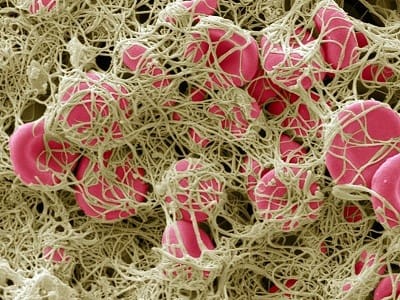
A blood clot showing red cells held together by fibrin fibers. Clots can cause heart attack, stroke, and breathing problems. photo: Steve Gschmeissner.
Further study showed aspirin benefits with women and other ethnicities, and benefits beyond hear attack, in any disease that induces disseminated intravascular coagulopathy. That’s doctor speak for excessive blood clots. Aspirin produced a reduction in stroke and in some cancers (Leukemia among them) and now it now seems likely that aspirin reduces the deadliness of COVID-19. Data from Wuhan showed that excessive blood clots were present in 71% of deaths vs. 0.4% of survivors. In the US, some 30% of those with serious COVID symptoms and death show excessive blood clots, particularly in the lungs. Aspirin and Vitamin D seem to help.
.The down-side of aspirin use is a reduction in wound healing and some intestinal bleeding. The intestinal bleeding is known as aspirin burn. Because of these side-effects it is common to give a lower dose today, just one baby aspirin per day, 81 mg. While this does does some good, It is not clear that it is ideal for all people. This recent study in the Lanset (2018) shows a strong relationship between body weight and aspirin response. Based on 117,279 patients, male and female, the Lanset study found that the low dose, baby aspirin provides MI benefits only in thin people, those who weigh less than about 60 kg (130 lb). If you weigh more than that, you need a higher dose, perhaps two baby aspirin per day, or a single adult aspirin every other day, the dose of the original doctors study.
In this study of COVID patients, published in July, those who had been taking aspirin fared far better than those who did not A followup study will examine the benefits of one baby aspirin (81 mg) with and without Vitamin D, read about it here. I should note that other pain medications do not have this blood-thinning effect, and would not be expected to have the same benefit.
While it seems likely that 2 baby aspirins might be better in fat people, or one full aspirin every other day, taking a lot more than this is deadly. During the Spanish flu some patients were given as much as 80 adult aspirins per day. It likely killed them. As Paracelsus noted, the difference between a cure and a poison is the dose.
Last night a CNN reporter was going around a Trump rally asking ‘When was America ever great?” It’s a legitimate question for anyone wearing a MAGA hat. “Make America Great AGAIN” suggests that America was once great and is no more. The answer the reporter pushed for, I think, was the one given by NY’s Governor Cuomo: “America was never that great.” Alternately, the answer of Michelle Obama, who claimed in 2008, “For the first time in my adult life, I am really proud of my country.” The attendees attempted other answers, like 1776, but the reporter shot them down, saying that people were enslaved in 1776, and telling the home audience that even later, women didn’t have the right to vote, or the LGBT community was denied the rights to which it was entitled. I was not there, and might have got shot down too, but I suspect the question deserves an exact answer: the last time America was great was just before October 24, 1945, United Nations Day, the day we submitted to be part of a world government.
Jackie Robinson, the first black American in major league baseball. Signed October 23, 1945.
By October 23, 1945 WWII was over. We had peace and plenty, the most powerful military, and the most powerful economy. Besides this, we had a baby boom (Children are a bedrock of success, IMHO). Also, on October 23, 1945, the Brooklyn Dodgers signed Jackie Robinson, the first black, major Leaguer since the late 1800s. We thus took a major step against the greatest of our original sins. These were aspects of US greatness, but they were were not guaranteed. They were based on two pre-requisites: a national dedication to self-improvement, and the sovereign control we had over our self-improvement. Total control ended on October 24, 1945 when we joined with the Soviet Union, the United Kingdom, China, France, and several other nations accepting (limited) control by the United Nations organization.
By accepting United Nations oversight, we gave over a significant chunk of sovereignty to other countries whose desire, mostly, was that the US should not be greater than them, and largely that it should not be great at all. To that end they endeavored to insure that we did not have the most powerful economy, the most powerful military, or a baby boom. From tat day on, other countries would sit in judgment on our behaviors and goals. More and more, they would demand remedies that served their interests and diminished US greatness, its exceptionalism. To the patriot this is a disaster. The New York Times declares that anti-exceptionalism is the road to world peace and prosperity. The MAGA crowd disagree.
The United Nations officially came into existence on October 24, 1945, after the United States, the Soviet Union, the United Kingdom, China, France ratify the UN Charter. The charter, once signed, was handed to Truman’s assistant, Alger Hiss.
It’s not that the MAGA Republicans are against world peace or prosperity. No sane person is, but they claim that the best way to achieve these things is for us to be exceptional and work in our own best interests. It is only a sad peace that is achieved by having a foreign body decide that we are at fault in every conflict, and that we should pay reparations to all who lag. There are many poor, socialist countries choosing judges, and these judges tend to rule that the US, as a rich nation, is always at fault and should always pay — both for “development” of the poor nations -overseen by them — and for the the UN too. We knew that their judges would rule this way, but likely didn’t care, or realize how much of our greatness rested on sovereignty. Without sovereignty, even the greatest of world powers will be brought down. Alger Hiss, the person Truman handed the signed UN charter to, was a spy for the Soviet Union. It was a telling beginning.
One of the big promises of Donald Trump is that he will limit the reach of the UN and of its ability to reach into our pockets. He already renegotiated or rejected trade agreements, like TPP that would have sent our jobs and technology abroad. Trump also placed import taxes (tariffs) on some foreign goods. The MAGA folks approve, but the Obama internationalists are scandalized. As depicted in the book “Fear”, long time (Obama) staffers at the White House stole tariff bills from the president’s desk to save the world by keeping them from Trump’s signature. Tariffs have been used throughout American history, and can be a benefit for jobs, and diplomacy and for American manufacturers. They are not radical, but some people lost out. Larely, those were US consumers of foreign goods who suffered. Things improved most for black and hispanic workers though. The intellectual class who claim to represent black and hispanic interests have removed Trump and supporters from social media. It’s their way of winning the argument.
Henry Cabot Lodge, Wilson’s main opponent ito the US joining the League of Nations,.
Trump also limited the power of the world trade organization and of the world court. It’s something that Henry Kissinger recommended In the Journal “Foreign Affairs 2001. Kissinger wrote that “The danger [in too much power for the world court] consists of substituting the tyranny of judges for that of governments; historically, the dictatorship of the virtuous has often led to inquisitions and even witch-hunts.” Trump also built up the military, and claims he will eliminate a postal agreement that gives low, subsidized rates, to China and poor countries so they can mail goods to the US for far less than we can to ourselves. Joe Biden has pushed for “the dictatorship of the virtuous” and promises to raise taxes to pay for it. He’s also suggested packing the supreme court. To me, this is far more radical than tariffs.
The MAGA divide between Trump and Obama/ Biden is not new. It’s existed to a greater or lesser extent between most Democrats and Republicans as far back as the civil war. One major cause of the civil war was tariffs. Then as now, tariffs benefit the manufacturer and worker, and hurt the aristocrat.
In 1918, the MAGA divide played flared because of Wilson’s support of the League of Nations. Republican, Henry Cabot Lodge opposed joining the League of Nations over the same complaints that Trump has raised. Trump’s MAGA claim is that he’ll make US agreements serve US interests. Also that he’s making the US military strong again, and making the US economy strong again. For all I know, the plan for the next four years is to try to ignite another baby boom, too. This, as I understand it, is the MAGA message.
As a side issue, I note that virtually every rapper is for Trump, and virtually every orthodox rabbi too. Yet the internationalist claim he’s racist. His approval among black voters is polled at 46%. Unless you hold that Jewish and black voters don’t understand their own interests. it would seem that Trump is not the racist he’s claimed to be. A recent, “jews for Trump” parade in NY was attacked with rocks, eggs, fists, and paint thrown on participants by white Democrats. The racists who run the NY Justice Department decided not to prosecute.
You may know that engineers recently succeed in decreasing the tilt of the “leaning” tower of Pizza by about 1.5°, changing it from about 5.5° to about to precisely 3.98° today –high precision given that the angle varies with the season. But you may not know how that there were at least eight other engineering attempts, and most of these did nothing or made things worse. Neither is it 100% clear that current solution didn’t make things worse. What follows is my effort to learn from the failures and successes, and to speculate on the future. The original-tilted tower is something of an engineering marvel, a highly tilted, stone on stone building that has outlasted earthquakes and weathering that toppled many younger buildings that were built straight vertical, most recently the 1989 collapse of the tower of Pavia. Part of any analysis, must also speak to why this tower survived so long when others failed.
First some basics. The tower of Pisa is an 8 story bell tower for the cathedral next door. It was likely designed by engineer Bonanno Pisano who started construction in 1173. We think it’s Pisano, because he put his name on an inscription on the base, “I, who without doubt have erected this marvelous work that is above all others, am the citizen of Pisa by the name of Bonanno.” Not so humble then, more humble when the tower started to lean, I suspect. The outer diameter at the base is 15.5 m and the weight of the finished tower is 14.7 million kg, 144 million Nt. The pressure exerted on the soil is 0.76 MPa (110 psi). By basic civil engineering, it should stand straight like the walls of the cathedral.
Bonanno’s marvelous work started to sink into the soil of Pisa almost immediately, though. Then it began to tilt. The name Pisa, in Greek, means swamp, and construction, it seems, was not quite on soil, but mud. When construction began the base was likely some 2.5 m (8 feet) above sea level. While a foundation of clay, sand and sea-shells could likely have withstood the weight of the tower, the mud below could not. Pisano added length to the south columns to keep the floors somewhat level, but after three floors were complete, and the tilt continued, he stopped construction. What to do now? What would you do?
If it were me, I’d consider widening the base to distribute the force better, and perhaps add weight to the north side. Instead, Pisano gave up. He completed the third level and went to do other things. The tower stood this way for 99 years, a three-floor, non-functional stub.
About 1272, another engineer, Giovanni di Simone, was charged with fixing the situation. His was the first fix, and it sort-of worked. He strengthened the stonework of the three original floors, widened the base so it wold distribute pressure better, and buried the base too. He then added three more floors. The tower still leaned, but not as fast. De Simone made the south-side columns slightly taller than the north to hide the tilt and allow the floors to be sort-of level. A final two stories were added about 1372, and then the first of the bells. The tower looked as it does today when Gallileo did his famous experiments, dropping balls of different size from the south of the 7th floor between 1589 and 1592.
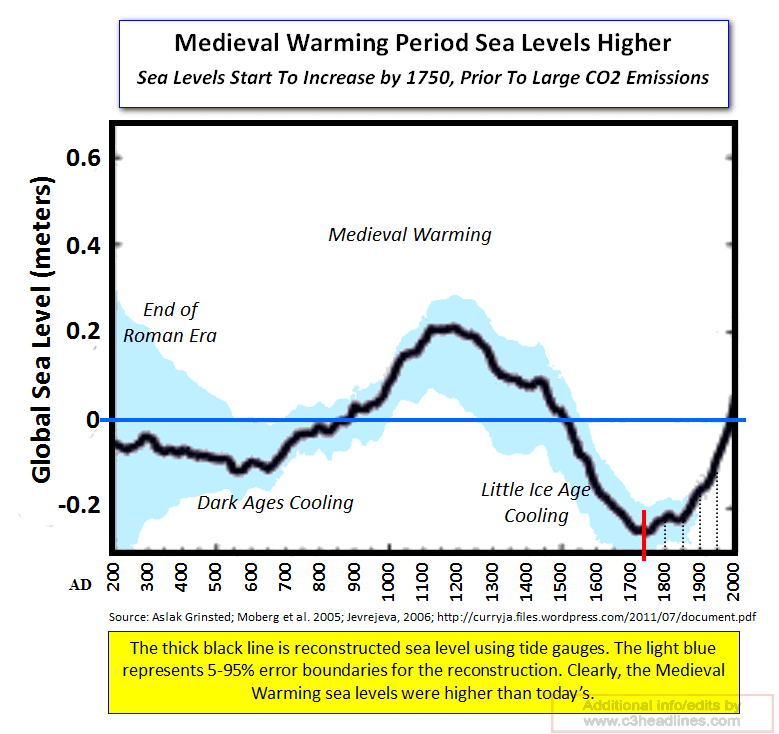
Fortunately for the construction, the world was getting colder and the water table was dropping. While dry soil is stronger than wet, wet soil is more plastic. I suspect it was the wet soil that helped the tower survive earthquakes that toppled other, straight towers. It seems that the tilt not only slowed during this period but briefly reversed, perhaps because of the shift in center of mass, or because of changes in the sea level. Shown below is 1800 years of gauge-based sea-level measurements. Other measures give different sea-level histories, but it seems clear that man-made climate change is not the primary cause. Sea levels would continue to fall till about 1750. By 1820 the tilt had resumed and had reached 4.5°.
The 2nd attempt was begun in 1838. Architect, Alessandro Della Gherardesca got permission to dig around the base at the north to show off the carvings and help right the tower. Unfortunately, the tower base had sunk below the water table. Further, it seems the dirt at the base was helping keep the tower from falling. As Della Gherardesca‘s crew dug, water came spurting out of the ground and the tower tilted another few inches south. The dig was stopped and filled in, but he dig uncovered the Pisano inscription, mentioned above. What would you do now? I might go away, and that’s what was done.
The next attempt to fix the tower (fix 3) was by that self-proclaimed engineering genius, Benito Mussolini. In 1934. Mussolini had his engineers pump some 200 tons of concrete into the south of the tower base hoping to push the tower vertical and stabilize it. The result was that the tower lurched another few inches south. The project was stopped. An engineering lesson: liquids don’t make for good foundations, even when it’s liquid concrete. An unfortunate part of the lesson is that years later engineers would try to fix the tower by pumping water beneath the north end. But that’s getting ahead of myself. Perhaps Mussolini should have made tests on a model before working on the historic tower. Ditto for the more recent version.
On March 18, 1989 the Civic Tower of Pavia started shedding bricks for no obvious reason. This was a vertical tower of the same age and approximate height as the Pisa tower. It collapsed killing four people and injuring 15. No official cause has been reported. I’m going to speculate that the cause was mechanical fatigue and crumbling of the sort that I’ve noticed on the chimney of my own house. Small vibrations of the chimney cause bits of brick to be ejected. If I don’t fix it soon, my chimney will collapse. The wet soils of Pisa may have reduced the vibration damage, or perhaps the stones of Pisa were more elastic. I’ve noticed brick and stone flaking on many prominent buildings, particularly at joins in the chimney.
John Burland’s team cam up with many of the fixes here. They are all science-based, but most of the fixes made things worse.
In 1990, a committee of science and engineering experts was formed to decide upon a fix for the tower of Pisa. It was headed by Professor John Burland, CBE, DSc(Eng), FREng, FRS, NAE, FIC, FCGI. He was, at the time, chair of soil mechanics at the Imperial College, London, and had worked with Ove, Arup, and Partners. He had written many, well regarded articles, and had headed the geological aspects of the design of the Queen Elizabeth II conference center. He was, in a word, an expert, but this tower was different, in part because it was an, already standing, stone-on stone tower that the city wished should remain tilted. The tower was closed to visitors along with all businesses to the south. The bells were removed as well. This was a safety measure, and I don’t count it as a fix. It bought time to decide on a solution. This took two years of deliberation and meetings
In 1992, the committee agreed to fix no 4. The tower was braced with plastic-covered, steel cables that were attached around the second and third floors, with the cables running about 5° from the horizontal to anchor points several hundred meters to the north. The fix was horribly ugly, and messed with traffic. Perhaps the tilt was slowed, it was not stopped.
In 1993, fix number 5. This was the most exciting engineering solution to date: 600 tons of lead ingots were stacked around the base, and water was pumped beneath the north side. This was the reverse of the Mussolini’s failed solution, and the hope was that the tower would tilt north into the now-soggy soil. Unfortunately, the tower tilted further south. One of the columns cracked too, and this attempt was stopped. They were science experts, and it’s not clear why the solution didn’t work. My guess is that they pumped in the water too fast. This is likely the solution I would have proposed, though I hope I would have tested it with a scale model and would have pumped slower. Whatever. Another solution was proposed, this one even more exotic than the last.
For fix number 6, 1995, the team of experts, still overseen by Burland, decided to move the cables and add additional tension. The cables would run straight down from anchors in the base of the north side of the tower to ten underground steel anchors that were to be installed 40 meters below ground level. This would have been an invisible solution, but the anchor depth was well into the water table. So, to anchor the ground anchors, Burland’s team had liquid nitrogen injected into the ground beneath the tower, on the north side where the ground anchors were to go. What Burland did not seem to have realized is that water expands when it freezes, and if you freeze 40 meters of water the length change is significant. On the night of September 7, 1995, the tower lurched southwards by more than it had done in the entire previous year. The team was summoned for an emergency meeting and the liquid nitrogen anchor plan was abandoned.
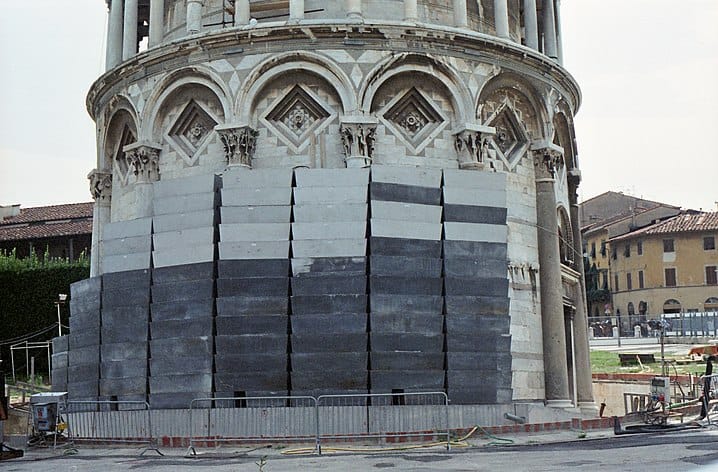
Tower with the two sets of lead ingots, 900 tons total, about the north side of the base. The weight of the tower is 14,700 tons.
Fix number 7: Another 300 tons of lead ingots were added to the north side as a temporary, simple fix. The fix seems to have worked stabilizing things while another approach was developed.
Fix number 8: In order to allow the removal of the ugly lead bricks another set of engineers were brought on, Roberto Cela and Michele Jamiolkowski. Using helical drills, they had holes drilled at an angle beneath the north side of the tower. Using hoses, they removed a gallon or two of dirt per day for eleven years. The effect of the lead and the dirt removal was to reduce the angle of the tower to 4.5°, the angle that had been measured in 1820. At this point the lead could be removed and tourists were allowed to re-enter. Even after the lead was removed, the angle continued to subside north. It’s now claimed to be 3.98°, and stable. This is remarkable precision for a curved tower whose tilt changes with the seasons. (An engineering joke: How may engineers does it take to change a lightbulb? 1.02).
The bells were replaced and all seemed good, but there was still the worry that the tower would start tilting again. Since water was clearly part of the problem, the British soils expert, Burland came up with fix number 9. He had a series of drainage tunnels built to keep the water from coming back. My worry is that this water removal will leave the tower vulnerable to earthquake and shedding damage, like with the Pavia tower and my chimney. We’ll have to wait for the next earthquake or windstorm to tell for sure. So far, this fix has done no harm.
Robert Buxbaum, October 9, 2020. It’s nice to learn from other folks mistakes, and embarrassments, as well as from their successes. It’s also nice to see how science really works, not with great experts providing the brilliant solution, but slowly, like stumbling in the dark. I see this with COVID-19.
There are small errors and great mistakes. I’d previously written about the mistakes that caused Britain to lose America — e.g. General Tarleton burning churches because he thought the sermons were anti monarchist. They were, but if he thought they were anti monarchist before burning the church, they were far more so after… He’d misjudged the American character, something that I think the Democrats are doing today with BLM. Another example was the British attack on Bunker Hill. They spent the lives of 600 soldiers, won a hill they didn’t need, and lost the colony. It’s a mistake we would make reputedly in Vietnam.
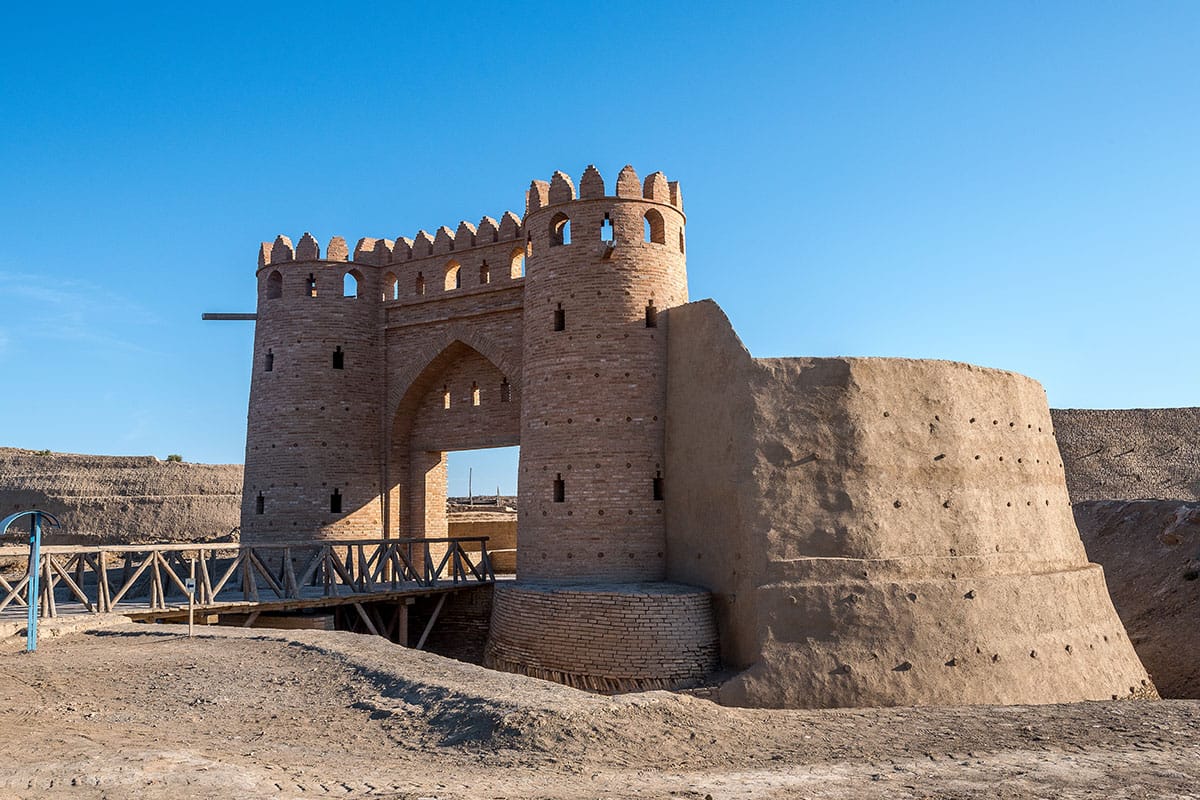
Another one of the larger of mistakes of history – and one that changed hsotry massively was made by Mohammad II, ruler of Persia and eastern Islam, from Turkey to Kazakhstan, Uzbekistan, and Afghanistan. He had an army of 100,000 and ruled from the walled city of Samarkand. Mohammed’s uncle, Inalchuq, served as a governor in Kazakhstan. With an army of 40-50,000, he ruled from the walled city of Otrar. A Mongol leader named Temujin contacted them asking to trade. Mohammed II ignored the request, but his uncle accepted it. Temujin ruled a poor, distant community of perhaps 100,000, and boasted a motley horse army of perhaps 10,000. But, what Mohammad II didn’t appreciate, was that these Mongol horsemen were uncommonly warlike, and that Temujin, also known as Genghis Kahn, was an uncommonly talented leader.
Gate of the mighty, walled city of Otrar. It’s now a ghost town.
Temujin was not someone to insult. He had laid waste to northern China, and defeated an army of over 1 million, because of an insult. The Chinese emperor had demanded Temujin come to Peking with a grift, then bow low and pledge allegiance. That is he wanted Temujin ,to Kowtow, a request that emperors had made to every tribal leader for centuries, but Temujin took it as an insult. He defeated the Chinese army and killed a good fraction of China’s population. Using methods that are discussed in Mongol literature, but are almost unknown in the west, or highly perverted, as in Mulan. I’ve written in speculation of one aspect of Mongol success here. Another aspect was psychological: Genghis Kahn was able to co-opt the Chinese army, and get them to fight for him. It’s a useful skill.
Now Temujin, Genghis Kahn, was writing to the leaders of eastern Islam asking to trade along the silk road. Inalchuq offered safe passage, and in 1218, the first trade caravan arrived with 100 laden camels and 450 men including an ambassador. Inalchuq did what sultans before him had done: He executed most of the men, sold the rest as slaves, and took the goods, selling them in markets of Bukhara. Mohammed II and his uncle were sure that Temujin would do nothing, he was 2000 miles away, but Temujin sent another peace delegation. This time 3 men direct to Mohmmed II asking for his goods back and for the punishment of those responsible. Mohammad II killed the lead ambassador, blinded one of the others, and had the face of the third disfigured. A year later, 1219, Genghis Kahn showed up in Otrar with siege engines.
Otrar held out for 5 months, falling when a traitor opened the gates and defected with part of the army. The Mongols took the city and let most people live, though he killed Inalchq and his army, as well as the defectors.. Genghis Kahn figured he could not trust a soldier who defects this way. Inalchq was killed by having molten silver poured into his eyes and ears.
Death of Sultan Mohammed II, Picture from the History of Rashad Al-Din.
Genghis then went after Mohammed II, but first defeated the Assassin sect. Mohammed had the sense to run. It didn’t save him, but it did buy him some years of life. When caught, Genghis locked him in a prison fed him gold coins. He is supposed to have explained that, had Mohammad II not hoarded gold, but shared it with his soldiers, they would have fought for him as Genghis’s soldiers had. It’s not a message we like to hear today because it’s practical, but not very charitable. Then again, Genghis Kahn was nothing if not practical.
The Mongols brought many innovations: paper, stirrups, the blast furnace, the number zero, “islamic numerals” (they’re really Mongol /Tibetan numerals), the compass, the printing press, the triangular plow, gun powder, and a new way in war (The Germans called it ‘Blitz Kreig’). I find that schools don’t teach much about Genghis Kahn or our debt to the Mongols, nor do they properly contextualize these innovations as means for a small nation to dominate many larger ones. Perhaps that’s because we find the whole idea of management disturbing, or it’s embarrassing. Western scholars used to write like we invented these things. There are several histories of the Mongols, one was written by Rashid Al-Din (Aladin), vizier over all Persia, the person responsible for renaming it Iran. He wrote an illustrated history of the world, particularly of the Mongols, called Jāmiʿ al-Tawārīkh (“Compendium of Chronicles”). I suspect it would be worthwhile reading but like much of Mongol literature, it is not available in any local library, nor is it referred to by most histories. Another Mongol history, also not available in libraries, is called the Secret History of the Mongols. This was likely written for and by Genghis’s third son, Ogedei, to describe for his children and grandchildren the true story of the early years, the conquests, his father’s and his management methods (some fairly brutal) and as a review of what Ogedei thought worked and what did not. It sounds like an honest book, worthwhile book — the sort modern readers would rather forget exists.
Rashid Al-Din (Aladin), Vizier of Persia. He renamed Persia Iran, and wrote a history of the world from the Mongol perspective. Known as a fictional character, or not at all today.
In general, I find our scholars would like to ignore the more unpleasant lessons of history, including that family matters, and that people like honor over kowtowing, and that they get surly if they’re not rewarded,. Much of our society is built by warriors for the purpose of destruction, as in this engineering joke. We are now in the process of destroying statues of warriors because we find they were often non-nice people who often did not-nice things, or held not-nice views. That’s the way it is with warriors, especially the successful ones. While I’m not a fan of having statues to bums, I think that ignoring successful warriors is worse than honoring them. I discuss the dilemma of military statues here. Without statues to important wars and warriors, modern leaders might repeat the mistake of Mohammed II, or Bunker hill , or of Mohammed IV, or of the Chinese emperor.
Robert Buxbaum, September 20, 2020. I’ve come to wonder if Mohammed II would have fared better if he didn’t steal from the Mongols. He would likely have put off the attack as he learned more about them, and they learned more about him. When the war came, as likely it would, he might have had gun powder, paper, the compass, and the stirrup. Then again, war might have come immediately. The proud Polish officers who collaborated/ surrendered to the Soviet Russians, were quickly murdered in the Katyn forest.
We’re still in the midst of a frenzy of statue removals, and among the most popular to remove is Columbus. The City of Columbus Ohio just removed theirs, and Detroit soon followed. What Columbus is accused of is colonialism, bringing evil western values and western religion to the peaceful Indians. At least that’s the legend being told these days.
The war god, Huitzilopochti, son of the sun, seated at right, required thousands of human sacrifices to keep the sun from going out. Columbus claims that many Indians preferred Christianity to his worship.
According to Columbus and his followers, the Indians of 1492 included some who were peaceful, and others who were murderous cannibals. According to Columbus, the less-violent of the Indians willingly accepted Christianity, or a sort, considering it better than the human sacrifice they were used to.
Mask for Tezcatlipoca, god of the night and sorcery, secondary son of the sun, brother of Huitzilopochtli.
Columbus described people being roasted and eaten with pineapple. Some of Columbus’s crew who were captured, claim they, were fattened for eating, and that others were eaten. That also is the story of Captain Cook, who appears to have been cooked and eaten in 1791, and of Michael Rockefeller, eaten by cannibals in New Guinea in 1961. Some customs die hard.
The natives of Mexico of the time are known to have practiced slavery and human sacrifice, killing thousands of young men and women each year to a wide variety of gods. For Huitzilopochtli, the war-god, son of the sun, Mexican priests cut out the still -beating hearts of adult male slaves, and ate them. This was done to prevent the sun from going out. On flat rocks they same Mexican Indians sacrificed to his brother, Tezcatlipoca, the god of the night and of sorcery. Though Texcatlipoca was slightly less powerful, he was more personally useful. The sacrifice to Tezcatlipoca is reminiscent of the attempted sacrifice of John Smith of the Virginia colony. According to testimony, in 1607, Smith was captured while hunting, kept in captivity for a few days, and was going to be sacrificed on a flat rock until saved by Pocahontas, the chief’s daughter. Later Pocahontas converted to Christianity, travelled to England, and was presented to King James I.
Pocahontas, renamed Rebecca, in 1616.
Related to the story of John Smith of the Virginia colony, is the landing of John Smith of the Massachussetts colony. The reason they settled on that spot in Plymouth bay, was that, when they landed there in 1620, the land was already cleared, but empty. Apparently, there had been a farming Indian tribe who had cleared the land, but had been recently killed off or enslaved by the local Iroquois. The Iroquois practiced slavery against their fellow Indians well before the arrival of the first African slaves in 1619. According to Frederic Douglas in 1870, the Indians treated their slaves better than the white settlers did, but he was writing 150 years later. The peaceful Indian, Squanto who helped the Massachusetts colony had been captured and brought to England in 1609 and brought back to the Americas by the John Smith of the Virginia colony. Squanto lived as a free man among the pilgrims. Squanto helped negotiate a peace treaty for the colony with the Wampanoags against the Narragansett. This treaty was settled at the first Thanksgiving, and lasted for the life of the Wampanoags Chief.
Returning to the Gods of the Mexicans, Tlaloc, the rain god, was responsible for fertility and agriculture. He required the sacrifice of children. There was also a corn god, Centeotl, I think Steven King has a story about his worship, it involved a corn sacrifice, plus spilling your own blood and killing a young woman and using her skin as a mask. There was also the feathered serpent god, Quetzalcoatl, god of love, knowledge, and intoxicating drink. She required the sacrifice of a mix of men, women, and children, plus ingestion of intoxicating substances. Columbus claimed that many Indians willingly changed religion to Christianity and away from the worship of these deities, a claim that modern liberals find ludicrous, but that I find believable. I think modern liberals imagine themselves as the priests of these religions, or perhaps nobles, but they do not see it, as I do, from the perspective of the unwilling sacrifices.
The folks behind the removal of Columbus statues and behind defunding the police would like to use the money for education about the noble pre-Columbian peoples. They would like to focus on the pyramids and on the large, flat sacrificial stones, without spending too much time on what the pyramids and stones were used for.
Chief Tammany signed a peace treaty with William Pitt in 1683. His grandson converted to Moravian (Protestant?) Christianity. He is considered a model of good will and good government.
The fate of the Indians varied. Some converted to Christianity, some did not. Some tribes integrated well into the new society, many did not. Among the most famous who converted and integrated well, we find Chief Tammany of the Turtle clan of the Delaware Indians. He signed a peace treaty with William Penn, 1683, and his tribe seems to have lived in peace with the settlers for 70 years at least and married into the most prominent families of the area. The Turkey of the same tribe did not fare so well, They sided with the French and warred against the English settlers, and suffered with the French defeat. Western involvement was not always good or fair to the Indians, but that is not inherently Columbus’s fault. Columbus did a service, I think, opening up the new world, and providing an alternative religion to natives who were rescued from human sacrifice. I believe western civilization is a boon to the world by the very balance of order and freedom that some find troubling. The Jewish Bible is strongly against tightly ordered religions with human sacrifice. Christianity is a big improvement, IMHO.
Philip Schuyler as a Major General in the Revolution. His statue was removed.
What most folks know about Alexander Hamilton’s father in law, Philip Schuyler, is that he was “loaded”, that he had three daughters, and that he quickly took to young Alexander. But an important fact varnished over is that Schuyler made his money in the slave trade, a trade that Hamilton was likely in when he met the young Schuyler daughters. Schuyler was also a slave owner, owning 13 slaves, by his record, and perhaps another 17 indentured servants working at two mansions. So far, only the Philip Schyler statue has been taken down. It seems possible that many monuments to Hamilton may follow.
Statue of Alexander Hamilton, proudly stands in front of Columbia University. The ten dollar founding father.
The play “Hamilton” proclaims Hamilton’s genius and exceptional work ethic, mentioning that, at the young age of 14 (more likely 16) he was left in charge of a trading company. This was for 5 months in 1771, while the owner was over seas doing business. Hamilton knew the business well; he’d been hired as a clerk at 11 at Beekman and Cruger, a similar import-export trading firm. What items did these firms trade — cotton, sugar, rum, and most profitable slaves. This likely was the business that kept the owner overseas for 5 months while Alexander ran the shop. There are at least two notifications of slave ships entering the harbor with human good for sale. Among Hamilton’s likely jobs would have been fattening and oiling the goods for sale. Hamilton himself seems to have owned a slave-boy named Ajax who he inherited (briefly) from his mother, Rachel. His mother is listed on the tax records as white. She owned five saves at one time, suggesting she was not entirely impoverished. Hamilton’s father, though a failed businessman, was a Scottish Laird (a Lord). As for the court-mandated transfer of Ajax from Alexander, it was to his half-brother James because James was “Legitimate.”
I base Hamilton’s age on the Nevis-St Kitts record of his birth, January 11, 1755.”[1] The play takes as a fact Hamilton’s claim to have been born two years later, January 11, 1757. I trust the written records here, and imagine Hamilton wanted to present himself as a young genius, rather than as a bright, but older fellow. In 1772, at at age 17, Hamilton wrote a “fire and brimstone” description of a deadly hurricane, describing it as “divine rebuke to human vanity and pomposity.”[2] Between this, and his skill at trading, the community leaders collected money to send him to New York, but unlike the play’s description, it was not only for further education. The deal was that he continue trading for the firm,[3] and this is likely how he met his future father in law. “[4]
In New York, Hamilton met Schuyler and his daughters. It seems likely that he met the father first, likely as possible customer for the slave trade from the Caribbean, or perhaps as a customer for rum and sugar. A 1772 letter in Hamilton’s handwriting [4] asks for the purchase of “two or three poor boys” for plantation work, “bound in the most reasonable manner you can.” As in the play, Hamilton was friends with John Laurens, an abolitionist, and among his first lodgings was with Hercules Mulligan, a tailor’s apprentice. Hercules is presented as black in the play, but he was quite white (see picture) with a black slave, Cato. Cato ran most of the messages. According to the play, “I’m joining the rebellion cuz I know it’s my chance To socially advance, Instead of sewin’ some pants, I’m taking my shot. No, Hercules was socially advanced ,married into the British Admiralty, even. He was a true believer in freedom and a slave-holder. His older brother, Hugh Mulligan, was one of the traders that Hamilton was supposed to work with.[5] As for Laurens and his anti-slavery organization, most of those in the organization owned slaves, and though they opposed slavery, they could never decide on when or how to end it. There is no evidence that Cato was ever set free.
The appointment to Washingtons staff was not likely a coincidence. The elder Schuyler was one of the four top generals appointed in 1775 to serve directly under Washington. Phillip oversaw, at a distance, the disastrous attack on Quebec and the victory at Saratoga– both, Burr served admirably. Phillip’s main role was as a quartermaster/supplier, and this is not a small role. Phillip Schuyler had been a quarter-master in the French and Indian war. It’s likely that it was Schuyler who got Hamilton his appointment to Washington’s staff.
Once on Washington’s staff, Hamilton served admirably. Originally serving as a secretary, Hamilton wrote many of Washington’s dispatches. Then, according to tradition, as a cannon commander, he took particular pleasure in the attack on Princeton University. He then served well as secretary of the Treasury, and as head of the Bank of The United States, the only major US bank until Burr opened the Bank of the Manhattan company. Despite his aversion to slavery, Hamilton also continued to deal in slaves. A 1796 cash book entry records Hamilton’s payment of $250 to his father-in-law for “2 Negro servants purchased by him for me.” This is only 3 years before 1799, when New York began to end slavery in the state with the Act for the Gradual Abolition of Slavery. Children of slaves born after July 4, 1799, were to be legally free, but required indentured servitude: to age 28 for males and 25 for females. Those born before July 4, 1799 became free in 1817. There is no evidence that Hamilton was a leader in any of this, but Burr, another slave-owning abolitionist, was a leader in the NY legislature at the time.
I’m with Burr.He was flawed, a slave-owning abolitionist, but vehimently against the Alien and Sedition Acts, a Hamiltonian horror.
It seems that Robert Morris introduced Hamilton to the importance of tariffs, and to the idea of using debt service as a backing to currency. It’s brilliant idea, but Hamilton understood it and took to it. Hamilton also understood the need for a coast guard to enforce the tariffs. As for Hamilton’s character, or Burr’s. Both, in my understanding, were imperfect people who did great deeds. I’ve already written that Hamilton was likely setting up Burr for murder, perhaps because of Burr’s vehement opposition to the Alien and Sedition Acts — That’s why Hamilton wore his glasses and fiddled with the gun so much. Burr was also gaining power through his Manhattan corporation and Tammany organization. both of which got his support among the immigrants.
My intent here is not to knock the image of Hamilton, Schuyler, Laurens and Mulligan, nor to raise that of Burr, but to correct some current fictions in the play “Hamilton”, and to fight a disease of our age, the cancel culture. The cancel culture elevates their heroes (Hamilton, Mulligan) to god-status. They will lie to cover the flaws of their heroes, and will lie also to claim a drop of black blood in them; neither Hamilton nor Mulligan were black and both owned slaves, as did Burr. The other side of the cancel culture is to cancel — to eliminate the validity — of the reactionaries, the non-revolutionary. In the play, these include Samuel Seebury and Aaron Burr. Great building is almost always the work of contradictory people. They need some talent, and a willingness to act, and because building requires a group, they have to work in a group, tolerating flaws of the others in the group. It is just these flawed, contradictory builders that are being cancelled, and I don’t think that’s right or healthy.
Readers of this blog know that I am not a fan of very harsh punishments for crime, in particular for crimes that have no direct victim, e.g. drug possession and sales. Prostitution is another crime with no direct victim. One could argue that society as a whole is the victim, but my sense is that punishments should be minimal and targeted, e.g. to prevent involuntary human trafficking and disease. Our current laws, depicted here, are clearly not designed for this, but there was a brief period where prostitution laws did make more sense. During the civil war, civil war, prostitution was legal and regulated to prevent disease.
In 1862, Union forces captured the southern cities of Nashville and Memphis, Tenn. Major Gen. William Rosecrans set up headquarters in Nashville. Before the war, Nashville was home to 198 white prostitutes and nine “mulatto,” operating in a two-block area known as “Smoky Row.”
By the end of 1862, Smokey row had grown and these numbers swelled to 1,500 “public women”. White southern women turned to prostitution out of poverty, largely. Their husbands were dead, or ill paid, and they were joined by recently freed slaves. Benton E. Dubbs, a Union private, reported a saying that “no man culd [sic] be a soldier unless he had gone through Smokey Row,” … “The street was about three-fourths of a mile long and every house or shanty on both sides was a house of ill fame. Women had no thought of dress or decency. They say Smokey Row killed more soldiers than the war.”
By 1863, venerial disease was becoming a major problem. The Surgeon General would document 183,000 cases of venereal disease in the Union Army alone, “…the Pocks and the Clap. The cases of this complaint is numerous, especially among the officers.”
Permit for Legal prostitution signed by Col George Spaulding.
At first General Rosecrans directed his assistant, Colonel Spaulding, to remove the women by sending them to other states, first by train, and then by boat commandeering the ship, Idaho for the purpose. The effect was horrible, not only was the ship turned back by every city, but the departure of these ladies just resulted in the appearance of a new cohort of sex-workers. By the time the Idaho had returned, Rosecrans had been relieved of command following embarrassing defeats at Chickamauga and Chattanooga . Col. Spaulding now tried a new technique to stop the plague of VD: legalized prostitution. It worked.
Women’s hospital during the war, Nashville.
For a $5/month fee a “public woman” could become a legal prostitute, or “Public Woman” so long as she submitted to monthly health inspections for a certificate of her soundness. If found infected, she was to report to a hospital dedicated to this treatment, was subject to imprisonment if she operated without the license and certificate. The effect was a major decline in sexually-transmitted disease, and an improvement (so it is claimed) in the quality of the services. The fees collected were sufficient to cover the cost of the operation and hospital, nearly.
At the end of the war, Col Spaulding and the union soldiers left Nashville, and prostitution returned to being illegal, if tolerated. One assumes that the VD rates went up as well.
George Spaulding, Congressman..
Colonel Spaulding and Maj. General Rosecrans are interesting characters beyond the above. Spaulding had entered the war as a private and rose through the ranks by merit. The rise didn’t stop at colonel. After the war, he became postmaster of Monroe Michigan, 1866 to 1870, US Treasury agent, 1871 to 1875, Mayor of Monroe, 1876 to ?, President of the board of education, a lawyer in 1878, and congressman for the MI 2nd district (Republican) 1894 -1898. He also served as board member of the Home for Girls 1885 to 1897, and postmaster of Monroe, 1899 to 1907.
William Rosecrans was a Catholic, engineer-inventor from West Point. Before the war, in 1853, he designed St. Mary’s Roman Catholic Church, one of the largest US churches at the time, site of the wedding of John Kennedy and Jacqueline Bouvier. He also designed and installed one of the first lock systems in Western Virginia. He and two partners built an early oil refinery. He patented a method of soap making and the first kerosene lamp to burn a round wick, and was one of the eleven incorporators of the Southern Pacific Railroad. After the war, he served as Ambassador to Mexico, 1868-69 and was congressman from California, 1st district (Democrat) 1880 – 1884. A true Democrat, Rosecrans could not stand either Grant or Garfield, and fought against Grant getting a retirement package.
Robert Buxbaum, June 5, 2020. There are other ways to stop the spread of sexual diseases. During the AIDS epidemic, condoms were the preferred method, and during the current COVID crisis, face masks are being touted. My preference is iodine hand wash. All methods work if they can reduce the transmission rate, Ro below 1.