Category Archives: religion

Sept. 11, 1683: Army of Islam attacks Vienna.

In the US, September 11 is mostly known for the 2001 attacks on the World Trade Center and the Pentagon. But to the wider world wide, I think it’s mostly known for the Battle of Vienna, the high-water mark of many battles where army of Islam tried to take over the ‘corrupt’ western world, the Dar al-Harab. This is not the first time that Islamic armies tried to make Vienna part of the world of Islāmic peace, the Dar al-Islam. Suleiman the Magnificent had tried unsuccessfully in 1526. In 1682, Caliph Mohamed IV set out to do what Suleiman had not. He broke the Treaty of Vasvár, and collected an army of 150,000 under the generalship of his Grand Vizier, Kara Mustafa Pasha.

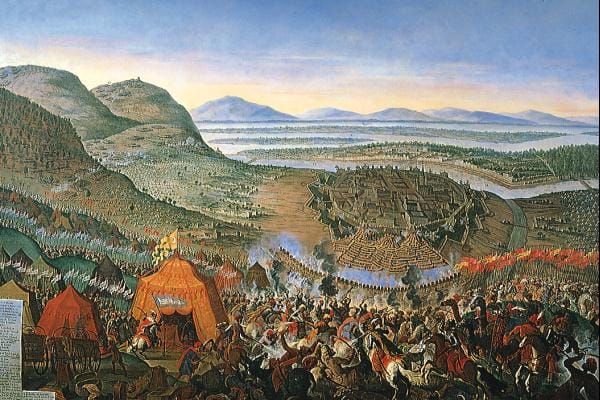
The forces of Mohamet IV surround Vienna, September 11, 1683.

The forces of the Caliph surround Vienna, the city of good wine, September, 1683.

Mohamed IV’s army spent a year on the march to Vienna. On the way, they conquered or subdued Rumania, Bulgaria, Serbia, Croatia, and Hungary. But the western leaders did not sit idly by. Emperor Leopold I and Charles V, Duke of Lorraine left Vienna to be defended by only 24,000 under command of Ernst Rüdiger von Starhemberg. Meanwhile, they scoured Europe for allies. By the time Kara Mustafa army arrived, July 14 1883, Leopold had gotten a pledge of financial support from the pope, and a mutual defense treaty with the Polish-Lithuanians, and with Saxony, Baden, Bavaria, Swabia and Franconia. it was good work, but none of these armies were at Vienna yet.

Fortunately (for Vienna), Kara Mustafa did not attack immediately but instead laid siege to the city, and to nearby Perchtoldsdorf (Petersdorf). Perchtoldsdorf surrendered, and Kara Mustafa massacred the entire Christian population who did not convert, some 30,000 people in the city square, and took their booty. This move did nothing to encourage a Viennese surrender. It took until September, 1683 for the armies of Leopold, Charles V, and John III Sobieski (Poland) to arrive. Kara Mustafa finally attacked on September 11, but it was too late. In the counter attack, his Islamic army was defeated. Kara Mustafa was put to death by the caliph for his failure to take Vienna (I guess he won’t make that mistake again).

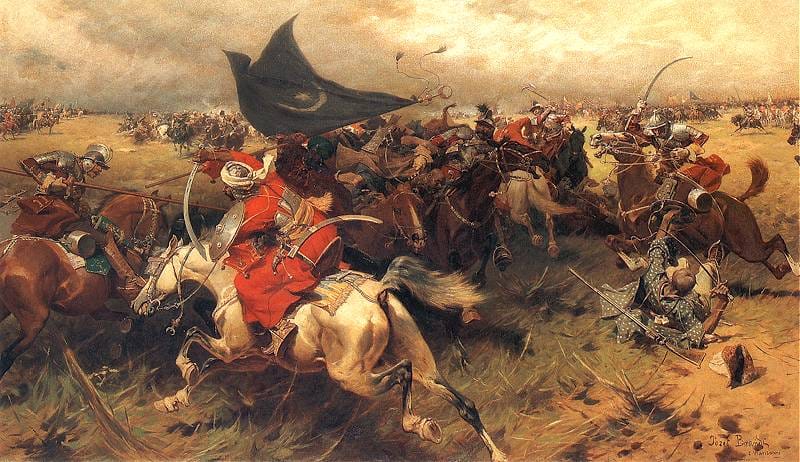
Cavalry fighting at the Battle of Vienna, 1683

The Polish cavalry at the Battle of Vienna, 1683

The loss at Vienna was the beginning of a long retreat for Mohamed IV and for Islam. Hapsburg rulers captured Romania, Bulgaria, and Hungary; Russia conquered the Ukraine from the Mongol-Tartars (the Golden Hoard). The victorious Viennese established a feast day for September 11, the Day of the Holy Name, and created a crescent-shaped sweet roll in the shape of the Moslem crescent as a remembrance. In France, these crescent rolls are called “Viennoise.”

I suspect that many believing Moslems find the breads and holiday offensive, as they believe Vienna is, by right part of the Dar al-Islam. My guess is that this is why Osama bin Laden picked September 11. Osama had traveled in Europe as a teen, and his bookshelf included titles suggesting he would have known about the date, e.g. , “The Rise and Fall of the Great Powers (Paul Kennedy)”. I note that the US embassy in Benghazi, was attacked September 11 (2012). Perhaps this was similar revenge on the earlier Sept 11’s, and not, as Ms Clinton claims, a response to a Jewish-made, Hollywood film.

It seems clear that not every Islāmic leader understands the obligation to conquer the Dar al Harab as one of armies, swords, and bombs. In the last year, the Iranian leader, Ayatollah Ali Khamenei has explained that his slogan, “Death to America,” does not mean death to the American people, but “death to U.S. policies and arrogance.” He claims this struggle is “backed by the reason and wisdom,” of the Koran.

"Muslims against Crusaders" chanting during the two minutes of Remembrance Day (Armistice Day) silence, 2010.

“Muslims against Crusaders” chanting during the two minutes of Remembrance Day (Armistice Day) silence, 2010, “Our soldiers are in paradise, yours burn in Hell.”

As I understand it, The Ayatollah is saying that aim of the Iran’s missiles and atom bomb program is our benefit: to save us from Hell, and make our countries part of the Dar al Islam, the Moslem world of peace. Even at our best, our infidel Dar al-Harab is considered evil because of our arrogance and independence. We compete with each other in a world of chaotic commerce. As they see it, each infidel tries to wrest wealth from his fellow in an economic struggle that can only be ended by Caliphate-control that must include Iraq, Saudi Arabia, and Israel.

The Ayatollah does not mention that the Dar al-Islam has been in turmoil for the last 1000 years but perhaps acknowledges it in private as a slight embarrassment. To me, it seems more like Aesop’s fable of the toad physician who claimed he could heal everyone, but could not heal himself. I note that many other religions have the same jaundiced view of commerce, and have fought over it. Many Islamic thinkers find this to be a flaw in Christianity, and they are right. All major religions, it seems, claim to seek peace, and claim to love their fellows as themselves. They then go on to enforce this peace and love by killing.

If you find errors in my thinking, please tell me; I’m an engineer, not a historian or a theologian. I know enough Hebrew/Aramaic to know what the above phrases mean, and boost my claim by the public comments of the Ayatollah, who I take to be a spokesperson for practical Isalm.  In case you have not guessed, I think that a world of economic chaos is  better, and more satisfying, than any world of statist religious rule. I’d say that G-d likes entropy in all its forms, and that chaos is a gift of God, producing an odd stability.

Robert E. Buxbaum, Friday, November 13, 2015.

Science is the Opposite of Religion

Some years ago, my daughter came back from religions school and asked for a definition of science. I told her that science was the opposite of religion. I didn’t mean to insult religion or science; the big bang for one thing, strongly suggests there is a God -creator, and quantum mechanics suggests (to me) that there is a God -maintainer, but religion deals with other things beyond a belief in God, and I meant to point out that every basic of how science looks at things finds its opposite in religion.

Science is based on reproducibility and lack of meaning: if you do the same experiment over and over, you’ll always get the same result as you did before and the same result as anyone else — when the results are measured to some good, statistical norm. The meaning for the observation? that’s a meaningless question. Religion is based on the centrality of drawing meaning, and the centrality of non-reproducible, one-time events: creation, the exodus from Egypt, the resurrection of Jesus, the birth of Zeus, etc. A religious believer is one who changes his or her life based on the lesson of these; to him, a non-believer is one who draws no meaning, or needs reproducible events.

Science also requires that anyone will get the same result if they do the same process. Thus, chemistry class results don’t depend on the age, sex, or election of the students. Any student who mixes the prescribed two chemicals and heats to a certain temperature is expected to get the same result. The same applies to measures of the size of the universe, or its angular momentum or age. In religion, it is fundamentally important what sex you are, how old you are, who your parents were, or what you are thinking at the time. If the right person says “hoc es corpus” over wine and wafers, they change; if not, they do not. If the right person opens the door to heaven, or closes it, it matters in religion.

A main aspect of all religion is prayer; the idea that what you are thinking or saying changes things on high and here below. In science, we only consider experiments where the words said over the experiment have no effect. Another aspect of religion is tchuvah (regret, repentance); the idea is that thoughts can change the effect of actions, at least retroactively. Science tends to ignore repentance, because they lack the ability to measure things that work backwards in time, and because the scientific instruments we have currently do not take measurements on the soul to see if the repentance had any effect. Basically, the science-universe is only populated with those things which can be measured or reproducibly affected, and that pretty much excludes the soul. That the soul does not exist in the science universe doesn’t mean it doesn’t exist.

Another main aspect of religion is morality: you’re supposed to do the right thing. Morality varies from one religion to another, and you may think the other fellow’s religion has a warped morality, but at least there is one in all religions. In science, for better or worse, there is no apparent morality, either to man or to the universe. Based on science, the universe will end, either by a bang or a whimper, and in that void of end it would seem that killing a mouse is about as important as killing a person. No religion I know of sees the universe ending in either cold or hot death; as a result. Consistent with this, they all see murder is a sin against God. This difference is a big plus for religion, IMHO. That man sees murder as a true evil is either a sign that religion is true, or that it isn’t depending on the value you put on life. Another example of the moral divide: Scientists, especially academics, tend to be elitists. Their morality, such as it is, values great minds and great projects over the humble and stupid. Classical religion sees the opposite; it promoting the elevation of the poor, weak, and humble. There is no fundamental way to tell which one is right, and I tend to think that both are right in their own, mirror-image universes.

It is now worthwhile to consider what each universe sees as wisdom. An Explanation in the universe of science has everything to do with utility and not any internal sense of having understood, as such. I understand something only to the extent I predict that thing or can do something based on the knowledge. in religion, the motivation for all activity is always just understanding — typically of God on the bone-deep level. This difference shows up very clearly in dealing with quantum mechanics. To a scientist, the quantum world is fundamentally a door from religion because it is basically non-understandable but very useful. Religion totally ignores quantum mechanics for the same reason: it’s non-understandable, but very precise and useful. Anything you can’t understand is meaningless to them (literally), and useful is mostly defined in terms of building the particular religion; I think this is a mistake on many levels. I note that looking for disproof is the glory-work of all science development, but the devil’s work of every religion. A religious leader will grab on to statistical findings that suggest that his type of prayer cures people, but will always reject disproof, e.g. evidence that someone else’s prayers works better, or that his prayer does nothing at all. Each religion is thus in a war with the other, each trying to build belief, while not removing it. Science is the opposite. Religion starts with the answer and accepts any support it can; fundamental change is considered a bad thing in religion. The opposite is so with science; disproof is considered “progress,” and change is good.

These are not minor aspects of science and religion, by the way, but these are the fundamental basics of each, as best I can tell. History, politics, and psychology seem to be border-line areas, somewhere between science and religion. The differences do not reflect a lack in these fields, but just a recognition that each works according to its own logic and universe.

My hope in life is to combine science and religion to the extent possible, but find that supporting science in any form presents difficulties when I have to speak to others in the religious community, my daughter’s teachers among them. As an example of the problem that come up, my sense is that the big bang is a fine proof of creation and should be welcomed by all (most) religious people. I think its a sign that there is a creator when science says everything came from nothing, 14,000,000 years ago. Sorry to say, the religious leaders I’ve met reject the big bang, and claim you can’t believe in anything that happened 14,000,000,000 years ago. So long as science shows no evidence of a bearded observer at the center, they are not interested. Scientists, too have trouble with the bang, I find. It’s a one-time event that they can’t quite explain away (Steven Hawking keeps trying). The only sane approach I’ve found is to keep blogging, and otherwise leave each to its area. There seems to be little reason to expect communal agreement.

by Robert E. Buxbaum, Apr. 7, 2013. For some further thoughts, see here.